You do solid work. Customers are happy when they hire you. Then the schedule swings anyway. One week the phone is nonstop. The next week your crew is waiting, your estimator is chasing cold inquiries, and you’re wondering why a business with real demand still feels unpredictable.
That feast-or-famine cycle usually isn’t a workmanship problem. It’s a system problem. Most home service companies don’t need one more random tactic. They need a home services marketing system that does three jobs at once: gets found when intent is high, converts that attention into inquiries fast, and tracks which inquiries become profitable jobs.
That matters because the market is big and still growing. The United States home services market was estimated at USD 842.04 billion in 2026 and is projected to reach USD 989.22 billion by 2031, implying a 3.27% CAGR over the forecast period, according to Mordor Intelligence’s U.S. home service market report. There’s demand. The issue is whether your company is visible and believable at the exact moment a homeowner is ready to hire.
The companies that smooth out the ups and downs usually stop thinking in terms of isolated channels. They build a pipeline. They define what a lead is, what a qualified lead is, and what a good job is. If that distinction is fuzzy inside your company, Pipeline On’s guide to identifying leads is a useful reset because it separates raw inquiries from the opportunities worth pursuing.
Table of Contents
- Why Your Phone Is Not Ringing Consistently
- Build Your Digital Storefront for Trust and Conversion
- Get Found by Customers Ready to Hire Now
- Activate Immediate Demand with Paid Advertising
- Build Lasting Trust and Repeat Business
- Measure What Matters From Clicks to Closed Jobs
- Your Phased Home Services Marketing Roadmap
Why Your Phone Is Not Ringing Consistently
In most shops, the problem isn’t a total lack of demand. It’s broken visibility mixed with broken follow-through. Referrals still matter, but referrals alone create uneven lead flow. They don’t give you coverage when search demand shifts by season, service type, or urgency.
A second problem sits right behind that one. Owners often judge marketing by activity instead of by system health. They sponsor something local, run a few ads, ask for a website tweak, post on Facebook for a month, then stop because nothing feels consistent. That’s like replacing random parts on a truck when the actual problem is the maintenance schedule.
Feast or famine usually comes from three gaps
- Visibility gap: Homeowners can’t hire you if you don’t appear where intent is highest.
- Trust gap: If they find you but don’t immediately see reviews, service clarity, and a fast way to contact you, they move on.
- Tracking gap: If you can’t tell which channels bring good jobs, you keep funding noise.
The strongest operators treat marketing like dispatch. It needs routing, priorities, response rules, and reporting. If any one part fails, the whole system leaks revenue.
Practical rule: A busy inbox and a quiet schedule can exist at the same time if the wrong leads are entering the pipeline.
There’s also a local reality many owners underestimate. Home services isn’t won by broad brand awareness alone. It’s won by showing up close to the buying moment with the right proof. That means your website, Google Business Profile, local search presence, and response process have to work together. If one piece lags, the others underperform.
Build Your Digital Storefront for Trust and Conversion
Your website and Google Business Profile are the two assets that carry almost every other marketing effort. Ads point to them. SEO supports them. Reviews strengthen them. If they’re weak, paid and organic traffic both get expensive.
Your website is your best estimator after hours
Most service company websites still act like brochures. They talk about being family-owned, mention years in business, and bury the contact options under generic copy. That doesn’t help a homeowner with a leaking pipe or a dead AC.
What works is simpler. A service business site should answer four questions fast: what you do, where you do it, why someone should trust you, and how to contact you right now. Practitioner guidance for this industry emphasizes mobile-first UX, visible booking paths, short forms, live chat, and responsive design because friction kills intent before your office ever gets the call, as outlined in Housecall Pro’s home services marketing resource.
A solid website checklist looks like this:
- Clear above-the-fold offer: State the service and service area without forcing visitors to hunt.
- Fast contact paths: Use click-to-call buttons, short forms, and chat where it fits your process.
- Real proof: Reviews, project photos, technician photos, certifications, and service guarantees.
- Tight page structure: One page per core service, then supporting location relevance where appropriate.
If your current site looks polished but converts poorly, this guide on service company website redesign for local growth gives a practical way to think about design as a lead-generation tool instead of a branding exercise.
Your Google Business Profile closes the trust gap
Your Google Business Profile often gets seen before your site. For many homeowners, it functions like a mini-homepage in search results. If the category setup is weak, service areas are unclear, or the review profile looks stale, your listing loses credibility before a click happens.
Treat GBP like a storefront window, not a listing you fill out once.
A weak profile tells searchers you might be hard to reach. A complete profile tells them you’re active, established, and local.
Focus on the basics that influence decision-making:
| Element | What to check |
|---|---|
| Primary category | Match your main revenue service as closely as possible |
| Services | List your real service lines clearly |
| Photos | Use current team, truck, and job photos |
| Reviews | Build a steady review process and reply consistently |
| Contact options | Make sure calls and website visits are frictionless |
When the website and GBP align, you remove the confusion that causes prospects to bounce. Same services, same geography, same brand signals, same contact paths. That consistency matters more than clever copy.
Get Found by Customers Ready to Hire Now
A homeowner hears water dripping behind a wall at 9:30 p.m. They do not start with brand research. They search for “emergency plumber near me,” scan the map, compare a few listings, and call the company that looks credible, close, and easy to reach.
That is the search moment that drives profitable jobs. Showing up for broad, low-intent traffic is nice. Showing up for urgent, high-intent searches is what fills the schedule with work people book.
Local SEO that matches how homeowners search
Good local SEO works like dispatch. The right service has to reach the right area with the right proof behind it. If your website lumps everything onto one generic services page, Google has to guess. Homeowners do too.
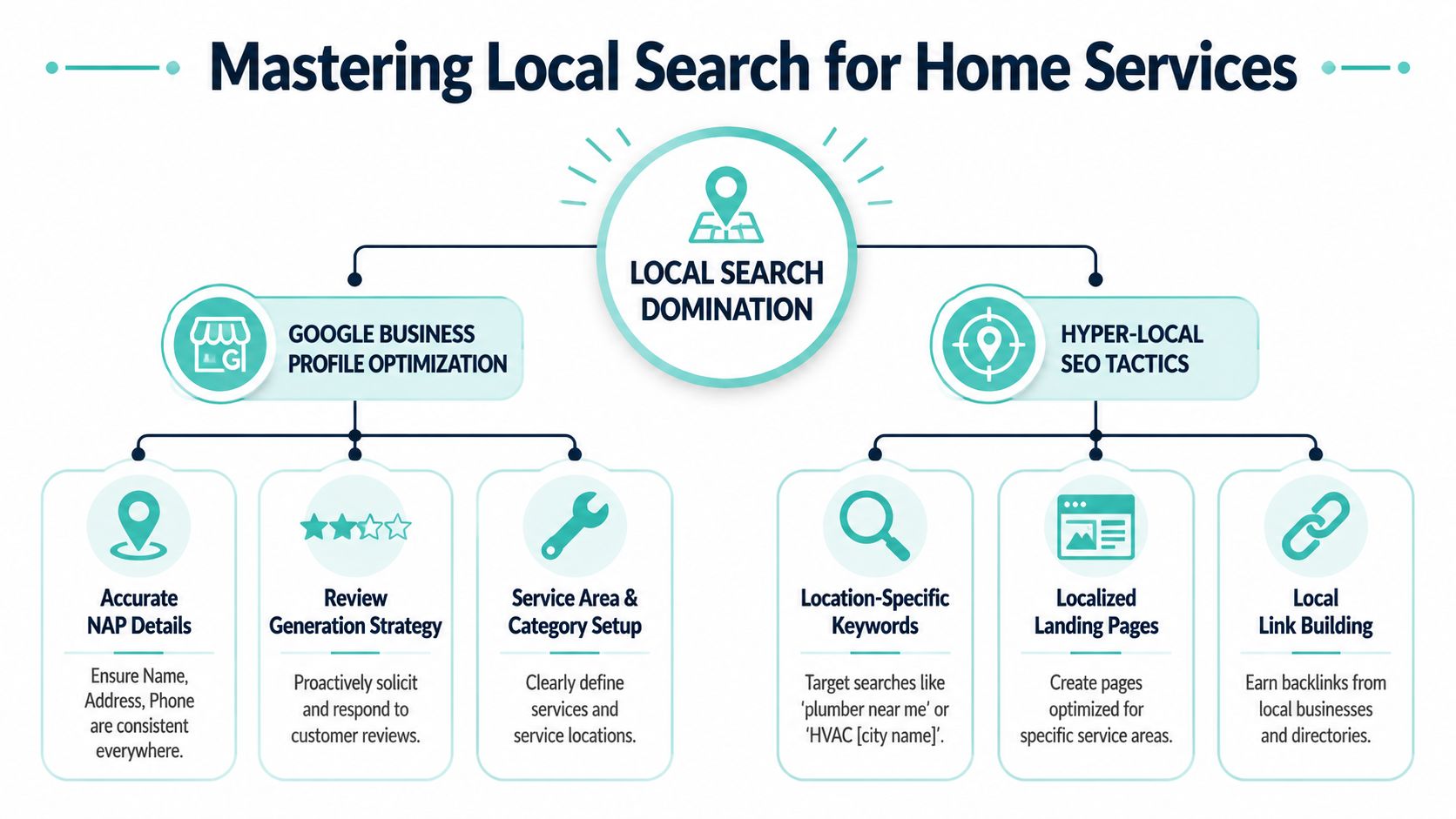
Three pieces usually decide whether a service business gets found for ready-to-hire searches:
-
Service pages built around real jobs
Create separate pages for the work you want more of. AC repair, water heater installation, panel upgrades, sewer line repair, roof leak repair. Specific pages rank better because they match how people search, and they convert better because they match the problem the homeowner is trying to solve.
-
Location signals grounded in reality
If you serve multiple cities, build pages that reflect actual coverage. Include response areas, local references where appropriate, and proof from jobs in those markets. Thin location pages created only to chase rankings usually waste time and can dilute trust.
-
Off-site validation
Local citations, chamber listings, supplier mentions, association profiles, and quality backlinks help confirm that your business operates in the places you claim. Google uses those signals to verify legitimacy, and homeowners pick up on the same pattern.
If you run a service-area business, this guide on optimizing local search for SABs is a useful reference for geographic targeting and profile setup.
If you want help executing the work, professional SEO services for service businesses should be judged by booked jobs, cost per acquisition, and revenue by service line. Rankings are only useful if they turn into profitable work.
AEO matters because search behavior is changing
Traditional SEO still matters. But local search is already shifting toward AI-generated answers, map summaries, and zero-click results. That means your content has to do two jobs at once. It needs to rank, and it needs to be easy for search engines to summarize accurately.
A lot of contractors are still publishing pages built for the old model. Long blocks of copy, vague headings, and little direct information. Those pages can struggle with both conversion and AI visibility. The better approach is simple. Write pages that answer the exact questions a homeowner and a search engine are both trying to resolve:
- What service do you offer
- Where do you offer it
- What problem does it solve
- How quickly can someone contact you
- Why should they trust your company
Clarity beats volume here.
Use concise service descriptions. Add FAQ sections only when they answer real questions. Keep your business details consistent across your site, Google profile, and directory listings. Structure content so a person can skim it in seconds and a search engine can interpret it without guessing.
That is how you future-proof local visibility. You are not chasing traffic for its own sake. You are building a search presence that gets your company found by homeowners who are ready to hire, and by the systems that increasingly decide which companies get seen first.
Activate Immediate Demand with Paid Advertising
SEO compounds over time. Paid advertising buys speed. Both matter, but they solve different business problems.
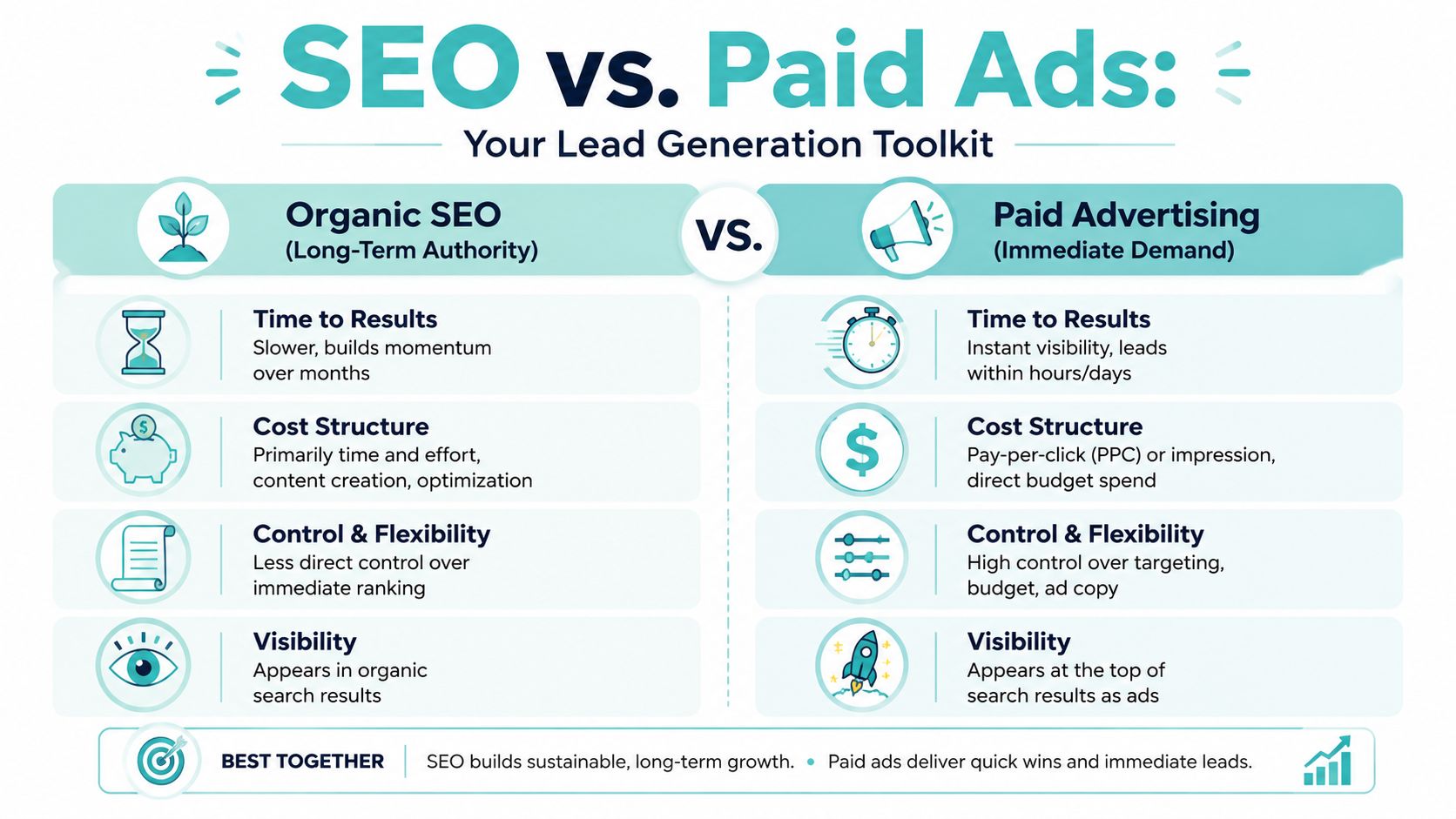
If you need jobs now because you’re entering a new market, filling schedule gaps, launching a service line, or competing in a crowded category, paid search earns its place fast. But the platform choice matters.
When LSAs make sense
Local Service Ads are often the cleanest starting point for many contractors because they align with urgent, local intent. They can also feel lower risk because the format is built around direct inquiry generation rather than pure click volume.
LSAs usually make the most sense when:
- You need phone calls quickly: Especially for repair or urgent service categories.
- Your review profile is solid: Trust carries more weight when searchers compare providers quickly.
- Your office can respond fast: Speed is part of the sale, not just the follow-up.
A 2025-2026 marketing benchmark cited average cost-per-lead near $45 for HVAC, $52 for plumbing, and $79 for roofing, while also reporting that 78% of consumers hire the first responder, according to Pipeline On’s home service marketing statistics. That last point is the part many teams miss. Buying the lead is only half the job. Capturing it first is what makes the spend pay off.
When traditional Google Ads gives you more control
Google Ads gives you more control than LSAs. That’s the upside and the danger. You can shape keyword targeting, ad copy, landing pages, scheduling, and budget allocation in far more detail. You can also waste money faster if the account structure is sloppy.
Use traditional PPC when you need to isolate high-value services, push seasonal offers, separate emergency from non-emergency demand, or test landing pages by trade. It’s especially useful when one service line is more profitable than the others and you want budget aimed there instead of spread across everything.
A simple comparison helps:
| Channel | Best fit | Main risk |
|---|---|---|
| LSA | Fast local inquiries with simpler setup | Low control over lead quality nuances |
| Google Ads | Tight targeting and service-level control | Wasted spend if keywords and landing pages are weak |
The rule is straightforward. Don’t ask paid ads to fix a broken website, a weak review profile, or a slow office response. Paid media amplifies whatever system sits underneath it.
Build Lasting Trust and Repeat Business
A homeowner finds you in a rush, books one job, and the work goes well. The easy mistake is treating that customer as finished revenue. In a healthy home services marketing system, that first job is the start of a longer relationship that produces maintenance work, replacements, referrals, and lower acquisition costs over time.
That matters because profitable growth does not come from piling up one-off leads. It comes from turning good customers into repeat buyers and trusted advocates.
Reviews shape the sale before your office speaks to them
By the time someone calls, they have usually done a quick risk check. Reviews are part of that filter. Customers use them to answer a simple question: “Is this company likely to show up, do the work right, and stand behind it?”
Treat review generation like a process tied to operations, not a marketing task you remember once a month.
- Ask right after a good outcome: Send the request when the customer is relieved, happy, and still thinking about the job.
- Make it easy to complete: Use a direct text or email link to the review page.
- Reply with specifics: A short, human response builds credibility better than canned language.
- Place reviews near buying decisions: Put them on service pages, quote request pages, and other points where people hesitate.
Reviews work like a digital version of word-of-mouth. They reduce perceived risk. They also support conversion when paired with strong page design, clear service proof, and a conversion rate optimization process for service businesses that removes friction from calls, forms, and booking paths.
Owners read reviews as praise or criticism. Homeowners read them as proof that hiring you will not become a headache.
Stay visible after the first job
SEO and ads help you win the first opportunity. Retention channels help you earn the second, third, and fourth one.
For most contractors, that means simple content and simple email. Not a complicated publishing calendar. Not weekly promos that train customers to ignore you. Just useful follow-up that keeps your company top of mind and gives people a reason to come back when the next need shows up.
Good retention content is practical:
- Seasonal reminders for maintenance people forget until a breakdown happens
- Post-job follow-up emails that ask for feedback and request a review
- Short homeowner tips tied to the services you already sell
- Referral requests sent after a clearly positive experience
- Before-and-after proof that helps past customers remember the quality of your work
The trade-off is attention. Retention marketing rarely feels as exciting as launching a new ad campaign, so owners push it aside. That costs them repeat revenue they already paid to acquire once.
A past customer who trusts your team is often worth more than a brand-new lead. They close faster, ask fewer defensive questions, and are more likely to approve higher-value work because your company already cleared the trust barrier.
That is also where future-proofing starts. As search shifts toward AI summaries and answer engines, brands with strong reviews, clear expertise, and consistent follow-up will have an advantage. The companies that earn trust in public and keep it after the job are in a better position to win both direct referrals and AI-influenced searches.
Measure What Matters From Clicks to Closed Jobs
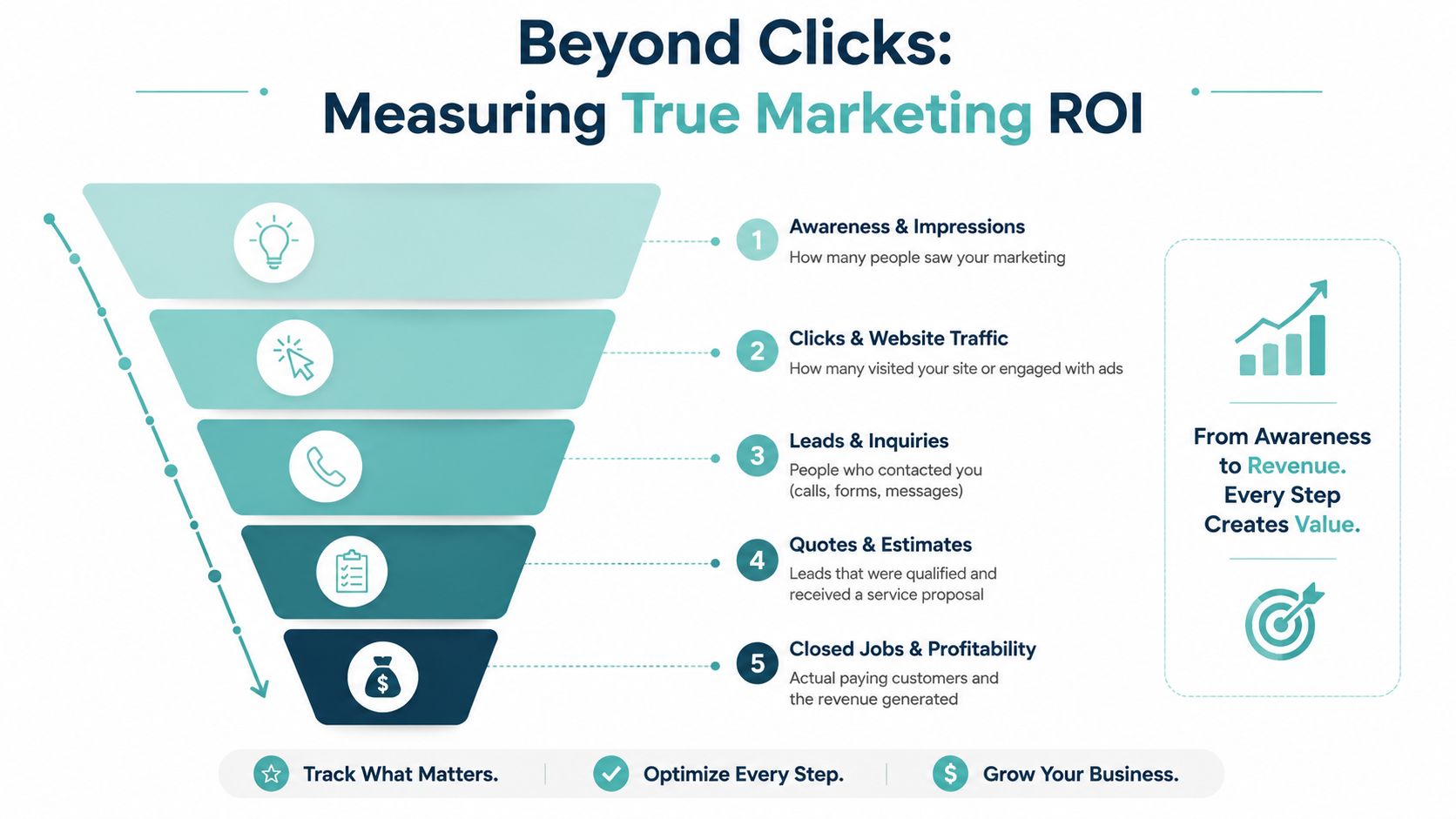
Most marketing reports in home services stop too early. They show traffic, rankings, calls, and form fills. Those metrics matter, but they’re not the finish line. They’re middle-of-funnel signals.
Why lead volume can mislead you
Most home services marketing content frames success around calls and form fills, but operational reality is that contractors need to know which channels produce profitable jobs. Recent guidance increasingly recommends call tracking and optimizing by lead quality and close-rate signals rather than traffic alone, as explained in Hughes Media’s guide to digital marketing for home services.
That distinction changes budget decisions.
A channel can generate lots of leads and still be a bad investment if those leads are price shoppers, out-of-area callers, wrong-service inquiries, or low-margin jobs that clog your schedule. Another channel can look quieter on paper and still outperform because the jobs close better and produce stronger revenue.
The practical mistake is treating all leads as equal. They aren’t.
Track the handoff from marketing to sales to operations
A usable measurement model follows the lead through the entire path:
-
Source
Did the inquiry come from GBP, organic search, LSA, Google Ads, direct traffic, referral, or another channel?
-
Lead type
Was it a phone call, form fill, chat, or message?
-
Qualification
Was it in your service area, for the right service, and worth quoting?
-
Outcome
Did your team book the estimate, sell the job, and complete profitable work?
That’s where call tracking and form tracking stop being “marketing tools” and start becoming operating tools. They help you see where leaks happen. Maybe Google Ads brings decent opportunities but your landing page sends the wrong expectations. Maybe SEO brings strong leads for one service and weak leads for another. Maybe your office staff closes repair calls well but loses replacement inquiries.
If you’re improving forms, CTAs, page layouts, and lead capture paths, a service partner focused on conversion rate optimization for lead generation websites should be measured by booked-job quality, not vanity lifts.
If a report can’t tell you which channel produced good jobs, it’s an activity report, not a business report.
A simple scorecard often beats an elaborate dashboard. Track source, lead quality, booked estimates, closed jobs, and gross profitability by channel. Then make budget decisions monthly, not emotionally.
Your Phased Home Services Marketing Roadmap
Most owners get overwhelmed because they try to fix everything at once. That usually creates half-built campaigns and scattered vendors. A phased roadmap works better because each stage supports the next one.
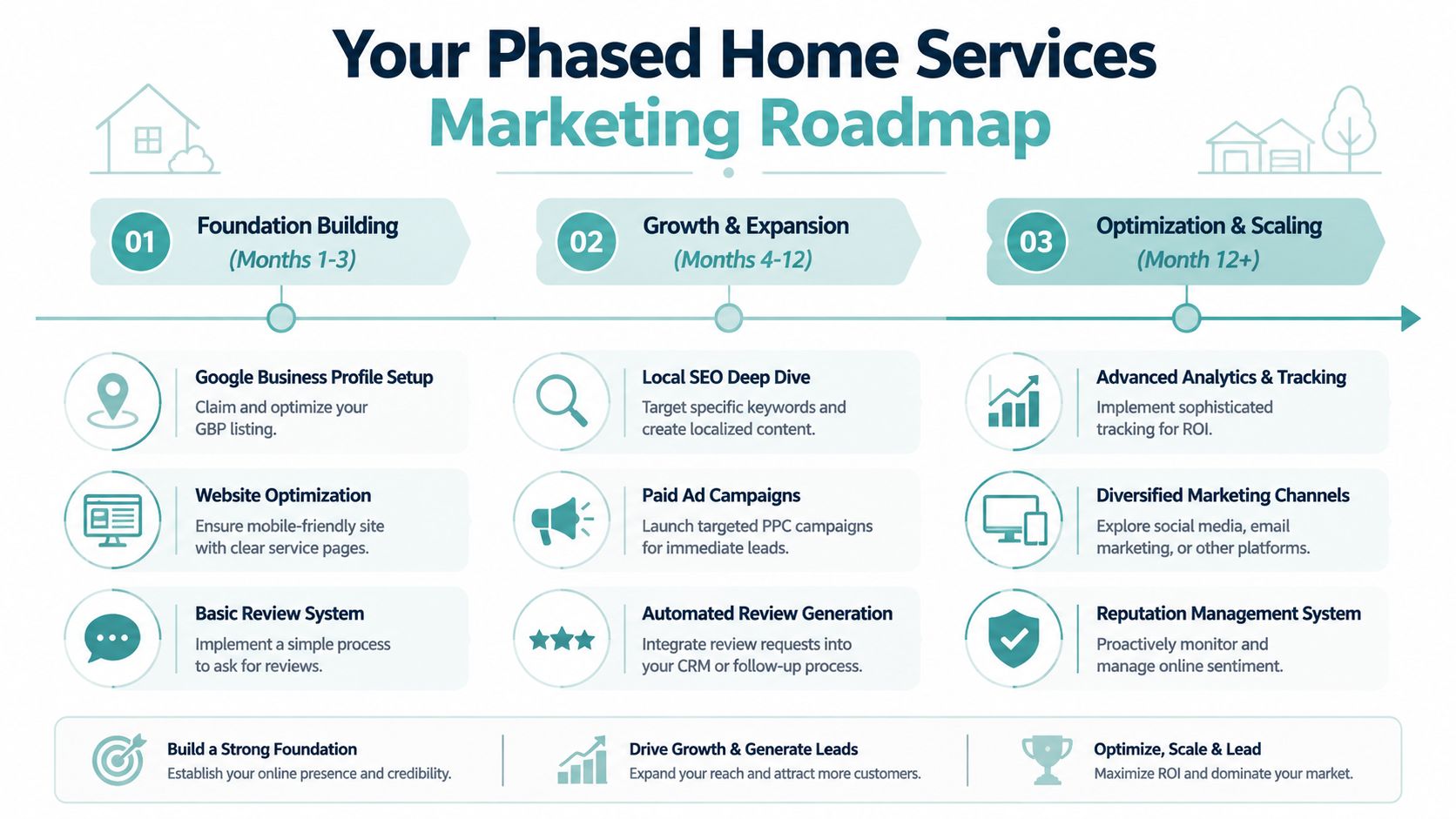
Phase one: Fix the foundation
Start with the assets that every other channel depends on. Tighten the website. Clean up your Google Business Profile. Make sure service pages are clear, mobile-friendly, and built to convert. Install call tracking, form tracking, and analytics before you add more spend.
This phase is less glamorous than launching campaigns, but it prevents expensive confusion later. If your foundation is shaky, every traffic source will underperform in a different way.
Phase two: Build a dependable demand engine
Once the storefront is solid, layer in local SEO and paid demand capture. Build or refine service pages. Add location relevance where it’s justified. Strengthen citations and local authority signals. If you need immediate volume, run LSAs or tightly scoped Google Ads around your best services.
Keep the emphasis narrow. Don’t market every service equally if a few services drive better margins or better close rates. Concentration usually beats complexity in the early growth stage.
A practical build order looks like this:
- First priority: Core service pages and GBP improvements
- Second priority: Call and form attribution
- Third priority: Local SEO expansion
- Fourth priority: Paid campaigns for priority services
- Fifth priority: Review generation and follow-up automation
Phase three: Optimize for margin, not noise
At this point, the job is refinement. Add content that supports both search visibility and customer trust. Use email to stay in front of past customers. Improve review workflows. Adjust paid budgets based on job quality, not on lead totals alone.
This is also where AEO becomes more important. Rewrite weak pages so they answer specific questions directly. Structure content for both search engines and answer engines. Tighten entity signals. Make it easier for AI-generated summaries to understand who you are, what you do, and where you do it.
The roadmap isn’t complicated. It’s disciplined. Build trust first. Capture demand second. Measure profit third. Then keep tuning.
If your company needs a website, SEO, and AEO system built to generate qualified inquiries instead of just more traffic, Digital Skyrocket helps service businesses create conversion-focused websites and search visibility strategies that connect rankings to real leads and booked work.