
Most advice on low competition keywords starts in the wrong place. It tells you to sort by keyword difficulty, chase the lowest number, and move on. That can work for a blog, but for a law firm, dentist, or roofer, a keyword only matters if the SERP is beatable and the query can turn into a call, form, or booked appointment.
That's the better test, because a phrase can look “easy” and still be useless. If the results are filled with big brands, weak intent alignment, or pages that already answer the query well, you're not finding opportunity, you're finding clutter. For service businesses, how to find low competition keywords is really a process of separating easy to rank from easy to monetize.
Table of Contents
- Why Low Competition Keywords Aren't Just Easy Keywords
- Setting the Bar for Commercial Intent First
- Tool Settings and Filters That Actually Work
- Reading the SERP for Real Weakness Signals
- Layering Local Modifiers and AEO Phrasing
- Mapping Keywords to Real Pages
- Tracking Rankings and Testing What Wins
Why Low Competition Keywords Aren't Just Easy Keywords
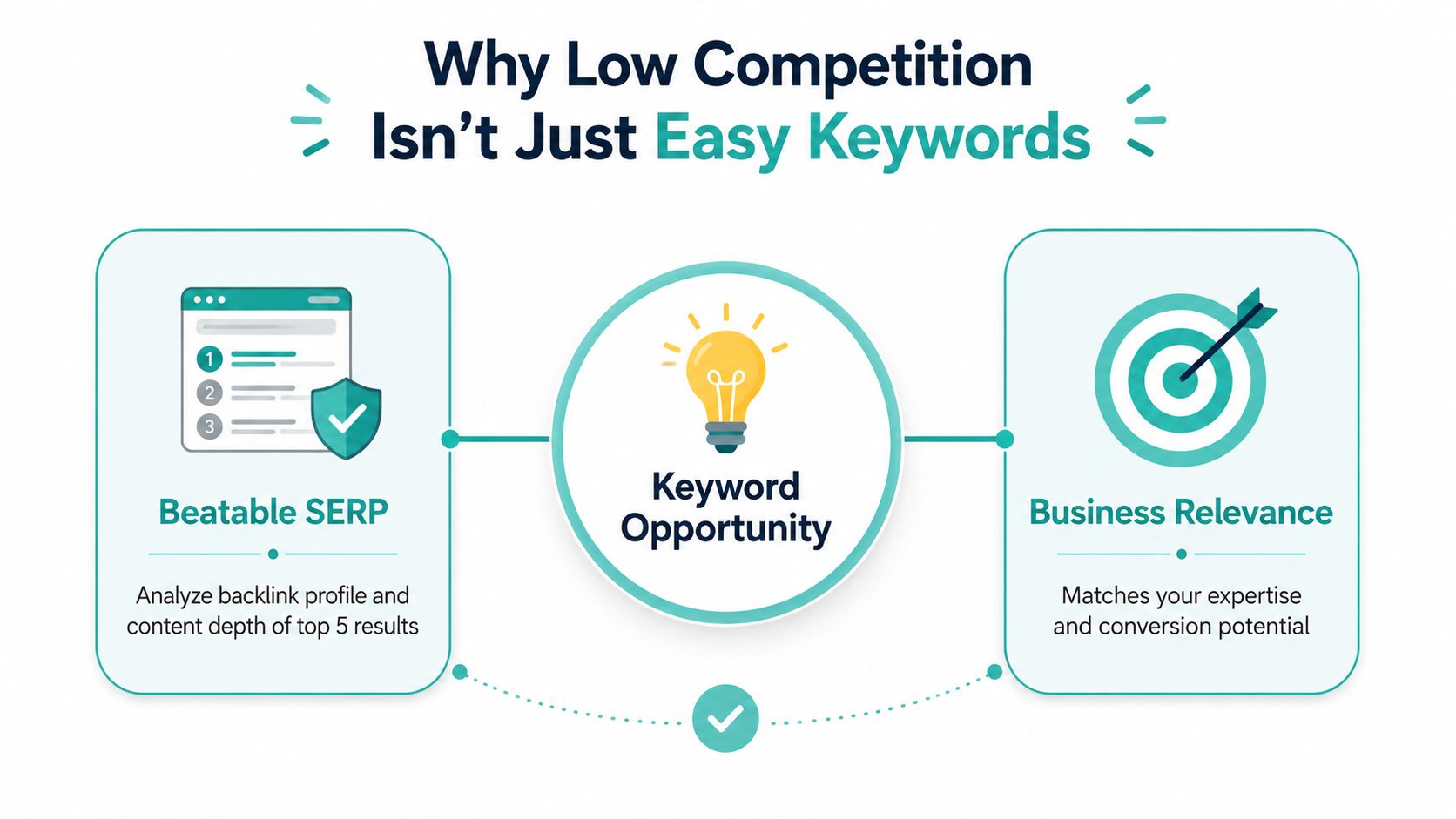
The usual advice says to filter by KD, keep the lowest-volume terms, and call those “low competition.” That misses what matters for a local service business. A keyword can look easy in a tool and still be a poor bet if it pulls in people who want definitions, DIY steps, or services you do not offer.
Semrush's guidance lines up with a typical workflow, starting with competitor keyword research and then filtering for Volume = 100+ and KD = Easy. It also shows buyer-intent examples where terms with MSV values from 110 to 1,900 can still sit in a manageable 31.58 to 48.19 KD% range, which is a useful reminder that decent volume and manageable difficulty can coexist.[^semrush] That said, the metric is only part of the decision. If the top results are strong, fresh, and tightly matched to intent, the page still will not be easy to win.
What makes a keyword low competition for a service business
For a roofer in Texas, “roof repair” is broad, but “emergency roof leak repair after storm” tells you much more about commercial intent. The second phrase is more likely to lead to a phone call because the searcher already has a problem and wants a solution. The same logic applies to a dentist targeting “same day tooth extraction near me” or a personal injury firm pursuing phrases tied to urgent legal help.
Practical rule: if the query does not sound like someone needs a service soon, it probably is not worth the page even when the KD score looks attractive.
That is why a page on how to write high-ranking content can help as a content-quality reference, but it should not distract from the primary test, which is whether the query maps to a lead-generating offer.[^lumi] A keyword also needs to fit the business and face a SERP that you can realistically beat. For long-tail targeting that supports this kind of filtering, a focused long-tail SEO approach is usually more useful than chasing broad terms with shiny volume.
What the SERP looks like matters as much as the keyword itself. If the first page is full of strong brand pages, local pack results, and tightly matched service pages, the term is harder than the tool makes it look. If the results are thin, outdated, or only loosely connected to the service, the opportunity is better. An infographic showing that keyword opportunities depend on both beatable search engine results and business relevance.
Setting the Bar for Commercial Intent First
Start with the query, not the tool. Ask five questions before you spend time filtering anything: does the phrase include a service, location, or buying signal, do the current results show ads or local packs, does the wording sound transactional or just informational, can your business serve that searcher, and would a ranking page realistically drive a call or form submission.
A quick pass-fail screen you can use in minutes
A roofer should treat “metal roof repair Houston” differently from “what is a metal roof.” The first can support lead generation, the second is mostly education. A personal injury firm can pursue “truck accident lawyer Dallas” because the query clearly points to legal help, but “what to do after a crash” may need a different page and a different conversion path.
A dentist faces the same trade-off. “Emergency dentist near me” has a different commercial temperature than “how long does tooth pain last.” Both can be useful, but they are not equally close to a call.
Search intent isn't just a content label. It decides whether your page earns a lead or just an impression.
Use the same screen on every keyword. If the searcher seems to want to compare, learn, or define, the term may still be useful, but it probably belongs in a support page rather than a money page. If the searcher appears ready to book, call, or request help, the keyword deserves a closer look.
One useful internal reference is the market screen used in a market opportunity assessment, because the strongest keyword choices usually come from a real view of service area demand and not from a spreadsheet alone.
Tool Settings and Filters That Actually Work
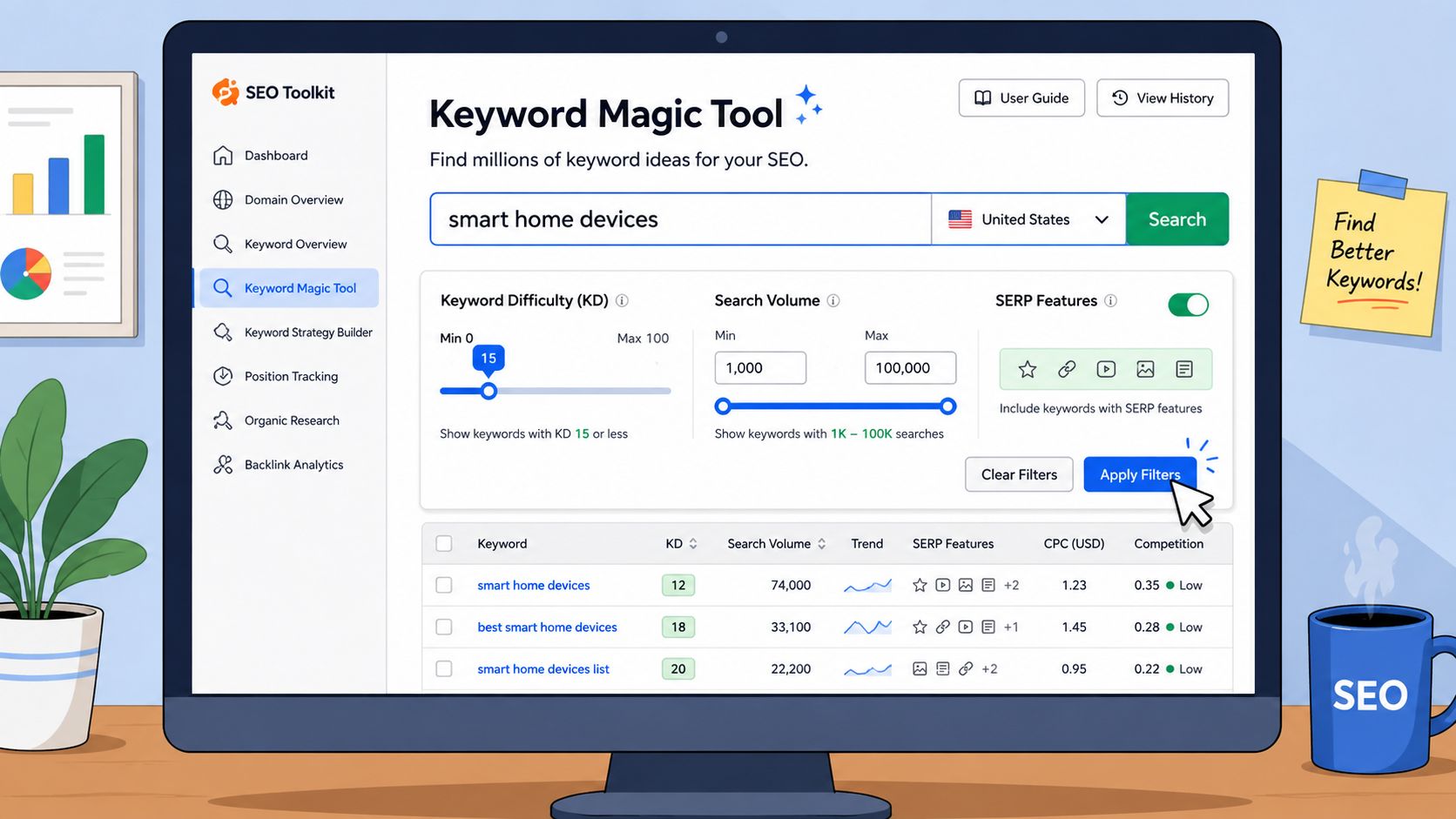
The cleanest way to start is with a seed term in Semrush's Keyword Magic Tool. From there, filter by KD %, choose the lowest difficulty tier available, and keep an eye on volume so you don't bury yourself in queries that will never move. Semrush's own guidance uses Volume = 100+ and KD = Easy as the starting filter, and that's a sensible baseline for local-service work.[^semrush]
The settings I'd start with for a service business
If you're newer or your site doesn't have much authority, lean toward terms that sit in the easier bands described in the brief. Independent guides commonly treat low competition as roughly below 20 to 30 KD, while some recommend prioritizing phrases in the 100 to 1,000 monthly searches range because that balances reach and attainability.[^semrush] That range is often where service businesses find useful work without chasing head terms they can't win.
Then remove the noise.
- Exclude branded terms: They usually distort opportunity because you're borrowing demand that already belongs to someone else.
- Exclude generic head terms: Broad phrases often hide weak intent and attract visitors who aren't ready to hire.
- Keep long-tail variations: Long-tail terms are usually more specific, and more specific is usually more monetizable.
- Use Keyword Gap: Enter your domain and up to four competitors' domains to surface terms they rank for that you don't.[^exploding]
For long-tail targeting, a good supporting resource is this guide on long-tail SEO, especially if your site needs pages that can rank for clusters instead of isolated phrases.
Don't chase zero-difficulty terms just because the number looks neat. Those queries often have no useful traffic or weak commercial value. A modest amount of search demand is better than a perfect score on a term nobody uses to hire anyone.
Reading the SERP for Real Weakness Signals
Difficulty scores are a starting point, not a verdict. Live results tell you whether a keyword is open. The strongest signal is not a number, it's the shape of the top five results.
What to look for in the top five
Weak SERPs usually expose themselves quickly. Forum threads, Quora posts, DR-under-30 sites, thin pages under 800 words, stale articles older than two years, and obvious intent mismatches all suggest a page can be built to beat the field.[^king] If a service query is being answered by a generic blog post, that's a different kind of weakness than a high-volume term surrounded by heavily optimized local pages.
A quick rule I use is simple. If the top results look like they were assembled for convenience instead of usefulness, there's probably room to win with a page that matches the query better. If the results are fresh, focused, and obviously designed to satisfy the searcher, the keyword may still be valuable, but it's not low competition in practice.
How competitor gaps point to shared weakness
Semrush's Keyword Gap tool becomes more useful when you treat it as a pattern finder instead of a list dump. Enter your domain plus up to four competitors' domains, then look for terms they all rank for that you don't.[^semrush] Shared overlap often means the market has already validated the phrase, but the current result set hasn't locked it down with unbeatable pages.
The LinkedIn workflow in the brief adds one more operational filter. After checking the top 5 ranking sites in the SERP, a keyword is treated as low competition when a competitor page with Domain Rating of 39 or below appears in those top five results.[^linkedin] That doesn't make the term automatically worth targeting, but it does turn a vague judgment into a repeatable check.
A SERP can look hard because the volume is solid, yet still be open if the pages are weak. It can also look easy because the wording is specific, yet be locked up by well-built local pages. The win comes from reading the actual results, not trusting the label.
Layering Local Modifiers and AEO Phrasing
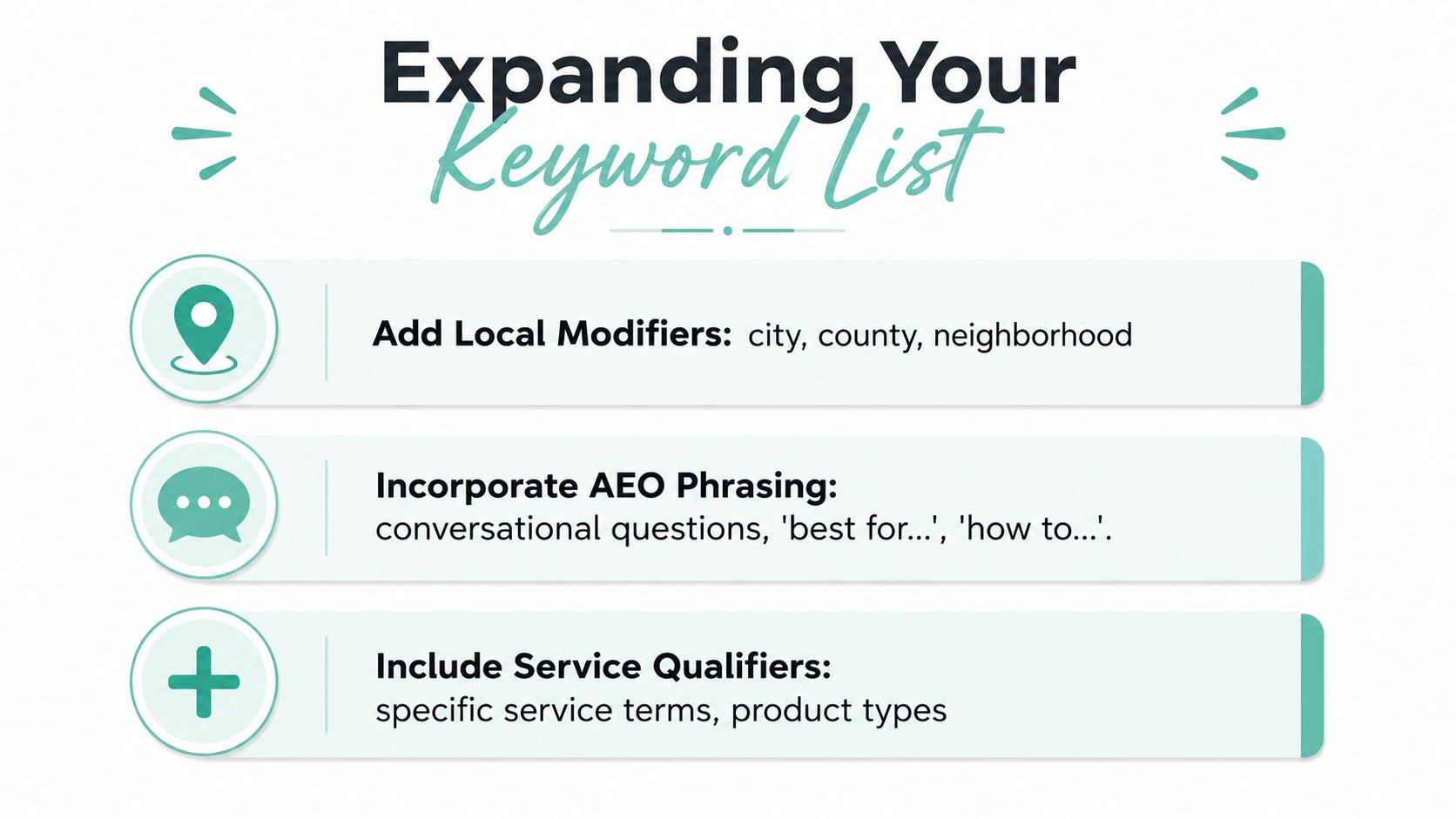
Once a shortlist passes the intent screen and the SERP test, expand it with location and service language. For local businesses, that usually means city, county, and neighborhood modifiers, plus words that sharpen urgency or buying intent, like emergency, after hours, on-site, or free consultation. The point is to get more specific without dropping into dead terms nobody searches.
How to turn a seed phrase into useful variations
A Texas roofer might start with “roof leak repair” and expand into “roof leak repair Dallas,” “emergency roof leak repair after hail,” and “roof leak repair near me.” A Dallas personal injury firm could move from “car accident lawyer” to “car accident lawyer Dallas,” “best car accident lawyer after crash,” and “free consultation car accident attorney.”
For AEO-style phrasing, use the kinds of questions people ask. Pull from Google's People Also Ask, Reddit-style pain queries, and “how much does X cost in [city]” patterns. Those queries often reveal language that answer engines can summarize cleanly, which makes them useful even when the final conversion happens later on the page.
Reliable free sources for expansion include:
- Google autocomplete: Good for phrasing people already use.
- People Also Ask: Useful for question formats and support content.
- Forum threads and community posts: Good for problem language and objections.
- Competitor headings: Helpful for spotting service qualifiers and local phrasing.
Useful filter: keep the modifiers that increase buying intent, drop the ones that only make the phrase awkward.
The goal isn't to stuff every page with a city name. It's to identify the wording that mirrors how a prospect asks for help. That's what gives the page a shot at both visibility and conversions.
Mapping Keywords to Real Pages
A keyword list is not a content plan. If you publish one page for every term, you'll create cannibalization, thin content, and a site that's hard to scale. The better move is to group related phrases by intent and give each cluster a clear home.
A simple page map for a multi-location HVAC company
Say the shortlist includes “AC repair Dallas,” “emergency AC repair near me,” “air conditioner not blowing cold air,” “HVAC maintenance Plano,” and “how often should HVAC be serviced.” Those aren't five separate pages by default. They point to a smaller set of page types.
A practical map might look like this:
- Core service pages: AC repair, furnace repair, HVAC maintenance.
- Location pages: Dallas, Plano, and any other market where the company serves.
- Support pages: Problem explainer content, maintenance questions, and comparison pages.
The service page should carry the money intent. The location page should reinforce local relevance. The support page should answer the questions that help a buyer move from uncertainty to action. That structure gives each cluster a place to rank without competing against itself.
For page-level structure, the internal guidance in internal linking best practices is useful because pages rank better when the site clearly shows which page owns which topic. Internal links should push authority toward the page that matches the main commercial query, not scatter it across ten near-duplicates.
A common mistake is building a standalone page for every city-keyword combination and calling it strategy. Search engines usually reward pages that cover a topic cluster well, especially when the page matches intent and the site doesn't split the same theme into fragments. One good page can capture a family of queries if the mapping is clean.
Tracking Rankings and Testing What Wins
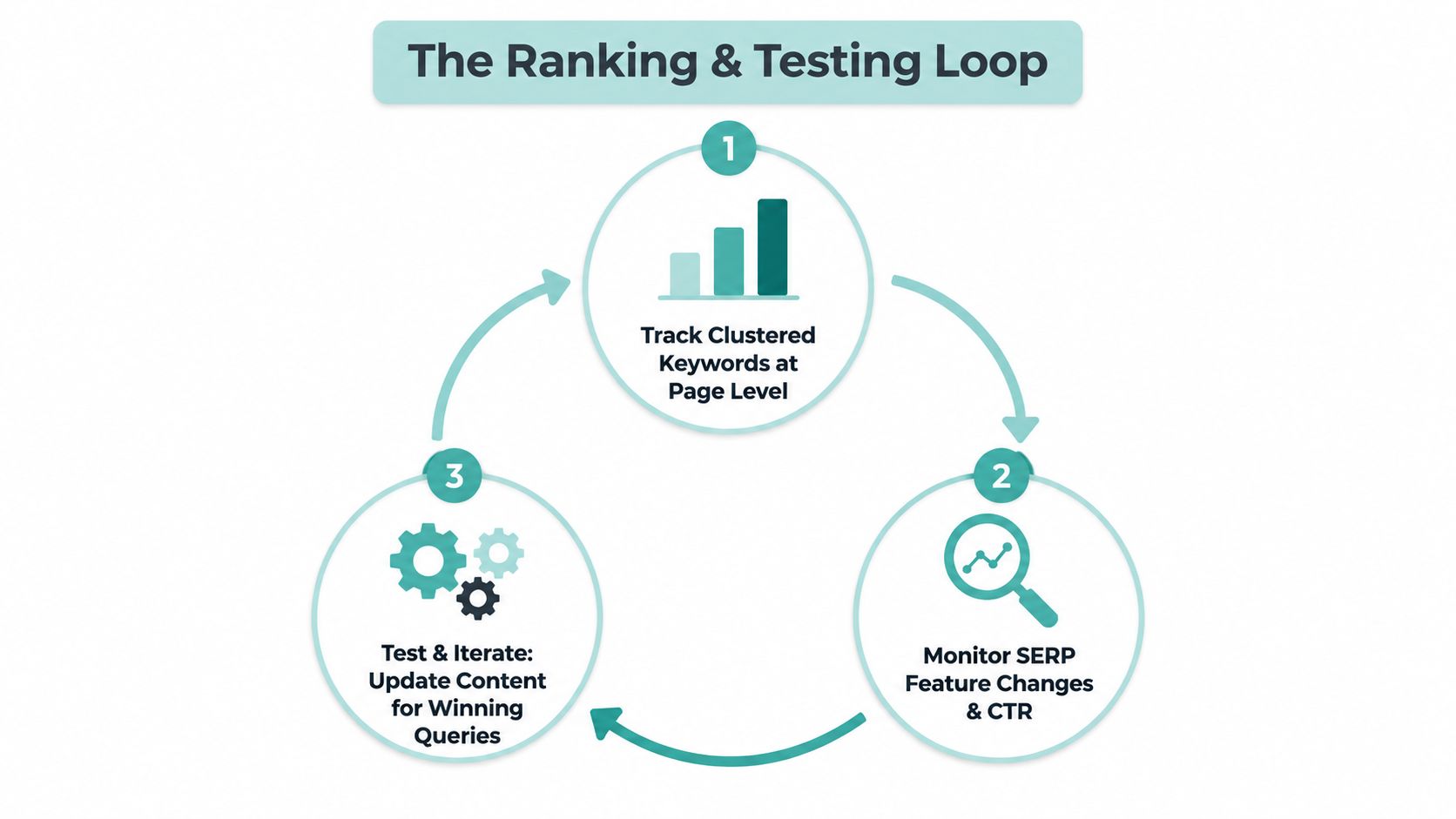
Publishing is the start of the test, not the end of the project. Track the page and the cluster, not just the exact phrase you targeted. The supporting terms often move first, and that movement tells you whether the page is starting to satisfy the underlying intent.
What to watch over the first few checkpoints
At 30 days, check indexing, crawlability, and whether the page is getting any early movement on close variants. At 60 days, look at which sub-terms are starting to surface and whether the SERP is changing in your favor. At 90 days, decide whether the page deserves a refresh, a content merge, or a stronger internal-link push.
If a page ranks but doesn't convert, the issue is usually one of three things. The intent is wrong, the offer is buried, or the page answers the question but doesn't move the reader toward action. Fix the conversion path before you assume the keyword was a mistake.
The ranking and testing loop should stay simple enough to repeat.
A repeatable workflow you can run next quarter
- Start with intent: keep only queries that can plausibly lead to a call or form.
- Check the SERP: look for forum posts, thin pages, stale content, and weak domains.
- Filter in the tool: use KD, volume, and competitor gaps to narrow the list.
- Add local and AEO variants: build out the phrasing people use.
- Cluster by page: map one topic group to one page type.
- Track at page level: watch the cluster, not just the seed keyword.
- Refresh what works: strengthen pages that show movement and fix pages that rank without leads.
This is the part that keeps the work profitable. If the page starts winning the right terms, invest in it. If it wins the wrong terms, adjust the intent match before adding more content.
Digital Skyrocket builds lead-focused websites, local SEO, and answer engine optimization for service businesses that want calls, not vanity traffic. If you want a keyword strategy that connects beatable SERPs to real intake, visit Digital Skyrocket and see how a focused SEO and website process can support your next growth push.