Your Google Analytics looks healthy. Organic sessions are coming in. A few pages even rank for terms that seem important. But the phones aren't ringing the way they should, quote requests are thin, and the leads you do get are often a bad fit.
That usually means the site is attracting attention without attracting intent.
A roofing company can rank for "roofing." A law firm can get clicks for "car accident." A dentist can pull in traffic for "teeth whitening." None of that guarantees the visitor needs help now, in your service area, for your desired work. Broad traffic flatters reports. Specific traffic pays invoices. That's where long-tail SEO becomes the practical lever for local service businesses that care about qualified inquiries, not vanity metrics.
Table of Contents
- From Website Traffic to Real Customers
- What Exactly Are Long-Tail Keywords
- Why Long-Tail SEO Is a Goldmine for Local Businesses
- How to Find and Prioritize Your Golden Keywords
- Mapping Keywords to Your Website Content and Structure
- The Future Is Conversational Long-Tail SEO for AI Search
- Start Attracting the Right Customers Today
From Website Traffic to Real Customers
A common scenario looks like this. An HVAC owner calls after staring at reports that show more organic traffic than last quarter. He assumes the site is improving, but when you ask how many estimate requests came from search, the answer gets vague. Traffic went up. Revenue from that channel didn't.
The problem usually isn't visibility by itself. It's visibility for the wrong searches.
If your site pulls in visitors searching broad phrases, you'll get a mixed crowd. Some are students. Some are researching a problem they won't solve for months. Some are outside your service area. Some want a DIY fix. Broad keywords cast a wide net, and service businesses rarely need a wider net. They need a tighter one.
What bad-fit traffic looks like
A local attorney might rank for "injury law." That can bring in curiosity clicks from people looking for definitions, news stories, or national information.
A better search is something like a person looking for legal help after a specific type of accident in a specific city. The same pattern shows up in every service category.
- Roofing: "roof repair" is broad, while a search about leak repair after a storm in a specific town signals immediate need.
- Dental: "dentist" is vague, while a query about same-day emergency tooth extraction in a nearby area is much closer to an appointment.
- HVAC: "air conditioner" doesn't tell you much, but a detailed search around repair for a certain issue does.
Traffic isn't the finish line. For a service business, the finish line is a qualified inquiry from someone who needs your service, in your market, soon.
Long-tail SEO shifts the target. Instead of chasing the phrase with the biggest apparent volume, you build pages around the way real buyers search when they know what they need. That's how a website starts acting less like a brochure and more like an intake channel.
The right metric to care about
Stop asking, "How many people visited?"
Start asking better questions:
- Lead quality: Did the visitor need the exact service you provide?
- Local relevance: Were they searching in the cities you serve?
- Commercial intent: Did the query sound like research, or like someone preparing to hire?
- Page fit: Did they land on a page built for that question, or a generic page trying to cover everything?
Once you look at search through that lens, long-tail SEO stops sounding like a niche tactic. It becomes the obvious way to turn search visibility into real customers.
What Exactly Are Long-Tail Keywords
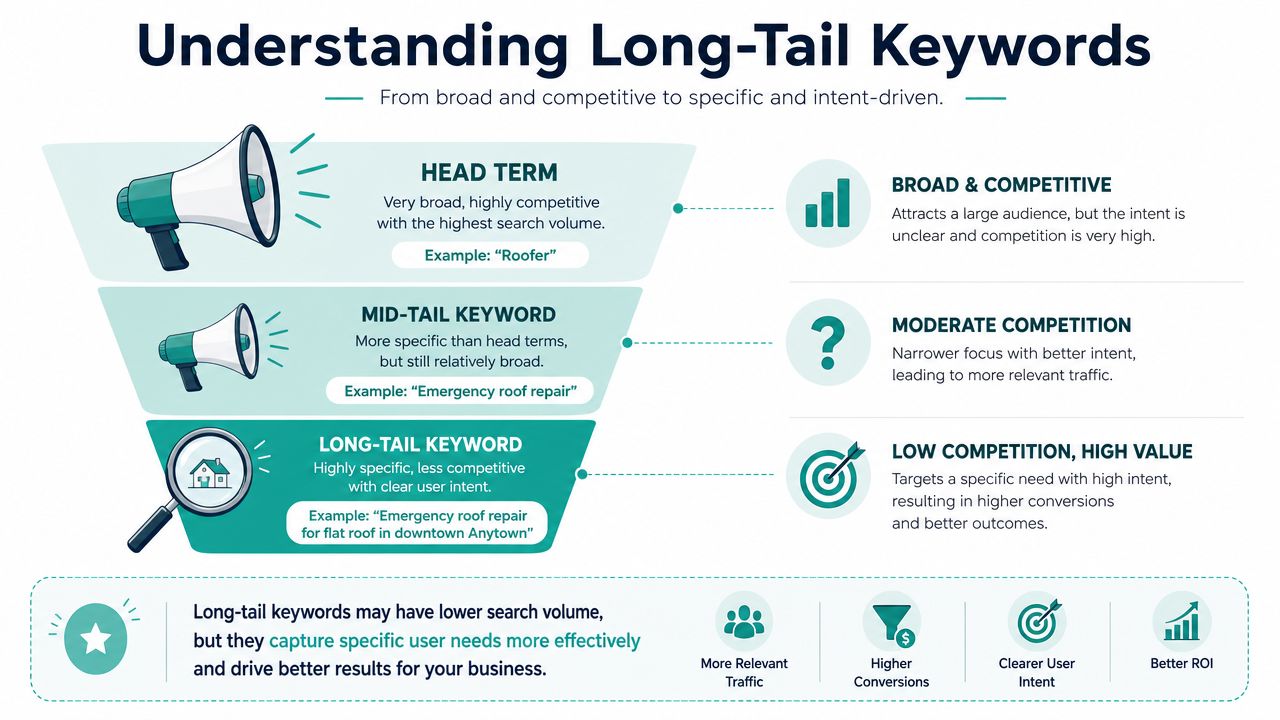
Long-tail keywords are specific search phrases, usually three or more words, that reflect a narrower need than broad head terms. They tend to have lower search volume individually, but they line up much better with what a serious buyer is trying to solve.
Think of search like a conversation
A head term is like standing in a crowded room and shouting, "Roofer!"
A long-tail query sounds more like a direct question to the right person: "best company for metal roof replacement in Tyler TX."
One gets attention from all kinds of people. The other comes from someone who already knows the category, the problem, and often the location. That's why long-tail SEO works so well for lead generation.
If you want a clean primer before going deeper, demystifying long tail keywords for marketers is a useful glossary-style resource.
Key point: Long-tail keywords aren't just "longer phrases." They're tighter expressions of intent.
What long-tail searches look like in the real world
Here are a few simple comparisons:
| Business type | Broad search | Long-tail search |
|---|---|---|
| Law firm | car accident lawyer | personal injury lawyer for car accidents in Dallas |
| HVAC company | AC repair | emergency AC repair for upstairs unit not cooling |
| Dentist | dentist | cosmetic dentist for chipped front tooth near me |
The wording matters because it mirrors how buyers think when the need becomes urgent or specific.
A contractor doesn't need every person searching "roof." They need the homeowner searching for help with the exact roof problem they have. A family dentist doesn't need random clicks for "dentist." They need the person searching for a treatment, a symptom, or an appointment type.
One reason this matters so much is scale. Long-tail keywords constitute the overwhelming majority of global search activity, with approximately 91.8% of all search queries classified as long-tail terms, according to Embryo's summary of long-tail keyword statistics.
Most of search isn't happening in a handful of trophy keywords. It's happening across a huge spread of highly specific queries.
That changes the strategy. You're not fighting for one giant phrase. You're building visibility across a large set of lower-volume searches that, together, bring in the people most likely to call, book, or request an estimate.
Why Long-Tail SEO Is a Goldmine for Local Businesses
For local service companies, long-tail SEO isn't a side tactic. It's often the shortest path to better leads because it aligns your site with what buyers ask right before they choose a provider.

Specific searches bring better prospects
The biggest advantage is intent.
Someone searching "plumber" may need a definition, a salary range, or a local company. Someone searching for drain clearing help in a specific city with a specific problem sounds like a person trying to hire. That distinction is everything.
Leads generated from organic search with long-tail intent have an average closing rate of 14.6%, according to Finance Yahoo's SEO statistics roundup. That stat matches what most lead-gen teams see in practice. The more precise the query, the less guessing you have to do about why the person landed on the page.
For local businesses, adding service modifiers and geographic terms sharpens that intent even further. "Water heater repair" is broad. "Tankless water heater repair in Plano" is the kind of search that can turn into a call if the landing page answers the need fast.
If you're trying to connect SEO to actual lead generation systems, this broader guide to marketing for service companies is worth reading because it frames search as part of the full intake process, not an isolated traffic exercise.
The hidden advantage is topical authority
Long-tail SEO also helps your site earn trust with search engines over time.
When you publish focused pages around related service questions, problem variants, and local use cases, your site stops looking generic. It starts looking like a business that understands the category in detail. A roofing company with pages on storm damage, flashing issues, flat roof leaks, insurance claim questions, and city-specific service pages sends a stronger signal than one site with a single "Roofing Services" page trying to do all the work.
That doesn't mean every long phrase deserves its own page. It means your content should cover the actual topics buyers search around.
- Lower wasted clicks: Specific pages filter out casual searchers and bring in better-fit visitors.
- Clearer messaging: The page can address one service, one problem, and one next step.
- Stronger local relevance: Geographic modifiers make it easier to match local demand with local service pages.
- Compounding visibility: One solid topic cluster can rank for many related searches, not just the phrase in the title.
A generic page talks about what you do. A strong long-tail page answers the exact question that makes someone pick up the phone.
That's why local businesses get so much mileage out of this approach. It doesn't just help rankings. It improves the odds that the person arriving is the person you want.
How to Find and Prioritize Your Golden Keywords
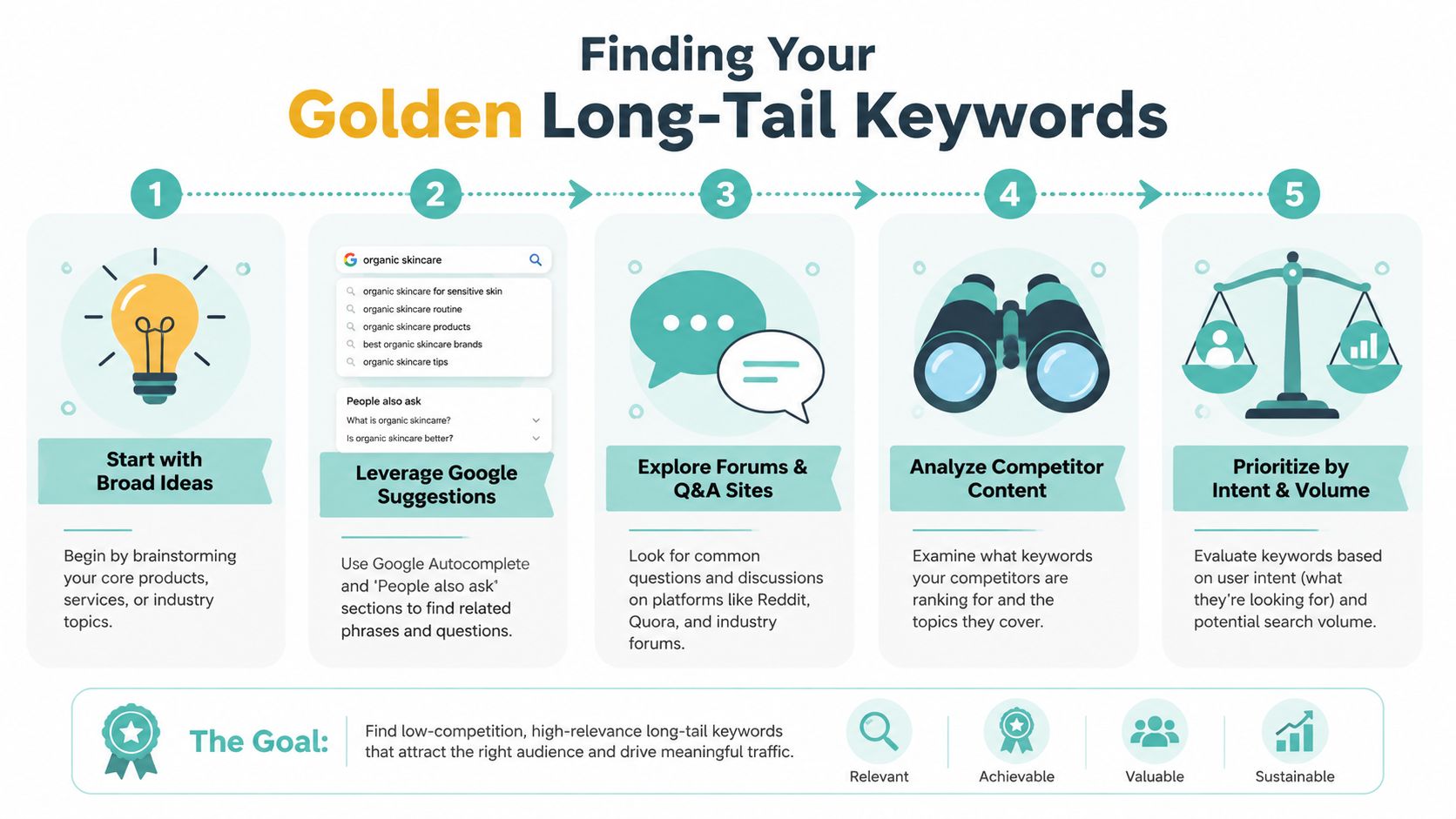
Most business owners overcomplicate keyword research. You don't need to start with an expensive platform and a spreadsheet full of every phrase under the sun. Start with the language your market already uses, then sort it by business value.
Start with questions you already hear from customers
Your best keyword source is often your own inbox, call log, and sales conversations.
If people keep asking whether insurance covers roof replacement after hail, that's a content topic. If callers keep asking how long a probate case takes in your county, that's a content topic. If patients keep asking whether same-day crowns are available, that's a content topic.
Then use search interfaces to expand those ideas:
- Google Autocomplete: Type your core service and see how Google completes it.
- People Also Ask: Review the question box for wording patterns and adjacent concerns.
- Google Search Console: Look for longer queries that already trigger impressions or clicks.
- Reddit and Quora: Mine the exact phrasing people use when they're confused, frustrated, or comparing options.
- Competitor pages: Check what topics competing firms and contractors cover well, then look for gaps in depth, locality, or clarity.
A practical workflow is simple. Start with your services. Add the modifier a customer would say out loud. Then add location, urgency, price concern, problem type, or audience qualifier.
Examples:
- Base service: divorce lawyer
- Problem version: divorce lawyer for high conflict custody case
- Local version: divorce lawyer for contested custody in Fort Worth
- Question version: how long does contested custody take in Texas
Prioritize by intent, not word count
Here's where many businesses waste time. They assume every long phrase is a good target.
It isn't.
The myth that "long tail keywords are easier to rank for" is flawed. Ranking difficulty correlates with competition, not just search volume. Successful long-tail SEO requires targeting high-intent phrases with clear conversion value, not just any four-word phrase, as discussed in this BigSEO discussion on the long-tail ranking myth.
That means you need a filter.
Use this simple decision table:
| Query type | Good target? | Why |
|---|---|---|
| "how much does roof repair cost after hail" | Yes | Strong commercial investigation |
| "what is a roof" | No | Informational, weak buyer signal |
| "emergency dentist open saturday near me" | Yes | Immediate local intent |
| "history of dental implants" | No | Academic interest, weak lead value |
For teams that want a more structured process, a professional SEO service usually turns this into a repeatable research and prioritization system. But even without that, the rule is straightforward.
Don't chase long phrases because they're long. Chase them because they signal a real buying situation.
The best long-tail keywords usually combine three things: a clear service need, a real-world qualifier, and obvious commercial intent. That's where the golden keywords live.
Mapping Keywords to Your Website Content and Structure
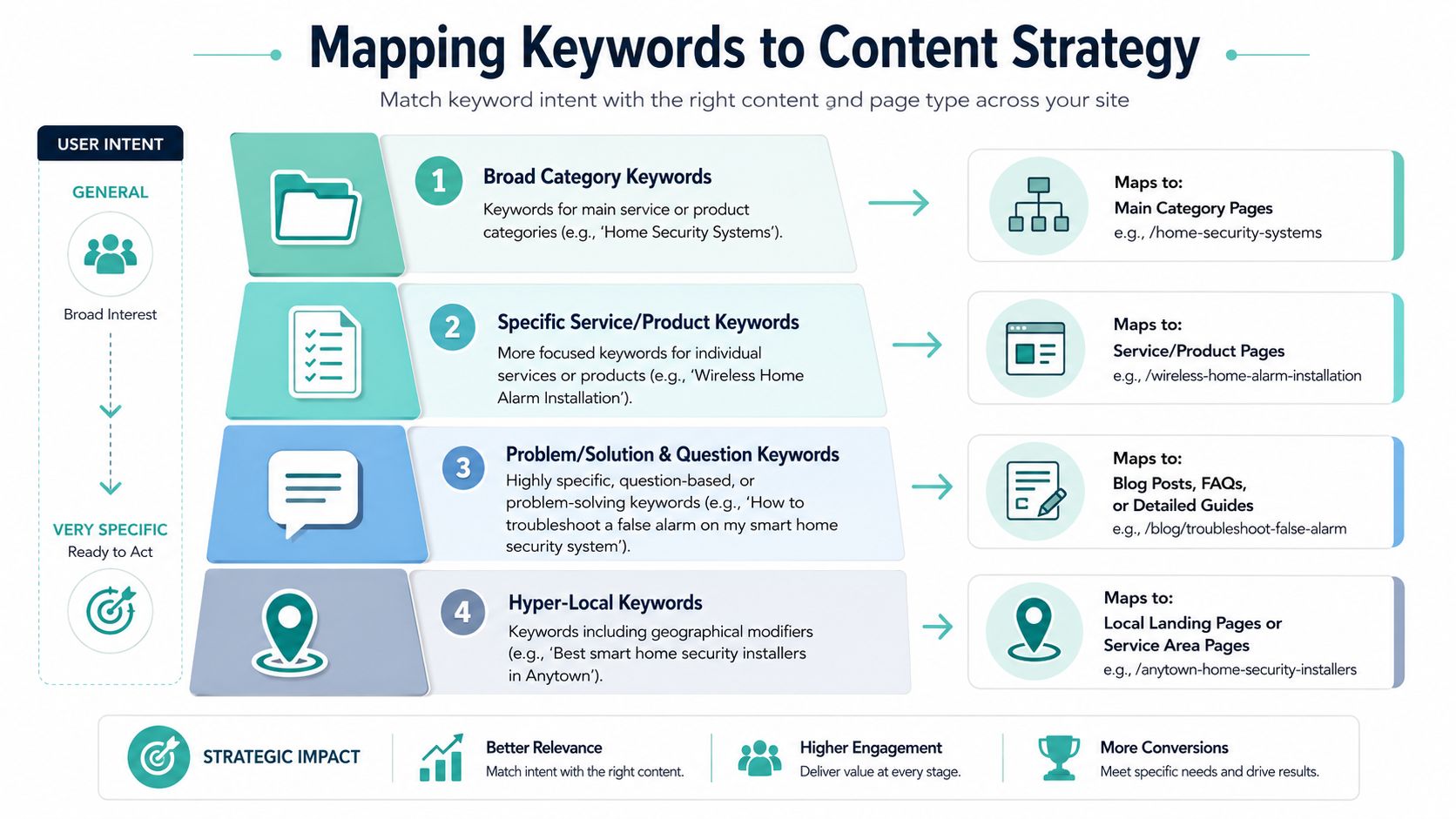
A keyword list by itself doesn't do much. The value comes from assigning the right query to the right page type, so searchers land where the answer belongs.
Match the page type to the search intent
Informational searches belong on educational pages. Transactional searches belong on service and location pages. Comparison searches often deserve dedicated articles or FAQs. Businesses get into trouble when they force every keyword onto the homepage or one generic service page.
A cleaner approach looks like this:
- Service pages: Use these for high-intent searches tied to a core offering, such as a specific legal case type, repair service, or treatment.
- Location pages: Use these when the same service needs geographic relevance for different cities or regions.
- Blog posts or guides: Use these for question-based searches, early-stage concerns, and problem diagnosis.
- FAQ sections: Use these to answer short, high-friction questions that support both users and search visibility.
This matters even more in AI-influenced search. Advanced techniques include using AI-powered tools to group related long-tail phrases by intent, then deploying FAQ schema markup to enhance visibility in answer engines, which increasingly prioritize question-answer formats for content ranking, according to Ahrefs' guide to long-tail keywords.
That advice lines up with what works on service sites. Group close variants together, build one strong page per intent cluster, and avoid thin pages that differ only by a few words.
A simple site map for a service business
Take a personal injury law firm.
A weak structure might have a homepage, a generic "Practice Areas" page, and one blog. That's not enough surface area to match the different ways prospects search.
A stronger structure looks like this:
| Page type | Example topic | Search intent |
|---|---|---|
| Main service page | Car accident lawyer | Core transactional |
| Sub-service page | Rear-end collision lawyer | Specific transactional |
| Location page | Car accident lawyer in Tulsa | Local transactional |
| Blog article | What to do after a rear-end collision | Informational |
| FAQ section | How long do I have to file a claim | Question-based support |
The same model works for dentists, HVAC companies, roofers, and other lead-gen businesses. Each page should have one job in the customer journey.
If your team is building this out from scratch, a focused content strategy for lead generation websites helps prevent the usual mess of overlapping pages and cannibalized keywords.
One page shouldn't try to rank for every version of a topic. It should own one intent cluster and answer it better than the alternatives.
That's the practical side of keyword mapping. It keeps the site organized, makes internal linking easier, and gives both Google and AI systems clearer signals about what each page is for.
The Future Is Conversational Long-Tail SEO for AI Search
Search behavior is getting more natural. People don't type like they did a decade ago, and AI interfaces are pushing that shift even faster. Instead of compressed keyword fragments, users ask full questions with context, constraints, and local details.
That changes what a smart long-tail strategy looks like.
AI search rewards direct answers
Google's AI features and other answer engines don't just look for pages that repeat a phrase. They look for content that resolves a question clearly.
Recent 2025–2026 data shows that 68% of AI-generated answers are triggered by long-tail, natural-language questions, according to Semrush's long-tail keyword guide. For service businesses, that's a major signal. The content most likely to surface isn't the most bloated page with the most keyword repetition. It's the page that answers a specific question in plain language and supports that answer with strong page structure.
That's one reason AEO keeps coming up in serious SEO conversations. If you're getting familiar with that side of search, this explainer on ranking in AI overviews gives a solid overview of how answer engine optimization fits alongside traditional rankings.
AI search doesn't reward vague category pages nearly as often as it rewards precise pages built around real questions.
What to change on your site now
You don't need to rebuild everything. You do need to adjust how you write and structure content.
Focus on a few moves:
- Write in question-answer format: Use headings that match how people ask.
- Add concise answers near the top: Don't bury the main response under brand fluff.
- Build FAQ sections where they help decision-making: Not generic filler. Real objections, cost questions, timeline questions, and service-fit questions.
- Use conversational phrasing: Especially on pages tied to urgent or nuanced service needs.
- Strengthen local specificity: Include service area context where it matters.
The businesses that adapt fastest will have an edge because most competitors still write for old-school rankings alone. They're targeting static phrases. Meanwhile, buyers are asking layered questions that sound more like a call with your front desk than a keyword stuffed into a search bar.
Long-tail SEO used to be an efficient way to rank for lower-volume searches. Now it's also the operating system for visibility in AI search.
Start Attracting the Right Customers Today
The core shift is simple. Stop treating search like a traffic contest and start treating it like customer matching.
Your best prospects don't search in vague, generic terms when they're ready to hire. They search with specifics. They mention the problem, the service, the location, the urgency, and sometimes the fear behind the decision. Long-tail SEO works because it lets your website meet that person with the right page at the right moment.
That means listening closely to customer language, choosing keywords with business value, and mapping them to pages built for distinct intent. It also means preparing your site for AI-driven search by answering questions directly, using clear structure, and treating conversational queries as assets instead of edge cases.
Specificity is what turns search visibility into qualified inquiries.
If you're a service business owner, this isn't a dark art. It's disciplined common sense. Build pages around what your buyers ask. Organize the site so each page has a job. Write like you're helping a real prospect make a decision. That's how long-tail SEO drives better leads now, and that's how it will keep working as search becomes more conversational.
If you want help turning your website into a lead-generation system, Digital Skyrocket builds and optimizes websites for service businesses that care about qualified inquiries, not empty traffic. The work combines web design, SEO, AEO, and conversion-focused structure so your site ranks for the searches that bring in calls, form submissions, and new business.