
You do solid work. Your crews know what they're doing. Customers thank you when the job is done. Then the schedule thins out, the phone gets quiet, and you start wondering whether you need to discount, buy leads, or just wait for referrals to kick back in.
That cycle wears contractors out. It also creates bad decisions. A roofer chases every inbound call after a storm, even the shoppers outside the service area. A plumber pays for clicks from people who want free advice, not service. An HVAC company keeps posting on social media while its Google Business Profile is half empty and its website still reads like a brochure from five years ago.
Digital marketing for contractors works best when you stop treating it like “promotion” and start treating it like a job pipeline. The goal isn't more noise. The goal is more of the right work, from the right neighborhoods, at the right margins.
Table of Contents
- Beyond Word of Mouth to Predictable Growth
- Building Your Local Foundation for Search Dominance
- Your Website Is Your Ultimate Sales Tool
- Creating Content That Answers Customer Questions
- Turning on the Faucet with Paid Media
- Measuring What Matters Most to Your Business
- Your Contractor Marketing Playbook in Action
Beyond Word of Mouth to Predictable Growth
Word of mouth is valuable. It's also uneven. You can't tell two past customers to suddenly have a kitchen leak, hail damage, or a failing condenser at the exact moment your calendar opens up.
That's why so many contractors stay stuck in feast or famine. They've built a reputation, but they haven't built a system. And the gap matters because only 45% of businesses in the contracting and construction industries are currently growing according to Blue Corona's contractor marketing statistics roundup. That tells you something important. A lot of competitors still don't have a real digital engine.
What predictable growth actually looks like
Predictable growth doesn't mean every month is identical. Contracting never works that way. Weather shifts demand. Emergencies spike. Seasonality changes what people search for.
It means your business shows up when demand appears. It means a homeowner in your service area can find your company on Google, understand what you do, trust what they see, and contact you without friction. It also means your site and forms help screen out bad-fit leads before they eat up your estimator's afternoon.
A small operator can learn a lot from broader digital marketing strategies for small businesses, but contractors need one extra layer. You're not selling a simple product. You're selling trust, response time, workmanship, service area coverage, and a clear next step.
Practical rule: If your marketing brings in calls but your crews still complain about bad leads, you don't have a lead problem. You have a qualification problem.
Why contractors need a system, not random tactics
A plumber and a roofer don't buy the same jobs the same way. The plumber fixing an active leak needs to win urgent local intent. The roofer responding after a storm needs visibility, trust, and fast call routing. An HVAC company selling replacement systems needs service pages, financing messaging, and proof that it handles the customer's exact town.
That's why random acts of marketing don't hold up. Posting on Facebook one week, boosting a post the next, then rewriting your homepage six months later isn't a strategy. A working system connects local visibility, website structure, conversion, and follow-up.
If you want a deeper look at how contractors turn search traffic into booked work, this guide on lead generation for contractors is useful because it focuses on the mechanics behind qualified inquiries, not just traffic.
Building Your Local Foundation for Search Dominance
Most contractors don't need national reach. They need to own a map. If you serve three counties, six zip codes, or a tight metro area, your marketing should reflect that with precision.
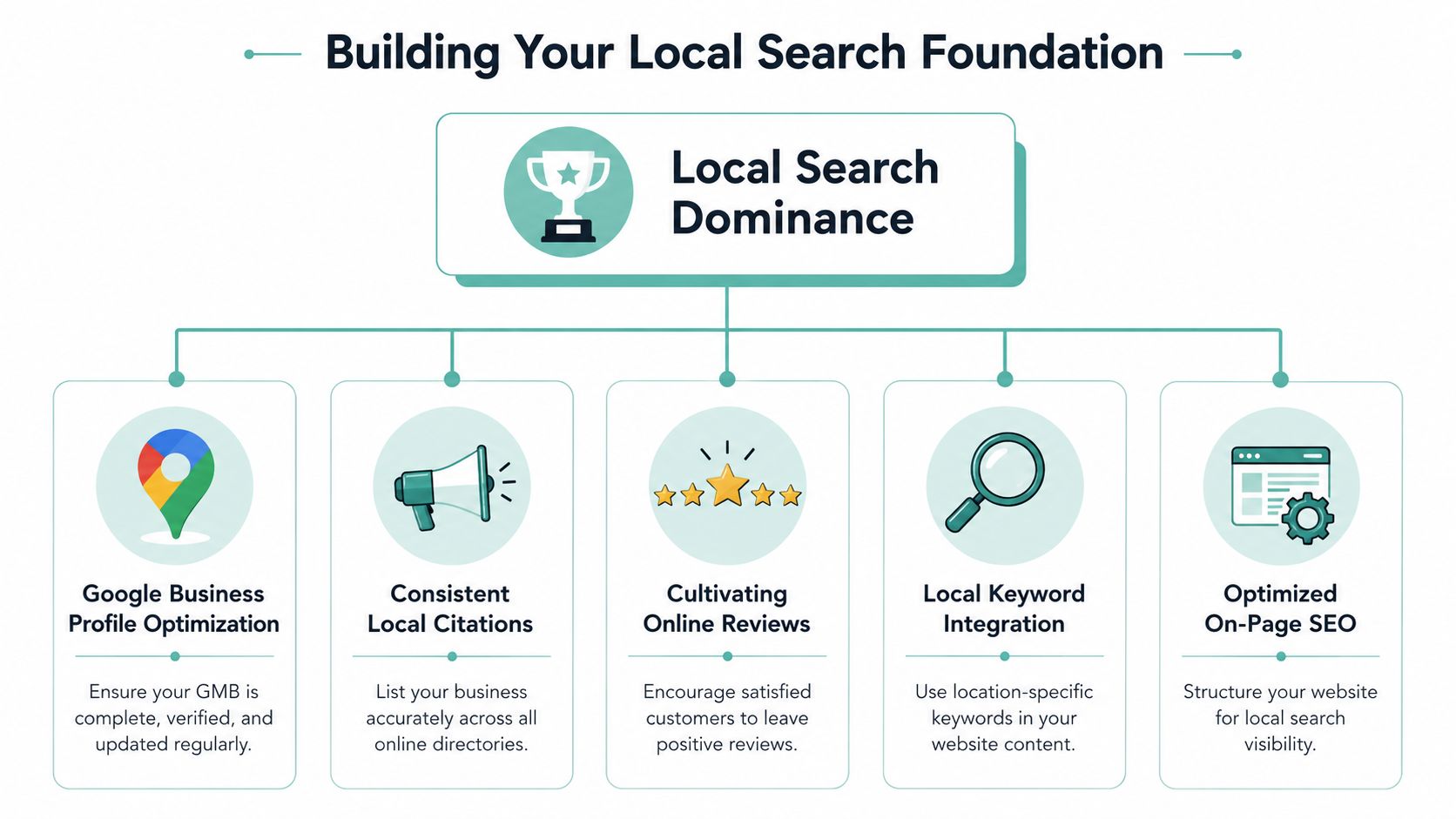
Construction websites convert in the 2.4% to 4.1% range, and mobile traffic accounts for 63% of all visits according to Construction Owners. That same source notes that firms with fully updated Google Business Profiles receive 156% more direct inquiries than those with basic listings. Local visibility isn't a side task. It's the base layer.
Why local beats broad
A contractor who tries to rank for broad terms usually wastes time. “Roof repair” means nothing without geography. “Water heater install” without a city or service area doesn't tell Google or the customer whether you can help.
Local search works because it matches intent with proximity. Someone searching “emergency plumber near me” isn't researching for fun. They need a result they can trust right now.
That trust starts with consistency:
- Google Business Profile details: Fill out categories, service areas, hours, services, and business description completely.
- NAP consistency: Your business name, address, and phone number need to match across directories like Yelp and Angi.
- Location pages: Build a separate page for each real service area you want to target.
- Mobile usability: If the site is clunky on a phone, you lose people before they call.
The local search checklist that actually moves the needle
A strong Google Business Profile does more than sit in Maps. It helps Google understand what you do and where you do it. For a roofer, that means categories aligned to roofing work, not a vague business label. For a remodeler, that means listing core services instead of assuming the homepage will do all the explaining.
Your website has to reinforce that profile. Create dedicated pages for each primary service and each primary location. A page called “Plumbing Services” is weak. A page called “Water Heater Repair in Garland” is much clearer. That page should show service details, local proof, and an obvious path to contact.
A contractor doesn't dominate local search by sounding bigger. The contractor wins by sounding specific.
If you work in roofing, this write-up on proven digital tactics for roofers is worth reading because it shows how trade-specific positioning changes what should appear on-page.
Where AI search changes the game
Traditional SEO still matters, but contractor marketing has changed. While 93% of contractors prioritize traditional SEO, existing content rarely addresses how to optimize for AI answer engines that now summarize contractor services for 40% of local search queries. Contractors can lose 35% of leads when AI answers misrepresent their services.
That's the AEO gap. If Google or another answer engine pulls the wrong summary, the customer may never click through to verify it. You lose the job before your site gets a chance.
So what helps?
- Write plainly: State exactly what services you offer, where you offer them, and what you don't do.
- Use clean page structure: Service headings, FAQ sections, and logical page hierarchy help machines extract the right answer.
- Add supporting proof: Reviews, project examples, and clear business details reduce ambiguity.
- Keep service area language honest: Don't stuff cities you don't serve.
AEO for contractors isn't mysterious. It's disciplined clarity. The contractor who explains services cleanly has a better shot at being represented correctly when AI tools summarize local options.
Your Website Is Your Ultimate Sales Tool
A homeowner finds you at 10:40 p.m. after a pipe bursts under the sink. Another finds you the morning after a hailstorm ripped shingles off the back slope. Both are ready to act. If your site makes them hunt for what you do, where you work, or how to contact you, they move on to the next contractor.
Your website does two jobs at the same time. It helps the right prospect say yes, and it helps the wrong prospect filter themselves out before your office wastes time on a bad fit.
A good contractor site sells and screens
Contractors get into trouble when the website tries to say everything at once. A plumbing company puts water heaters, drain cleaning, repipes, sewer work, remodels, and emergency service on one page. An HVAC company mixes repair, maintenance, and replacement into a single generic service block. A roofer buries insurance claim help under a broad “roofing services” headline.
That hurts conversion because the visitor cannot tell, fast enough, whether you solve their exact problem.
A stronger setup is more specific. A plumber should have separate pages for slab leaks, drain cleaning, repipes, and emergency plumbing. A roofer should separate storm damage inspections, repairs, and full replacements. If you only handle residential work, say so. If you do not service certain ZIP codes, say that too. Clear scope gets better leads because it removes guesswork before the call.
That clarity also matters for AI-driven search results. Search engines and answer engines summarize what your company does before a prospect ever clicks. If your pages blur service lines, those systems can blur them too. Good page structure, plain language, and FAQs built around real homeowner questions improve how your business gets represented. These AI content optimization techniques are useful if you want your service pages cited accurately instead of summarized poorly.
What high-converting contractor pages usually include
High-performing pages follow the same practical sequence. Confirm the job. Confirm the location. Reduce risk. Ask for the contact.
A page targeting “water heater replacement in McKinney” should not read like a company bio. It should answer the questions a serious buyer has in the first few seconds. Do you install the type of unit they need? Do you work in their area? What does the process look like? Why should they trust you in their home?
| Page element | Why it matters |
|---|---|
| Specific headline | Confirms the visitor found the right service |
| Short service explanation | Explains the job without making people scroll for basics |
| Service area details | Cuts down calls from people outside your radius |
| Proof | Reviews, photos, licenses, and warranties lower hesitation |
| Focused CTA | Gives one clear next action |
Mobile usability matters here because contractor traffic often comes from people dealing with a live problem. A homeowner with no AC in July is using one hand and a phone. Long walls of text, tiny buttons, and hard-to-use forms cost real jobs.
If your current site looks polished but does not guide people toward action, this service company website redesign guide for local growth is a useful reference. It shows how page structure, calls to action, and local proof affect performance more than cosmetic design choices.
Follow-up starts on the page
Conversion does not start after someone submits a form. It starts with the confidence your page creates before they reach out.
That is why the details matter. A strong contact form asks for enough information to route the lead properly. A commercial tenant improvement request should not go into the same bucket as a midnight toilet backup. Confirmation pages should tell people what happens next and how fast they should expect a response. If you offer emergency service, the phone number should be impossible to miss. If you book larger estimate-driven jobs, the form should help screen for job type, timeline, and service area.
The best contractor websites act like a disciplined salesperson. They answer the obvious questions, handle objections early, and make the next step easy. They also protect your schedule from tire-kickers by being direct about fit, process, and scope. That is how a website stops being a brochure and starts helping you win the right jobs.
Creating Content That Answers Customer Questions
Most contractors hear “content marketing” and think they need to become publishers. They don't. They need to answer the questions customers already ask on calls, in estimate visits, and in text messages.
That means practical content. Not generic posts about “the importance of quality.” Real questions. Real jobs. Real decisions.
Start with the questions customers already ask
If a homeowner asks your office the same question every week, that's content. If your estimator keeps explaining the same trade-off on every appointment, that's content too.
Useful contractor content often starts with topics like:
- Cost questions: “What affects the cost of sewer line replacement?”
- Problem signs: “How do I know if I need roof repair or full replacement?”
- Option comparisons: “Tank vs tankless water heater for a family home”
- Timing questions: “Can I replace an AC system before it fails completely?”
- Process questions: “What happens during a slab leak inspection?”
These pages do two jobs. They bring in search traffic, and they pre-educate people before the call. That usually makes the conversation better.
Trade examples that work in the real world
A roofer should create pages that speak to storm inspections, repair-versus-replace decisions, and material comparisons. A storm-damaged homeowner wants clarity fast. They don't want to dig through a generic company history page.
A plumber can win with content around active problems. Leak detection, water pressure issues, sewer smells, clogged drains, and water heater failure all have clear search intent. Someone looking those up is often close to booking.
An HVAC contractor has a slightly different angle. The best content often helps buyers compare repair against replacement, understand system sizing discussions, or evaluate seasonal maintenance before peak demand hits.
Good contractor content sounds like the calm estimator in the driveway, not a marketing department trying to impress another marketing department.
Visual content matters too. Before-and-after photos, local project galleries, and short explanations of what changed build credibility fast. A kitchen remodeler showing “before, during, after” tells a stronger story than three paragraphs of self-praise.
For teams thinking about how AI tools pull and cite website information, this article on AI content optimization techniques is helpful because it focuses on structure and extractable clarity. And if you're trying to find the service-specific questions that bring in narrower, high-intent traffic, this guide to long-tail SEO is a practical starting point.
Turning on the Faucet with Paid Media
A roofer can wait for SEO to mature after storm season has passed. A plumber with three trucks sitting idle on a Tuesday cannot. Paid media fills that gap, but only if the campaign is built around job value, service area, and response speed.
That last part matters more than contractors expect. If your office misses calls, takes two hours to return a lead, or sends every click to a generic homepage, paid ads will expose those problems fast.
When paid ads make sense
Paid search works best when the buyer already knows what they need and wants a contractor now. Emergency drain cleaning, AC repair during a heat wave, storm damage tarping, electrical troubleshooting, and quote-ready replacement jobs all fit that pattern. Broad awareness campaigns usually do not.
Control is the advantage. You can push harder on high-margin services, slow spend in zip codes that turn into low-value jobs, and respond to seasonality without waiting months for rankings to improve. That makes paid media useful for contractors who want to shape demand, not just collect whatever comes in.
A remodeler usually needs a different approach than a service plumber. Remodeling leads have a longer sales cycle and a bigger education burden, so broad search ads can get expensive fast. A plumber dealing with active leaks has tighter intent, shorter decision windows, and a cleaner path from search to phone call.
What contractors get wrong with ad spend
The biggest mistake is buying attention from people you would never want to dispatch a crew to in the first place. If your team works a tight radius, your ads should follow that reality. Cheap clicks from the wrong suburb still waste budget, office time, and estimator capacity.
The second mistake is weak message match. If the ad says “24/7 emergency plumber” and the landing page talks about your family-owned history, the searcher has to work too hard to confirm you solve the problem they have right now. Good paid campaigns reduce friction. They answer three questions fast: Do you handle this job, do you serve my area, and how do I reach you?
I also see contractors underprice their own time in campaign setup. They run one ad, one landing page, and broad match keywords, then assume Google will figure it out. It won't. A storm-response roofer should separate emergency tarping from full roof replacement. The first search comes from urgency. The second comes from comparison shopping, insurance questions, and scope review. Those are different clicks, different pages, and different sales conversations.
A few operating rules keep paid media from turning into expensive noise:
- Match geography to actual dispatch patterns: Build campaigns around the towns, zip codes, or neighborhoods your crews can serve profitably.
- Split services by intent: Keep emergency repair, maintenance, and replacement offers in separate campaigns so the ad copy and landing page match the search.
- Track qualified actions, not just leads: A booked estimate for sewer line replacement is worth more than three weak form fills for small handyman work.
- Test ads and pages regularly: The market changes, weather changes demand, and a headline that worked in spring may underperform in July.
Those principles line up with this contractor advertising guidance on YouTube. The advice is simple because the mistakes are simple. Too wide a radius. Too broad a keyword set. Too vague an offer.
Paid media should act like a valve, not a fire hose. Open it where margins are strong, where close rates are healthy, and where your team can deliver a good customer experience. That is how ads help you get more of the right jobs while filtering out the calls you never wanted.
Measuring What Matters Most to Your Business
A lot of contractors look at reports full of impressions, clicks, and traffic graphs and still can't answer one simple question. Did this marketing help us book better jobs?
That's the standard. Not activity. Not dashboards. Booked work from the right services in the right areas.
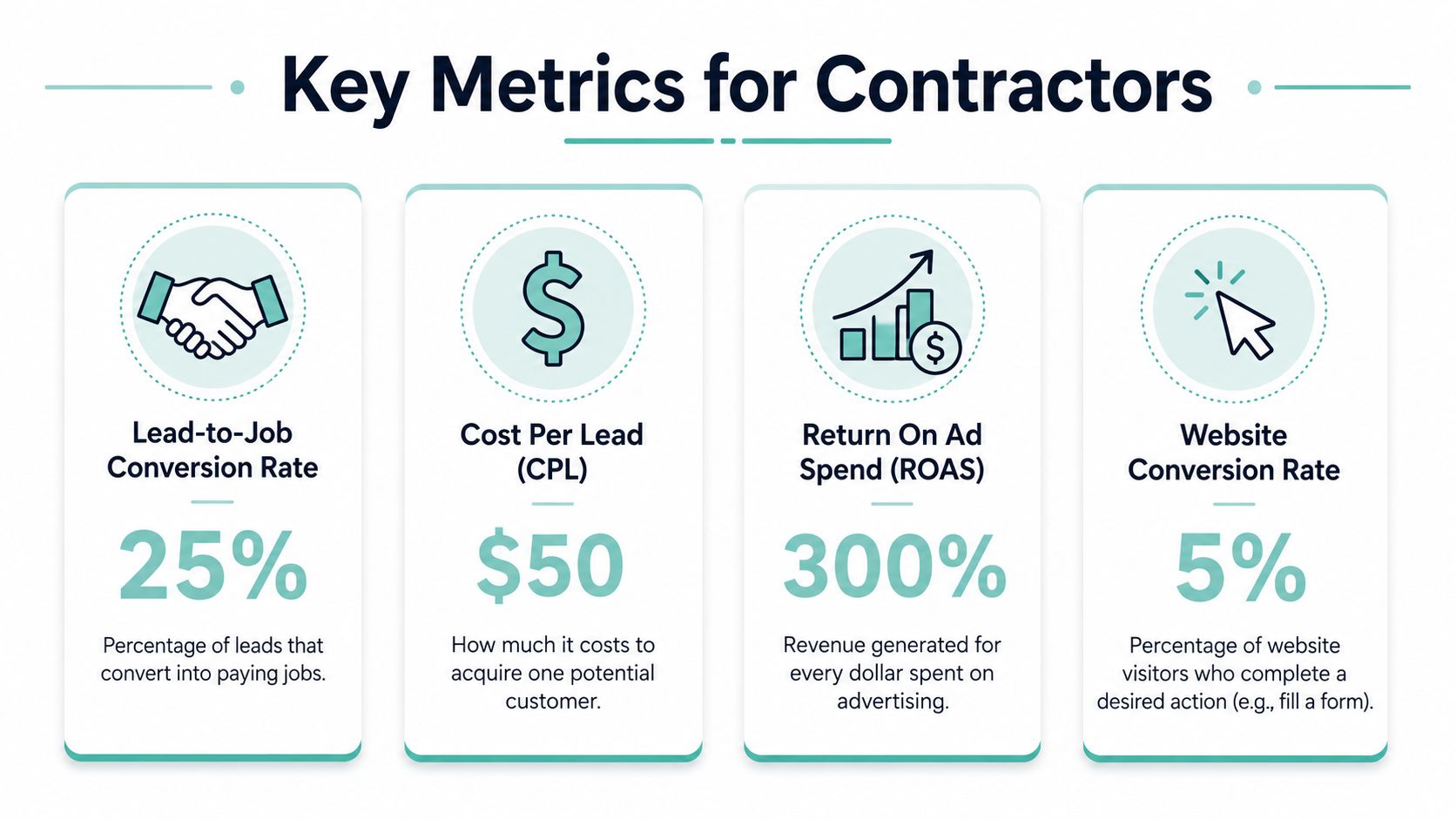
The reason SEO deserves close attention is straightforward. Leads generated through SEO close at a rate of 14.6%, dramatically outperforming the 1.7% closing rate typical of outbound marketing efforts like cold calls or direct mail, according to Incremys. That gap is why contractor reporting should stay tied to search visibility and lead quality, not vanity numbers.
Vanity metrics won't book jobs
Clicks feel measurable, but they're often misleading. A contractor can buy plenty of clicks from broad terms, loose geography, or weak-fit searchers who never had serious intent.
The same problem shows up with total traffic. If your site gets more visitors but the office keeps saying, “none of these people are qualified,” you don't have progress. You have prettier reporting.
Field test: If a metric doesn't help you decide where to put time, budget, or staff attention next month, it's probably not a priority metric.
The numbers worth watching every month
Most contractors don't need complicated analytics. They need a short list tied to revenue-producing behavior.
Focus on these:
- Qualified phone calls: Not every call. The ones tied to real service requests.
- Service-specific form submissions: Which pages bring in which kinds of jobs.
- Google Business Profile inquiries: Strong signal for local intent.
- Keyword visibility for high-intent local terms: Terms connected to buying behavior.
- Lead quality by source: Which channels produce work you want.
A roofer may discover repair pages bring in better-margin jobs than broad “roofing company” traffic. A plumber may see that location pages for older neighborhoods generate more repipe inquiries. An HVAC company may find replacement pages attract higher-value leads than generic maintenance content.
That's what good measurement does. It gives you a way to choose, cut, and double down.
Your Contractor Marketing Playbook in Action
Most contractors don't need a giant marketing overhaul on day one. They need the right sequence. When you stack the work in the right order, each piece supports the next one.
Start with local visibility and website clarity. Then build out content that answers real buyer questions. Add paid media only when the destination and follow-up process are ready. Measure the outcome by lead quality and booked jobs, not by how busy the reports look.
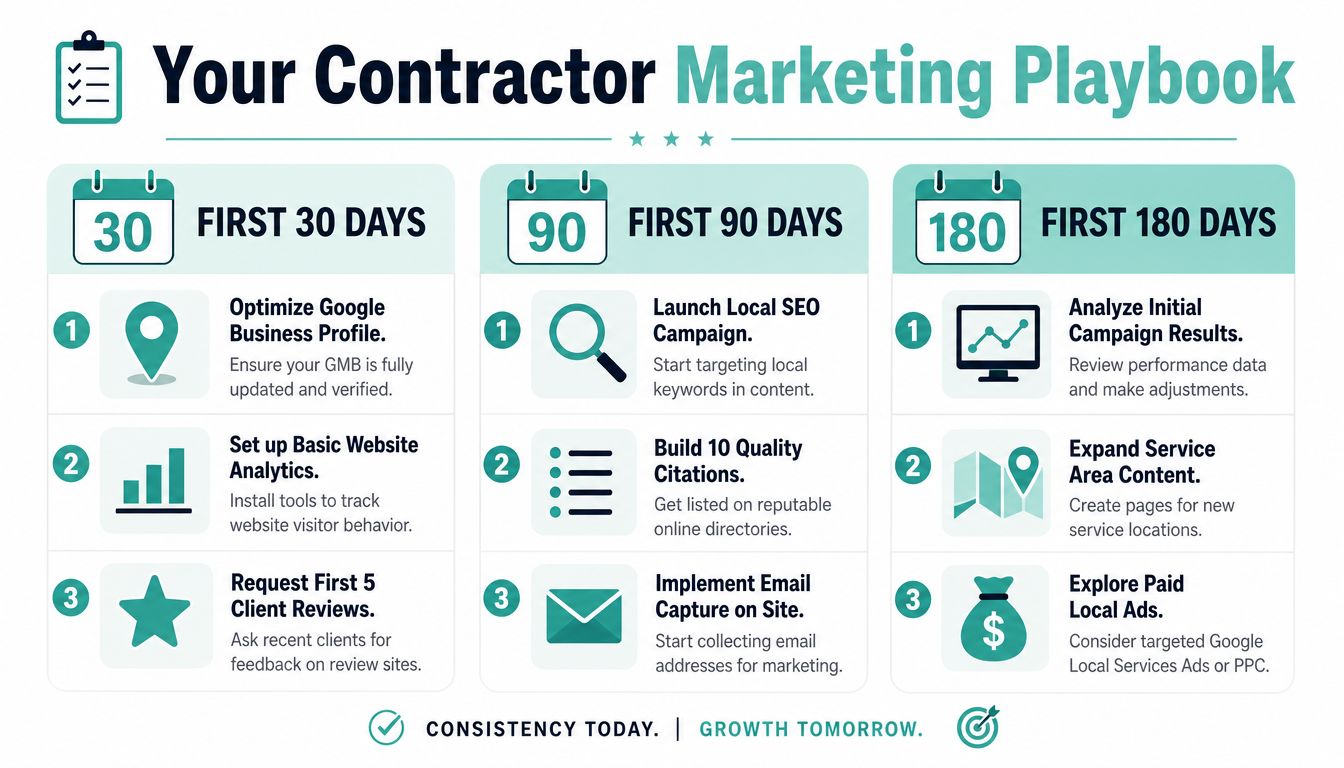
The first 30 days
The early stage is about fixing blind spots. If your Google Business Profile is thin, your site is unclear, and no one tracks what happens after a lead comes in, there's no point layering on complexity.
In the first month, concentrate on:
- Google Business Profile completeness
- Service and location clarity on the website
- Basic lead tracking for calls and forms
- A review request process after completed work
This is also when you decide what work you want more of. Emergency service, replacements, storm response, remodels, higher-ticket installs. If you don't define that up front, your marketing stays generic.
The first 90 days
By this point, the foundation should be stable enough to expand. You're no longer just cleaning up listings and page titles. You're building depth.
That usually means creating stronger service pages, publishing location-specific content, tightening trust signals, and refining conversion points based on real user behavior. If you choose to run ads, this is when geographic boundaries and landing page alignment need discipline.
A contractor that serves specific cities should look specific in every part of the digital experience. The office shouldn't be clarifying basics that the website could have handled first.
The first 180 days
Half a year is long enough to spot patterns. Certain pages will attract stronger jobs. Certain towns will produce better-fit leads. Certain service types will show weaker intent than expected.
At this stage, the playbook becomes less about setup and more about refinement:
- Expand what attracts qualified work
- Trim pages or offers that bring low-intent leads
- Improve form flows and calls to action
- Build more content around profitable service questions
- Keep review generation and response consistent
The contractors who win over time aren't always the biggest. They're often the clearest. They explain what they do, where they do it, and why a customer should trust them.
Quick Win Checklists by Trade
| Trade | Quick Win 1 | Quick Win 2 | Quick Win 3 |
|---|---|---|---|
| Roofer | Build separate pages for repair, replacement, and storm damage | Add project photos and local proof to each main service area page | Use ad targeting that matches actual storm-response territory |
| HVAC | Separate repair from replacement messaging on the site | Add trust signals near quote forms, including warranties and certifications | Publish content that answers repair-versus-replace questions |
| Plumber | Create service pages for urgent problems like leaks, drains, and water heaters | Tighten form fields so office staff can qualify the issue fast | Build location pages for the neighborhoods that generate the best service calls |
A contractor doesn't need to master every marketing channel. The smarter move is to build the channels that fit how people already buy contracting services. Local search, a conversion-focused website, clear service pages, practical content, strong review habits, and measured follow-up will outperform a scattered approach almost every time.
If you want help building a contractor website that's designed to rank, convert, and support ongoing SEO and AEO, Digital Skyrocket is worth a look. They focus on lead-generating websites, local SEO, reputation management, and conversion improvements for service companies that want better-qualified inquiries from Google, not just more traffic.