You publish service pages, answer common customer questions, and keep adding blog posts. Yet a competitor with a smaller-looking website keeps appearing for the searches that lead to calls, consultations, and quote requests. Their advantage often isn't better writing. They may cover the buyer's questions, formats, locations, and decision points that your site has missed.
Content gap analysis identifies those blind spots. It compares what your website publishes with what your audience searches for, what competitors cover, and what search engines or answer engines expect from a useful result. For a law firm, dentist, roofer, or HVAC company, that means looking beyond missing keywords and examining whether each page answers the right question in the right format at the right stage of the buying journey.
Table of Contents
- Why Your Service Business Is Missing Search Visibility
- The Four Types of Content Gaps You Need to Find
- A Repeatable Five-Step Gap Analysis Methodology
- Choosing the Right Tools for Your Gap Analysis
- Prioritizing Gaps by Business Impact and Intent Alignment
- How a Personal Injury Firm Used Gap Analysis to Grow Leads
- Next Steps for Implementing Your Gap Analysis Findings
Why Your Service Business Is Missing Search Visibility
A roofing company might have a polished homepage, a services page for roof replacement, and a handful of seasonal articles. Meanwhile, another roofer ranks for searches about storm damage inspections, insurance claims, roof repair timelines, and whether a homeowner should repair or replace a leaking roof. The first company is publishing. The second is covering the decisions customers make.
That distinction defines a content gap. It isn't merely a missing blog post. It can be a topic your audience cares about, a question your page answers poorly, an important service area you haven't addressed, or a format that searchers expect but your site doesn't provide. Keyword Insights describes content gap analysis as a process for finding topics or formats a site hasn't covered, or has covered poorly, and mapping them to user needs across the buyer journey.
The gap often sits between pages
Service businesses commonly build content around internal categories. A law firm writes about practice areas. A dental office writes about procedures. An HVAC contractor lists equipment and maintenance services. Customers, however, organize their search around situations, urgency, risk, price, location, and next steps.
A personal injury prospect may search for what to do after a collision before searching for a lawyer. A homeowner may look for signs of hail damage before looking for a roofing contractor. A patient may compare sedation options before booking a dental consultation. If your site only targets the final service term, it leaves much of the decision path uncovered.
Structured audits make that problem visible. Current guidance frames content gap analysis as a comparison between a site's actual performance and its desired performance, using URL inventories, rankings, organic traffic, word count, funnel stage, persona, and competitor coverage to identify what needs to change. MarketMuse's content gap analysis guidance places the method within a repeatable planning process for SEO, content strategy, and conversion optimization.
Local relevance changes the stakes
Local service search has a narrow commercial path. A visitor who finds a useful answer about an emergency water leak, a workers' compensation question, or a same-day dental appointment may become a lead quickly. A competitor that answers the preliminary question can earn trust before the searcher ever reaches the service comparison stage.
Practical rule: Audit the questions that happen before the phone call, not only the phrases that describe the service you sell.
A strong content gap analysis connects each missing opportunity to a location, audience need, service, and next action. It shows whether you need a new page, a better section on an existing page, a clearer comparison, or a concise answer that an AI system can extract accurately.
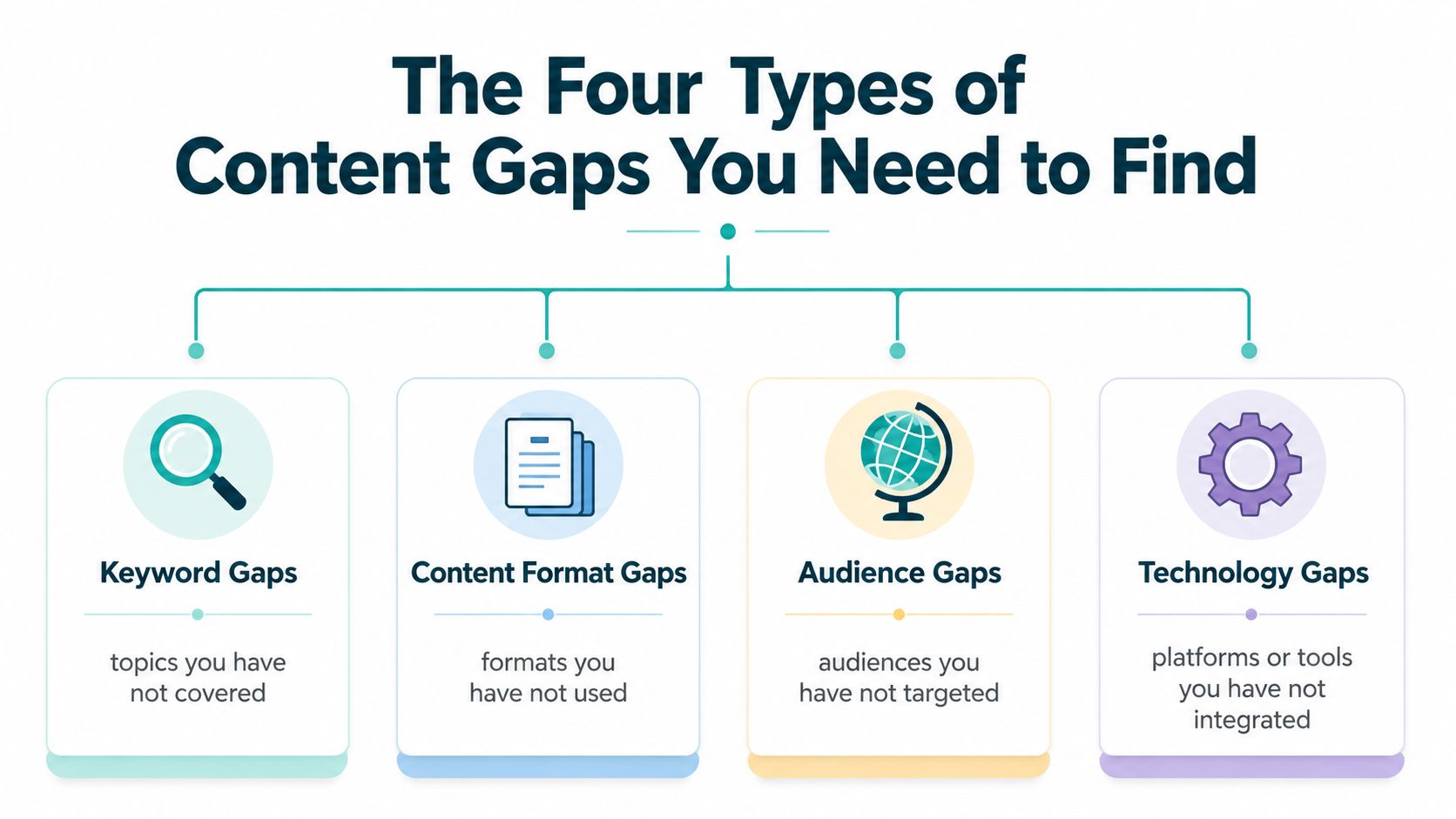
The Four Types of Content Gaps You Need to Find
Keyword gaps are the easiest to spot, which is why teams often stop there. A competitor ranks for “emergency roof repair,” your site doesn't, and the obvious response is to create a page. That response may work when the topic is genuinely absent. It won't solve the problem if your existing page targets the term but fails to match the searcher's purpose.
Keyword gaps reveal missing subjects
A keyword gap exists when your audience searches for a relevant subject and your website has no meaningful page for it. A family law firm may cover divorce but not relocation after divorce, temporary orders, or how custody decisions affect school enrollment. A roofer may offer roof replacement but never explain hail damage documentation.
The fix is usually a new resource, service page, or location page. Before publishing, confirm that the topic supports a real customer need and a logical internal link to a commercial page.
Intent gaps expose the wrong answer
An intent gap occurs when a page mentions the target topic but doesn't satisfy what the searcher wants. Search Engine Land distinguishes intent gaps from content gaps, using the difference between informational content and comparison or troubleshooting content as a practical example.
A dentist's article explaining what a crown is won't satisfy someone searching for crown alternatives. A legal guide about accident law won't answer a person asking what to do immediately after a crash. A roofer's general maintenance article won't help a homeowner deciding whether a leak requires emergency service.
Format gaps limit usability
A format gap appears when the result page favors a format your site doesn't offer. Searchers may expect a checklist, cost explanation, comparison table, instructional video, calculator, map, or visual walkthrough. A text-only page can contain accurate information and still feel inconvenient beside results that help users act.
Format should follow intent. A damage assessment checklist may work better than a long essay. A service comparison may need a table. A complex installation explanation may benefit from photographs or video, provided the page still contains clear written answers.
AI-answer gaps affect extraction and citation
An AI-answer gap exists when your page covers a subject but doesn't present the answer clearly enough for an answer engine to identify, summarize, or cite. Search Engine Land's practical framework describes gaps as including thin or outdated pages as well as pages that miss the dominant intent. The AI dimension adds another test: can a system extract a self-contained answer under a specific heading?
For a law firm, that might mean answering a common post-accident question directly before adding legal context. For an HVAC company, it could mean defining the signs of a failing system in a concise section, followed by diagnostic detail and a service call to action. Recent guidance on keyword gap analysis and AI visibility recommends evaluating semantic fit and AI citation opportunity alongside traditional keyword gaps, with recurring refreshes for active answer-engine optimization programs.
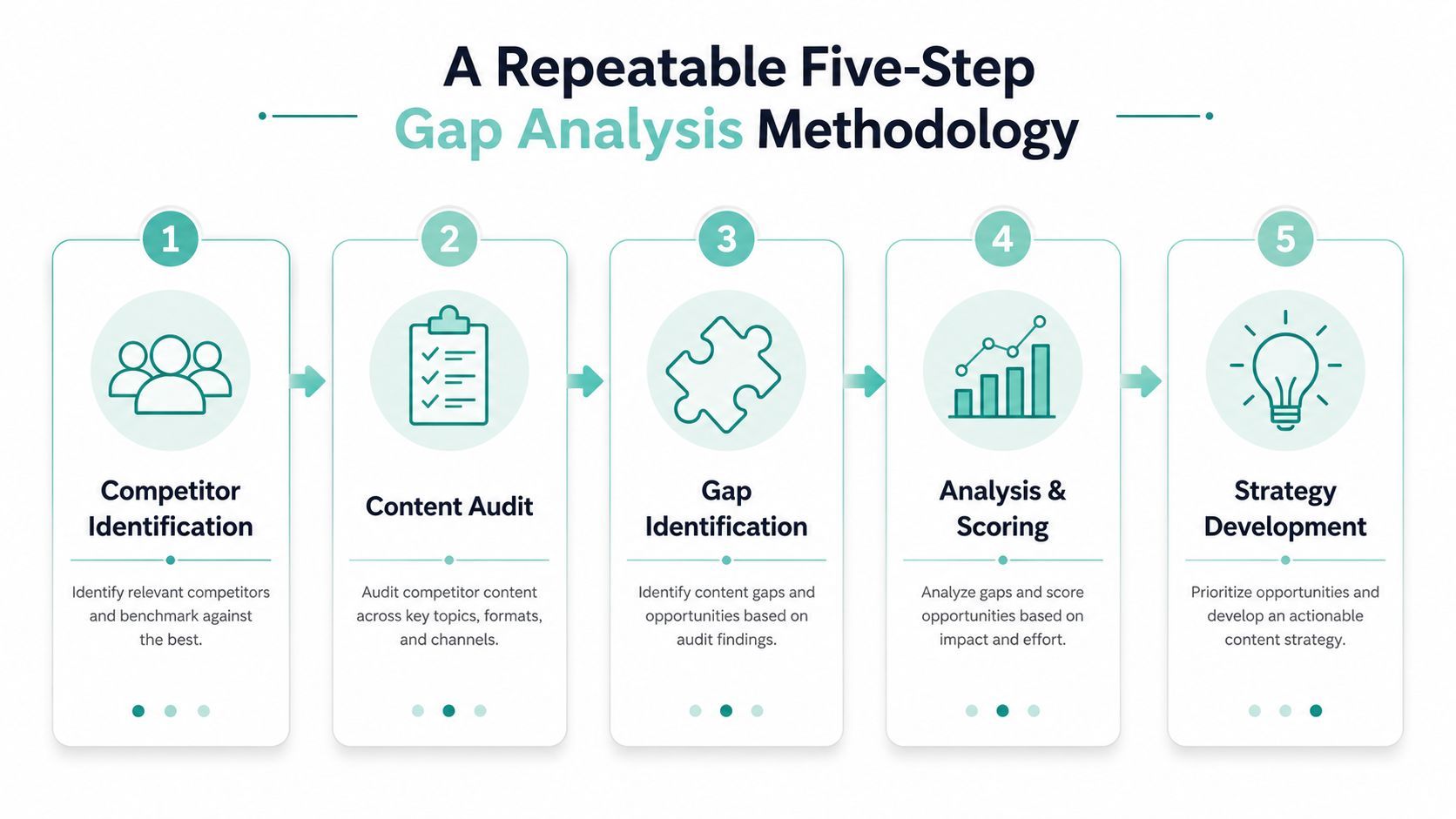
A Repeatable Five-Step Gap Analysis Methodology
A useful audit produces decisions, not a spreadsheet of loosely related keywords. Run the work in five stages, keeping every finding tied to a URL, search intent, location, and business outcome. For local service businesses, the review must also test whether a page can appear in AI-generated answers, not only traditional search results.
Step one defines the competitive set
Start with five to ten significant competitors, a range recommended by Moz before collecting competitor keywords in its content gap analysis process. Include direct competitors in your service area and aspirational competitors with particularly useful resources. Review the domains appearing for valuable local and service-related searches, even if your team has never considered those businesses competitors.
Record each domain, primary services, locations served, content strengths, and visible presence in answer-engine results. A competitor that performs well for informational searches may expose a different opportunity from one that dominates local service pages or earns citations in AI responses.
Step two gathers query and prompt evidence
Export page-level queries from Google Search Console. Add keyword and competitor data from Ahrefs or Semrush, then group the findings by topic and intent. Search Console shows the queries already generating impressions for your pages, including terms missing from prominent page copy.
Use categories such as:
- Informational: Questions, definitions, symptoms, and early research.
- Commercial: Comparisons, costs, qualifications, and provider selection.
- Transactional: Booking, calling, requesting an estimate, or hiring.
- Local: Service plus city, neighborhood, or “near me” variations.
- Urgent: Immediate problems requiring fast guidance or response.
For priority clusters, review Google results, People Also Ask questions, and AI responses. Record the answer format, cited sources, recurring subtopics, and whether your business or pages appear. A local plumber, for example, may need to address a short emergency question before presenting detailed service information.
Step three audits each meaningful URL
Create a content inventory with one row per URL. Include page type, service, location, persona, funnel stage, primary topic, supporting queries, organic traffic, rankings, bounce rate, time on page, backlinks, social shares, and conversion rate when those metrics are available. These are common audit measures for finding weak coverage and prioritizing fixes, as documented in Backlinko's content gap analysis guide.
Prioritize pages by business role. A service page with strong impressions but few qualified inquiries needs a different response from an old article unrelated to your core services. Also check whether headings and answer blocks state the information an answer engine could extract without reconstructing the response from several paragraphs.
Step four compares competitors with customer language
Overlay your inventory with competitor topics, local questions, sales-call notes, support requests, reviews, and the wording customers use. Mark each opportunity as missing, weak, outdated, duplicated, or misaligned.
A competitor page proves that a topic has coverage, not that copying it will win. Examine its angle and usefulness, then identify a stronger local example, clearer explanation, better answer structure, or shorter route to contacting the business. Customer questions often reveal gaps competitors have also missed.
Step five scores intent alignment
For each important page, compare its language and structure with the dominant query cluster. One expert method assigns an intent gap score from 0 to 100, based on how closely a page's meta description and content language match high-demand query clusters, as explained in Search Engine Land's Search Console intent-gap method.
The score supports prioritization; it does not guarantee rankings. A page with high impressions and weak alignment is often a rewrite candidate. If the dominant intent requires a format the page cannot provide, create a new URL instead. Repeat the audit quarterly, and refresh priority clusters more often when local demand or AI search results change quickly.
Choosing the Right Tools for Your Gap Analysis
No tool can decide whether a missing topic deserves a page. Tools collect evidence. Your team still has to judge service relevance, local intent, page quality, and the next conversion step.
| Tool | Best For | Local SEO Support | Intent Clustering | Price Range |
|---|---|---|---|---|
| Google Search Console | Existing query and page performance | Limited, requires manual local filtering | Manual or external clustering | Free |
| Ahrefs | Competitor keywords, backlinks, and ranking comparisons | Useful for location-based keyword research, limited map analysis | Requires workflow or supporting tools | Paid subscription |
| Semrush | Keyword Gap, competitor research, and broader visibility analysis | Strong keyword comparison, local features depend on plan and setup | Useful clustering and topic workflows | Paid subscription |
| Moz | Straightforward competitor keyword research | Practical for local SEO users, less expansive than specialist local platforms | More manual than dedicated content systems | Paid subscription |
| MarketMuse | Topic coverage, content depth, and planning | Limited local-specific data | Strong topic and coverage analysis | Paid subscription |
Match the platform to the decision
Search Console should be the starting point for nearly every site because it reveals real impressions and queries connected to your pages. It won't provide a complete competitor view, and it won't automatically explain why a page misses intent.
Ahrefs is strong when backlinks, competitor pages, and organic keyword overlap matter. Semrush works well for broad competitive research and repeatable keyword-gap exports. A typical workflow can include your domain plus competitor domains, followed by a CSV review, a process also described by WebTonic's SEO content gap workflow.
Moz suits teams that want a simpler competitive baseline. MarketMuse is more valuable when a larger content operation needs topic coverage and editorial planning, but a small local business may find the analysis heavier than the website requires.
A paid platform is justified when it shortens a recurring research process and produces decisions your team can execute. It isn't justified merely because its keyword database is large.
For a small service site, start with Search Console, competitor SERP reviews, customer questions, and a manageable spreadsheet. If you need help turning that evidence into low-competition keyword opportunities, use a specialist workflow rather than buying every platform at once.
Prioritizing Gaps by Business Impact and Intent Alignment
A backlog of promising topics can still produce poor results if the team publishes the easiest ideas instead of the most valuable ones. Prioritization should answer three questions: Does this support a service? Does it match a real search need? Can the business create a credible result?
Start with business impact. A query about emergency plumbing, a consultation-ready legal issue, or a high-value replacement service usually deserves more attention than a loosely related educational topic. Assess how naturally the page can connect to a service, location, proof point, and conversion path.
Then inspect demand and competition qualitatively. Use Search Console impressions, keyword tools, trend direction, competitor strength, and the quality of current results. Monthly search volume can inform the decision, but it shouldn't override strong local relevance or clear commercial intent.
Rewrite before creating
Pages with high impressions and weak intent alignment often represent the fastest opportunity. If a service page appears for comparison searches but only describes your company, add the comparison information searchers need. If an informational article attracts users looking for an urgent next step, place the direct action and safety guidance where the visitor can find it immediately.
Create a new page when the existing URL cannot satisfy the dominant intent without becoming confusing. Don't force every query into one oversized page. A clean architecture usually serves both users and search engines better than a single page that tries to answer every variation.
Add AI-answer opportunity to the score
AI search visibility introduces another prioritization signal. Review whether answer-engine results favor concise definitions, direct recommendations, FAQs, checklists, examples, or cited explanatory pages. A page can rank for a phrase and still fail to provide the answer format users receive in an AI response.
Make important sections self-contained:
- Direct answer: State the answer beneath the relevant heading.
- Supporting detail: Explain exceptions, process, risk, or local context.
- Evidence and experience: Add original examples, first-party information, or specialist input when available.
- Next step: Connect the answer to an appropriate service action.
Market opportunity assessment can help teams evaluate whether a gap represents a real market opening rather than an attractive but weakly connected keyword.
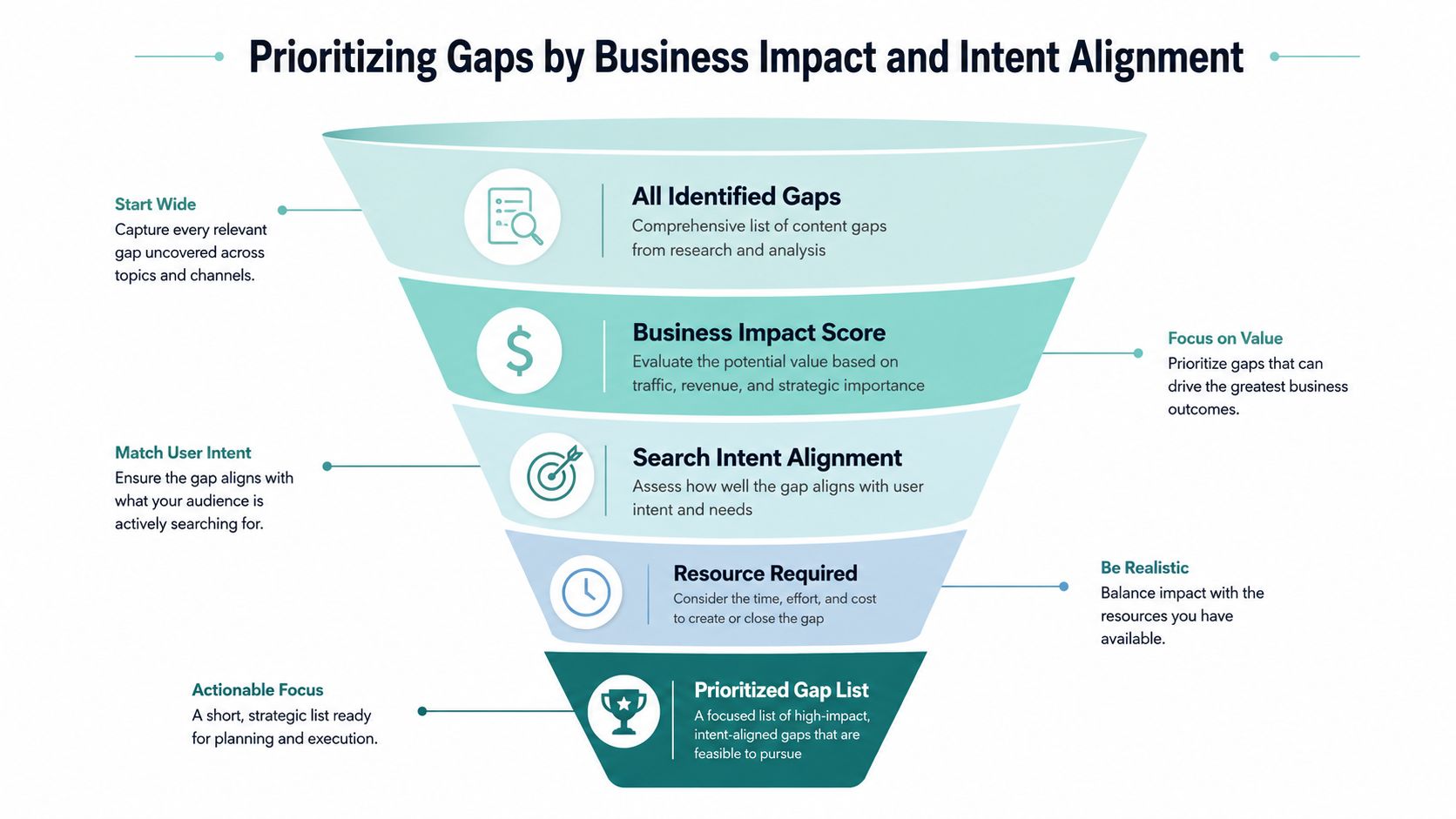
Use a simple scorecard with fields for business relevance, intent fit, local value, competitive feasibility, AI-answer opportunity, and production effort. The exact weighting should reflect your business. What matters is that every proposed page has a reason to exist and a measurable outcome to monitor.
How a Personal Injury Firm Used Gap Analysis to Grow Leads
Consider a personal injury firm serving Texas that noticed competitors appearing for searches such as “truck accident lawyer near me” and “what to do after a car accident in Texas.” Its existing blog contained useful general legal information, but the content didn't reflect the specific questions people ask immediately after an accident or while comparing attorneys.
The audit found three distinct problems. First, the firm had a local intent gap because its general accident articles didn't provide location-specific guidance. Second, service pages lacked a structured FAQ format with concise answers to common questions. Third, the site didn't address comparison queries that potential clients use before choosing a firm.
The content decisions
The firm created location-specific accident guides that connected practical post-accident steps with relevant legal considerations. It restructured service pages so each important question received a direct answer before deeper explanation, and it developed a comparison-oriented content hub covering how prospective clients evaluate personal injury firms.
The work also improved the relationship between informational pages and commercial pages. A visitor reading about a truck collision could find the relevant service, local context, consultation path, and supporting answers without returning to a generic practice-area page.
This example is a planning illustration, not a claim of measured client performance. The important lesson is the decision sequence: identify the missed intent, determine whether an existing page can be rebuilt, create new local resources where necessary, and make the answers easier for both readers and answer engines to interpret.
The strongest legal content doesn't merely explain the law. It helps a worried person understand what to do next and why the firm's service is relevant.
Track organic impressions, rankings, qualified consultation requests, calls, forms, and the pages associated with those actions. AI visibility deserves a separate observation log because appearing in an answer, receiving a citation, and generating a visit are different outcomes.
Next Steps for Implementing Your Gap Analysis Findings
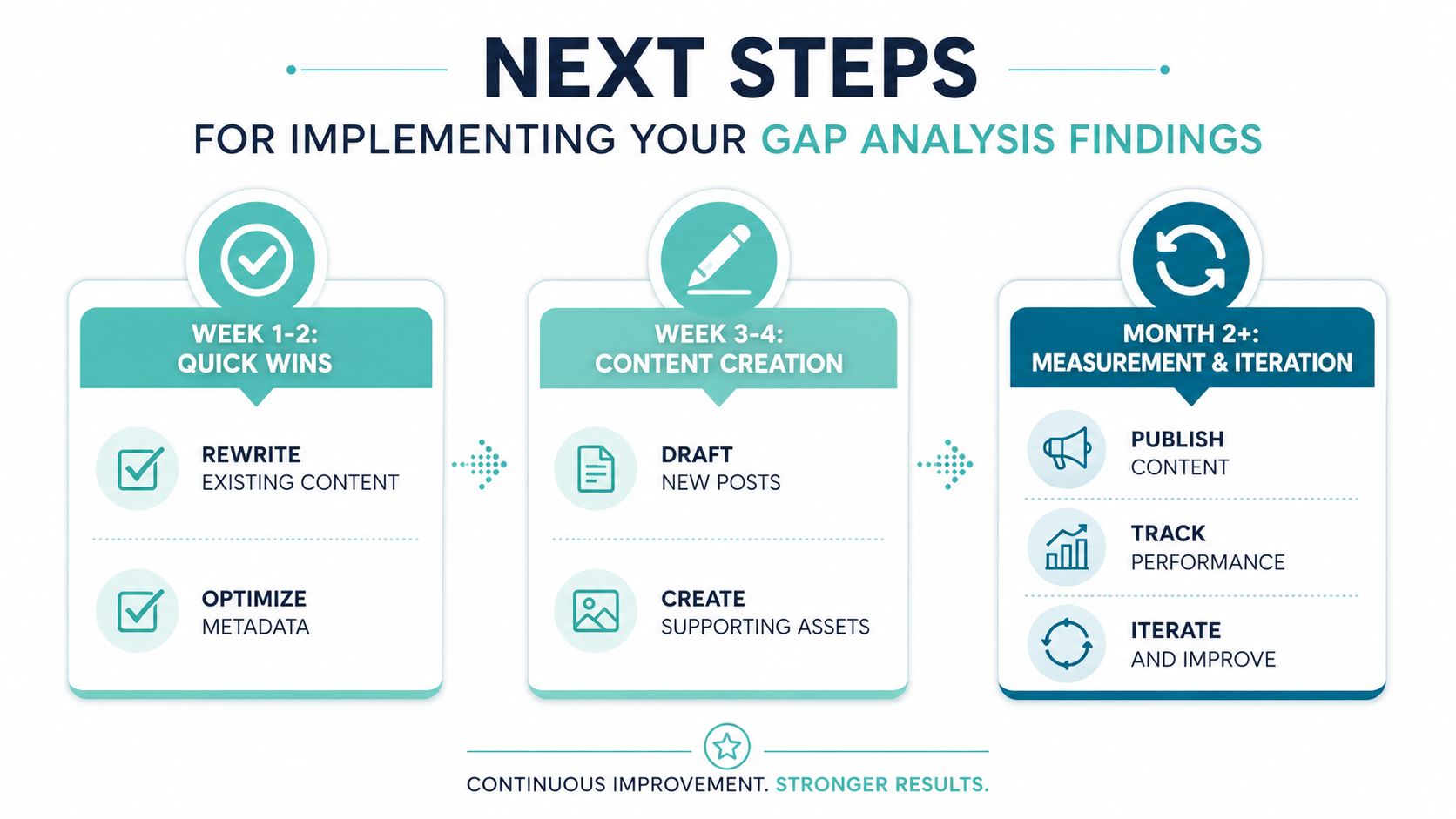
Turn the audit into a short execution list rather than a large editorial backlog.
- Week 1 to 2: Rewrite pages with clear intent mismatches, improve headings and metadata, add concise answers, strengthen internal links, and clarify calls to action.
- Week 3 to 4: Create missing service pages, location-specific guides, comparison resources, and supporting assets based on the highest-priority gaps.
- Month 2 onward: Monitor rankings, impressions, organic visits, lead activity, and AI mentions or citations. Refresh pages when search intent, competitor coverage, or answer formats shift.
A capable in-house team can handle the work when someone owns research, writing, implementation, and measurement. An agency becomes useful when the business needs a full content hierarchy, competitive benchmarking, website changes, local SEO, answer-engine optimization, conversion improvements, and ongoing reporting rather than isolated articles. A professional engagement should define discovery sessions, page strategy, on-page development, technical implementation, analytics instrumentation, and an iteration process before production begins.
For a broader lead-generation approach, review content marketing for leads and turn each approved gap into a page brief with a target audience, intent, service connection, local relevance, format, internal links, and success metric.
Digital Skyrocket helps service businesses plan, build, optimize, and improve lead-generating websites through technical SEO, local SEO, answer engine optimization, and conversion-focused content strategy. Visit Digital Skyrocket to explore a structured discovery process for finding the content gaps that can turn search visibility into qualified inquiries.