Your site gets visitors. Maybe your Google Business Profile shows some activity. A few blog posts are indexed. But the phone doesn't ring enough, the form submissions are thin, and the leads you do get often aren't a fit.
That's the problem most service businesses have. Not a traffic problem. A conversion problem tied to the wrong content.
For lawyers, roofers, dentists, and other local service companies, content marketing for leads isn't about publishing generic advice pieces and hoping someone fills out a download form. It's about building pages that answer the exact questions people ask right before they hire. It's about matching search intent, trust signals, and calls to action so a visitor becomes a caller.
Table of Contents
- Why Your Website Needs More Than Just Traffic
- Building Your Lead Generation Content Strategy
- Creating Content That Converts Visitors Into Callers
- Optimizing for Google and AI Answer Engines
- Promoting Content to Win the Local Market
- Measuring What Matters and Your Quick-Win Checklist
Why Your Website Needs More Than Just Traffic
A lot of business owners still treat content like a side project. They publish a blog post when someone has time, pick a broad topic, and call it SEO. That approach usually creates pages that rank for loose informational searches but don't produce many inquiries.
That's why content marketing for leads has to start with a different standard. Every page should either attract a qualified prospect, move that prospect closer to contact, or support a page that does.
According to B2B Digital Marketers' roundup of content marketing benchmarks, content marketing is 3 times more efficient in generating leads than outbound marketing and costs 62% less per lead. The same source notes that companies publishing 16 or more blog posts per month see 4.5 times more leads than those publishing less often. For a service business, the lesson isn't “publish more random articles.” It's that a structured content engine compounds, while interruption-based marketing resets every time you stop spending.
Traffic without intent is a vanity metric
A roofer doesn't need more visitors who searched “how are shingles made.” A personal injury firm doesn't need students looking for a definition of negligence for a class paper. A dentist doesn't need broad traffic from someone outside the service area reading a cosmetic dentistry trend article.
They need pages tied to hiring intent. Searches like:
- Cost-focused queries such as “roof replacement cost in Dallas”
- Comparison queries like “dental implant vs bridge”
- Decision-stage queries such as “how to choose a personal injury lawyer”
- Service-location combinations like “emergency dentist in Tyler”
Those searches produce better conversations because the visitor already knows the problem and wants help.
Practical rule: If a page can't reasonably lead to a call, form fill, or internal click to a service page, it's probably not helping your pipeline.
Content works when it behaves like a salesperson
The best-performing service content doesn't feel like blogging. It feels like a well-trained intake person who answers the right question, builds confidence fast, and tells the prospect what to do next.
That means your content should do four jobs:
| Job | What it looks like on the page |
|---|---|
| Clarify the problem | Plain-English explanation of the issue and what the visitor should watch for |
| Show fit | Service area, type of cases or jobs handled, and who the service is for |
| Reduce friction | Cost info, timeline expectations, FAQs, and next steps |
| Prompt action | Call button, short form, and contextual CTA before the footer |
A good-looking site without this structure is just a brochure. A lead-focused site uses content to pre-qualify, persuade, and direct action all day, every day.
Building Your Lead Generation Content Strategy
The strategy starts before anyone writes a headline. If you skip the planning and jump straight into content production, you usually end up with disconnected articles that don't support your service pages or your sales process.
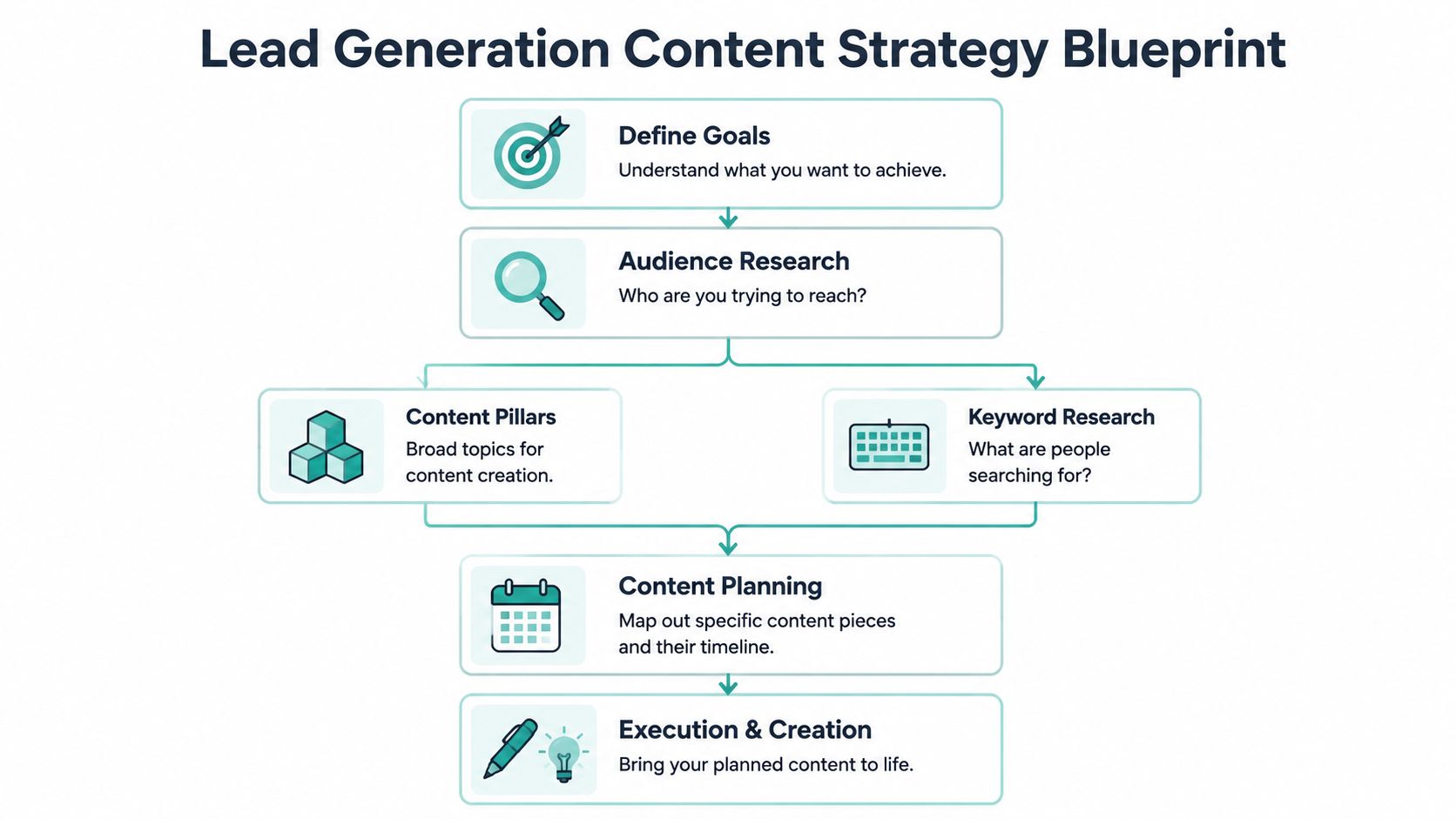
The reason businesses invest in content is clear. According to E2M Solutions' content marketing facts roundup, 85% of organizations prioritize lead generation as the main goal of content marketing, ahead of sales and lead nurturing. That lines up with how service businesses should think about content. Not as a publishing calendar first, but as a lead system first.
Start with the jobs your clients need done
Strongest content plans begin with real-world questions prospects ask before they hire. For a law firm, that may be liability, timing, evidence, or case value. For a roofing company, it may be storm damage, insurance, repair versus replacement, or pricing. For a dental practice, it may be pain, urgency, treatment options, and cost.
Build your strategy from those themes:
List your core services
Start with the services that drive the most revenue or the best-fit clients. Don't bury these under vague category pages.Write down buying questions
Pull these from intake calls, contact forms, Google Search Console queries, sales notes, and front-desk conversations.Separate urgency from curiosity
“What to do after a car accident” is closer to action than “history of personal injury law.” “How much does a roof replacement cost” is stronger than “types of roofing materials.”Assign an action goal to each page
Some pages should drive calls. Others should push users into a service page. Some should support intake through FAQs.
Build around pillar pages and supporting content
Most service businesses need a simple hierarchy, not a giant content maze. The center of the site should be pillar service pages. Those pages target the main service and location combinations that matter commercially. Supporting articles should strengthen those pages, answer adjacent questions, and pass relevance through internal links.
A practical structure looks like this:
Pillar pages
Main service pages such as personal injury lawyer, emergency roof repair, or dental implants.Support pages
Cost pages, comparison pages, FAQ pages, and “what to do next” articles tied to the pillar.Local proof content
Service-area pages, neighborhood pages where appropriate, and localized examples that show experience in the market.
If you're mapping keyword themes, a useful reference on narrowing topic targets is this guide to long-tail SEO for service businesses. It's a good model for turning broad categories into specific, intent-driven content opportunities.
A content calendar should follow the sales path. If it doesn't help a prospect understand the problem, trust the provider, or take the next step, it's noise.
Use email follow-up without making content carry the whole burden
Email still matters, especially for estimate follow-up, consultations, intake reminders, and reactivation. But many teams make the mistake of forcing every page to capture an email before giving the answer. That's where content plans break.
A better setup is simple. Let high-intent pages convert immediately, then use email after the person raises a hand. If your internal process needs a stronger follow-up sequence, this email strategy guide for professionals is a useful companion to a lead-focused content system.
Creating Content That Converts Visitors Into Callers
Generic advice says every strong piece of content needs a lead magnet. For local service businesses, that's often wrong.
A person dealing with a leaking roof, a criminal charge, or a broken tooth usually doesn't want a downloadable checklist. They want a direct answer, proof that you handle this problem, and a quick way to contact you.

Why gated content often fails for local service intent
For local, high-intent searches, friction kills conversions. According to UseInstant's analysis of content marketing for lead generation, 72% of users abandon sites with gated content for queries like “personal injury lawyer Texas” because they want immediate answers, not delayed downloads. The same source notes that the highest-performing content for these searches centers on clear CTAs and instant contact forms.
That matches what works in practice. If someone searches with urgent intent, gating the answer tells them your process is slower than the problem they're trying to solve.
Here's the trade-off:
| Approach | Usually better for | Usually worse for |
|---|---|---|
| Gated asset | Longer sales cycles, broader B2B nurture paths | Urgent local services, mobile users, immediate-contact scenarios |
| Ungated page with CTA | Lawyers, roofers, dentists, HVAC, emergency services | Audiences looking for deep research before any contact |
The pages that actually drive calls and form fills
High-converting service content usually sits near the bottom of the funnel. It addresses questions people ask when they're comparing providers or deciding whether to call.
These page types consistently do the job:
Cost pages
Examples include “How much does roof replacement cost in Dallas?” or “What does a dental implant cost?” These pages reduce uncertainty and qualify buyers.Comparison pages
“Roof repair vs replacement,” “veneers vs bonding,” or “settlement vs trial” pages help users make a decision without leaving your site.What to do now pages
These work well for urgent searches. Think “What to do after hail damage,” “What to do after a car accident,” or “What to do if you crack a tooth.”Service FAQs
Tight answers to practical objections. Insurance, timing, pain, recovery, scheduling, financing, and process questions belong here.
Put the contact option where the doubt appears. If a visitor hits a cost concern halfway down the page, that's where the CTA belongs.
A few content rules matter more than clever writing:
- Answer the query early so the visitor doesn't have to hunt for the point.
- Use local references where relevant, especially city names, service areas, and context tied to the job.
- Keep forms short. Name, contact info, and the essentials are enough for most first touches.
- Repeat the CTA naturally. Call, schedule, request an estimate, or start a consultation.
Content marketing for leads serves a practical purpose. The page isn't trying to win an award. It's trying to help a prospect make contact while the intent is still hot.
Optimizing for Google and AI Answer Engines
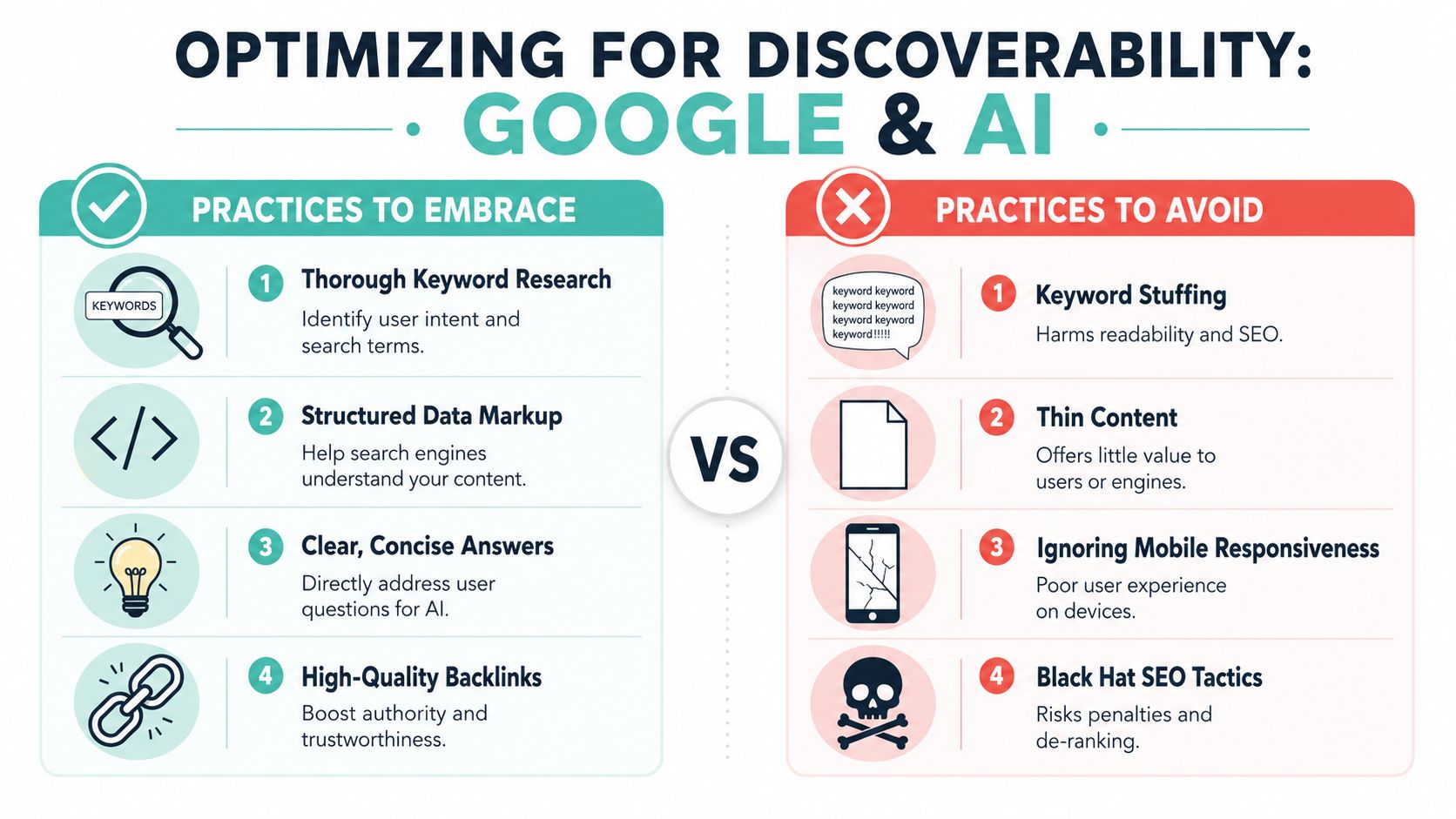
Ranking content today takes two layers of thinking. The first is traditional SEO. The second is formatting content so AI-driven results can extract and surface it.
Most businesses still only work on the first layer. According to Data Hunters Agency's write-up on content marketing for leads, 78% of B2B marketers still optimize only for traditional Google search while ignoring how AI overviews suppress click-through rates. That same source points to the new priority: creating extractable data blocks that answer engines prefer to cite.
Traditional SEO still matters
AEO doesn't replace search optimization. It sharpens it.
For service companies, the basics still include:
- Targeting one primary topic per page
- Using clean title tags and headings
- Matching search intent instead of forcing a keyword
- Linking support content back to core service pages
- Keeping the site architecture organized
If your site structure is messy, content struggles to rank and users struggle to find their way. A clean planning model like this sample sitemap for a website shows how to keep services, locations, and support content from competing with each other.
AEO changes how you structure the page
Answer Engine Optimization is less about stuffing in AI language and more about making your page easy to parse.
That means using formats machines and humans can both read quickly:
- Direct question-and-answer blocks near the top of the page
- Short paragraphs that state a clear conclusion
- Bulleted lists for steps, requirements, or options
- Tables for comparisons
- Schema and structured page elements where appropriate
- Service pages that state who the service is for, what happens next, and how to contact you
For example, a roofer's page about storm damage shouldn't open with a long company story. It should answer what storm damage looks like, whether temporary mitigation is needed, how insurance usually fits into the process, and how to request an inspection. A law firm page should define the issue, explain when to act, outline likely next steps, and present an intake path.
AI systems pull clean answers. People hire the company that makes the next step obvious.
The important shift is this. Don't build all educational content as isolated blog posts. Build AEO-friendly service assets that satisfy the answer and still give the visitor a reason to contact you. That's especially important for decision-stage searches where someone is evaluating providers, not just learning vocabulary.
Promoting Content to Win the Local Market
Publishing a strong page isn't enough. Local visibility improves when you push that content into the channels and signals that reinforce service relevance in your market.
For service companies, that doesn't usually mean chasing every social platform. It means strengthening the assets that affect local search trust and local conversion paths.
Use local distribution channels that affect search visibility
One of the fastest ways to get traction is to pair content with your Google Business Profile. Turn a useful article into a post. Use cost pages, FAQ content, and seasonal service advice to support your local presence. If you've published a page about hail damage, insurance timelines, or emergency dental care, that's the kind of material worth surfacing there.
Content also performs better when it's tied to realistic keyword opportunities. According to Qualent Media's lead generation content guidance, for quicker ranking wins in service-industry SEO, you should prioritize keywords with a difficulty score under 40 and at least 200 monthly searches. The same source says that contextual CTAs inside content outperform footer-only CTAs by 2x to 3x in click-through rate.
That should affect both promotion and page editing. If you're sending traffic to an article from your Google Business Profile, local email list, or partner referral, don't make the only call to action sit in the footer. Put it near the sections where the visitor is making a decision.
Push authority toward money pages
A lot of sites accidentally build authority around blog posts while their service pages stay thin and underlinked. That's backwards.
Use internal linking with intent. When a support article earns visibility, pass that attention to the page that drives the inquiry.
A simple local promotion playbook:
Publish a service-supporting article
Example: “Signs hail damage requires roof replacement.”Link it to the related service page
Send readers to roof replacement, storm repair, or inspection request pages with relevant anchor text.Reuse it in local assets
Google Business Profile posts, newsletters, sales follow-up, or community partner mentions.Look for local link opportunities
Supplier websites, chambers, associations, local publications, and neighborhood organizations often make more sense than generic directory blasts.Refresh your best pages
Add stronger examples, better FAQs, and more visible CTAs rather than constantly publishing net-new content.
This is how a service business wins a local market. Not by being everywhere, but by making core pages stronger and easier to discover.
Measuring What Matters and Your Quick-Win Checklist
Most reporting dashboards overvalue traffic and undervalue pipeline. For a service business, the cleanest question is simple: which pages produce qualified conversations?
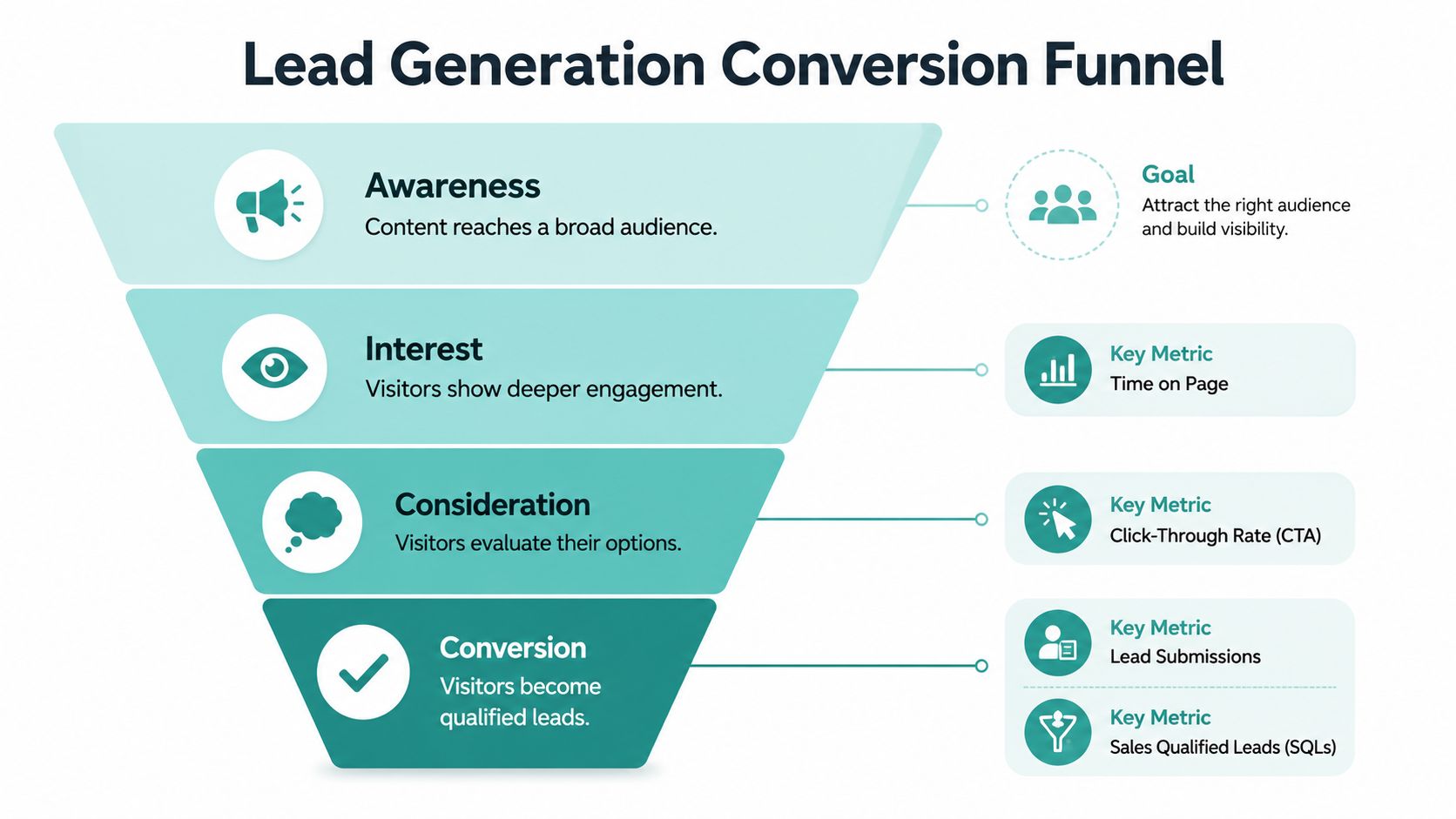
The two most useful content metrics are clear. According to Causal Funnel's lead generation tactics article, leads per post and MQL conversion rate are the core measures for content-led growth, tracked through a stage-by-stage dashboard. The same source warns against common mistakes such as gating awareness-stage content and hiding CTAs at the bottom of the page, which reduces CTR by 2 to 3 times.
Track outcomes, not pageview trophies
A useful dashboard for content marketing for leads should tie content to movement through the funnel.
Track metrics like these:
Leads per page or post
Which URLs actually generate calls or form submissions?MQL conversion rate
Which pages produce the right type of lead, not just any lead?Service-page assisted conversions
Which articles help move users into the pages where they convert?CTA click behavior
Which in-content prompts get attention, and which are being ignored?
If you serve local businesses, align these metrics with your service categories and locations. A broad article may attract visits, but a specific cost page or emergency service page may drive valuable inquiries. That distinction matters.
For teams building a stronger operating system around local search, this overview of marketing for service companies is useful for thinking through how website structure, SEO, and conversion work together.
A quick-win checklist for the next seven days
You don't need a full content overhaul to get movement. Start with the pages that already have intent.
Upgrade your top three service pages
Add one direct CTA above the fold, one in the middle of the page, and one near the end.Remove gates from high-intent local pages
If the page targets urgent or decision-stage searches, let people get the answer and contact you immediately.Publish one cost or comparison page
These topics often reveal stronger buyer intent than broad educational posts.Turn one article into a Google Business Profile post
Reuse what you already have instead of waiting on a brand-new campaign.Review your internal links
Make sure supporting content points toward the service pages that matter most.
The best quick win is usually not “publish more.” It's “make your existing high-intent pages easier to act on.”
If you want a website that brings in qualified leads instead of just traffic, Digital Skyrocket builds and optimizes lead-generating sites for service businesses that need stronger performance from Google and AI search. They focus on web design, local SEO, AEO, and conversion improvements for firms and contractors that want more calls, form fills, and better-fit inquiries.