
Your website probably already has the symptoms of a weak sitemap, even if no one has called it that yet. Service pages sit three clicks deep, location pages feel bolted on, blog posts drift without purpose, and the contact page does too much of the selling because the rest of the site doesn't guide people well. Google can still crawl some of it, but that doesn't mean the structure is helping you win.
A strong sitemap fixes that. It gives visitors a clear path, gives search engines a clean hierarchy, and gives your team a blueprint before design and development start. That's why I treat a sample sitemap for website planning as more than a technical deliverable. It's where SEO, AEO, and lead generation start to line up.
A poorly planned sitemap is like building a house without blueprints. Visitors get lost, important rooms are hard to reach, and search engines waste time trying to figure out what's connected to what. If you're launching a website effectively, the sitemap is one of the few decisions that affects everything downstream.
This guide gives you 8 battle-tested sitemap models for service businesses. Each one is built for real companies like law firms, roofers, HVAC contractors, and dental practices that need more than a pretty site. They need a structure that attracts qualified traffic and turns visits into inquiries.
Table of Contents
- 1. Hierarchical Sitemap for Service-Based Websites
- 2. Lead Generation Conversion Funnel Sitemap
- 3. Geographic Service Area Sitemap
- 4. Technical SEO and Performance Sitemap
- 5. Content Pillar and Topic Cluster Sitemap
- 6. Answer Engine Optimization AEO Sitemap
- 7. Reputation and Social Proof Sitemap
- 8. Lean Conversion-Focused Sitemap
- 8 Sitemap Strategies Compared
- Choosing the Right Sitemap for Your Service Business
1. Hierarchical Sitemap for Service-Based Websites
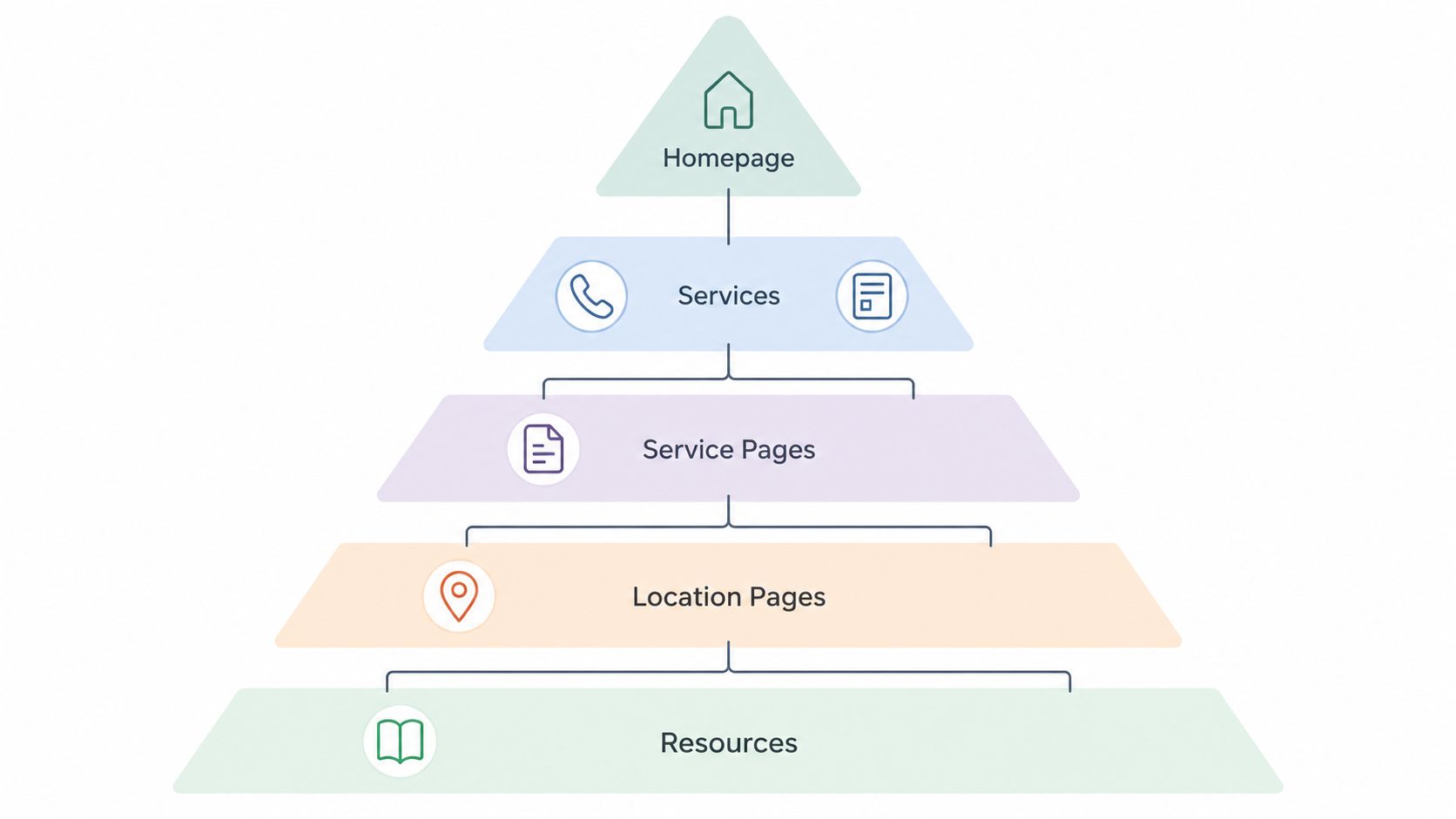
This is the safest starting point for most service companies. Homepage at the top. Service category pages beneath it. Individual services below that. Then location pages and supporting resources connected in a way that doesn't bury money pages.
A law firm might structure it like this: Home → Practice Areas → Personal Injury → Car Accidents, Truck Accidents, Wrongful Death, then connect those to city pages such as Dallas or Tyler. An HVAC company can do the same with Heating, Cooling, Indoor Air Quality, then branch into repair, replacement, and maintenance pages for each market it serves.
The pyramid that keeps key pages close
A sitemap's hierarchy directly affects crawl efficiency because it helps search systems understand which pages matter and how they relate to each other, especially on sites with deeper archives or more complex navigation, as explained in Search Engine Journal's sitemap examples guide. In practice, that means your highest-intent service and location pages shouldn't be hidden under vague menu labels or disconnected from the main architecture.
I usually keep this structure within three to four levels. Once you go deeper than that, service-area pages tend to lose prominence, internal linking gets sloppy, and users stop feeling confident that they've landed in the right place.
Practical rule: If a profitable page takes too many clicks to reach from the homepage, the sitemap is working against both SEO and conversions.
A clean hierarchical sample sitemap for website planning often looks like this in plain language:
- Homepage: Brand promise, primary services, trust signals, and the main paths into the site.
- Service categories: Broad buckets such as Family Law, Roof Repair, or Cosmetic Dentistry.
- Individual service pages: Specific pages that target intent and explain the offer clearly.
- Location pages: City or region pages with customized content, not copied templates.
- Support pages: FAQs, financing, case results, testimonials, and resources that strengthen decision-making.
Breadcrumbs help reinforce this structure in the live user experience. So do URL patterns that reflect the hierarchy, such as /services/roof-repair/ or /locations/dallas/personal-injury/.
2. Lead Generation Conversion Funnel Sitemap
A conversion funnel sitemap starts with behavior, not navigation labels. People don't wake up wanting to browse a site map. They want to solve a problem, compare options, reduce risk, and decide whether to contact you.
That changes how pages should be grouped. A personal injury firm might create awareness pages around accident types, consideration pages around settlement versus litigation questions, and decision-stage pages featuring attorney credibility, FAQs, and contact paths. For a roofer, the funnel could move from storm-damage education to roofing material comparisons to financing and inspection request pages.
Structure pages around buyer intent
The best funnel sitemap mirrors the prospect journey. That means the architecture supports problem-aware visitors and ready-to-call visitors at the same time, instead of forcing both into the same generic service page.
For law firms, this often means keeping high-intent pages near the top while supporting them with pages that answer objections and comparison questions. Digital Skyrocket's approach to lead generation for law firms reflects that reality. The site structure has to move a visitor from uncertainty to inquiry without creating dead ends.
A practical funnel structure often includes:
- Awareness pages: Educational content on symptoms, risks, causes, or first steps.
- Consideration pages: Comparisons, process explanations, timelines, and objection handling.
- Decision pages: Service pages, attorney or provider profiles, testimonials, and forms.
- Conversion endpoints: Contact, booking, consultation, or emergency-response pages.
Funnel pages fail when every stage says the same thing. Awareness pages should teach. Decision pages should reduce friction.
If you're mapping this type of sample sitemap for website growth, don't treat CTAs as a footer-only feature. Put action paths on every meaningful page, then test placement and copy over time. Teams that want a broader overview of customer-journey architecture can review funnel strategies for agencies and apply the principles selectively to service businesses.
3. Geographic Service Area Sitemap
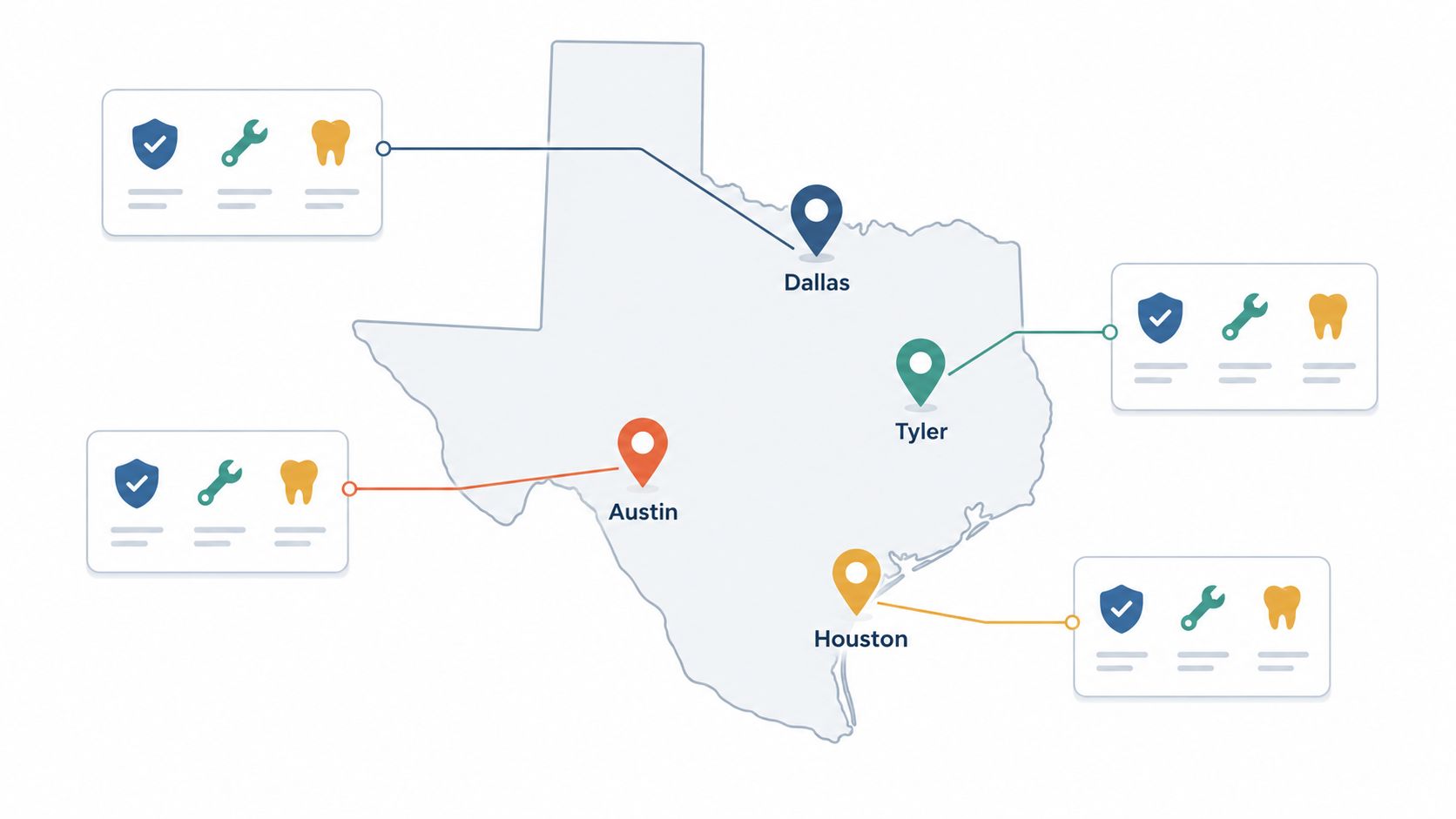
Some businesses don't need a service-first structure. They need a location-first one. If your law firm, HVAC company, or dental group competes across multiple cities, each market often deserves its own branch near the top of the sitemap.
A regional injury firm, for example, may need primary pages for Dallas, Houston, Austin, and San Antonio, then nest service variations under each city. An HVAC contractor serving DFW and East Texas may benefit from major region pages first, with city-specific service pages beneath them. That gives each market room for local proof, local staff references, and local search intent.
When location pages deserve top billing
This structure works best when each market has meaningful differences. Different teams. Different testimonials. Different service availability. Different competitive environments. If every location page says the same thing with only the city name swapped out, the architecture looks smart on a diagram but weak in real use.
Use naming conventions consistently. Pick one pattern and keep it. “Dallas,” “Dallas TX,” and “Dallas Texas” shouldn't all appear as competing versions in navigation and URLs.
I recommend including the following on location branches:
- Local entry pages: Regional or city pages that explain coverage, relevance, and trust.
- Nested service pages: City-plus-service combinations for major markets where demand justifies them.
- Market-specific proof: Staff bios, photos, reviews, and examples that are local.
- Cross-links: Direct links from each location page to related service offerings and contact paths.
A geographic sitemap works when each page feels like it belongs to that place, not when the city name is just a find-and-replace edit.
This model is often the right answer when local visibility is the business model, not just a supporting tactic.
4. Technical SEO and Performance Sitemap
Some sitemap problems don't show up in design reviews. They show up when key pages never get indexed, old URLs stay in the XML feed, or important pages sit too far from the homepage for crawlers to treat them efficiently. That's where a technical SEO sitemap matters.
The XML side has strict protocol requirements. A sitemap must begin with an opening <urlset> tag, define the namespace, include a <url> entry for each page, and place a <loc> child under each URL. The data must be entity-escaped and UTF-8 encoded according to the official sitemaps.org protocol.
Build for crawlability first
Large inventories need organization, not one giant file. A single XML sitemap is limited to 50,000 URLs and 50 MB uncompressed, which is why larger sites need a sitemap index file that references multiple smaller sitemaps. For service businesses with a lot of locations and service combinations, splitting files by content type usually works better than dumping everything into one list.
I like structures such as services.xml, locations.xml, and posts.xml, all referenced from a root sitemap index. It keeps maintenance cleaner and makes troubleshooting faster when indexing problems appear.
Your technical setup should also cover distribution:
- Root placement: Put the XML file in the root directory, such as
domain.com/sitemap.xml. - Robots.txt reference: Add the full sitemap URL using the sitemap directive so crawlers can find it.
- Accurate updates: Use
lastmodonly when content has changed in a meaningful way. - Audit routine: Crawl the site and compare indexable URLs against what the sitemap includes.
Digital Skyrocket's work on WordPress maintenance for support, security, and speed fits directly into this kind of structure. Technical upkeep isn't separate from sitemap health. It's part of it.
Keep the XML sitemap boring. Clean format, valid URLs, accurate updates, no vanity fields.
5. Content Pillar and Topic Cluster Sitemap
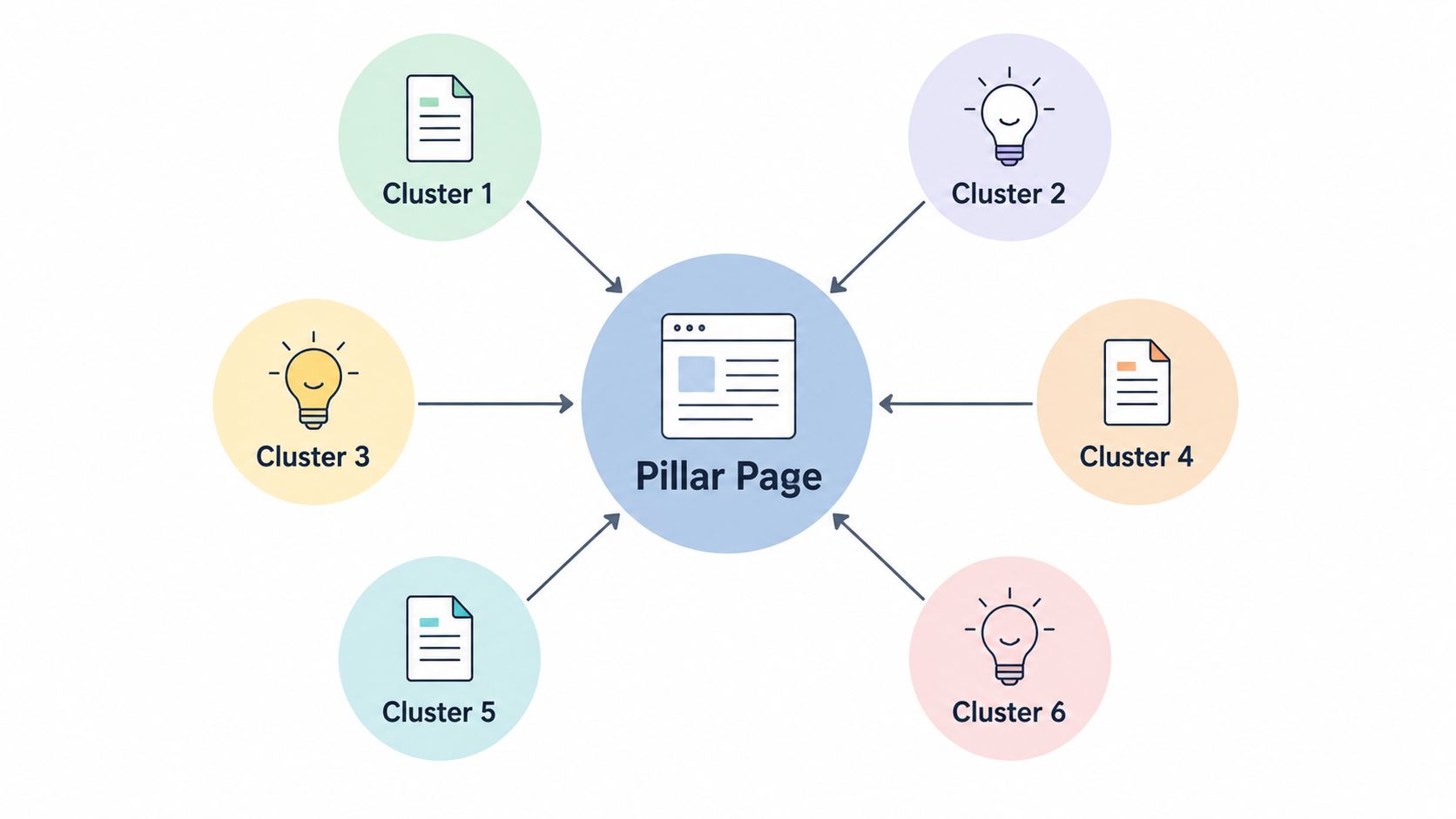
A topic cluster sitemap helps when your business needs authority, not just visibility for a few service terms. This works well for firms and contractors that answer the same category of questions repeatedly and need to prove depth across a subject.
Think of a roofing company with a pillar page on roof damage repair. Around it sit cluster pages on hail damage, leak detection, insurance claims, and repair-versus-replacement decisions. A personal injury firm can build a car accident claims pillar with clusters on medical bills, negligence, evidence, and settlement stages.
Authority comes from organized depth
This model is different from a blog stuffed with unrelated posts. Every cluster page should support a broader commercial topic and link back to a central pillar page. The pillar acts as the main authority asset. The clusters handle narrower intent and longer-tail questions.
Use this only when you can sustain quality. A weak pillar-cluster structure creates more pages, but not more clarity. Good cluster maps stay tightly aligned to service demand and user questions.
A strong topic cluster sitemap usually includes:
- One pillar per major service theme: Broad, thorough pages tied to real business value.
- Cluster pages with clear subtopics: Specific issues, scenarios, or comparisons.
- Internal linking discipline: Clusters link up to the pillar and sideways where relevant.
- Commercial bridge pages: Service pages connect educational content to actual inquiry paths.
This is one of the most effective versions of a sample sitemap for website expansion because it gives content marketing a clear lane without letting it drift away from conversion goals.
6. Answer Engine Optimization AEO Sitemap
A homeowner asks Google, "Do I need to replace my AC or can it be repaired?" An injured driver asks, "How long do I have to file a claim?" If your site has no page built for that exact question and no clear path from the answer to the service page, an answer engine has very little to work with.
That is the core job of an AEO sitemap. It maps how service businesses earn visibility for specific questions, then turns that visibility into booked calls, form fills, and consultations. If you want the broader search context behind this shift, understand GEO and AEO strategies.
A standard service hierarchy is still useful. An AEO sitemap adds a second layer. It organizes pages around question intent, entity clarity, and next-step actions so search engines, AI summaries, and site visitors can all follow the same logic.
Build around questions with commercial paths
For a personal injury firm, that can mean pages such as "How long does a settlement take?", "What if I was partly at fault?", and "Should I talk to the insurance adjuster first?" Each page should answer the question directly, define the scenario clearly, and lead to the right practice-area page.
For HVAC companies, strong AEO branches often cover "repair vs replace," "why is one room hotter than the others," "how often should I service my unit," and "what size system do I need." For dentists, the structure may follow concerns like tooth pain, chipped teeth, dental anxiety, and implant candidacy.
I usually map these pages before content writing starts. Each page card gets four fields: target question, searcher type, best supporting service page, and the conversion action. That step prevents the common mistake of publishing FAQ-style content that attracts visits but has no role in the sales path.
Useful AEO sitemap elements include:
- Question-led branches: Group pages by the exact phrasing prospects use before they are ready to contact you.
- Intent labels: Mark whether the page serves early research, comparison, urgency, or decision-stage intent.
- Answer-to-service connections: Link each answer page to one primary service page and one low-friction conversion step.
- Schema-ready page types: Plan FAQ, service, local business, attorney, medical, or review-related markup where it fits the page purpose.
- Entity clarity: Keep provider names, service names, locations, and outcomes consistent across the structure.
The trade-off is maintenance. An AEO sitemap creates more intent-specific pages, and weak pages add clutter fast. Service businesses should only build these branches where they can give a better answer than competitors and connect that answer to a real buying decision.
This structure also supports trust. A law firm answering sensitive case questions should tie those pages into attorney bios, case-specific proof, and a stronger reputation framework. Firms that need that layer can pair this approach with reputation management for personal injury attorneys.
If your sitemap only tracks URLs, it documents pages. An AEO sitemap documents how answers lead to action.
7. Reputation and Social Proof Sitemap
Trust content shouldn't live on an island. Too many service websites create one testimonials page, one case results page, and one credentials page, then expect visitors to hunt for proof on their own. That's not how people decide.
A better sitemap places proof near the decision point. A personal injury page should feature relevant outcomes and client feedback tied to that type of case. A roofing location page should show local before-and-after examples. A dental office page should include provider credentials and patient experience signals where the visitor is already evaluating fit.
Trust content belongs inside the structure
This approach works because it matches how buyers assess risk. They don't consume trust in one sitting. They pick it up in pieces while moving through the site. The sitemap should support that pattern.
A practical reputation-first structure can include these layers:
- Service-level proof: Testimonials, outcomes, certifications, or galleries embedded on service pages.
- Location-level proof: Reviews, local photos, and staff details specific to the office or city.
- Dedicated proof hubs: Full case results, video testimonials, or detailed success stories for visitors who want deeper validation.
- Decision-page reinforcement: Contact and consultation pages that repeat the strongest credibility signals.
For firms that need a stronger framework around public perception and search visibility, Digital Skyrocket's work in reputation management for personal injury attorneys shows how trust content can support both rankings and conversions when it's integrated into the site architecture.
People believe proof that feels specific to their problem. Generic praise rarely moves a high-stakes lead.
8. Lean Conversion-Focused Sitemap
Not every business needs a sprawling architecture. Sometimes the smartest sitemap is the one that removes half the pages you were about to build.
A solo attorney, local HVAC contractor, or single-location dental office can launch effectively with a compact structure: home, about, core services, testimonials, contact, and a small number of support pages that answer buying questions. That kind of site is easier to maintain, easier to measure, and often easier for visitors to trust because it feels focused.
Less content can produce better decisions
This approach is useful when budget, time, or team capacity is limited. It's also useful when a business has one main service line and doesn't need dozens of variations yet. The mistake isn't being small. The mistake is creating thin pages just to make the site look substantial.
I often recommend a lean structure when the company is new or repositioning. Start with the pages that support real inquiry behavior. Add branches only when demand and performance justify them.
A lean sitemap usually prioritizes:
- Core intent pages: Main services, emergency pages, appointment pages, and contact.
- One strong trust page: Testimonials, credentials, or case results collected in a useful format.
- A focused about section: Enough depth to establish credibility without turning into autobiography.
- Selective educational content: A few articles or FAQs tied directly to sales conversations.
This kind of sample sitemap for website planning doesn't try to impress with volume. It tries to make every page earn its place.
8 Sitemap Strategies Compared
| Sitemap type | 🔄 Implementation complexity | ⚡ Resource requirements | ⭐📊 Expected outcomes | 💡 Ideal use cases | Key advantages |
|---|---|---|---|---|---|
| Hierarchical Sitemap for Service-Based Websites | Moderate, planning for parent-child depth and prominence | Medium, content localization and IA work | ⭐⭐⭐ 📊 Better SEO authority distribution and clearer conversion paths | Multi-location service firms (law, HVAC, dental) needing geographic & service hierarchy | Clear structure, improved indexation, supports local SEO |
| Lead Generation Conversion Funnel Sitemap | High, requires audience mapping and iterative CRO | High, multiple funnel pages, analytics, testing | ⭐⭐⭐⭐ 📊 Increased qualified leads and measurable conversion lift | Service businesses prioritizing lead volume and conversion optimization | Aligned to buyer journey, optimized CTAs, testable funnels |
| Geographic Service Area Sitemap | High, many location branches and management overhead | High, per-location content, schema, GMB setup | ⭐⭐⭐⭐ 📊 Strong local search visibility and targeted rankings | Multi-location businesses competing in regional markets | Location-targeted SEO, customized messaging, local reputation control |
| Technical SEO and Performance Sitemap | Medium–High, technical architecture and crawl strategy | Medium, dev work, monitoring, ongoing performance tuning | ⭐⭐⭐⭐ 📊 Improved crawlability, faster pages, better Core Web Vitals | Competitive sites needing fast indexing and performance (site migrations) | Crawl efficiency, indexation control, faster load times, canonical strategy |
| Content Pillar and Topic Cluster Sitemap | Medium–High, requires topical strategy and planning | High, extensive content creation and ongoing updates | ⭐⭐⭐⭐ 📊 Builds topical authority and broader keyword coverage over time | Organizations building long-term content authority and thought leadership | Strong internal linking, comprehensive keyword coverage, topical signals |
| Answer Engine Optimization (AEO) Sitemap | High, must match AI sourcing patterns and structured data | High, authoritative content, schema, credentialing | ⭐⭐⭐ 📊 Potential citations in AI answer engines and improved conversational visibility | Companies aiming to be cited by AI/answer engines and capture Q&A traffic | FAQ/schema optimization, E‑E‑A‑T alignment, citation potential in AI responses |
| Reputation and Social Proof Sitemap | Medium, integrates testimonials/case results sitewide | Medium, collection, permissions, multimedia assets | ⭐⭐⭐⭐ 📊 Higher trust and conversion rates; richer E‑E‑A‑T signals | Service businesses where trust drives decisions (law, medical, contractors) | Multiplies social proof impact, improves conversions, fresh indexable content |
| Lean Conversion-Focused Sitemap | Low, minimal pages and linear paths | Low, limited content budget, fast implementation | ⭐⭐⭐ 📊 High conversion per page and fast time-to-market; narrower keyword reach | Small teams, new sites, or businesses needing quick, focused launch | Fast launch, low maintenance, concentrated CRO focus and speed benefits |
Choosing the Right Sitemap for Your Service Business
The right sitemap isn't a universal template. It's a business decision. The best structure depends on how people search for your services, how many markets you serve, how much proof you need to build into the experience, and whether your growth depends more on local visibility, topical authority, or efficient conversion paths.
If you're a multi-location law firm or home service company, a geographic or hierarchical sitemap usually gives you the clearest foundation. It keeps service pages and location pages organized without scattering authority. If your site relies heavily on education and search visibility across a broad topic set, a pillar-and-cluster structure can make more sense. If your business is newer or narrower, a lean conversion-focused map often outperforms a large site full of weak pages.
The technical side matters just as much as the visual one. A sitemap isn't only a planning diagram. It's also an XML file that needs to be valid, discoverable, and aligned with what you want indexed. Place it correctly, keep it updated, and make sure it reflects the canonical pages that matter. If your site is larger, split XML files logically and use a sitemap index rather than forcing everything into one messy file. The file should help search systems understand your structure, not clean up after a bad one.
One documented service-business case showed what happens when structure improves early. Using a hierarchical visual sitemap in discovery, followed by a compliant XML sitemap submitted through Google Search Console, reduced crawl depth from 4.2 to 2.1 levels within 6 weeks and was followed by a 68% increase in organic traffic plus a 42% rise in qualified lead form submissions over 90 days. The same implementation followed protocol requirements such as UTF-8 encoding, entity-escaped values, a <urlset> root, <loc> children, and lastmod tags for most URLs.
That result doesn't mean every business should copy one exact diagram. It means structure has consequences. Strong websites don't improvise architecture after the pages are written. They define hierarchy, internal relationships, and conversion paths before design starts.
At Digital Skyrocket, sitemap planning is part of the build, not an afterthought. We use it to connect content strategy, technical SEO, AEO, local search intent, and CRO into one working system so the final site doesn't just look better. It performs better.
If your current site feels scattered, underperforms in search, or generates traffic without enough qualified inquiries, Digital Skyrocket can help you rebuild the architecture the right way. We plan, design, develop, and optimize lead-generating websites for service businesses that want stronger visibility on Google and answer engines, with a sharp focus on law firms, dentists, roofers, HVAC companies, and other local service providers. If you want a website structure that supports rankings and real conversions from day one, talk with Digital Skyrocket.