

A potential client just searched your firm name. They were ready to call. Then they saw an old one-star review, a half-complete Google Business Profile, and a third-party listing with the wrong phone number. You may still be the better trial lawyer. You may have the stronger settlement record. But in that moment, none of that matters if your online reputation introduces doubt before your intake team ever gets a chance to speak.
That's the reality of personal injury practice online. PI clients are often hiring under stress, comparing several firms quickly, and using reviews, search results, and directory profiles as shortcuts for trust. Reputation management for personal injury attorneys isn't a side project for slow afternoons. It's part of intake, part of SEO, part of client experience, and sometimes part of crisis response.
Table of Contents
- Why Reputation Is Your Most Valuable Asset
- Building Your Digital Listening Post
- The Ethical System for Generating 5-Star Reviews
- Responding to Reviews with Professionalism and Empathy
- Using SEO and AEO for Reputation Defense
- Handling Defamation and Malicious Attacks
- Measuring ROI and Choosing Your Implementation Path
Why Reputation Is Your Most Valuable Asset
A PI lawyer can lose a strong case before the consultation starts. It happens when a prospect asks a spouse, friend, or doctor for a second opinion, then runs a quick branded search and sees friction. One harsh review. One unanswered complaint. One outdated profile that makes the firm look inattentive.
That single search matters because the stakes in this practice area are large. The U.S. personal injury law market reached $61.3 billion in 2024, and in a market of that size, reputation directly affects who captures revenue and who gets screened out during the client's decision process, as noted in these personal injury market statistics. A firm's digital trust signals now sit beside courtroom credentials, referrals, and case results.
I've seen attorneys assume their reputation is secure because they've been practicing for years and doing good work. That's not enough online. Searchers don't experience your résumé the way you do. They experience your Google reviews, directory listings, branded search results, and whether your responses sound composed or defensive.
Practical rule: A prospect doesn't need proof that you're the best lawyer in town. They need enough confidence to believe they won't regret calling you.
In contingency-fee practice, trust is revenue protection. If your name search creates hesitation, your intake team inherits skepticism. If your search results reinforce competence, responsiveness, and professionalism, you start the conversation ahead.
Reputation management for personal injury attorneys works best when it's treated as an operating system, not a cleanup job. You monitor what's being said, generate real reviews ethically, answer criticism carefully, strengthen the search environment around your name, and know when to escalate false attacks beyond marketing into legal recourse.
Building Your Digital Listening Post
The first mistake firms make is trying to improve reputation before they know what's already live. You need a listening post. Not a vague awareness that “someone checks reviews sometimes,” but a repeatable system that surfaces new mentions fast.

Start with the obvious names
Set alerts for every branded variation that a client might search:
- Firm name: Include your exact firm name, common abbreviations, and any older brand names still floating around online.
- Attorney names: Add partners, lead trial lawyers, and intake-facing attorneys whose names appear in ads, media, or referrals.
- Misspellings: Track frequent spelling errors. Clients often search fast, especially on mobile.
Google Alerts is the simplest starting point. It won't catch everything, but it's useful for early warning on blog mentions, news items, and indexed pages. For reviews and directory activity, reputation software gives you a stronger dashboard, especially when you need one place to watch Google, Avvo, FindLaw, social platforms, and local citations.
Map the places that shape first impressions
Your listening post should cover the places clients use to judge credibility. In PI, that usually includes Google Business Profile, Avvo, FindLaw, Yelp, Facebook, local directories, and any news or blog coverage tied to your name.
A lot of firms monitor Google reviews and stop there. That's incomplete. If you want a cleaner local search presence, your Google Business Profile SEO for personal injury firms needs to work alongside review monitoring, directory consistency, and branded search tracking.
I also recommend thinking beyond obvious review platforms when there's a genuine threat model. If your firm has dealt with impersonation attempts, leaked credentials, or targeted harassment, resources explaining how dark web monitoring aids investigations can help your team understand how broader monitoring fits into investigative and reputation-protection workflows.
The fastest way to lose control of a reputation issue is to learn about it from a client instead of your own monitoring system.
Turn monitoring into a weekly operating rhythm
A listening post only works if someone owns it. Assign a person, not a department. Give that person a checklist and a schedule.
A practical weekly rhythm looks like this:
- Review branded search results: Search the firm name and attorney names in an incognito browser.
- Check review platforms: Look for new reviews, rating shifts, duplicate listings, and unanswered feedback.
- Audit directory accuracy: Confirm phone numbers, addresses, hours, and attorney names match across major profiles.
- Flag new content: Save screenshots of anything problematic before it changes or disappears.
- Escalate by category: Send service complaints to operations, fake reviews to the designated response lead, and possible defamation to counsel.
This step is boring. That's exactly why it works. Firms that stay ahead of reputation issues usually aren't doing anything flashy. They're catching problems early, documenting them well, and responding before a small issue becomes the first thing a prospect sees.
The Ethical System for Generating 5-Star Reviews
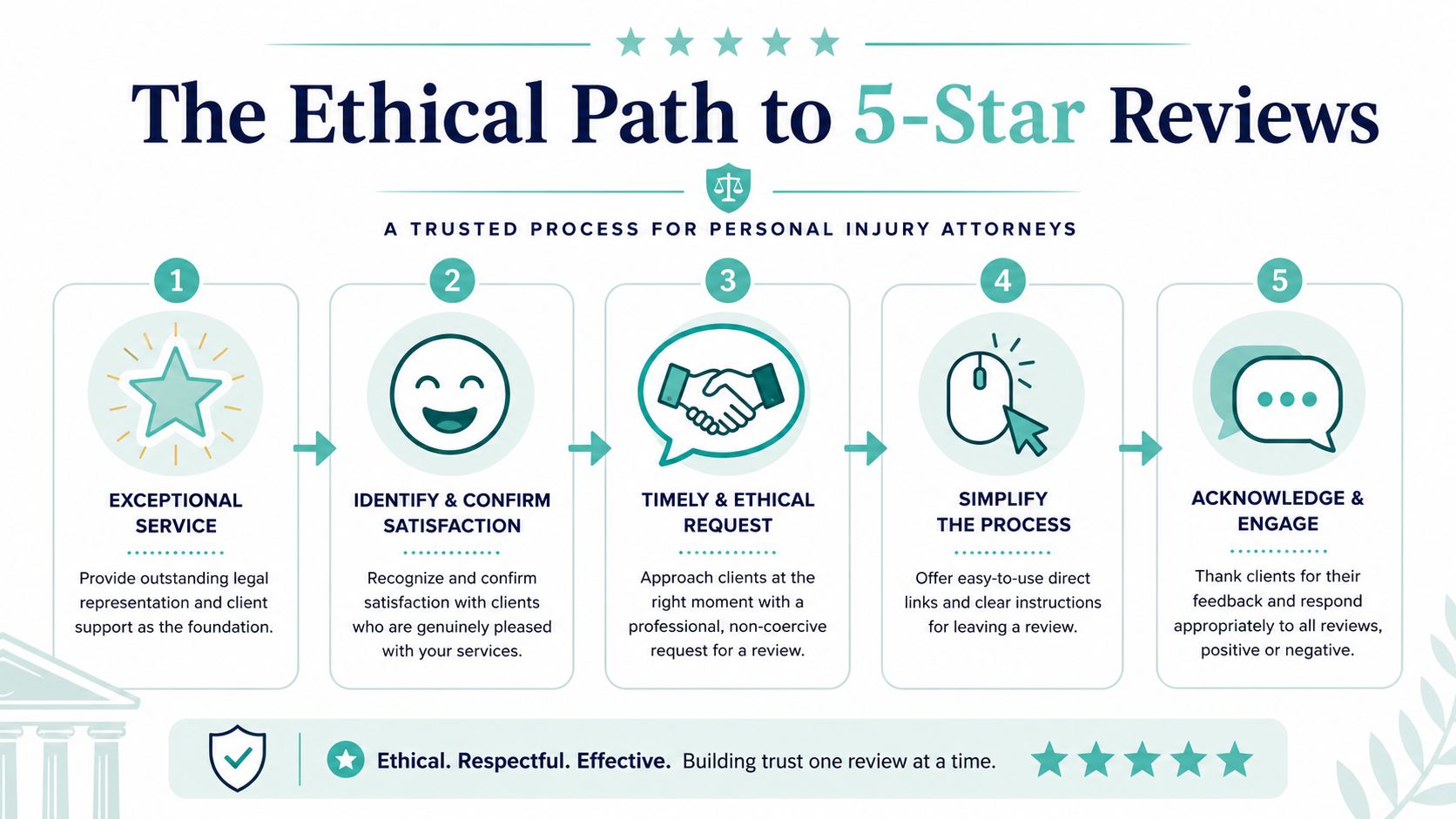
Most PI firms already know they need more positive reviews. What they usually lack is a system that respects client emotion, confidentiality, and bar rules while still producing steady review growth.
A proven method is to request reviews from satisfied clients at the right moments, such as after a successful outcome, and to build that request into CRM workflows with direct links to Google and Avvo. Done well, that process can increase client conversion rates by up to 30% in major markets, according to this guide to online reputation management for attorneys.
Timing matters more than enthusiasm
The wrong ask at the wrong time creates discomfort. PI clients may be relieved, exhausted, grieving, or still dealing with medical treatment even after a legal milestone. If your team asks too early, the request feels self-serving.
The right time usually comes after one of these moments:
- A successful outcome: Settlement funds are on the way, expectations were met, and the client feels closure.
- A positive service interaction: Someone on your team solved a stressful problem quickly and the client expresses appreciation.
- A case milestone with visible progress: The client feels informed, supported, and no longer confused about what's happening.
The ask should be simple and low-pressure. Something like: if you're comfortable sharing your experience, we'd appreciate a review, and we can send a direct link. That language matters. You're inviting, not pushing.
Build the request into your workflow
Firms fail at review generation when they rely on memory. A case manager remembers sometimes. A lawyer asks when they happen to be on the phone. Nobody follows up. The result is randomness.
A better system uses your CRM or case management process to trigger outreach after defined milestones. The message should include:
- A direct link: Don't make clients search for your profile.
- A short explanation: Tell them their feedback helps other injured people choose representation.
- A soft opt-out tone: Make it clear there's no pressure and no effect on service.
Keep your script plain. Don't overproduce it. Clients can feel when a message sounds like marketing copy instead of a genuine request.
What works and what crosses the line
Here's what works:
- Ask satisfied clients individually: Personal messages outperform generic blasts because they feel human.
- Use milestone triggers: Requests tied to clear positive moments feel natural.
- Train staff on phrasing: The same client experience can produce very different outcomes depending on how the request is framed.
- Respond after the review appears: A simple thank-you reinforces professionalism.
Here's what doesn't:
- Incentivizing reviews: Gift cards, discounts, or anything that looks like payment can create ethical problems and credibility issues.
- Screening for only happy clients with deceptive tactics: It's fine to pay attention to client sentiment. It's not fine to manipulate public feedback deceptively.
- Writing reviews for clients: Obvious problem. Don't do it.
- Pushing vulnerable clients: PI clients often have strong emotions around their cases. Pressure damages trust.
If a review request would sound uncomfortable if read aloud in a disciplinary hearing, don't send it.
The strongest review profiles in this practice area are built on disciplined service and disciplined timing. Not gimmicks. Not incentives. Not volume for volume's sake. Ethical reputation management for personal injury attorneys always starts with a real client experience worth talking about.
Responding to Reviews with Professionalism and Empathy
Your review response process isn't just customer service. It's public evidence of how your firm handles pressure, criticism, and dissatisfied people. Prospects read your replies to decide whether you're mature, careful, and respectful.
That's why structured response protocols matter. Firms that use them see a 40% reduction in long-term reputational damage, and firms that apologize when appropriate and offer offline resolution see a 25% increase in prospective client inquiries compared with firms that ignore or fight back, according to these law firm reputation management benchmarks.
The public response is for future clients too
When a happy client leaves praise, keep the response warm and brief. Thank them. Don't overstate specifics. Don't reveal confidential details to prove you remember the case.
When a mixed or negative review appears, the instinct to defend the file is strong. Resist it. A public debate about facts rarely helps, and confidentiality rules narrow what you can safely say anyway.
A sound response framework looks like this:
- Acknowledge the concern: Show that the review was read.
- Express empathy: Not every complaint is accurate, but frustration is still real to the writer.
- Avoid factual sparring: Don't publish timelines, strategies, or account details.
- Move it offline: Offer a direct path to discuss the issue privately.
- Document internally: Public replies should be paired with internal review of the complaint.
A calm reply to an unfair review often helps more than “winning” the argument in public.
Ethical Review Response Templates for PI Attorneys
| Review Type | Core Strategy | Ethically Compliant Template |
|---|---|---|
| Positive review | Thank them without disclosing case facts | Thank you for your kind words. We appreciate you taking the time to share your experience with our firm. It was a privilege to assist you, and we wish you the best moving forward. |
| Positive review mentioning staff | Recognize the feedback, keep details general | Thank you for recognizing our team. We work hard to keep clients informed and supported throughout the process, and we're grateful you shared your experience. |
| Mixed review | Acknowledge concerns and invite discussion | Thank you for your feedback. We're sorry to hear parts of your experience did not meet expectations. We take client communication seriously and would welcome the chance to speak with you directly to better understand your concerns. |
| Negative review from apparent client | Empathy first, then move offline | We're sorry to hear that you feel this way. Our firm aims to treat every client with professionalism and care. Because we respect privacy and confidentiality, we can't address case-specific matters here, but we invite you to contact our office so we can discuss your concerns directly. |
| Negative review that may be mistaken identity | Stay neutral and verify privately | We take feedback seriously and would like to learn more. We're unable to identify this matter from the information provided. Please contact our office directly so we can review your concern and determine the appropriate next steps. |
| Suspicious or likely fake review | Avoid accusation in the public reply | We take all feedback seriously. At this time, we're unable to match this review to a client matter. Please contact our office directly with additional information so we can investigate. |
A few practical warnings matter here.
First, never let a lawyer write in anger. Draft the response, let someone else review it, and post later. Second, don't copy and paste the same reply to every review. It looks automated and insincere. Third, don't let intake staff promise outcomes in response messages. A review response is not a place to market.
The best review replies sound measured because they are measured. They don't posture. They don't leak facts. They signal that your firm is stable enough to handle conflict without becoming part of the spectacle.
Using SEO and AEO for Reputation Defense
Reviews matter, but reviews alone do not control your reputation. Search results do. When someone Googles your name, they aren't just seeing star ratings. They're seeing whatever Google and answer engines decide is the clearest summary of who you are.
That's why reputation management for personal injury attorneys needs a search defense layer. With 62% of potential clients checking up to five different review sites before contacting a law firm, a weak result on one platform can influence the entire decision path. Scorpion's analysis of how PI clients choose a law firm makes that point clearly. If you don't shape branded search results, other people will shape them for you.
Own more of page one
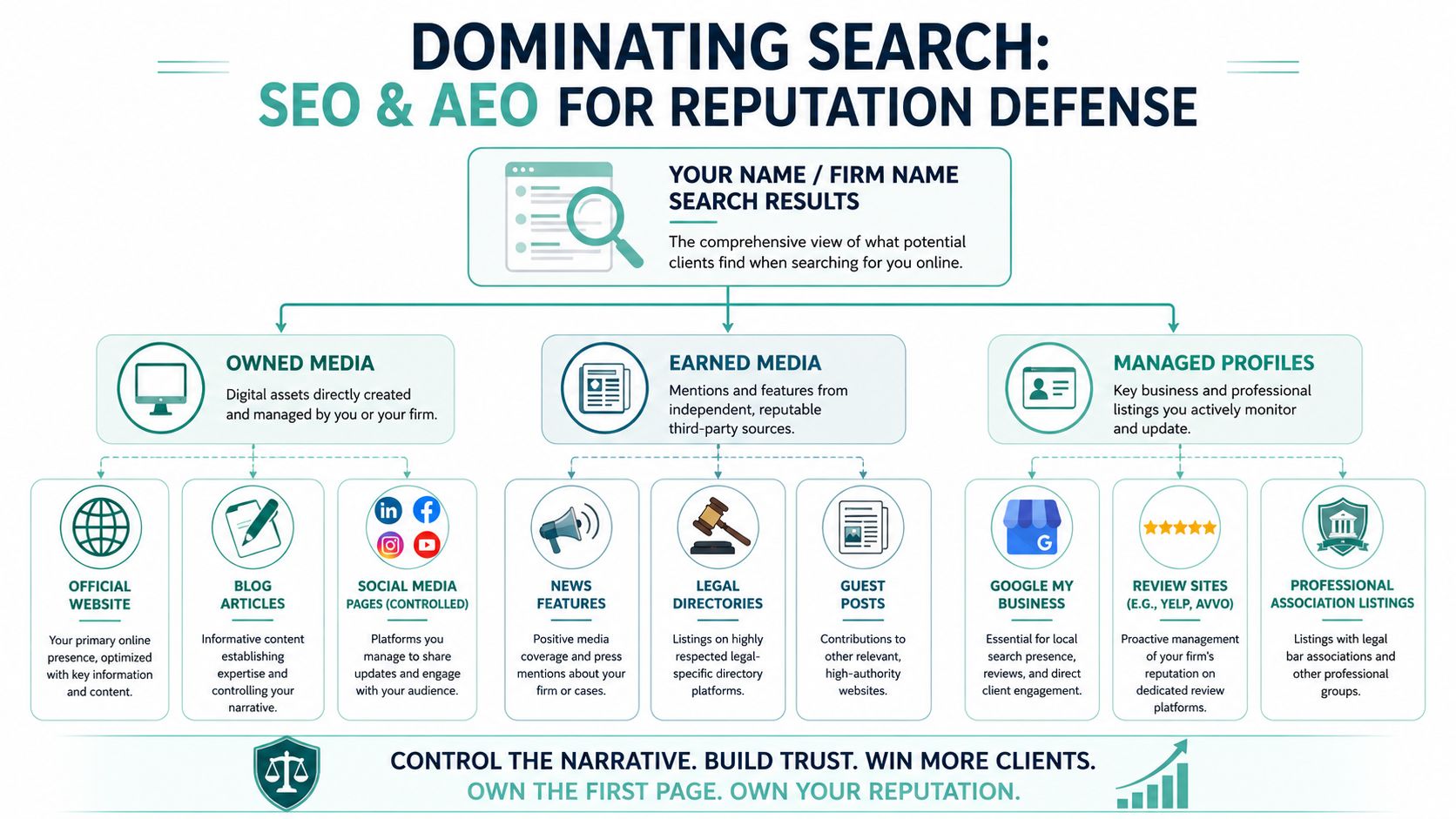
The core SEO defense strategy is simple. Publish and strengthen assets you control so they occupy more branded search real estate.
That usually means:
- Attorney bio pages: Full profiles with practice focus, credentials, media mentions, and contact paths.
- Firm about pages: Clear, authoritative pages that explain who leads the practice and how clients are served.
- Relevant blog content: Articles tied to your jurisdiction, case types, and common client questions.
- Managed directory profiles: Avvo, bar association listings, and trusted local profiles with consistent information.
- Press and community coverage: Earned mentions that reinforce legitimacy.
This is one reason firms investing in personal injury lawyer website design often see reputation benefits that go beyond aesthetics. Better site architecture gives Google stronger branded assets to rank, and better content gives prospects fewer reasons to click into low-quality third-party pages.
AEO changes what people see before they click
Answer engine optimization adds another layer. Google and AI-driven answer surfaces often extract summaries from attorney bios, FAQ content, review language, and third-party mentions. If your owned content is vague, outdated, or thin, you create room for weaker sources to define you.
AEO-friendly reputation defense includes:
- Publishing direct answers to common client questions on branded and service pages.
- Keeping bios current so search systems can pull accurate role, location, and practice information.
- Using consistent naming across your website, directories, and profiles.
- Building topical depth so your firm is associated with the matters you want to be known for.
The first page isn't just a list of links anymore. It's a stitched-together reputation summary built from every signal you leave online.
What doesn't work is trying to bury bad results with low-quality filler. Thin microsites, empty press releases, and generic profile spam rarely hold long-term positions. Strong branded pages, credible third-party listings, and useful content do.
A sound search defense program doesn't erase criticism. It gives accurate, credible information more prominence than stale, misleading, or low-context material. That's the difference between hiding and defending.
Handling Defamation and Malicious Attacks
Not every bad review is defamation. In fact, most aren't. Many are opinions, exaggerations, or one-sided retellings of a frustrating client experience. They may be unfair, but unfair doesn't automatically mean actionable.
Opinion is painful but usually protected
“This lawyer was rude.” That's usually opinion.
“This law firm never called me back.” That may be opinion, or it may be a factual dispute that's hard to untangle on a platform.
“This lawyer stole my settlement funds.” That's different. It's a concrete factual accusation. If false, it may cross into defamation and also violate platform rules.
The practical distinction is whether the statement expresses a personal view or asserts a false fact capable of being proven true or false. For PI firms, the emotional setting makes this harder because many reviews blend both. A reviewer may post a protected opinion and slip in a false factual allegation beside it.
That's why your first move shouldn't be public outrage. It should be classification.
- Service complaint: frustrating, possibly legitimate, usually handled with response and internal review.
- Mistaken identity: the reviewer may have the wrong firm or attorney.
- Competitor or troll attack: suspicious profile, vague details, no matching matter.
- Potential defamation: false factual claims that could damage professional standing.
The right escalation path
A disciplined escalation path looks like this.
First, preserve evidence. Capture screenshots, profile details, dates, and URLs. If the post changes later, you'll want the original version.
Second, review the platform's policies. Many platforms prohibit impersonation, false allegations, conflicts of interest, and non-client reviews. A terms-of-service report is often the fastest path to removal.
Third, keep your public response narrow if you respond at all. Don't publish case facts to prove the reviewer is lying. That can create a second problem while trying to solve the first.
Fourth, involve your own counsel when the attack includes false factual allegations, impersonation, extortion, or coordinated harassment. At that point, the issue may have moved beyond marketing into legal enforcement.
Some reviews should be answered. Some should be flagged. A smaller group should be handed directly to counsel.
What doesn't work is threatening legal action against every unhappy reviewer. It looks heavy-handed, and it can amplify the underlying post. What also doesn't work is passivity when someone falsely accuses your firm of criminal or unethical conduct. The right response depends on the content, the platform, the evidence, and your jurisdiction.
PI firms are especially vulnerable because case values are high and emotions run hot. That makes calm documentation and careful escalation far more useful than panic.
Measuring ROI and Choosing Your Implementation Path
Reputation work needs to tie back to signed cases, intake quality, and the visibility of your branded search presence. Otherwise it becomes one more recurring task with no clear owner and no business standard.
The budget question matters too. Extensive reputation management campaigns for PI firms often start at $3,000 per month, with costs scaling based on issue severity, according to this review of online reputation management options for personal injury lawyers. That price makes sense only if you know what you're buying and how you'll judge success.
What to track if you want business value
You don't need a huge dashboard. You need a useful one.
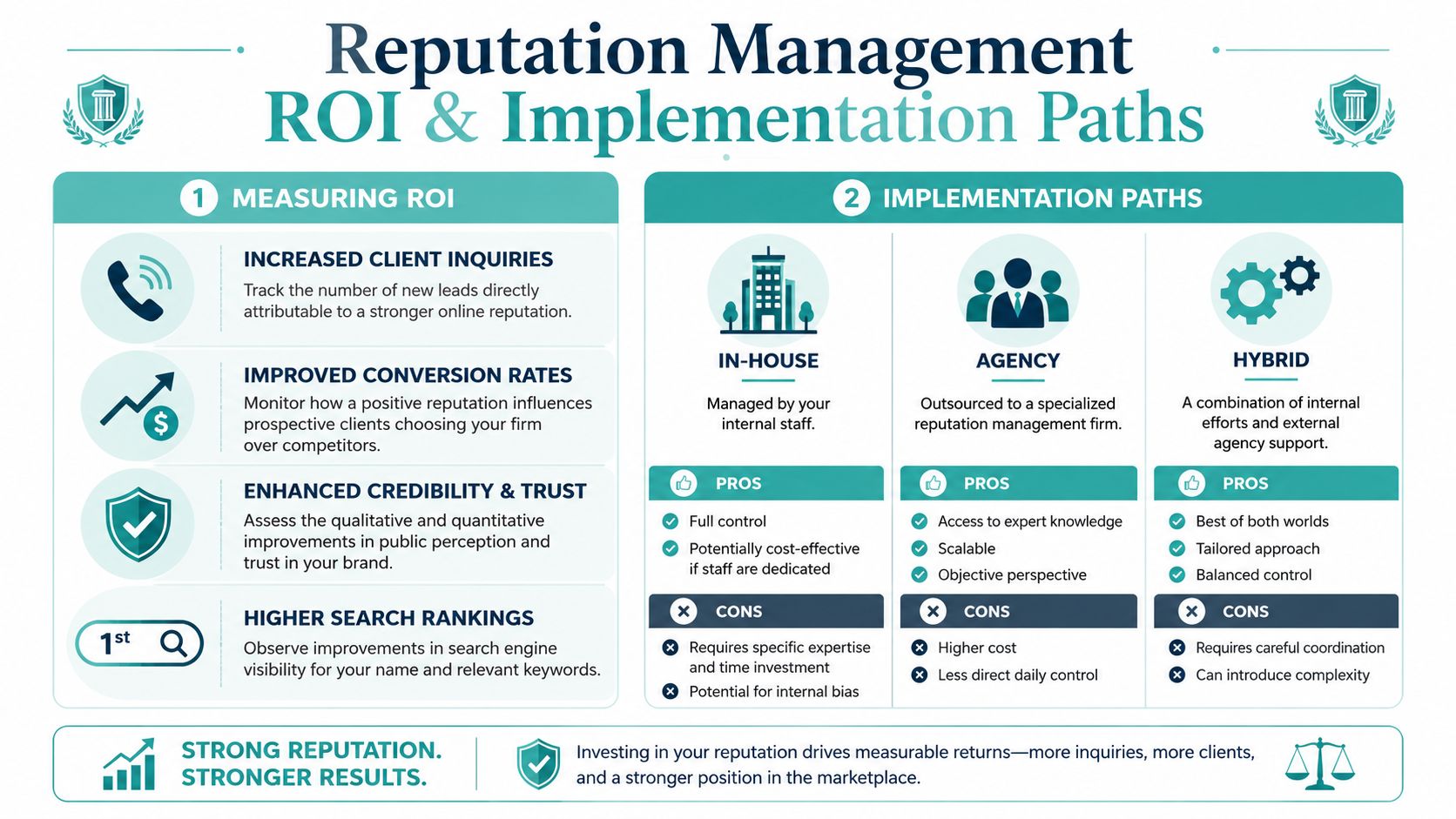
Track a mix of reputation, search, and intake indicators:
- Average star rating: This is the fast trust signal prospects notice first.
- Review volume and recency: A good rating with stale reviews feels less credible than a current profile.
- Response coverage: Are you replying consistently, especially to criticism?
- Branded search results: What content appears for your firm and key attorneys?
- Lead quality notes from intake: Are prospects referencing reviews, specific attorneys, or concerns they saw online?
- Conversion behavior: Are more branded leads turning into consultations and signed matters?
New threats should also change your ROI thinking. Firms now need to understand how synthetic media can trigger reputation crises, especially if a false audio clip or manipulated video starts circulating. A plain-English explainer on how deepfake technology works is worth reviewing with your leadership team because future reputation defense won't be limited to review sites.
For growth-minded firms, broader strategy matters too. Reputation efforts work better when they support intake and organic visibility instead of sitting in isolation. That's why many firms pair reputation work with a larger plan for how to grow a law firm.
In-house versus agency versus hybrid
There isn't one correct model. There is only the model your firm can execute consistently.
| Path | Best Fit | Trade-off |
|---|---|---|
| In-house | Firms with a disciplined operations lead and low to moderate reputation complexity | More control, but internal teams often lack SEO suppression skills, monitoring depth, and crisis experience |
| Agency | Firms dealing with active negative content, fragmented profiles, or branded search problems | More expertise and capacity, but less day-to-day proximity and higher monthly cost |
| Hybrid | Firms with internal ownership but external needs around search defense, review systems, or crisis support | Strong balance, but requires clear roles so tasks don't get duplicated or dropped |
If your issue is basic review collection and profile upkeep, a well-trained internal coordinator may be enough. If your issue includes branded SERP problems, defamation risk, or multi-platform inconsistency, outside help becomes more compelling. Hybrid models often work best because the firm owns client communication and ethics, while specialists handle monitoring systems, search strategy, and technical cleanup.
The biggest implementation mistake is choosing a model based on price alone. Choose based on complexity, urgency, internal discipline, and whether the people involved understand both legal ethics and search behavior.
If your firm needs a stronger website, better branded search control, and a reputation strategy that supports qualified inquiries, Digital Skyrocket focuses on web design, SEO, AEO, and reputation management for service businesses and law firms. They don't take broad marketing engagements, and they only work where a new site and ongoing SEO are part of the plan. For personal injury firms outside Texas that want a cleaner, more defensible search presence, that specialization is the point.