

Most advice on how to grow my law firm starts in the same place: buy more traffic, rank for more keywords, pour more money into lead generation. That advice isn't always wrong. It's just incomplete, expensive, and often badly sequenced.
A firm can push hard on SEO, paid search, and intake volume and still stay stuck because growth doesn't come only from cold demand. It also comes from systematically staying visible to people who already know, trust, or nearly trust you. That includes former clients, current clients, professional contacts, and referral partners who mean to send work your way but forget until someone else gets there first.
That is where a newsletter earns its place. Not as a vanity send. Not as a holiday greeting with a firm logo. As a repeatable business development system that nurtures relationships at scale, keeps your name in circulation, and creates more warm conversations than most firms expect. If your website is already part of your growth strategy, strong SEO for law firms still matters. But traffic generation and relationship nurturing should work together, not compete for attention.
Table of Contents
- Beyond Chasing Leads How to Actually Grow Your Firm
- Why Newsletters Are a Growth Engine Not a Time Sink
- Navigating Ethics and Compliance in Legal Marketing
- Segmenting Your Audience for Maximum Impact
- Crafting Content That Connects and Converts
- Choosing Your Tools and Distribution Strategy
- Measuring Success and Optimizing for Growth
- Your Law Firm Newsletter Rollout Checklist
Beyond Chasing Leads How to Actually Grow Your Firm
Law firms often overinvest in acquisition because acquisition is easy to count. You can see clicks, form fills, and cost per lead on a dashboard. What you cannot see as easily is the revenue lost when past clients, referral partners, and warm prospects stop hearing from you.
That blind spot gets expensive.
A firm that depends only on ads, search, and new lead volume has to keep buying attention month after month. A firm that builds a newsletter creates an owned channel. That means lower dependence on fluctuating ad costs, more repeat visibility with known contacts, and more chances to turn existing trust into new matters.
Legal hiring rarely happens on first contact. A general counsel may not need outside employment counsel today. A former estate planning client may not think about updating documents until a life event forces the issue. A business owner may meet your firm, like your team, and still wait six months before a problem becomes urgent. If your firm goes quiet during that gap, another lawyer often gets the call.
Newsletters solve a business problem, not just a marketing one. They keep relationships warm at scale.
Warm relationships are cheaper to convert, easier for staff to handle, and more likely to produce qualified matters. They also support the channels firms already spend money on. A strong website, good intake, and SEO for law firms bring people into your orbit. A newsletter gives you a disciplined way to stay there.
There is also a practical referral benefit. Referral sources do not need constant promotion. They need clarity. They need to remember what kinds of matters fit your firm, what has changed in your practice, and when to send someone your way. A well-run newsletter gives them that reminder without forcing your attorneys to schedule another round of lunches and check-ins.
Past clients are similar. They usually do not disappear because they had a bad experience. They drift because their legal need is intermittent and your firm stopped appearing in their world. Consistent email closes that gap with far less effort than one-off follow-up.
Firms grow faster when they manage memory, not just lead flow.
That does not mean email replaces everything else. It does mean growth gets stronger when the firm treats attention already earned as an asset worth protecting. For lawyers concerned about promotion rules and CAN-SPAM compliance, the answer is not to avoid newsletters. The answer is to run them with the same discipline you apply to intake, conflicts, and client communication.
Many firms leave money on the table here. They spend to attract a first visit, then fail to keep in touch with people who already know the firm, already trust it, or already came close to hiring. A newsletter gives that relationship structure. Over time, that structure produces repeat matters, better referrals, and steadier growth than a strategy built only on chasing the next lead.
Why Newsletters Are a Growth Engine Not a Time Sink
The objection comes up fast. Attorneys say newsletters sound nice, but they don't have time. That objection makes sense only if the newsletter is treated like a branding chore.
A strong newsletter is closer to an automated relationship manager. It keeps your firm in front of the right people, gives them something worth sharing, and reinforces your expertise in a format they can consume quickly. Done right, it saves time because it replaces scattered one-off follow-ups with one structured touchpoint.
Top of mind wins more than firms admit
Most legal work doesn't arrive the moment someone first learns your name. It arrives later, when a problem appears. If your firm has gone silent for months, another attorney often gets the call.
A newsletter keeps the relationship active. Not aggressively. Just consistently.
That matters with three groups in particular:
- Past clients: They may return with a new matter, or mention your name when someone asks for help.
- Referral partners: They need regular reminders of what you do well, what has changed, and who you're the right fit for.
- Prospects not yet ready: Some people inquire, then wait. A newsletter gives them continuing proof that your firm is credible and active.
Useful content does more than polite check-ins
Generic updates don't build authority. Useful content does. Filevine notes that to establish authority and drive organic growth, your content must solve specific client problems, and firms that create detailed content supported by attorney bios and client reviews build trust, which leads to higher conversion rates from referrals, the highest-converting channel in the legal sector, in its guide on driving organic traffic to your law firm website.
That same logic applies to newsletters. A practical explainer on custody modifications, business contract pitfalls, probate timelines, or what to do after an injury gives readers a reason to keep reading and forwarding.
A holiday email says you're alive. A problem-solving newsletter says you're capable.
The list itself becomes an asset
Most firms treat their contact list like a storage bin. Names go in. Very little happens after that. A better view is that your email list is a business asset that can appreciate when handled well.
Use it to:
| Newsletter function | Business effect |
|---|---|
| Ongoing education | Builds confidence before a matter arises |
| Repeated visibility | Improves recall when someone needs counsel |
| Shareable insights | Makes referrals easier and more specific |
Practical rule: If an issue can help a client avoid risk, understand a change, or make a better decision, it belongs in your newsletter.
This is why newsletters aren't a time sink. They are one of the few marketing activities that strengthen client loyalty, referral flow, and perceived expertise at the same time.
Navigating Ethics and Compliance in Legal Marketing
A law firm newsletter can strengthen reputation or create avoidable risk. The difference usually comes down to process. Before the first send, the firm needs clear review standards for ethics, privacy, and advertising compliance.
Start with the same caution you would use in any public statement
A newsletter is published marketing content. Treat it that way. Every issue should be reviewed for attorney advertising rules in the relevant jurisdiction, confidentiality concerns, testimonial usage, specialization claims, and statements that could be read as legal advice for a specific matter.
Some practical guardrails help:
- Use clear disclaimers: State that the content is for general informational purposes and doesn't create an attorney-client relationship.
- Avoid fact patterns that identify clients: Even if a name is removed, details can still expose a person or business.
- Be careful with outcomes: If you mention results, add the context your jurisdiction requires and avoid implying the same outcome is likely elsewhere.
- Watch specialization language: Don't claim to be a specialist unless your jurisdiction permits it and the designation is accurate.
Write like a lawyer, edit like a regulator
Promotional language often causes more trouble than the substance. Phrases such as "best," "guaranteed," "expert," or "you will win" are unnecessary and risky. Plain claims are stronger anyway.
The newsletter should also have a straightforward unsubscribe option, a valid sender identity, and sending practices that respect email law. For a practical operational checklist, marketing teams should review this guide to CAN-SPAM compliance before launch.
If a sentence sounds impressive but would be difficult to defend before a disciplinary committee, cut it.
Build an approval workflow before you need one
The easiest way to stay compliant is to avoid improvisation. Set a basic workflow for every issue:
- Draft review by marketing or business development
- Substantive review by a supervising attorney
- Final check for disclaimers, links, and audience segment
- Archive the final version
This protects the firm and speeds production because the team knows who signs off on what. It also reduces the common last-minute problem where a partner remembers too late that a client story shouldn't be shared or a headline overstates the point.
A good newsletter sounds human and useful. It also stays disciplined. In legal marketing, that combination matters.
Segmenting Your Audience for Maximum Impact
The fastest way to make a newsletter irrelevant is to send the same message to everyone. A former estate planning client, an accountant who refers business owners, and a prospect who downloaded a guide from your website don't need the same email.
Relevance starts with segmentation. Not elaborate automation. Just a clean understanding of who is on your list and why they matter to the firm.
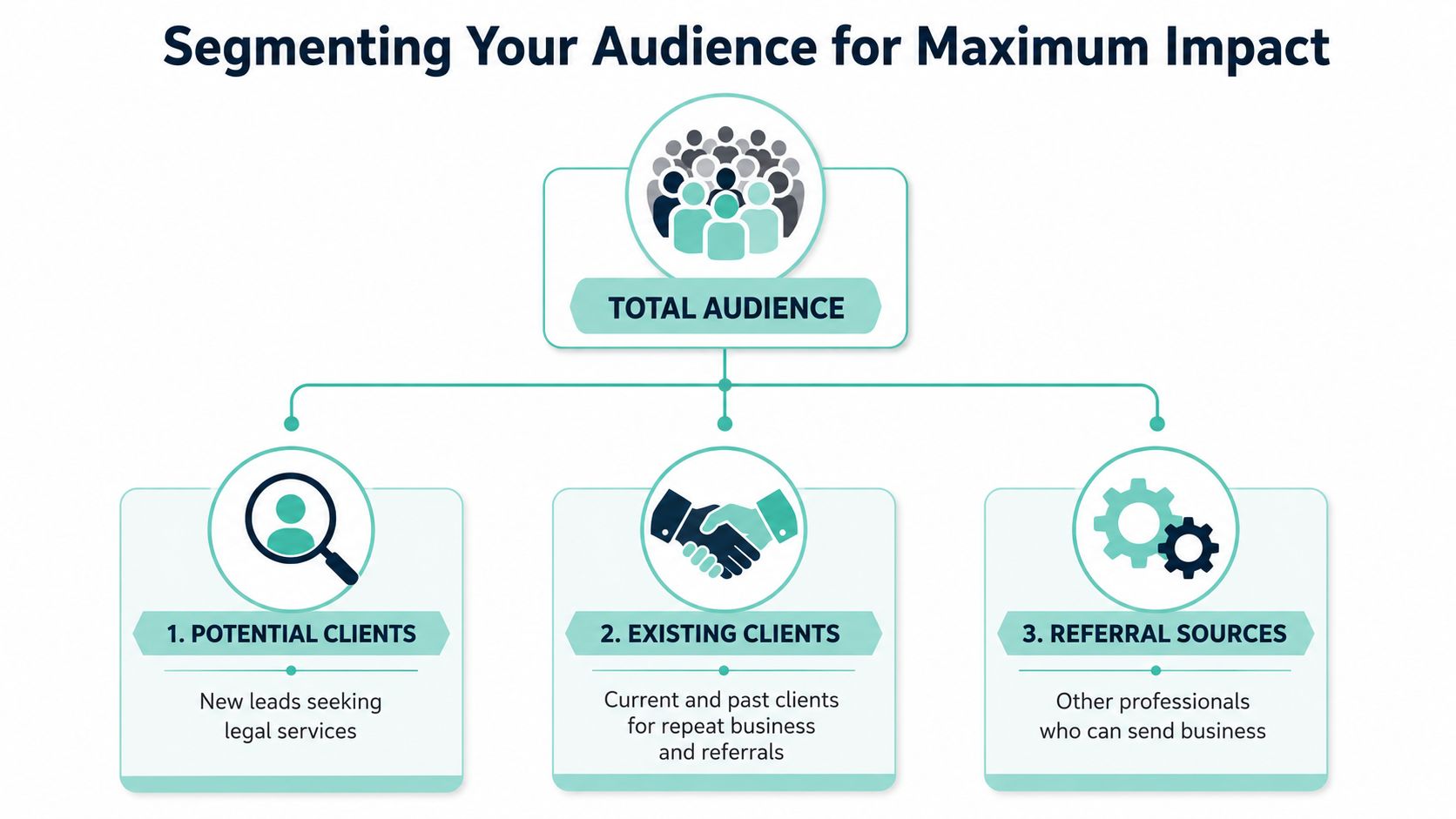
The Three Audiences That Matter Most
Most firms can begin with three practical groups.
Potential clients are people who have shown interest but haven't hired you. They need clarity, reassurance, and reasons to take the next step. Educational content works best here, especially answers to common questions, short explanations of process, and plain-language issue spotting.
Existing clients include current and former clients. Current clients need communication that reinforces professionalism and trust without interfering with active representation. Former clients respond well to updates that connect to life stages, business changes, or recurring legal risks they may face again.
Referral sources include attorneys in adjacent practices, accountants, financial advisors, therapists, physicians, and local business professionals. They don't need broad legal education. They need confidence about when to send someone to you and what kind of matter you handle best.
How to Send Different Messages Without Building Chaos
Segmentation doesn't require three entirely separate editorial calendars. It requires one core idea adapted three ways.
For example, if the core issue is business succession:
- Prospect version: explain common mistakes and when to speak with counsel.
- Client version: discuss changes that should trigger a document review.
- Referral partner version: highlight signs their own clients may need legal planning.
That keeps production manageable while improving relevance.
A simple contact framework usually works:
| Segment | What they care about | Best newsletter angle |
|---|---|---|
| Potential clients | Clarity and confidence | FAQs, process explainers, next-step guidance |
| Existing clients | Ongoing trust and practical value | Updates tied to prior matters or life events |
| Referral sources | Credibility and fit | Issue spotting, firm capabilities, shareable insights |
Best use case: Write one strong piece each month, then adjust the intro, examples, and call to action for each audience.
The mistake firms make is overpersonalizing too early or refusing to segment at all. Keep it simple. Tag contacts by relationship type, practice area interest, and referral role. That alone usually improves relevance enough to change how the list performs.
Crafting Content That Connects and Converts
A newsletter fails when it reads like internal firm news sent to people outside the firm. Most recipients don't care that you launched a redesign, attended a conference, or hired a lateral partner unless you connect that update to something useful for them.
The content that works answers a live question, solves a specific problem, or helps a referral source recognize a matter worth sending your way.

Build Around Problems Not Firm Announcements
The easiest editorial filter is this: would a client save this email, forward it, or reply to it?
If not, the topic probably belongs on your internal Slack, not in the newsletter.
Good newsletter topics usually fall into a few durable categories:
- Legal changes that affect decisions: New rules, deadlines, process shifts, or court developments.
- Recurring client questions: The same issue your attorneys explain every week is often your best topic.
- Risk prevention: Common mistakes, timing problems, missing documents, weak contracts, poor records.
- Decision guides: What to gather before a consultation, when to update an estate plan, when a dispute should escalate.
You can sharpen those topics with a defined content strategy for service firms so each issue supports both client education and business development.
A Simple Newsletter Content Matrix
Instead of inventing topics from scratch every month, use a matrix. Pair one topic pillar with one format.
| Topic pillar | Useful format |
|---|---|
| Practice area update | Short attorney Q&A |
| Common legal mistake | Checklist or brief explainer |
| Client question | FAQ format |
| Firm capability | Mini case pattern with anonymized lessons |
| Community or firm update | Why it matters to clients |
This keeps the writing grounded. A family law firm might pair "co-parenting modification issues" with a short Q&A. A personal injury firm might pair "post-accident documentation" with a checklist. A business firm might pair "partnership disputes" with a decision guide.
Write subject lines like a client question, not a law review title.
Examples:
- What changes should trigger an estate plan review?
- When should a business owner call a lawyer about a partner dispute?
- What should you document after a workplace injury?
Write for Humans and AI Retrieval
Email newsletters increasingly feed more than inboxes. They influence what gets copied into blogs, cited in referral conversations, and surfaced in AI-driven search and answer tools.
That is why Answer Engine Optimization, or AEO, belongs in your editorial process. Law firms often neglect AEO, despite 68% of professionals using AI for legal research, and firms that structure content for AI ingestion can see 3.2x higher consultation requests from AI-driven queries, according to this discussion of law firm AEO and AI-driven search behavior.
For newsletter writing, that means:
- Use question-based headings: They mirror how people query AI tools.
- Answer directly in the first paragraph: Don't bury the conclusion.
- Define legal terms plainly: Clarity improves human understanding and machine retrieval.
- Keep sections scannable: Short paragraphs, bullets, and clean hierarchy help.
A good newsletter issue can become a blog post, a client alert, a referral follow-up, and a source for AI-visible content. That is far more valuable than a one-time email blast.
Choosing Your Tools and Distribution Strategy
Once the content is clear, execution matters. A strong editorial plan can still underperform if the platform is clumsy, the template breaks on phones, or the send schedule is erratic.
The right setup is usually boring in the best sense. It should be easy for your team to use, easy for readers to follow, and easy to repeat.
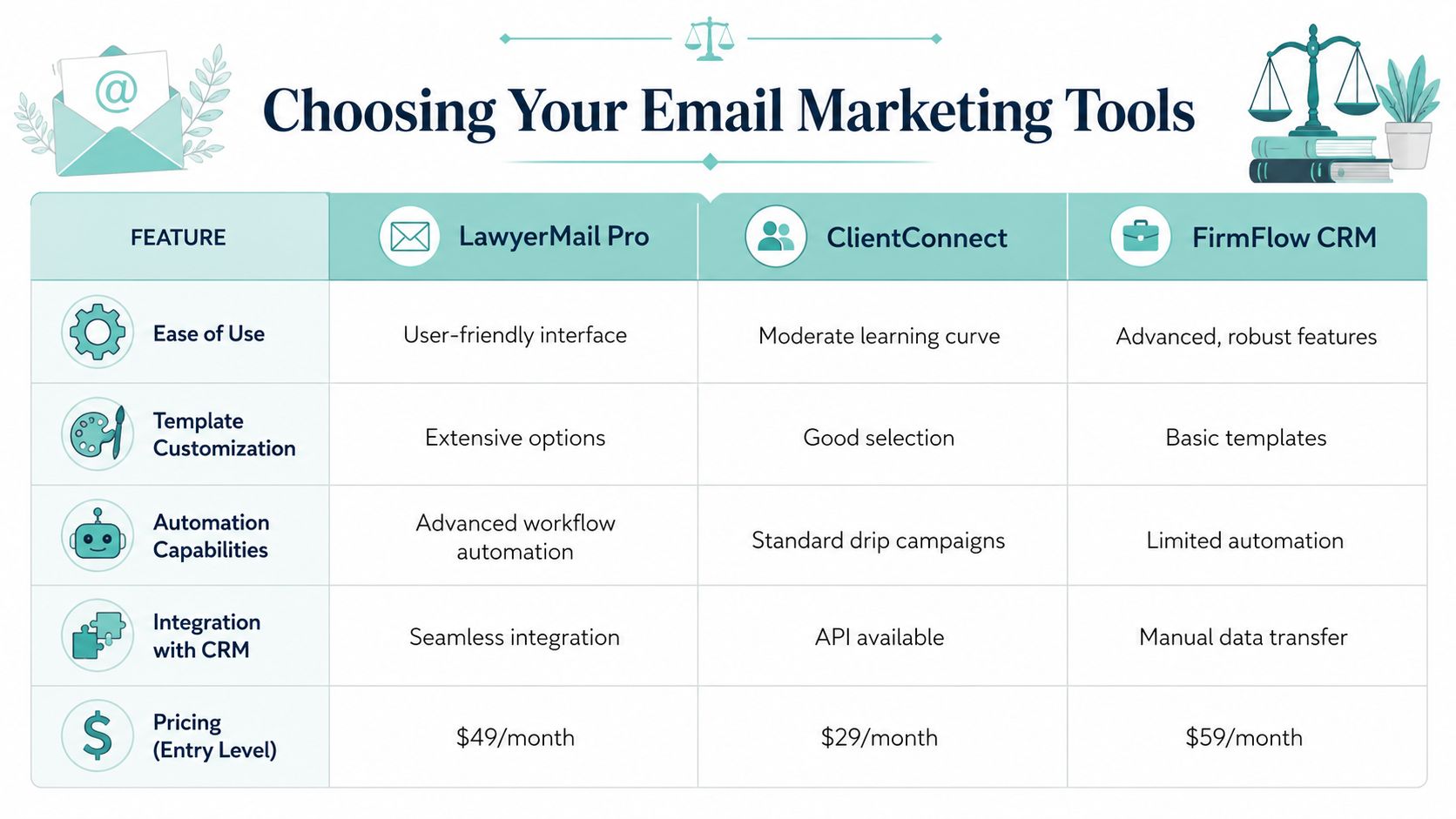
What to Look for in an Email Platform
For many firms, Mailchimp is enough. It handles basic segmentation, templates, and scheduling without much training. Constant Contact works similarly and is often comfortable for teams that want a simpler interface. Firms with a more complex intake process may prefer a CRM with email built in, especially if they want to track newsletter engagement alongside consultations and referrals.
The key evaluation criteria are practical:
- Ease of use: Can a coordinator build and send an issue without outside help?
- Segmentation: Can you separate former clients, prospects, and referral sources cleanly?
- Automation: Can the platform support welcome sequences or follow-up drips later?
- Reporting: Can you see clicks, replies, and audience-level behavior without exporting everything manually?
Monthly Beats Sporadic
The best frequency is the one your firm will sustain. For most firms, monthly is the right cadence. Quarterly is often too infrequent to maintain recall. Weekly is usually unrealistic unless the firm already has a strong content operation.
Template design should also be mobile-first. According to law firm conversion guidance focused on mobile and SEO foundations, over 60% of organic search visits to law firm websites come from mobile devices, and prioritizing mobile experience has been shown to increase inquiry volume by 196% in related digital marketing contexts. Email recipients behave the same way. They scan quickly, often on a phone, often between meetings.
That means your newsletter should have:
- A short opening paragraph
- One primary article or insight
- A visible call to action
- Buttons large enough to tap
- Minimal clutter in the header
If your intake depends on fast response after a newsletter-driven inquiry, the handoff matters too. Some firms pair the newsletter with a documented intake workflow or an answering service for law firms so after-hours replies and call spikes don't get missed.
Consistency beats complexity here. A plain, readable template sent on schedule will outperform an elaborate design that the team avoids using.
Measuring Success and Optimizing for Growth
A law firm newsletter should be judged like any other business development asset. Did it produce inquiries, strengthen referral relationships, or help signed matters happen faster? If the answer is unclear, the measurement system is too shallow.
Open rates have some use, especially for spotting sudden delivery problems or weak subject lines. They do not tell a partner whether the program is helping the firm grow. The stronger signals come later in the chain, after the reader decides to click, reply, forward, or contact the firm.
The Metrics That Matter More Than Opens
Track actions that connect to revenue and relationship quality.
- Article clicks: Which subjects hold attention for clients, prospects, or referral sources?
- Replies: Direct responses often surface legal needs, timing, objections, or warm introductions.
- Forwarding behavior: You may infer this from referral mentions, shared links, or inquiries that reference the email.
- Consultation requests tied to specific issues: This shows which topics move readers from interest to action.
- Referral mentions: Ask every new inquiry how they heard about the firm, then log the newsletter when it influenced the path.
A useful monthly review fits on one page:
| KPI | What it tells you |
|---|---|
| Click rate by article | Topic relevance |
| Reply volume | Relationship engagement |
| Consultation requests from email | Immediate business impact |
| Referral mentions after sends | Top-of-mind lift |
| Unsubscribes by segment | Relevance problems or list quality issues |
If engagement drops suddenly, check deliverability before rewriting the content. This guide on how to check if emails are going to spam is useful when inbox placement is the likely problem.
Tie Newsletter Activity to Intake Outcomes
Many firms stop at clicks because clicks are easy to report. That misses the main point. A newsletter is not just a content channel. It is a trust-building system that should feed the intake pipeline with better-informed, better-qualified contacts.
As noted earlier, law firms often lose growth at the handoff between inquiry, consultation, and signed engagement. That is why newsletter reporting should follow three simple questions:
- Did the newsletter produce an inquiry?
- Did that inquiry book a consultation?
- Did that consultation sign?
The trade-off becomes evident. A newsletter may generate interest without producing immediate matters, especially with referral sources or longer-cycle practice areas. That does not make it ineffective. It means the firm needs a longer attribution window and tighter intake tracking.
If the newsletter brings good-fit prospects into the funnel but conversion slows later, the issue is usually operational. Response time, intake quality, follow-up discipline, and landing page performance often decide whether interest turns into revenue. Firms that want clearer answers often connect newsletter reporting with conversion rate optimization services for law firm intake and landing pages.
The firms that get the best return from newsletters do not treat them as a vanity metric exercise. They use them to learn which messages build trust, which audiences produce referrals, and where the business development process breaks after a reader raises a hand.
Your Law Firm Newsletter Rollout Checklist
A newsletter program works best when the firm treats it like an operational system, not a creative side project. The rollout should be small enough to launch and structured enough to improve.
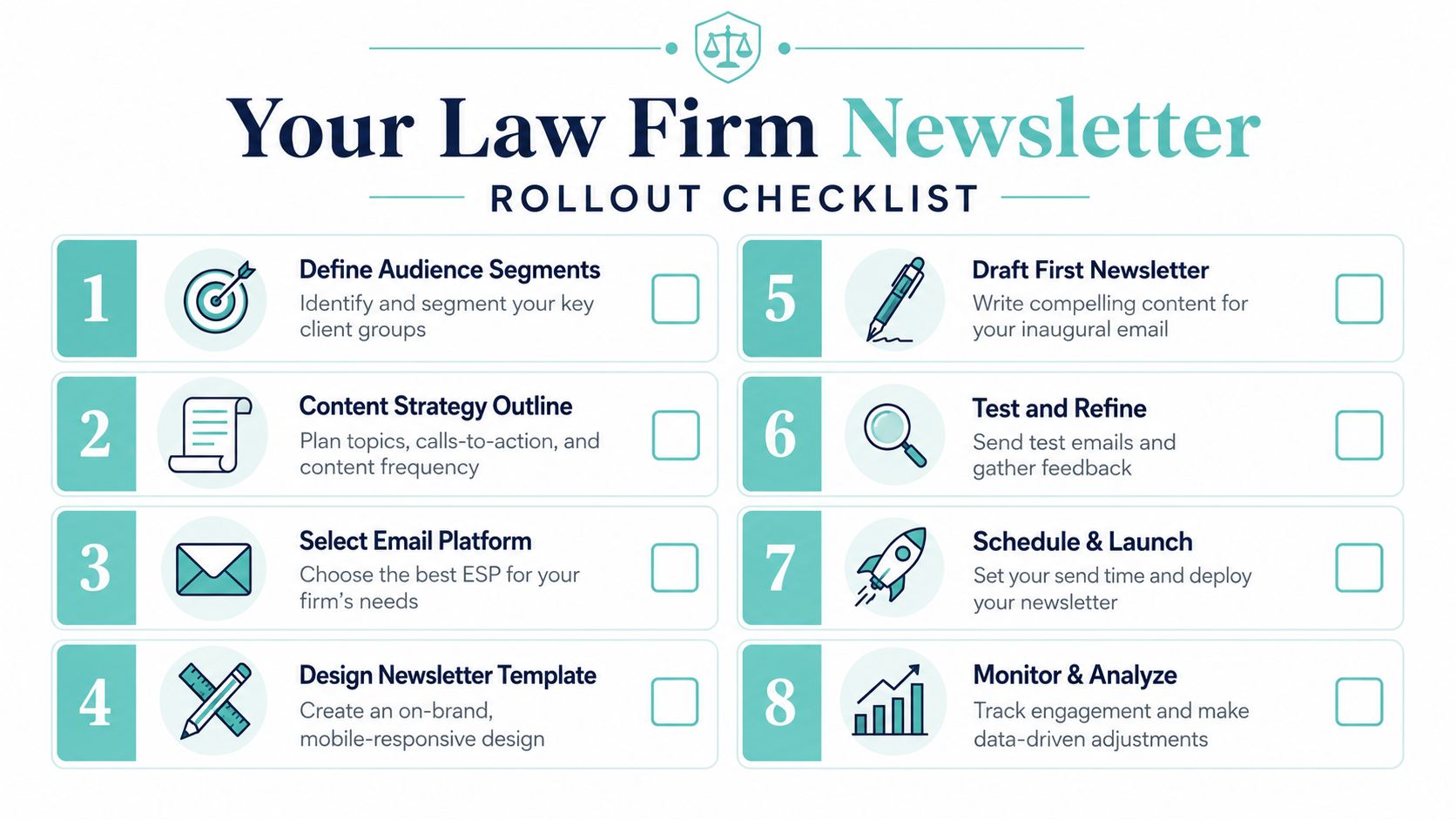
Use this checklist to get the first quarter in motion:
- Define the business goal: Choose the primary purpose. Referral generation, client retention, reactivation, or consultation growth.
- Clean the contact list: Remove outdated records, organize contacts by relationship type, and confirm who should not receive marketing email.
- Create three core segments: Prospects, existing or former clients, and referral sources.
- Choose the platform: Pick the simplest tool your team will use consistently.
- Build one mobile-friendly template: Keep branding professional and layout uncluttered.
- Set a three-issue content calendar: Start with common client questions and one issue designed for referral partners.
- Establish legal review: Assign approval responsibility for disclaimers, confidentiality, and advertising compliance.
- Define measurement rules: Decide how the firm will log replies, inquiries, consultations, and referral mentions after each send.
A newsletter becomes a growth engine when the firm commits to cadence, relevance, and follow-up all at once.
Many firms overthink the launch and underinvest in the rhythm. Don't wait for a perfect editorial machine. Build a workable one, send consistently, and improve from the evidence you collect.
If your firm wants better-qualified inquiries from organic search and a website that turns visibility into consultations, Digital Skyrocket helps law firms build and optimize lead-generating websites with focused SEO, AEO, and conversion strategy.