You're probably dealing with one of two problems right now. Either your phone rings with low-quality leads that go nowhere, or it doesn't ring enough when you need profitable jobs on the schedule.
That's where most roofers get stuck. They spend money on yard signs, wrapped trucks, lead platforms, boosted posts, or a cousin who “does websites,” then wonder why the jobs coming in feel random. One week is busy. The next is dry. And when leads do show up, they're often price shoppers talking to five other contractors.
Good digital marketing for roofers fixes that by building a system. Not a bundle of tactics. A system that helps the right homeowner find you, trust you, contact you, and choose you before your competitor gets the job. If it doesn't lead to qualified inspections, estimates, and signed contracts, it's noise.
Table of Contents
- Why Your Next Job Will Come From Google Not a Billboard
- Your Digital Foundation The High-Converting Roofer Website
- Dominating Your Service Area with Local SEO
- Building Authority with Content and Answer Engine Optimization
- Accelerating Leads with Paid Advertising
- Turning Website Visitors into Signed Contracts with CRO
- Tracking What Matters KPIs and Budgeting for Growth
- Conclusion Choosing Your Path DIY In-House or Agency Partner
Why Your Next Job Will Come From Google Not a Billboard
A bad lead usually looks the same. The homeowner barely remembers which company they contacted. They clicked through a lead marketplace, sent the same request to multiple roofers, and now your estimator is racing to be first while getting dragged into a price conversation before anyone has built trust.
A strong lead feels different. The homeowner searched for a roofer, reviewed your company, looked at your work, checked your service area, and called you directly. That lead is warmer before your team even picks up the phone.
That difference matters because homeowner behavior has already shifted. In a projected 2026 homeowner survey, 54% of homeowners primarily use online search engines to find roofing contractors, and 96% turn to the internet for research, according to roofing homeowner search behavior data. If you're not visible where they search, you're not even in the running for a large share of serious opportunities.
What that means in the field
Word-of-mouth still matters. Truck wraps still help. Referrals still close well. But those channels don't replace search anymore. They often feed into it.
A homeowner hears your name from a neighbor, then Googles you. They see your reviews, your website, your Google Business Profile, your photos, and the pages that explain whether you handle their exact problem. If that search experience looks weak, the referral doesn't save you.
Practical rule: Offline marketing can create awareness. Google decides whether that awareness turns into a lead.
There's another shift roofers can't ignore. AI-driven search is becoming part of how homeowners compare contractors. If you want a good overview of where search behavior is heading, this roundup of digital marketing trends for 2026 is worth reading because it shows why standard “just post more content” advice is already outdated.
Billboards create visibility. Search captures demand.
A billboard reaches people who may or may not need a roofer. Search reaches people actively looking for one. That's the key business difference.
The homeowner typing “roof leak repair near me” is already in-market. They have urgency. They have intent. They often have money or insurance involved. Digital marketing for roofers works best when it's built around those moments instead of chasing broad awareness and hoping demand appears later.
If your next growth phase depends on better jobs, not just more noise, Google is where the fight starts.
Your Digital Foundation The High-Converting Roofer Website
A homeowner finds your company at 9:30 p.m. after a leak starts dripping through the ceiling. They are on a phone, comparing three roofers, and trying to decide who feels credible enough to call first. Your website either shortens that decision or gives the job away.
That is the standard. A roofer website has to help you win qualified leads and better jobs, not just sit online and look respectable.
Your site has one job
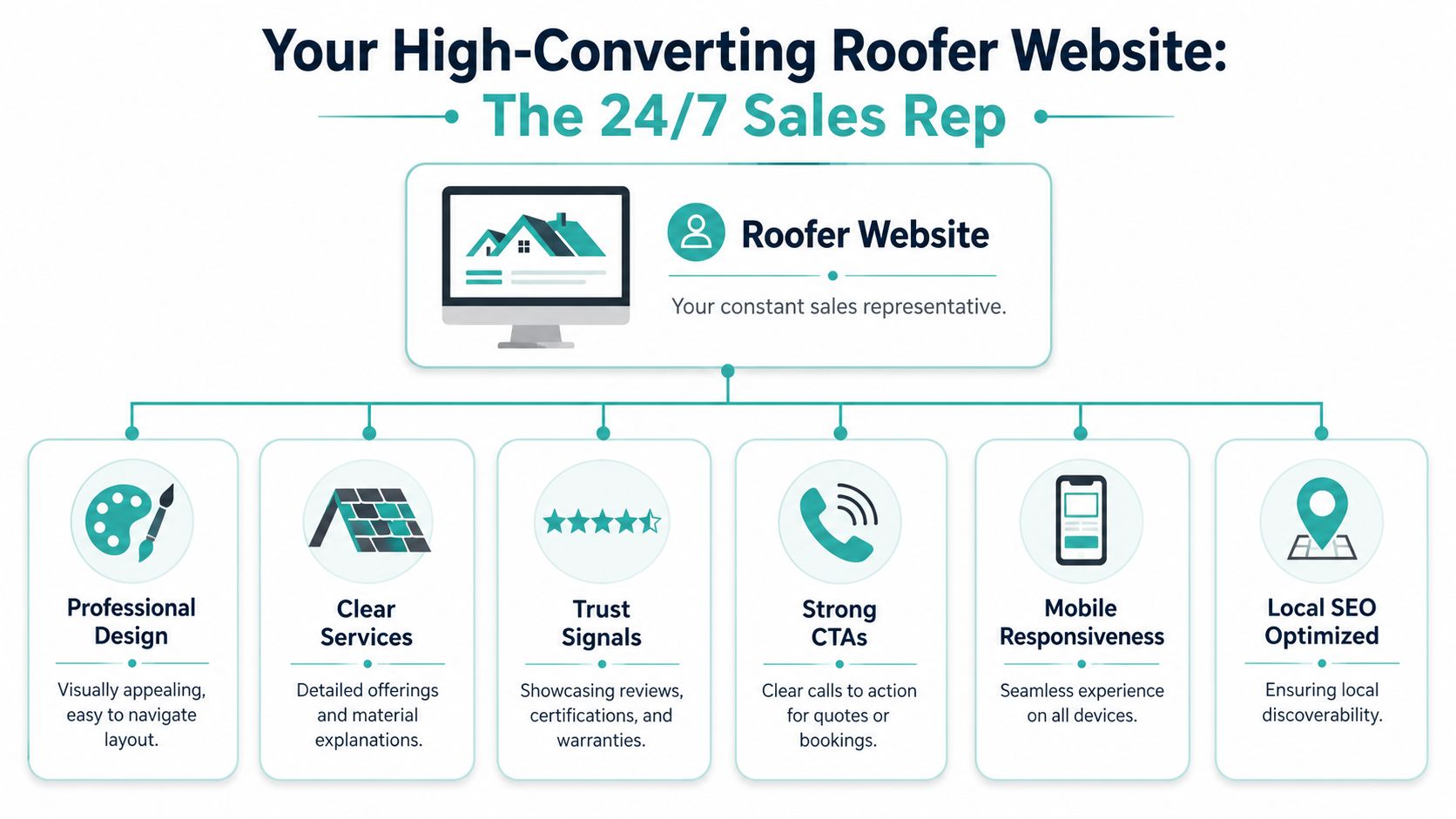
The homepage should answer four questions fast. What do you do? Where do you work? Why should someone trust you? What should they do next?
Roofing contractors lose leads when those answers are buried under vague slogans, thin service descriptions, or a design that forces people to hunt for basic information. Good websites reduce doubt. Great ones pre-qualify the lead before the phone rings.
That means clear service positioning, visible proof, and direct calls to action.
A strong roofer website usually includes:
- Clear service pages: Separate pages for roof repair, replacement, storm damage, inspections, commercial work, and specialty systems.
- Visible trust markers: License details, insurance status, manufacturer certifications, warranty coverage, and recent reviews.
- Real project visuals: Actual crew photos, trucks, in-progress work, and completed jobs in your market.
- One primary action: “Request an Inspection” or “Get an Estimate” works better than splitting attention across too many equal choices.
If you want a practical model for layout and lead flow, this guide to web design for roofers focuses on turning traffic into calls and form fills.
What to place above the fold
The top section of the page does more sales work than roofers usually think. People with active leaks, storm damage, or insurance questions scan first and read second.
Put the core decision points at the top:
| Element | What the homeowner should see |
|---|---|
| Primary headline | The main service and the cities you serve |
| Phone CTA | A tappable number on mobile |
| Inspection CTA | A short button with a direct next step |
| Trust proof | License, insurance, warranty, reviews |
| Visual proof | A real job photo from your team |
Google's own guidance on creating helpful, reliable, people-first content lines up with what converts in roofing. Show clear answers, real expertise, and proof that your company is legitimate. That helps both rankings and lead quality.
AEO matters here too. AI search tools and Google's evolving results pull fast answers from pages that state things clearly. If your site explains service areas, repair types, warranty terms, and inspection process in plain language, you improve your chances of showing up in those answer-driven results. That visibility matters only if the page also makes contact easy.
What hurts conversions fast
A lot of roofing sites fail in predictable ways, and each one has a real cost.
- Too many menu choices: People looking for urgent help should not sort through a maze of pages.
- Long contact forms: Early-stage leads do not want homework. Name, phone, address, and project type are usually enough.
- Generic copy: “Quality roofing solutions” does not sell. “Hail damage roof repair in Plano with insurance claim support” does.
- Weak mobile experience: Slow load times, tiny buttons, and cluttered layouts lose calls.
- One-page service structure: Sending every visitor to the homepage lowers relevance and makes both SEO and AEO harder.
One trade-off is worth stating plainly. A cleaner website with fewer words often converts better on paid traffic, but organic search and AI search still need enough detail to understand what you do. The answer is not thin copy. The answer is focused copy on the right pages.
A good roofer website builds trust quickly, answers key buying questions, and turns search demand into booked inspections. That is the foundation every other marketing channel depends on.
Dominating Your Service Area with Local SEO
Most roofing companies don't need national visibility. They need to win the map, the city, and the nearby towns that produce profitable work.
That's why local SEO matters so much. When someone searches for roof repair, storm damage help, or a roof replacement contractor in your area, Google has to feel confident that your business is relevant, legitimate, and local. If it does, you show up. If it doesn't, another roofer gets the call.
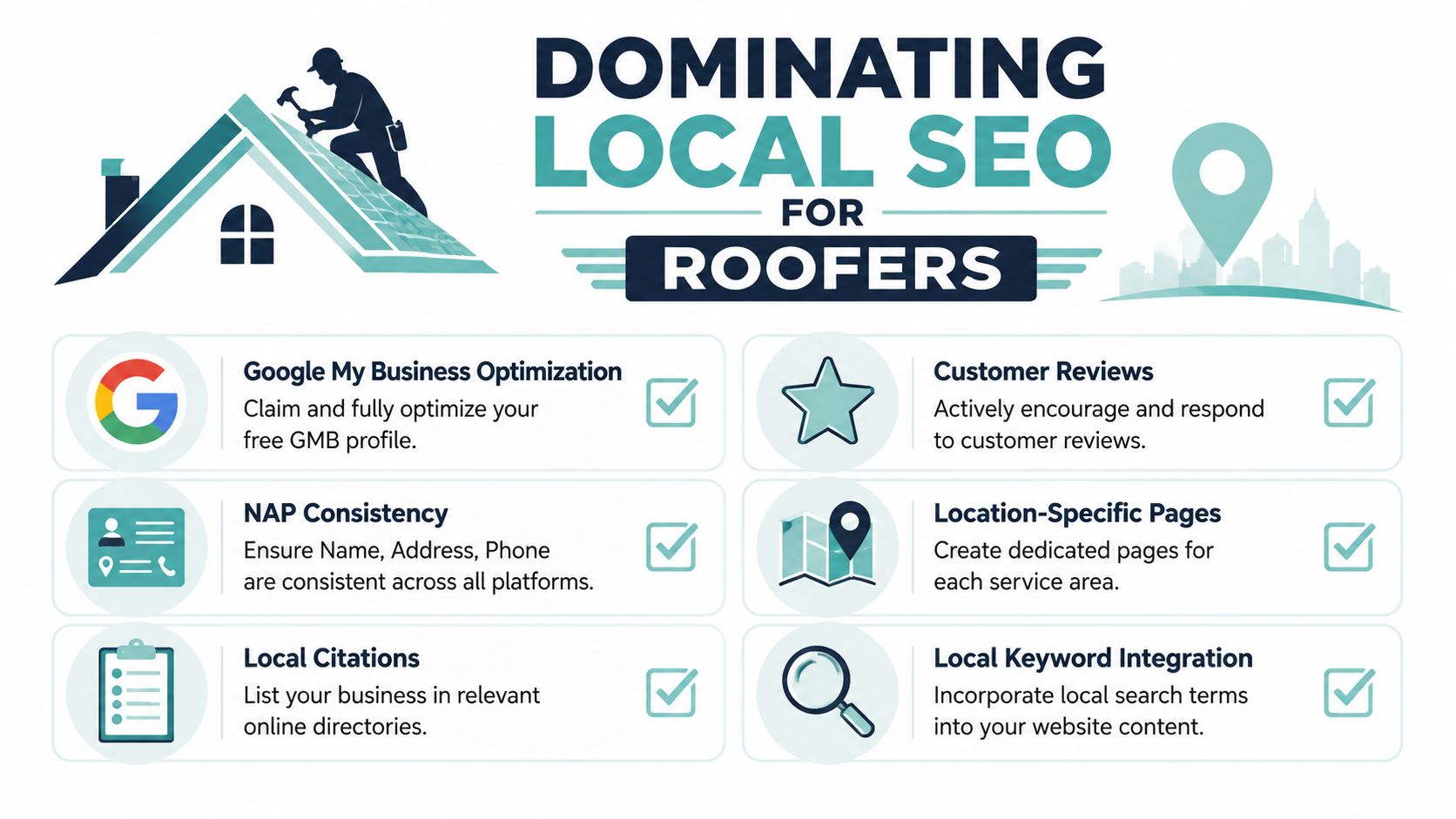
Google Business Profile comes first
Your Google Business Profile is often the fastest local visibility lever available. It feeds Maps visibility and heavily influences whether a homeowner chooses to click, call, or move on.
Start with the basics and get them right:
- Claim and verify the profile
- Use your exact business name consistently
- Set the right primary and secondary categories
- List services clearly
- Add real project photos regularly
- Keep hours accurate
- Answer reviews and questions
If your business recently moved or your listing data is messy, fixing that early matters. This walkthrough on how to change your address on Google is relevant because bad location data can weaken local trust signals.
Service-area pages do the heavy lifting
A lot of roofers stop at a Google profile and wonder why rankings stall. The answer is usually on the website.
According to technical SEO benchmarks for roofing contractors, implementing mobile-first design and local business schema can increase visibility in Google's local pack by 35%. The same source notes that sites with structured service-area pages generate 2.3x more qualified leads.
That matters because Google needs local proof from your website, not just your listing.
A useful service-area page should include:
- The city and service in the headline: “Roof Repair in Tyler” works better than “Our Roofing Services”
- Specific local context: Mention the kinds of roofing issues common in that market
- Relevant proof: Reviews, job photos, and project references from that area
- Internal links: Connect city pages to service pages and vice versa
- A local FAQ section: Answer the questions homeowners in that city ask
Local trust signals that actually matter
A roofer doesn't need every SEO trick. They need the right local signals lined up correctly.
Here's the short list that usually produces the clearest impact:
- NAP consistency: Your business name, address, and phone should match across your website, directories, and Google profile.
- Schema markup: Local business details help search engines understand who you are, where you operate, and what you offer.
- Review momentum: Fresh reviews matter more than a dusty profile.
- Location-page depth: Thin city pages don't carry weight. Useful ones do.
Field note: The companies that win local search usually aren't doing magic. They're doing the basics better and more consistently than everyone else.
Local SEO for roofers pays off because it captures intent close to the decision. A homeowner searching in your service area isn't browsing for entertainment. They're trying to hire someone.
Building Authority with Content and Answer Engine Optimization
A lot of roofing content fails because it's written like homework. Generic blog post titles. Thin service pages. City pages with the same paragraph swapped out fifty times. None of that builds authority, and it doesn't help you show up in AI-driven search results either.
The better approach is simple. Build pages that answer real homeowner questions with enough clarity that both Google and AI systems can understand them.
According to AEO guidance for roofing contractors, 40% of homeowners use AI assistants for initial queries. That changes what good content looks like. It's no longer enough to rank a generic page. Your site needs dedicated service-area pages and FAQ sections built for answer retrieval, not just keyword stuffing.
AI search changes what a good page looks like
Search engines still crawl pages. AI systems also extract answers.
That means your page structure matters more than ever. A page on metal roof repair shouldn't be one long sales pitch. It should have clear subtopics, direct explanations, and a FAQ section that answers specific questions such as whether repair is possible, how leaks are diagnosed, what signs require replacement, and whether insurance may apply.
Good AEO content usually includes:
- A focused page topic: One page for one service or one location intent
- Clear headings: They help both readers and machines interpret the page
- Direct answers near the top: Don't bury the useful part
- FAQ blocks: Short, plain-language responses work well
- Supporting detail below: Add expertise after the answer, not before it
What to publish instead of generic blogs
Most roofers don't need more vague “roofing tips” content. They need pages that line up with how customers search.
That usually means building out:
- Core service pages: Roof repair, roof replacement, inspections, storm damage, commercial roofing, metal roofing, TPO, shingle systems
- City pages: One for each meaningful service area
- Problem-based pages: Hail damage, active leaks, flashing failures, flat roof ponding, insurance claim support
- FAQ-driven resources: Short answers to common questions that support service and city pages
If you want a practical keyword lens for these pages, this resource on long-tail SEO helps because roofing searches often come with location, urgency, and problem-specific wording.
The roofer who answers the homeowner's real question before the phone call usually starts that sales conversation ahead.
One important trade-off. Don't publish city pages just to have them. A thin page weakens trust. A useful page strengthens it. If you serve a city, prove it with substance. Mention the service. Show the context. Add FAQs. Link to related pages. Make the page worth indexing.
Content and AEO work because they build pre-sale trust. By the time a homeowner calls, they've often already decided whether your company sounds credible, local, and experienced enough to invite out.
Accelerating Leads with Paid Advertising
Paid ads can fill the pipeline fast. They can also burn cash fast.
That's why roofers should treat paid traffic as an accelerator, not the foundation. If your website is weak and your service pages are vague, ads will send more people to a page that doesn't convert. If the foundation is solid, paid search can help you capture urgent demand right now.
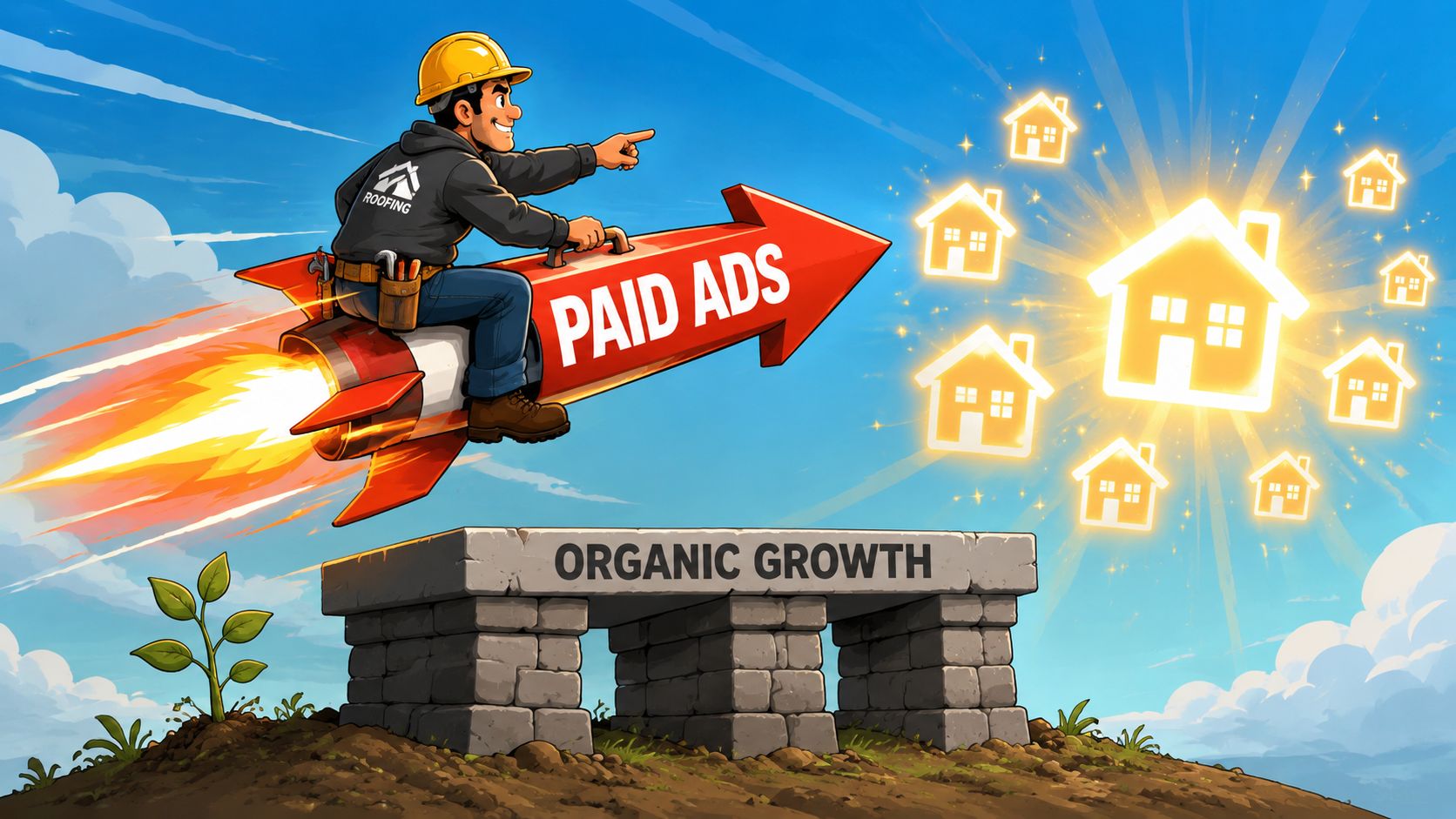
Where paid ads fit
For roofing, the best paid opportunities usually come from high-intent search activity. Someone has damage, a leak, an insurance issue, or a replacement timeline. They need a contractor, not brand storytelling.
In practice, many roofers should look at paid channels in this order:
- Local Service Ads first: They often align better with direct lead generation because homeowners are already looking for contractors.
- Google Ads second: Best used for tightly targeted service and emergency searches.
- Paid social later: Better for awareness and remarketing than immediate high-intent demand.
What to expect from Google Ads
According to roofing paid advertising benchmarks, roofing leads generated through Google Ads have an average conversion rate of 12.5%, with cost per lead typically ranging from $60 to $150, and those costs have increased by 25% since 2020. That tells you two things. Google Ads can work, and sloppy campaign management gets expensive.
If you run search campaigns, keep them tight:
| Better approach | Weaker approach |
|---|---|
| Separate campaigns by service intent | One campaign for every roofing keyword |
| Send clicks to relevant landing pages | Send all clicks to the homepage |
| Use local targeting | Run broad, loose geographies |
| Match calls and forms back to keywords | Judge success by clicks alone |
A good operator also pays attention to wasted spend. Search terms, locations, timing, and landing page quality all matter. If you want a useful reminder of how testing protects budget, these 670 ad experiment insights make the case well.
Paid ads work best when you already know which jobs you want more of. Emergency residential repair. Insurance-driven storm work. Commercial flat roof inspections. Specific intent produces cleaner campaigns. Broad intent produces messy lead quality.
Turning Website Visitors into Signed Contracts with CRO
A homeowner in your service area lands on your site after spotting a ceiling stain. They need an answer fast. If the page makes them hunt for a phone number, second-guess whether you are licensed, or fill out a long form before they can ask a simple question, they leave and call the next roofer.
That is the primary job of CRO. Get more qualified calls, form fills, and inspection requests from traffic you already paid for or worked to earn. For roofers, that usually means less wasted ad spend, better lead quality, and more estimates from the same number of visitors.
The biggest conversion problems are rarely complicated. They are usually friction problems.
A high-converting roofing page makes the next step obvious and low-risk. The phone number should be tappable on mobile. The primary call to action should sit above the fold. Forms should ask for the minimum needed to book the next step, not every detail of the project. Proof should sit close to the action point, including reviews, license information, insurance, manufacturer certifications, financing options, and warranty details.
Here is the trade-off. A shorter form usually increases lead volume, but it can lower lead quality if it invites tire-kickers. A longer form can filter weak inquiries, but it also suppresses real opportunities. For most roofers, the best middle ground is simple. Name, address, phone, email, service needed, and a short message box. Let your office qualify the rest on the call.
Intent matters just as much as layout. Someone searching for emergency roof repair wants speed, availability, and a fast inspection process. Someone researching a full replacement wants proof, financing information, material options, and confidence that your crew can handle a larger job. Pages that match that intent convert better because they answer the question behind the click.
This is also where AEO supports CRO. If your content already answers the specific question that brought the visitor in, such as whether insurance may cover hail damage or how quickly a leak inspection can happen, the page does more than rank. It pre-sells the next conversation. That shortens trust-building and improves the odds that the lead turns into a profitable contract instead of a price-shopping inquiry.
Video can help if you use it well. A short clip from the owner, estimator, or project manager explaining what happens after a form submission can reduce hesitation. Keep it plain and practical. Skip the drone-heavy brand reel unless it serves a purpose on that page. These ideas on increase conversions for landing page videos are useful because they focus on trust and clarity.
A good CRO process for roofers is simple:
- Check mobile first: Many roofing leads come from phones, especially urgent repair searches.
- Put one primary action on each page: Call now, request inspection, or book an estimate. Do not split attention across five competing buttons.
- Place proof next to the form: Reviews and certifications work better near the decision point than buried on a separate page.
- Write CTAs that match the job: “Request Roof Inspection” is stronger than “Submit.”
- Test service-specific pages: Emergency repair, storm damage, replacement, and commercial roofing should not all use the same message.
Good CRO cuts waste. It turns more of your existing traffic into real sales conversations, and it helps your SEO, AEO, and paid traffic produce actual roofing jobs instead of just more visits.
Tracking What Matters KPIs and Budgeting for Growth
Most roofing companies track too much of the wrong stuff and not enough of the right stuff. Impressions. Reach. Clicks. Those numbers can be useful diagnostics, but they don't tell you whether marketing is producing profitable work.
The KPIs that matter are closer to revenue.
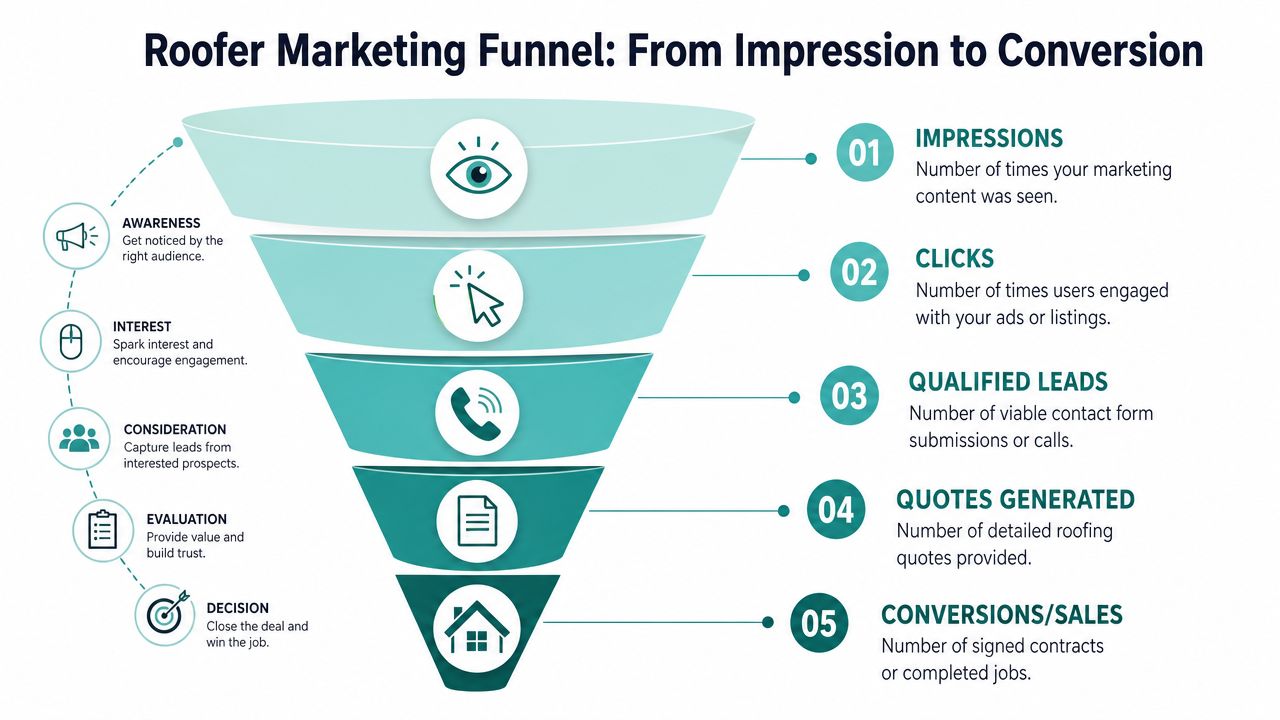
Stop obsessing over vanity metrics
A roofer should know, at minimum:
- Qualified leads: Calls and forms from people in the right service area asking for the right work
- Lead source: Google organic, Google Business Profile, paid ads, referral, direct
- Lead-to-estimate rate: How many inquiries become inspections or quotes
- Estimate-to-close rate: How many quotes turn into signed jobs
- Cost per qualified lead: What you paid to generate a real opportunity
- Customer acquisition cost: What it cost to win a customer
That last metric keeps owners honest. A campaign can look busy and still be unprofitable if it attracts poor-fit jobs or low close-rate leads.
A simple budgeting model
Budgeting works better when you reverse-engineer from a revenue target. One benchmark states that a mid-sized roofing company aiming to capture 10% of projected $1.6M revenue should target 160 leads annually and plan for an online marketing budget of approximately $280,000, as outlined in this roofing lead and budgeting example.
You don't need to copy that model exactly. You do need the logic behind it.
Start here:
- Set a revenue target
- Estimate average job value
- Determine how many closed jobs you need
- Look at your close rate from estimate to sale
- Work backward to the number of qualified leads required
- Set channel budgets based on lead quality, not guesswork
Here's the part many roofers miss. Different lead sources produce different job quality. A search-driven lead looking for a contractor in your exact service area often behaves differently from a cold social lead or a shared directory lead. If you don't track that difference, you can't budget intelligently.
The cleanest marketing dashboard for a roofer is the one that ties every lead source back to sold work.
Conclusion Choosing Your Path DIY In-House or Agency Partner
The playbook is straightforward even if the execution isn't. You need a website that converts, local visibility that puts you in front of active buyers, and content that answers real roofing questions well enough to win both traditional search and AI-driven search.
That's the modern version of digital marketing for roofers. Not random posting. Not vanity branding. A lead system built around search intent, trust, and conversion.
The real choice is time plus skill
Most roofers have three options.
DIY works if you have time, patience, and enough technical ability to manage a website, write pages, improve local SEO, handle reviews, and monitor performance. The upside is control. The downside is that execution usually becomes inconsistent once production, estimates, and hiring get busy.
In-house can work if you're large enough to support a skilled marketing hire. The challenge is range. One person may be decent at content but weak at technical SEO, web design, local optimization, or CRO.
Agency partner makes sense when you want specialized execution and tighter accountability. The risk is choosing the wrong one.
Why specialists usually win
That last point matters because the roofing industry has already seen a lot of weak marketing work. According to roofing SEO industry statistics, 98% of roofing website content generates zero traffic, and 70% of roofing companies are unhappy with their SEO provider.
That doesn't mean SEO doesn't work. It means generic execution fails.
If you hire outside help, ask direct questions:
- Do they build websites for lead generation or just design?
- Can they explain local page structure clearly?
- Do they understand AEO and FAQ architecture for AI search?
- How do they tie rankings to calls and form submissions?
- Will they work with your direct competitors in your market?
A specialist usually wins because they've already seen the common roofing mistakes. Thin city pages. Generic service copy. bad mobile layouts. weak trust signals. disconnected reporting. They know how to fix the core bottlenecks instead of hiding behind jargon.
The right move depends on your stage, your team, and how fast you need growth. But if your goal is more qualified leads and better jobs, the answer usually isn't “do more marketing.” It's “build a tighter system.”
If you want help building that system, Digital Skyrocket focuses on lead-generating websites, local SEO, answer engine optimization, and CRO for service businesses that need more qualified inquiries from Google. They don't do everything, and that's the point. Their work is built around the parts of digital marketing that most directly affect search visibility, trust, and conversion.