
Most local keyword research still begins with the same advice: type your service, add your city, and export the phrases with the highest volume. That shortcut produces tidy spreadsheets, but it often misses the searches that signal a customer is ready to act. “Service + city” is a useful starting point, not a local SEO strategy.
Modern keyword research for local SEO has to account for proximity, urgency, mobile behavior, conversational questions, and the difference between a query that deserves a page and one that belongs in a paragraph, FAQ, or Google Business Profile. The strongest keyword map reflects how people look for help, not how marketers prefer to label a spreadsheet.
Table of Contents
- Why Most Local Keyword Research Fails Before It Starts
- Building Your Local Keyword Seed List From Real Business Data
- Validating Keywords Against Local Search Reality
- Mapping Keywords to Pages and Locations Without Cannibalization
- Prioritizing Keywords by Intent Quality and Competitive Difficulty
- Tracking and Evolving Your Local Keyword Strategy Over Time
Why Most Local Keyword Research Fails Before It Starts
The familiar formula, “roofing contractor + city” or “personal injury lawyer + city,” isn't wrong. It's incomplete. A city modifier tells Google where the service is relevant, but it doesn't tell you whether the searcher wants an explanation, a comparison, directions, immediate availability, or a phone call.
Google's own historical data showed that mobile searches containing “near me” grew by more than 500% over two years. During the same period, searches shaped like “___ near me today/tonight” rose by more than 900%, while “Open + now + near me” increased by more than 200%. Google also highlighted more than 150% growth in “___ near me now” searches in its analysis of near-me search behavior. These aren't merely alternate ways to add a location. They express urgency and availability.
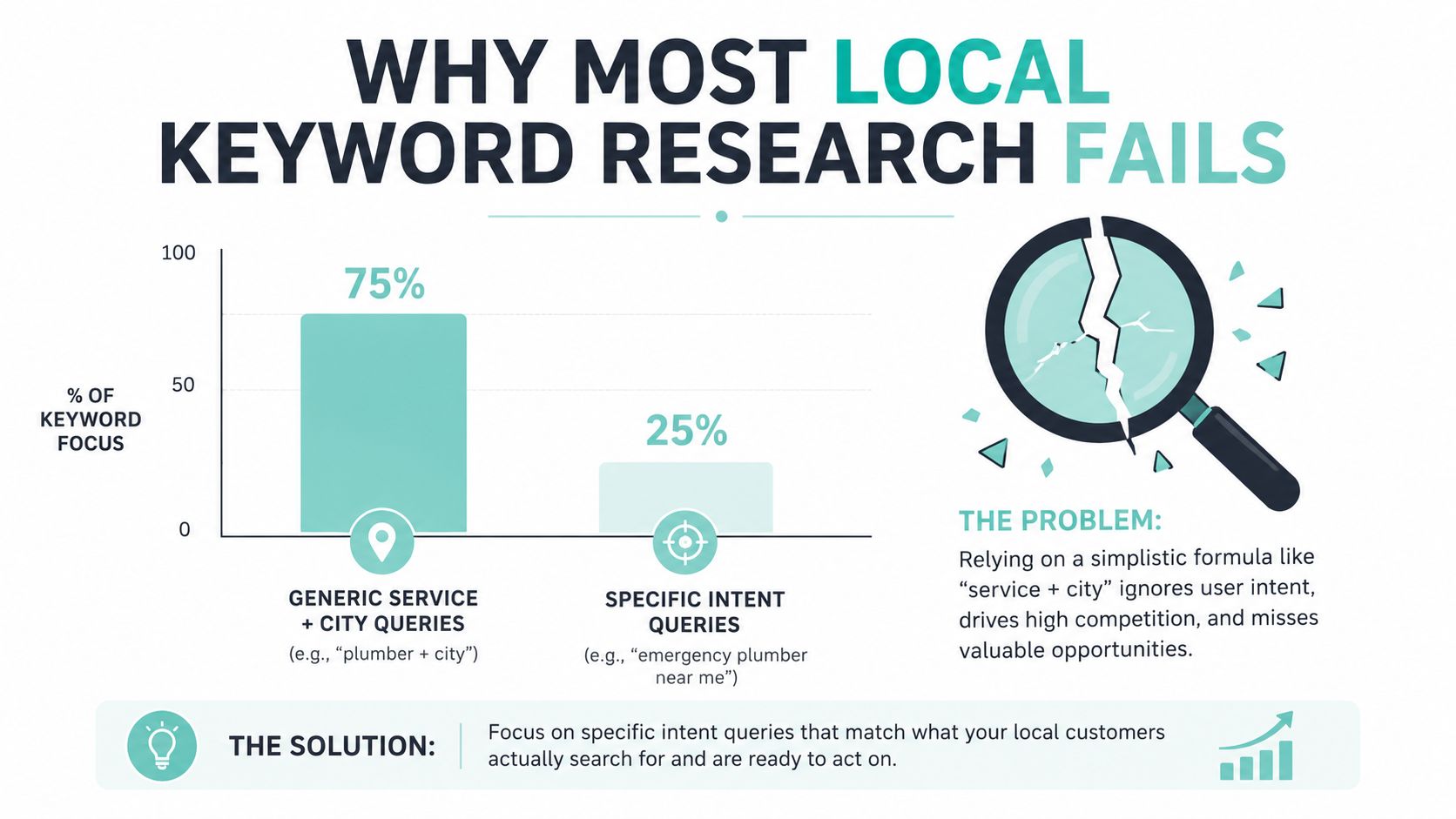
A person searching “emergency HVAC repair open now” has a different need from someone searching “how does a heat pump work.” Treating both as variations of “HVAC company Dallas” leads to weak page assignments, generic copy, and missed conversion opportunities.
Geographic terms aren't intent signals
Local queries generally fall into several practical groups:
- Informational searches ask for knowledge, such as “how to stop a leaking roof.”
- Commercial searches compare options, such as “best roofer near downtown.”
- Transactional searches show immediate readiness, such as “emergency roofer near me.”
- Navigational searches seek a known business, address, phone number, hours, or directions.
- Availability searches add terms such as “open,” “today,” “tonight,” or “same day.”
The mistake is assuming every phrase containing a city deserves a dedicated landing page. Many variants produce nearly identical results. Others reveal a completely different task and need a different content format.
Local SEO isn't national SEO with a ZIP code
National SEO often emphasizes broad topical coverage and authority. Local SEO still needs those foundations, but Google also evaluates relevance, distance, and prominence, as explained in its official guidance on local ranking results. A perfectly optimized page can't overcome every distance constraint, and a high-volume keyword doesn't guarantee visibility in a specific neighborhood.
That changes the research question. Instead of asking, “Which city phrase has the biggest volume?” ask, “What does this searcher need, where are they located, and which Google surface answers that need?” The answer may point to a service page, a location page, a map listing, a review, or a concise FAQ.
Practical rule: Use “service + city” to create your first seed. Never use it as the final structure for your entire local keyword map.
Building Your Local Keyword Seed List From Real Business Data
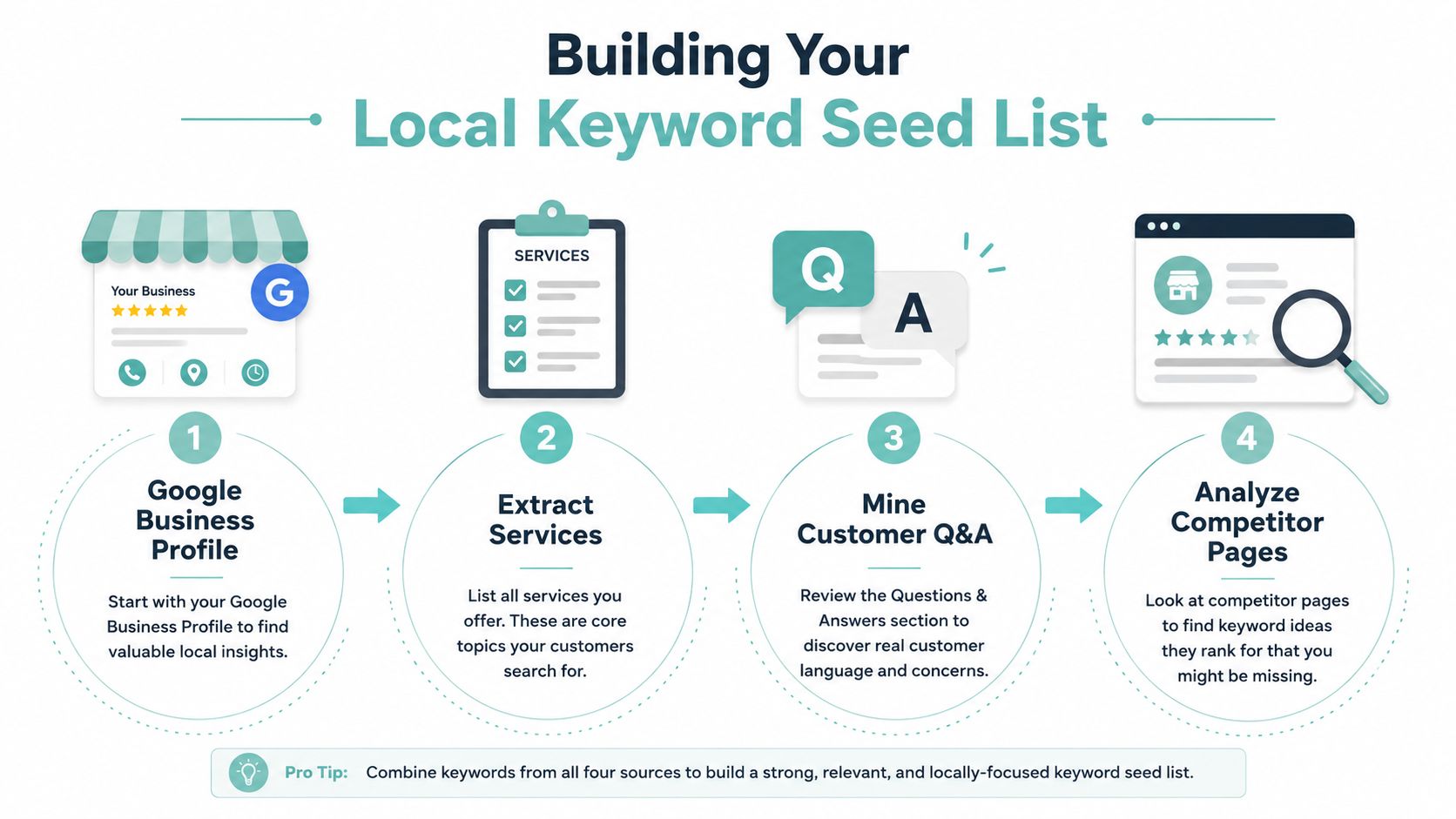
The best seed list usually starts inside the business, not inside a keyword tool. Customer calls, intake forms, chat messages, reviews, staff notes, and support questions reveal the language people use when they describe a problem. Tools can expand and validate that language, but they can't reliably invent every regional phrase or customer-specific description.
Begin with the business's primary and secondary Google Business Profile categories. A law firm might use personal injury attorney as its primary category and add relevant secondary categories that accurately describe its practice. A roofer could begin with roofing contractor, then examine related services such as roof repair or emergency roofing if those services exist. An HVAC company might separate heating, cooling, maintenance, and emergency repair themes. A dental practice could distinguish general dentistry, cosmetic dentistry, emergency dentistry, and pediatric services where the profile categories fit the actual business.
Search Engine Land recommends building the initial list around the brand, services, and major amenities, then expanding it with Google Autocomplete, Google Business Profile Performance, and Searches Breakdown data. That sequence keeps the research connected to real search behavior instead of starting with assumptions.
Expand by service, problem, and context
Create separate groups for:
- Core services, such as “roof replacement,” “car accident lawyer,” “AC repair,” or “root canal.”
- Problems, such as “hail damage roof,” “rear-end accident attorney,” “AC not blowing cold air,” or “tooth pain dentist.”
- Modifiers, including “emergency,” “same day,” “affordable,” “free consultation,” “walk-in,” “open Saturday,” and “near me,” when they accurately describe the offer.
- Geography, including cities, neighborhoods, ZIP codes, landmarks, and service-area descriptions.
- Questions, such as “can a roofer repair a leaking chimney” or “how much does a dental implant consultation involve.”
Competitor categories and service menus can reveal gaps, but don't copy every phrase a competitor uses. A competitor may rank for a term because of distance, prominence, reviews, or established relevance. Add a phrase only when it matches your services and customer intent.
For businesses working on long-tail variations, Digital Skyrocket's long-tail SEO workflow provides a useful way to combine Autocomplete, People Also Ask, Search Console, community discussions, and competitor language with local modifiers.
Keep the list organized
A spreadsheet should include the phrase, service topic, location, intent type, likely page, Google Business Profile relevance, and validation status. Group synonyms that produce the same search intent rather than giving every wording variation its own row of planned content.
The aim isn't to collect the largest list. In a dataset of approximately 4.5 million unique keywords, research recommended selecting the highest-demand candidate for each distinct topic, repeating the process across primary and secondary categories, and validating candidates through local searches. The resulting practical range was 3 to 7 keywords per location for distinct local search topics, as documented in the ACM study of local keyword selection.
Validating Keywords Against Local Search Reality
Keyword tools are useful for discovery, but local SERPs decide whether a phrase deserves attention. A keyword can show attractive national demand and still be a poor target if the search results don't match your service area, the query triggers a different intent, or the top results are dominated by businesses you can't realistically displace.
Start with a local test search from the target market. Use a location-specific browser setting, a neutral device, or a rank-tracking platform that supports local coordinates. Then record what Google displays, not just the phrase and its estimated volume.
Read the result page before assigning a URL
Look for the dominant result types:
- Local Pack or Maps results indicate that Google interprets the query as local and may connect it to your Google Business Profile.
- Local Services Ads show a paid local provider surface, but they don't prove that an organic service page should target the same phrase.
- Organic service pages suggest a page-based opportunity with a commercial or transactional angle.
- Featured snippets, People Also Ask, or answer-focused results often indicate an informational question that belongs in a guide or FAQ.
- Directions, hours, and address results signal a navigational or utility task, where profile accuracy may matter more than a new article.
Local search is broad behavior rather than a niche corner of Google. Industry sources report that 46% of Google searches have local intent, and a Statista-based estimate found that 56% of U.S. online consumers searched for local businesses through mobile browsers. An earlier Search Engine Land summary reported that 80% of “near me” searches came from mobile devices. These figures are compiled in BizIQ's local search statistics overview. Your validation process should therefore include mobile phrasing and mobile SERP inspection.
Test the language customers use on the move
Mobile users often search with compressed phrases, practical modifiers, and immediate needs. A person may type “dentist open Saturday” rather than a full sentence. A homeowner may use “water heater repair near me now.” A voice assistant user may ask, “Who can fix my furnace tonight?”
Don't force every literal modifier onto a page. Google can infer local intent from context and location, and repeating “near me” throughout a page is not a substitute for accurate business data. Use those phrases to understand the task, then make the page answer the task clearly.
Check SERP overlap
Search two related terms and compare the results. If “emergency plumber Austin” and “plumber open now Austin” return nearly the same businesses and page types, they likely belong to one intent cluster. If “commercial roof repair Austin” produces a distinct set of competitors and service pages, it may deserve its own target.
A useful validation record includes:
- The location used for the test.
- The result types shown.
- The recurring competitors.
- The page types ranking.
- The degree of overlap with related phrases.
- The action the searcher appears ready to take.
BrightLocal's research emphasizes that local queries are shaped by geography, mobile context, and task type, with geographically focused tasks representing at least 13% of web queries and 56% of on-the-go searches carrying local intent. Its local SEO statistics resource supports a practical conclusion: local relevance comes from context, not raw keyword wording alone.
Mapping Keywords to Pages and Locations Without Cannibalization
A keyword map should make ownership obvious. Each important search topic needs one primary URL, one clear search intent, and a logical connection to the relevant location or Google Business Profile. When several pages target the same intent, they compete with each other and make performance harder to diagnose.
Give each page type a defined job
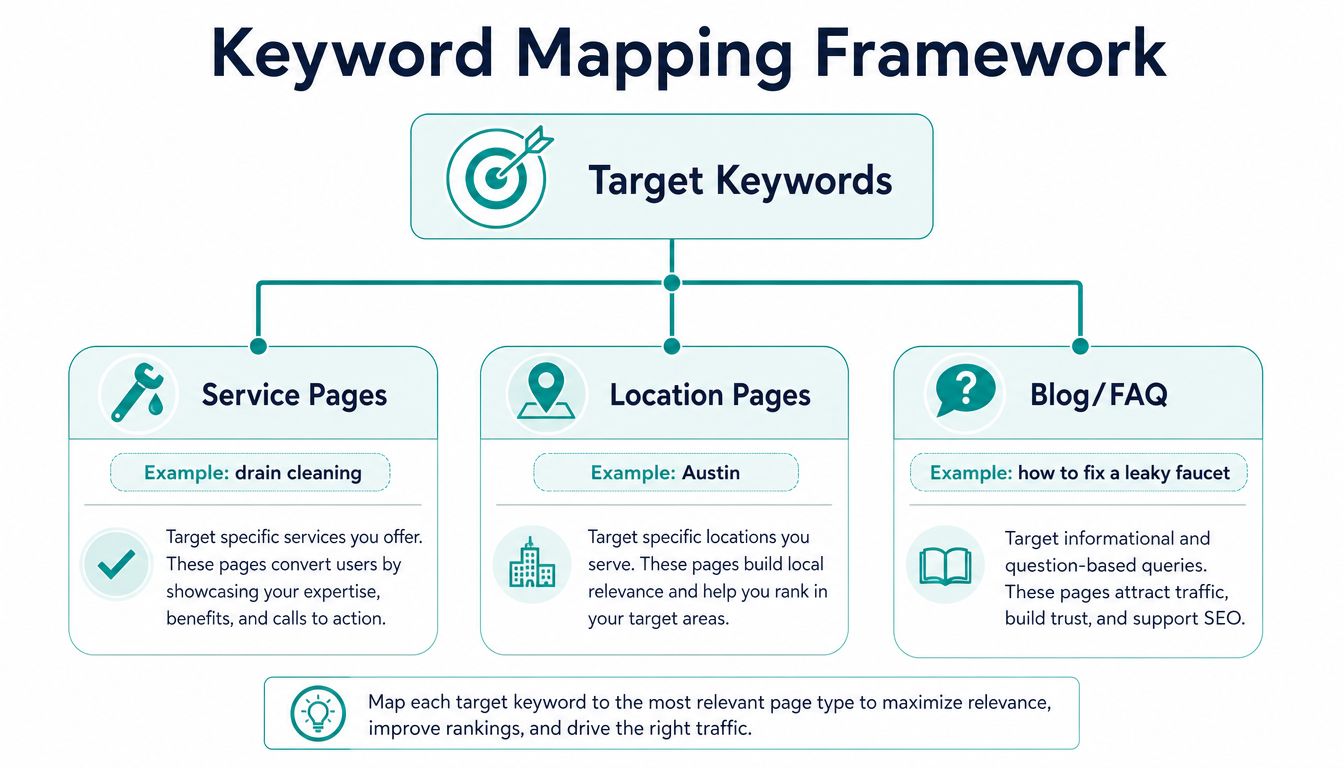
A service page should target a service and its meaningful variants. For a roofer, “roof repair,” “emergency roof repair,” and “roof leak repair” may belong together if the local SERP shows the same intent. A separate page can make sense for “commercial roof repair” if the audience, process, proof, and competitors differ.
A location page should explain the business's genuine presence or service coverage in that area. It needs local substance, such as relevant services, service limitations, staff or office details, nearby areas served, testimonials, and useful contact information. Swapping city names into identical templates creates thin pages and can resemble doorway-page behavior.
A blog or FAQ page should answer questions that don't belong on a conversion-focused service page. “How to prepare for a root canal” and “What should I do after a hailstorm?” can support a local service cluster without pretending the reader is ready to hire immediately.
Use content gap analysis to identify missing topics, but don't turn every competitor keyword into a new URL. A gap is an opportunity only when it matches your services, audience, geography, and result-page intent.
Apply the 3 to 7 keyword location range carefully
Research found that 3 to 7 keywords per location is a practical range for covering distinct topics without fragmenting the strategy, based on the ACM dataset referenced earlier. Treat that as a planning guideline, not a quota. A complex multi-service business may need more total keywords, while a focused local practice may need fewer.
A clean map might look like this:
| Search topic | Primary target | Supporting terms | Page destination |
|---|---|---|---|
| Emergency HVAC repair | emergency HVAC repair | HVAC repair open now, same-day AC repair | Service page |
| HVAC service in a city | HVAC company in the target city | local HVAC contractor, heating and cooling service | Location page |
| Furnace troubleshooting | why a furnace won't turn on | furnace problem questions, heating FAQs | Blog or FAQ |
| Business availability | HVAC company hours | open HVAC service, phone, directions | Google Business Profile |
Use one page when the intent is shared
Don't create separate pages for every preposition, neighborhood spelling, or close synonym. Combine terms when the SERP overlap is strong and one page can answer the full need naturally. Split them when the audience, service, location, or desired action changes.
The page title, headings, copy, internal links, structured data, and profile services should reinforce the same entity relationship. A page about “Dallas emergency AC repair” shouldn't target unrelated appliance repair terms because a tool shows them as variants.
Prioritizing Keywords by Intent Quality and Competitive Difficulty
Volume is only one input, and for local businesses it often isn't the most useful one. A lower-volume phrase that signals an urgent service need can deserve attention before a broad city term that attracts researchers, job seekers, or people outside your service area.
Google's local framework provides the right competitive lens. Relevance asks whether the business matches the search. Distance reflects proximity to the searcher. Prominence reflects how well-known the business is, including signals such as links and reviews, according to Google's explanation of local rankings. BrightLocal further describes categories, website keywords, reviews, backlinks, social mentions, and broader web references as factors connected to relevance and prominence in its local algorithm guide.
Use a practical scoring model
Score each candidate qualitatively across three dimensions:
- Traffic potential: Is the query broad enough to attract meaningful demand, or is it highly specific?
- Intent quality: Does the searcher want to hire, compare, visit, call, or learn?
- Market difficulty: Do established competitors with strong profiles, reviews, links, and location relevance dominate the results?
Then add a fourth consideration, business fit. A keyword isn't a priority if the company doesn't offer the service, doesn't operate in the location, or can't satisfy the implied expectation.
| Priority Tier | Intent Signal | Competition Level | Expected Timeline | Action |
|---|---|---|---|---|
| Immediate opportunity | Strong hire, call, booking, or availability intent | Manageable local competition | Near-term testing | Optimize the matching service page and GBP elements |
| Strategic build | Valuable commercial intent with established competitors | High relevance and prominence barriers | Longer-term investment | Build service depth, proof, internal links, and local authority |
| Supporting opportunity | Informational or question-based intent | Variable | Depends on content quality | Publish an FAQ or guide that supports a service cluster |
| Deprioritize | Weak fit, unclear local intent, or no realistic offer | Any level | Not worth estimating | Leave out or revisit only if the business changes |
For businesses trying to uncover realistic targets, this guide to finding low-competition keywords can complement local SERP review. The important distinction is between low competition in a tool and attainable competition in the actual market.
A keyword earns priority when it combines a real customer need with a page your business can credibly provide.
Avoid spreadsheet optimism
A high-volume city term can consume months of effort without producing qualified inquiries. A specific “emergency,” “open now,” “free consultation,” or neighborhood query may have less visible demand but a much clearer commercial task. Don't promise a timeline based on keyword difficulty alone. Distance, profile strength, reviews, links, content quality, and competitor activity all affect the outcome.
Tracking and Evolving Your Local Keyword Strategy Over Time
A local keyword map becomes useful only when it changes in response to evidence. Search Console can reveal the queries that generate impressions and clicks, while Google Business Profile analytics can show how people discover and interact with the listing. Compare those signals with calls, forms, bookings, and qualified inquiries so rankings don't become the only measure of success.
Review the map on a regular cycle
A practical review should examine:
- New query language: Look for phrases Search Console surfaces that aren't in the current map.
- Intent changes: Check whether a keyword now produces a Local Pack, FAQ result, or answer-focused feature.
- Location shifts: Compare performance across cities, neighborhoods, and service areas.
- Page ownership: Identify terms where several URLs appear or where no relevant page satisfies the query.
- Business changes: Add new services, hours, locations, or availability only when the business supports them.
- Competitor movement: Recheck the businesses appearing in local results and note new services, categories, and recurring review language.
Seasonal services deserve special attention. HVAC searches may change around heating or cooling demand, while roofing terms may become more problem-focused after severe weather. Build the content before the business needs it, but don't create artificial urgency or publish pages for services you don't provide.
Prepare for conversational and answer-engine searches
Voice and conversational search favor questions that include personal context, geography, availability, distance, and practical constraints. Research on conversational local search points to opportunities around phrases such as “open now,” “best,” “how far,” “from my location,” and problem-first questions in its local voice search analysis.
Answer-engine visibility requires more than inserting a question into a heading. State the answer directly, identify the service and location clearly, support claims with evidence, and organize the page so a search system can retrieve a concise passage. FAQs, service details, hours, service areas, and structured data should agree with the Google Business Profile and the rest of the website.
Recent guidance also notes that Google can treat “near me” as an implicit local-intent signal even when the phrase isn't present in the query, as discussed in Semrush's local keyword research guide. That means repeating the words “near me” isn't the strategy. Accurate location signals, useful answers, and clear service entities are.
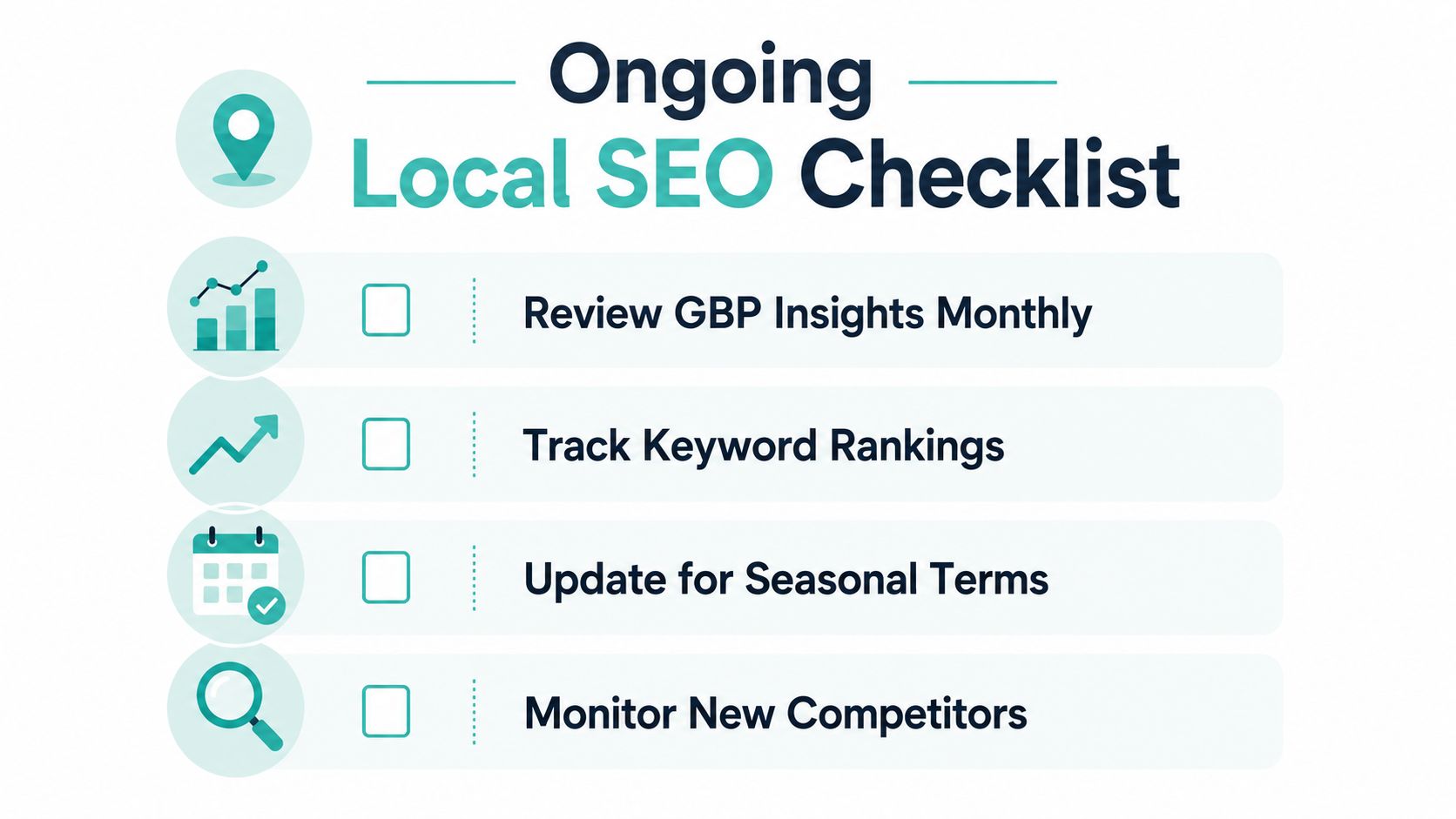
A quarterly review is enough to catch many structural problems, while monthly checks of profile and Search Console data can surface new language sooner. Update the map when the evidence changes, not because a calendar tells you to publish another city page.
Digital Skyrocket builds lead-generating websites and ongoing SEO and answer engine optimization for service businesses, connecting local keyword research with page architecture, technical implementation, reputation signals, and conversion paths. Visit Digital Skyrocket to discuss a website and local search strategy built around qualified inquiries rather than vanity rankings.