You've probably been in this spot already. Your crew does solid work, your trucks look sharp, and your referrals are decent, but your website still feels like dead weight. It looks fine. It technically works. Yet when storms hit and homeowners start searching, the calls don't come in the way they should.
That's the core problem with most roofer websites. They're built like brochures, not sales systems. They show a few photos, list services, add a contact form, and hope someone reaches out. That approach loses leads to faster, clearer, more local competitors.
Web design for roofers has changed. Your site now has to do three jobs at once. It has to rank, build trust fast, and convert mobile visitors into calls without friction. It also has to be structured for the AI era, because homeowners aren't only using standard search results anymore. They're increasingly getting answers, recommendations, and contractor suggestions from AI-driven search experiences.
Table of Contents
- Your Website Should Be Your Best Salesperson
- Why Generic Web Design Fails Roofers
- The Anatomy of a High-Converting Roofer Website
- Technical Must-Haves for Performance and Visibility
- Budgeting for Your New Website Costs and Timelines
- How to Choose the Right Web Design Agency
- Conclusion Your Website Is Your Hardest-Working Employee
Your Website Should Be Your Best Salesperson
A roofer can spend serious money on a website and still end up with something useless. That happens when the site looks polished but doesn't move visitors toward a call, an estimate request, or a clear next step. Homeowners don't reward pretty. They reward clarity.
When a storm rolls through, people search fast and decide faster. If your site buries the phone number, loads awkwardly on mobile, or makes visitors hunt for basic service information, they leave. They don't study your brand story. They call the next roofer who feels easier to trust.
That's why your website should work like your best salesperson. It should answer the first questions immediately, remove doubt, and make contact effortless.
Practical rule: If a homeowner can't tell within a few seconds what you do, where you work, and how to contact you, your website is costing you leads.
The strongest service-business websites all follow the same business logic. They reduce friction, match buyer intent, and make the next action obvious. If you want a useful outside example of how lead generation systems are being approached in another local service sector, this piece on boosting real estate client leads in 2025 is worth reading because the core lesson is the same. Visibility matters, but conversion mechanics matter more.
You should also think beyond “having a website” and start thinking about a contractor lead engine. A strong framework for that mindset appears in this guide on lead generation for contractors, especially if your current site gets traffic but doesn't turn enough of it into calls.
A brochure site says, “Here's our company.”
A lead-generation site says, “You need help. We do this work in your area. Here's why you can trust us. Call now.”
That difference changes revenue.
Why Generic Web Design Fails Roofers
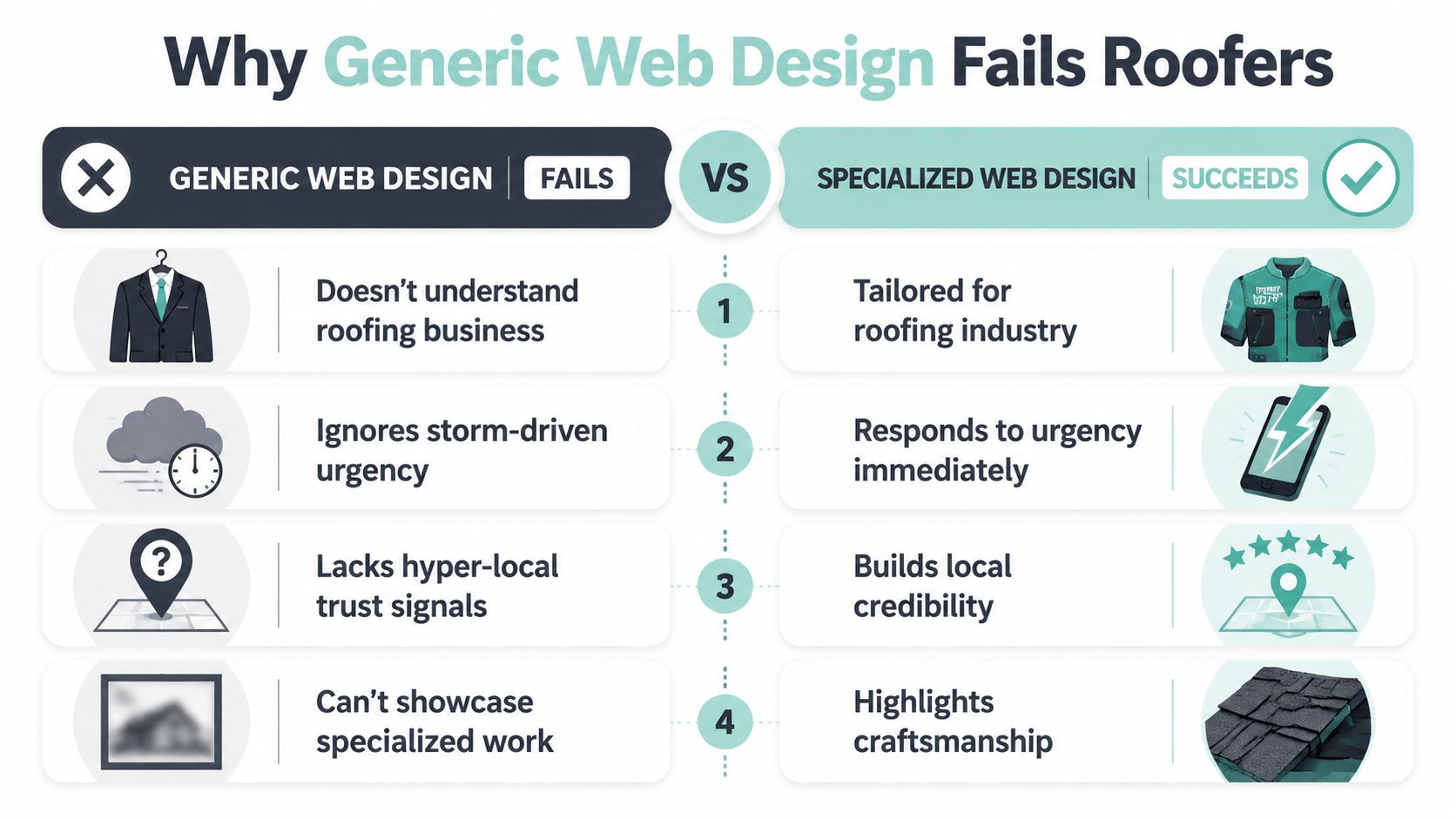
Generic web design fails roofers because roofing isn't a generic buying decision. It's urgent, local, trust-sensitive, and often emotional. A homeowner dealing with a leak, wind damage, or visible storm impact doesn't browse like someone shopping for office decor or a coffee subscription.
Template-driven websites miss that urgency. They tend to flatten everything into the same layout and same message. You get one vague hero section, one generic services grid, one recycled contact form, and no real attention to how roofing leads happen.
Roofing buyers don't behave like generic consumers
A roofer's website has to handle different buyer states at the same time:
- Emergency intent means someone needs a repair now, not next week.
- Research intent means someone is comparing reroof options, materials, and contractor credibility.
- Insurance-driven intent means someone wants help understanding the claim process after weather damage.
- Local validation means the visitor wants proof you serve their city and nearby neighborhoods.
A generic site doesn't separate those paths well. It mixes services together, uses weak headlines, and forces every visitor into the same funnel. That's lazy design.
The AI shift already changed local search
Most articles about web design for roofers still talk like it's 2019. They mention mobile responsiveness and buttons, which still matter, but they ignore the bigger shift. Search is becoming answer-driven.
One verified stat makes this problem impossible to ignore. 68% of homeowners now use AI assistants like Google's AI Overviews to find local contractors, yet only 12% of roofing websites are structured with concise, schema-tagged FAQ content to be cited by these systems according to Hook Agency's roofing website analysis. That gap matters because if your site isn't structured for citation, it can lose visibility before a homeowner ever clicks a traditional result.
If your site isn't readable by answer engines, it's easier for AI systems to skip you and summarize a competitor instead.
Generic design becomes obsolete. A broad small-business template won't naturally include answer-focused FAQ architecture, local schema planning, service-intent page structure, or content blocks written to earn AI visibility.
Generic design also weakens trust
Roofing is one of those categories where people look for reasons to disqualify you. If your site feels stock, thin, or vague, they assume your operation may be the same.
Here's what generic design often gets wrong:
- Stock visuals over real proof because fake-looking imagery doesn't reassure homeowners.
- City pages with swapped place names because templated local pages don't feel credible.
- Overdesigned layouts because motion effects and clever transitions don't help someone book an estimate.
- No distinction between repair and replacement because those leads need different messaging.
A roofer doesn't need a website that wins design awards. You need one that wins search visibility, trust, and calls.
The Anatomy of a High-Converting Roofer Website
A high-converting roofer website isn't built around style first. It's built around intent. Every section should help a homeowner move from uncertainty to contact with as little resistance as possible.
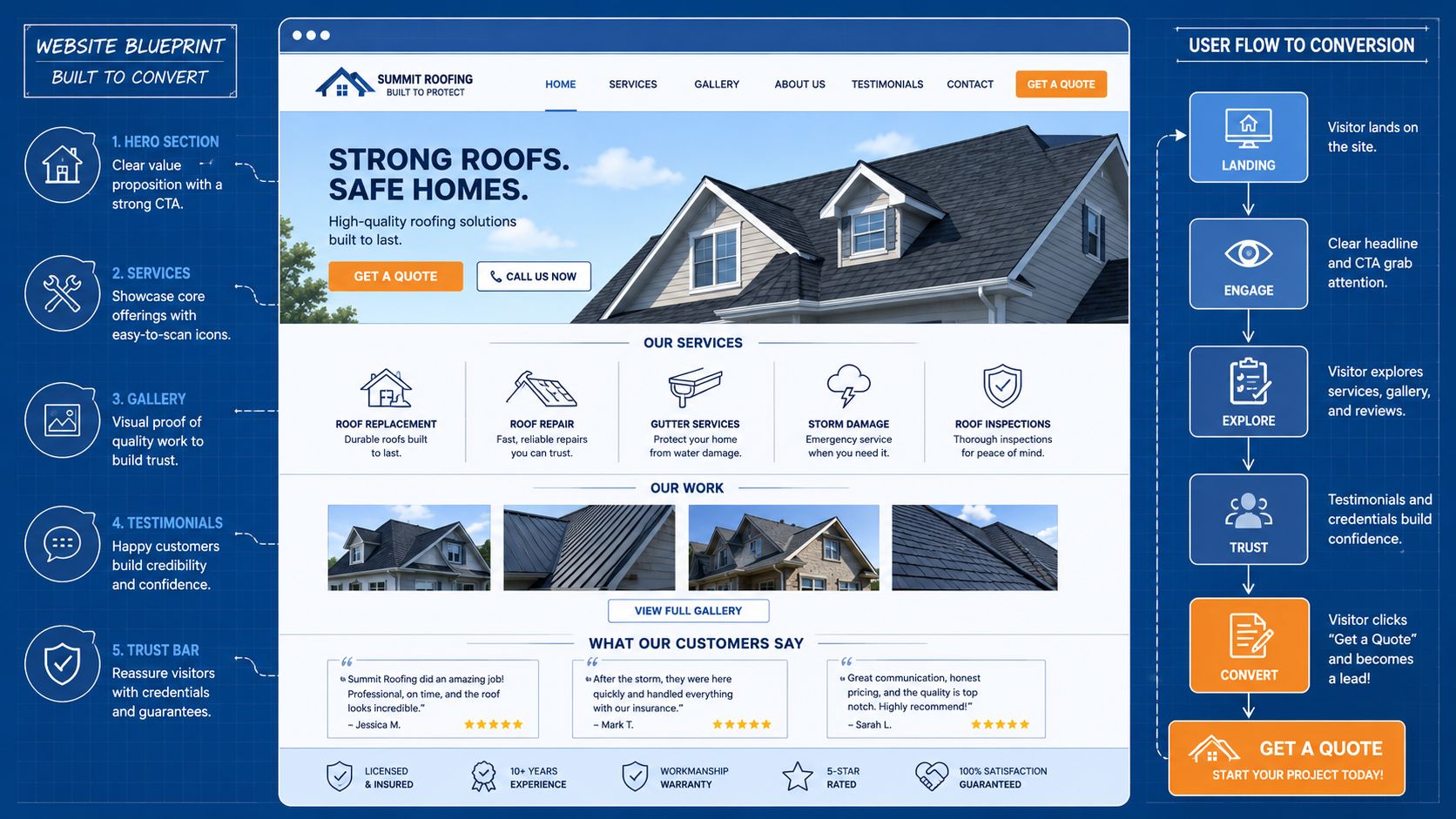
The most useful blueprint is simple. Put the right offer in front of the right visitor, prove you're credible in their area, and make it painfully easy to call or request an estimate.
Your homepage has one job
Your homepage should qualify and direct traffic. It should not try to tell your whole company story.
The first screen needs to answer these questions immediately:
- What do you do
- Where do you work
- What kind of lead are you trying to capture right now
- How does someone contact you fast
A verified best practice from Skill Mammoth's roofing website design guidance is especially important here. A high-converting roofing website must prioritize mobile-first contact mechanics by rendering the phone number as the largest tappable element on mobile devices, exceeding the logo's visual weight and paired with dual clear CTAs such as storm repair and reroof. That matters because homeowners searching during active storms are on smartphones, and speed plus clarity directly reduce friction.
That one decision tells you a lot about what good web design for roofers looks like. Your logo isn't the hero. Contact access is.
Put ego below utility. Homeowners don't care how large your logo is when water is entering the house.
Service pages should sell one intent at a time
Too many roofer websites create one “Services” page and call it done. That weakens search relevance and conversion.
You need separate pages for distinct commercial intent. Examples include roof repair, roof replacement, storm damage repair, emergency tarping, residential roofing, commercial roofing, and insurance claim support if that's part of your process. Each page should match the language and concerns of that specific buyer.
A strong service page usually includes:
- A direct headline that mirrors the searcher's problem.
- A short opening section that states where you provide that service.
- Visual proof tied to the actual service, not random gallery images.
- Trust elements like licenses, insurance, certifications, and review excerpts.
- A simple CTA path with click-to-call and a short form.
Don't overload every page with every service. A homeowner looking for leak repair doesn't want to read a general essay about your full company history.
Local pages need proof, not filler
Many roofers know they need city pages. Most build them badly.
A useful city page isn't just a duplicate with a different location name. It should feel grounded in that market. Mention neighborhoods you serve, weather patterns you commonly respond to, roof types you work on, and the service mix that tends to matter there.
The visual strategy matters too. According to the same verified guidance from Skill Mammoth, embedding drone-captured job photos organized by neighborhood above the fold on city-specific pages reinforces local credibility and significantly improves click-through rates from organic search results. That's a practical move because homeowners want proof that you work near them, not just a claim that you do.
Use local proof such as:
- Neighborhood-tagged project photos that show recognizable settings
- Review snippets from nearby customers when available
- Maps or service-area references that make your coverage obvious
- Service-specific examples relevant to that city
This is one of the fastest ways to separate a serious roofing site from a generic contractor template.
Trust signals must show up before doubt does
Trust isn't a section you tack on near the footer. It should be layered throughout the site.
That means visitors should encounter confidence-builders early and often. Not in a cheesy way. In a practical way.
A good trust stack usually includes a mix of the following:
| Trust Element | Why It Matters |
|---|---|
| License and insurance details | Reassures homeowners you're legitimate |
| Recent reviews | Reduces perceived risk |
| Real team and truck photos | Makes the company feel real |
| Material or manufacturer affiliations | Supports quality perception |
| Process explanation | Shows professionalism and reduces confusion |
Notice what's not on that list. Empty slogans. “Quality you can trust” means nothing by itself. “Fully insured, local crews, storm repair available” is stronger because it gives the visitor something concrete.
You should also tighten your forms. Ask only for information your office will use to respond. Long forms don't make a lead more qualified. They usually make the lead disappear.
Technical Must-Haves for Performance and Visibility
The technical side of your site isn't separate from lead generation. It supports it. If the structure is weak, the content underperforms. If the site is slow or confusing to search engines, you'll lose visibility and frustrate users before your sales message even has a chance.
Speed affects lead flow
Roofing traffic is impatient. A homeowner on a phone during bad weather has no interest in waiting for oversized images, bloated scripts, or fancy effects that delay the page.
You don't need to memorize every performance metric. You do need to ask whether your developer is treating speed as a business priority. That includes image compression, clean code, lean plugins, stable mobile layouts, and fast-loading core page elements.
Fast sites do three useful things:
- They reduce abandonment because visitors stay on the page long enough to act.
- They support search visibility because search engines prefer pages that deliver a better experience.
- They improve mobile conversion because tap targets and form flows feel immediate instead of clunky.
Schema is your translator
Schema markup is one of the most misunderstood parts of local SEO. The simplest way to think about it is this. Schema helps search engines read your business with less guesswork.
It tells platforms that you're a roofing contractor, where you operate, what services you offer, and how certain page elements should be interpreted. It can also support FAQs, reviews, business details, and service information when implemented properly.
Schema doesn't replace strong content. It makes strong content easier for search engines and answer engines to classify.
If you're evaluating vendors or planning a rebuild, make sure technical SEO is included from the start instead of bolted on later. A good benchmark for the kind of work that should be part of the conversation is found in this overview of SEO service for local growth.
AEO requires structured answers
Answer Engine Optimization, or AEO, is where many roofer websites now fall behind. Standard SEO helps your pages rank. AEO helps your content get pulled into AI-generated answers, summaries, and recommendation layers.
For roofers, that usually means your site should include concise answer blocks for common questions like service availability, insurance concerns, repair timing, inspection steps, and material choices. The answers should be clear, direct, and easy for machines to interpret.
The structure matters as much as the wording. AEO-friendly content often works best when it is:
- Question-led because it mirrors how homeowners search
- Concise because answer engines prefer extractable responses
- Properly tagged because structured markup improves interpretation
- Located on relevant service or FAQ pages because context matters
Most roofing sites still publish content as long, mushy sales copy. That format is weak for AI-era visibility. You need pages that can both persuade humans and feed answer systems clean, usable information.
Budgeting for Your New Website Costs and Timelines
If you're trying to budget for a new roofing website, the first thing to understand is that there's no single “normal” price. The cost depends on whether you're buying a template with your logo on it or building a real lead-generation asset with strategy, content structure, technical SEO, and conversion planning baked in.
That's why cheap and expensive aren't useful categories by themselves. Useful and useless are.
Cheap websites usually create expensive problems
A low-cost site often looks affordable because a lot of the important work gets skipped. You may get a theme, a few pages, and basic branding. What you usually don't get is a serious local content plan, strong service architecture, schema implementation, conversion-focused mobile design, or a site someone is prepared to keep improving after launch.
That creates familiar problems:
- You launch fast but don't rank well
- You get traffic but weak lead quality
- You need a redesign sooner than expected
- Your team keeps patching around bad structure
A stronger build costs more because there's more strategic work involved. Someone has to plan the page hierarchy, write or guide the copy, structure service and city pages, coordinate technical implementation, and make sure the final result supports both SEO and conversion.
Typical Roofer Website Investment Levels 2026
The table below is a practical framework, not a universal rate card. Agencies, freelancers, and markets vary. Use it to compare scope, not just price.
| Tier | Typical Investment | What You Get | Best For |
|---|---|---|---|
| Starter template build | Lower investment | Theme-based design, basic page setup, light customization, simple contact forms | Small operators who need a basic web presence fast |
| Mid-range strategic build | Mid-range investment | Custom design direction, service-page planning, local SEO foundations, conversion-focused layout, stronger mobile UX | Established roofers who want more qualified organic leads |
| Full custom lead-generation build | Higher investment | Deep discovery, custom WordPress development, robust content architecture, technical SEO, AEO foundations, CRO planning, reporting setup | Growth-focused roofing companies competing in crowded local markets |
Don't obsess over launch-day polish alone. Ask what the site is built to do over the next few years.
For a deeper look at how a redesign can support local service growth instead of just changing the appearance, this guide on service company website redesign for local growth is a useful reference.
What drives timeline
Timeline depends less on coding speed and more on decision quality. Roofing websites slow down when nobody owns content, approvals take forever, service areas aren't defined, or the agency has to guess what makes the company different.
A realistic project usually moves through these stages:
- Discovery and planning where goals, services, and target markets are defined.
- Content and site structure where pages, messaging, and conversion paths are mapped.
- Design and development where the interface and backend get built.
- Optimization and launch prep where technical fixes, forms, analytics, and QA are completed.
If you want a site that performs, give the process enough room to be done correctly. Rushed websites usually look finished before they're ready to sell.
How to Choose the Right Web Design Agency
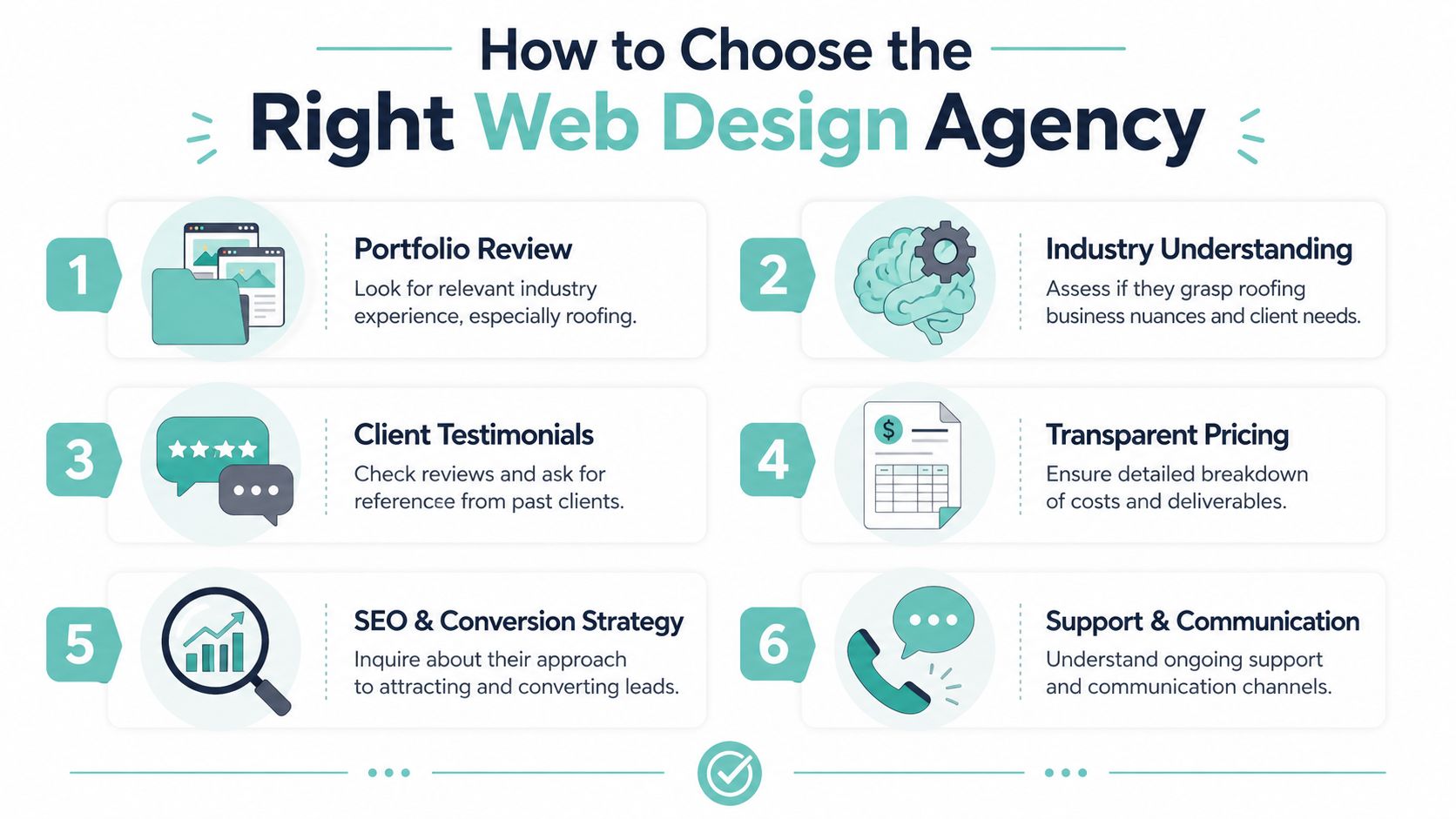
Most roofing companies choose a web design agency the wrong way. They look at visuals first, pricing second, and strategy almost not at all. That's how they end up with a nice-looking site that doesn't bring in enough calls.
You're not hiring an artist. You're hiring a business partner to build an asset that should produce leads.
Review proof, not mockups
A portfolio matters, but not for the reason most owners think. Pretty screenshots tell you almost nothing about whether an agency understands roofing demand, local search, or conversion behavior.
Look for signs that the agency can build around service intent, local trust, and lead flow. If they've worked with service businesses, inspect the actual sites, not just cropped homepage images in a slideshow.
What to review closely:
- Industry relevance so you can see whether they understand contractor buying behavior
- Service-page depth so you know they can separate intent properly
- Local page quality so you can spot whether they use thin copy or real market-specific content
- Mobile experience because roofing leads often arrive on phones first
If they show case studies, focus on whether the outcomes described connect to organic visibility, lead quality, and conversion. If they can't speak clearly about those issues, they're probably selling aesthetics more than performance.
Ask questions that expose the strategy
A good agency should be able to explain its process without hiding behind jargon. Ask direct questions and pay attention to whether the answers are specific or slippery.
Use questions like these:
- How do you structure service pages for different lead intents
- How do you approach city-specific pages without creating duplicate content
- What's your process for writing or guiding content
- How do you handle technical SEO during the build
- What's your approach to AEO and schema
- How do you measure whether the new site is producing better inquiries
- What happens after launch
The right agency won't just promise rankings. They'll explain how structure, content, and conversion design work together.
You should also ask who does the work. Some firms sell the strategy, then outsource execution to whoever is available. That doesn't always mean bad work, but it often leads to inconsistent quality and communication.
Watch for red flags early
Roofing companies waste time with agencies that say impressive things but can't support them. Red flags usually show up before the contract is signed.
Watch for these warning signs:
- Guaranteed ranking promises because nobody credible controls search results that way
- No questions about your market because strategy starts with understanding your service area and offer mix
- A one-size-fits-all package because roofing needs differ from dental, legal, and retail
- No discussion of conversion paths because traffic without action is weak marketing
- Vague reporting language because you need clarity on what success looks like
A good agency should challenge you a little. They should ask about your best services, ideal service areas, seasonality, operational capacity, and the kinds of leads you want. If they don't ask those questions, they're probably not building around business outcomes.
The best fit is usually an agency that understands local service companies, talks plainly, values both SEO and conversion, and can show disciplined thinking instead of generic enthusiasm.
Conclusion Your Website Is Your Hardest-Working Employee
A roofer's website should do more than exist. It should answer questions, build trust, rank in local search, support AI visibility, and turn visitors into real opportunities. If it doesn't do those things, it's not an asset. It's overhead.
The good news is that the gap between weak sites and strong ones is usually obvious. Strong sites are clear on mobile, built around buyer intent, grounded in local proof, and structured for both search engines and answer engines. Weak sites are vague, generic, and hard to act on.
That's the standard you should use when judging your own site. Not whether it looks modern. Not whether your cousin likes the colors. Whether it helps a homeowner contact you quickly and confidently.
Audit your current website with brutal honesty. Check the mobile experience. Check the service pages. Check whether your city pages feel real. Check whether your content is structured to be found and cited in the AI era. Then decide whether you're maintaining a brochure or building a machine.
A roofing company that takes its website seriously gives itself a better chance to capture the next call, the next estimate, and the next neighborhood.
If you want a website that's built to generate qualified roofing leads instead of just sitting online, Digital Skyrocket focuses on web design, SEO, and AEO for service companies that need stronger local visibility and better conversion from search traffic.