

Your partner approved the redesign. The new site looks polished, the attorney photos are sharp, and the homepage finally feels modern. Then the monthly report comes in and nothing meaningful has changed. Calls aren't up. Form fills aren't better. The pages that should bring in cases still don't show up where prospective clients are looking.
That's the trap. Too many law firm websites are built to impress other lawyers, not to win search visibility, earn trust fast, and move a stressed prospective client to contact the firm. Good SEO web design for lawyers isn't three separate projects called branding, SEO, and conversion. It's one system. If those pieces aren't planned together from the start, the site usually underperforms no matter how nice it looks.
The bigger shift now is that prospects don't only search in the old way. They still use Google, but they also ask AI tools direct legal questions and expect direct answers. That changes how a law firm website should be structured, written, and measured.
Table of Contents
- Beyond a Digital Brochure
- The Strategic Blueprint for Attracting Your Ideal Client
- Designing for Instant Credibility and Conversion
- Building Your Technical and Content Engine
- Tracking Performance and Optimizing for Growth
- Navigating Compliance, Ethics, and Agency Partnerships
Beyond a Digital Brochure
A law firm website should function like a rainmaker. Many don't. They sit online as expensive brochures, filled with generic copy, stock photos, and thin service pages that never rank well enough or convert well enough to matter.
The problem usually starts before design. Firms say they want more traffic, so the agency produces a prettier homepage and adds broad practice-area language. That approach misses how legal clients behave. A person dealing with a car wreck, arrest, divorce, denied claim, or custody fight isn't browsing for inspiration. They're trying to decide, quickly, whether your firm handles their exact problem and whether contacting you feels safe.
Practical rule: If a visitor can't confirm "they handle my issue, in my area, and I know what to do next" within seconds, the site is leaking cases.
Modern SEO web design for lawyers has to do three jobs at once. It needs to help search engines understand the site, help answer engines extract reliable answers, and help humans take the next step without friction. If one part breaks, the whole system weakens.
That means the old handoff model doesn't work anymore. Strategy can't stop at keyword lists. Design can't stop at aesthetics. Development can't stop at launch. The firms that get better outcomes usually treat the website as an intake asset with a search layer, a trust layer, and a conversion layer built together.
A strong legal website also has to respect the realities of the profession. You need credibility without puffery. Clear calls to action without sounding desperate. Useful content without creating ethical problems. That's why the best-performing law firm sites are rarely the loudest. They're the clearest, fastest, and easiest to trust.
The Strategic Blueprint for Attracting Your Ideal Client
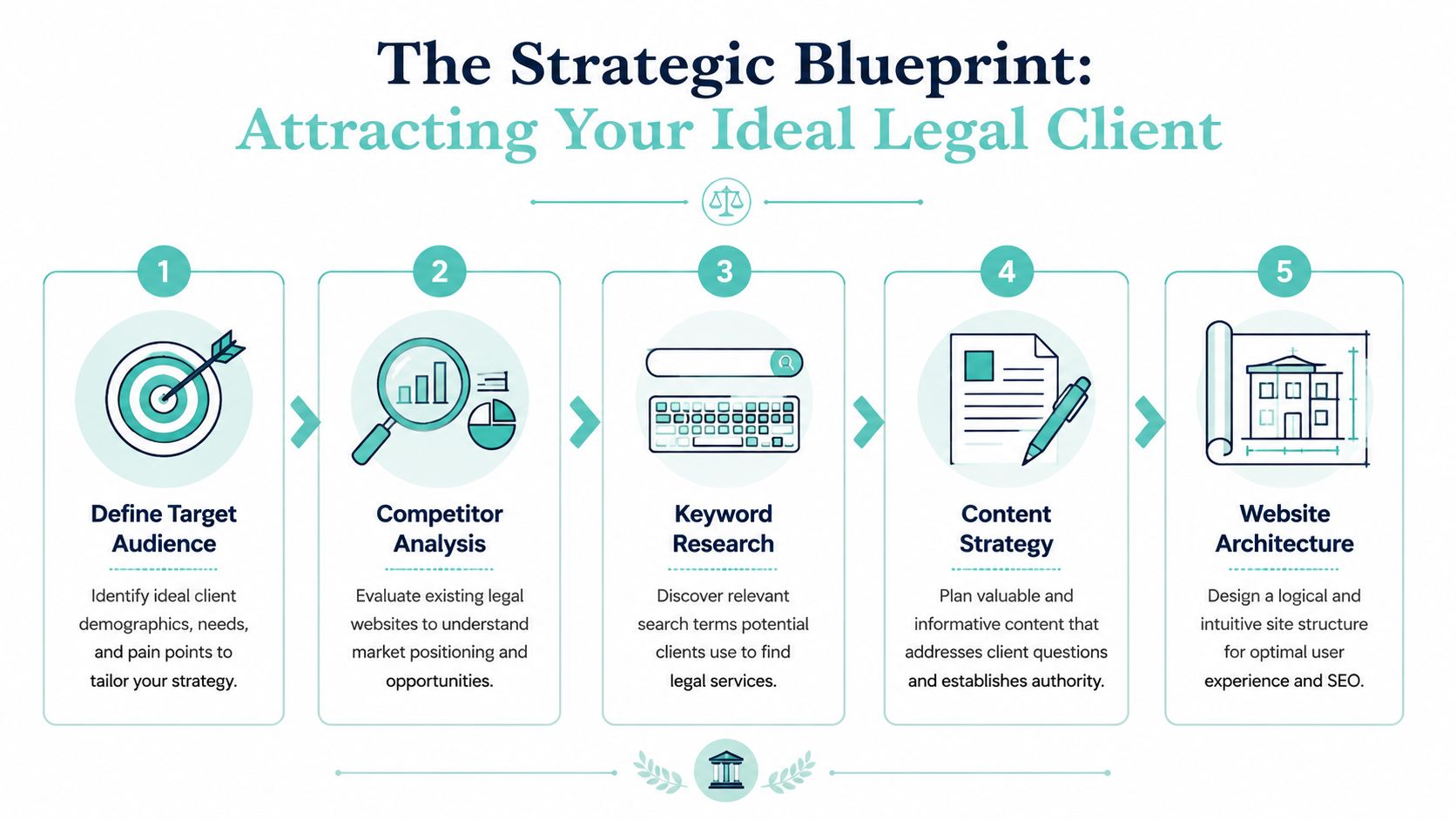
Most weak legal websites fail in the planning stage. They start with a sitemap and a mood board. They should start with a business question: which matters does the firm want more of?
Start with the case type, not the homepage
A strategic blueprint begins by narrowing the target, not broadening it. "We want more leads" is not a strategy. "We want more qualified personal injury cases in the markets we can profitably serve" is something a site can be built around.
That planning work should answer a few blunt questions:
Which practice areas matter most
Some pages deserve full investment. Others can stay secondary. If everything is a priority, nothing is.Which client problems trigger search behavior
Prospects usually search around incidents, urgency, and local context. A family law prospect asks a different question than a criminal defense prospect. The page structure should reflect that reality.Which proof points reduce hesitation
Board certifications, years in practice, office location context, attorney bios, process explanations, and outcome-focused FAQs all affect whether a prospect moves forward.Which action should happen on each page
A contact page can ask for a full inquiry. A blog post may only need to move the reader to a related service page. A practice page might prioritize a call.
A good page map looks less like a brochure and more like an intake funnel. Core services deserve dedicated pages. Subtopics deserve supporting pages. Attorney profiles, FAQs, locations, and supporting educational content should reinforce the main service lines instead of floating around disconnected.
For firms refining their positioning before a redesign, this short guide on how to grow a law firm is useful because it frames website planning as a business development decision, not a cosmetic one.
Build for answerability, not just rankings
Most guides on SEO web design for lawyers lag behind because, while they talk about keywords and maybe mention FAQs, they stop short of structuring the site for AI-driven discovery.
Bizango highlights a real gap in legal web strategy. A critical underserved angle in SEO web design for lawyers is the specific integration of Answer Engine Optimization into the website's structural design to capture AI-driven traffic, including the need to architect schema markup and natural language hierarchies specifically for legal practice areas so firms can appear in AI-generated answers such as Google's SGE or Bing's Chat, as discussed in Bizango's law firm web design perspective.
That matters in planning, not as an afterthought. If you wait until after launch to think about AEO, you usually end up patching in FAQ blocks without the underlying structure needed to support them.
Use this blueprint when mapping your site:
| Focus area | What to plan | Why it matters |
|---|---|---|
| Service hierarchy | Main practice pages with clear subtopics | Search engines and answer engines need clean topical relationships |
| Natural language headings | Questions and plain-English subheads | Prospects and AI systems both parse clearer language more easily |
| Entity clarity | Attorney names, office locations, practice focus | Reduces ambiguity about who the firm is and what it does |
| Schema-ready content | FAQs, reviews, organization details, legal services | Supports machine-readable understanding |
| Conversion paths | Calls, forms, consultation prompts, page-level CTAs | Visibility without action still doesn't produce cases |
The best legal websites don't just rank. They answer, reassure, and route the visitor to the right next step.
Designing for Instant Credibility and Conversion
A prospective client judges your firm before reading much of anything. Design handles that first impression. On law firm sites, design isn't decoration. It's evidence.
Trust is a design decision
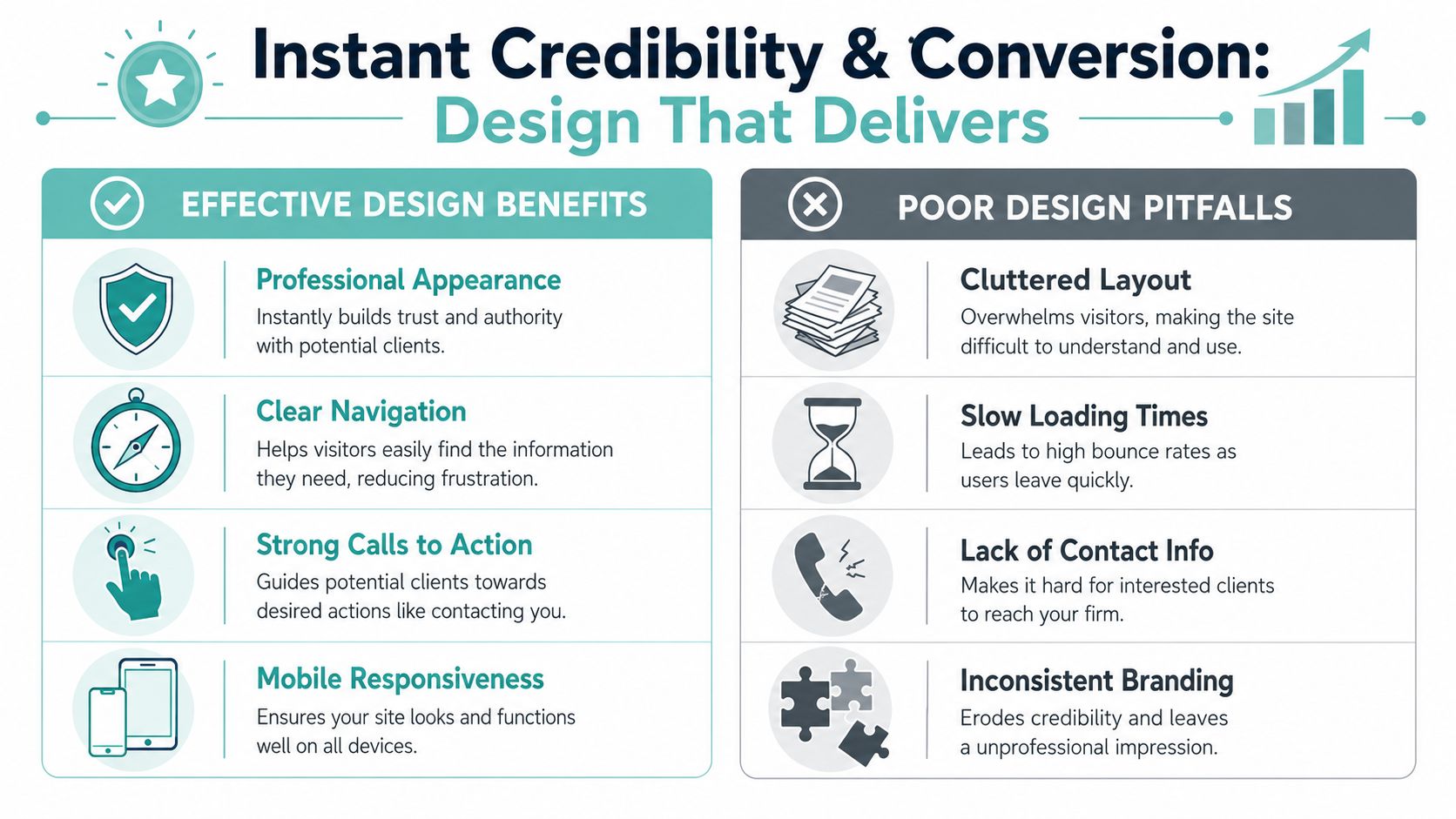
Credibility starts with restraint. Clean typography, consistent spacing, real attorney photography, a stable layout, and visible contact options tell a visitor the firm is organized and serious. Sliders, visual clutter, vague slogans, and oversized stock imagery do the opposite.
Legal prospects are usually evaluating two things at once. First, "Can this firm help me?" Second, "Do I trust them enough to reach out?" Design influences both before the copy has a chance.
Strong conversion-oriented design often includes:
- A clear above-the-fold message that states the practice area, audience, and geography without clever wording.
- Visible contact options in the header and on key pages, especially for mobile users.
- Focused calls to action like consultation requests, call prompts, or case evaluation forms that fit the practice area and intake process.
- Trust signals in context such as attorney bios, bar admissions, review excerpts, media mentions, and carefully presented results or testimonials where ethics rules allow.
- Consistent visual hierarchy so users can scan rather than work to understand the page.
Clio notes a practical usability standard that many firms ignore. A critical pitfall is neglecting mobile usability and site speed, and sites with unoptimized images or heavy video fail to convert mobile legal prospects. Clio also notes that ensuring no more than three clicks to reach any page aligns with user testing best practices that increase conversions from visitors to inquiries, as explained in Clio's guide to lawyer websites.
For personal injury firms in particular, local visibility and website conversion need to reinforce each other. A firm that improves maps visibility but sends visitors to a weak site still leaves cases on the table. This overview of Google Business Profile SEO for personal injury firms is a good companion to on-site CRO because local pack clicks only matter if the landing experience closes the gap.
What kills conversion on law firm sites
The most common conversion failures are ordinary. That's why firms miss them.
A page promises "aggressive representation" but doesn't explain what happens next. A consultation form asks for too much too soon. The mobile header hides the phone number. The hero section takes up the entire screen and says nothing concrete. Reviews exist, but they're buried. Practice pages read like law school summaries instead of decision-making tools.
Use this comparison when reviewing your own site:
| High-converting pattern | Conversion-killing pattern |
|---|---|
| Specific service and location messaging | Generic firm-first slogans |
| Short forms matched to user intent | Long intake forms on every page |
| Real attorney photos and bios | Generic stock imagery |
| Obvious CTA placement | Contact option hidden in navigation |
| Strong page structure for mobile | Dense blocks of text and tiny tap targets |
Reputation also affects conversion after the click. If a prospect likes your site and then searches your firm name, off-site signals can reinforce or weaken trust. That's why law firms should pair site conversion work with sensible online reputation strategies so branded searches don't expose a mismatch between the website and what prospects find elsewhere.
A beautiful site that doesn't make contact easy is still a bad intake asset.
Building Your Technical and Content Engine
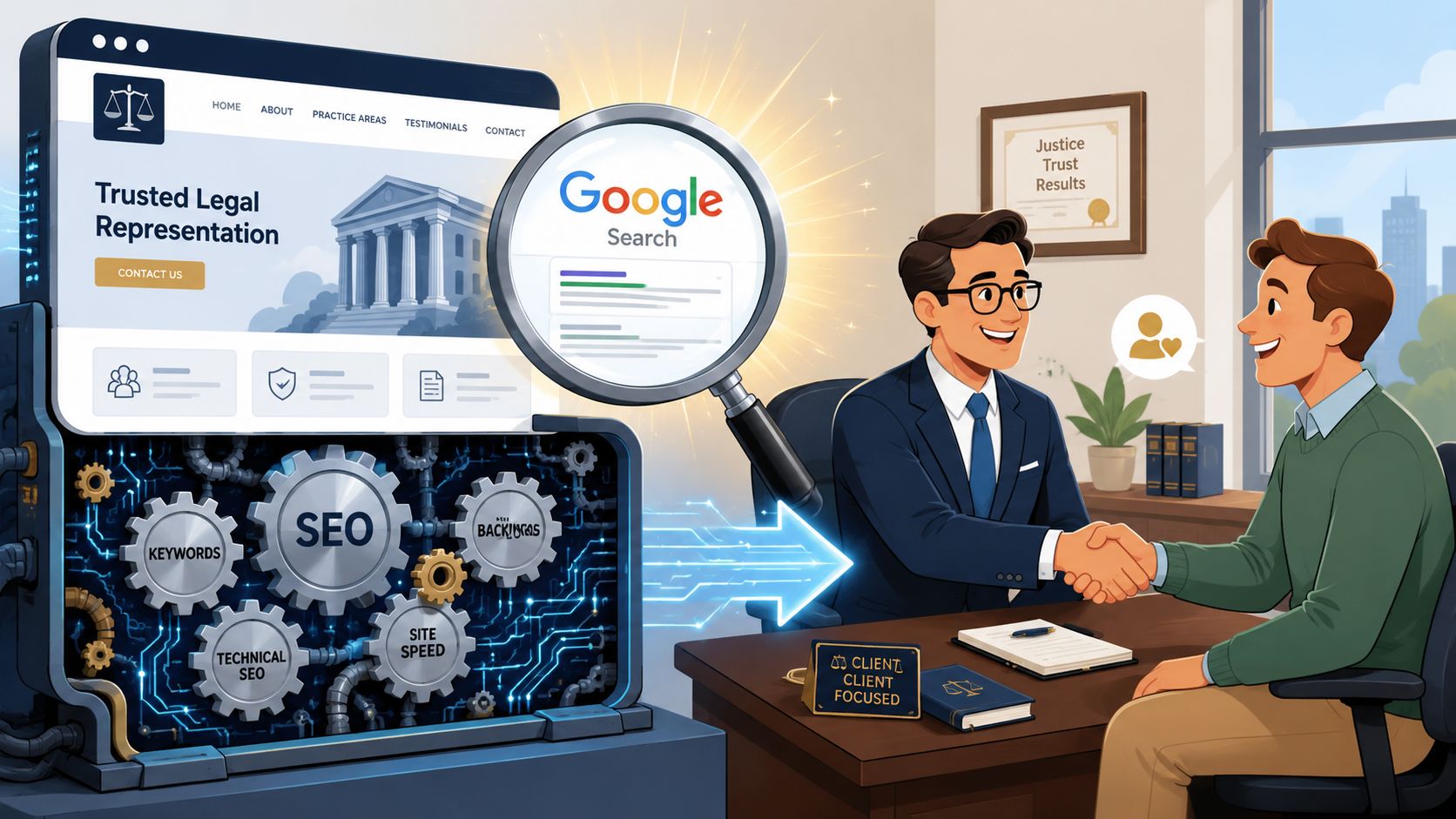
Design gets attention. Technical quality and content depth earn discoverability. If those two pieces are weak, the site won't hold rankings for competitive legal searches no matter how polished the interface looks.
Performance standards that actually matter
Law firms often treat technical SEO like a cleanup task for after launch. That's backwards. The technical build determines whether the content can compete.
PaperStreet lays out a useful benchmark set for legal sites. Expert-level technical specification for lawyer web design mandates achieving three Core Web Vitals benchmarks: Largest Contentful Paint within 2.5 seconds, Interaction to Next Paint under 200 milliseconds, and Cumulative Layout Shift below 0.1. The same framework also ties performance to deeper page strategy and crawl clarity in PaperStreet's law firm SEO guide.
In practice, that means development choices matter more than fancy effects. Heavy animations, oversized video backgrounds, bloated plugins, and image abuse usually work against legal lead generation.
The technical foundation should include:
- Dynamic XML sitemaps so search engines can find active pages efficiently.
- Proper HTML meta tags that help each page communicate its topic and purpose.
- Structured data through tools such as Yoast or All in One SEO on WordPress when appropriate, which helps search systems understand entities, page types, and hierarchy.
- Lean templates and compressed media so the site stays usable under real-world mobile conditions.
- Accessible internal linking with descriptive anchor text, which supports both usability and crawlability.
A lot of attorneys never see this layer, but they should ask about it in plain language. If the agency can't explain how the site handles crawlability, page speed, metadata, and structured data without hiding behind jargon, that's a warning sign.
For firms comparing implementation ideas and build approaches, this collection of web design articles from Taja AI is worth reviewing because it helps frame technical choices in a broader site strategy context.
Content depth wins competitive legal searches
Thin service pages don't hold up well in legal SEO. A page with a headline, a short pitch, and a contact form may look tidy, but it usually lacks the substance needed to become the best answer on a competitive topic.
PaperStreet's guidance is unusually direct here. Main practice area pages should contain over 2,000 words of substantial, high-quality text per topic and create a 1:1 content-to-keyword match so the site can become a dominant resource for the legal service in question, according to their legal SEO framework.
That doesn't mean writing long pages for the sake of length. It means building pages that thoroughly answer the essential questions a prospective client has before contacting counsel. Good legal service pages usually include:
What the page should cover
- Case and issue overview so visitors know they're in the right place.
- Common scenarios that mirror the prospect's situation in plain English.
- Process explanations that reduce uncertainty about what happens after contact.
- Local relevance when the page targets a city, county, or service area.
- Objection handling around timing, costs, insurance, charges, deadlines, or risk.
- Next-step guidance that makes contacting the firm feel low friction.
What to avoid
- Keyword stuffing that makes the page unreadable.
- Practice-area templates copied across cities with minimal edits.
- Academic tone that explains legal doctrine but not practical client concerns.
- Orphan pages with no internal links from the main navigation or related content.
Strong legal content doesn't read like a treatise. It reads like a clear answer from a lawyer who understands the client's situation and knows what to do next.
The best content engines for law firms usually combine cornerstone practice pages, supporting FAQ content, attorney credibility pages, and location signals into one coherent architecture. That's how SEO web design for lawyers moves from isolated pages to a system that can rank, surface in AI summaries, and convert.
Tracking Performance and Optimizing for Growth
A website launch is not proof that the strategy worked. It's the beginning of a testing cycle. If you don't measure the right things after launch, you'll end up arguing about rankings while intake stays flat.
Track the path from visit to qualified inquiry
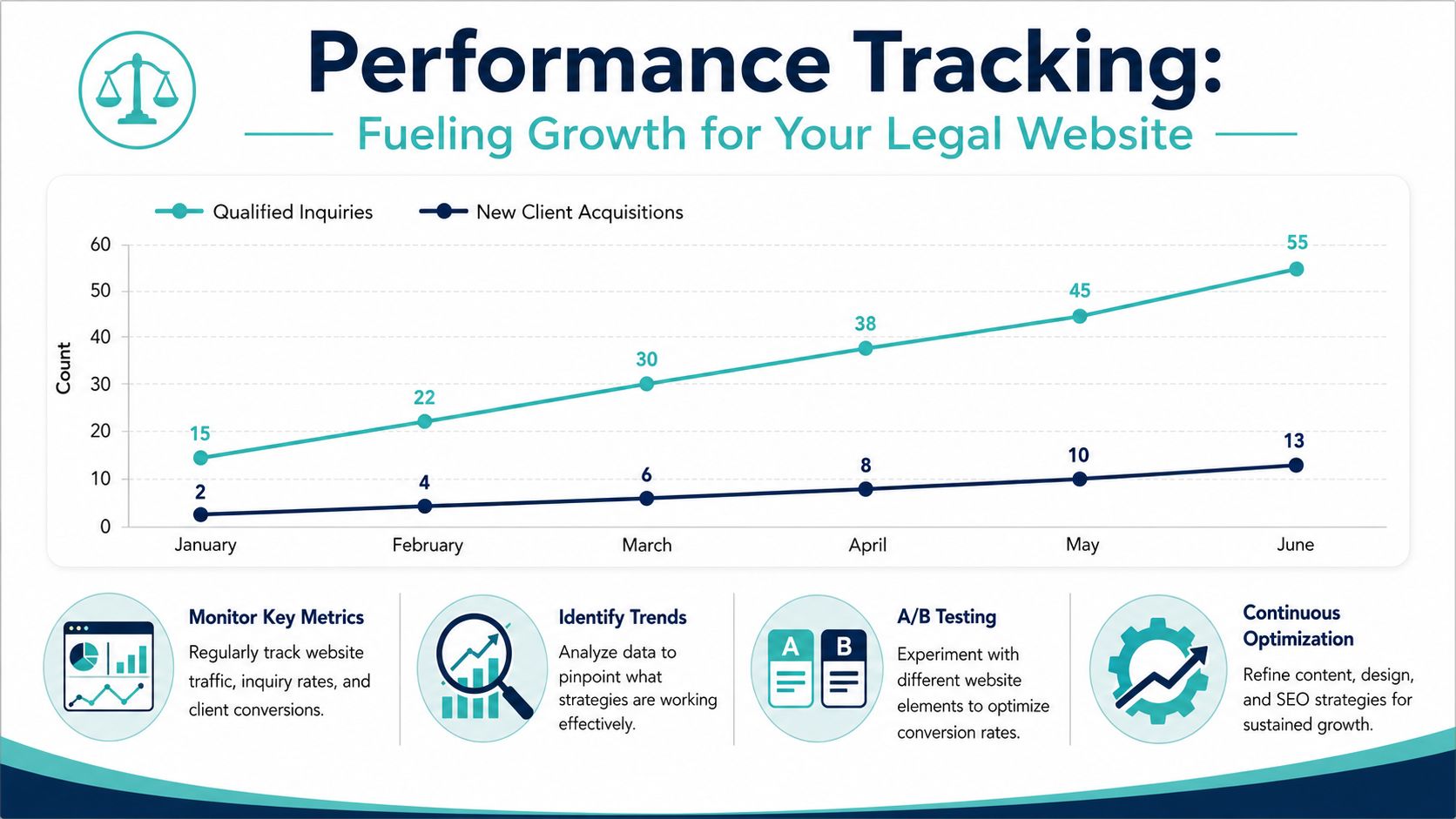
Law firms often overvalue vanity metrics. Raw traffic alone doesn't tell you whether the site is producing better cases. A useful reporting view follows the user from search visibility to inquiry quality.
The most practical post-launch dashboard usually answers these questions:
Which practice pages attract organic visits
Not every page matters equally. Core service pages should carry more weight than blog traffic.Which pages generate calls and form submissions
If a page ranks but doesn't produce action, review the offer, layout, and CTA placement.Which inquiries are qualified
Intake feedback matters. A form submission that doesn't fit the firm's case criteria is not the same as a strong lead.Where users hesitate
Heatmaps, call tracking, form analytics, and session recordings can reveal friction points that standard analytics won't.
A good optimization routine doesn't chase random tweaks. It reviews evidence, adjusts one meaningful element at a time, and validates whether the change improved inquiry quality.
Watch what prospects do, not what internal teams assume they'll do.
Use the timeline correctly
One of the biggest mistakes law firms make is declaring victory too early or failure too early. SEO compounds, but it takes time for technical fixes, content improvements, and authority signals to work together.
A realistic expectation comes from the timeline outlined by Dan Gilroy. Most law firms see measurable progress within 3 to 6 months of SEO implementation, with sustained lead generation typically stabilizing between 6 and 12 months of consistent effort, as explained in Dan Gilroy's law firm SEO FAQ.
That timeline should shape management decisions. If you redesign the site, publish stronger practice pages, improve internal linking, and tighten conversion paths, you still need enough runway to evaluate the outcome objectively.
Use this post-launch rhythm:
| Timeframe | What to review | What to avoid |
|---|---|---|
| Early months | Tracking accuracy, indexation, page engagement, form flow issues | Judging the campaign solely on rankings |
| Middle stretch | Practice page traction, conversion rates, content gaps, local visibility | Constantly rewriting strategy |
| Longer horizon | Lead quality trends, intake source patterns, expansion opportunities | Assuming maintenance is optional |
The firms that get the most from SEO web design for lawyers usually treat optimization as operating discipline. They improve the pages that matter, remove friction from the intake path, and keep publishing where clear search demand and case value overlap.
Navigating Compliance, Ethics, and Agency Partnerships
Many firms assume they must choose between aggressive performance tactics and accessibility compliance. That's a false choice. On legal websites, accessibility, ethics, usability, and search performance often reinforce each other when the work is done correctly.
Accessibility and SEO are not opposing goals
Justia points to a gap that deserves more attention. A frequently asked question is how to balance strict ADA/WCAG accessibility compliance with high-conversion, aggressive SEO design tactics, especially through keyboard-only navigation and alt-text for complex legal infographics while simultaneously optimizing for mobile-first local SEO and rapid lead capture, as noted in Justia's law firm web design article.
The practical takeaway is simple. Accessibility isn't a bolt-on widget and it isn't a design tax. It's part of building a usable site.
These choices usually help both accessibility and SEO:
- Logical heading structures that help users scan and assistive technologies process.
- Descriptive alt text that improves context for non-visual users and strengthens page clarity.
- Keyboard-friendly forms and menus that reduce friction for all users, not only users with disabilities.
- Readable typography and contrast that improve comprehension on mobile devices.
- Clear button labels and anchor text that help search systems and users understand where a click leads.
For firms trying to understand the overlap in practical terms, this guide on accessibility and SEO traffic is a useful reference because it connects compliance work with discoverability rather than treating them as separate agendas.
There's also the ethics layer. Lawyers can't market like unregulated lead gen shops. Testimonials, results language, comparative claims, chat prompts, and form copy all need review through the lens of state bar rules and the firm's own risk tolerance. Fast growth isn't helpful if the site creates advertising problems.
How to vet a legal web design and SEO partner
Hiring the wrong agency usually creates two problems. First, the site underperforms. Second, the firm doesn't realize why until months later.
Ask direct questions. A credible partner should answer them clearly.
Questions that separate operators from order takers
How do you decide which practice areas deserve primary pages
If the answer is based only on a generic template, keep looking.How do you structure a site for both search and answer engines
You want to hear about hierarchy, schema, page relationships, and natural language organization.What is your conversion philosophy
They should discuss calls to action, form friction, mobile behavior, and trust signals, not just aesthetics.How do you handle accessibility during design and development
If compliance is treated as a plugin purchase, that's not enough.Who owns the website assets
The firm should have clarity around access, hosting relationships, analytics, and content control.How do you report results
Ranking snapshots aren't enough. The reporting should connect visibility to inquiries and intake quality.
Red flags that usually lead to disappointment
- Guaranteed rankings
Serious SEO providers don't make promises they can't control. - One-size-fits-all legal websites
Practice area nuance matters too much for cookie-cutter strategy. - No discussion of intake quality
Traffic without case fit is noise. - No mention of technical standards
Design-only shops often ignore the engine under the hood. - No understanding of legal ethics
That's a major liability in this industry.
A law firm website should be built like a business asset with compliance discipline, not like a branding project with a contact form attached. Firms that understand that usually make better agency decisions and get better long-term results.
If your firm needs a website that ranks, answers, and converts, Digital Skyrocket builds and optimizes lead-generating websites for law firms with a focus on web design, SEO, AEO, and CRO. They only take engagements that include a new website and ongoing SEO, and they work with one client per industry and service area so they aren't competing against their own clients.