
A potential client gets rear-ended on the way home, ends up in urgent care, then searches for a lawyer from a phone while waiting on discharge paperwork. They don't read ten blog posts. They scan the map results, tap a profile that looks legitimate, read a few reviews, and call.
That's the market you're competing in right now. Not the abstract idea of “SEO.” Not broad visibility. One cramped section of Google where urgency, trust, and proximity collide.
For personal injury firms, Google Business Profile SEO is often the shortest path between a search and a signed case. But there's a catch. Many firms chase visibility with sloppy shortcuts, especially around categories, office setup, and business names. Those shortcuts can work briefly, then wipe out the profile that was carrying intake. Long-term wins come from treating your profile like a regulated asset, not a hackable listing.
Table of Contents
- Why the Google Map Pack Is Your Firm's Most Valuable Real Estate
- Understanding the Local Search Ecosystem
- Building a Bulletproof Google Business Profile
- The Power of Reviews and Consistent Citations
- The Hidden Risk That Can Erase Your Rankings Overnight
- Measuring What Matters and Choosing the Right Partner
- Your Next Steps to Local Search Dominance
Why the Google Map Pack Is Your Firm's Most Valuable Real Estate
A personal injury firm can spend heavily on branding, produce polished site content, and still lose a valuable case to the office that shows up first in the map pack with a cleaner profile and stronger social proof. That happens every day.
The reason is simple. Searchers in distress don't behave like leisurely researchers. They want a nearby law firm, a believable reputation, and a fast way to call. The map pack gives them all three in one place.
Think about the difference between ranking on a traditional organic result and owning a strong map listing. In the organic results, the user still has to choose to click, wait for the site to load, and decide whether the page looks trustworthy. In the map pack, Google has already preloaded much of the decision. Reviews, location, hours, phone number, directions, and service context are all visible before your website gets a chance to speak.
That's why Google Business Profile SEO for personal injury firms isn't a side task for a junior marketer. It's front-line intake infrastructure.
Practical rule: If your firm serves local injury clients, your Google Business Profile deserves the same scrutiny as your intake process. A bad setup costs real cases.
The firms that win this space usually aren't doing magic. They're doing the basics with discipline. Their category is correct. Their office details are believable. Their reviews come in steadily. Their listing doesn't look neglected. Most important, they aren't gambling the whole asset on tactics that violate Google's rules.
A strong profile turns a directory listing into a client-acquisition channel. A weak or noncompliant one becomes a liability.
Understanding the Local Search Ecosystem
Most lawyers hear that local SEO is a black box. It isn't. Google's local system behaves a lot like a referral network in everyday life.
If a friend asked who to hire after a crash, you'd probably judge the answer on three things. Is the lawyer nearby? Does the lawyer handle that kind of case? Does the lawyer have a strong local reputation? Google does the same thing at scale.
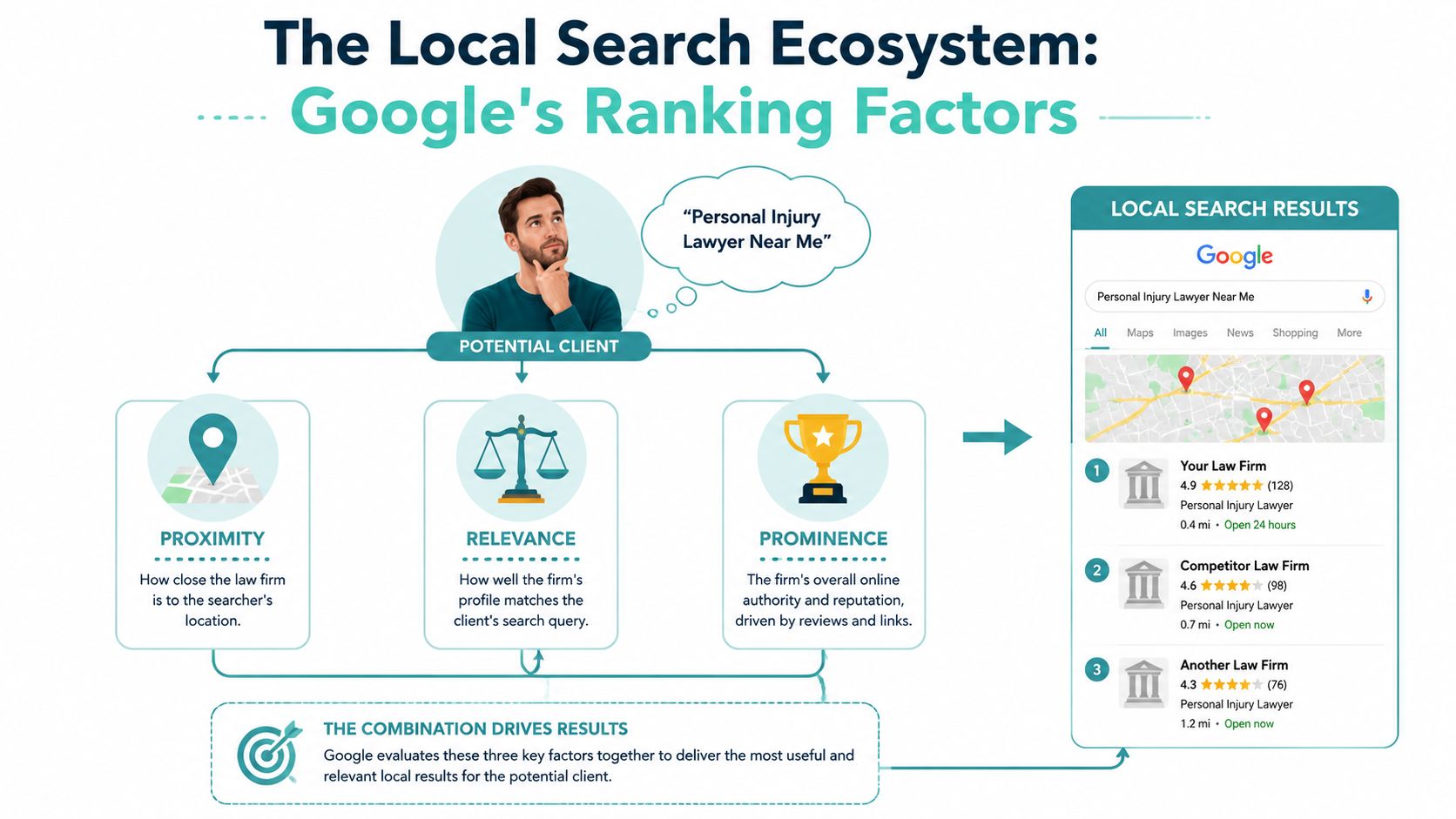
Google judges local firms the way clients do
The three pillars are proximity, relevance, and prominence.
- Proximity means how close your staffed office is to the searcher or to the location implied in the search.
- Relevance means how well your profile matches what the person needs, such as a car accident lawyer rather than a generic law office.
- Prominence is your firm's reputation footprint online. Reviews, mentions, citations, and the strength of your broader web presence feed this.
Lawyers tend to overfocus on one pillar. They obsess over reviews and ignore category setup. Or they build location pages but leave the profile thin. Google doesn't reward imbalance. It wants a coherent local entity.
That's one reason firms are paying more attention to structured topical coverage and entity architecture for LLMs. Even though that term comes from AI search work, the underlying idea matters in local SEO too. When your services, locations, practice areas, and firm identity line up cleanly across the web, Google has fewer reasons to doubt what you are.
Your profile is the storefront, not a side listing
Your Google Business Profile is the hub of that local entity. It isn't just another citation. It's the record Google trusts most when deciding whether your office belongs in local results.
That also means your website can't operate in a separate universe. Practice area pages, location pages, and local signals should reinforce what the profile says, not contradict it. If your site says one thing and your profile says another, Google has to decide which version to trust.
For firms that want a broader foundation around local visibility, this law firm SEO guide is useful because it frames local SEO as one part of a larger search system rather than an isolated checklist.
Google doesn't rank a profile in a vacuum. It ranks a business it believes exists, serves a specific area, and has earned attention there.
Once you understand that, local SEO gets less mysterious. You stop chasing tricks and start building evidence.
Building a Bulletproof Google Business Profile
A personal injury firm can spend months building local visibility and lose it because one profile field is inaccurate, one update looks manipulative, or one verification issue goes ignored. That is why profile work for PI firms is not just an optimization task. It is a compliance task with ranking upside.
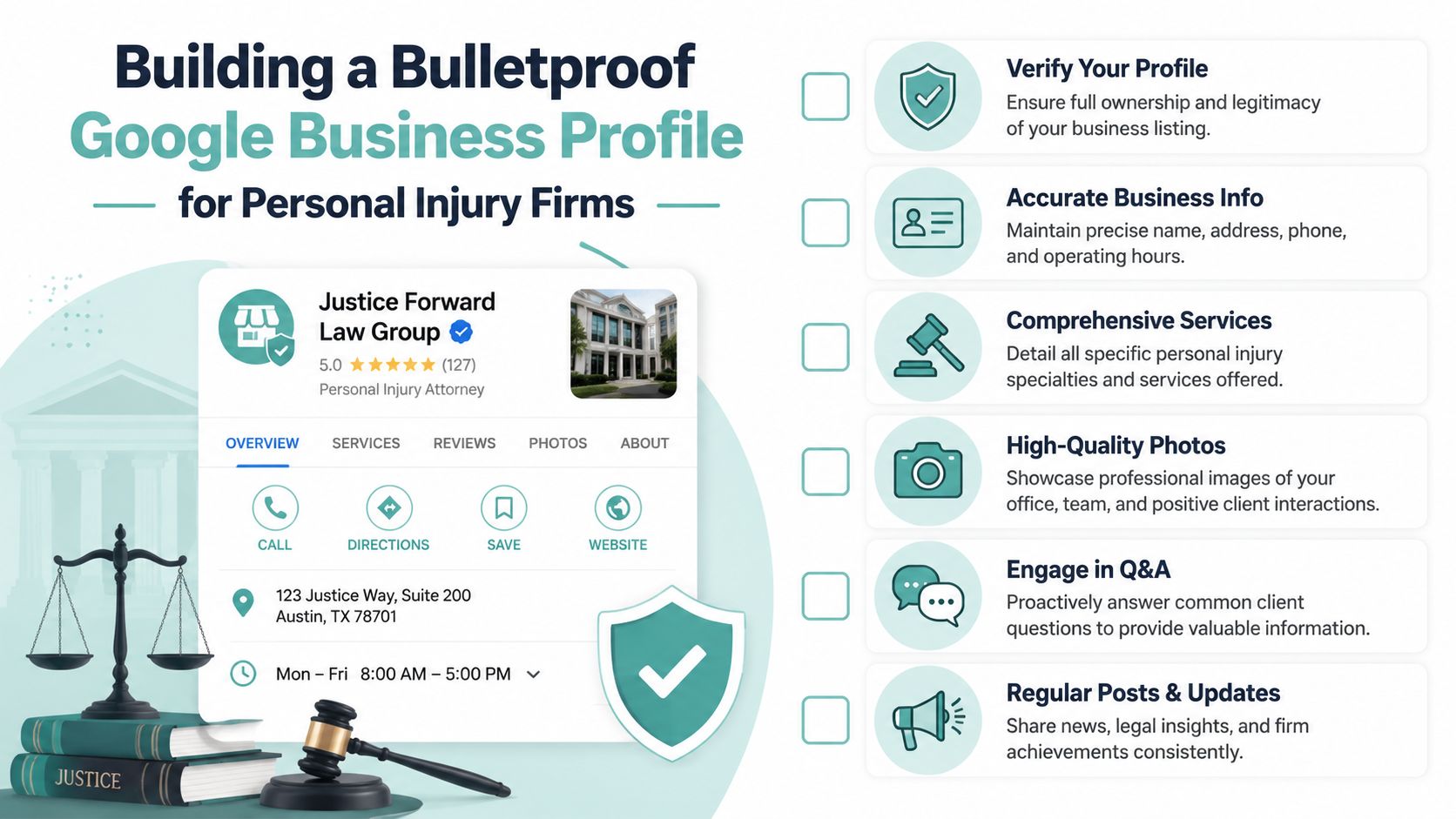
Get the category and core fields right first
Start with the fields that affect eligibility, not just clicks. For most PI firms, the primary category should be Personal Injury Attorney. Google's own Business Profile guidelines make clear that categories should describe the business as specifically as possible. Broad or mismatched categories create confusion about what the office does.
That choice has consequences. A firm using a generic legal category may still appear for branded searches, but it usually has a harder time earning strong visibility for car accident, truck accident, or wrongful death queries in the map pack.
Then set the core business details with the same care you would use in a filed pleading:
- Business name: Use your official firm name only. No keyword stuffing.
- Address: Use the actual staffed office address. Virtual office shortcuts are where suspension problems often start.
- Phone number: Use the direct local number you want associated with that office across the web.
- Hours: Keep them current, including holiday changes.
- Website link: Send users to the page that best matches the office, usually the location page.
Google also expects businesses that meet clients in person to show a real presence. The Google Business Profile quality guidelines are blunt about this. If the office is not staffed during stated hours, or if signage and occupancy cannot be supported, the profile can become vulnerable during a manual review.
Write for relevance, but stay inside the lines
The description field should confirm two things fast. What the firm handles, and where it practices.
Write it in plain English. Name the main injury matters, mention the city or region, and end with a clear next step. Do not turn it into an awards paragraph or a wall of marketing copy. Prospects skim. Google classifies.
A simple structure works well:
- State who the firm helps.
- Name the primary injury case types.
- Mention the office market or service area.
- End with a direct call to contact the firm.
Example framework:
Personal injury law firm serving injured clients in Dallas and surrounding communities. We handle car accident, truck accident, wrongful death, and other serious injury claims. Our attorneys help clients pursue compensation after serious negligence. Call today to speak with our team.
Services deserve the same level of precision. Add separate service entries for major practice areas instead of hiding everything under “law firm” or “legal services.” That gives Google cleaner relevance signals and gives prospects a quicker confirmation that they found the right office.
Use photos, links, and tracking like an operator
Photos are evidence. They support trust with prospects and legitimacy with Google.
Use real attorney headshots, reception photos, conference rooms, building signage, and exterior shots that match the office clients will visit. Stock images of gavels and courtrooms do not help. In aggressive PI markets, generic imagery can make a listing look thin or fabricated.
A short checklist helps:
| Profile element | What works | What fails |
|---|---|---|
| Photos | Real attorneys, real office, visible branding | Stock courtroom images |
| Services | One entry per practice area | One vague “legal services” entry |
| Description | Practice areas plus geography plus CTA | Awards-only bio copy |
| Website URL | Tagged for attribution | Untagged homepage link |
Use UTM parameters on the website link so GBP traffic is easy to isolate in analytics. Google provides guidance on campaign URL tagging in Analytics, and the setup is simple. Discipline matters more than complexity here.
Posts, Q&A, and review responses can also help keep the profile active, but they are secondary to accuracy and compliance. A perfectly active profile with a shaky address setup is still exposed. Firms that want stronger systems around client feedback and public trust usually need a documented law firm reputation management process, not random staff reminders.
A strong profile does three jobs at once. It tells Google the office is legitimate, tells prospects the firm handles their case type, and avoids the shortcuts that trigger suspensions.
That is what makes a profile bulletproof. It ranks, converts, and survives scrutiny.
The Power of Reviews and Consistent Citations
A personal injury prospect often sees two things before they ever reach your site. Your star rating and the basic business details attached to your listing. If either looks weak, the click goes to another firm.
Reviews and citations carry more weight in PI than many firms realize. Serious injury cases come with high anxiety, high fees, and high scrutiny. Prospects use reviews to judge whether the firm feels trusted publicly. Google uses citation consistency to decide whether that office is legitimate enough to rank.
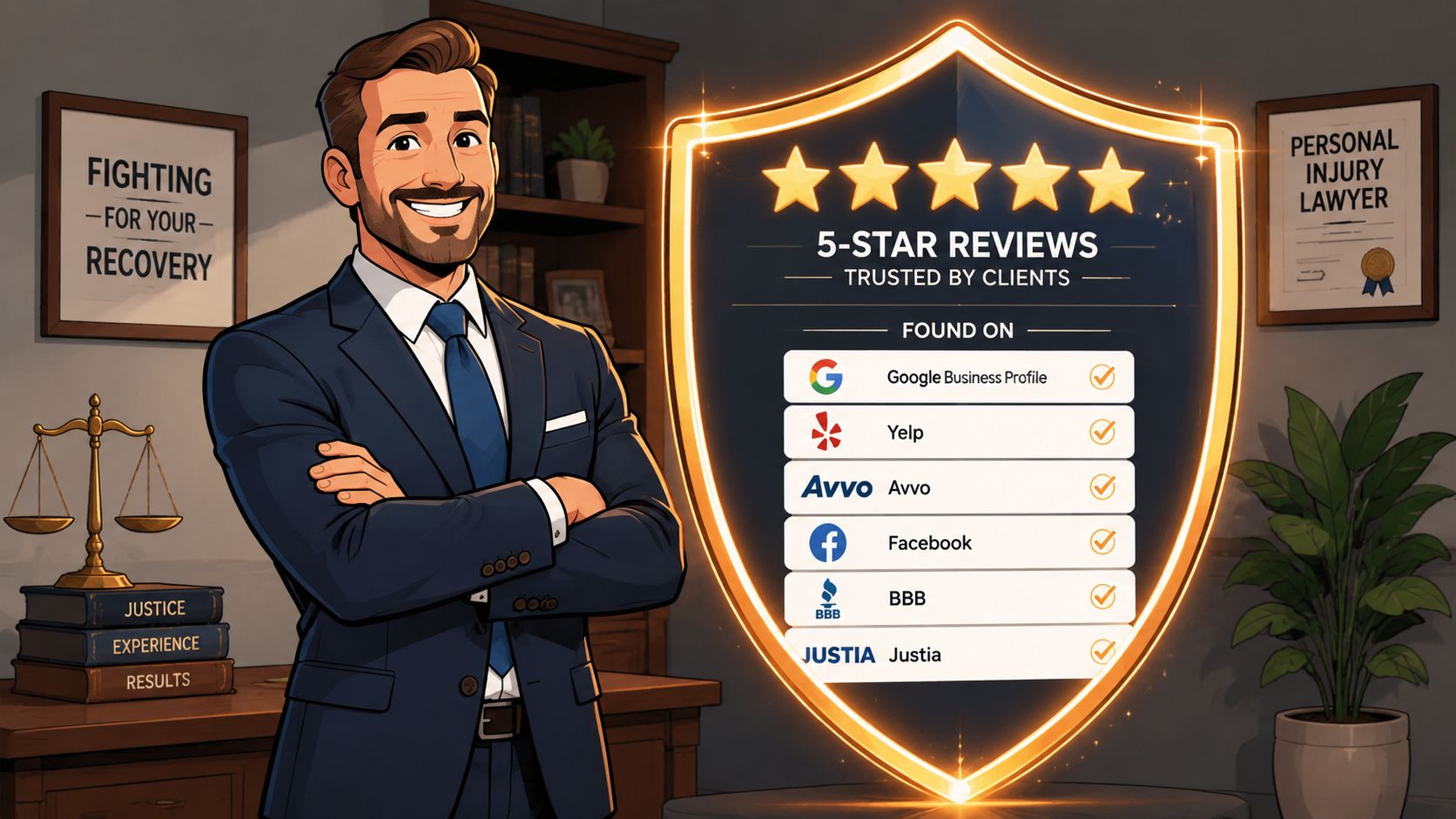
Reviews shape local trust before a prospect ever calls
Reviews do not just improve conversion. They also reinforce that the firm is active, serving real clients, and earning feedback in the market it claims to cover.
The firms that win here use a repeatable intake-closeout process. They do not leave review requests to memory or enthusiasm. In PI, timing matters because a request made during treatment, active litigation, or a frustrating insurance dispute can backfire. The better window is after a client expresses relief, gratitude, or satisfaction with the outcome or service.
A review process that holds up usually includes:
- Post-resolution timing: Ask after a positive milestone, not during the most stressful stage of the case.
- Clear instructions: Send the direct review link with a short, plain-language request.
- Ethical guardrails: Do not script facts, filter requests based on expected sentiment, or offer incentives.
- Response discipline: Reply consistently so the profile looks managed and prospective clients see professionalism.
Firms that need a tighter operational system usually benefit from a documented reputation management process for service businesses. That keeps review generation tied to workflow, not staff reminders and guesswork.
Citations are your firm's licensing paperwork online
If reviews show public trust, citations confirm identity.
For personal injury firms with one office or several, NAP consistency is a strict requirement. Your firm name, address, and phone number need to match across your Google Business Profile, legal directories, local citations, and location pages. Google Business Profile support documentation explains that businesses should present accurate, consistent information across Google and the web because mismatched details create confusion for users and for Google's local systems, as outlined in Google's guidance for representing your business on Google.
Small discrepancies cause real problems. A different suite format. A call tracking number used in one directory but not others. An old intake line that still appears on a local citation. None of those errors look dramatic in isolation. Together, they muddy the record and weaken trust signals.
Multi-office PI firms feel this most. Each staffed, client-facing office needs its own verified profile, its own matching citation footprint, and its own local landing page. Google also recommends choosing the most specific primary category available for the business, which is why "Personal Injury Attorney" is usually the right core category for these offices, according to Google's business category guidance.
The trade-off is straightforward. Firms want market coverage fast, but local authority is built on clean records tied to real offices. Expanding before the operational details are stable usually creates citation drift, review confusion, and compliance exposure.
Your citations should read like sworn testimony. Every platform should identify the same firm, at the same office, with the same contact details.
One office is manageable with a checklist. Several offices require governance. Someone has to own the master record, approve edits, and audit the major directories before bad data spreads.
The Hidden Risk That Can Erase Your Rankings Overnight
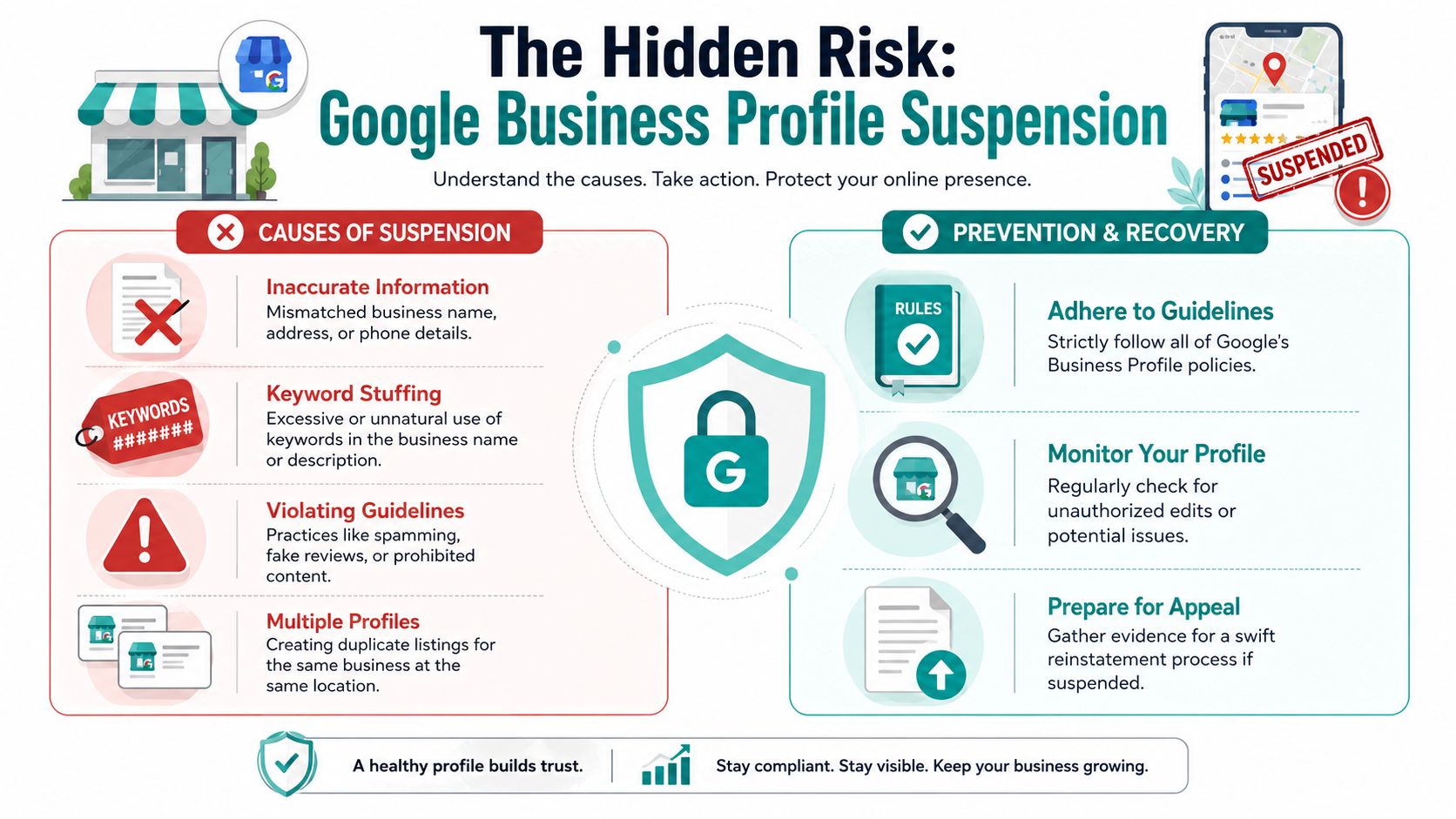
A PI firm opens a new office, adds "car accident lawyer" to the profile name, points the listing to a rented mailbox, and sees a short bump in map visibility. Then Google asks for proof. The profile gets suspended, calls stop, reviews disappear from view, and the firm is stuck in a reinstatement queue while competitors take the cases.
That is the primary compliance problem with Google Business Profile SEO for personal injury firms. Aggressive tactics can produce a temporary gain. They can also wipe out your local presence in a single review cycle.
The bad advice that gets firms suspended
Law firms get risky GBP advice all the time. Add practice-area keywords to the business name. Create listings in cities where you want cases before the office is operational. Use a shared workspace and clean it up later.
Google's rules are stricter than many agencies admit. Google says your business name should reflect your real-world name and that in-person businesses should show a real, staffed location that customers can visit during stated hours, according to Google's guidelines for representing your business on Google. For PI firms, that standard matters because expansion often happens faster than operations.
The weak point is usually "almost real" office presence. A mailing address is not enough. A borrowed conference room is not enough. If the office cannot stand up to verification with signage, staff presence, and business records that match the profile, the listing is exposed.
Common suspension triggers include:
- Keyword-stuffed business names: names on the profile that do not match the firm's actual branding
- Virtual offices or shared spaces: especially where the firm lacks permanent signage or staffed availability
- Phone inconsistencies: profile numbers that conflict with citations, the website, or verification documents
- Duplicate listings: multiple profiles for the same office, lawyer, or practice without a valid reason under Google's rules
I see one trade-off come up again and again. Firms want broader coverage across a metro area. Google wants proof that each listing represents a real, client-facing office. If you choose speed over proof, the profile becomes a liability.
A compliance-first recovery and prevention playbook
The safest approach is plain and disciplined. Use the actual firm name. Verify only offices you can document. Keep every field tied to records you would be comfortable handing to a regulator or opposing counsel.
If a profile is suspended, handle it like a case file:
- Audit every public field. Review the business name, address, phone, category, hours, and website URL against your legal and operational records.
- Fix the clear violation first. Remove added keywords, unsupported categories, or location details that do not reflect the actual office.
- Build the evidence set. Gather lease documents, utility bills, business registration, permanent signage photos, and office images that show the firm operates there.
- Clean up supporting references. Align the website, major directories, and any tracking setup before filing an appeal. If you are changing locations, this Google Business Profile address change process is a useful reference.
- Submit a factual reinstatement request. Keep the appeal short, document-backed, and focused on compliance.
Call handling matters here too. A lot of firms create avoidable problems by swapping numbers without a plan, which can trigger data conflicts across citations and the profile. If your team uses tracking, set it up carefully and understand the reporting trade-offs. This primer on measuring marketing ROI from calls is helpful for that.
A profile that survives scrutiny beats a profile that spikes for three weeks and disappears.
Long-term map pack dominance in PI is not about finding a loophole. It is about building listings Google can trust, defend, and keep live through audits, edits, and competitor reports.
Measuring What Matters and Choosing the Right Partner
Ranking screenshots don't sign cases. Intake does.
A law firm can celebrate more map visibility and still have no idea whether the profile is generating qualified calls, website visits that convert, or direction requests from real prospects. If you can't connect local SEO work to client inquiries, you're grading appearances.
Vanity metrics versus intake metrics
Some metrics are useful diagnostics. They just aren't business outcomes.
Use this filter:
| Metric type | Useful for | Not enough by itself |
|---|---|---|
| Impressions | Visibility trend | Doesn't prove case value |
| Rank checks | Competitive monitoring | Can mislead across locations |
| Website clicks | Interest signal | Doesn't show lead quality |
| Calls from GBP | Intake intent | Needs source tracking |
| Direction requests | Local action signal | Needs context by office |
The most important measurement question is simple. Did the profile generate conversations with potential clients?
That's why firms should pay attention to call attribution and call handling. If you need a practical primer on measuring marketing ROI from calls, that resource is helpful for understanding how call tracking can clarify which channels are producing intake.
Questions to ask before hiring help
Most SEO vendors know the language of rankings. Fewer understand the compliance risks tied to law firm profiles.
Ask direct questions:
- How do you handle GBP compliance? If they suggest adding keywords to the business name, end the meeting.
- What is your process for multi-office verification? They should care about staffed, client-facing locations.
- How do you report on calls and lead attribution? “We track impressions” is not enough.
- Who writes and updates the profile content? You want someone who understands injury practice areas and local intent.
- What happens if a profile is suspended? If they have no response framework, they're not prepared.
The right partner won't promise magic. They'll show a process, insist on clean data, and talk about risk before they talk about rank.
Your Next Steps to Local Search Dominance
The firms that keep winning local search usually do three things well. They maintain a complete and credible Google Business Profile, they protect data consistency across the web, and they avoid shortcuts that put the asset at risk.
That's the essential context for Google Business Profile SEO for personal injury firms. It isn't only optimization. It's optimization under compliance pressure.
What to do this week
Start with a short working audit.
- Audit the profile itself: Confirm the business name is clean, the primary category is correct, the services are specific, and the description reflects your actual practice areas and geography.
- Check identity consistency: Compare your office name, address, and phone number across your website, directories, and profile.
- Systematize review requests: Assign ownership to intake or case management staff and make review outreach part of the client journey.
Then add one ongoing habit. To maintain active engagement and improve visibility, firms should aim for at least one new Google Business Profile post per week, using short FAQs, blog links, case highlights, recent wins, or community involvement updates, as noted in this Google Business Profile posting recommendation.
If you want another perspective on the broader local framework, this guide on local SEO for law firms is a useful companion read.
The point isn't to do everything at once. It's to stop letting a high-value intake channel run on autopilot. A clean, active, defensible profile can keep producing long after trend-chasing tactics burn out.
If your firm wants a serious rebuild of its local search presence, Digital Skyrocket focuses on lead-generating websites, local SEO, and reputation management for service businesses, including law firms. The work centers on durable visibility, conversion-focused design, and the kind of compliance-minded execution that helps firms grow without gambling their Google Business Profile.