
Your firm may already have the expensive website. Clean design. Good photography. Attorney bios. Practice area pages. Maybe even a blog with a few dozen posts.
And yet the phone isn’t ringing from organic search the way it should.
That usually isn’t a design problem. It’s a systems problem. A law firm website only becomes a client acquisition asset when it’s built to rank for the searches that matter, earn trust fast, and turn visitors into consultations. That’s what SEO for law firms is really about. Not vanity rankings. Not traffic for its own sake. Qualified case inquiries from people actively looking for legal help.
The firms that win in search treat SEO like intake infrastructure. They build pages around practice areas, locations, and real legal questions. They strengthen local signals. They clean up technical issues that block performance. Then they measure whether those efforts produce calls and form submissions, not just impressions.
Why Most Law Firm Websites Fail at SEO
A law firm website fails at SEO when it looks polished but gives Google no clear reason to rank it and gives prospects no clear reason to contact you. That’s the common pattern. Firms invest heavily in branding, then wonder why search traffic stays flat and case inquiries remain inconsistent.
The opportunity cost is large. Organic search accounts for 53% of all website visits, the #1 organic result captures 39.8% of clicks, and law firms spent an average of $120,000 annually on SEO in 2024 according to attorney SEO statistics compiled by EverSpark Interactive. That tells you two things immediately. Search is still the biggest traffic channel, and serious firms already treat it as a core growth investment.
A website is not a strategy
Most underperforming legal sites have one or more of these problems:
- They target the wrong pages: The homepage tries to rank for everything, while the actual money pages are thin or buried.
- They publish disconnected content: Articles exist, but they don’t support practice area pages or local service pages.
- They ignore local search signals: The firm wants cases in specific cities, but the site barely references those markets.
- They bury the conversion path: Visitors have to hunt for a phone number, form, or next step.
A beautiful site can still be invisible. Search engines rank structure, relevance, authority, and usability. They don’t reward a firm solely for having a modern layout.
Practical rule: If your site can’t clearly answer what you do, where you do it, and why someone should contact you, it usually won’t perform.
What actually moves cases into your pipeline
Effective SEO for law firms works like a system. A prospect searches for a legal problem. Your page appears because it matches the intent and the geography. The content answers the question clearly. The page builds trust fast. Then the site gives the visitor an easy way to call or submit a form.
That is much different from “let’s blog more and hope rankings improve.”
A stronger way to think about legal SEO is to treat every important page as a business asset. Practice area pages should target commercial intent. Location pages should reinforce service areas. Supporting articles should answer questions that lead people toward hiring decisions. Internal links should move authority toward the pages that generate revenue.
If you want another practitioner-level perspective on how firms structure that process, CasePulse’s law firm SEO guide is a useful companion read.
The Foundation of Local SEO for Attorneys
For most firms, local SEO is where search visibility starts or stops. Someone needs a car accident lawyer, divorce attorney, DUI defense lawyer, or probate attorney. They usually want help in their city or nearby. If your local signals are weak, your firm won’t show up when intent is highest.
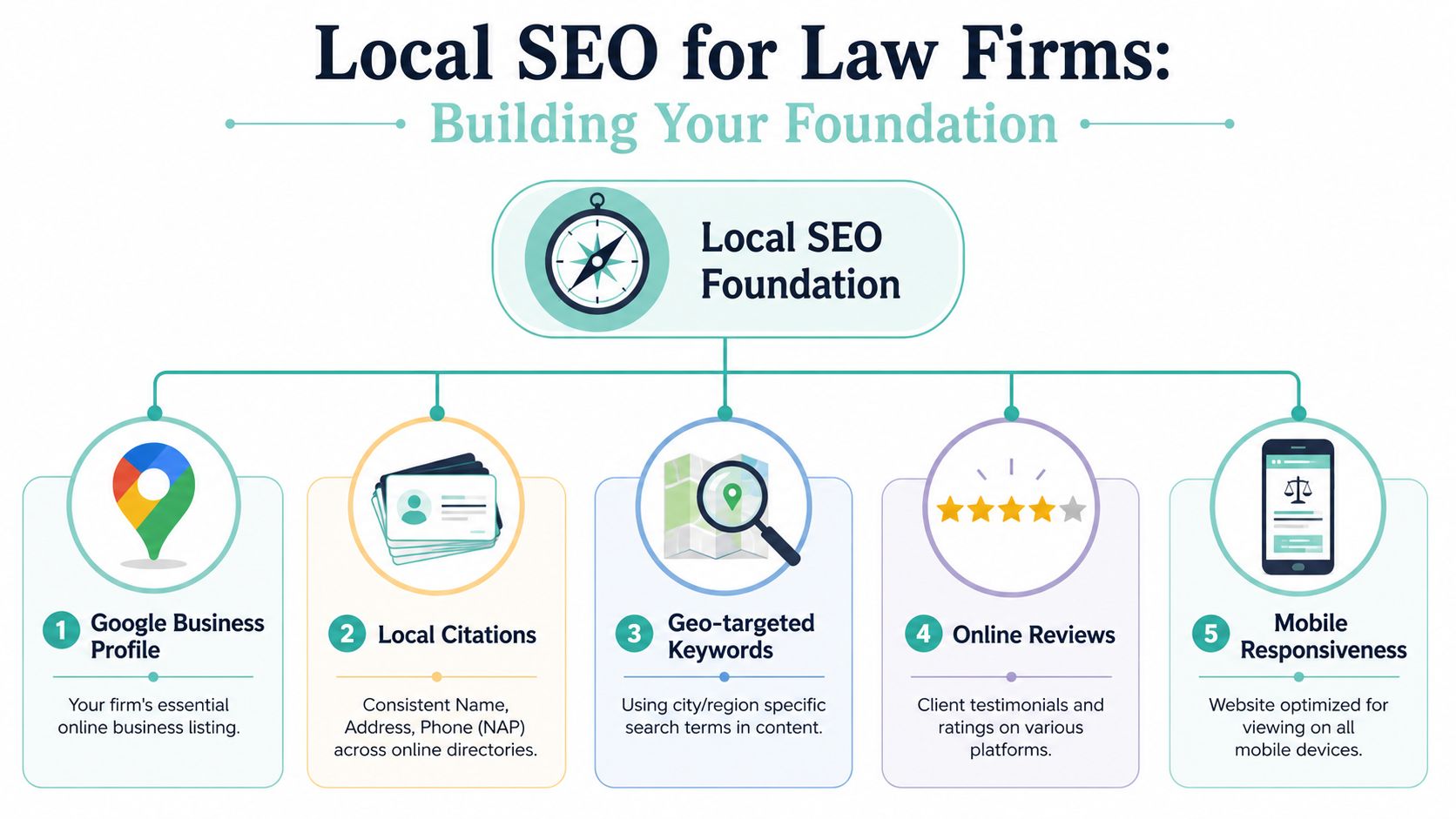
Your Google Business Profile does the heavy lifting
Your Google Business Profile is one of the most important local assets your firm controls. It feeds Google Maps, local pack visibility, branded search results, and basic trust signals.
A weak profile usually has obvious flaws. Incomplete categories. Thin business descriptions. Few photos. Inconsistent hours. No review responses. Sometimes the wrong primary category.
A strong profile is much tighter:
- Primary category selection: Choose the category that best reflects your core practice, not a vague general option if a better fit exists.
- Service accuracy: Make sure your services align with your actual practice areas and markets.
- Review management: Ask for reviews consistently and respond professionally.
- Visual completeness: Add office photos, attorney photos, and branding that reinforces legitimacy.
Your website has to reinforce your geography
Your website should confirm the same local signals your Google profile suggests. That means your firm’s name, address, and phone number need to be consistent and easy to find. It also means your content should reflect where you work.
Location relevance usually comes from a combination of page structure and language. A firm might have a personal injury hub page, then city pages for the primary markets it serves. Those pages should not be clones with only a city name swapped out. They need useful local context, clear service relevance, and clean internal linking.
One good way to stay current on local ranking considerations is to review curated material on Digital Skyrocket’s local SEO articles.
Local SEO works best when your Google profile, website pages, and third-party mentions all tell the same story about who you are and where you serve clients.
Citations and reviews validate your firm
Citations are mentions of your firm’s name, address, and phone number across directories, legal platforms, and business listings. Reviews are a related signal, but they do a different job. Citations help validate your entity. Reviews help validate trust.
Here’s the simplest way to think about the local foundation:
| Element | What it tells Google | Common mistake |
|---|---|---|
| Google Business Profile | You are a real local business | Leaving fields incomplete |
| Website location pages | You serve specific markets | Creating duplicate city pages |
| Citations | Your business data is consistent | Mismatched phone numbers or addresses |
| Reviews | Clients recognize and trust your firm | Asking sporadically instead of consistently |
If your firm serves multiple locations, the challenge gets harder. You need accuracy across every listing, every office detail, and every local landing page. The firms that stay disciplined here usually outperform firms that chase shortcuts.
Develop a Content Strategy That Captures Legal Intent
Law firms lose a lot of search opportunity by writing content that sounds informative but doesn’t map to how people search for legal help. The issue usually isn’t a lack of content. It’s a lack of intent alignment.
A legal marketing source reports that 96% of people seeking legal advice use a search engine, and 62% of legal searches are non-branded, which means many prospects begin with a legal problem rather than a firm name, as noted by The Trust Agency’s law firm SEO statistics. That’s why your content strategy has to be built around discovery, not brand recognition.
Most legal searches start without your brand
A person rarely begins with loyalty to your firm. They begin with urgency.
They search things like:
- Commercial intent: “personal injury lawyer near me”
- Local service intent: “child custody attorney in Phoenix”
- Problem-aware intent: “what to do after a truck accident”
- Process intent: “how long do I have to file a claim”
Those are not equal. Some searches are much closer to hiring. Others are research-oriented. Your content plan should cover both, but not with the same page type.
A service page should not read like a glossary entry. A blog article should not pretend to be your main conversion page.
Build hubs, not random blog posts
For legal SEO, one of the most reliable structures is a practice area hub supported by tightly related subpages. The hub acts as the main authority page. Supporting pages target narrower services, subtopics, and locations.
For example, a personal injury firm might build a hub-and-cluster structure like this:
- Hub page: Personal Injury Lawyer
- Supporting service pages: Car Accidents, Truck Accidents, Wrongful Death, Slip and Fall
- Location pages: Personal Injury Lawyer in specific cities
- Support content: FAQs, claim timelines, liability explanations, settlement process guidance
That structure is stronger than publishing isolated articles because every supporting page reinforces topical relevance. If you’re planning that architecture, Digital Skyrocket’s content strategy service overview outlines the kind of hierarchy firms often need before they write another page.
Match content to the stage of the client journey
A practical content strategy usually separates pages into three buckets:
| Content type | Best use | What usually goes wrong |
|---|---|---|
| Practice area pages | Capture hiring intent | Too short, too generic, too broad |
| Location pages | Capture local commercial intent | Duplicate content with city swaps |
| Educational articles | Capture early research and trust-building | Written with no path toward conversion |
Here’s the trade-off. Informational content can attract early-stage visitors, but it won’t carry your SEO program by itself. High-intent commercial pages are what usually drive consultations. Educational content supports them by building relevance, internal linking depth, and trust.
So stop asking whether your firm “needs a blog.” The better question is whether every new page has a defined role in the path from search to signed case.
The strongest legal content strategies don’t publish more. They publish with a job in mind.
Implement Essential On-Page and Technical SEO
A potential client searches “car accident lawyer near me” on a phone, taps your result, and lands on a page that loads slowly, buries the contact option, and gives Google mixed signals about what the page is about. You do not just lose a visit. You lose a case inquiry.
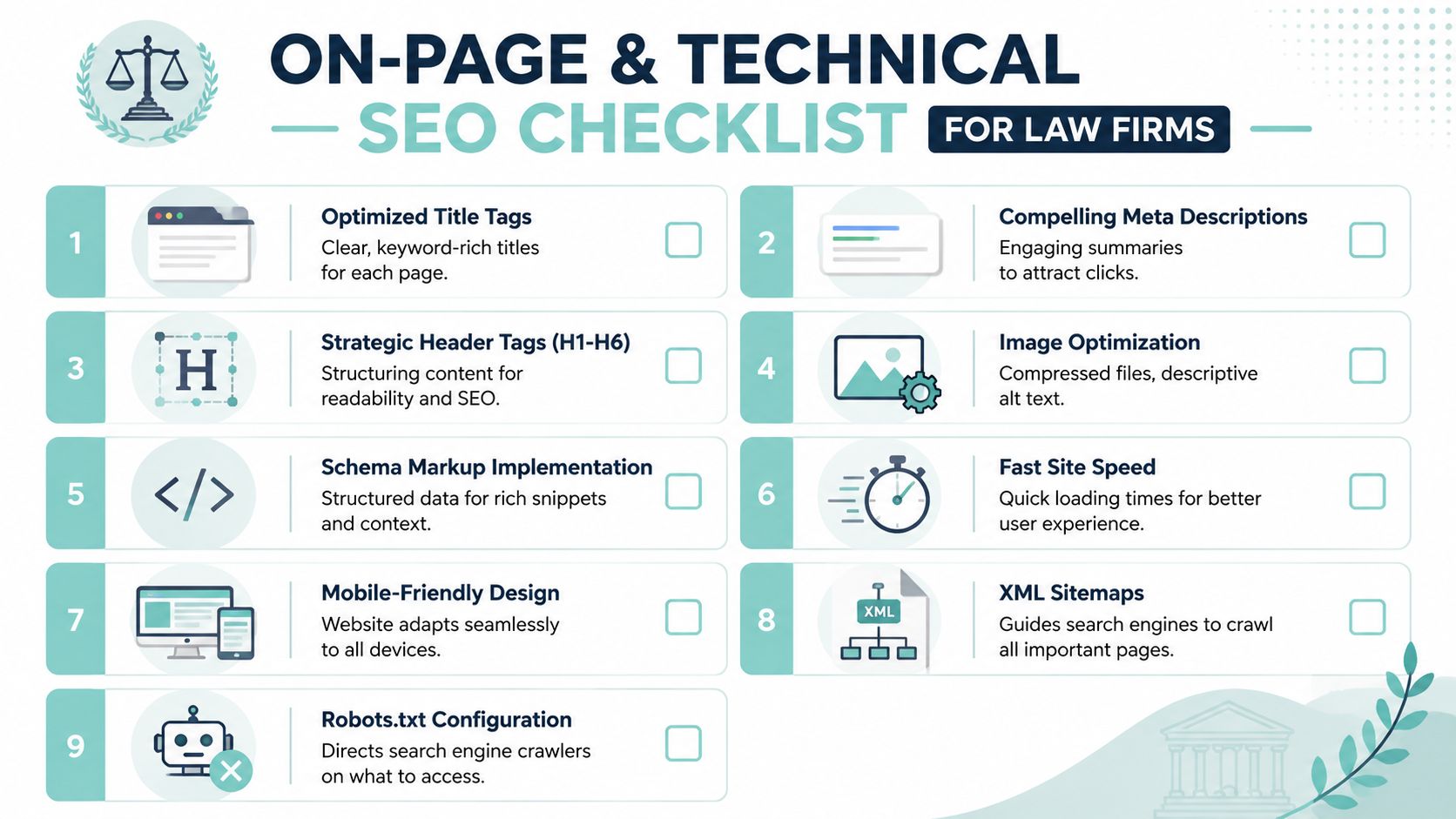
On-page and technical SEO determine whether your best pages can rank, whether they earn clicks, and whether those clicks turn into consultations. For law firms, this work is not a maintenance task. It is the infrastructure behind predictable client acquisition from search.
Architecture decides which pages get authority
Law firm websites often break down the same way. New practice pages get added without a clear parent page. Location pages sit outside the main service structure. Blog posts attract internal links while revenue pages stay isolated. Google can crawl all of that, but it has a harder time understanding which pages matter most.
A better setup is simple and deliberate:
- Top level: Core practice area hubs
- Second level: Specific case type or service pages
- Third level: Location pages and support resources
- Internal linking: Contextual links that point authority toward the pages that drive consultations
Site structure impacts more than just rankings. It determines which pages accumulate internal authority, appear for high-intent searches, and guide a visitor toward contacting your firm. I usually see the same trade-off: firms publish a lot of useful content, but the pages that should bring in qualified leads are too hard to reach, too weakly linked, or too similar to each other.
Keep important pages close to the homepage. Give every practice area a clear place in the hierarchy. Remove duplicate or overlapping pages before they start competing with each other.
Technical SEO removes friction for search engines and prospects
A law firm site does not need complicated technical work. It needs clean execution.
Fortress Growth’s technical SEO guidance for law firms points to the areas that matter most: speed, mobile usability, and structured data such as LocalBusiness schema. Those priorities line up with how legal searches happen in the real world. Many prospects search on mobile, often under stress, and make fast judgments about trust.
Focus on the basics that affect visibility and conversion:
- Speed: Compress oversized images, remove unnecessary scripts, and keep page templates light
- Mobile usability: Use tap-friendly buttons, readable text, and short forms
- Security: Run the site on HTTPS and keep plugins, themes, and CMS software updated
- Indexing: Make sure important pages are crawlable, canonicalized correctly, and included in clean XML sitemaps
- Structured data: Mark up your firm details, reviews where appropriate, FAQs, and core business information so search engines can interpret the page with less guesswork
Technical problems rarely announce themselves. They show up as pages that do not rank as well as they should, location pages that never get traction, or leads that drop because mobile visitors give up before the page finishes loading.
On-page SEO sharpens relevance and improves click-through
On-page SEO is where legal websites either get precise or get sloppy. Precision wins.
Each core page should target one primary search intent. A personal injury homepage, a car accident page, and a truck accident page should not all chase the same term with slightly different wording. That is how firms create internal competition and dilute relevance.
Tighten these elements first:
- Title tags: State the service clearly and include geography only where it helps match local intent
- Meta descriptions: Write for the searcher deciding whether to click, not for keyword repetition
- Headers: Use one clear H1, then organize H2s and H3s around the client’s actual questions
- Body copy: Cover the issue with enough depth to show authority, but keep the page focused on one hiring intent
- Images: Use descriptive alt text and properly sized files
- Internal anchors: Link naturally to related services, locations, and next-step pages
The goal is not higher rankings in isolation. The goal is a page that ranks for the right query, earns the click, and moves the visitor toward a consultation request.
A fast site with vague targeting underperforms. A well-targeted page on a slow, messy site underperforms too. Firms that treat SEO like a client acquisition system get both sides right.
Build Authority with Citations and Link Building
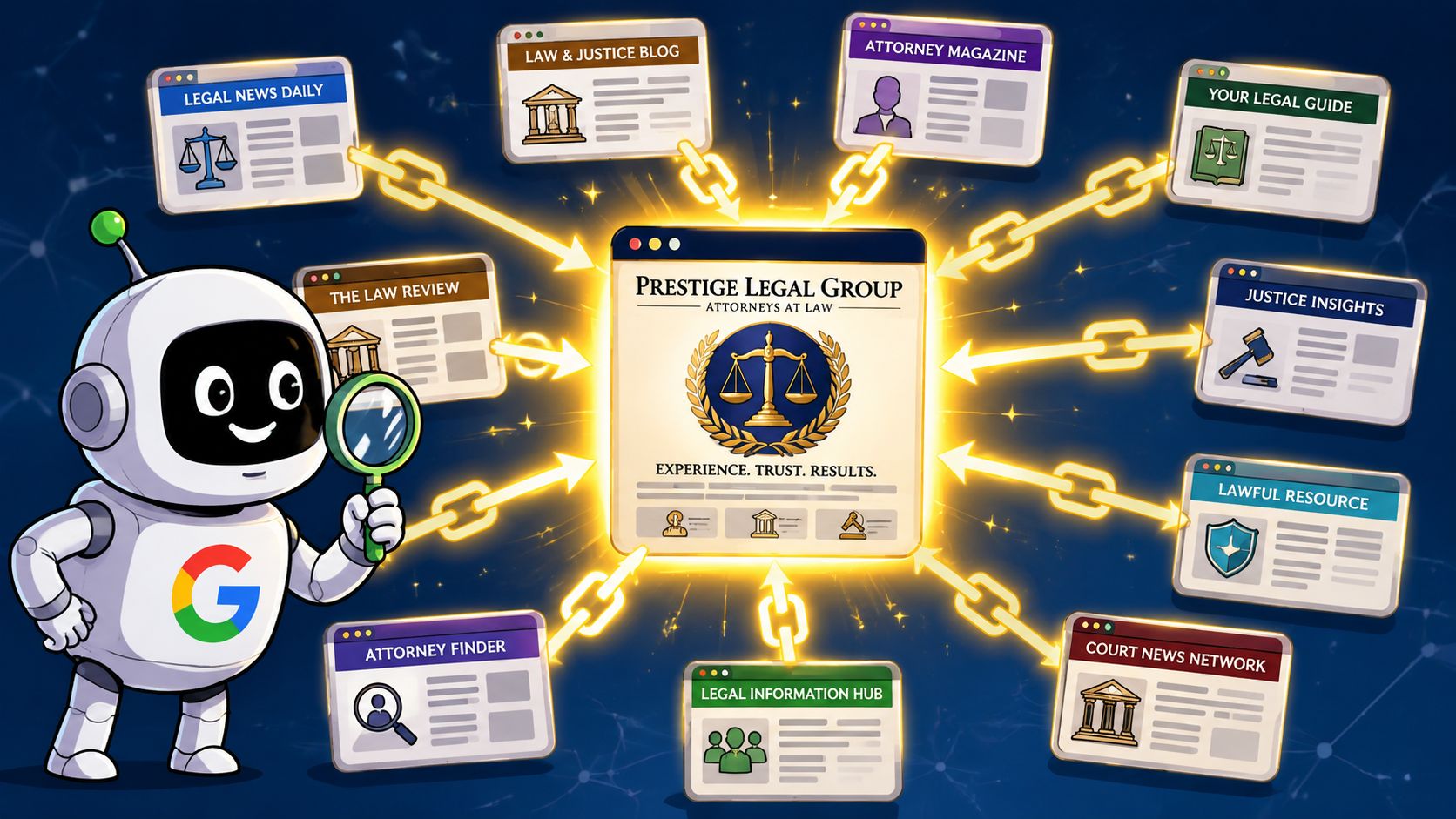
Authority signals come from outside your website. Google looks at those signals to help decide whether your firm is credible, locally established, and worth surfacing for competitive legal queries. But law firms often lump everything together under “link building,” which leads to wasted effort and bad outreach.
Citations and backlinks are not the same
A citation is a mention of your business details on a directory, legal platform, chamber site, or local listing. A backlink is a hyperlink from another website to yours.
They support SEO in different ways:
| Signal | Main purpose | Typical examples |
|---|---|---|
| Citations | Validate business identity and location | Legal directories, local business directories, bar associations |
| Backlinks | Transfer authority and editorial trust | News stories, legal publications, community organizations |
A citation can exist without much editorial value. A backlink can be powerful even if it doesn’t include full business details. You usually need both.
What works and what usually wastes time
Foundational citation work is straightforward. Claim profiles on relevant legal and local directories. Keep your data consistent. Remove duplicates where possible. Make sure your site URL, phone number, and office details match exactly.
Backlink acquisition is more selective. The best links usually come from actual relevance, not volume.
Strategies that tend to work:
- Local involvement: Sponsorships, community partnerships, scholarship pages, and local organizations that legitimately mention your firm.
- Expert commentary: Contributing legal insight to journalists, publishers, or niche industry sites.
- Useful legal resources: Publishing pages worth citing, such as process guides, court navigation resources, or locally relevant FAQs.
- Professional relationships: Vendor mentions, associations, and legal community references.
Tactics that usually hurt or waste budget:
- Paid link schemes: Easy to buy, easy for search engines to distrust.
- Low-quality guest posting at scale: Looks productive in a report, rarely builds durable authority.
- Irrelevant directories: Hundreds of weak listings add noise, not strength.
- Exact-match anchor obsession: Manufactured anchor text patterns are a red flag.
Good legal link building looks like reputation building. Bad legal link building looks like procurement.
If a proposed strategy sounds like a shortcut, it usually is. The firms that build durable authority do the slower work of becoming cite-worthy in their market.
Prepare for the Future with Answer Engine Optimization
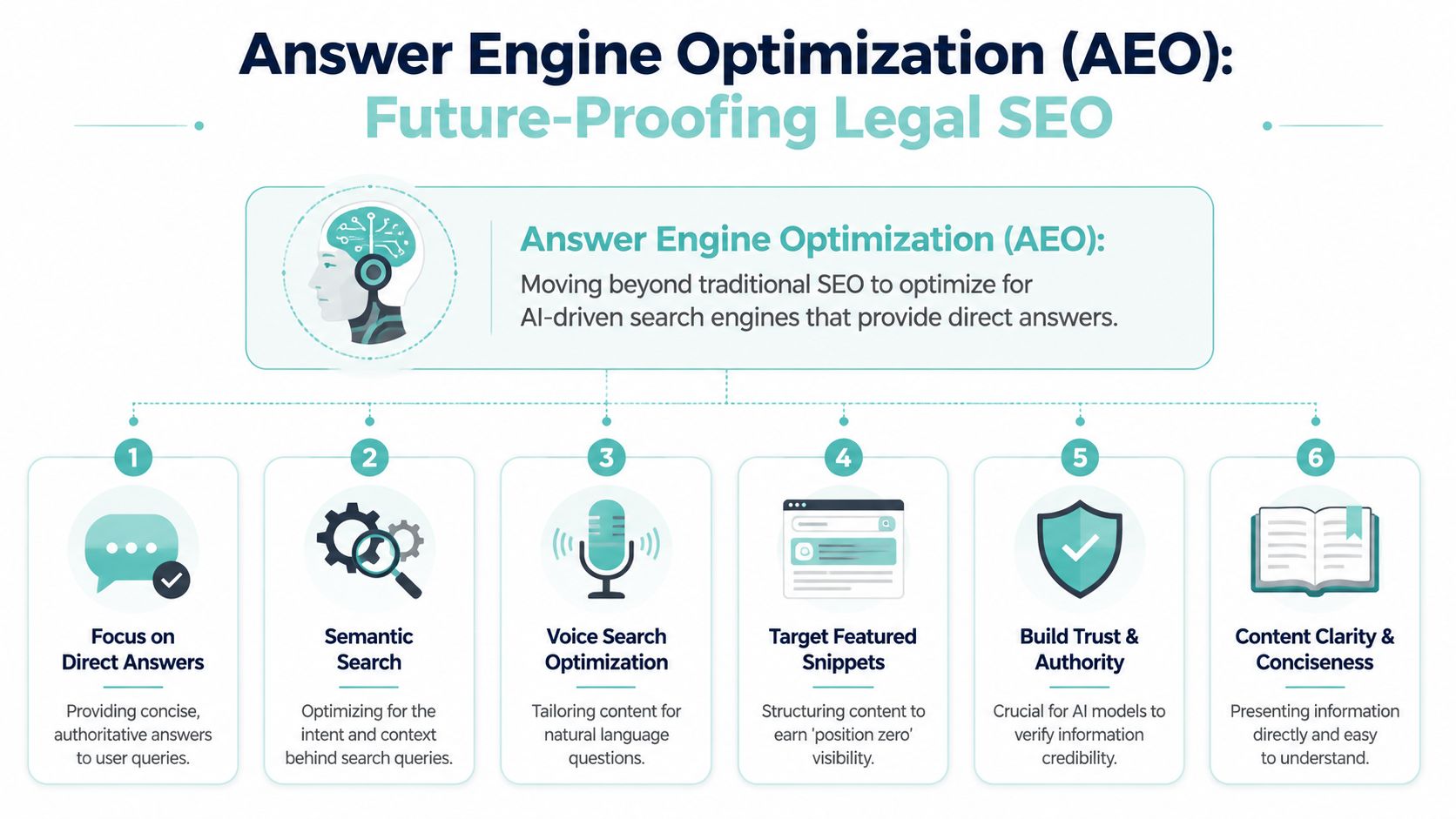
Search has changed. A page no longer needs to earn only a blue-link click to create visibility. It may also be parsed, summarized, or quoted by AI-driven search experiences. That shifts how legal content should be written.
Search engines now extract answers, not just rank pages
Recent legal SEO guidance says law firm pages should be written for fragment retrieval, meaning AI systems may pull a short passage rather than evaluate the page only as a whole. The recommendation is to use clear H2s that ask a question and answer it directly in the first one to two sentences, as explained in Eve Legal’s law firm SEO strategies.
This changes the writing style that works best.
A lot of older legal content buries the answer beneath long introductions, generic disclaimers, and repeated keyword phrases. That format is weak for both users and AI systems. If someone asks, “How long do I have to file a personal injury claim?” your page should answer that immediately, then expand with nuance, exceptions, and local context.
How to format legal content for fragment retrieval
AEO doesn’t replace SEO for law firms. It sharpens it.
Pages that tend to perform better in answer-driven search usually include:
- Question-based headings: Use headings that mirror the actual query a prospect might ask.
- Answer-first paragraphs: Give the direct answer early, then add detail.
- Self-contained sections: Each section should make sense even if extracted from the full page.
- Clean supporting context: Add jurisdictional notes, definitions, and next steps after the core answer.
- Consistent entity signals: Make it obvious which attorney or firm is providing the information.
For firms trying to understand how large language model visibility may develop beyond Google, SEO for Claude answers offers a useful perspective on answer-oriented optimization.
Here’s the trade-off. If you write every page like a FAQ stub, you may lose persuasion and depth. If you write every page like a long-form essay, AI systems may skip over your best material. The right move is hybrid structure. Lead with a concise answer. Follow with legal nuance. End with a clear next step.
The firms most likely to win AI visibility are often the ones that remove throat-clearing and answer the question like a lawyer speaking plainly to a client.
Turn Clicks into Clients by Optimizing for Conversion
SEO can produce the right visitor and still fail the business goal. That happens when a practice area page ranks, traffic arrives, and the page gives the person no confident path to contact your firm.
Traffic without conversion is a reporting illusion
A law firm page should do more than attract a click. It should reduce uncertainty and move a stressed prospect toward action.
Many legal sites lose conversions for avoidable reasons:
- Weak calls to action: The page says “contact us” but never explains why or when.
- Poor form design: Forms ask for too much, feel impersonal, or break on mobile.
- Trust signals buried low: Reviews, results, attorney credentials, and proof points appear too late.
- No urgency cues: The page doesn’t acknowledge that legal problems often require quick decisions.
A visitor who lands on your site from a high-intent search is not browsing casually. They’re evaluating risk. They want clarity, competence, and a low-friction next step.
What high-converting law firm pages usually include
The strongest conversion pages often have a few patterns in common:
- Visible contact options: Phone number, form, and next-step prompt above the fold.
- Specific CTA language: “Speak with an attorney about your injury case” is stronger than “Submit.”
- Credibility cues near the top: Attorney bios, jurisdictions served, reviews, awards, and experience indicators.
- Page-level reassurance: Explain what happens after someone reaches out.
- Mobile-first form flow: Short fields, easy tap targets, and no clutter.
For firms refining intake UX, optimizing contact forms for law firms is worth reviewing because form friction is one of the most common silent conversion killers.
Conversion work should also be measured and improved over time, not guessed at once during a redesign. A structured approach to conversion rate optimization for lead generation websites helps firms tighten layouts, forms, and calls to action after launch, when real visitor behavior starts revealing what’s working.
The key point is simple. SEO gets you the audience. Conversion strategy determines whether that audience becomes a consultation.
Measure Success and Choose the Right SEO Partner
A law firm can spend months paying for SEO and still have no clear answer to a simple question: is search producing the kinds of cases your firm wants?
That happens when reporting focuses on activity instead of outcomes. Keyword movement, traffic charts, and long task lists can all look impressive while intake quality stays flat. If your firm handles high-value matters, SEO should be judged as a client acquisition system. The standard is not “did visibility improve?” The standard is “did qualified case inquiries increase, and can you trace them back to the right pages, markets, and search themes?”
What to measure if you care about signed cases
Start with signed-case potential and work backward into the metrics that influence it.
A useful scorecard usually includes:
- Qualified organic leads: Calls and form submissions from people in your target geographies who match the case types you want.
- Lead-to-consultation rate: How many organic inquiries become scheduled consultations.
- Consultation-to-client rate: Whether SEO is bringing in viable matters or filling intake with poor-fit leads.
- Page-level lead contribution: Which practice area pages, city pages, and supporting articles generate inquiries.
- Local visibility by market: Whether your firm appears in the places where you want more cases, especially in the map pack and localized organic results.
- Intake feedback: What your intake team hears on calls. Wrong jurisdiction, wrong matter type, low urgency, and price shoppers all point to targeting problems.
Rankings still matter. They just belong lower on the dashboard. I care about rankings because they help diagnose visibility problems and reveal opportunities. I do not treat them as proof of ROI. A page ranking third for “car accident lawyer [city]” and producing retained cases beats a page ranking first for a broad informational term that never turns into a consultation.
Review site structure during performance analysis too. If your practice area pages, subtopics, and location pages are scattered or competing with each other, measurement gets muddy and growth slows. Strong legal SEO usually comes from a clean content hierarchy that makes it easy to see which topics and markets are driving revenue.
Questions to ask before hiring an SEO partner
The right SEO partner should be able to explain how they plan to get your firm more qualified inquiries, not just more impressions.
Ask these questions early:
- How do you prioritize practice areas and markets? The answer should tie search opportunity to case value, competition, and your intake capacity.
- How do you decide which pages to create, merge, or improve first? Good strategy starts with revenue potential and search intent, not a generic content calendar.
- How do you track lead quality after the form fill or phone call? If they stop at traffic and conversions, they are missing the part that matters most to a law firm.
- How do technical SEO, local SEO, content, and conversion work together? On legal sites, these functions affect each other directly.
- Who is responsible for strategy and who is doing the work? You want clarity on whether senior people are involved or only present during the sales process.
- Do you work with competing firms in my market and practice area? Conflict policy matters. So does focus.
- How do you report results to show business impact? The report should connect organic performance to consultations, signed cases, or at minimum qualified leads.
Pay attention to how they answer, not just what they say. Specific answers usually signal experience. Vague language, guaranteed rankings, and one-size-fits-all packages usually signal the opposite.
Legal SEO has trade-offs. A firm may need to choose between expanding into new location pages, improving conversion on existing high-intent pages, or cleaning up technical issues that suppress performance across the whole site. A strong partner can explain those trade-offs, set priorities, and defend the plan with business logic.
If your law firm wants a website that does more than look credible, Digital Skyrocket helps firms build lead-generating sites that combine web design, local SEO, reputation management, and conversion-focused structure. If you need a clearer plan for turning search visibility into qualified case inquiries, they’re worth a closer look.