You just finished a job that went well. The roof leak is fixed, the closing is signed, the dental work is done, and the customer is visibly relieved. Then the conversation ends, the crew packs up, and nobody says the one thing that can turn that good experience into search visibility, more trust, and better leads, a review.
That's where most service businesses lose momentum. They assume happy customers will leave feedback on their own, but they usually need a clear prompt, a good time, and a simple path. The practical part of how to ask for reviews is less about clever wording and more about matching the request to the customer's moment, the channel they'll notice, and the platform rules you can't afford to ignore.
Table of Contents
- Introduction the Missed Opportunity in Every Service Call
- When to Ask the Timing Framework for Service Businesses
- Where to Ask Channel-Specific Playbooks and Templates
- Handling Negative Reviews and Staying Compliant
- Automation Tools and Metrics That Matter
- Conclusion Building a Review-Ready Culture
Introduction the Missed Opportunity in Every Service Call
A roofer gets the final walkthrough. The homeowner says, “Looks great, I'm so glad this is done.” The estimator nods, hands over the invoice, and leaves. Two weeks later, the office manager wonders why the Google profile is still quiet.
That pattern shows up in law firms, HVAC shops, dentists' offices, and every other service business where satisfaction is earned in the moment but not captured in the moment. Review requests fail when teams treat them like a courtesy afterthought instead of part of the service experience. Google's own guidance says to ask after a positive experience and make the process simple, which is exactly why a vague “let us know what you think” rarely performs well Google Business Profile review guidance.
The businesses that do this well don't wait for enthusiasm to fade. They identify the moment a customer is most likely to say yes, then remove friction with a direct link, a short message, and a channel the customer will see. If your map visibility also matters, the review process should support the broader local SEO work already in place, not sit apart from it. Local map optimization guide
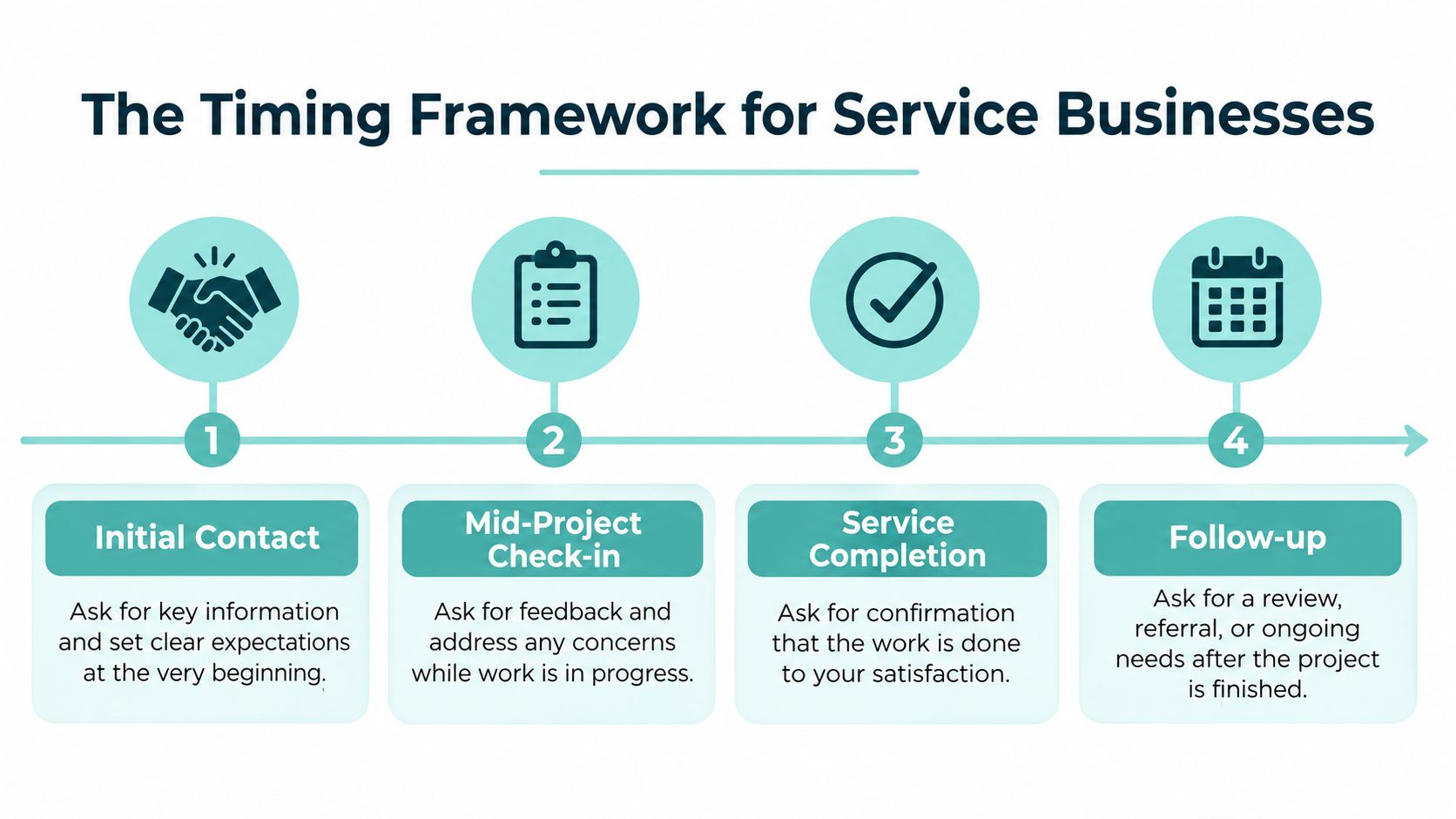
When to Ask the Timing Framework for Service Businesses
The best time to ask is not “at the end” in a generic sense. It's when the customer's satisfaction is visible, specific, and still fresh enough that they can describe it without effort. In service businesses, that moment can arrive before final closeout, especially when the customer has just seen a fix, a clean finish, or a competent interaction with your crew.
Match the ask to the journey stage
A long-cycle case, job, or project often has more than one peak. For a law firm, the first clear win might be the moment a client understands the next step and feels less anxious. For a roofer, it may be the walkthrough when the repaired section is visible. For HVAC, it's often when the system is running normally again and the customer can feel the difference immediately.
Practical rule: ask when the customer is reacting to a result, not when your internal process says the job is “officially done.”
That rule matters because timing changes the quality of the response. Consumer research shows that 68% of customers will leave a review if asked, another source says 70% will leave a review when asked, and a separate survey found 53% are likely or highly likely to leave a review when they receive an email or text request from the business Qualtrics review stats. The numbers point to the same operational truth, asking is the trigger, not a passive hope.
Use trigger points, not memory
The cleanest workflow is to tie the ask to a real event. That could be a job marked complete in your CRM, a ticket closed, a follow-up call marked successful, or a final inspection signed off by the customer. When the ask depends on someone remembering it later, it gets skipped.
Here's a simple decision filter:
- Visible satisfaction: the customer says thank you, compliments the crew, or asks for your card for a neighbor.
- Clear milestone: the visible result is done, even if paperwork or billing still follows.
- Low friction: the customer can leave feedback without searching, logging in, or hunting for a link.
- No unresolved issue: if a support ticket is still open or the customer is still confused, wait.
For service businesses with layered projects, that often means asking before the final administrative wrap-up if the customer already had the positive moment you wanted. A final invoice can be too late because the emotional peak has passed. A clean completion photo, a technician's helpful explanation, or a successful outcome is usually the better trigger.
Where to Ask Channel-Specific Playbooks and Templates
Channel choice changes everything. A customer who ignores a long email might respond instantly to a short text. Someone who forgets a verbal request may still submit a review after scanning a QR code on a receipt. The strongest approach is rarely one channel alone, it's a sequence that matches how the customer already communicates.
Email works when the relationship is established
Email is still useful because it gives you room for context, a thank-you, and a direct link. The downside is attention. BrightLocal's historical consumer data showed that 45% of consumers recalled review requests via email, compared with 20% via SMS, 34% in person at the point of sale, and 30% on a receipt consumer review request channels. That doesn't mean email is weak, it means email works best when the customer already checks messages from your company.
A simple email template can stay short:
- Subject line: Thanks again, quick favor
- Body: Thanks for choosing us. If you're happy with the service, would you mind leaving a quick review? It helps other customers know what to expect.
- Link placement: one direct review link, above the signature, not buried.
SMS is the fastest follow-through channel
SMS tends to win on speed because people see texts quickly. Industry guidance notes SMS open rates are about 98%, far above email's roughly 20%, which is why a text sent right after a verbal ask often gets the strongest completion Martech review request guidance. The point isn't to spam someone by text, it's to remove delay when the customer is still in a positive frame of mind.
A good text should be tiny:
- Friendly opener: Thanks again for today.
- Clear ask: If you have a minute, would you leave a review?
- Single link: one tap, one destination.
AppFollow's guidance is even stricter for message design. It recommends prompting eligible users only, keeping the request to one friendly sentence, using one clear link in SMS, and staying ideally within about 140 characters AppFollow review prompt rules. That level of restraint keeps the message readable and reduces the chance of sounding automated.
A two-touch workflow usually works best in the field. The first touch is verbal, the second is the text or email that carries the link. In practice, the second message does the administrative work while the first one does the human work.
In-person asks still matter
Some teams skip the face-to-face request because it feels awkward. It shouldn't. A short, natural ask at the moment of visible satisfaction often lands better than a polished message sent later. The key is to ask once, ask plainly, and then give the customer an easy next step.
I've seen the cleanest results when the staff member says thank you first, then sends the link while the customer is still standing there.
QR codes and direct links keep friction low
For Google Business Profile, BrightLocal documents a direct workflow. A user can sign in, click “Ask for reviews,” then copy the review link or download the QR code to share with customers. It also notes that campaigns can go to one or multiple recipients via email or SMS, with notifications set for up to five email addresses BrightLocal Google review workflow. That makes the process concrete instead of theoretical.
QR codes work best where they feel natural, on a receipt, a follow-up card, or a thank-you handout, not slapped onto every surface in sight. A visible code should support a real conversation, not replace it.
For teams building a bigger content system around referrals, repeat business, and local trust, the broader playbook should support the review ask, not compete with it. Content marketing for leads
If you want a practical outside example of a review workflow built for small businesses, the Polaris Marketing Solutions review guide is a useful reference point for how to think about structure, even if your own scripts need to stay tighter and more compliant.
Handling Negative Reviews and Staying Compliant
The fear is familiar, ask for reviews and you'll surface complaints. In reality, a disciplined ask process can reduce that risk because it gives unhappy customers a different path before they go public. The mistake is treating every customer the same and hoping the review page sorts things out.
Filter before you ask
AppFollow's eligibility logic is a good model for any service business thinking about automation and segmentation. It recommends filtering for people who were crash-free on their last session, completed a success event, had at least 2–3 sessions, and have no open support ticket AppFollow review prompt rules. That advice comes from app review behavior, but the principle transfers cleanly to service businesses, only prompt people who've reached a positive, stable outcome.
That means you don't ask immediately after a delay, a complaint, or a bill dispute. You ask when the work has landed and the customer has had a fair chance to feel the value.
Stay inside policy, not just etiquette
Google's guidance is clear that requests should follow a positive experience and remain simple Google Business Profile review guidance. Incentives, pressure tactics, and repeated nudges create trust problems fast, and they're especially dangerous in regulated fields like law and healthcare where ethics rules are stricter. A review request should never sound like a favor with strings attached.
If a customer is unhappy, respond to the issue directly instead of trying to redirect them into a public review. That doesn't mean you abandon review generation. It means you separate service recovery from reputation building.
Practical rule: solve the problem first, then ask for feedback later only if the customer's concern is fully resolved.
A negative review isn't proof that asking was the wrong move. It's usually proof that the ask process didn't screen or time the request well enough. That's an operational issue, not a reason to stop asking altogether.
Automation Tools and Metrics That Matter
Manual review requests break down as soon as volume grows. Someone forgets. Someone sends the wrong version. Someone asks too early. Automation fixes consistency, but only if the trigger logic is tied to real customer milestones instead of a generic weekly blast.
The simplest setup is already sitting in many businesses' CRM or email platform. Send the request after a completed job, a signed closeout, or a support ticket closure. Segment customers by service type or team so the language stays relevant. A homeowner finishing an HVAC repair shouldn't get the same note as a client concluding a legal matter.
Track what the team actually controls
The metrics that matter are the ones tied to behavior.
- Request volume: how many asks went out.
- Response rate: how many customers took the step you wanted.
- Review yield: how many public reviews resulted from the request.
The 2024 review-requests study is useful here because it shows process matters. Businesses actively asking customers for reviews averaged 122 reviews per location, compared with 53 reviews per location where review requests were absent. The combined SMS + email approach produced 26 reviews per 100 requests, versus 20 per 100 for SMS only and 15 per 100 for email only, and only 6% of surveyed businesses used both channels together review-requests study. The takeaway is practical, multi-channel asking is still underused, and the process itself materially changes review volume.
Keep automation from getting sloppy
Automation should make the ask more relevant, not more robotic. If the same person gets repeated requests after a complaint, your workflow is broken. If the message arrives before the customer can evaluate the service, your trigger is too early. If your team can't tell which ask produced the review, you're flying blind.
A simple quarterly review of the workflow usually surfaces the fix. Tighten the trigger. Shorten the message. Remove unnecessary follow-ups. Then compare what the team sends against what gets posted.
Conclusion Building a Review-Ready Culture
Review generation works best when it's part of the customer experience, not a separate marketing stunt. The right ask, at the right moment, through the right channel, creates a steady habit instead of a scramble for stars. Once your team sees reviews as a normal part of good service, the process gets easier to repeat and easier to improve.
For the next 30 days, train staff on one timing rule, one compliant script, and one follow-up channel. Build the ask into the job closeout, not the afterthought pile. The businesses that keep earning strong reviews are the ones that make it simple for happy customers to speak up while the experience is still fresh.
If you want help turning review requests into a repeatable part of your local SEO and lead generation system, Digital Skyrocket builds service-business websites and reputation strategies that fit how customers decide. The team works with law firms, roofers, HVAC companies, dentists, and other service providers that want more qualified inquiries from Google, not just more traffic.