
Your phone rings hard for a few days. Then it goes quiet. You try Angi, HomeAdvisor, Local Service Ads, maybe some boosted posts, and for a moment it feels like something is working. Then the lead quality drops, the cost climbs, and you're back to wondering why you're paying so much for jobs that should've come directly to you.
That cycle wears contractors out because it creates dependency. You're renting attention instead of building an asset. If you want lead generation for contractors that gets stronger over time, your website, local SEO, and answer-focused content have to become the center of the system.
Table of Contents
- Moving Beyond Inconsistent and Expensive Leads
- Building Your Digital Foundation a High-Converting Website
- Dominating Your Service Area with Local SEO and AEO
- Creating Content That Attracts and Converts Clients
- Amplifying Your Reach with Smart Paid and Partnership Tactics
- Measuring Success and Implementing Your 90-Day Plan
Moving Beyond Inconsistent and Expensive Leads
A lot of contractors start with whatever gets the phone to ring fastest. That usually means bought leads, marketplaces, or ad platforms that promise volume. It feels practical at first because you need jobs now, not six months from now.
The problem is that these channels rarely build anything you own. You pay, leads come in. You stop paying, they stop. In many cases, you're also competing for the same prospect at the same moment, which turns your business into one option in a pile instead of the obvious local choice.
The financial pressure is real. Construction companies face an average cost of $280 per lead across major markets, according to OnDeck Marketing's construction lead analysis. If you're buying low-intent or shared leads at that level, you can burn through budget fast without building long-term visibility.
Why rented leads create a ceiling
When your pipeline depends on third-party platforms, three things usually happen:
- Lead quality gets harder to control because you don't own the audience or the qualification process.
- Brand recall stays weak because the homeowner often remembers the platform before they remember your company.
- Margins get squeezed because every slow month pushes you to spend more just to keep volume steady.
Practical rule: If a lead source disappears the moment you stop paying for it, treat it as a supplement, not the foundation.
That doesn't mean paid channels are useless. It means they're best used after your website can convert and after your local presence is strong enough to capture demand you already should be winning.
What a durable system looks like
A durable lead engine for contractors is simpler than it's often made to sound. It has a few moving parts, but each one supports the others:
| Asset | What it does | Why it matters |
|---|---|---|
| Website | Converts searchers into calls and forms | You control the experience |
| Local SEO | Gets you found in your service area | Captures high-intent demand |
| AEO content | Answers exact homeowner questions | Improves visibility in AI-driven search |
| Review system | Builds trust before the call | Reduces hesitation |
| Follow-up process | Turns inquiries into appointments | Prevents lead waste |
If you want to modernize how your team handles early-stage inquiry flow, it's worth reviewing how AI lead generation tools fit into intake, routing, and qualification. The right tools can support your process, but they won't fix weak positioning, a thin website, or poor local visibility.
The main shift is mindset. Stop asking, “Where can I buy more leads this month?” Start asking, “What would make my company the best local result when someone is ready to hire?”
Building Your Digital Foundation a High-Converting Website
Most contractor websites don't fail because they look terrible. They fail because they don't answer basic buying questions quickly enough. A homeowner lands on the page and can't tell if you serve their area, handle their job type, or look trustworthy enough to contact.
That's why the website has to act like a sales rep, not a brochure. The pages need to remove doubt fast, especially on mobile.
Your website has one job
The best contractor sites make the next step obvious. Call, request an estimate, upload project details, or book an inspection. Everything else supports that action.
There's a big performance gap between average sites and sites built for local conversion. Contractor landing pages with comprehensive local SEO and CRO implementations achieve a 12-15% conversion rate from organic traffic, compared to 3-5% for non-optimized pages. The difference usually comes down to reducing location ambiguity and building immediate trust.
A site redesign should be tied to lead flow, not aesthetics alone. If you're planning a rebuild, this service company website redesign guide for local growth is a useful reference because it focuses on structure, local intent, and conversion paths instead of generic design trends.
What a contractor site must show immediately
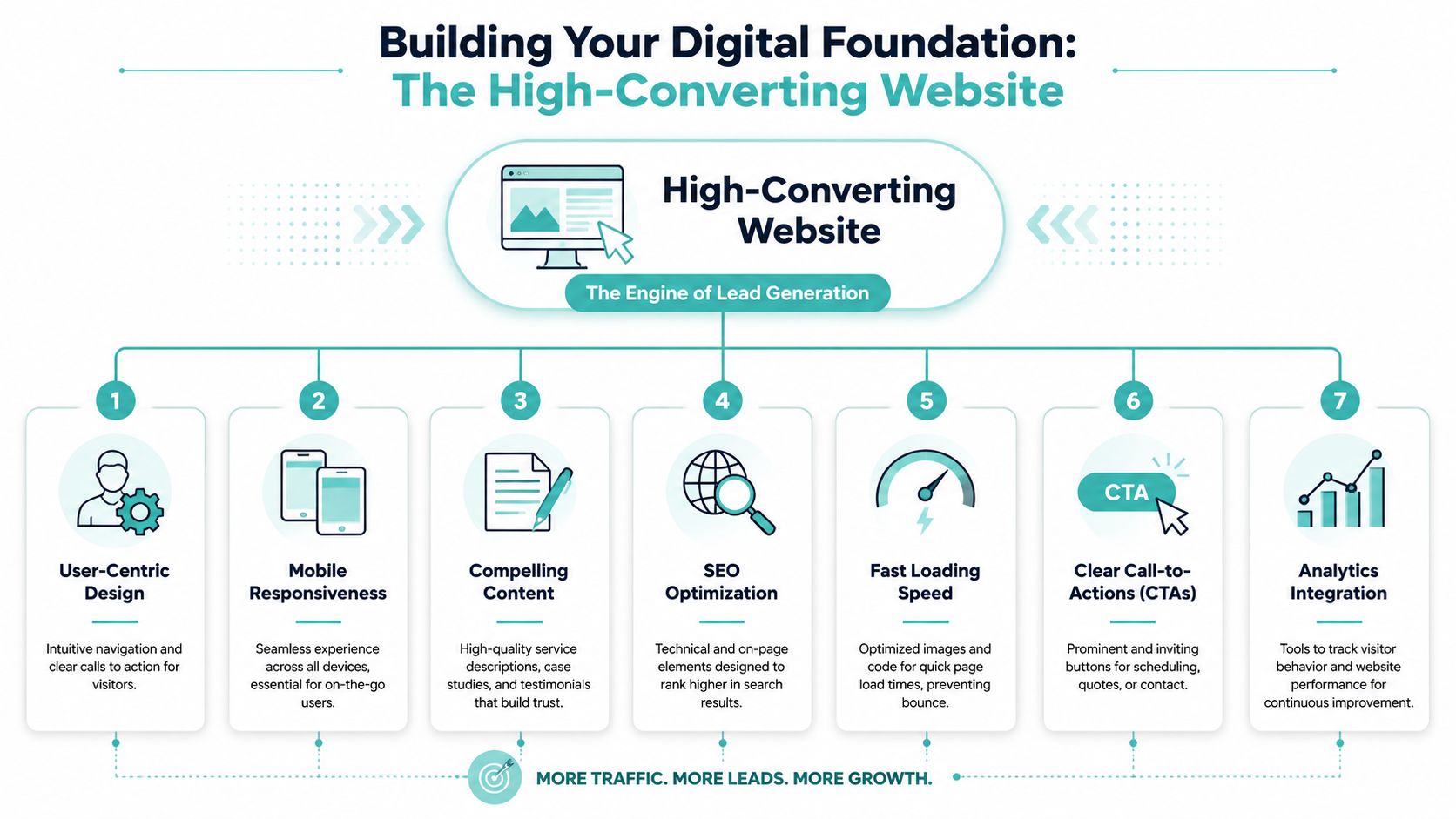
Within the first screen on mobile, your site should answer four things:
- Who you help with a clear service statement
- Where you work with visible city, county, or service area language
- Why you're credible through licensing, insurance, reviews, affiliations, or years in business
- What to do next with a strong CTA
If any of those are missing, visitors hesitate. Hesitation kills lead volume.
Here's what I'd treat as essential on a contractor homepage and top service pages:
- Clear service-area language: Don't bury locations in the footer. Put service areas near the top.
- Specific CTAs: “Request an Estimate” works better than vague contact prompts.
- Trust signals above the fold: Show review snippets, badge logos, financing if relevant, and local proof.
- Real project photography: Stock photos weaken credibility fast.
- Dedicated service pages: One page per core service is standard. Don't mash everything into one generic page.
A homeowner doesn't need to admire your website. They need to trust it quickly enough to call you.
What to measure on the site
A high-converting site isn't judged by traffic alone. You need to know whether the traffic turns into qualified actions.
Track:
- Form submissions from service pages and landing pages
- Tracked phone calls from mobile and desktop
- Top landing pages by lead activity
- Service-area page engagement to see where local intent is strongest
Speed matters too. Slow sites bleed trust before your copy even gets read. If you want a grounded explanation of the technical side, this piece on Google Pagespeed's impact on SEO is worth reviewing. Contractors often focus on design first and performance second, when both affect whether the lead ever happens.
Dominating Your Service Area with Local SEO and AEO
For contractors, visibility is local before it is anything else. If someone needs roof repair, HVAC service, concrete work, or a kitchen remodel, they're usually looking for someone nearby who can show up and do the work.
That's why local SEO matters so much. A definitive 46% of all Google searches target local information, according to Contractor Accelerator's local search report. If your business doesn't show strong local relevance, you're missing a huge portion of buying intent.
Local visibility starts with coverage clarity
One of the most common contractor SEO problems is sloppy service-area messaging. The business may serve multiple towns, rural routes, or scattered ZIP codes, but the site only mentions one city on the homepage. Google can't confidently match that site to searches across the full service footprint, and homeowners can't immediately tell whether you'll come out.
You need dedicated location support throughout the site:
- Service area pages for meaningful towns, counties, or regions
- Localized service pages when a service is a major revenue line
- Project writeups that mention the actual location naturally
- Schema and business details that reinforce local relevance
If you've moved offices or changed your official listing details, clean that up first. This guide on changing your Google business address is a practical place to start because inconsistent location data causes more ranking problems than many contractors realize.
Your Google Business Profile is not a side task
A neglected Google Business Profile costs you calls. Contractors often claim the profile, add a few photos, and then forget it. Meanwhile, competitors keep updating services, posting jobsite photos, answering reviews, and tightening category relevance.
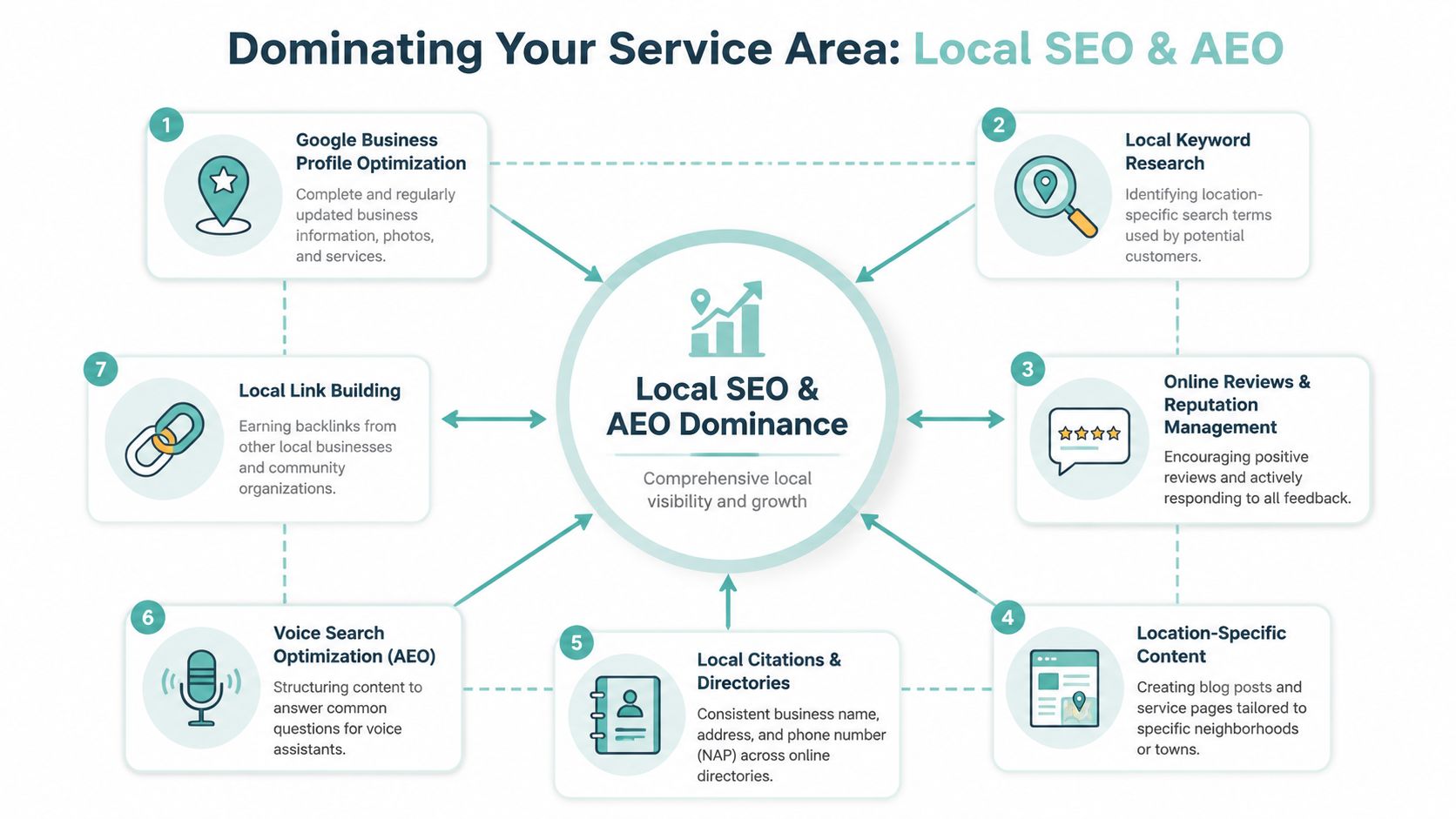
At minimum, keep these areas current:
- Primary and secondary categories: Pick the closest real fit for your work.
- Services: Break out specific offerings instead of leaving them broad.
- Photos: Add real jobs, crews, equipment, and finished work.
- Reviews: Ask consistently and respond professionally.
- Business description: Write for homeowners, not algorithms.
Field note: The businesses that win locally usually make it easy for Google and the customer to understand exactly what they do and exactly where they do it.
Local citations still matter too. Your business name, address, and phone details need to be consistent across reputable directories and local listings. Beyond that, local link authority helps a lot, especially from chambers, suppliers, associations, and neighborhood organizations. If you need ideas for earning those links without spammy outreach, this playbook for agency link building has useful tactics that translate well to local contractor campaigns.
How AEO changes contractor content
Answer Engine Optimization matters because more people now expect a direct answer instead of a list of blue links. That changes how contractor websites should structure content.
AEO means you create pages that answer real hiring questions cleanly and directly, such as:
- How much does roof replacement involve in this area?
- Do you handle insurance claim roof repairs?
- What's included in a bathroom remodel estimate?
- Do you offer emergency HVAC service in my county?
- How long does a foundation repair project usually take?
Instead of hiding answers inside walls of copy, make them easy to extract:
- Use clear question-based subheadings on service pages and FAQ sections.
- Answer in plain language first, then add detail underneath.
- Support answers with local context, not generic national copy.
- Connect answers to proof, such as project examples, photos, and review snippets.
AEO doesn't replace SEO. It sharpens it. The contractors who'll keep winning organic leads are the ones whose sites can rank, convert, and also serve as the cleanest answer source for AI-assisted search experiences.
Creating Content That Attracts and Converts Clients
Content for contractors doesn't need to sound clever. It needs to make a homeowner feel understood, informed, and safe contacting you. That means building pages around how people search and how they choose.
The weak version is common. One services page. A short About page. A gallery with no context. Maybe a blog post or two written around random topics. That setup rarely supports strong lead generation for contractors because it doesn't match buyer intent.
Service pages that do real work
A good service page targets one core service and speaks to one buying situation. A page for roof replacement should not try to rank for roof repair, storm damage restoration, inspections, gutter installation, and financing all at once.
A strong service page usually includes:
- A plain-English opening: State the service and who it's for.
- Signs the homeowner might need it: This helps the page connect to real problems.
- What your process looks like: Inspection, estimate, scheduling, installation, cleanup.
- Common objections answered: Timing, disruption, material choices, insurance questions.
- Local proof: Mention nearby areas served and relevant project examples.
- A direct CTA: Request estimate, book inspection, call now.
The best pages don't read like SEO content. They read like the conversation your estimator has every week.
Project pages that sell for you
Project portfolio pages are one of the most underused assets on contractor websites. Done right, they work as mini case studies without needing formal case-study language.
A roofing company might publish a page about replacing hail-damaged shingles on a two-story home in a specific town. A remodeler might publish a kitchen renovation page showing layout changes, material selections, and finish details. An HVAC company might document a replacement job and explain why the old system failed.
What matters is context:
- Before and after photos
- The customer's starting problem
- The work performed
- Materials or approach used
- Location context
- Result in practical terms
Show the kind of work you want more of. Your portfolio shapes the leads you attract.
These pages help in two ways. They give search engines more local, service-specific relevance, and they give prospects a way to picture you handling their project.
FAQ content that supports both search and sales
Many contractor FAQs are filler. They answer generic questions no serious buyer is asking. Better FAQ content deals with friction points that stop calls from happening.
Useful topics include:
| Question type | Why it matters |
|---|---|
| Service area questions | Confirms whether you travel to the customer |
| Estimate questions | Reduces fear around hidden costs or sales pressure |
| Timeline questions | Helps homeowners plan |
| Permit or insurance questions | Builds authority |
| Repair vs replacement questions | Matches high-intent search behavior |
A separate FAQ page can help, but the best place for many answers is directly on service and location pages. That keeps the content close to the decision point.
If you're deciding what to write next, don't start with blog topics. Start with sales questions, service pages, and project proof. That content drives better inquiries than generic “top tips” articles almost every time.
Amplifying Your Reach with Smart Paid and Partnership Tactics
Paid channels are useful when they sit on top of a solid organic base. They become expensive when they're asked to do all the work themselves.
That distinction matters because many contractor marketing plans are built backward. They start with ads, then try to patch the website later. A more durable system starts with owned visibility and uses paid tactics for acceleration, retargeting, and selective gap filling.
Owned leads versus rented leads
The core trade-off is control.
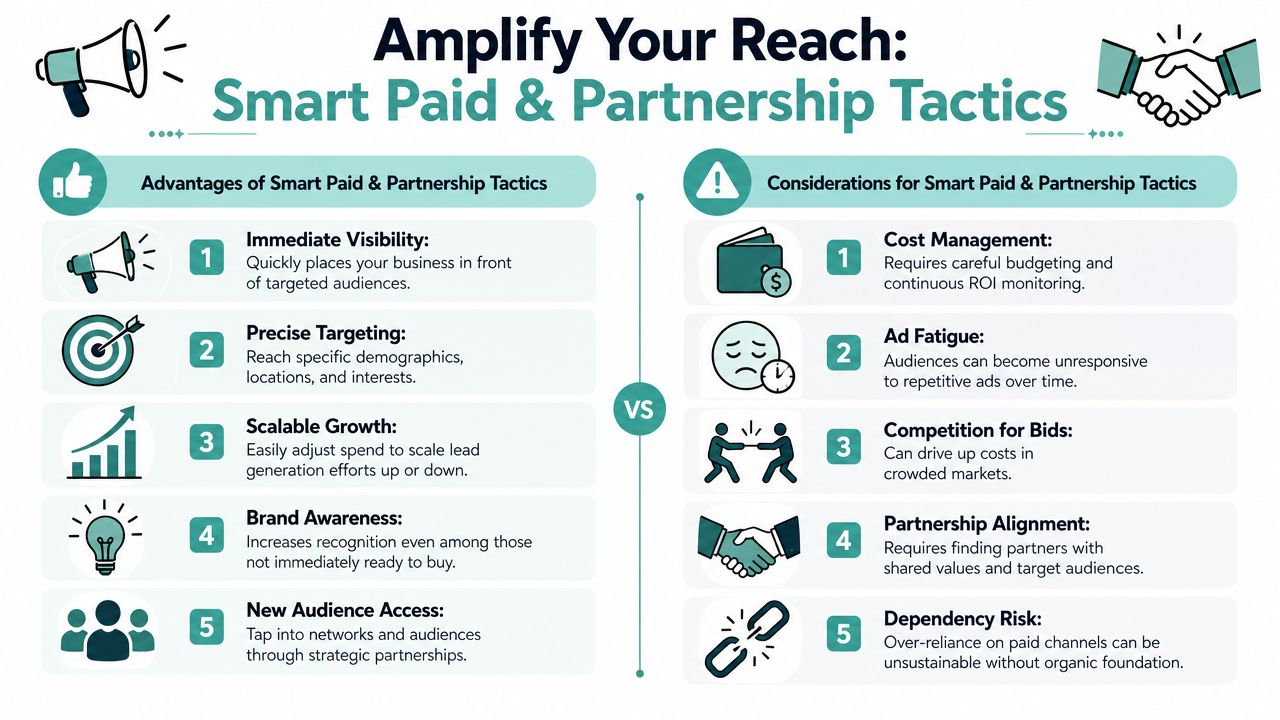
Organic SEO and AEO build an asset you keep improving. Paid ads and marketplaces create access only while the spend continues. That's why most content about contractor growth feels incomplete. It overemphasizes channels that create activity now and underexplains how to build a durable lead engine where organic traffic can grow over time without ad dependence.
That doesn't make paid wrong. It just means you should know what role it's playing.
| Channel | Strength | Limitation |
|---|---|---|
| SEO and AEO | Builds long-term visibility you own | Takes time and discipline |
| Local Service Ads | Can generate immediate inquiry volume | Shared attention, ongoing spend |
| Lead marketplaces | Easy to turn on | Weak exclusivity and lower control |
| Referral partnerships | High trust and often low cost | Requires relationship building |
If you want a broad view of how paid service campaigns are commonly positioned in the trades, this overview of advertising for plumbers is a useful comparison point because the economics and decision logic are similar across many home service categories.
Where paid still makes sense
Google Local Service Ads can be useful for contractors who need immediate volume and can respond quickly. They work on a pay-per-call model and typically require a monthly budget that starts at $1,500, plus background checks and license verification for the Google Guaranteed badge, as outlined in Build-Folio's review of contractor lead generation services.
That setup can work well in the right situation. It can also create expensive noise if your team is slow to answer or if your website and reputation don't support the close.
Paid works best when you use it for:
- Immediate gap filling during seasonality or expansion
- Brand defense on your own business name
- Remarketing to previous site visitors
- Testing service demand before building deeper organic content
Partnerships most contractors underuse
The lowest-drama lead sources are often local relationships that already sit near the customer before the project starts.
Good partners include:
- Real estate agents who see repair needs during transactions
- Property managers who need reliable vendors repeatedly
- Insurance-adjacent professionals who hear about damage early
- Non-competing trades with overlapping homeowners
- Suppliers and showrooms who talk to buyers mid-decision
These leads usually arrive warmer because trust transfers. They also strengthen your local footprint in ways ad spend never will.
Measuring Success and Implementing Your 90-Day Plan
Lead generation for contractors falls apart when nobody knows what's working. A contractor sees more traffic, a few calls come in, some forms get submitted, but there's no clean line between effort and result. That's how weak channels stay alive too long and strong channels get underfunded.
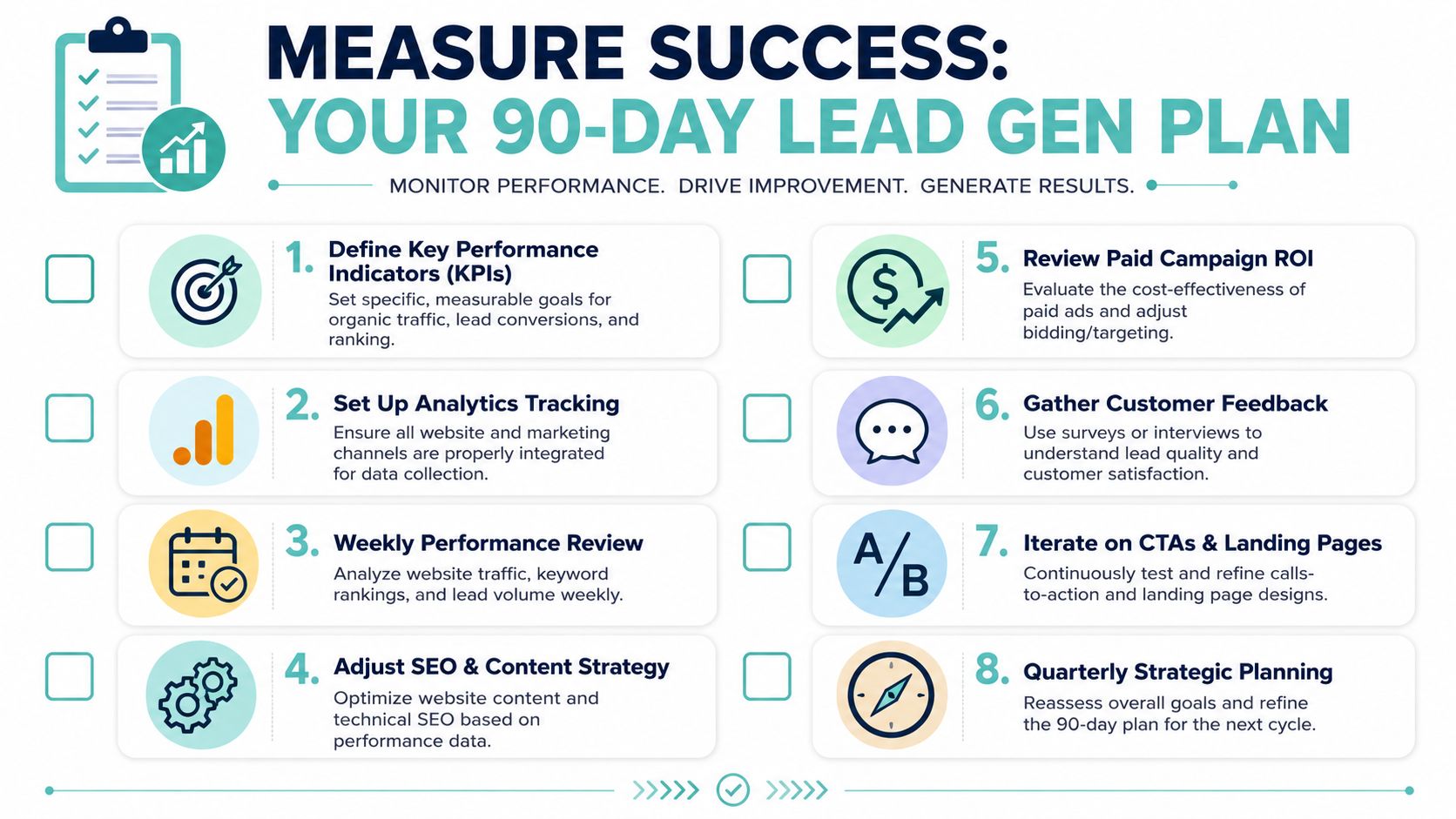
The simplest fix is to track a small set of meaningful signals and review them on a schedule.
Track the right signals
Start with tools you likely already have access to, especially Google Analytics and Google Search Console. You don't need a giant dashboard at first. You need clean tracking and regular review.
Focus on:
- Organic landing pages that generate calls and forms
- Search queries tied to service and location intent
- Call tracking and form tracking by page and campaign
- Lead quality notes from whoever answers the phone
- Appointment set rate from inbound web leads
If you're getting more visits but not more qualified inquiries, the problem usually sits in one of three places: weak page intent, low trust, or poor follow-up.
A practical 90-day rollout
The first three months should be structured, not chaotic.
Days 1 to 30
- Audit your website for trust gaps, weak CTAs, and unclear service areas.
- Set up or verify Analytics, Search Console, call tracking, and form tracking.
- Clean up your Google Business Profile and core business information.
- Build or revise your core service pages.
Days 31 to 60
- Publish location-supporting content and project pages.
- Improve internal linking between service, location, and portfolio pages.
- Start a steady review request process after completed jobs.
- Tighten mobile experience and page speed issues.
Days 61 to 90
- Review which pages and queries are driving the best leads.
- Expand content around the highest-intent services and locations.
- Add better FAQs based on real customer questions.
- Refine conversion points based on call recordings and form quality.
The best marketing reports answer one question clearly: which pages are producing qualified jobs, and which ones need work?
Speed to lead closes the loop
Even a great system leaks money if nobody responds fast enough. Contractors who respond to inbound web inquiries within 5 minutes capture 35% of leads, while those responding within 24 hours capture only 12%. Automated SMS follow-ups perform 2.8x better than email-only follow-ups.
That single operational habit changes the value of every channel you use.
Build a response process that includes:
- Instant notifications to the right person
- A fast first-touch script for calls and texts
- Basic qualification around service area, project type, and timing
- A backup owner when the main contact is in the field
You don't need perfect systems before you start. You do need discipline. Contractors who win online usually aren't doing magic. They're doing the fundamentals consistently, and they're doing them better than competitors who still rely on rented leads and hope.
If you want a website and SEO system built specifically to generate qualified contractor leads from Google and AI-driven search, Digital Skyrocket is worth a look. They focus on high-converting websites, local SEO, and AEO for service businesses that want a durable lead engine instead of another short-term marketing experiment.