

Your phone rings, but too many calls are the wrong calls. Someone wants the cheapest drain clear. Someone else is outside your service area. A third caller needs emergency help, but your dispatcher can’t tell which ad drove the lead, so you keep spending blind.
That’s the trap in advertising for plumbers. Owners think they have a lead problem, when they often have a filtering problem, a website problem, or a tracking problem. Good advertising doesn’t just produce activity. It produces the right jobs, from the right neighborhoods, at a cost your margins can support.
The plumbers who grow steadily usually stop treating marketing like scattered tactics. They build a system. The website sits at the center of that system, because every ad, listing, mailer, referral search, and branded query eventually sends people somewhere to decide whether to trust you, call you, or move on.
Table of Contents
- Laying the Groundwork for Profitable Advertising
- Your Website The Unsung Hero of Every Ad Campaign
- Choosing the Right Channels to Attract Customers
- Setting Your Budget and Crafting Ads That Work
- Tracking Results and Optimizing for Profitability
- Turning Your Ads into a Predictable Growth Engine
Laying the Groundwork for Profitable Advertising
Advertising for plumbers breaks down when every lead is treated like a good lead. It isn’t. A midnight burst pipe and a planned repipe are both plumbing jobs, but they demand different messaging, different response processes, and often different economics.
The U.S. plumbing market reached $124 billion, and ServiceTitan’s guide says plumbing businesses should dedicate 10–15% of sales to marketing, which tells you this isn’t a casual side task anymore. It’s a budget line that needs discipline and job-level thinking, not random promotion (ServiceTitan plumbing marketing guide, opens in a new tab).

Define the job types before you buy attention
Start with two buckets.
Emergency jobs need speed. The customer cares about availability, proximity, and trust under pressure. These leads can be valuable, but they can also be messy, price-sensitive, and operationally disruptive if your team isn’t set up for after-hours dispatch.
Project jobs include work like water heater replacement, larger repairs, and other scheduled services. These leads usually give you more room to educate, estimate, and sell value instead of racing to the phone first.
If your ads don’t separate those buckets, your message turns generic fast. Generic ads attract generic leads.
A simple filter helps:
- Service area fit: Only target neighborhoods, cities, or zip clusters your crews can serve profitably.
- Job type fit: Decide which services deserve aggressive promotion and which ones should stay secondary.
- Margin fit: Some jobs keep trucks busy without producing enough profit to justify paid acquisition.
- Schedule fit: If your office can’t handle true emergency intake, don’t position yourself like a 24/7 operator.
Practical rule: Don’t ask advertising to fix a service mix problem. Pick the jobs you want more of first, then build campaigns around them.
Build a simple filter for profitable leads
Write down your ideal customer profile in plain language. It doesn’t need to be fancy. It needs to be usable by whoever handles your website, search visibility, intake, and reputation.
For example, a strong profile might sound like this: homeowner in a defined service area, older home, urgent repair or planned replacement, willing to pay for licensed work, and likely to call rather than fill out a long form. That’s more useful than “anyone who needs plumbing.”
Lead quality also depends on what happens after the ad. If your team struggles with missed calls, weak intake, or inconsistent follow-up, you need that fixed alongside promotion. A practical resource on managing plumber calls can help tighten that part of the funnel before more ad spend pours in.
Your digital foundation matters here too. If you’re evaluating how websites, local SEO, and reviews support home service growth, this guide on home services marketing is a useful reference point.
Your Website The Unsung Hero of Every Ad Campaign
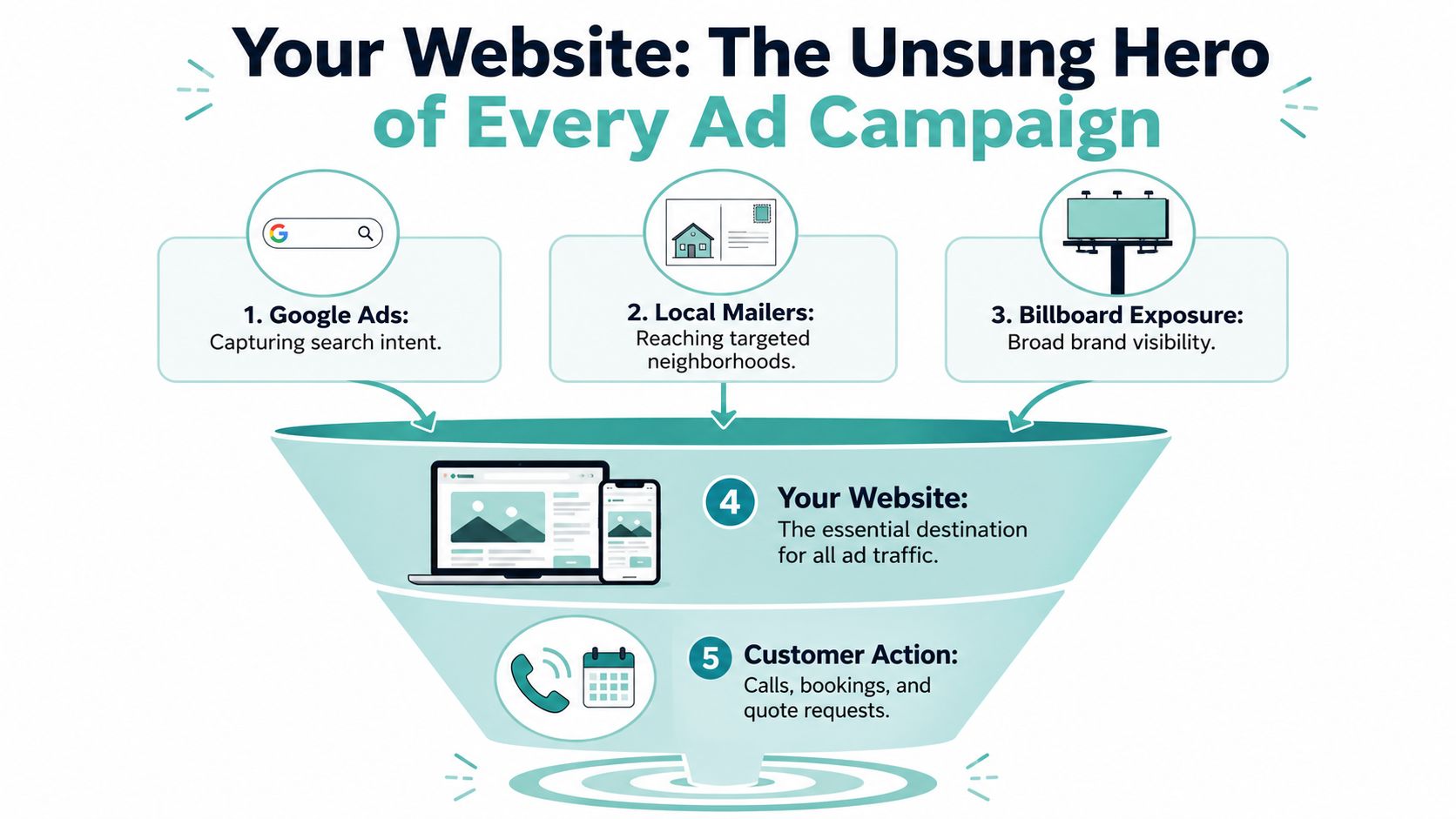
A lot of plumbers spend time debating channels and almost no time questioning the destination. That’s backwards. Every campaign points somewhere. If that “somewhere” is slow, confusing, or thin on trust, your ad budget leaks before the office phone ever rings.
Think of it this way. Running strong ads into a bad website is like buying a premium billboard that sends people to a condemned storefront. The promotion creates interest, but the destination kills action.
A weak website makes every ad more expensive
For plumbers, the website isn’t a brochure. It’s the conversion layer between attention and booked work. A homeowner clicks your Google result, scans your service page, checks your credibility, and decides whether to call. That decision often happens in seconds.
When the site fails, the ad gets blamed. But the actual issue is usually one of these:
- Mobile friction: Emergency searches happen on phones, so tiny buttons, slow pages, or cluttered layouts cost you calls.
- Weak trust signals: If a visitor can’t quickly see reviews, service areas, certifications, or real team photos, hesitation rises.
- Confusing next steps: Too many menus and too few clear calls to action force the user to think when they want relief.
- Thin service pages: A generic “plumbing services” page rarely answers the specific question behind the click.
Your website should answer four things fast: Do you handle my problem, do you serve my area, can I trust you, and what do I do next?
Conversion rate optimization is key. You don’t need more traffic if the current traffic keeps bouncing or stalling. Small improvements in layout, messaging, form friction, and click-to-call visibility can make the same ad spend produce more real opportunities.
What a plumber website must do on the first visit
The first screen should carry the load. On a plumber site, that usually means a clear service promise, visible service area language, a click-to-call button, and supporting trust cues without forcing the user to scroll for basics.
Then the deeper pages need to match intent. Someone searching for leak detection wants a leak detection page. Someone searching for water heater installation wants a page built around that job, with the right expectations, proof, and call to action.
Here’s the practical checklist I use when reviewing sites for plumbing companies:
- Call-first design: Prominent phone buttons on mobile and desktop.
- Intent-matched pages: Individual pages for core services and target locations.
- Trust built into the layout: Reviews, badges, warranties, financing information if applicable, and real photos.
- Fast contact paths: Short forms for quote requests and obvious emergency contact options.
- Message consistency: The wording on the ad, listing, or mailer should match the page headline the visitor lands on.
If you’re reworking an underperforming site, this guide on a service company website redesign for local growth lays out the structural issues that usually hurt lead flow.
Choosing the Right Channels to Attract Customers
Not every advertising channel deserves equal attention. For plumbers, channel choice should follow intent. The closer a person is to “I need help now” or “I’m ready to schedule,” the more valuable that channel becomes.
That’s why Google usually sits at the center of advertising for plumbers. Search behavior concentrates attention into a tiny number of positions. Research summarized by AMRA & Elma reports that the top three organic results captured 68.7% of all clicks, the first position averaged a 39.8% click-through rate, and the local 3-pack delivered 126% more traffic than businesses in positions 4–10. The same source says the map pack appeared in 93% of searches with local intent (AMRA & Elma plumbing marketing statistics, opens in a new tab).
Where intent is highest
Local SEO works best when you want durable visibility for service pages, city pages, and your Google Business Profile. It isn’t instant, but it compounds. A strong local organic presence also supports branded trust when someone sees your truck, hears about you from a neighbor, or clicks a paid ad and then searches your name.
Google Local Services Ads are useful when trust and lead screening matter. They put you in front of local searchers who want a provider, not content. They’re especially helpful when the customer wants reassurance before making a fast decision.
Traditional Google Ads are the direct-response channel. They let you segment by service line, send searchers to specific landing pages, and control messaging tightly. If your website converts well and your intake process is sharp, this channel can produce immediate opportunities.
Traditional media and social platforms still have a role, but not the same role. Mailers, wrapped trucks, neighborhood sponsorships, and social proof content can strengthen recall. They usually don’t replace Google for urgent intent.
Plumber Advertising Channel Comparison
| Channel | Average Cost | Lead Quality | Time to Results |
|---|---|---|---|
| Local SEO | Longer-term investment, not paid per click | High when service pages and local signals match real intent | Slower to build, stronger over time |
| Google Local Services Ads | Varies by market and setup | Strong for local trust-driven searches | Faster once approved and active |
| Google Ads | Benchmark costs vary by service line and competition | High when tightly segmented by job type | Immediate once campaigns launch |
| Direct mail and offline branding | Variable production and distribution costs | Mixed, depends on targeting and offer | Moderate, often supports branded search rather than direct urgency |
| Social media promotion | Usually better for awareness and retargeting than urgent demand capture | Lower for emergency intent, stronger for reminder marketing | Fast to launch, but less direct for bottom-funnel demand |
The practical order is usually simple. First, make sure your website and local search presence are credible. Second, own the Google surfaces where buyers make quick decisions. Third, use offline and social channels to reinforce brand familiarity so more people recognize your name when a plumbing problem becomes urgent.
Setting Your Budget and Crafting Ads That Work
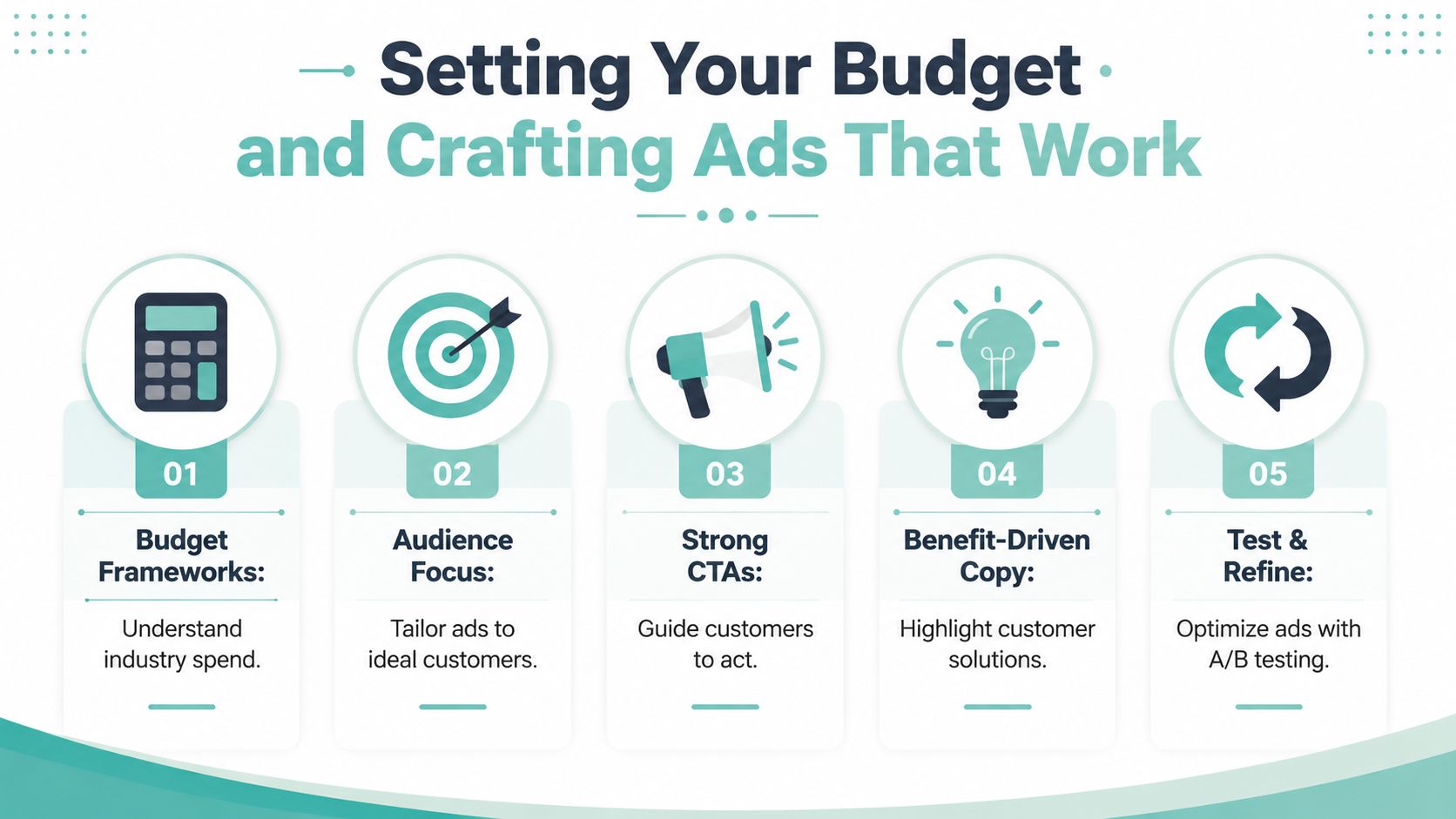
Budgeting gets easier when you stop asking, “How much should I spend?” and start asking, “What kind of lead can I afford for this service line?” That shift changes everything. A campaign for emergency drain work shouldn’t be judged the same way as a campaign for water heater installs.
For Google Ads, a 2026 benchmark based on observed non-branded spend across plumbing accounts found an average non-branded CPL of $183, a median CPL of $168, and a quartile spread of $107 to $253. The same benchmark says Performance Max averaged $82 per lead, while water-heater campaigns averaged $256 per lead (plumbing Google Ads cost per lead benchmarks, opens in a new tab).
Budget from margins not hope
Use those benchmarks as guardrails, not promises. The median is often the healthier planning number because average figures can get pulled upward by expensive segments.
A practical budgeting workflow looks like this:
-
Segment by service line
Separate emergency plumbing, drain cleaning, leak repair, water heaters, and higher-ticket project work. Don’t bundle them into one campaign and expect clean data. -
Set lead targets by job economics
A service with stronger margins can tolerate a higher acquisition cost than a lower-ticket call. -
Build around intent
Emergency keywords deserve faster response paths and call-driven landing experiences. Project campaigns need stronger education and estimate requests. -
Protect your budget with exclusions
Remove irrelevant searches, weak geographic areas, and low-value service terms that consume spend without producing bookable work.
If a service line consistently brings in leads you don’t want, the answer usually isn’t “optimize harder.” It’s “stop buying that traffic.”
Ad copy that matches the job type
Good plumber ads don’t try to sound clever. They reduce uncertainty.
For emergency work, the copy should stress availability, local presence, and immediate action. For scheduled work, it should stress clarity, professionalism, and the next step.
Sample Google ad for emergency plumbing
- Headline option: Burst Pipe? Local Plumber Available Now
- Headline option: Emergency Plumbing Help Near You
- Description: Fast response for urgent plumbing problems. Clear communication, local service, and an easy call path.
Sample Google ad for water heater installs
- Headline option: Water Heater Installation by Local Pros
- Headline option: Get Help Choosing the Right Water Heater
- Description: Book an estimate for replacement or installation. Clear scheduling, professional workmanship, and a simple quote process.
Sample direct mail angle
- Front message: No hot water or recurring plumbing issues?
- Back message: Local plumbing help for repairs and replacements, with an easy way to call or request service online.
A better way to think about video ads
A lot of video advice for plumbers focuses on before-and-after visuals. That can build trust, but it can miss urgency. For emergency intent, the first seconds need to show availability and local relevance, not just the repair itself.
A 2025 Google Labs study on service search intent found that 68% of users searching “emergency plumber” skipped video ads that lacked a visible map pin or “available now” badge in the thumbnail. That’s a creative lesson, not just a production note. If you’re using video, lead with local availability signals before the wrench shot.
Tracking Results and Optimizing for Profitability
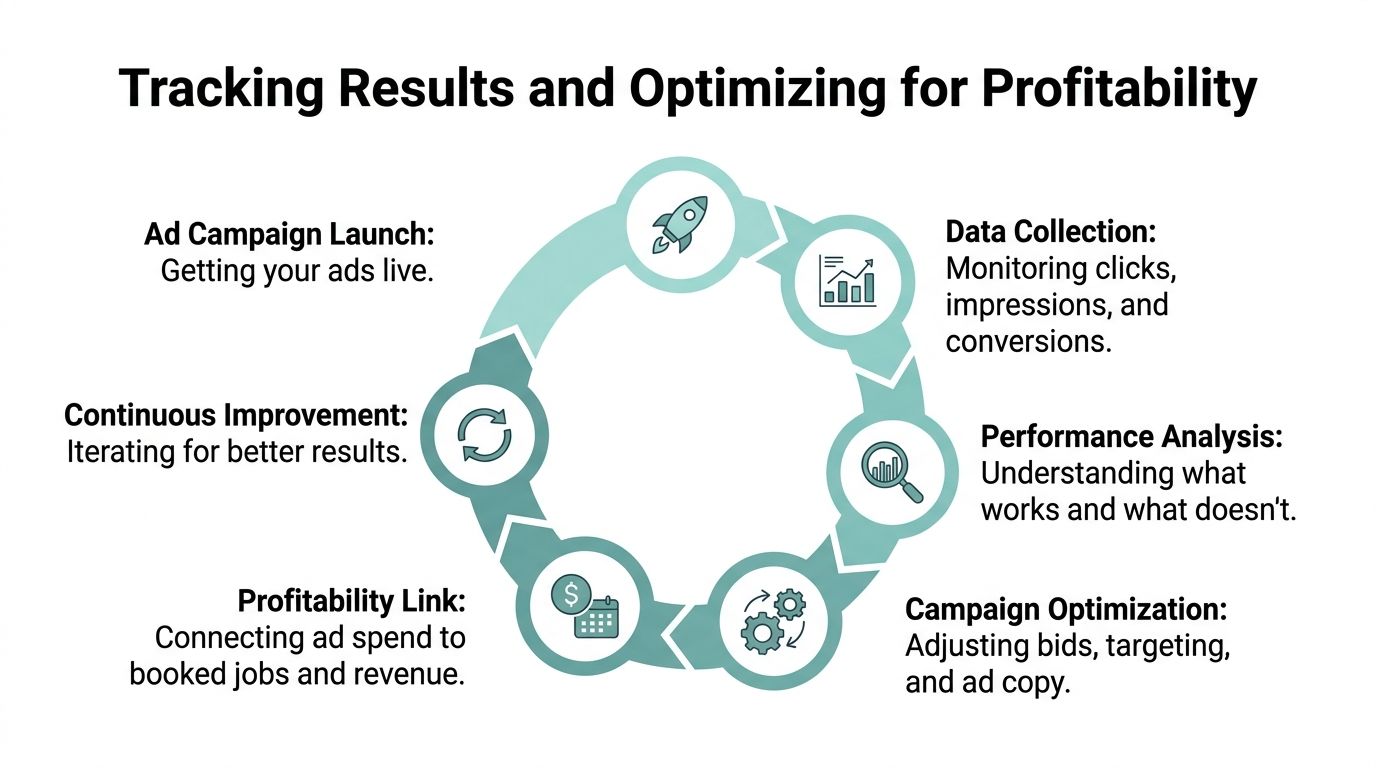
Launching ads is easy. Knowing which campaigns turned into booked jobs is where most plumbing companies lose the plot. They can see clicks, maybe calls, maybe forms, but they can’t trace those interactions to actual revenue.
That gap is why some owners think advertising for plumbers doesn’t work, when the problem is missing attribution. If you can’t connect spend to outcomes, you can’t scale what works or cut what doesn’t.
Track the handoff from click to booked job
Three systems matter most.
Call tracking tells you which campaigns generated phone leads and what happened on those calls. For plumbers, that’s not optional. Phone calls often carry the strongest intent, especially on urgent jobs.
Analytics tracking helps you measure quote requests, contact submissions, and key page actions. If you need a clean primer on event setup and attribution logic, this walkthrough on how to understand conversion tracking in GA4 is worth reviewing.
CRM or booking system notes close the loop. Someone on your team needs to label lead source, job type, booked status, and eventual value. Without that operational handoff, marketing reports stay incomplete.
A clean review process should answer:
- Which channel drove the lead
- Which service the customer wanted
- Whether the lead booked
- Whether the job was profitable enough to keep funding that channel
That’s where website performance comes back into the picture. If your forms, calls to action, and landing pages aren’t structured to capture intent cleanly, attribution gets messy and optimization slows down. Teams that want tighter performance often pair tracking improvements with conversion rate optimization services so more of the traffic becomes measurable opportunity.
Test trust angles not just headlines
Most ad testing is shallow. Owners swap a headline, change a call to action, and call it optimization. Better testing goes after trust.
One underused angle is the anti-testimonial. Instead of only showing happy customers, the ad addresses the reasons people distrust plumbers in the first place. Hidden fees. No-shows. Misdiagnosed problems. Poor communication.
A contrarian analysis found that this myth-addressing approach generated a 24% higher click-through rate in the emergency search segment compared with standard positive testimonial ads. The lesson isn’t to sound negative. It’s to reduce skepticism faster.
“We show up when we say we will” can outperform generic praise because it answers a fear the buyer already has.
Handled carefully, this angle works on landing pages, search ads, and short video scripts. The strongest versions don’t attack competitors. They clarify your standards and remove friction from the decision.
Turning Your Ads into a Predictable Growth Engine
Profitable advertising for plumbers doesn’t come from chasing a single perfect channel. It comes from a connected system. You define which jobs deserve attention, build a site that converts that attention, choose channels based on intent, budget with real job economics in mind, and track every handoff through to booked work.
That’s how you get out of the feast-or-famine cycle. The website stops being an afterthought and becomes the asset that makes every other marketing move more efficient. SEO gives you durable visibility. Reviews strengthen trust. Paid traffic performs better because the destination is built to convert, not just exist.
If you want another practical perspective on bringing in better-fit leads, this guide on how to attract qualified home service customers adds useful context around lead quality and filtering.
The companies that win usually aren’t the loudest. They’re the ones with a tighter system. Their ads promise the right thing, their website confirms it fast, and their team knows exactly which marketing efforts are producing profitable jobs.
If your plumbing company needs a stronger website foundation before you put more money into advertising, Digital Skyrocket helps service businesses build lead-generating websites backed by local SEO, reputation management, and conversion-focused structure. If your current site looks acceptable but doesn’t turn traffic into calls and quote requests, it may be time to rebuild the home base that all your advertising depends on.