

You're probably seeing one of two patterns right now. Either your practice has invested in SEO, ads, or both, and traffic is showing up without enough appointment requests to justify the spend. Or you know your visibility isn't where it should be, but you also suspect that sending more people to an average website won't fix the core problem.
That instinct is correct.
Most dental practice marketing advice treats visibility as the finish line. It isn't. Visibility is the first step. The objective is to turn searchers into qualified inquiries, inquiries into scheduled visits, and scheduled visits into retained patients who refer others. If that chain breaks at the website, the campaign underperforms no matter how many clicks it generates.
Table of Contents
- Beyond Traffic An Introduction to Patient-Focused Marketing
- Laying the Groundwork Strategy Positioning and Budget
- Dominating Local Search with SEO and Google Business Profile
- Turning Clicks into Patients Website and Conversion Optimization
- Building Trust Through Content Reviews and Patient Retention
- Amplifying Your Reach with Paid Ads and Social Media
- Measuring What Matters Tying Marketing to Practice Growth
Beyond Traffic An Introduction to Patient-Focused Marketing
A lot of dental practices don't have a traffic problem. They have a conversion problem.
That distinction matters because traffic is easy to celebrate and hard to bank. Rankings improve, website sessions rise, phones stay quieter than expected, and the team starts wondering whether SEO “works.” In many cases, SEO did work. The site just wasn't prepared to convert the intent it attracted.
The gap is larger than most owners realize. Dental Practice Insider notes that 70-80% of dental site visitors leave without booking, and that service-specific landing pages with optimized conversion paths can convert 3x higher than generic homepages. That's the difference between a website acting like a brochure and a website acting like a patient acquisition system.
Practical rule: If a visitor lands on your site and has to figure out what you offer, whether you treat their problem, and how to book, you're already losing qualified inquiries.
Most dental practice marketing plans break down here. They put budget into search visibility, maybe into Google Ads, sometimes into reputation management, but they don't connect those channels to a clear booking path. A patient searching for “Invisalign near me” shouldn't land on a broad homepage and hunt through navigation. A parent searching for “kids dentist” shouldn't have to decode your brand language.
Patient-focused marketing starts with a simpler question: what does this person need to believe and do in the next sixty seconds? If the page answers that clearly, marketing gets more efficient. If it doesn't, every channel becomes more expensive than it needs to be.
Laying the Groundwork Strategy Positioning and Budget
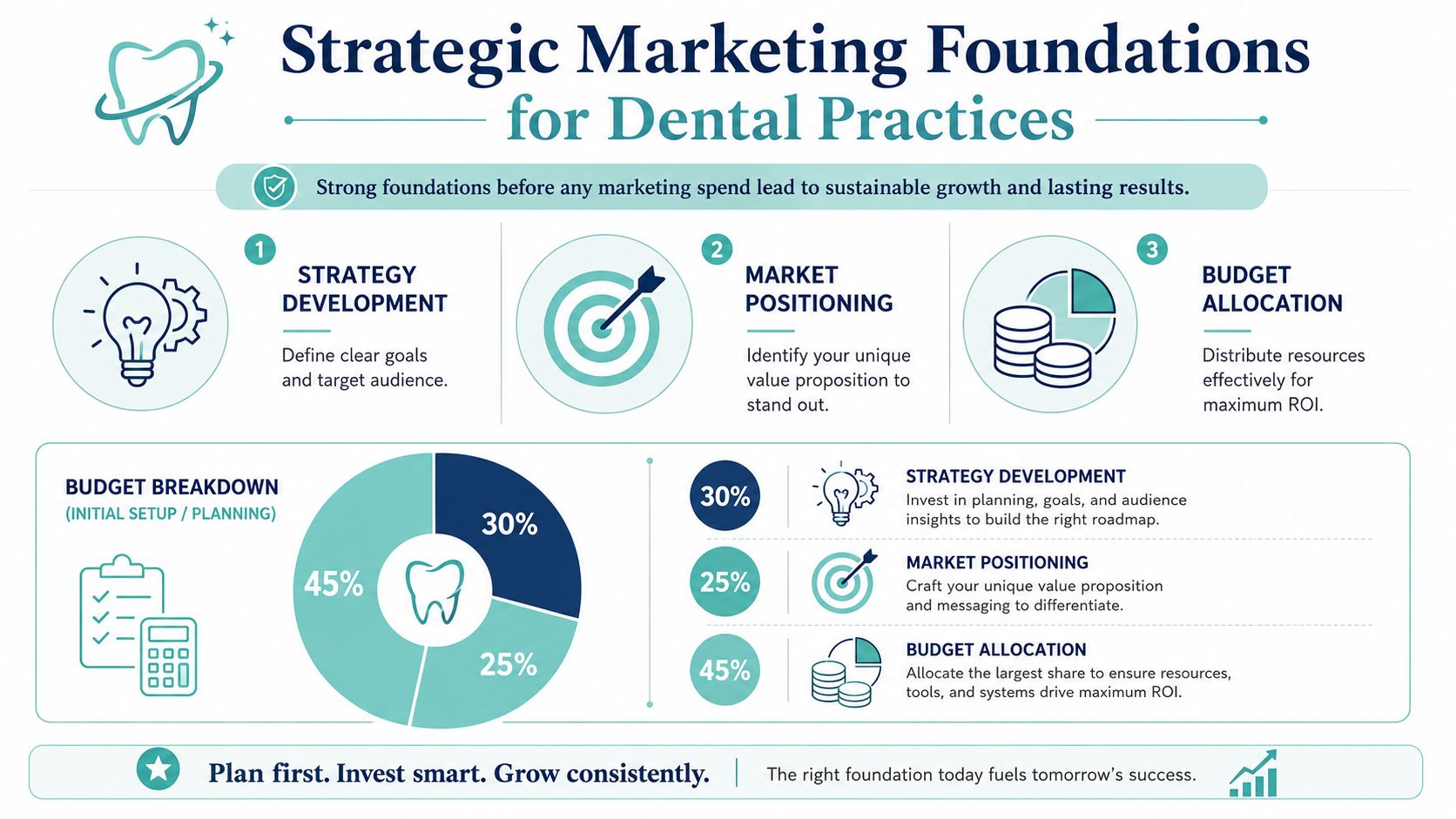
Tactics fail when the practice doesn't know who it wants to attract, what it wants to be known for, or what level of investment the goal requires.
A general office trying to grow family dentistry has a different marketing plan than a practice focused on implants, veneers, or emergency cases. The mistake is using one generic message for all of them. That creates weak pages, weak ads, and weak follow-up because the offer never feels specific to the patient.
Start with the patient you want
Define the growth target before you choose channels.
If you want more hygiene-driven family care, your messaging should reduce friction, emphasize convenience, insurance clarity, and trust. If you want more cosmetic or restorative cases, your content needs stronger treatment education, more proof, and more reassurance because the decision cycle is longer.
A simple way to frame this is to answer three questions:
- Who are you trying to attract: Families, emergency patients, cosmetic patients, implant cases, or a mix.
- What problem do they think they have: Pain, embarrassment, neglect, old dental work failing, or a desire to improve appearance.
- What would make them choose you: Same-day access, sedation options, financing clarity, a specific technology stack, stronger before-and-after proof, or a more personal care experience.
For service businesses in general, that groundwork determines whether marketing becomes coherent or scattered. This broader service company marketing framework shows the same principle in another context. Strategy sharpens every downstream decision.
Build a position patients can understand fast
Most practices don't need a clever slogan. They need a clear position.
That position should answer, in plain language, why a patient should trust your practice for a specific type of need. “Complete modern dentistry for busy families” is clearer than abstract brand language. “Cosmetic dentistry with a conservative treatment philosophy” tells a different story than “Smile transformations.”
Use this quick filter when evaluating your positioning:
| Question | Weak answer | Strong answer |
|---|---|---|
| What do you do best? | General dentistry | Family dentistry, emergency care, and restorative treatment |
| Who is it for? | Everyone | Busy parents, anxious patients, adults seeking cosmetic improvements |
| Why choose you? | Friendly team | Convenient scheduling, strong patient education, clear treatment planning |
The best positioning sounds obvious after you hear it. That's usually a good sign.
Set a budget that matches the growth goal
Underspending is one of the most common reasons dental practice marketing stalls. Practices often set a budget based on comfort rather than ambition, then expect growth-level results from maintenance-level spend.
According to DentX, practices in growth mode should allocate 10–15% of gross revenue to marketing, while stable practices can invest 5–7%, and 81% of practices are increasing SEO investment because of its average 300% ROI. The practical takeaway is straightforward. Growth requires committed investment, especially if the website, local SEO, and content foundation still need work.
A useful budgeting lens looks like this:
- Stable practice mode: Protect rankings, maintain reviews, improve conversion paths, and support retention.
- Growth mode: Build service pages, strengthen local search visibility, fix the website, and create enough demand to fill the schedule consistently.
- Startup or repositioning mode: Expect heavier early spend because the practice is building trust and visibility at the same time.
Don't divide budget evenly across every channel. Put more into the parts of the system that remove the biggest bottleneck. If the site doesn't convert, fix that first. If the site converts but visibility is weak, invest harder in local SEO. If both are healthy and a priority service line needs faster volume, layer in paid search.
Dominating Local Search with SEO and Google Business Profile
For most practices, local intent is the battlefield. People don't search for a dentist the way they shop for national products. They search by need, location, urgency, and trust. That's why strong local SEO and a fully managed Google Business Profile matter so much.
The most important shift is where discovery happens. A 2025 review of dental marketing changes reported that 60% of patient discovery happens directly on Google Business Profiles rather than websites, and practices using automated instant-response tools on those platforms saw 40-60% improvements in lead conversion. If your profile is thin, outdated, or unmanaged, patients may never reach your website in the first place.
Your Google Business Profile often gets the first look
Many practices still treat GBP like a directory listing. It's closer to a storefront.
Patients look at your category setup, services, reviews, recent photos, hours, and how current the profile feels. If they see stale posts, limited images, unanswered questions, or conflicting information, trust drops before a call happens.
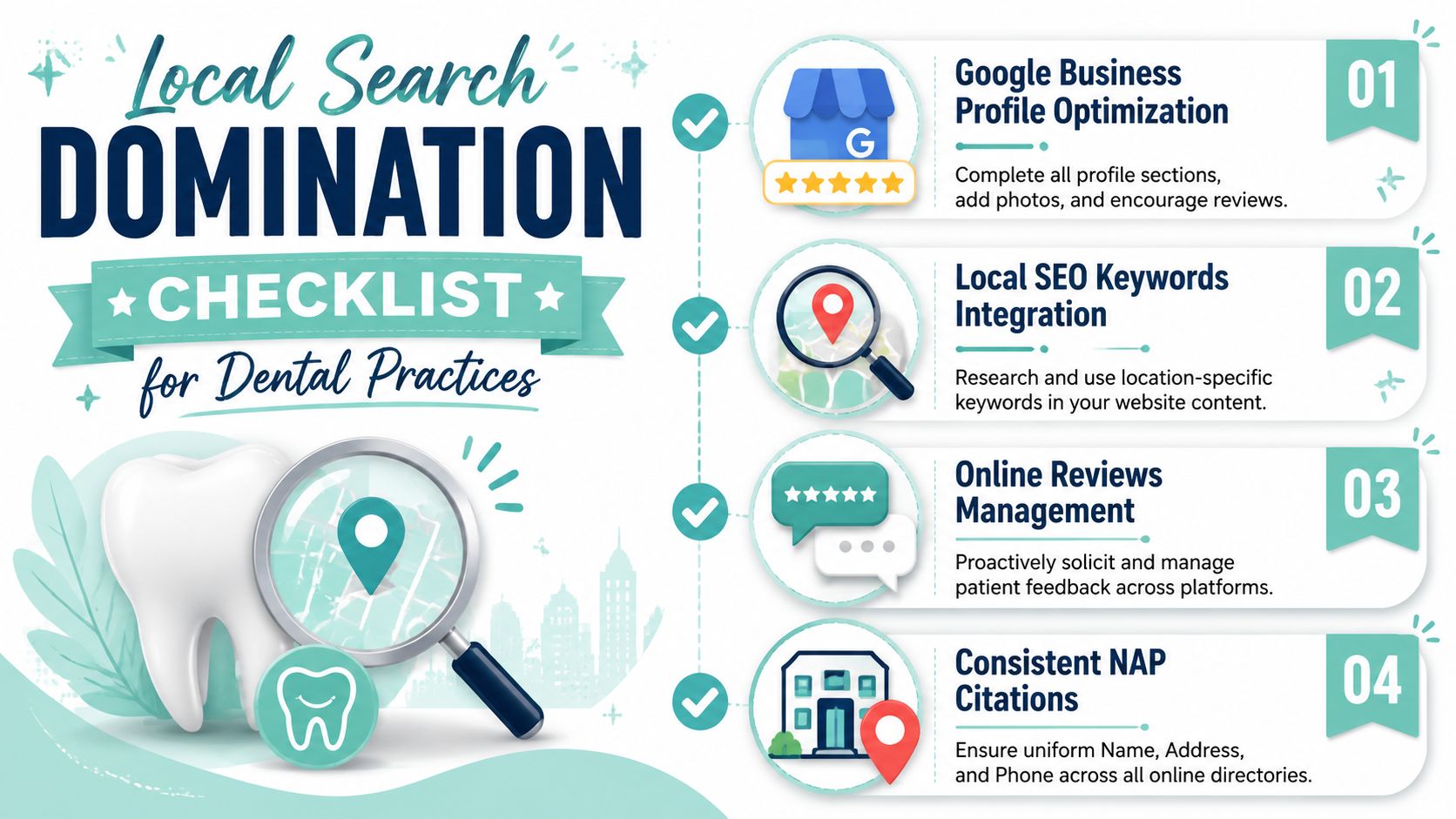
A useful optimization checklist includes:
- Complete every core field: Categories, services, hours, business description, and appointment options should all be current.
- Add photo depth: NexHealth reports that Google Business Profiles with 100+ photos receive 520% more calls than listings with fewer than 10. For dental practices, that means team photos, operatories, exterior signage, technology, and branded interior shots.
- Manage questions proactively: Seed common Q&A topics patients already ask your front desk, then answer them clearly.
- Keep posting: Share updates, service highlights, team moments, and seasonal reminders so the profile doesn't look abandoned.
If you're unsure how complete the profile is, it helps to analyze your local business profile before making changes. A structured audit usually reveals missing categories, weak visuals, and inconsistent details faster than a manual glance.
Local SEO has to match real patient searches
Local SEO breaks when practices build pages around internal language instead of patient intent.
Patients don't search for “complete oral health solutions.” They search for “emergency dentist,” “teeth whitening,” “veneers,” “dental implants,” and “dentist near me” plus a city or neighborhood. Your website needs pages that map directly to those searches.
The strongest local structures usually include:
- A distinct page for each priority service. General dentistry, cosmetic dentistry, implants, emergency care, Invisalign, pediatric dentistry, and other major offerings should not be buried on one all-services page.
- Location relevance in titles and copy. Use real service-area language naturally, not stuffed into every line.
- Consistent business information across the web. Your name, address, and phone need to match on major directories and local citations.
- Internal links that support decision paths. A visitor on an emergency page should be able to call or request an appointment immediately, not bounce back to the homepage.
Address changes create a surprising amount of local SEO damage when they aren't cleaned up properly. This guide on changing your address on Google is useful if the practice has moved or inherited inconsistent listings.
Response speed changes outcomes
Local visibility gets the searcher. Response handling wins the lead.
A common failure point is after-hours intent. Someone finds the profile at night, opens the website, has a question, and leaves because nobody answers. That doesn't mean the market lacked demand. It means the practice wasn't available at the moment interest peaked.
Fast response is part of local SEO now. Visibility without immediate follow-up leaves money on the table.
That's why profile management, website intake, chat, and front-desk process can't operate as separate projects. The patient experiences them as one system.
Turning Clicks into Patients Website and Conversion Optimization
The website's job isn't to impress other dentists. It's to help the right patient decide and book.
That sounds obvious, but many dental websites still prioritize aesthetics over action. They open with generic branding, hide the primary call to action, spread treatment information thinly, and make the visitor work too hard. When that happens, traffic quality gets blamed for a website problem.
A dental website is a booking tool
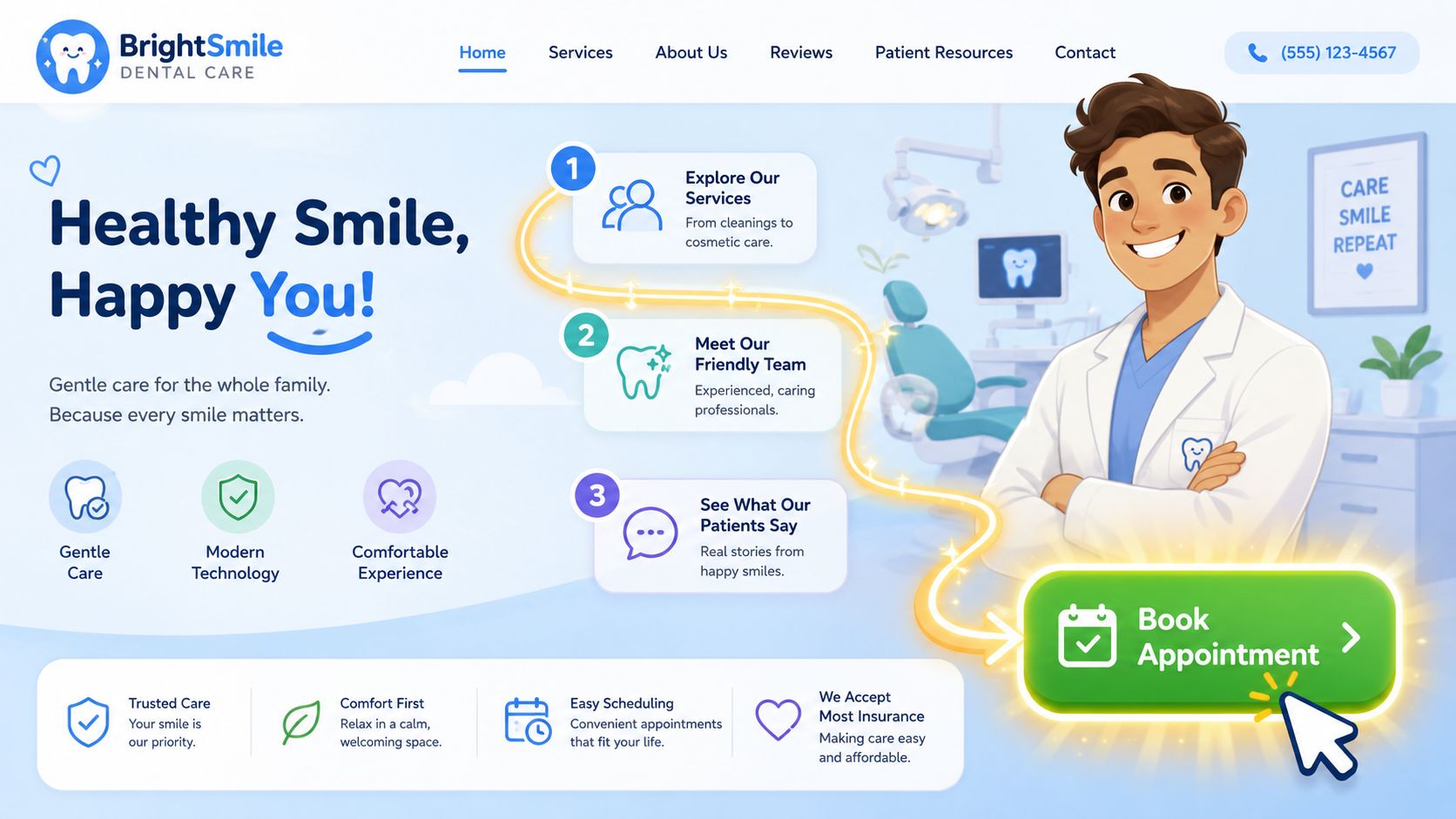
A good dental website does three things fast. It confirms the visitor is in the right place, reduces uncertainty, and gives a simple next step.
That means every high-intent page should quickly answer:
- Do you offer the service I searched for
- Do you serve my area
- Why should I trust you
- How do I book right now
If one of those answers is missing, conversion suffers. This is why cosmetic and high-value treatment pages need more than a brief paragraph and a stock image. Patients need enough clarity to take the next step without calling the office just to understand the basics.
A beautiful homepage can still be a poor sales page if it doesn't move the patient toward action.
The core CRO fixes that matter
The strongest guidance here is tactical, not theoretical. Golden Proportions recommends a CRO process built around simplifying booking forms, using prominent call-to-action buttons, embedding trust signals like reviews, and A/B testing page elements to improve patient conversions without increasing ad spend.
In practice, that usually means fixing these points first:
- Shorten the form: Ask for name, phone, email, and preferred time. That's enough to start the conversation.
- Place the CTA everywhere it matters: “Book Appointment Today” or an equivalent action should appear on every key page, not just in the header.
- Match page to traffic source: An Invisalign ad should land on an Invisalign page. An emergency search should land on an emergency page.
- Add trust near the action: Reviews, affiliations, certifications, financing clarity, and doctor credibility belong close to the form or call button.
- Reduce hesitation on mobile: Tap-to-call, sticky booking buttons, and readable page layouts matter because many searches happen on phones.
If you want an outside perspective on usability friction, this guide on how to boost landing page conversions is a useful companion to a manual page audit.
What to test before buying more traffic
Before increasing SEO or ad spend, test the page experience.
A practical CRO review often uncovers issues like mismatched headlines, weak treatment explanations, buried financing information, or confusing appointment options. None of those problems improve by sending more visitors.
Use a simple test queue:
| Element | What to test | Why it matters |
|---|---|---|
| Hero headline | Specific treatment promise vs general brand statement | Clarifies relevance immediately |
| CTA text | Book now vs request appointment vs call today | Changes perceived effort |
| Form length | Minimal fields vs detailed intake | Reduces abandonment |
| Trust placement | Reviews beside form vs lower on page | Supports action at decision point |
A redesign shouldn't start with colors or trends. It should start with page purpose, conversion paths, and how local search visitors behave. This website redesign guide for local growth approaches the problem from that angle.
Building Trust Through Content Reviews and Patient Retention
The practices that grow steadily usually aren't the ones chasing every new channel. They're the ones that make trust easier to see and easier to verify.
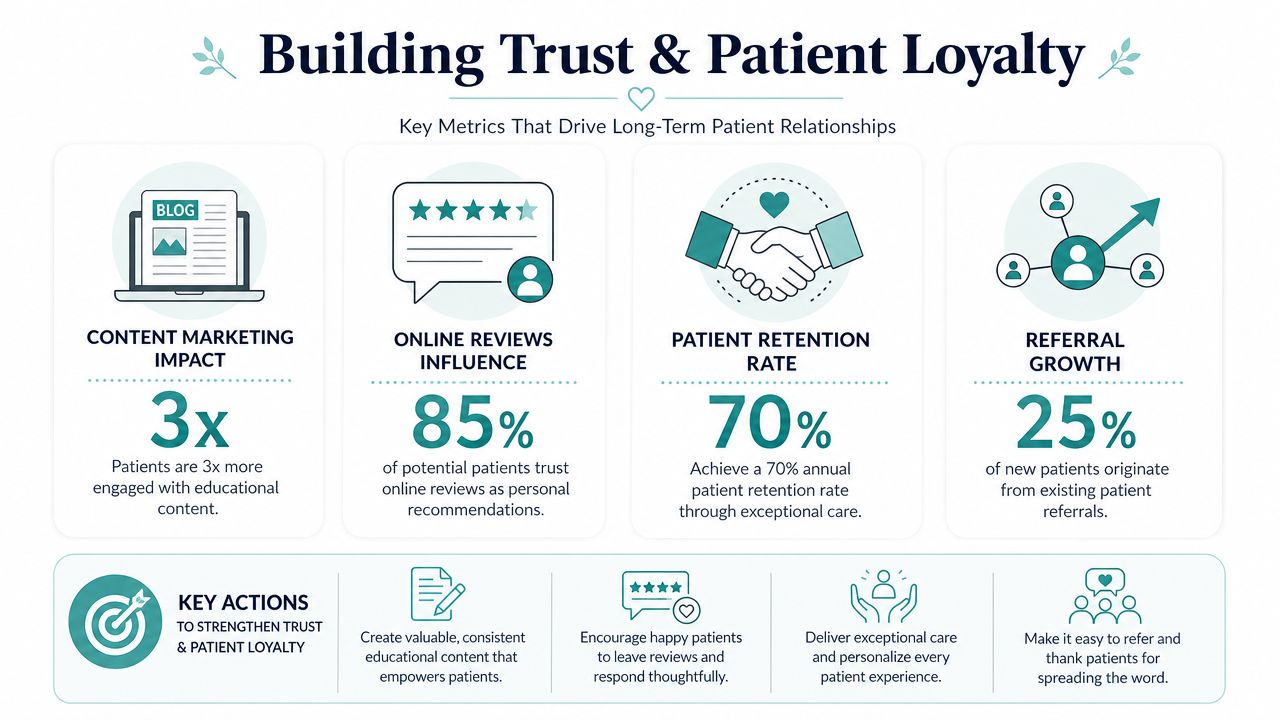
Trust in dentistry comes from three places working together. Patients find helpful information before they call. They see evidence that other patients had a good experience. Then, after treatment, they stay engaged and talk about the practice to others. When one of those parts is weak, growth gets less efficient.
Trust compounds when content answers real questions
Content works best when it sounds like the conversations your team already has every day.
Patients ask whether a toothache is urgent, how long veneers last, what Invisalign feels like, whether implants hurt, what sedation involves, and how insurance applies. Those questions belong in service pages, FAQs, short blog posts, and Google Business Profile content. They also support answer engine visibility because they align with direct, problem-based searches.
Useful topics usually come from operational reality, not brainstorming sessions. Pull them from front-desk call logs, consult objections, and post-op questions. Then write them in plain language, with clear next steps.
A strong content mix usually includes:
- Service decision content: What the treatment is, who it's for, what to expect, and common concerns.
- Problem-based content: Tooth pain, broken teeth, sensitivity, smile concerns, missing teeth, and urgent issues.
- Trust content: Doctor philosophy, technology, financing approach, and what first visits are like.
Reviews shape whether patients call
Reviews aren't a nice extra. They're part of the sales process.
According to MouthWatch, patient referrals are the most effective marketing channel for 77.5% of practices, and 81% of potential patients trust feedback from past patients above all else. That tells you something important about review strategy. Reviews don't sit apart from referrals. They extend referral-style trust into search.
The system doesn't have to be complicated:
- Ask shortly after a positive visit, while the experience is still fresh.
- Make it easy with a direct link or QR code.
- Train the team on when to ask and how to ask naturally.
- Respond to reviews consistently so the profile feels active and attentive.
The best review request isn't robotic. It sounds like a real invitation from someone who knows the patient had a good experience.
Retention and referrals outperform flashy tactics
The highest-performing growth channel in many practices is still the one that feels least like marketing.
That channel is the patient who returns, brings family members, and mentions the practice to friends. Referral-driven growth converts well because trust is already established before the first visit. That's why retention systems deserve as much attention as acquisition systems.
Build retention around actual patient behavior:
- Pre-appointment communication: Reminder texts, confirmations, and easy rescheduling reduce friction.
- Chairside follow-through: Explain treatment clearly, set expectations, and make the patient feel looked after.
- Post-visit follow-up: Check in after major procedures and keep recall communication consistent.
- Referral encouragement: Thank happy patients, mention that referrals are welcome, and make sharing easy without making it feel transactional.
Dental practice marketing transcends lead generation. It becomes experience management. The marketing team can attract attention, but the practice earns advocacy through consistent care and communication.
Amplifying Your Reach with Paid Ads and Social Media
Paid channels work best when they support a strong foundation. They work poorly when they're expected to rescue a weak one.
That's the trade-off many practices miss. Google Ads can generate demand quickly for services like emergency dentistry, implants, or Invisalign, but if the landing page is generic, the front desk is slow to respond, or the offer isn't clear, the spend gets inefficient fast. Paid traffic magnifies whatever already exists in the system.
Use ads where speed matters
Ads are most useful when the practice needs one of three things: immediate visibility, controlled promotion of a priority service, or message testing.
If a new location opens, ads can help fill the gap while SEO matures. If the practice wants more high-value procedures, ads can target high-intent searches with dedicated pages. If the team isn't sure which service message resonates, ad copy and landing page tests can surface useful insight before that language rolls into broader SEO content.
A practical decision filter looks like this:
- Use paid search when: Speed matters, a service line has high value, or ranking organically will take time.
- Hold back when: The website still has major conversion friction or intake handling is inconsistent.
- Expect the best performance when: Ads, landing pages, reviews, and front-desk response all align.
One more trade-off matters here. Paid ads stop when the budget stops. Organic visibility and review strength compound over time. That's why paid media should usually play an amplifier role, not become the entire growth plan.
Social media supports trust more than intent capture
Social media can help a dental practice feel familiar before a patient ever calls. It can show team personality, office culture, community involvement, and treatment education in a less formal format.
What it usually doesn't do on its own is capture bottom-of-funnel intent as efficiently as local search. People on Instagram or Facebook aren't always looking for a dentist at that exact moment. People searching on Google often are.
Treat social media accordingly. Use it to reinforce trust, support retention, and give patients a reason to feel comfortable with your brand. Post office life, educational clips, doctor perspective, patient-friendly explanations, and community moments. Don't expect it to carry the full acquisition burden.
A healthy channel mix often looks like this: local SEO and GBP capture intent, the website converts it, reviews reduce hesitation, and social content makes the brand feel more human.
Measuring What Matters Tying Marketing to Practice Growth
Most reporting in dental practice marketing is too soft to guide decisions. It focuses on impressions, likes, reach, or traffic totals without connecting those numbers to scheduled patients and production.
A practice doesn't need a complicated analytics stack to fix that. It needs a small set of metrics that tie activity to outcomes and a consistent way to review them.
Track inquiries not vanity metrics
The first metric to protect is qualified new patient inquiries.
That means phone calls, form submissions, chat conversations, and appointment requests from people who fit the services and geography you want. Website sessions matter only if they produce those actions. Rankings matter only if they bring qualified intent. Social engagement matters only if it supports trust or retention.
A useful KPI set includes:
- Qualified inquiries: Count the calls, forms, and messages that could become real patients.
- Booked appointments from marketing: Separate inquiries from scheduled visits.
- Source by channel: Know whether the lead came from Google Business Profile, organic search, paid search, reviews, direct traffic, or referral.
- Service-line mix: Track what kinds of cases the marketing is attracting.
- Show rate and patient quality: A lead that doesn't show isn't equal to one that starts treatment.
Good reporting changes behavior. If a metric doesn't guide an action, it probably doesn't belong on the dashboard.
Build a simple reporting rhythm
Most practices do better with one monthly dashboard and one quarterly review than with constant fragmented reporting.
The monthly view should answer practical questions. How many qualified inquiries came in? Which pages or channels produced them? Did response speed hold up? Which services gained traction? Where did leads stall?
The quarterly review should look for pattern changes, not noise. Maybe emergency care demand is strong but cosmetic pages underperform. Maybe GBP is generating calls but the website's implant page isn't converting. Maybe review volume is healthy but older service pages need stronger trust elements.
A clean dashboard can be built with tools you likely already use, such as Google Analytics, call tracking, form tracking, appointment software exports, and a simple spreadsheet or reporting layer. The exact toolset matters less than consistent attribution.
A practical 12 month rollout
A good marketing plan doesn't launch everything at once. It sequences work based on dependencies.
Here's a practical rollout model:
First quarter
- Audit the website, local rankings, GBP, reviews, and intake process.
- Clarify positioning and priority service lines.
- Fix core page structure, calls to action, forms, and tracking.
Second quarter
- Build or improve priority service pages.
- Strengthen Google Business Profile management and photo coverage.
- Clean up citation consistency and local signals.
Third quarter
- Publish content tied to patient questions and treatment intent.
- Expand review generation systems.
- Test conversion improvements on top traffic pages.
Fourth quarter
- Review channel performance by service type.
- Tighten retention and referral processes.
- Decide whether paid search should support specific growth goals next year.
That sequence works because it respects cause and effect. Better traffic without a better site wastes demand. Better pages without local visibility stay underexposed. Better acquisition without retention leaves growth fragile.
If your practice needs a stronger website, sharper local SEO, and a clearer path from Google visibility to qualified patient inquiries, Digital Skyrocket is built for that kind of work. They focus on web design, local SEO, answer engine optimization, and conversion improvements for service businesses that want more than traffic. They want leads that turn into real revenue.