
A branch manager changes the opening hours, a receptionist updates the phone number, and a corporate marketer publishes a new location page with the city name swapped into an old template. A month later, Google shows conflicting information across Maps, the website, and directories. One branch receives reviews nobody answers, another has the wrong category, and several location pages sit disconnected from the main site.
That's the operational reality behind local SEO for multiple locations. Rankings depend on marketing, but they also depend on ownership, data controls, profile governance, page architecture, and repeatable local workflows. Treat every branch as an isolated listing and the system becomes chaotic. Treat the footprint as an operating system, and optimization becomes manageable.
Table of Contents
- Why Multi-Location Local SEO Is an Operations Problem First
- Building Your Master NAP Sheet and Google Business Profile Foundation
- Choosing the Right Site Architecture for Your Locations
- Writing Location Pages That Earn Rankings Instead of Duplicate Filters
- Citations, Reviews, and Internal Links Working Together
- Common Pitfalls That Quietly Kill Multi-Location Visibility
- Tracking, Reporting, and a 90-Day Rollout Plan
Why Multi-Location Local SEO Is an Operations Problem First
Most owners approach multi-location SEO as a campaign. They commission pages, improve profiles, request reviews, and expect visibility to follow. That sequence skips the part that determines whether every later task is accurate: deciding who owns the data and how changes move through the organization.
Once a business operates beyond 10 locations, Google Business Profile bulk management becomes the practical control point. Google's official workflow allows a business to upload a spreadsheet, review imported locations, correct errors, and publish the approved records through its bulk location management process. That workflow only works reliably when the spreadsheet is more than an upload file. It needs to be the canonical record for every branch.
Build the operating system before the campaign
Your master record should connect each physical location to:
- Identity: The approved business name, street address, local phone number, and website URL.
- Operations: Opening hours, holiday-hour process, service area details, and branch-specific services.
- Search data: Primary and secondary categories, location-page URL, profile status, and verification status.
- Ownership: Location manager, regional owner, central administrator, and Location Group assignment.
- Change control: Last audit date, pending edits, approved changes, and the person responsible for publishing them.
This structure matters because a Tyler law firm with three offices and a Dallas HVAC company with eight service zones can hit the same failure point. NAP details drift, categories vary without a deliberate reason, and branch pages become orphaned from the site's navigation. The industry changes, but the governance problem stays familiar.
Practical rule: If a branch detail exists in three different spreadsheets, inboxes, or vendor dashboards, you don't have a source of truth. You have competing versions of reality.
Assign authority by task
Central teams should control ownership, naming standards, categories, and verification. Regional managers can coordinate local updates, while branch staff can supply photos, answer review notifications, and report changes in hours or services. Keep editing access narrow enough that a well-intentioned local change can't rewrite the brand's identity across every profile.
The same principle applies to pages and citations. A profile update, website edit, and directory correction should begin with the same approved row in the master record. Businesses that need a broader introduction to local search fundamentals can also use DigiVisi Ltd local SEO 2026 as supplementary reading, while a dedicated NAP consistency workflow helps translate the principle into an editorial and technical process.
The takeaway is straightforward: multi-location local SEO is a systems discipline first. Content, citations, and reviews perform better when people, permissions, and data flows are settled before publication begins.
Building Your Master NAP Sheet and Google Business Profile Foundation
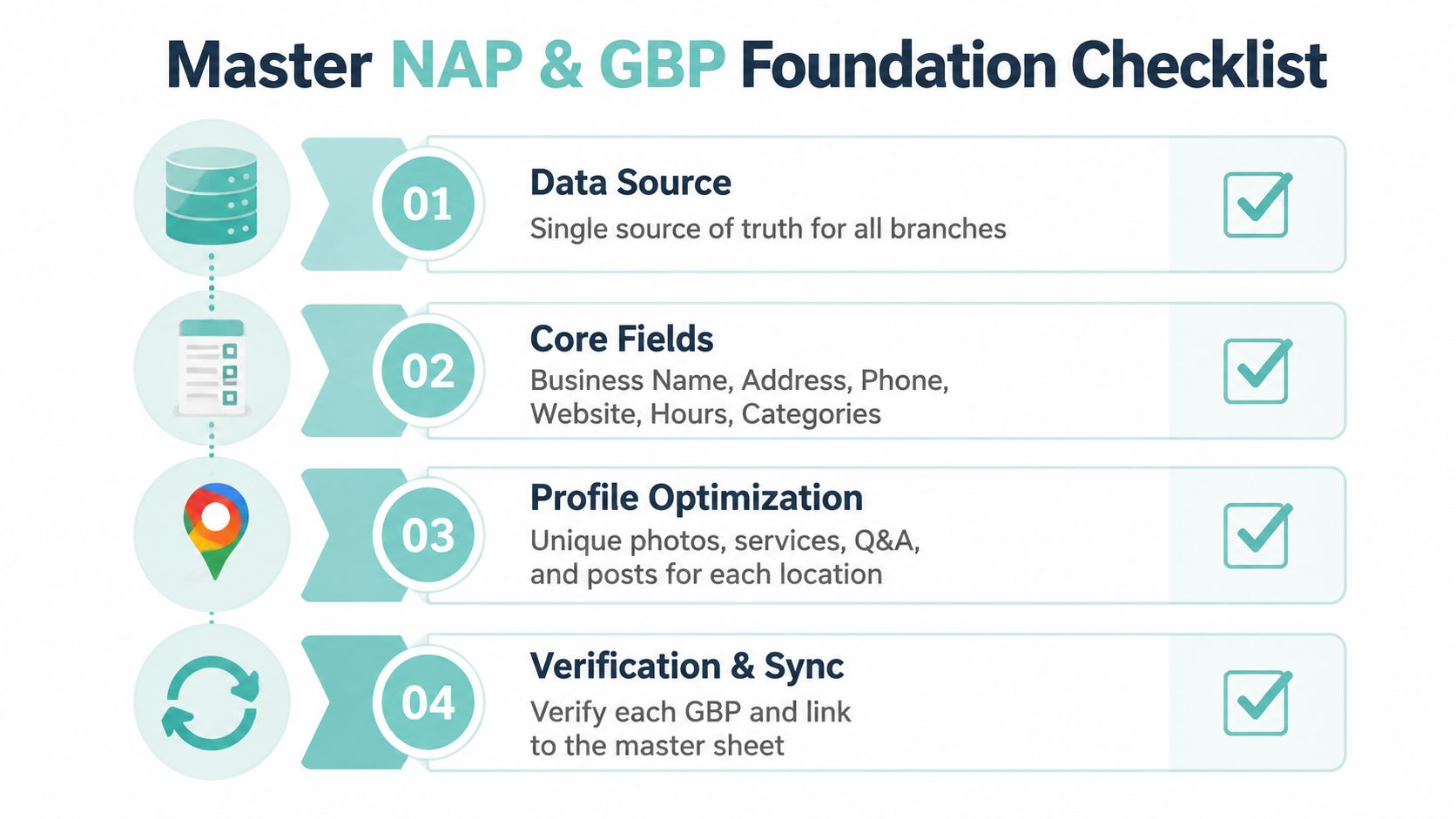
Start with the spreadsheet, not the profile editor. Create one row for every real location and make each field explicit enough that a new team member can understand the branch without opening another document.
Fields that belong in every row
Capture the following:
- Business identity: The approved real-world business name and any location code used internally.
- Physical presence: Complete street address, suite information, public-facing address status, and service area where relevant.
- Contact details: Direct branch phone number, website URL, and the exact location-page URL.
- Profile configuration: Primary category, secondary categories, available services, and Location Group assignment.
- Operational details: Regular hours, holiday-hour owner, branch manager, and escalation contact.
- Verification controls: Verification status, verification date, profile owner, and unresolved Google issues.
- Content assets: Storefront photographs, team photographs, local FAQs, and approved branch-specific descriptions.
Google expects locations offering the same service to use the same business name unless branding consistently differs by location. It also recommends using the same category when locations provide the same service. That doesn't prevent legitimate branch differences, but those differences should reflect actual operations, not a manager's personal preference. The Google guidance on names and categories is the reference point for setting the rule.
Separate staffed locations from service areas
A staffed branch that customers can visit should have its own profile. Google's multi-location guidance expects separate profiles for separate staffed locations, rather than one listing covering many branches. That separation helps Maps and Search associate reviews, hours, categories, and contact information with the correct physical entity.
A service-area business requires a different setup. Don't publish a virtual office, mailbox, or misleading address just to create another local profile. Google's Business Profile guidelines for representing businesses require the address or service area to be accurate and precise.
Upload, review, verify, and govern
The bulk workflow is practical: upload the approved spreadsheet, inspect the imported locations, resolve errors, then publish. For eligible businesses, Google supports bulk verification tied to a Location Group. The owner or an authorized representative should control that process, as explained in guidance on verifying multiple Google Business Profiles.
After verification, keep the Location Group clean. Every new branch should enter through the master sheet, receive an owner, and pass a profile review before publication. That process prevents a familiar problem: a new location goes live with the wrong hours, an incomplete category, or a URL that leads to a generic contact page.
Choosing the Right Site Architecture for Your Locations
A single page that says “we serve every city in the state” rarely gives Google or a customer enough branch-level evidence. A useful architecture reflects how the business operates and how people search.
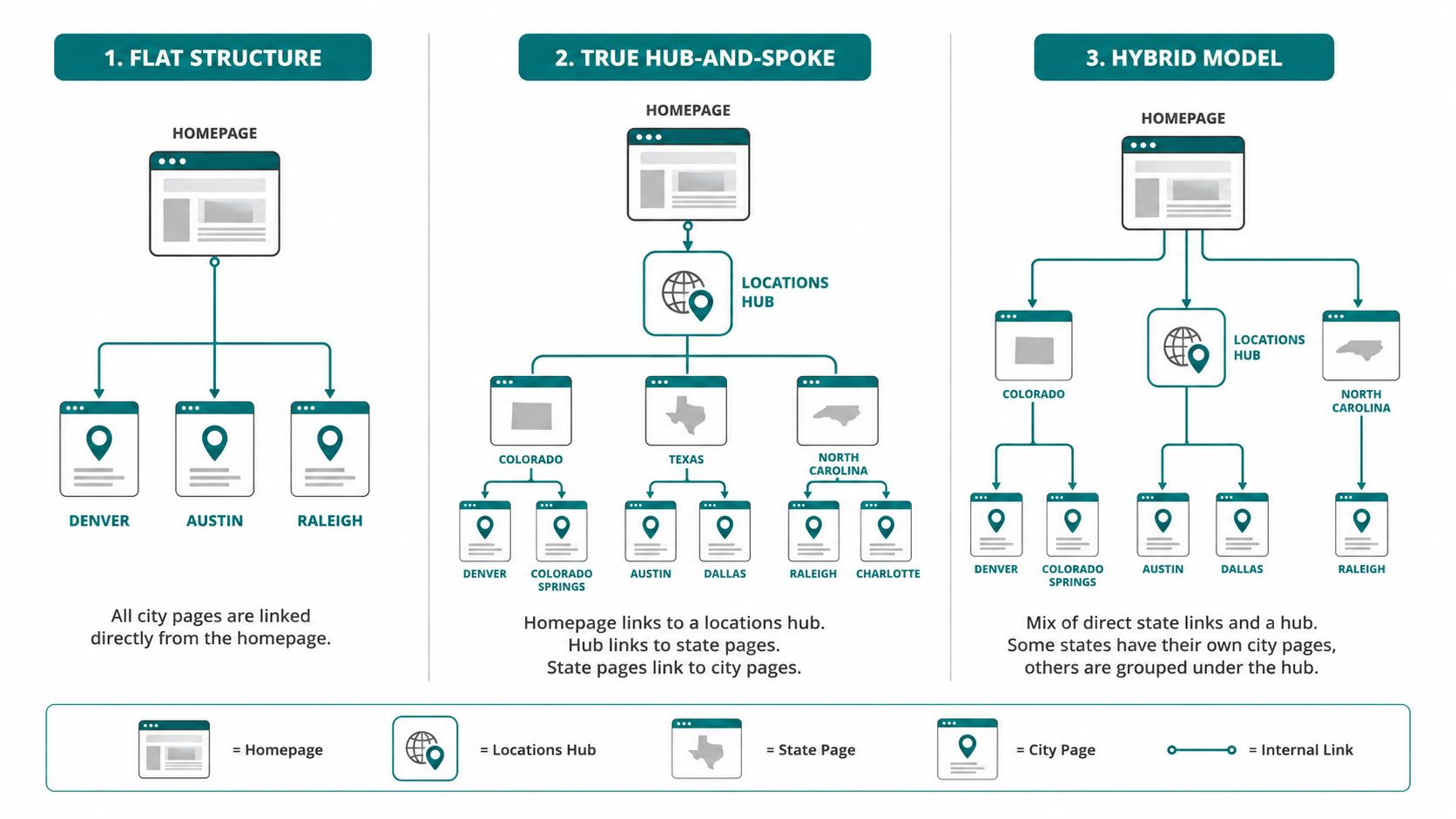
The durable pattern is a hub-and-spoke structure. A brand-level locations hub links to state or metro hubs, and each city or branch page targets a specific local intent. This approach is described in guidance on multi-location local SEO site structures.
Three structures, three use cases
A flat structure places every city page directly under one locations directory. It's easy to build and can suit a small footprint, but it becomes difficult to manage as branches multiply. It also gives state and metro relationships little emphasis.
A true hub-and-spoke structure creates a hierarchy such as:
/locations//locations/texas//locations/texas/dallas//locations/texas/dallas/branch-name/
The locations hub supports discovery. State and metro hubs provide context. Branch pages carry the address, services, staff, reviews, hours, and conversion path for one real location.
A hybrid structure adds service-in-city pages only when they serve a distinct search and conversion need. For example, a Dallas HVAC branch might need a branch page, while a separate commercial HVAC in Dallas page earns its place only if the service has meaningful demand and the content can explain a different offer.
Use a decision rubric, not a page quota
Build a branch page when customers can identify a real staffed location or a clearly defined operating base. Add a service-in-city page when the business has legitimate coverage, the query reflects a distinct service intent, and the page can provide local proof rather than recycled copy. Skip the page when it would only swap one city name for another.
A page hierarchy should make internal relationships obvious. Link every branch to its relevant state or metro hub, connect nearby branches where that helps customers, and link service pages to the locations that provide those services. A practical sample website sitemap can help teams visualize those relationships before development begins.
The trade-off is important. More URLs create more maintenance, more schema to validate, and more opportunities for conflicting information. Build the smallest architecture that matches real demand and real operations, then expand when evidence supports the next page.
Writing Location Pages That Earn Rankings Instead of Duplicate Filters
A location page earns its place by proving that the branch exists, operates locally, and helps a nearby customer make a decision. The address alone isn't enough. A paragraph with a city name inserted into a national template isn't local expertise either.
Start with information a real visitor could verify:
- The branch's complete address, direct phone number, and current hours.
- Services available at that location, including services unavailable elsewhere.
- Local staff, office photographs, storefront images, and branch-specific credentials.
- Parking, access, appointment, dispatch, or service-boundary information.
- Reviews connected to that branch, with clear context.
- Local FAQs that answer practical questions instead of repeating generic marketing copy.
- Links to relevant services, nearby branches, and the regional hub.
Expert guidance emphasizes unique address-level content, local staff or photos and reviews, local service descriptions, and distinct JSON-LD because repeated templates can dilute relevance and create cannibalization or thin-content problems. The implementation should be structured, but the facts must come from the branch.
| Element | Strong page | Weak page |
|---|---|---|
| Address proof | Exact branch details, directions, access notes, and a direct contact path | City name added to a generic footer |
| Service detail | Services confirmed for that location, with local availability explained | National service list copied to every branch |
| Local evidence | Actual team, storefront, project, or customer material | Stock photography and vague neighborhood references |
| Conversion path | Branch-specific phone, form, hours, and appointment guidance | One generic contact button |
| Internal links | Relevant service pages, regional hub, and nearby branch links | Orphaned page with no meaningful navigation |
Use one schema block for one branch
Each branch page should have its own LocalBusiness JSON-LD record. Adapt the subtype to the business where appropriate, and keep the structured data aligned with visible page content.
{
  "@context": "https://schema.org",
  "@type": "LocalBusiness",
  "name": "Approved Branch Name",
  "url": "https://example.com/locations/branch-name/",
  "telephone": "+1-000-000-0000",
  "address": {
    "@type": "PostalAddress",
    "streetAddress": "123 Main Street",
    "addressLocality": "City",
    "addressRegion": "State",
    "postalCode": "00000",
    "addressCountry": "US"
  },
  "openingHoursSpecification": [
    {
      "@type": "OpeningHoursSpecification",
      "dayOfWeek": ["Monday", "Tuesday", "Wednesday", "Thursday", "Friday"],
      "opens": "09:00",
      "closes": "17:00"
    }
  ],
  "areaServed": "Local service area"
}
Validate every branch record against the master sheet. A wrong phone number in schema is still wrong, even if the visible page is accurate. Avoid review markup unless the reviews and implementation meet Google's requirements and are represented.
Citations, Reviews, and Internal Links Working Together
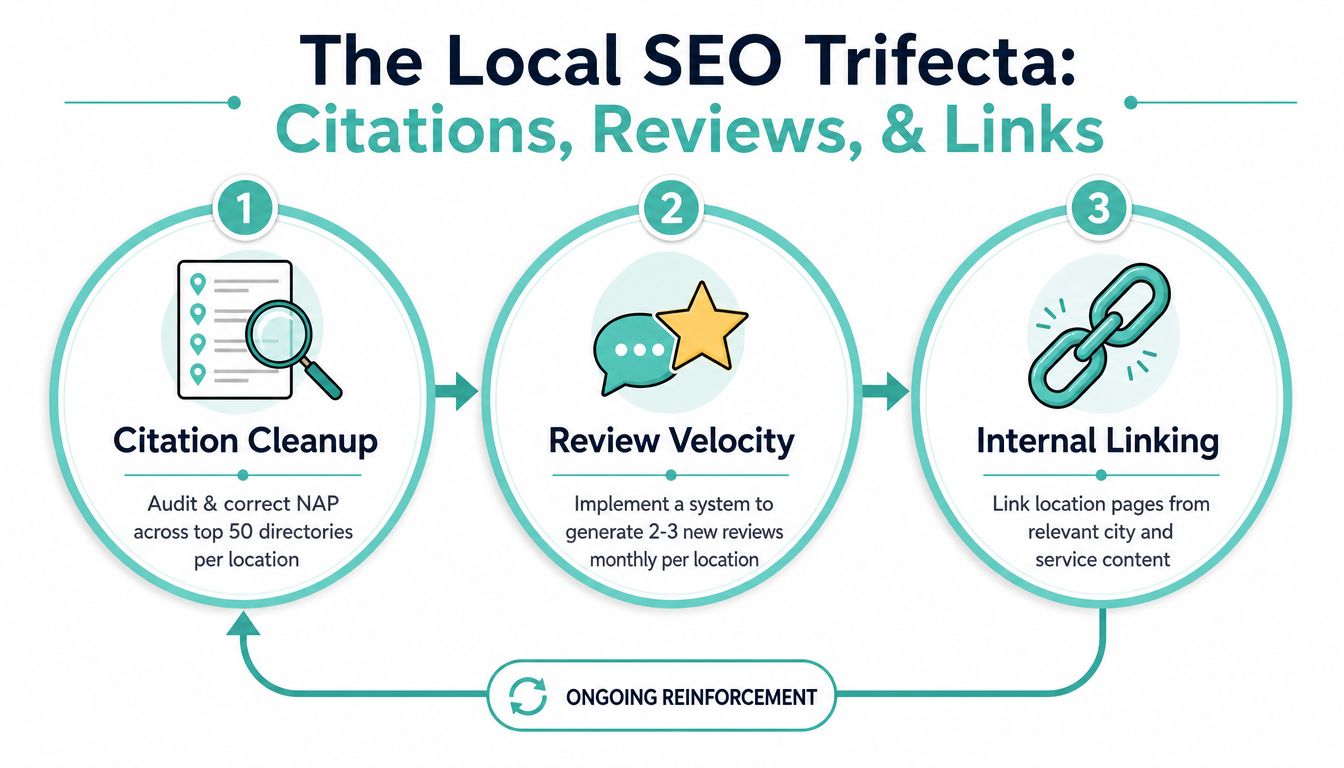
These systems need one operating process. Start with the master sheet, correct priority citation records, assign review ownership by branch, and connect the website so search engines and customers can move through a consistent local footprint.
Clean priority records first
Audit major mapping platforms, core directories, industry listings, and citations that send referral traffic. Correct each listing's name, address, phone, URL, categories, and hours against the approved branch row. Archive old phone numbers and outdated location pages rather than leaving conflicting records discoverable.
Use a structured local citation building process to assign owners, record submission status, and document the approved data. Chasing every obscure directory wastes time. The practical goal is agreement across records that influence entity matching, local discovery, or customer actions.
Give every branch a review owner
Reviews attach to individual profiles, so corporate reputation does not automatically transfer between branches. Assign a person or team to monitor each location, request feedback through approved channels, respond with branch-specific details, and escalate service issues. Repeated corporate replies provide little local context and can make the workflow appear automated.
Set the rollout order by operational dependency. First identify missing or conflicting citations. Then stabilize review requests and responses by branch. After those records are controlled, inspect internal links: the locations hub should reach regional hubs and branch pages, while service pages should link to branches that provide the service.
An industry report on citation and profile consistency for multi-location businesses notes that businesses improving NAP consistency across citation tiers see average ranking gains of 2 to 3 positions within 60 days after cleanup. Treat that as an industry-reported outcome, not a promise. The dependable operational lesson is clearer: accurate records reduce uncertainty, while branch-specific reviews and useful internal links strengthen relevance and help customers reach the right location.
Common Pitfalls That Quietly Kill Multi-Location Visibility
The assumption that more pages and more profiles automatically create more visibility is expensive. Search engines need to distinguish branches, services, and entities. Repetition makes that job harder.
Clone pages with city names swapped
Symptom: Pages are indexed inconsistently, compete for the same terms, or fail to attract meaningful organic visits.
Cause: The company publishes one template and changes only the city, phone, and heading.
Fix: Add branch-specific services, staff, photographs, reviews, access information, and local FAQs. If a page can be moved to another city without changing its usefulness, it probably needs more real local evidence.
Duplicate profiles for one physical location
Symptom: Reviews split across listings, customers see conflicting hours, and Maps displays the wrong profile.
Cause: A former agency, local manager, or automated system created another profile instead of updating the existing one.
Fix: Identify the legitimate profile, remove or resolve duplicates through Google's processes, and keep one canonical record for the physical location. Don't create a second listing to recover from a poor review history.
Categories drift from branch to branch
Symptom: Similar branches appear for different searches even though they offer the same core service.
Cause: Local teams select categories independently or add loosely related categories to chase extra visibility.
Fix: Set a central category policy. Allow exceptions only when the branch operates differently, and document the reason in the master sheet.
Branch pages compete with the homepage
Symptom: The homepage and location pages send mixed relevance signals for the same city or service query.
Cause: Every page targets the same broad keyword instead of assigning each URL a distinct intent.
Fix: Give the homepage brand-level responsibility, the regional hub geographic responsibility, and each branch page a specific location and service role.
Hours and ownership break trust
Symptom: Customers arrive during closed hours, reviews mention poor information, and staff make conflicting edits.
Cause: No one owns holiday updates, profile permissions are too broad, or changes don't propagate from the central record.
Fix: Assign an hours owner, define an approval path, and audit profile, website, schema, and citation details together.
The scale problem is often overlooked. Guidance on managing Google Business Profiles at scale highlights how governance gaps create NAP drift, inconsistent categories, and fragmented review responses across larger footprints. The remedy isn't another checklist. It's controlled access, synchronized data, and a clear person responsible for each update.
Tracking, Reporting, and a 90-Day Rollout Plan
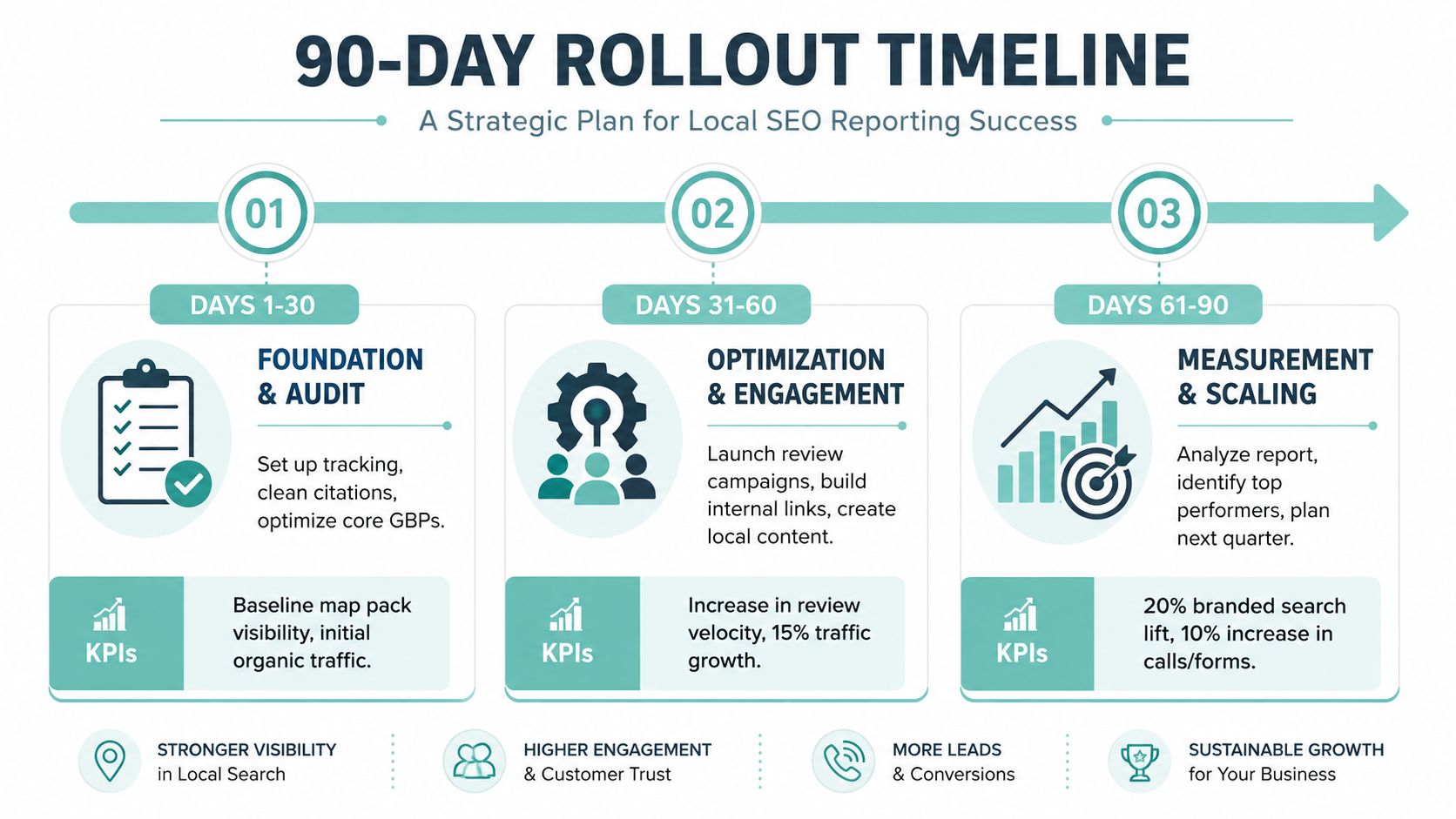
A useful report separates brand performance from branch performance. Track map pack visibility by location, organic traffic to each branch page, branded search activity, calls and forms by branch, citation consistency, review activity, and response rate. A rank tracker can show local visibility, analytics can show landing-page engagement, call tracking can attribute phone leads, and the master sheet can hold operational audit status.
Roll out the system in controlled phases
- Weeks one and two: Create the master sheet, assign ownership, audit profiles, identify duplicates, and establish baseline reporting.
- Weeks three through six: Publish the first wave of useful branch pages, correct priority citations, and resolve profile verification or access issues.
- Weeks seven through ten: Stabilize review requests and responses, add internal links, and validate hours, phone numbers, URLs, and schema.
- Weeks eleven and twelve: Compare branch performance, identify recurring governance failures, and decide which page, citation, or content process should scale next.
Recent coverage favors intent-based architecture over blanket page-sprawl, with a locations hub, one page per actual branch, and optional service-in-city pages when demand exists. That approach also connects local SEO with answer engine optimization and conversion design, as discussed in recent multi-location local SEO guidance.
Frequently asked questions
Does a service-area-only business need a Google Business Profile?
It can, when it represents a legitimate business operating from an accurate base and follows Google's service-area rules. Don't create profiles for virtual locations or pretend that a service zone is a staffed branch.
What should happen during a rebrand?
Update the master record first, then coordinate the profile, website, schema, and priority citations. Change one location at a time when necessary, document the old and new identity, and verify that customers still reach the correct branch.
How does AI-driven search change local visibility?
It increases the value of consistent, structured, branch-specific information. Complete profiles, useful location pages, accurate services, and authentic review context give answer systems clearer evidence about which branch fits a customer's request. It doesn't eliminate map visibility. It adds another reason to govern the underlying data carefully.
Digital Skyrocket helps service businesses plan and build lead-generating websites, local SEO systems, AEO foundations, and reputation workflows that connect branch visibility to calls and form submissions. Visit Digital Skyrocket to discuss a multi-location website and SEO program built around accurate data, useful location pages, and ongoing measurement.