
If you've ever opened your phone and found missed calls from a number that should've routed to the right office, you already know how fast local listing problems turn into lost work. A contractor in Tyler might be paying for leads while the web still shows an old suite number, or a law practice may be sending prospects to a dormant phone line because one directory never got updated. NAP consistency is the fix for that kind of mess, and it's less about polish than about making sure every public record points to the same business.
Table of Contents
- What NAP Consistency Means and Why It Matters
- Defining Your Canonical Business Record
- Auditing Your Existing Listings
- Prioritizing Fixes Through Data Aggregators
- Handling Multi-Location and Phone-Tracking Setups
- Maintaining Consistency After Changes
- Tying NAP Consistency to Leads and Knowing When to Get Help
What NAP Consistency Means and Why It Matters
A roofing company in Tyler can do solid work, answer the phone, and still lose calls because one directory points to a Dallas number or an old office address. The same thing happens to law firms, dental practices, HVAC companies, and any service business that relies on local search. NAP means name, address, and phone number, and NAP consistency means those details match across your website, Google Business Profile, directories, review sites, and social profiles.
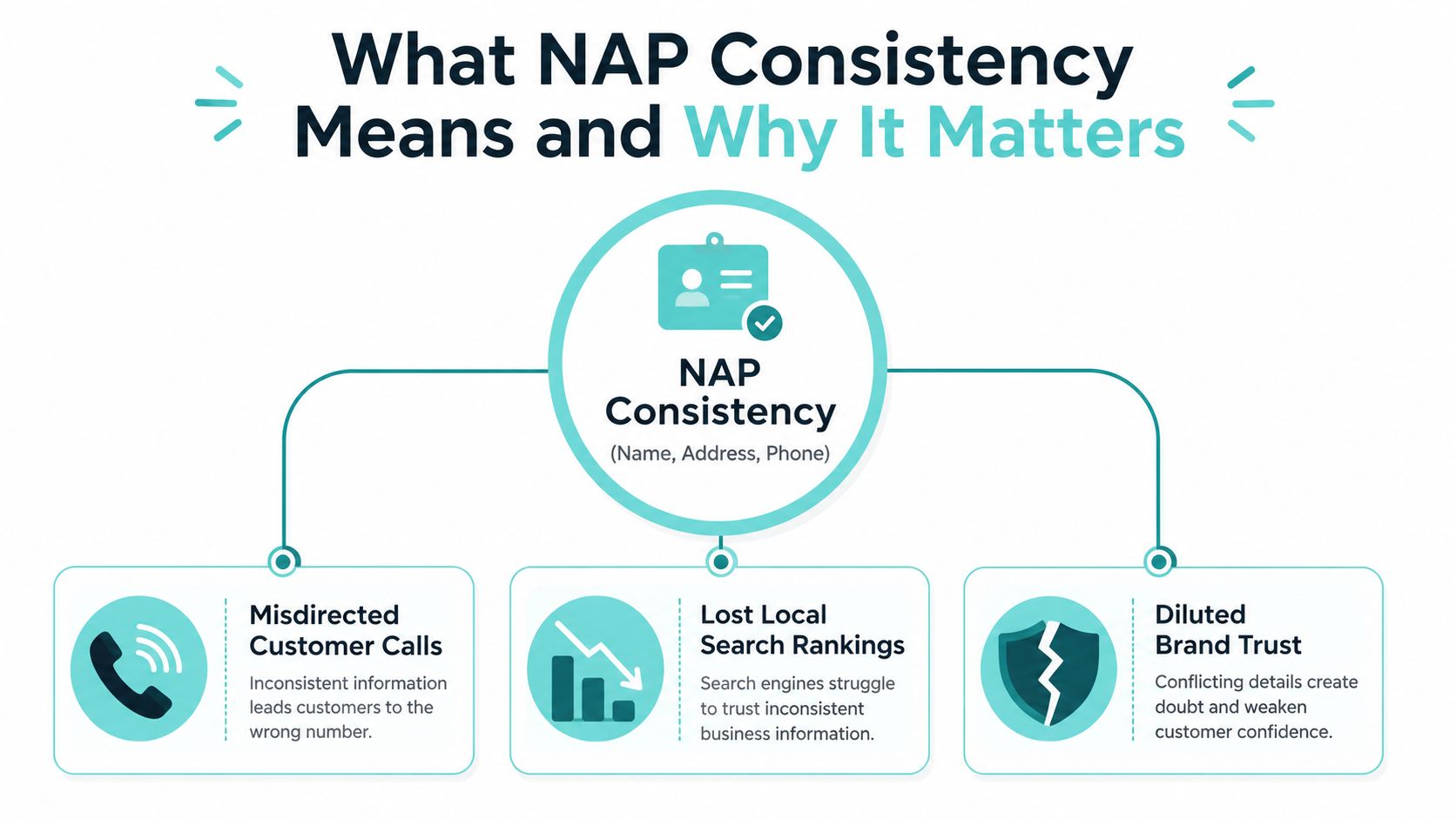
Search systems use those matching identity signals to decide whether all of those mentions belong to one real business or a pile of conflicting records. BrightLocal treats NAP consistency as a baseline local SEO requirement, not a nice-to-have cleanup task, because matching business identity across the web helps local systems keep one entity unified rather than fragmented (BrightLocal). Moz's guidance also frames the workflow the same way, start with one primary number and keep the website, Google Business Profile, and major listings aligned (Moz).
What counts as a real mismatch
Not every difference is a problem. Yext notes that phone digits must match, while abbreviations like road and rd can be acceptable when the underlying business data is still the same (Yext). That means search systems can usually tolerate minor formatting variation.
The issues that hurt are the ones that change the actual business identity. A dropped suite number can matter in a crowded office park. An old phone number, a duplicate listing, or a different location entirely creates conflicting signals that can split calls, confuse customers, and weaken map-pack visibility.
Practical rule: if a customer could reasonably end up at the wrong place or call the wrong line, treat it as a real NAP problem.
For service businesses, the operational cost is immediate. Misdirected calls waste time, old addresses send people to the wrong building, and inconsistent records make it harder for Google and Bing to trust the listing you want to rank. Transactional LLC on NAP consistency is a useful plain-English reference if you need to explain the concept to an owner who's never thought about citation data before.
Defining Your Canonical Business Record
Before touching a single directory, pick one version of the business record and make it the standard. If that step stays fuzzy, every correction drifts back into inconsistency the minute someone opens a new profile, adds a location, or updates a SaaS tool. The goal is simple, one source of truth that every future listing must match exactly.
Lock the primary phone and address format
Start with the phone number that should represent the business everywhere permanent. Moz's guidance says to use one primary number as the NAP standard and to check the major citation sites after any contact change (Moz). If the business uses multiple lines, choose the one that should live in citations, schema markup, and profile records, then keep tracking numbers out of those permanent fields.
For the address, decide whether the suite, floor, or building name belongs in the public format. Once that call is made, don't improvise later. A fixed template keeps staff from “helpfully” rewriting the same address three different ways.
A practical template looks like this:
- Business name: Hillcrest Roofing
- Address: 123 W Main St Ste 400, Tyler, TX
- Phone: (903) 555-0100
- Website footer: exact same format
- Schema markup: exact same format
Make the template operational
Write the canonical record somewhere staff can use it, then point every new profile creation process to that document. That matters for franchise partners, intake vendors, marketing teams, and software tools that ask for business data.
If a new listing can't match the canonical record exactly, it shouldn't go live yet.
That one rule prevents the slow creep that usually creates citation messes. It also gives you a clean benchmark for audits, since you're comparing every public record against a single approved version rather than arguing about which listing “looks close enough.”
Auditing Your Existing Listings
A real audit is a comparison exercise, not a guess. Pull your canonical record beside the current listings and check the business website, Google Business Profile, Apple Maps, Bing Places, Facebook, Yelp, and the niche directories that matter for your industry. For a law firm, that can mean legal directories like Avvo and FindLaw. For roofers, dentists, and HVAC companies, the important list shifts toward industry and local authority sites that customers use.
The fastest way to stay sane is to log everything in a spreadsheet. Track the platform, the platform type, the mismatch, the current value, and the canonical value. That gives you a prioritization map instead of a vague list of “stuff to fix.”
| Mismatch Type | Example | Fix Priority |
|---|---|---|
| Old phone number | A prior office line still active on a directory | High |
| Dropped suite number | Suite missing from a downtown office listing | High |
| Duplicate listing | Two profiles for the same branch after a move | High |
| Abbreviated suffix drift | Street written as Ave on one site and Avenue on another | Medium |
| Outdated address formatting | Old building name or floor format remains live | Medium |
| Low-value niche directory mismatch | A small directory lags behind the canonical record | Low |
Start where the damage is most visible
The website, Google Business Profile, and the top directory listings should be checked first because they're the records most customers see. If you find a duplicate listing, follow the removal or merging process before you do anything else, since duplicates can confuse both users and search engines. If you need a walkthrough for deleting or cleaning up a Google profile, this internal guide on how to delete a Google Business page is the right starting point.
Claim before you correct
Not every listing can be edited immediately. Some profiles need to be claimed first, especially older directory pages or records created during a move or acquisition. If you hit a locked listing, log it, claim it, and then update it in the same workstream so it doesn't get forgotten.
Practical insight: an audit is only useful when it ends with a ranked fix list. If you walk away with “we've got some inconsistencies,” the work hasn't really started.
A clean audit gives you three things, the worst errors, the highest-value platforms, and the listings that must be claimed before they can be corrected.
Prioritizing Fixes Through Data Aggregators
Updating citations one by one sounds thorough, but it usually wastes time. Most major directories don't rely on a manual human review of every business record. They pull from a distributed local-data ecosystem, so corrections need to be pushed where downstream sites are most likely to inherit them.
Fix the upstream sources first
The four major U.S. aggregators are Infogroup, Neustar/Localeze, Factual, and Acxiom. Industry guidance recommends updating those sources early because major directories often feed from them, which means one accepted correction can propagate to many downstream listings (seojuice). That doesn't make the process instant, but it does make it more efficient than playing directory whack-a-mole.
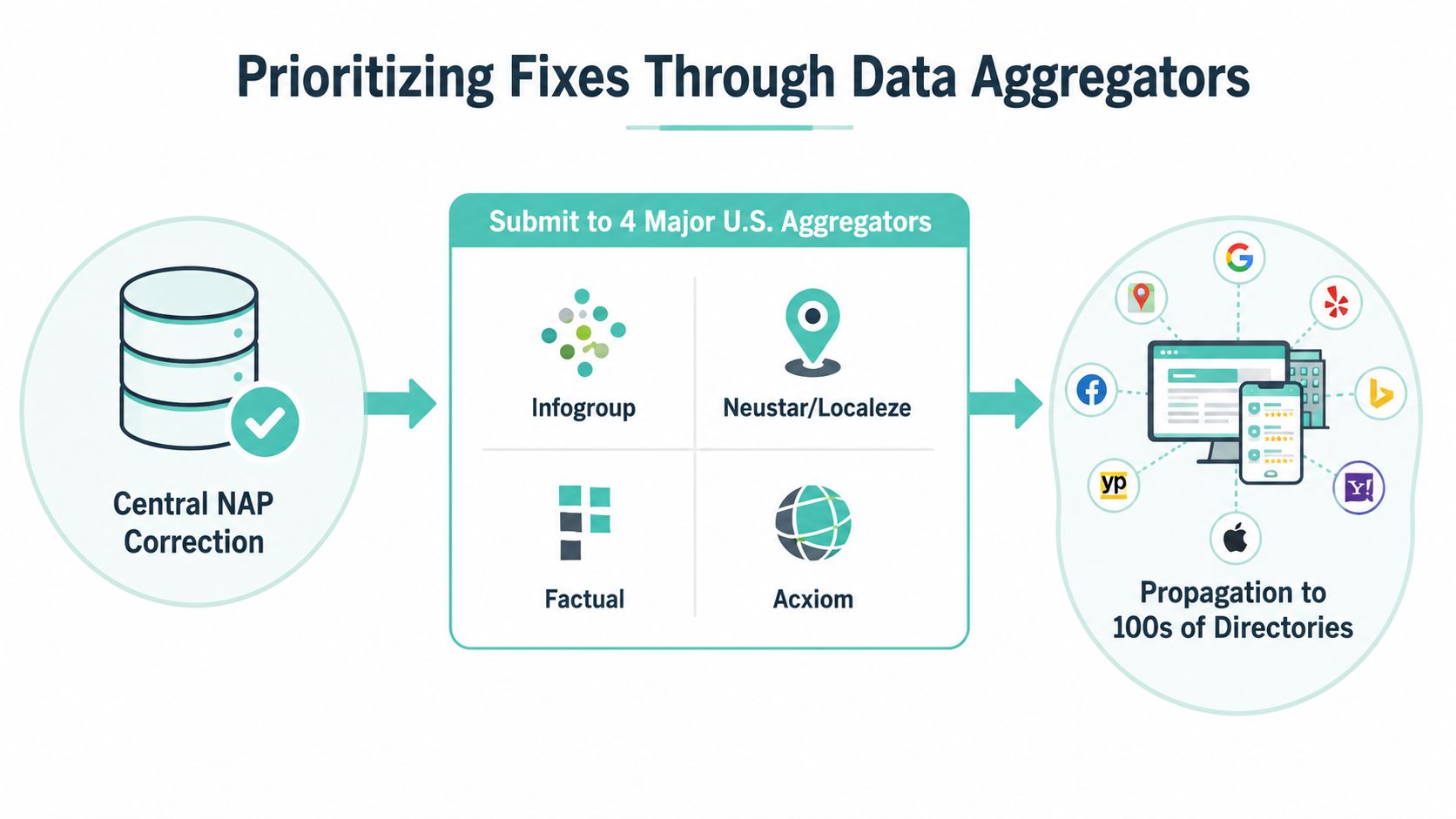
The operational move is straightforward. Submit the canonical business record to the aggregators, confirm the submission was accepted, then watch downstream directories for inherited updates. If a listing doesn't change after the upstream correction, that's the one worth handling manually.
Know what deserves manual cleanup
When there are hundreds of citations, don't treat every directory as equally important. High-authority and customer-facing platforms deserve direct attention first. For a personal injury firm, Avvo and FindLaw are worth prioritizing. For a roofer, the Better Business Bureau and Houzz are higher on the list because they carry more local trust and visibility.
A smaller niche site can wait if the correction already exists in the canonical source and the aggregator network is likely to update it. The exception is any directory that still sends real traffic or still shows an old phone number tied to a high-value branch.
Set expectations for propagation
Propagation isn't immediate. That matters because owners often assume an update should appear everywhere by the next business day, then start overcorrecting. Let the downstream systems catch up before you create a second set of edits that introduces a new mismatch.
Rule of thumb: upstream first, high-value manual fixes second, stragglers last.
One more practical note, if you're deciding where to spend time after the aggregators are updated, prioritize the platforms customers can see and use. Everything else is cleanup debt, not the first lever to pull.
Handling Multi-Location and Phone-Tracking Setups
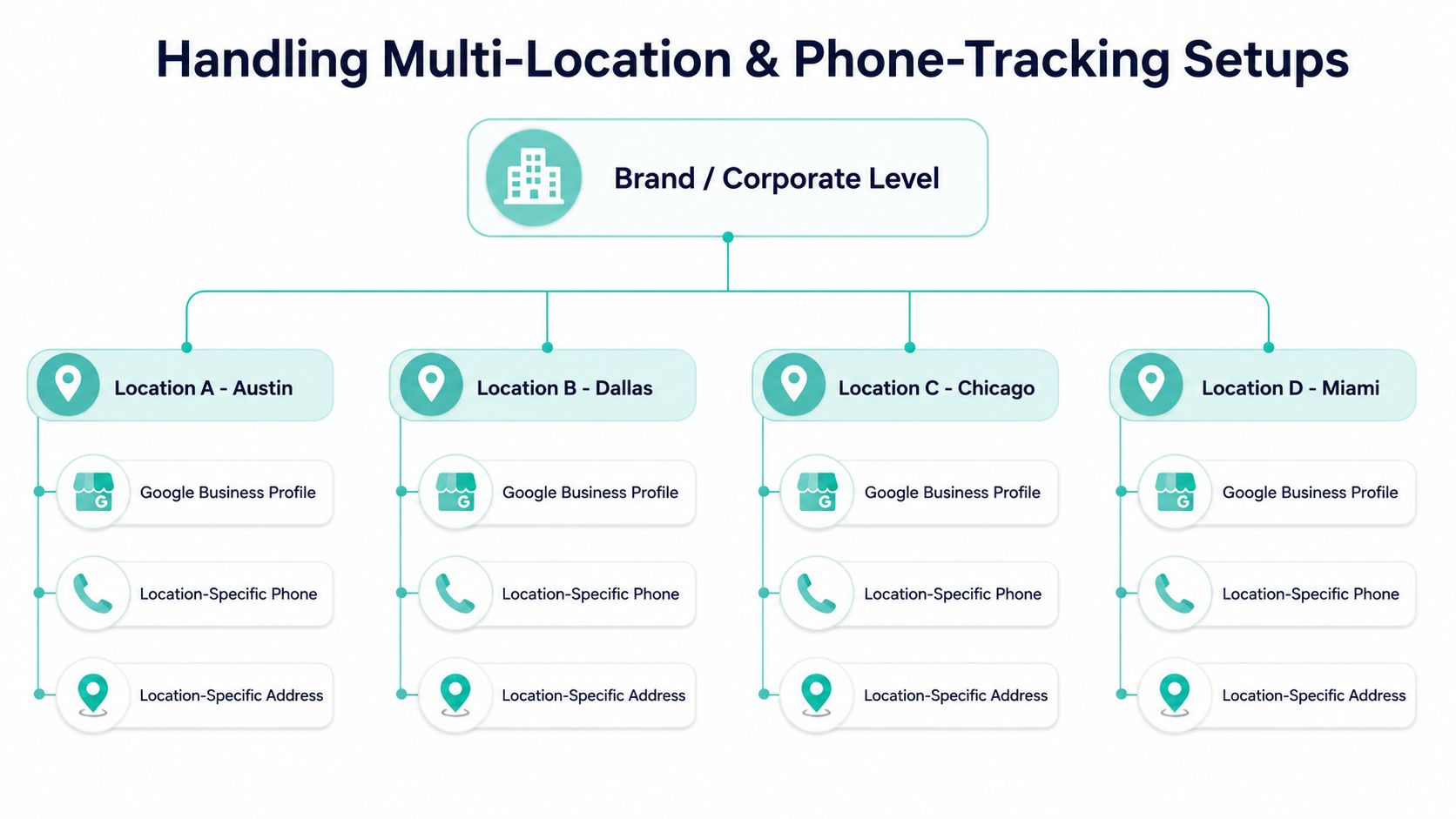
Multi-location businesses need tighter rules, not looser ones. Devstars advises that each physical location should have its own Google Business Profile and a location-specific phone number that rings directly to that branch, while the name format stays identical across listings (Devstars). That's the cleanest way to avoid cross-routed calls and mixed location signals.
Separate branch records from brand rules
The brand can stay consistent while each branch gets its own local details. A parent company might keep one official naming convention, but every office needs the correct branch address, local phone number, and matching profile data. That's especially important for service businesses that cover several counties or metro areas, where a caller needs the nearest team, not a generic corporate line.
If you're choosing a phone line for a new location, choose a business phone line that can route cleanly to the right branch and won't force you into a future cleanup because it was never meant to be the public listing number.
Use tracking without breaking permanence
Dynamic Number Insertion, or DNI, is safe on your own website because it changes the visible number for users without changing the permanent data search engines rely on. The permanent listings, schema markup, and directories should still carry the canonical phone number. Call tracking belongs in the website experience, not in every citation field that a directory copies downstream.
For businesses with virtual offices, the decision is simpler than it feels. If customers don't visit the location, don't try to make that address do work it can't do. Use the setup that matches how the business operates, then keep the public record aligned with that reality.
Match the setup to the business model
A staffed service area without a customer-facing office should not be treated like a storefront. A service-area business on Google needs accurate service boundaries and a listing model that reflects how the business serves customers, not a fake front desk identity. The same principle applies to any branch that exists to receive work rather than walk-ins.
The basic decision rule is this. If the location receives customers, it gets its own physical record. If it doesn't, don't force a storefront-style citation pattern onto it. The more honest the structure, the less cleanup you'll need later.
Maintaining Consistency After Changes
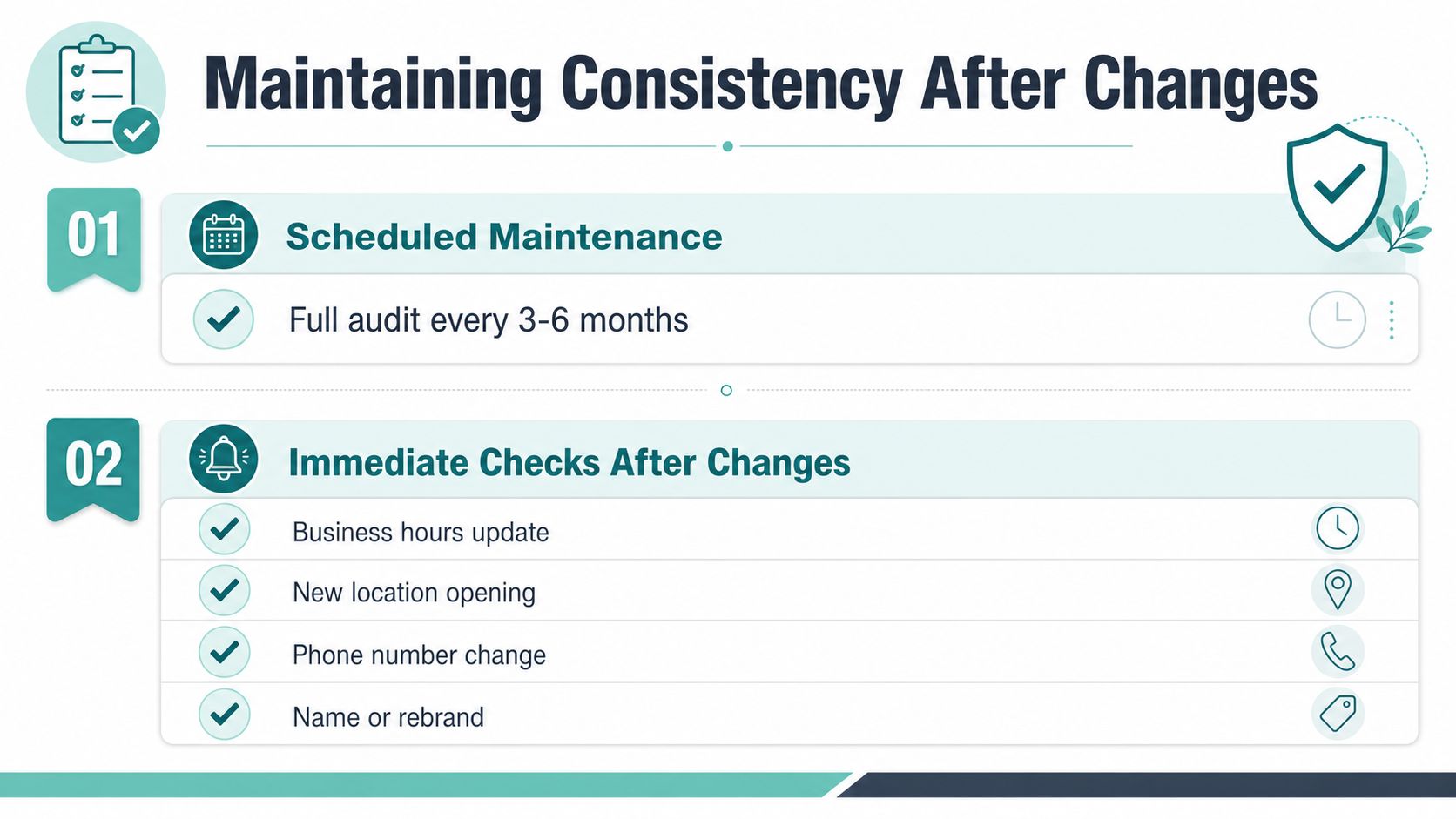
NAP work doesn't end when the spreadsheet is empty. Businesses relocate, add a second line, rebrand, merge, acquire another company, or open a new location, and each of those changes can reopen the citation problem. A good maintenance rhythm is a full audit every three to six months, plus an immediate check after any move, phone-system swap, rebrand, acquisition, or location opening (Nadja Eberhardt).
Verify the update actually landed
After a change, check Google Business Profile, Apple Maps, Bing Places, and the major aggregators first. If the new information hasn't surfaced there, the slower directories probably won't be reliable yet either. The point isn't to chase every listing the same day, it's to confirm the core ecosystem has absorbed the update before you assume the job is done.
The maintenance task can be tracked in a project tool with a short checklist:
- Scheduled audit: review all core listings every three to six months.
- Immediate trigger: update after a move, rebrand, number change, acquisition, or new branch.
- Core verification: confirm Google, Apple Maps, Bing Places, and the aggregators.
- Downstream review: revisit the highest-value directories and any old duplicates.
- Record keeping: log what changed, when it changed, and where it was corrected.
Treat changes as reset points
The most common failure isn't the first cleanup, it's the second change that arrives before the first one has fully propagated. That's where old data persists, duplicates come back, and call-routing errors sneak in again. If you changed the address, that's the moment to update your website's contact page and footer as well, not three months later when the old location starts showing up in search again. For that kind of location change, the walkthrough on changing an address in Google is worth keeping handy.
The operational win here is simple. Quarterly audits plus immediate post-change checks lower the odds of misrouted calls and keep map-pack visibility from drifting because the business identity is no longer split across the web.
Tying NAP Consistency to Leads and Knowing When to Get Help
Clean citations support trust, and trust supports the calls and form fills a service business wants. A law firm, dentist, roofer, or HVAC contractor can't cash in on local visibility if customers reach the wrong number or land on an outdated address. That's why NAP discipline sits underneath map-pack performance instead of sitting beside it as a clerical task.
When the listing footprint gets large, manual cleanup stops being efficient. Dozens of locations, hundreds of citations, and constant operational changes are a sign that spreadsheets alone aren't the right tool anymore. At that point, citation-management software or a local SEO agency becomes the practical way to keep the record stable.
For service businesses with intake-heavy models, that connection is direct. If your team depends on incoming calls, even a small mismatch can push a real lead toward a competitor with cleaner data. That's the same reason CPA answering service features matter in related service categories, the front line only works when the contact data behind it is accurate.
If you need a local SEO reset for a trade, law, or multi-location business, Digital Skyrocket builds and maintains service-business websites and local SEO systems that include citation cleanup, ongoing tracking, and the contact-data discipline this work depends on. If your NAP records are messy and your calls are leaking, visit Digital Skyrocket and get a plan for cleaning up the listings that are costing you leads.