
You've finished a repaint that looks better than the client expected. The lines are clean, the prep work was thorough, and the homeowner says they'll recommend you. A week later, though, your phone is quiet while another contractor keeps appearing in Google's map results and booking estimates.
That gap usually isn't about workmanship. It's about being visible when a nearby customer is ready to hire. SEO for painting contractors works best as a lead-generation system, not a traffic project. Every ranking decision should connect to a practical outcome, such as a phone call, estimate request, or booked consultation.
Table of Contents
- Why Your Best Work Stays Invisible Without Local SEO
- Finding Keywords That Attract Ready-to-Hire Customers
- Mastering Your Google Business Profile for Top Rankings
- Developing a 5-Star Review Generation System
- Structuring Your Website to Convert Visitors into Leads
- Building Local Authority with Citations and Backlinks
Why Your Best Work Stays Invisible Without Local SEO
A homeowner can search for a painter, compare three listings, and request an estimate before ever asking a neighbor for a recommendation. If your company does not appear in that moment, strong workmanship and past referrals may never enter the decision.
Local search is the central battleground for painting contractors. Industry-compiled data reports that 46% of all Google searches have local intent, with about 3.9 billion local searches each day, and the Google Map Pack appearing in a majority of local searches. For painting-specific searches, the top three Map Pack positions are reported to receive 44% of local-search clicks. The same source cites organic click-through rates of 24.4% for Position 1, 13.3% for Position 2, and 8.6% for Position 3. Local SEO statistics for contractors provides context for those figures.

The practical implication is straightforward. Ranking for the broad term “painter” matters less than appearing for the service, location, and buying situation you can serve. A credible Google Business Profile, focused service pages, location relevance, recent reviews, and visible phone and estimate-request options turn visibility into opportunities.
Visibility creates a shorter path to the phone
Search demand shows why this channel deserves dedicated attention. “House Painters Near Me” averages 135,000 monthly U.S. searches, while “Home Painters Near Me” averages the same amount. “Painting Contractors” and “Painting Company” each average 60,500 monthly U.S. searches, and “Painting Contractors Near Me” averages 49,500 monthly searches, according to painting local search data.
Those searches often come from people comparing providers, reviewing project photos, or trying to request an estimate. Your listing and landing page must answer two questions quickly: Can you do this job, and can the customer trust you to show up? Put the service area, relevant project type, proof of quality, and next action where a visitor can find them without digging.
A Florida real estate SEO guide offers useful perspective on building location relevance for service-area businesses. Apply the same discipline to painting pages by naming the communities you serve and matching each page to a real service, rather than claiming coverage across an undefined region.
Finding Keywords That Attract Ready-to-Hire Customers
A homeowner searches “exterior house painting in Plano,” sees several contractors, and contacts the one that answers the practical questions first. That search is worth more than a broad visit from someone browsing paint colors. Keyword research for painters should start with the job a customer wants completed and the likelihood that the search will produce a booking.
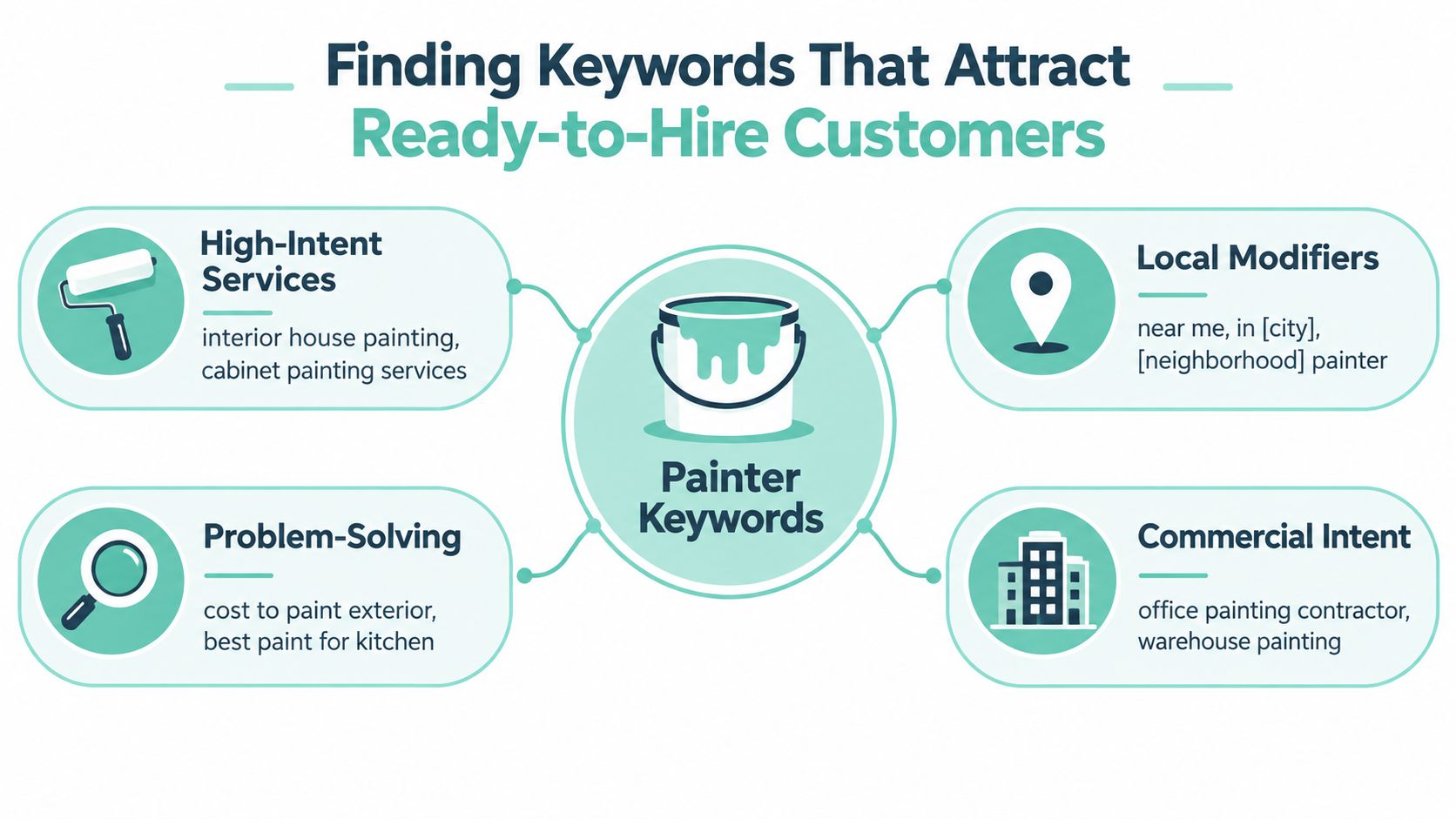
Separate research traffic from booking traffic. “Paint color ideas” may introduce your company to a future customer. “Local cabinet painter” signals a current project. Build the keyword list around that difference, then connect every target term to a page, proof point, and conversion action.
Start with service terms
List every profitable service you want to sell. Do not stop at “house painting.” Divide the work into focused pages and search themes:
- Interior services: interior house painting, room painting, ceiling painting, trim painting.
- Exterior services: exterior house painting, siding painting, brick painting, fence painting.
- Specialty services: cabinet painting, cabinet refinishing, deck staining, drywall repair and painting.
- Commercial services: office painting contractor, retail painting, warehouse painting, apartment turnover painting.
Each phrase implies a different landing page and sales conversation. Cabinet customers need details about preparation, finish durability, hardware removal, and downtime. Commercial buyers may prioritize scheduling, site coordination, insurance, and work in occupied spaces. Put those answers on the relevant page instead of forcing every visitor through one generic painting page.
Add location modifiers carefully
Combine each core service with the cities, suburbs, neighborhoods, and service-area phrases you cover. Useful patterns include “[service] in [city],” “[city] [service] contractor,” “near me,” and “[neighborhood] painter.”
A city page needs local evidence, not a replaced city name. Mention the types of homes your crew paints, nearby communities you serve, and project examples from that market. Include an estimate form or phone option near the service explanation so the page can generate work, not just impressions.
Do not publish dozens of near-identical pages by swapping location names. Thin pages create little trust for visitors and give search engines limited evidence that each page deserves visibility. A smaller set of distinct pages, each tied to a real service area and customer need, usually creates a stronger foundation. This local SEO keyword research resource can help organize service, location, and question-based terms into a usable content plan.
Capture questions that precede a quote
Question keywords work when they support a service page or address a concern that prevents contact. Group them by the decision a customer is trying to make:
- Cost: cost to paint a house, exterior painting cost in [city], cabinet painting cost.
- Timing: how long exterior painting takes, how long cabinets need to cure.
- Preparation: whether walls need repair, how painters protect furniture, what homeowners must move.
- Selection: best paint for kitchens, paint finishes for bathrooms, exterior paint for specific surfaces.
The research cited earlier indicates that near-me searches often lead to a local business visit within a short period. That makes service-plus-place phrases valuable for lead generation, especially when the page provides a clear next step. Use question content to remove hesitation, then direct readers to an estimate request rather than leaving them at an informational dead end.
Put the final list in a spreadsheet with columns for service, location, intent, target page, and conversion goal. Assign a page only when a keyword represents a real customer need and the business can provide a useful answer.
Mastering Your Google Business Profile for Top Rankings
A homeowner searching “house painter near me” may compare several listings before contacting anyone. Your Google Business Profile has to answer the first sales questions quickly: what you paint, where you work, whether your results look professional, and how to request an estimate. Analysts attribute about 32% of local-pack ranking weight to Google Business Profile signals, ahead of on-page, review, link, behavioral, citation, and personalization signals, as summarized by Google Business Profile statistics.
That priority affects where you spend time. Complete the profile before chasing obscure directories or publishing articles that do not lead customers toward a quote. For the full setup process, use this Google Business Profile optimization guide.
Complete the profile with commercial intent
Set up the listing around the services that produce booked work.
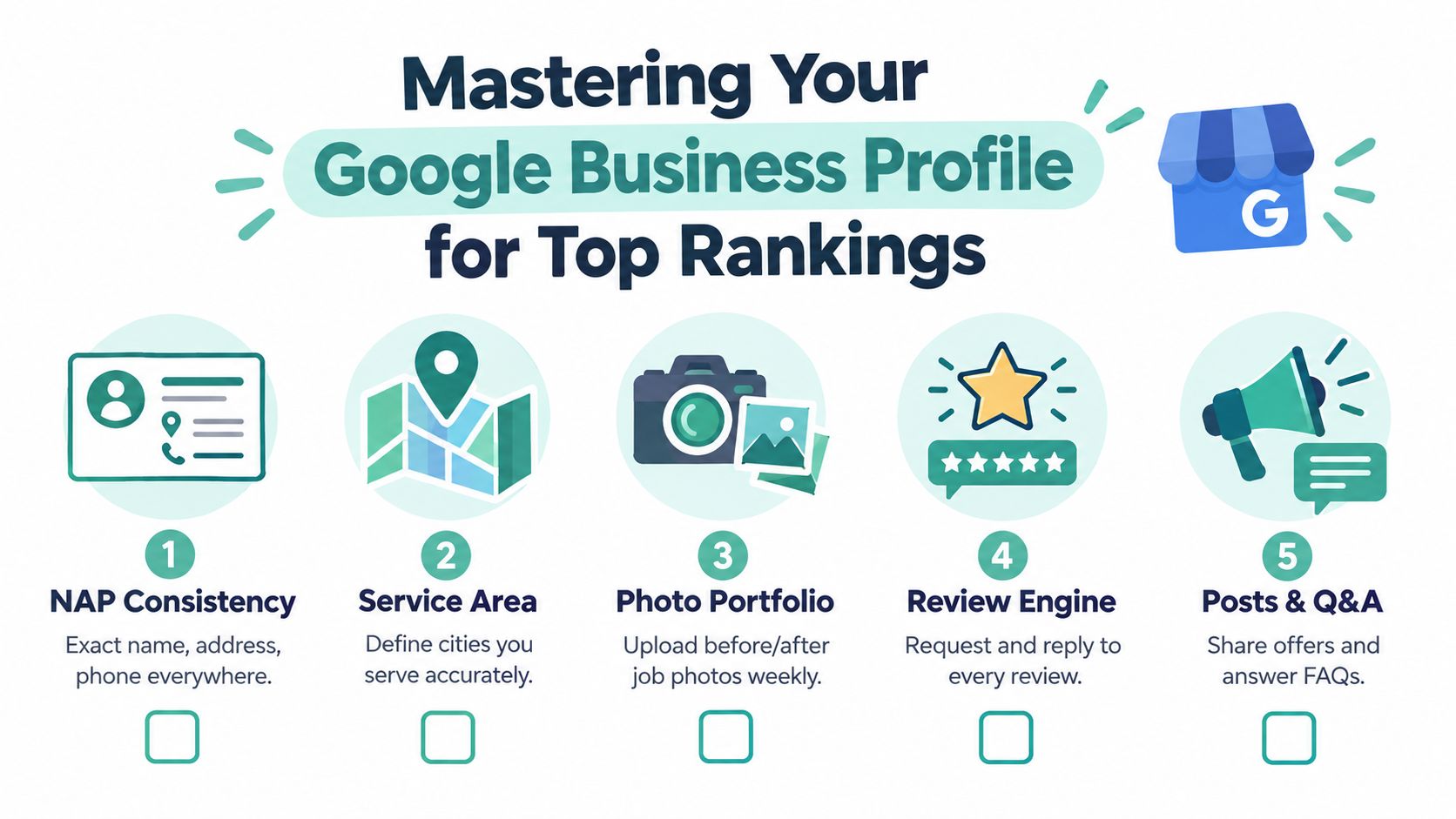
- Choose the most accurate primary category. Select the category that best describes your main painting service. Add secondary categories only for services your company provides.
- Define service areas accurately. List the cities and communities your crews serve. Claiming distant locations can create poor customer experiences and weaken Google's understanding of your relevance.
- Write a specific business description. State the painting services you perform, the customers you serve, and the areas you cover. Keep keywords natural and avoid unsupported promises.
- Add complete service entries. Describe interior painting, exterior painting, cabinets, decks, commercial projects, and other offered services. Where the profile allows it, link each service to the matching website page.
- Keep contact details consistent. Your business name, address, and phone number should match the website and important business listings.
Google says local results are mainly based on relevance, distance, and prominence. Relevance measures how closely the profile matches the search. Distance reflects proximity to the searcher. Prominence reflects how well-known the business is, with reviews and website links contributing to it. Read Google's explanation of local rankings when deciding which profile improvements deserve priority.
Turn the profile into a visual portfolio
Painting customers want proof before requesting an estimate. Upload completed rooms, exterior transformations, cabinet finishes, detail work, crews preparing a space, and the protections used around floors and furniture. These images can reduce uncertainty that would otherwise stop a lead.
Use descriptive file names, choose well-lit photos, and remove blurry, repetitive, or unrelated images. A homeowner should understand your standard of work after a short scan.
Use posts to feature completed projects, seasonal availability, preparation advice, or the estimate process. Add Q&A responses for recurring objections, such as painting occupied homes or preparing a room. Write for customers, not as a place to repeat keywords.
Practical rule: Every profile update should improve relevance, reduce uncertainty, or make the next contact step easier.
Developing a 5-Star Review Generation System
Reviews don't appear reliably because a contractor hopes satisfied customers will leave them. They appear when the company builds a simple request into the job-completion process.
Ask at the moment the customer has experienced the finished work and confirmed that the space is complete. A short text or email containing the direct Google review link removes the friction of finding your profile. Your team can send it after the final walkthrough, provided the request is neutral and follows platform policies.
Create a repeatable request sequence
A practical process looks like this:
- Confirm completion: Make sure the customer knows the project is finished and any final questions have been addressed.
- Ask personally: The project manager or office contact should make the request in a natural message.
- Use one direct link: Send the customer straight to the review form instead of asking them to search for the business.
- Follow up once: If there's no response, send a polite reminder rather than repeated requests.
- Record the outcome: Track who received a request so your team can maintain a consistent process.
Never offer rewards for positive reviews or pressure customers to use particular wording. You want feedback that describes the actual experience, including communication, preparation, cleanliness, punctuality, and the finished result.
Respond to every review
A response serves two audiences. It reassures the reviewer that you pay attention, and it gives future customers another sign that your business remains engaged after payment. Thank positive reviewers specifically, mentioning the service when appropriate without copying the same response each time.
Negative reviews require restraint. Acknowledge the concern, avoid arguing about details in public, and invite the customer to continue the conversation privately. If the complaint identifies a real process failure, fix the process instead of treating the response as reputation theater.
Review volume has a measurable relationship with local ranking performance. In an analysis of 16,098 profiles, top-three outcomes rose from 39.3% at 1 to 5 reviews to 73.0% at 201 to 500 reviews, while photo count continued improving without an observed ceiling at 500 or more images, according to Localo's analysis of local SEO ranking factors. Those findings support a steady collection system, not a one-time campaign.
Display selected reviews on relevant service pages, but don't treat testimonials as a substitute for fixing weak pages or slow responses. Social proof helps conversion after visibility brings the visitor in.
Structuring Your Website to Convert Visitors into Leads
A painting website can rank and still fail commercially. If a visitor lands on a generic services page, can't find relevant project photos, and has to search for a phone number, the SEO work has created an opportunity without completing the sale.
The site should mirror how customers buy. Someone searching for cabinet painting needs a cabinet page. Someone searching for exterior painting in a specific city needs a page that confirms local availability and explains the work in that environment.
Build pages around decisions
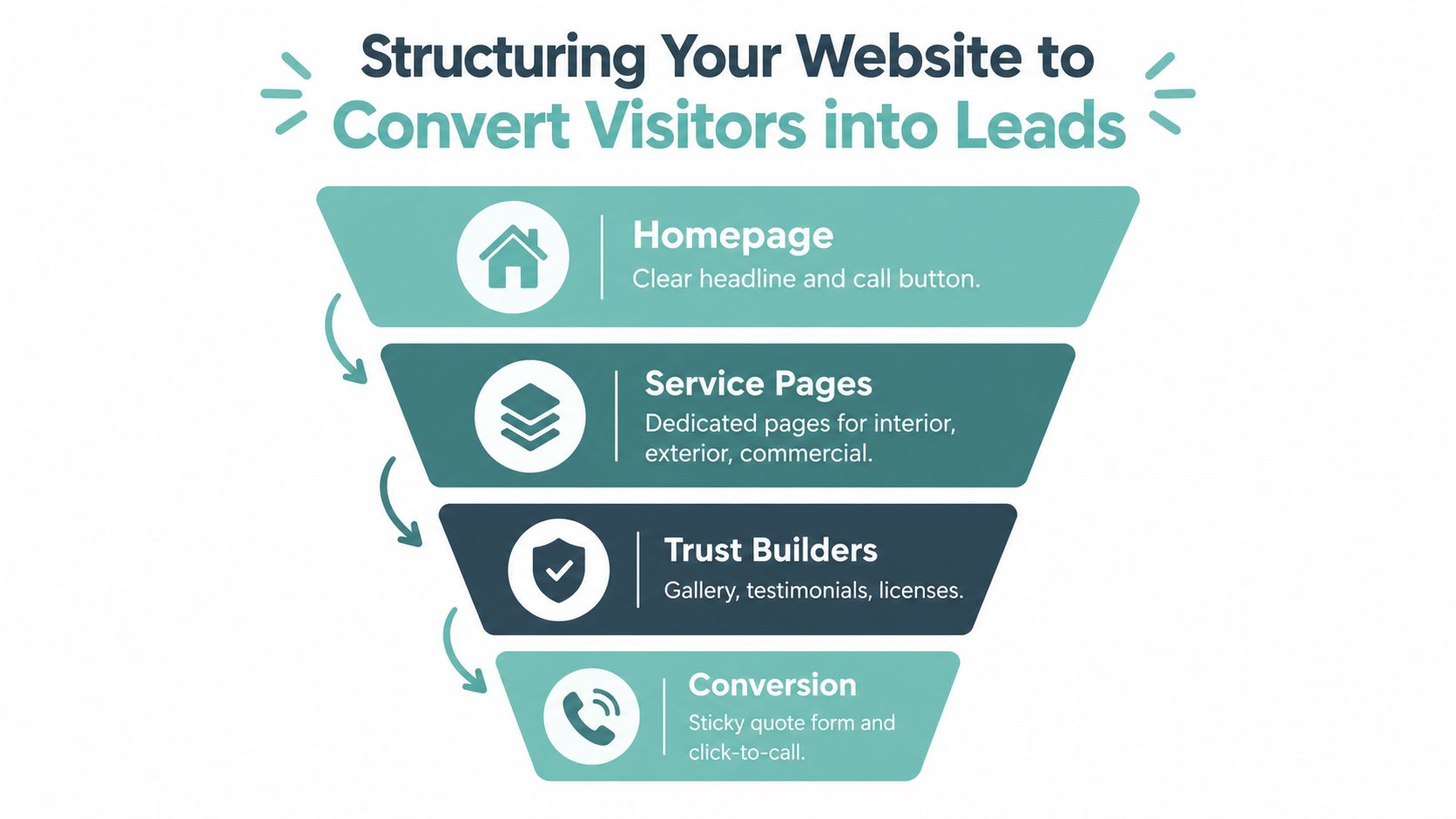
Your homepage should establish the service area, core offer, credibility signals, and primary call to action quickly. It doesn't need to explain every painting process. Its job is to direct visitors to the service or location that matches their need.
Service pages should answer the questions that influence a quote request:
- What surfaces and spaces do you paint?
- How do you prepare and protect the property?
- What finishes or materials do you work with?
- What does the process look like?
- What factors affect cost and timing?
- What should the customer do next?
Include project photos, relevant reviews, qualifications, service-area details, and a visible Request a Free Estimate button. A phone number should remain easy to tap on mobile, especially near the top of the page and after major sections.
Make location pages genuinely useful
A location page should do more than repeat the same service copy with a different city name. Mention the actual neighborhoods or communities served, describe common property types when relevant, and connect readers to the specific services available there. Add local project examples or testimonials only when they're real and permission has been handled appropriately.
The seasonal and project-specific opportunity is significant. Coverage of painting contractor search behavior notes that exterior demand spikes in spring and early summer, while interior demand is steadier but can dip during peak summer. That creates room for pages such as “exterior painting cost in [city],” “cabinet painting services,” and project-specific preparation guides, as discussed in painting contractor SEO coverage.
A dedicated lead-generation website design resource provides further guidance on connecting page structure with forms, calls, and conversion paths.
Remove conversion friction
Use a short estimate form that asks only for information needed to start the conversation, such as name, contact details, service type, location, and a brief project description. Let visitors call without filling out a form.
Test the site on a phone. Confirm that buttons work, forms submit properly, images load quickly, and the visitor can understand your service area without zooming or hunting through menus. Google's mobile guidance is reinforced by local SEO summaries that cite a target mobile load time under 3 seconds, while those summaries note that contractor sites often load in 5 to 8 seconds and stronger performers run around 1.5 to 2.5 seconds. Mobile local SEO guidance supports treating speed as both an SEO and conversion requirement.
Building Local Authority with Citations and Backlinks
Citations are online mentions of your business name, address, and phone number. For a painting contractor, the practical priority is consistency. If your phone number, address format, or business name differs across Google, Yelp, Angi, the Better Business Bureau, and local directories, customers may hesitate and search engines may have a harder time connecting the records.
Start with a spreadsheet containing the exact version of your business information. Claim the listings that matter, correct outdated details, remove duplicates where possible, and keep service descriptions aligned with your actual operations.
Google's local ranking guidance connects prominence with signals such as reviews and links from other websites. BrightLocal's summary assigns local-pack weight across multiple categories, including 32% for Google Business Profile signals, 19% for on-page signals, 16% for review signals, 15% for link signals, 8% for behavioral signals, and 7% for citation signals. BrightLocal's local ranking-factor summary shows why citations matter, while also illustrating why they shouldn't replace profile, review, and website work.
Earn links through local relationships
The strongest link opportunities often come from relationships you already have or can build locally:
- Suppliers: Ask paint stores, hardware partners, or manufacturers whether they maintain contractor directories or project pages.
- Real estate professionals: Offer useful repainting guidance for listings, rentals, or move-in preparation, then seek a relevant business mention where appropriate.
- Community organizations: Support a legitimate neighborhood project, nonprofit improvement, or local event and document your contribution professionally.
- Property partners: Build relationships with property managers, remodelers, flooring companies, and designers whose customers may need painting services.
- Local publications: Pitch practical content about preparing homes for sale, maintaining exteriors, or choosing finishes for local property types.
Don't buy random links or publish low-quality guest posts solely to place an anchor text. A relevant local mention can send referral traffic and reinforce credibility. An unrelated link rarely helps your lead-generation system.
Audit authority monthly alongside your leads. Measure calls, estimate forms, map visibility, and service-page inquiries, not just rankings. A keyword position has value only when it helps a qualified customer choose your company.
Digital Skyrocket builds lead-generating websites and provides local SEO, answer engine optimization, reputation management, and conversion optimization for service businesses, including contractors. If your painting company needs a website and ongoing SEO system designed to turn local searches into calls and estimate requests, visit Digital Skyrocket to start a fit conversation.