

A managing partner pulls the marketing lead aside after another quiet week. The firm has published blog posts for months, the website looks polished, and the reporting deck highlights rising impressions. Yet the intake team isn't handling more qualified consultations. The problem often isn't a lack of content. It's a keyword map built around traffic instead of cases.
Keyword research for lawyers should answer a commercial question before it answers an SEO question: Can this firm take the matter, in this jurisdiction, at a value that justifies the investment, and does the page give the prospect a clear path to contact intake? That standard changes which terms you pursue, which pages you build, and which rankings you ignore.
Legal search behavior supports that focus. 76% of adult internet users in the United States seeking an attorney used online resources at some point, and Google was the most commonly cited online legal resource among people who searched online for a lawyer, according to the 2026 law firm SEO statistics summary. Search isn't merely an awareness channel. It influences how prospective clients compare firms, evaluate reviews, and make shortlists.
Table of Contents
- Why Most Law Firms Pick the Wrong Keywords
- Defining Your Practice Areas, Jurisdictions, and Case-Value Tiers
- Choosing Tools That Actually Surface Lawyer Searches
- Mapping Search Intent to the Right Page Type
- Building Topic Clusters Around Pillars and Supporting Pages
- Researching Question and Answer-Engine Keywords
- Prioritizing Keywords by Case Value, Difficulty, and Intent
Why Most Law Firms Pick the Wrong Keywords
The marketing lead usually brings a familiar explanation to the partner's office: the firm needs more content, more backlinks, or a larger keyword list. After reviewing the site, the issue is often easier to find. The firm has spent months publishing articles for broad questions that attract readers the intake team can't serve, while its highest-value services have thin or nonexistent location pages.
Three choices create most of the waste.
First, firms chase head terms such as “lawyer” or “personal injury attorney” because the tools display attractive demand. Legal directories and established publishers often dominate those results, and a small or mid-sized firm may spend months trying to displace sites with far broader authority. A head term can be useful as a category, but it isn't automatically a useful target.
Second, firms treat local intent as a modifier added at the end. They build one generic service page, insert a city name, and expect it to serve every nearby market. That approach ignores how clients search across counties, suburbs, neighborhoods, and adjacent metros. Google says local results primarily reflect relevance, distance, and prominence, with relevance tied to how well a Business Profile matches the query and prominence influenced by signals such as links and reviews, as explained in Google's local ranking guidance.
Third, firms publish informational content without an intake path. An article answering a legal definition may be accurate and useful, but it won't necessarily produce a retained matter. The page needs a next step that fits the reader's situation, whether that's a relevant service page, a jurisdiction-specific guide, or a consultation request.
Practical rule: A keyword earns priority when the firm can serve the searcher, win visibility, and convert the resulting visit into a qualified intake.
A durable map connects every term to a real practice area, jurisdiction, case-value tier, intent, and page type. The workflow below replaces vanity traffic with decisions the partners and intake team can act on.
Defining Your Practice Areas, Jurisdictions, and Case-Value Tiers
Don't open Ahrefs or Semrush first. Start with the firm's actual business.
Ask each practice group to identify the matters it actively accepts, the matters it refers out, and the matters it accepts only under specific conditions. A plaintiff firm might want severe injury and commercial vehicle cases while declining minor property-damage claims. A family firm might prioritize contested custody and high-conflict divorce while treating simple uncontested filings as volume work. Those distinctions should shape the keyword map before search volume enters the discussion.
Next, layer geography over the practice inventory:
- State: Record every state where the attorneys are licensed and permitted to serve clients.
- County and court area: Identify jurisdictions where the firm regularly files, appears, or has meaningful local credibility.
- Metro and nearby markets: Add cities and neighborhoods the firm can realistically support without creating thin, duplicate pages.
- Intake coverage: Confirm that someone can answer calls, respond to forms, and qualify leads from each target location.
Case value is the variable most firms omit. Assign each practice-area and location combination to a tier. High-value work may include commercial litigation, severe injury, and complex estate disputes. Mid-value work may include DUI, divorce, and M&A. Lower-value volume work may include small claims and traffic matters.
| Practice Area | Target Jurisdictions | Case-Value Tier | Seed Keyword Examples |
|---|---|---|---|
| Severe injury | State, target counties, primary metro | High | severe injury lawyer, catastrophic injury attorney, truck accident lawyer |
| Family law | State, county, metro, selected nearby cities | Mid to high | divorce lawyer, contested divorce attorney, child custody lawyer |
| DUI defense | State, counties where the firm appears | Mid | DUI lawyer, first offense DUI attorney, DWI defense lawyer |
| Traffic defense | Local courts and nearby municipalities | Lower volume | traffic lawyer, speeding ticket attorney, traffic court lawyer |
| Commercial litigation | Statewide or selected business markets | High | commercial litigation lawyer, business dispute attorney, contract lawsuit lawyer |
Put these fields in a spreadsheet: practice area, accepted matter types, excluded matter types, state, county, city, intake eligibility, case-value tier, seed terms, likely page type, and responsible attorney. A partner and intake manager can complete the first version in an afternoon. The result won't be a finished keyword map, but it will prevent a tool from generating thousands of irrelevant phrases.
Choosing Tools That Actually Surface Lawyer Searches
Tools don't understand the firm's economics unless the team supplies that context. Their job is to reveal patterns, competitors, ranking conditions, and language. The team still has to decide whether a term is worth pursuing.
| Tool | Best For | Legal Search Strength | Key Blind Spot | Best-Fit Firm |
|---|---|---|---|---|
| Ahrefs | Competitor discovery and backlink review | Shows ranking pages, related terms, and link profiles | Estimates can miss local-intent nuance | Firms building a competitive research process |
| Semrush | Broad keyword and technical research | Combines keyword discovery, SERP features, and site audits | Large datasets can encourage unfocused targeting | Mid-sized firms with an active SEO team |
| STAT | SERP monitoring | Useful for tracking specific legal and local result sets | More infrastructure than a solo firm usually needs | Larger firms or agencies monitoring many markets |
| Google Keyword Planner | Seed expansion | Provides Google-based keyword ideas and commercial context | Doesn't replace manual intent or SERP analysis | Solos and small firms starting with a lean stack |
| AnswerThePublic | Question discovery | Surfaces natural-language questions around a seed | Doesn't prove that a question has an intake path | Firms developing educational clusters |
| FindLaw Insights | Legal-market benchmarking | Adds legal-industry context to keyword and competitor review | May be less flexible than general SEO suites | Firms already using FindLaw's ecosystem |
| LawRank competitive dashboards | Legal competitor comparisons | Frames visibility around law-firm competitors | Dashboard data still needs human SERP validation | Firms seeking legal-specific reporting |
A solo firm often gets more value from Google autocomplete, People Also Ask, Google Search Console, a spreadsheet, and a single paid tool than from an enterprise subscription. A mid-sized firm tracking several states may justify Ahrefs, Semrush, or STAT because competitor movement and page-level data become harder to manage manually. Specialized platforms can add context, but they shouldn't replace direct review of the results page.
Use a repeatable starter workflow:
- Expand seeds: Search the firm's services in Google and record autocomplete suggestions.
- Mine questions: Capture People Also Ask variations and recurring client language.
- Check commercial data: Use Google Keyword Planner or a paid suite to compare relative demand, CPC, ranking pages, and related terms.
- Review the SERP: Manually inspect the top twenty results for directories, local packs, service pages, guides, videos, and AI-generated summaries.
- Attach an intake path: Mark whether each term belongs to a service page, local page, guide, comparison page, or FAQ.
- Validate the business fit: Remove terms tied to matters the firm doesn't accept or locations it can't serve.
- Record the decision: Keep the chosen term, rejected term, rationale, owner, and next review date in the map.
For a practical local mapping reference, see Digital Skyrocket's guide to keyword research for local SEO. The exact tool matters less than whether the process surfaces these seven data points: query language, intent, location, ranking difficulty, current position, competing page type, and intake potential.
Mapping Search Intent to the Right Page Type
A keyword doesn't tell you what to publish until you understand why the searcher typed it. Legal pages fail when a firm forces one URL to serve every stage of the decision.
| Intent Bucket | Example Query | Page Type | Conversion Expectation |
|---|---|---|---|
| Informational | what happens after a car accident, how does divorce mediation work | Long-form guide or process explainer | Indirect, through education and internal links |
| Navigational | Smith divorce lawyer, DUI attorney downtown | Firm location or practice-area page | Direct if the searcher already knows the firm or destination |
| Commercial investigation | best divorce lawyer for custody dispute, should I hire a DUI attorney | Comparison page, FAQ, or decision guide | Moderate, provided the page explains fit and next steps |
| Transactional | car accident lawyer near me, divorce attorney consultation | Conversion-focused service or local page | High, when the firm accepts the matter and location |
An informational query such as “what happens after a car accident” needs a guide that explains the sequence, evidence, deadlines, and decision points. It shouldn't open with a wall of sales copy. The guide can connect readers to a car accident service page once their situation becomes clearer.
A transactional query such as “car accident lawyer near me” requires a different experience. The page should make the service area, attorney qualifications, case fit, contact methods, and consultation process easy to verify. A general article may rank for related language, but it usually doesn't provide enough local or commercial clarity for intake.
Divorce searches illustrate the same distinction. “How long does an uncontested divorce take” belongs on a process guide or focused FAQ. “Divorce lawyer in [city]” belongs on a location-specific service page. “Best divorce lawyer for a high-conflict custody case” calls for a commercial page that explains the firm's relevant experience, approach, and limitations without making misleading promises.
Run this classification test before assigning a keyword:
- What question is the searcher trying to resolve?
- Does the result page favor guides, firms, directories, videos, or local listings?
- Is the searcher selecting information, comparing providers, or seeking contact now?
- Can the firm provide a relevant next step without forcing the visitor into a different journey?
The page type should follow the dominant SERP intent, not the firm's preferred publishing format.
Building Topic Clusters Around Pillars and Supporting Pages
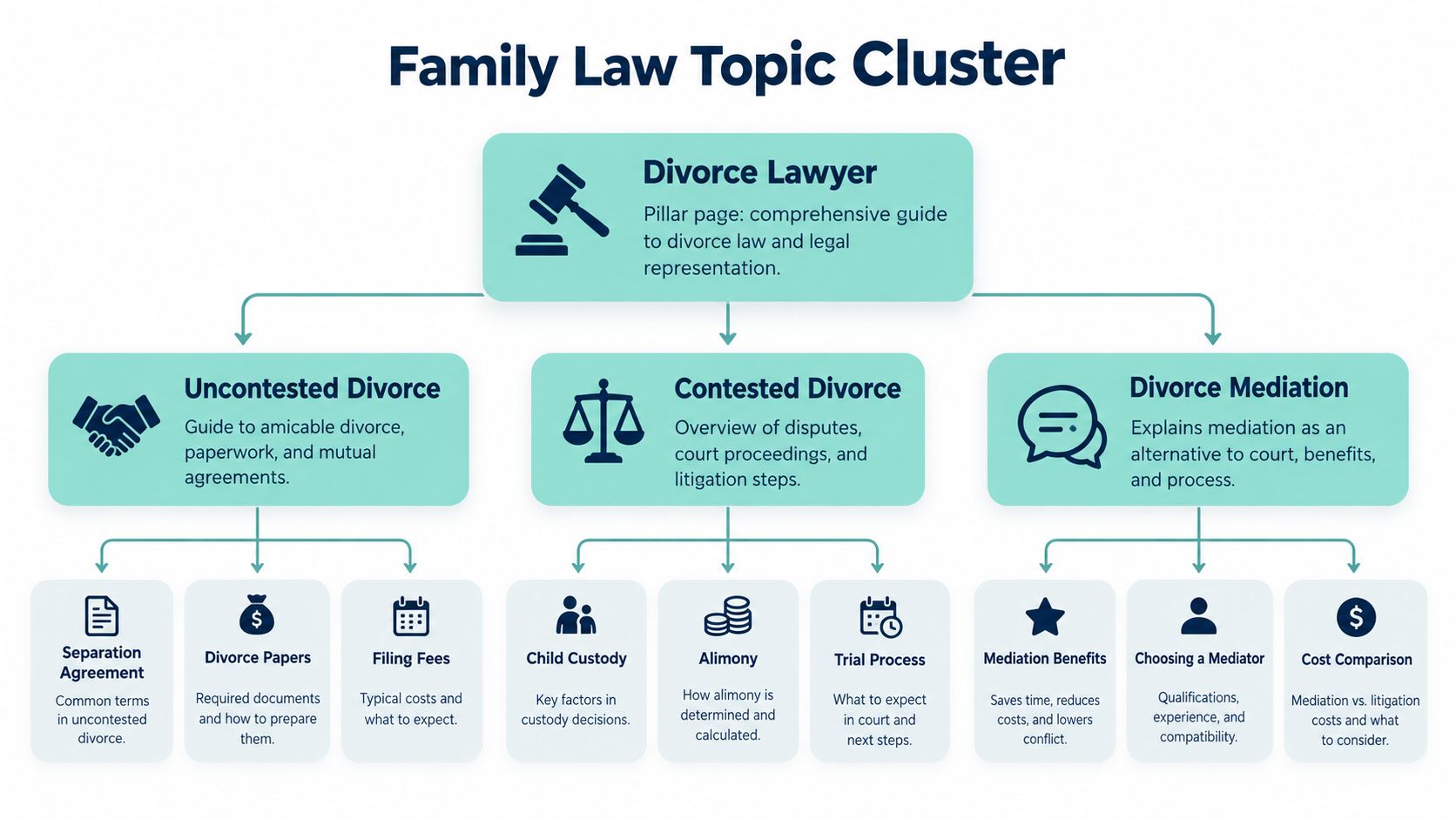
A family law cluster often begins with a broad seed such as “divorce lawyer.” That phrase can become the pillar page, but it shouldn't carry every related question. Supporting pages give distinct client problems their own space while allowing the pillar to explain the broader service and direct visitors to the right path.
Start with the pillar. It should cover divorce representation, the types of disputes the firm handles, jurisdictional scope, attorney fit, and consultation options. Then branch into pages that represent materially different needs:
- Uncontested divorce: Agreements, paperwork, filing steps, and common issues when spouses cooperate.
- Contested divorce: Disputes, court proceedings, discovery, negotiation, and trial preparation.
- Divorce mediation: The mediation process, appropriate circumstances, benefits, limitations, and selecting a mediator.
- Military divorce: A distinct jurisdictional and procedural topic when the firm actively handles those matters.
Validate each supporting topic in three places. Compare SERP overlap to see whether Google treats the phrase as part of the pillar or as a separate result set. Mine People Also Ask patterns for subtopics. Then compare the list with intake questions, because repeated questions from prospective clients often reveal the strongest content opportunities.
Internal linking rules
Every supporting page should link upward to the Divorce Lawyer pillar using descriptive anchor text that makes sense in context. It should also link to one or two sibling pages where the reader naturally needs another explanation, such as connecting uncontested divorce to separation agreements or contested divorce to child custody.
Don't use the same exact commercial anchor in every paragraph. Over-optimized links can make the site look engineered rather than useful. Vary anchors naturally while preserving clear meaning.
A complete cluster should pass this checklist:
- The pillar covers the broad service and links to each relevant support page.
- Each support page addresses a distinct intent or client problem.
- The pages reflect matters the firm accepts.
- Jurisdictional differences are handled accurately.
- Every support page links back to the pillar.
- Sibling links help the reader continue the research journey.
- No page exists solely to capture a minor variation of another page.
- Calls to action match the reader's stage.
For a structured method of finding missing topics and competitor weaknesses, use Digital Skyrocket's content gap analysis resource. The aim isn't to publish the largest cluster. It's to build the smallest complete cluster that supports qualified intake.
Researching Question and Answer-Engine Keywords
Question keywords deserve their own research layer because they serve a different search experience from conventional service terms. A firm may rank for “personal injury lawyer,” yet miss the questions that shape whether a visitor trusts the firm, understands urgency, or decides to call.
The shift matters in legal search. One industry analysis reported that about 78% of legal queries trigger Google AI Overviews, and traditional-result click-through was reported at 8% when summaries appeared versus 15% without them, according to the PR Newswire analysis of AI Overviews and legal search. These figures are specific to that analysis, but the strategic implication is broader: a page can lose click share even while remaining visible, so concise, well-structured answers and credible supporting context matter.
Build questions from real intake language
Start with sources the firm already owns:
- Intake calls: Have staff tag recurring questions, hesitation points, and phrases callers use verbatim.
- Support tickets and emails: Look for questions that appear after someone reads a service page or submits a form.
- Bar association FAQs: Use them to identify accepted terminology and jurisdictional issues, then verify the law before publishing.
- Competing People Also Ask boxes: Capture questions appearing around the firm's priority services.
- Reddit and Avvo threads: Treat these as language-mining sources, not legal authority. They reveal confusion and natural phrasing, but attorneys must validate every substantive answer.
Run those questions through Google autocomplete, People Also Ask, and answer-engine result pages. Group them by situation rather than by superficial wording. “What happens after a rear-end collision,” “when should I call an attorney after a crash,” and “what evidence helps a car accident claim” may belong to one accident-response cluster if the SERP and intake process support that grouping.
A question page should answer directly near the top, then add context, exceptions, jurisdictional qualifications, and a clear next step. Concise answers help search systems extract meaning, while attorney authorship, citations, update dates, and accurate service information support trust. FAQ schema can help search engines interpret question-and-answer content, but markup doesn't compensate for vague or duplicative writing.
Answer-engine principle: Write the short answer for extraction, then write the surrounding explanation for a person deciding what to do.
Turn competitor gaps into intake opportunities
Don't compare yourself with every firm in the map pack. Build a true competitor list:
- Identify the firms owning the top three practice-area keywords.
- Identify the firms owning the top three geo-modified terms.
- Add one or two legal-directory aggregators that absorb branded or generic clicks.
- For each rival, export its top fifty organic pages.
- Tag every page by informational, navigational, commercial, or transactional intent.
- Run a keyword gap that removes informational terms with no plausible intake route.
- Score the remaining gaps by rival domain authority, content depth, and backlink velocity.
The output should be a focused list of ten to twenty gaps, with a page type attached to each. That list is more useful than a large export filled with terms the firm can't win or can't monetize.
| Gap Keyword | Rival Domain Authority | Content Depth Score (1-5) | Backlink Velocity | Winnability (Low / Med / High) | Required Page Type |
|---|---|---|---|---|---|
| Question or service gap | Relative competitor measure | 1 to 5 | Relative movement | Low, Med, or High | Guide, local page, service page, FAQ |
| Location-specific issue | Relative competitor measure | 1 to 5 | Relative movement | Low, Med, or High | Local service page |
| Comparison question | Relative competitor measure | 1 to 5 | Relative movement | Low, Med, or High | Commercial guide |
| Urgent intake question | Relative competitor measure | 1 to 5 | Relative movement | Low, Med, or High | FAQ plus service link |
For a broader framework on optimizing content for answer engines, consult Digital Skyrocket's explanation of answer engine optimization. The priority isn't appearing in every generated answer. It's becoming a credible source for questions connected to matters the firm can accept.
Prioritizing Keywords by Case Value, Difficulty, and Intent
Search volume belongs in the analysis, but it shouldn't control the queue. A term with broad demand can be less valuable than a specific local query if the broad visitor is researching a definition, lives outside the firm's market, or needs a matter the firm refers elsewhere.
Use a four-factor scorecard for every keyword that survives the mapping process:
| Factor | Weight | Scale | Notes |
|---|---|---|---|
| Estimated case value | 40% | Low to high | Based on accepted matter type, likely fee structure, and strategic value |
| Intent strength | 30% | 1 to 4 | Informational at the low end, transactional at the high end |
| Winnability | 20% | Low to high | Calibrated to domain strength, SERP competition, content quality, and links |
| Current average position | 10% | Weak to strong | Rewards pages already near meaningful visibility and worth improving |
The 40% case-value weighting keeps revenue reality ahead of traffic volume. Intent receives 30%, because a qualified searcher matters more than a large audience with no route to consultation. Winnability receives 20%, which prevents the firm from assigning all resources to entrenched competitors. Current position receives 10%, helping identify pages where focused improvements may produce faster progress.
The scale can remain simple. For intent, assign informational queries the lowest score, navigational and broad commercial queries the middle range, and clear service-plus-location or consultation queries the highest score. For winnability, compare the actual top results, not a tool's difficulty number alone. A result set dominated by directories and thin pages may offer an opening, while a set of authoritative firms with deep location coverage may not.
Turn scores into a publishing queue
Run every approved keyword through the same sheet. The resulting shortlist should contain twenty to thirty targets per quarter, divided by role:
- Top tier: Pillar and core service pages tied to high-value matters.
- Middle tier: Supporting pages, local service combinations, and commercial comparison content.
- Lower tier: FAQs and answer-engine assets that strengthen the cluster and help prospects move toward intake.
Review the map as a living operating document. Re-score a keyword when a rival launches a relevant page or when the firm's position moves more than five spots in a month. Don't keep a target on the roadmap because it appeared in an original export.
Use a 30-60-90 rhythm
At thirty days, review priority-tier rankings, question-keyword impressions, pillar-page click-through rate, and qualified consultation requests attributed to organic search. The output should be a short list of pages needing technical, content, internal-link, or conversion work.
At sixty days, refresh the view with competitor launches, new ranking pages, intake language, and emerging questions. The team should produce an updated opportunity list, not just a recurring report.
At ninety days, re-pull search data, re-score intent and winnability, and repeat the competitor gap analysis. Quarterly, retire keywords that have stalled for two cycles and replace them with practice-area expansions, new jurisdictions, and question clusters drawn from real intake calls.
Local performance also depends on reputation signals. A 16,098-profile Google Business Profile study found review count was the strongest measured local ranking factor, with top-three visibility rising from 39.3% for profiles with 1 to 5 reviews to 73.0% for profiles with 201 to 500 reviews; the same study reported that photo performance continued improving at 500 or more images, with no practical ceiling observed for that signal, as detailed in the Localo local ranking factor study. Reviews must still comply with professional-responsibility rules. For example, New York State Bar Association Ethics Opinion 771 says testimonials and past results may be permissible when they don't create unjustified expectations or become false, deceptive, or misleading. Florida guidance also creates a technical requirement around disclaimer pages, stating that required disclaimer information must be structured so general search or site search can't reach the content without displaying the disclaimer page each time, according to Florida Bar website guidance.
Digital Skyrocket builds law-firm websites and ongoing SEO programs around case-value-driven keyword maps, local search visibility, answer engine optimization, and conversion paths rather than traffic alone. Visit Digital Skyrocket to discuss a fit meeting, review your current search and intake opportunities, and determine which practice-area and jurisdiction targets deserve investment.