
The most popular SEO advice, publish more content and chase more traffic, can send a service business in the wrong direction. A roofing company doesn't need a bigger audience for unrelated maintenance tips. It needs homeowners in its service area who understand the offer and book an inspection.
A long term SEO strategy should connect website improvements to qualified inquiries, not just rankings. Fewer clicks can even accompany better results when searchers get simple answers without visiting a website, then return through a branded search when they're ready to hire. The job is to distinguish that possibility from genuine loss of demand.
Table of Contents
- The 12-Month Roadmap, Owners and Hours
- How to Run a Discovery Baseline Before Any Changes
- Technical Foundations That Stay Healthy Over Time
- Content Built for Search Engines and AI Answers
- Local SEO and Reviews Across Your Service Area
- What to Measure Beyond Rankings and Traffic
- Confirm Your First 90 Days Before You Commit
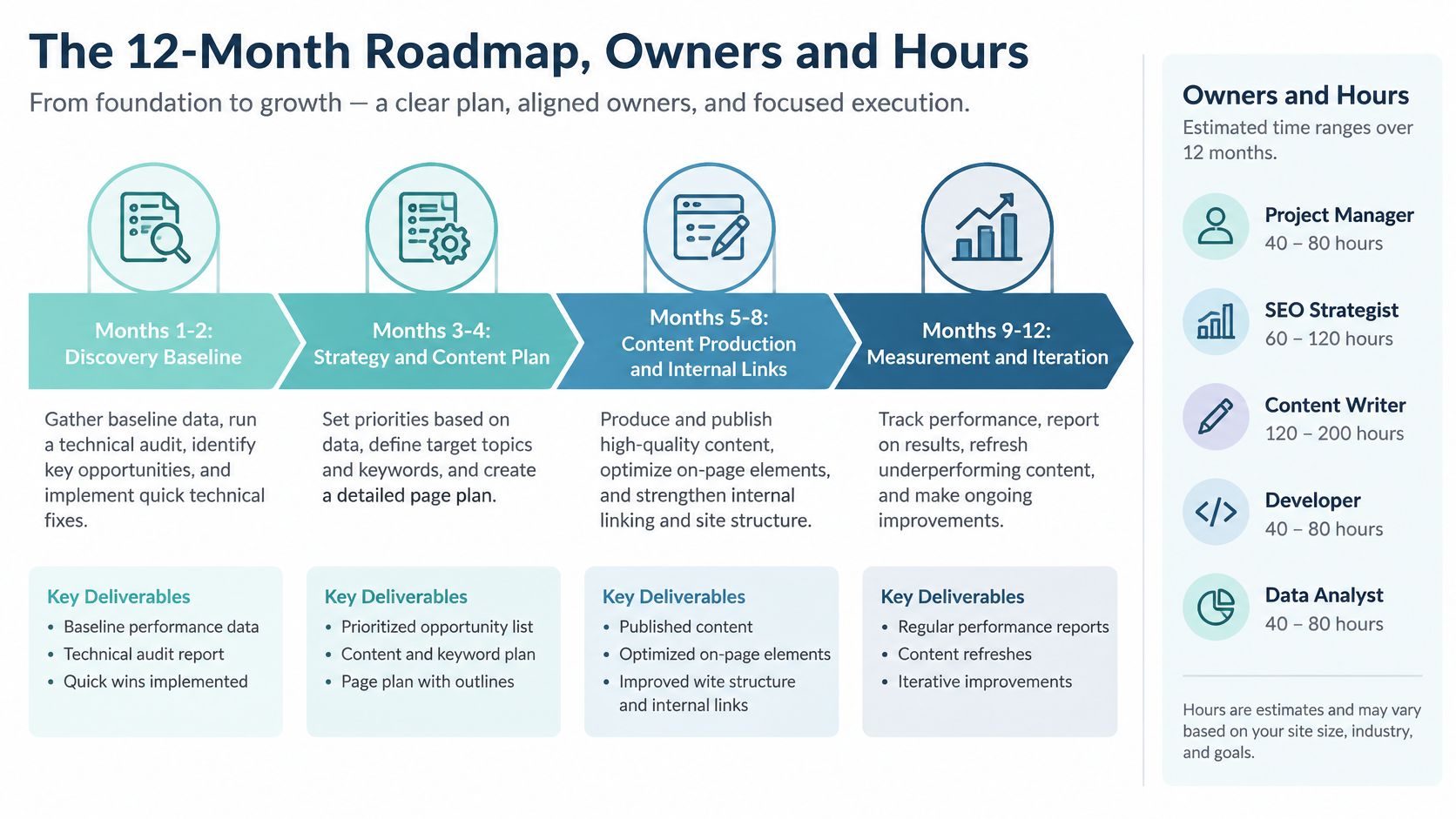
The 12-Month Roadmap, Owners and Hours
| Phase | Months | Main output | Likely owner | Hours per month |
|---|---|---|---|---|
| Baseline and fixes | Months 1-2 | Discovery report, technical fixes, Business Profile cleanup | Business owner with outside help | 6-10 |
| Core pages | Months 3-4 | Service and location pages with FAQs | Marketing lead | 8-12 |
| Expansion | Months 5-9 | Problem, comparison and local-intent pages, review system | Marketing lead | 4-6 |
| Maintenance | Months 10-12 onward | Refreshes, consolidated pages, quarterly reviews | Marketing lead | 3-5 |
Treat these hours as a starter staffing budget, not an industry benchmark or a full website-rebuild estimate. They assume a manageable service website, access to the accounts, and someone inside the business who can approve accurate content. Custom development, photography, extensive copywriting, or a migration needs a separate scope.
Give every phase an acceptance test
During the baseline phase, require a discovery report that names broken templates, tracking gaps, and indexing problems. An owner should be able to read it and understand what gets fixed first, who fixes it, and how completion will be checked.
For core pages, the deliverable isn't a keyword spreadsheet. It's a finished service page with an FAQ block, relevant proof, working contact options, and a defined place in the navigation. The marketing lead coordinates production; the business owner verifies service claims.
Expansion should produce supporting pages that address actual buying decisions. A comparison page should help someone choose between repair and replacement, while the review system should have a named operator and a repeatable request process.
Maintenance means making decisions, not sending a report without recommendations. Require a change log showing which pages were refreshed, which overlapping pages were consolidated, and why.
Budget rule: Reserve time for approvals and implementation. An agency can identify a problem, but an unattended approval queue can leave it unresolved.
For planning, leave room for a first meaningful shift in calls and forms around months four through six for a single-location business. Competitive metro terms may require a year or longer. These are working allowances, not measured averages or promises.
The staffing decision is straightforward: can your team protect these hours, or do you need to buy execution capacity?
How to Run a Discovery Baseline Before Any Changes
Record the starting position before changing URLs, rewriting pages, or replacing the website. Otherwise, you'll struggle to separate implementation effects from seasonal demand, existing brand recognition, or tracking errors.
Export Search Console history. Use twelve months of queries, pages, and countries where available, and separate branded from non-branded searches. This exposes seasonal patterns and prevents searches for your company name from being mistaken for new customer discovery.
Pull organic landing-page conversions. Export calls and form submissions from analytics and your call-tracking platform, then test those events yourself. A phone-button click isn't necessarily a connected call, and a form submission isn't necessarily a qualified prospect.
Record Business Profile activity. Save views, calls, direction requests, review count, and average rating. Keep these separate from website conversions so overlapping reports don't inflate your totals.
Inventory service and city pages. List each URL beside its intended query, current average position, monthly clicks, and conversion action. This makes competing pages and commercially important gaps visible.
Inspect priority URLs. Start with your top twenty pages in Search Console's URL Inspection tool and check for accidental noindex directives or conflicting canonicals. Prioritize service pages that should attract business over low-value archive pages.
Interview intake staff. Ask for ten questions prospects raise before booking and mark which pages already answer them. Intake conversations reveal objections that keyword tools won't explain.
Calculate qualified-lead rate. Divide qualified or booked organic inquiries by organic sessions, using consistent definitions and reporting periods. Record qualification criteria so next month's calculation measures the same thing.

Make the report usable
Consider a hypothetical five-person HVAC company that reports only rankings. Its baseline could reveal that half its organic calls come from branded searches, meaning its dashboard has confused existing recognition with new discovery. That's a reason to segment performance, not dismiss branded demand.
Use a website audit checklist to keep access, tracking, technical checks, and content inventory together. The final report should contain the baseline spreadsheet, a prioritized issue list, named owners, and a measurement plan.
Google's ranking systems guide explains that ranking systems primarily evaluate individual pages, while also using site-wide signals. Your report should therefore identify specific URLs and search intents, not merely assign the domain an overall score.
Technical Foundations That Stay Healthy Over Time
| Metric | Good threshold | Where to check | First fix if failing |
|---|---|---|---|
| Largest Contentful Paint | 2.5 seconds or less | Search Console Core Web Vitals report | Compress and resize hero images |
| Interaction to Next Paint | Under 200 milliseconds | Same report | Defer noncritical scripts, especially on forms and menus |
| Cumulative Layout Shift | Under 0.1 | Same report | Reserve space for images, embeds and form elements |
Use these working performance targets alongside Google's Core Web Vitals guidance, and assess real-user performance rather than relying only on a favorable laboratory test. A passing score isn't a ranking guarantee, but a slow or unstable inquiry experience is still worth fixing.
Start with the highest-traffic template. Say every service page loads the same oversized background image and third-party booking script. Correcting that shared template is a better use of development time than polishing an isolated blog post.
Compress and properly size images, remove unnecessary render-blocking JavaScript, defer nonessential scripts, and investigate slow server responses. Retest mobile menus and forms after deployment. A faster page that breaks appointment requests isn't an improvement.
Keep discovery and comprehension simple
Maintain an accurate XML sitemap containing the URLs you want indexed. Remove obsolete redirects and deleted pages from it, and check that important pages don't contradict their intended indexing status through canonical or noindex settings.
Put essential service information in crawlable text. Your service scope, coverage area, credentials, and contact details shouldn't exist only inside graphics or a slideshow. Google's getting-started documentation identifies text as the safest format for helping it understand page information and explains how structured data can supply additional clues.
Organization and local-business markup should match what visitors can see. Don't describe offices, services, or ratings in markup that the page doesn't support.
A sophisticated schema implementation won't compensate for an inaccessible service description or a broken contact form.
Assign ongoing technical ownership
Review technical health monthly and after substantial releases. Record the deployment date, affected templates, intended improvement, and test result so later changes in performance have context.
Keep a short operational checklist:
- Indexing: Investigate unexpected exclusions on commercial pages.
- Functionality: Submit test inquiries and confirm delivery to intake.
- Performance: Check template-level regressions before adding more scripts.
- Accuracy: Remove outdated service claims and broken navigation paths.
Technical maintenance isn't finished at launch. Someone needs authority to prevent a new plugin, tracking tag, or design change from undoing earlier work.
Content Built for Search Engines and AI Answers
Build a page a prospect can use to make a decision, rather than a page assembled around repeated keywords. Google's guidance for AI features says foundational SEO practices still apply, including crawlability, internal links, useful text, page experience, and structured data that matches visible content. There's no separate special AI schema requirement.
Consider a roofing page about hail damage versus age-related wear. Its opening should directly explain that visible roof deterioration can have different causes and that an on-site assessment is needed before making a coverage or repair judgment.
The rest should make the next decision easier:
- Scope: Explain what the inspection covers and what requires another professional.
- Evidence: Describe the documentation an adjuster may review without promising a claim outcome.
- Preparation: Tell homeowners to photograph accessible damage from the ground, not climb onto an unsafe roof.
- Costs and scheduling: Explain the factors that change the estimate and appointment timing.
- Next step: Offer an inspection request with clear expectations about what happens afterward.

Add evidence only your business can supply
Use original crew photos, applicable licensing details, named technicians, documented project timelines, and verifiable reviews. Have the practitioner responsible for the work check technical explanations before publication. Don't manufacture precision about prices or completion times just to make the copy sound authoritative.
I'd start with three to five real customer questions per page, selected from intake notes. Use a content gap analysis to identify unanswered buying questions, not topics competitors have published.
Build pathways instead of duplicate pages
Map each distinct service-and-area intent to a primary URL. Link core service pages to relevant problem, comparison, and local pages, then provide a useful route back to the commercial service.
A town-name swap isn't local differentiation. If neighboring areas have the same service conditions and no meaningful distinction, a strong regional page may be more useful than separate thin pages.
Every important page should be reachable through another crawlable page. Google's SEO Starter Guide explains that crawlers primarily discover new pages through links and that submitting a sitemap doesn't guarantee indexing.
Review declining pages quarterly. Diagnose whether the problem is outdated information, overlapping intent, weak evidence, or changing demand before adding more words.
Local SEO and Reviews Across Your Service Area
Relevance, distance, and prominence are the main local ranking factors identified in Google's local ranking guidance. Relevance concerns how well the business matches the search, distance concerns proximity, and prominence concerns how well-known the business is. Google also identifies website links and customer reviews as prominence considerations.
You can't move your real location closer to every searcher. You can improve the accuracy of your categories, services, descriptions, operating hours, and website information. Don't create fictional offices or stretch a Business Profile beyond what the business can legitimately represent.
Earn recognition and maintain consistency
Pursue legitimate mentions from chambers, trade associations, suppliers, and community organizations where you participate. Event sponsorships should reflect a real relationship, not a purchase made solely for a keyword-rich link.
Keep your business name, address, and phone consistent across listings. Treat that consistency as an accuracy task, not a promise that directory submissions alone will improve rankings.
Directories can also help owners understand how customers compare providers. For example, someone evaluating repair options can browse tablet repair shops in Philadelphia through RepairSeeker. Assess directories for customer usefulness and listing accuracy rather than assuming every listing deserves your budget.
Make review requests part of job completion
Use this recommended operating routine:
- Send the request promptly: Text a review link within a day of completing the job, with the customer's permission.
- Equip the crew: Provide a printed QR-code card so customers don't have to search for the profile.
- Respond consistently: Assign someone to reply within a week, including to critical reviews.
- Avoid selective requests: Invite honest feedback without incentives or filtering out dissatisfied customers.
Document ownership and response standards using reputation management best practices. Keep private customer details out of public replies, particularly in legal and healthcare settings.
For a business operating across East Texas and Dallas-Fort Worth, market pages should explain genuine differences: crews serving the area, available services, local projects, and scheduling constraints. Don't imply that every market has a staffed office.
A business planning web design in Tyler, TX can use the same approach when comparing its primary market with the East Texas and DFW web design service areas. Each page needs a reason to exist beyond the city name.
What to Measure Beyond Rankings and Traffic
In Pew Research Center's analysis of March 2025 browsing activity from about 900 U.S. adults, traditional-result clicks occurred on 8% of visits with an AI summary versus 15% without one, and 26% of visits with a summary ended the browsing session without another page visit.
That finding doesn't prove AI summaries improve your business results. It means sessions alone are an incomplete performance measure. Fewer visits can represent better SEO if qualified inquiries, booked consultations, and attributable revenue improve.
Track the business outcome
- Qualified-lead rate: Use a stable qualification definition and compare similar reporting periods.
- Calls and forms by landing page: Separate connected inquiries from button clicks, spam, and duplicate submissions.
- Branded search demand: Monitor Search Console brand-query impressions and clicks as directional indicators, not a complete count of brand interest.
- Booked consultations: Track whether intake converts qualified inquiries into appointments.
- Revenue by originating page: Connect won work to the initial recorded landing page where attribution is available.
Connect form submissions and call records to your CRM. Store the landing page, acquisition source, inquiry date, service requested, qualification status, and eventual outcome. Preserve source information when intake staff create or update the contact.
Attribution caution: A rise in direct traffic or branded searches isn't proof that an AI answer caused it. Record what you can observe and label the rest as uncertain.
Review missed calls and slow follow-up alongside SEO performance. If prospects arrive but nobody answers, publishing another article won't fix the intake problem.
A high-traffic page with no inquiries needs diagnosis before retirement. It might serve a useful supporting role, target the wrong audience, or hide its next step. Likewise, merge overlapping pages only after checking which intent and useful information each page serves.
| Cadence | What to review | Decision it drives |
|---|---|---|
| Weekly | Calls and form submissions by source page | Follow up on new leads and flag dead forms |
| Monthly | Core query positions, Business Profile insights, technical health | Fix broken pages and template-level speed issues |
| Quarterly | Page-level qualified-lead rate, impressions, overlapping pages | Refresh, merge or retire pages |
| Annually | Branded search trend, revenue by service, competitor movement | Reset the roadmap and budget hours |
Use this cadence as an operating schedule, not a reason to postpone urgent fixes. A dead inquiry form needs attention immediately.
Confirm Your First 90 Days Before You Commit
Use the first 90 days to verify that the program can be executed and measured. The schedule below is a recommended work sequence, not a deadline for guaranteed ranking gains.
| Window | Work to complete | Evidence of completion |
|---|---|---|
| Weeks 1-4 | Complete discovery and record qualified-lead rate | Baseline report with definitions, access checks, and assigned owners |
| Weeks 5-8 | Correct high-traffic template performance issues and audit Business Profile details | Tested fixes and accurate name, address, phone, and categories for legitimate locations |
| Weeks 9-12 | Publish or rewrite three high-value service pages and activate review requests | Approved pages, tested inquiry paths, and an assigned review-process owner |
Choose those service pages by commercial value, delivery capacity, and actual search intent. Don't prioritize a service your team can't profitably fulfill merely because its keyword volume looks attractive. Give each page a direct opening answer and enough operational detail to support a hiring decision.
Reject the failures before they become habits
The common failures are predictable:
- Chasing traffic instead of inquiries: A report can look healthy while intake receives irrelevant requests.
- Publishing interchangeable city pages: Expansion without unique local information creates more pages to maintain, not necessarily more useful coverage.
- Abandoning the program after three months: Judge whether the agreed work is complete and the measurement works before treating delayed outcomes as proof of failure.
Patience doesn't mean accepting inactivity. Ask what shipped, what was tested, what changed, and what the next decision will be.
Require evidence before a long contract
Ask a prospective vendor for a discovery report before signing a major commitment. It should name baseline measurements, implementation owners, account-access requirements, and a plan for connecting website activity to qualified inquiries.
If outside help is appropriate, Digital Skyrocket, a web design in Tyler, TX firm, is one option to evaluate against that standard. Its working model combines a new website with ongoing SEO, rather than standalone general marketing services.
Your decision this month isn't whether to believe an SEO forecast. It's whether to sign only after you have a discovery report that makes the scope, responsibilities, and measurement clear.
Digital Skyrocket offers discovery, custom website development, and ongoing SEO for service businesses that need a new website and a measurable inquiry strategy. Visit Digital Skyrocket to discuss fit and an evidence-based discovery process before committing to a long-term website and SEO program.