
Your reputation shows up before your sales team does. In local service businesses, prospects usually see the Google Business Profile, reviews, map pack, and website before they ever call, which means reputation management is part of the sales process, not a side project. The market signal is clear too, the online reputation management market was valued at roughly $6.9 billion in 2025 and is projected to reach about $14.0 billion by 2031, a sign that businesses now treat reputation as an operating system for acquisition, not just brand cleanup (market overview).
That's why reputation management best practices have to connect the whole local-firm growth path, earning and answering reviews, protecting trust, turning proof into website conversions, and reporting the effect on qualified inquiries. The same playbook doesn't look identical for a law firm, a dental practice, a roofer, or an HVAC contractor, because the risks, consent rules, and buying triggers differ. Still, the mechanics are consistent, monitor what people say, respond with discipline, publish credible proof, and make that proof easy to find on the pages that drive calls and form fills.
Table of Contents
- 1. Monitor and Respond to Online Reviews Across All Platforms
- 2. Optimize and Claim Your Google Business Profile Completely
- 3. Build and Maintain Consistent Business Citations and NAP Data
- 4. Create and Publish Case Studies and Results Documentation
- 5. Implement Strategic Internal Linking and Content Hub Architecture
- 6. Develop Authoritative, Answer-Engine Optimized Content
- 7. Gather and Leverage Client Testimonials Strategically
- 8. Build Quality Backlinks Through Strategic Outreach and Partnerships
- 9. Establish Author Authority and E-E-A-T Signals Throughout Your Website
- 10. Monitor Competitor Reputation and Differentiate Your Messaging
- 10-Point Reputation Management Best-Practices Comparison
- Turn Reputation Signals Into a Repeatable Growth System
1. Monitor and Respond to Online Reviews Across All Platforms
A business can't manage what it doesn't see. That's why review monitoring needs to cover Google Business Profile, Yelp, Trustpilot, and any industry-specific platform where prospects compare providers, because reviews often sit right where a buyer is making the decision.
The highest-value habit is simple, check daily and respond fast. Independent guidance recommends treating reviews like support tickets, with same-day responses on high-visibility platforms such as Google and Yelp, and a practical benchmark of acknowledging negative reviews within 24 hours and aiming for resolution within 48 hours when possible (Curogram guidance). The point isn't speed for its own sake, it's showing that a real person is paying attention.
Use one owner, one workflow
A review response owner should be named, trained, and backed up. That person can use Google Business Profile, Birdeye, or Reputation.com to keep alerts in one place, but the software only works if the response process stays consistent. If your law firm replies with legal precision, your roofing office with project detail, and your dental front desk with calm reassurance, prospects notice the difference.
- Keep replies specific: Mention the service, visit, or job type so the response feels real.
- Stay under 150 words: Short replies are easier to trust and less likely to sound defensive.
- Train the whole front office: Every client-facing staff member should know how to ask for reviews after a good experience.
- Track complaint themes: If the same issue keeps appearing, fix it in operations instead of only answering online.
Practical rule: Reply to the person who wrote the review, but write for the next prospect who will read it.
For law firms, that means responding carefully to comments about communication or case handling without discussing confidential details. For roofers and HVAC companies, it means addressing scheduling, weather, or emergency-response frustrations without arguing. For dental practices, it means staying clinical and empathetic, especially when patients mention comfort, pain, or treatment expectations.
2. Optimize and Claim Your Google Business Profile Completely
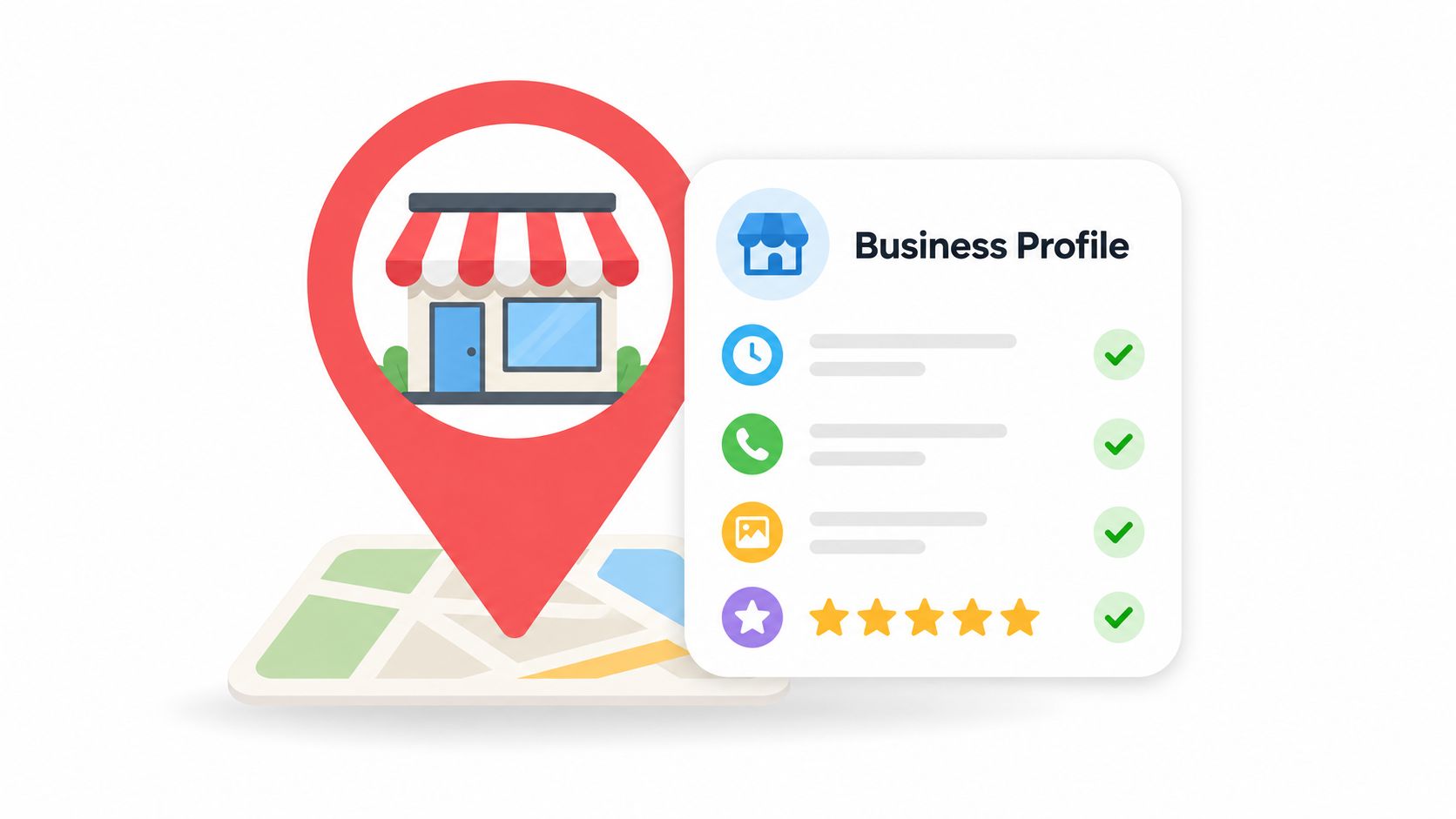
A partially filled Google Business Profile leaves money on the table. Searchers see your name, map pin, photos, hours, categories, service areas, and Q&A before they ever visit your site, so the profile has to feel complete, current, and obviously maintained.
The profile should reflect exactly what the business does and where it serves. That means accurate business name, address, phone number, service areas, hours, categories, and strong photos, because local search visibility depends on how clearly Google can match your business to intent. A complete profile also matters for answer engines and map results, where the first impression can be shaped by the profile itself before someone clicks through.
Fill the profile like a conversion page
Use high-resolution photos, ideally at least 720×720 pixels when possible, showing the office, team, and work samples. Add all relevant categories, not just the primary one, and define service areas by zip code or radius when that makes sense for the business. Keep NAP details consistent across the profile, the website, and citations, because inconsistency creates doubt for both search engines and buyers.
The practical payoff shows up differently by industry. A personal injury law firm can show service areas across multiple states, verified office photos, and helpful Q&A. A multi-location roofer can separate each territory cleanly. HVAC companies can use Q&A to answer emergency-service availability and warranty questions. Dental practices can add office photos, team bios, and treatment imagery that help anxious patients feel comfortable before they book.
- Post at least bi-weekly: Regular updates signal active business management.
- Answer Q&A within 24 hours: Fast answers build trust on high-intent searches.
- Use Google Posts intentionally: Seasonal offers, new services, and time-sensitive notices belong there.
- Check categories and hours often: A holiday or emergency-hours mistake can cost a call.
3. Build and Maintain Consistent Business Citations and NAP Data
Citation consistency sounds boring until a business has a messy directory trail and can't figure out why local visibility is weak. Search engines use Name, Address, and Phone consistency as a trust signal, and local firms live or die by those signals in regional search.
This is especially important for service companies that compete across a metro area or several nearby cities. A law firm should look consistent across Avvo, Justia, and state bar directories. Roofers should be listed cleanly across contractor directories, home services platforms, and local chamber sites. Multi-location dental practices need separate, correct citations for each office, and HVAC companies should verify the big local directories and industry platforms that buyers use.
Audit first, then clean up
Start with an audit using BrightLocal, Semrush Local Business, or Whitespark. That gives you a baseline before you touch anything, and it shows where third-party changes have introduced errors. Once the audit is done, prioritize high-authority directories that matter for your niche, because a few strong listings beat a scatter of weak, inconsistent ones.
Formatting details matter more than most owners expect. If the address always says “Suite,” keep it that way everywhere. If a phone extension exists, publish it clearly so directory systems don't mangle it into duplicate records. For multi-location businesses, each location needs its own unique citation set so Google doesn't collapse the locations together or confuse service areas.
A citation cleanup is not glamorous work, but it lowers friction everywhere else, from map rankings to call quality.
A quarterly review keeps the data fresh. Directory platforms and aggregators can overwrite your information, so someone on the team should check for drift and correct it before it spreads. Yext or Whitespark can help manage bulk updates, but the discipline still has to come from the business itself.
4. Create and Publish Case Studies and Results Documentation
Prospects trust proof more than promises. A strong case study shows what the business solved, how it solved it, and what changed afterward, which is why documented results belong on the website and not only in sales decks or private folders.
For law firms, case studies need to respect confidentiality and legal ethics, so the format should stay factual, permission-based, and careful with identifying details. For roofers, before-and-after photography can show the scale of a difficult project without overselling it. Dental practices can document cosmetic or implant journeys with patient consent, and HVAC companies can show system replacements or energy-efficiency improvements in practical terms.
Make the proof easy to scan
Good case studies usually answer five questions quickly, what was the problem, what service was used, what happened during the project, what changed, and who can relate to it. If the company can include metrics such as organic traffic growth, lead volume, ranking improvements, or case outcomes, that proof should be tied to written consent and clear context. Visuals help, too, especially Google Analytics screenshots, before-and-after imagery, or timeline graphics.
Organizing the case studies by service type or outcome makes them more usable. A visitor looking for roof replacement financing shouldn't have to dig through general company news to find a relevant transformation. The same is true for a dental patient considering implants or a homeowner trying to decide whether an HVAC replacement is worth it.
A good case study also supports website conversions. It gives the sales page a reason to feel credible, and it gives the prospect a low-risk way to imagine working with the firm.
5. Implement Strategic Internal Linking and Content Hub Architecture
A reputation system breaks down when proof lives in isolated pockets. Internal linking connects reviews, testimonials, case studies, and service pages into a structure that helps both visitors and search engines understand what the business does best.
The cleanest approach is a pillar-and-cluster model. A law firm can build a pillar page for personal injury claims, then link out to pages on injury types, local jurisdiction issues, and settlement process questions. A roofing company can do the same around roof replacement, while an HVAC contractor can anchor around installation and a dental practice can anchor around cosmetic dentistry.
Build the path from proof to action
Start by mapping the core services and the questions people ask before they call. Then create supporting pages that answer those questions and link them back to the main service page with consistent anchor text. That structure helps search engines see topical depth, but it also helps prospects move naturally from information to inquiry.
Use breadcrumbs so the site feels easy to use, especially on mobile. Update old pages with links to new cluster content so the authority flows through the site instead of sitting on one page. If a roof replacement article earns attention, send that attention toward the financing page, the emergency repair page, or the main service page where a call can happen.
Strong internal linking does two jobs at once, it explains the business to Google and it guides a human toward the next useful step.
Track which links get clicked. If a service page gets visits but no movement to contact, the content may be missing proof, clarity, or a strong enough next step. Internal linking is not decoration, it's part of the conversion path.
6. Develop Authoritative, Answer-Engine Optimized Content
Search is no longer just a list of blue links. AI Overviews and answer engines increasingly summarize information from multiple sources, which means a business needs content that is complete, credible, and easy for systems to parse.
Recent guidance on reputational risk management notes that AI search and generative-answer tools now surface brand sentiment from broader web signals, not just Google reviews, and that systems synthesize information from multiple sources rather than a single review profile (reputational risk management paper). That shift matters for local firms, because a detailed, accurate website can shape what answer engines say about service quality, process, and trust.
Write for the question before the keyword
The best answer-engine content starts with real questions from buyers, not with marketing language. A law firm might publish a guide on filing a personal injury claim. A roofer might cover roof damage and insurance claims. HVAC companies can answer maintenance, repair, and replacement questions. Dental practices can create a smile-makeover guide that compares treatments and candidacy in plain language.
This content has to be useful. That means clear headers, step-by-step explanations, and source attribution where facts are used. It also means keeping the content organized enough for both humans and machines, with clean structure and a straightforward path to related service pages.
- Use the questions prospects ask: Pull them from search suggestions, Search Console, and sales calls.
- Go deep on high-value topics: Long-form guides earn trust when they answer the next three questions a buyer has.
- Add FAQ schema where appropriate: Structured data helps parsers understand the page.
- Link to the related service page: Educational content should drive action, not sit apart from the rest of the site.
For law and dental content, accuracy and ethical boundaries matter even more. The goal is to educate, not to promise outcomes or overstate results. Clear, careful language is an asset in both industries.
7. Gather and Leverage Client Testimonials Strategically
Testimonials work best when they're placed where hesitation happens. A homepage quote is useful, but a testimonial beside a service CTA or intake form often does more real work because that's where the buyer is deciding whether to click.
A practical testimonial program starts the moment a client is happiest. That could be after a case result, a completed roof replacement, a successful HVAC installation, or a dental treatment that delivered the expected comfort and outcome. The ask should be simple and specific, and the business should request permission for names, photos, and any identifying details it plans to use.
Make testimonials feel earned, not staged
A strong testimonial usually names the problem, the experience, and the result. For example, a homeowner might talk about how the roofing crew handled weather delays professionally, while an HVAC customer might focus on reliability and responsiveness after the install. A dental patient might mention pain management, friendliness, and how clearly the staff explained the treatment path.
Use a mix of written, video, and audio when possible. Video can add authenticity, but a short written quote still works if it's specific and believable. Rotate testimonials regularly so the site doesn't feel stale, and match them to the page where they'll have the most impact.
One useful habit is to pair testimonials with matching Google reviews when the client has left both. That consistency helps prospects see the same story in more than one place, which matters when trust is still being built.
If the testimonial sounds like marketing copy, rewrite it. If it sounds like a real customer, keep it.
For law firms and dental practices, the review and testimonial process should stay tightly aligned with ethical and privacy obligations. Use only what's approved, and don't imply guarantees that can't be supported.
8. Build Quality Backlinks Through Strategic Outreach and Partnerships
Reputation isn't only what people say in reviews, it's also what authoritative sites say when they link to you. Quality backlinks still matter because they help search engines trust the business, especially in competitive local markets where many firms claim the same services.
The best links come from relevance, not volume. A law firm can earn links from legal directories, state bar associations, and publications that serve legal audiences. Roofers can build links through chambers of commerce, contractor associations, and local home-improvement outlets. HVAC companies can look for energy-efficiency organizations and contractor networks, while dental practices may find good opportunities with dental associations and health-focused community sites.
Use outreach that gives the other site a reason to care
Start by studying competitor backlinks with Semrush, Ahrefs, or Moz to see which sources are already linking in the space. Then create something link-worthy, a guide, a tool, useful statistics, or original research that editors and local organizations can reference. Partnerships with complementary businesses can also work well, especially when each side has a clear reason to mention the other.
Be selective with guest posts. A link only helps if the content is useful to the audience, and that standard matters more than pushing a placement. Awards, media mentions, and local sponsorships can help too, but only when they fit the business and don't feel forced.
One of the cleanest tactics is expert commentary. If a reporter is covering storm damage, emergency HVAC issues, or medical billing concerns, a useful quote can earn a mention and a link at the same time. That kind of placement supports both reputation and visibility.
building earned links naturally
9. Establish Author Authority and E-E-A-T Signals Throughout Your Website
Trust gets stronger when the website shows who is behind the advice. Clear author bios, credentials, and validation signals help prove that the business knows what it's talking about, especially in legal and medical settings where buyers are cautious for good reason.
The basics are straightforward. Put the author byline on content. Link it to a real biography page. Show licenses, certifications, affiliations, years of experience, and relevant practice areas or service specialties. Then back those claims with visible proof, such as testimonials, media mentions, speaking engagements, or professional designations.
Make expertise visible where the reader needs it
A law firm partner page should show bar admission, case focus, and practical experience. A dental team page should make licenses and specializations easy to find. HVAC contractor profiles should highlight manufacturer certifications and years in the field, and roofing company profiles should show licensing and insurance information clearly.
Author schema can help search engines connect content to the right person. But schema only supports trust, it doesn't replace it. The site still needs believable photography, current team information, and consistent detail across the pages that matter.
One overlooked trust signal is freshness. Updated headshots, current office photos, and reviewed bios tell a visitor that the business is active and real. Stale pages create doubt fast, especially when the company handles high-consideration work.
People want to know who is speaking to them before they decide whether to believe the page.
This matters most for Your Money or Your Life topics, where the wrong tone can reduce trust immediately. A careful, transparent presentation is part of the reputation itself.
10. Monitor Competitor Reputation and Differentiate Your Messaging
You don't need to copy a competitor's brand to learn from it. Watching how nearby firms handle reviews, messaging, and content can show where buyers are still unhappy and where your business can stand apart.
Start with three to five direct competitors. Look at their Google Business Profiles, review response patterns, site messaging, case studies, and service pages. If a competitor constantly talks about large settlements, but prospects keep complaining about poor communication, a law firm can lean into responsiveness and clarity. If a roofer's competitors all look similar, financing options or cleaner project updates can become the differentiator.
Mine the complaints, then answer them honestly
Read the review themes carefully. The same complaint across multiple competitors often reveals a market expectation that nobody is meeting well. For HVAC companies, the opening may be 24/7 emergency messaging. For dental practices, it may be a clearer explanation of invisible orthodontics or implants. The point isn't to attack the competition, it's to identify what buyers still wish they were getting.
Tracking local search visibility also helps. If one competitor owns the map pack more often, their profile completeness, review patterns, or local content may be stronger. If another competitor has poor testimonials but strong rankings, there may be a way to win by being more credible once the user lands on your site.
One useful practice is to compare how competitors handle negative reviews. Businesses that stay calm and specific usually look more trustworthy than those that argue or paste the same response everywhere. That observation can shape your own tone.
The smartest messaging choices often come from gaps, not slogans. A business that says less but proves more tends to win more serious inquiries.
10-Point Reputation Management Best-Practices Comparison
| Strategy | Implementation Complexity (🔄) | Resource Requirements (⚡) | Expected Outcomes (⭐📊) | Ideal Use Cases (📊) | Key Advantages (💡) |
|---|---|---|---|---|---|
| Monitor and Respond to Online Reviews Across All Platforms | 🔄🔄 | ⚡⚡ | ⭐⭐⭐ Improved trust, CTR, and local ranking; mitigates churn 📊 | Service firms with public reviews (law, roofing, HVAC, dental) | Builds trust; converts skeptics; real-time reputation control 💡 |
| Optimize and Claim Your Google Business Profile Completely | 🔄🔄 | ⚡ | ⭐⭐⭐ Higher visibility in Maps/local pack and more direct leads 📊 | Any local business; multi-location organizations | Free high-impact visibility; maps placement; direct contact tools 💡 |
| Build and Maintain Consistent Business Citations and NAP Data | 🔄🔄🔄 | ⚡⚡ | ⭐⭐⭐ Stronger local ranking signals and increased trust 📊 | Regional competitors; multi-location businesses | Foundational local SEO; cost-effective longevity 💡 |
| Create and Publish Case Studies and Results Documentation | 🔄🔄🔄 | ⚡⚡⚡ | ⭐⭐⭐ Increased credibility and higher conversion rates 📊 | High-stakes services and B2B sales (legal, complex projects) | Concrete proof of results; differentiates from competitors 💡 |
| Implement Strategic Internal Linking and Content Hub Architecture | 🔄🔄🔄 | ⚡⚡⚡ | ⭐⭐⭐ Improved topical rankings, session depth, and conversion paths 📊 | Sites with multiple services/topics needing authority | Guides user journeys; consolidates topical authority 💡 |
| Develop Authoritative, Answer-Engine Optimized Content | 🔄🔄🔄 | ⚡⚡⚡ | ⭐⭐⭐ Potential AI/overview visibility and backlink attraction 📊 | Thought-leadership goals; FAQ-driven queries; AI snippet targets | Future-proofs content; attracts citations and organic authority 💡 |
| Gather and Leverage Client Testimonials Strategically | 🔄🔄 | ⚡⚡ | ⭐⭐–⭐⭐⭐ Higher conversion near CTAs; improved social proof 📊 | Conversion-focused pages and service funnels | High-impact near CTAs; versatile (video/text) social proof 💡 |
| Build Quality Backlinks Through Strategic Outreach and Partnerships | 🔄🔄🔄 | ⚡⚡⚡ | ⭐⭐⭐ Significant domain authority and ranking improvements 📊 | Competitive keyword targets; authority-building campaigns | Long-term ranking lift; referral traffic and PR value 💡 |
| Establish Author Authority and E-E-A-T Signals Throughout Your Website | 🔄🔄 | ⚡⚡ | ⭐⭐⭐ Stronger YMYL trust signals and ranking resilience 📊 | YMYL industries (legal, medical), firms needing credibility | Increases trust; protects rankings during algorithm changes 💡 |
| Monitor Competitor Reputation and Differentiate Your Messaging | 🔄🔄 | ⚡⚡ | ⭐⭐–⭐⭐⭐ Actionable differentiation insights and messaging wins 📊 | Saturated markets where positioning matters | Identifies gaps; informs value proposition and pricing 💡 |
Turn Reputation Signals Into a Repeatable Growth System
The strongest reputation management best practices work as a sequence, not a pile of tactics. First, establish monitoring, profile accuracy, and citation consistency so you know what prospects are seeing and where the business is showing up. Then build an ethical review and testimonial workflow that asks at the right moment, responds quickly, and keeps the language calm, specific, and compliant.
After that, publish proof and authoritative answers. Case studies, internal links, answer-engine content, and author bios turn reputation into something a visitor can verify on the site itself. That matters because the website is where trust has to become action, especially when the buyer is choosing between several local firms that all claim to be experienced.
The final step is measurement. Reputation work should be tied to visibility, profile engagement, and qualified inquiries so the business can see what changed after the process improved. If reviews rise but conversions don't, the issue may be on the service page, the intake path, or the way proof is being presented. If the site gets attention but calls don't improve, the message may need sharper differentiation or stronger trust signals.
Law firms and dental practices need especially careful consent, credential, and outcome language. Roofers and HVAC companies usually have more room to show project results, but they still need honesty around timing, warranties, and scope. The industry changes, the ethical boundaries change, but the operating system stays the same, earn trust, show proof, and make it easy to act on that proof.
Digital Skyrocket fits naturally here because it focuses on lead-generating websites, local SEO, answer engine optimization, conversion design, and ongoing reporting for service businesses. For firms that need reputation management built into a new site and a clearer inquiry path, that combination is often the difference between looking credible and converting.
Digital Skyrocket builds websites and SEO systems for service businesses that need reputation signals to turn into qualified inquiries. If you want your reviews, case studies, and local trust proof connected to a site that's built for local SEO and conversion, visit Digital Skyrocket and see how they approach it.