58.5% of legal searches end without a website visit, according to a 2026 legal-consumer report. People research in an AI chat or a broad results page, then choose a lawyer from Maps, reviews, and a phone call. Your pages still have to earn trust. They just have to do it as a fact source, not only as a destination.
That changes the job of law firm website content. A managing partner doesn't need another brochure. You need pages a stranger can quote before they ever arrive, and an intake path that stays clear, accessible, and honest about what a form does not create.
If you own or market a small or midsize firm, treat the site like a courthouse directory with the lights on. The sign has to name the matter and the next door. If it doesn't, people leave, often without a click you can see in analytics.
Table of Contents
- Essential Pages on a Law Firm Website
- Claims Access and the Inquiry Path
- How to Write Practice Pages and Bios
- Search and Answer Visibility Off the Site
- Production Workflow and the Metrics That Matter
- Start With Content Before the Redesign
Essential Pages on a Law Firm Website
Assign the map this week, before anyone writes a new paragraph. A small or midsize firm needs eight page types. Not a pile of near-duplicates. Think of the site as a well-labeled courthouse directory. If the sign doesn't name the matter and the next door, people turn around.
| Page | Visitor question | Required blocks | Primary action |
|---|---|---|---|
| Home | Do you handle my kind of problem near me? | Who you help, where, proof of licensure, one path to contact | Request a consultation |
| Practice area | Do you take this matter and what happens next? | Eligibility, process, jurisdiction, limits, related FAQs | Start an intake for this matter |
| Attorney bio | Who would actually handle my case? | Admissions, courts, matters, representative results labeled as not typical | Meet or call this attorney |
| FAQ | What should I know before I call? | Short answers on timing, cost ranges if allowed, confidentiality, documents | Go to the matching practice page |
| Landing page | Is this offer for my situation? | One campaign, qualifier, what the consult includes, short form | Submit the campaign form |
| Location or service area | Do you serve my city? | Cities and counties actually served, local proof, directions or map | Call the local office |
| Pillar or blog | How does this legal issue work? | One question, plain explanation, link to the practice page, author and date | Read the service page next |
| Contact and intake | What happens if I reach out? | Hours, phone, form, response time, no-representation notice | Send only the minimum needed to start |
Why each row has to be specific
Home answers "near me" above the fold. Name who you help, the cities or counties you serve, and one consultation path. A slider of slogans doesn't do that job.
Practice-area pages are one matter each. Car wrecks are not "personal injury" in the abstract if your intake rules out commercial vehicles. Say eligibility in plain language, the usual path, the courts or jurisdictions you serve, and what you don't take.
Attorney bios list bar admissions, courts, and representative matters. Label those matters as representative, not typical. A bio that reads like a trophy case makes the reader guess who would return the call.
FAQs exist for the questions people ask before they dial. Timing, what to bring, and whether a consult is confidential belong here. If your jurisdiction allows fee talk, keep any range qualified. If it doesn't, don't invent one.
Landing pages serve one campaign and one offer. They are not a second homepage. Location pages name real cities and counties, not a slogan about "serving the region."
A pillar or blog supports a practice page. It doesn't replace it. One useful model is a document checklist that tells a family exactly what to gather, the way the Law Office of Bryan Fagan probate documents page does for opening an estate. Your version should link back to the service page, name an author, and show a date.
Contact explains what happens after someone reaches out. Hours, phone, a short form, a response window, and a notice that sending the form doesn't create an attorney-client relationship.
Independent research is already normal
A 2019 Legal Trends study found that 57% of people who had ever looked for a lawyer searched independently rather than relying only on referrals. Among those self-directed researchers, online search engines and attorney websites were each used by 17%.
The same study is a phone test as much as a content test. 49% of Gen Z respondents and 48% of Millennials said a lawyer's website mattered, compared with 34% of Generation X and 21% of Baby Boomers. Younger readers will judge you on a small screen, in a hurry, often between other tabs.
Practical rule: Pick the rows you lack before you write anything new. A missing practice page or a vague contact page will waste every later blog post.
Print the table. Mark what you have, what's thin, and what's missing. That marked sheet is the only brief your next draft needs.
Claims Access and the Inquiry Path
"Best results in the state" is not a headline. It's a claim you usually can't publish. ABA Model Rules 7.1 through 7.5 prohibit false or misleading statements about results, expertise, or comparative superiority, and they also govern advertising, solicitation, practice-area descriptions, and firm identification, as summarized in this lawyer advertising ethics overview. State rules can be stricter than the model rules, so the approver has to be a lawyer in the jurisdiction you target, not only a marketer.
California's Rule of Professional Conduct 7.1 bars false or misleading communications about the lawyer or the services, including material misrepresentations and omissions that make the whole message misleading. Bios, testimonials, verdict lines, and fee claims are lawyer advertising. They aren't "just the website."
Three edits that remove the risk
- Attach evidence, a date, and a named approver to every verdict, ranking, fee, and geographic claim. If nobody can point to the source, the sentence doesn't ship.
- Label outcomes as representative, dependent on facts and jurisdiction, and not a guarantee. "We recovered $X in one case" is a different sentence from "clients like you get $X."
- Remove countdown copy and unqualified "free case" claims. Urgency that isn't true is still a misleading communication.
A family-law page can still be useful without puffery. A careful explainer such as choosing counsel for private infant adoption shows the tone you want. It helps the reader judge fit. It doesn't crown the firm.
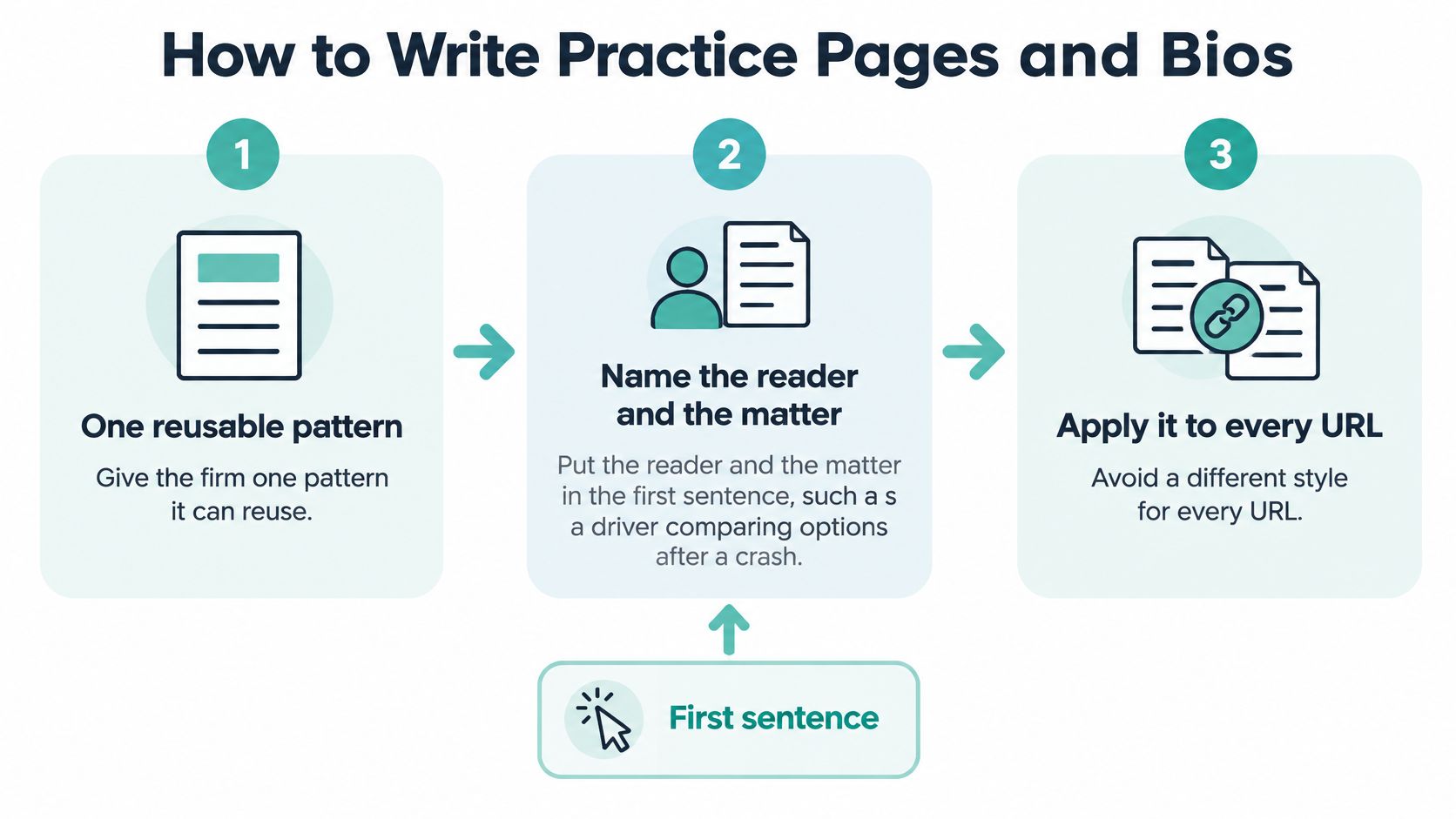
Give the firm one reusable pattern. Name the reader and the matter in the first sentence. Then use that pattern on every URL so a bio doesn't sound like a different firm from the practice page.
Contact details are not a clear path
Finding a phone number isn't the same as understanding what to do. Reporting on the 2024 Legal Trends findings says 84% of prospective clients could find contact information on law firm websites, but only 36% called the process of finding a lawyer straightforward, and only 30% said it was easy to understand based on the website.
The follow-up numbers are harsher. Only 33% of firms responded to secret-shopper emails, and 40% answered their phone calls. 73% of those shoppers said they would not recommend the firms they contacted. A polished page can't survive a dead line.
Put the next step in the same breath as the explanation. "Call this number on weekdays from 8 to 5, or send the short form. We reply by the next business day. Have the date, the county, and the other party's name if you know it."
Use one short form at the moment of decision. Don't ask for a full case story in a chatbot. Name reply hours and what to bring. The form should say it doesn't create an attorney-client relationship, and it should cover confidentiality limits, how long you keep the submission, when you'll reply, and the few fields you need for a conflict check.
What someone can safely send
Business Law Today frames the question firms skip. What should a prospective client safely disclose online, and how can the firm make that process accessible without implying representation? Long forms, urgent claims, chatbots, and "free case evaluation" language can undercut trust and widen confidentiality risk.
Map each form to the minimum for that stage. A general question form should not invite a detailed narrative before you've explained conflicts screening, retention, and response expectations. Say how personally identifiable information is used and shared. Offer a plain-language path that isn't phone-only.
FTC privacy and security guidance is the operations side of that copy. Collect only what the intake purpose needs, keep it secure, and dispose of it securely. The FTC's own assessment describes HTTPS with TLS, AES-256 encryption, access limited to authorized staff, and destruction by erasure, degaussing, or physical shredding. Your form copy should match whatever your vendor does. Don't promise a vault you haven't bought.
Access is part of the intake
WCAG 2.2 is the practical spec for the words and the widgets. Its principles are perceivable, operable, understandable, and resilient. Level AA is the benchmark most organizations should build to. Version 2.2 adds criteria beyond 2.1, including focus visibility, accessible authentication, redundant entry, target size, and alternatives to dragging.
On a practice page that means real headings, descriptive links, enough contrast, keyboard access, a visible focus state, labeled fields, error text, alt text on meaningful images, and captions or transcripts on video. Automated scans miss context. Have someone tab through the form with a keyboard.
The U.S. Department of Justice treats website accessibility as part of the ADA's nondiscrimination and effective-communication duties for businesses open to the public, including law firms. DOJ hasn't issued one detailed technical standard for private businesses, but its guidance points to WCAG and Section 508 as useful references, and it calls for a way to report accessibility problems. Put that report path on the contact page.
Then secret-shop the firm yourself. Call at lunch. Email the address on the site. If the page promises a next-business-day reply and nobody answers, the content is false even when the law is right.
How to Write Practice Pages and Bios
Stop inventing a new voice for every URL. One pattern, reused, is how a two-lawyer shop stays consistent when the marketing director is also the person answering the phone.
The six steps
- Name the reader and the matter in the first sentence. "If you were hit while driving in Smith County and you're comparing firms, start here." The county matters. "Injured?" doesn't.
- Say who you help and who is a poor fit. Geography, deadlines you can't meet, and facts you don't take. A rear-end case in your county is not a maritime claim two states away. Saying no saves both sides a conflict check.
- Explain the path in three to five plain steps. First call, documents, investigation or filing, negotiation or hearing, resolution. Describe the sequence. Don't promise where it ends.
- Add proof someone can check. Licensure, courts, years in practice, and past outcomes marked representative rather than typical. If you can't verify a ranking, leave it off.
- Answer three questions on the page. Usually timing, which documents to keep, and whether a consult is confidential. Short enough that a results snippet could lift one sentence without distorting it.
- Close with one action and what you'll do next. "Submit this form. A staff member calls within one business day to screen conflicts. That call isn't representation." One button. One window. Not three competing offers.
Bios are a shorter cut of the same pattern. Role, admissions, matters, and one true personal detail that doesn't invent a credential. "Raised in Longview" is fine. "The top trial lawyer in East Texas" isn't, unless a source you'd show a regulator says that.
FAQs stay short enough to quote. Don't hide a pitch inside the answer. Landing pages drop the lesson and keep the offer, the qualifier, and the form. A blog or pillar takes one question and links back to the practice page. It shouldn't try to rank for the whole practice by itself.
Firms that publish a clean index of matters, the way Bell Law's legal practice areas does, make the next click obvious. Your index should use the words clients use. Our guide to keyword research for lawyers is the place to match those phrases to real queries before you draft.
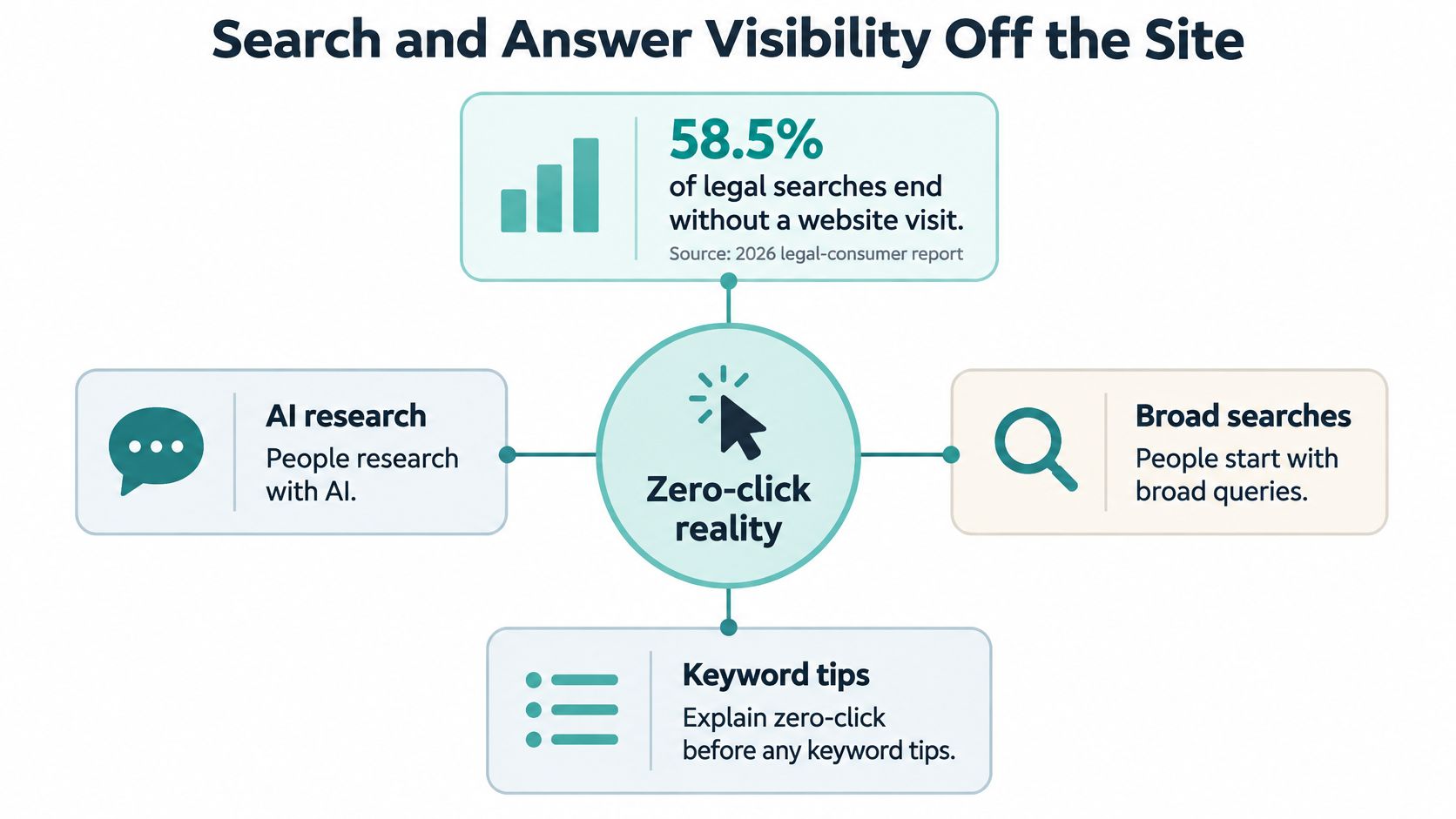
The first sentence isn't only for the human who scrolls. It's the line an answer engine can lift when the visitor never arrives.
One worked page, then a blank you can copy
Say the page is car wrecks, not all of injury law. Open with the driver in a named county. Say you help people hurt in ordinary passenger crashes there, and you don't take commercial-fleet cases or crashes outside the counties you list. Steps might be the consult, collecting the crash report and medical records, dealing with the insurer, and either a settlement talk or a lawsuit. Proof is the lawyer's license, the courts where they're admitted, and two or three representative results with the facts and the disclaimer. Questions cover how fast to call, photos and repair estimates to keep, and that a consult is confidential but a web form isn't yet a client relationship. The close is one intake button and a next-business-day call.
Family law and criminal defense change the eligibility language. A divorce page talks about county of filing and whether you handle custody. A defense page talks about the charge level and whether you appear in that court. The six steps don't change.
Copy this skeleton for the next matter. Reader and county. Who you help and who you don't. Three to five steps. Checkable proof. Three questions. One action plus the reply window.
Hand that outline to the lawyer who knows the exclusions. The writer shouldn't guess them.
Search and Answer Visibility Off the Site
A storefront window has to state the offer even when the shopper never comes inside. That's the zero-click client journey. People research with AI tools and broad search, then come back to Google Maps, reviews, and the phone when they're ready to choose. Publishing another long practice page doesn't fix a profile that still says "general practice" or a paragraph no system can quote.
Small and midsize firms feel this more than national brands. A lot of website advice chases rankings and sessions. The decision often happens off the site. You can still earn a qualified inquiry with fewer clicks if the facts stay consistent everywhere a machine or a map can reuse them.

Passages that can stand alone
Write short answers for the questions a results page or an AI interface may resolve without a visit.
- Fact pattern: Do you take rideshare crashes in this county, or only privately insured drivers?
- Jurisdiction: Which cities and counties do you serve?
- Evidence: What should someone preserve in the first week, such as photos, the crash report, and medical visit dates?
- Confidentiality: Is a consult confidential, and does the web form create a client relationship? Say no if it doesn't.
- After contact: Who replies, by when, and what happens if there's a conflict?
Match one primary query to each practice page. Use the same firm name, address, phone, and practice names on the site, the Google Business Profile, and your citations. A nickname on the website and a formal name on the profile looks like two firms.
Add LocalBusiness or LegalService structured data, plus Person markup on bios, that repeats only facts already visible on the page. Include areaServed for real cities, not a wish list. Titles and H1s should name the matter and the place. Give every page a visible author or firm byline, and a date when the law or the offer can change.
If you want the mechanics of showing up in Google's answer modules, read how to rank in AI Overviews. The content job stays the same. Clear facts, stable names, and a sentence that can survive being quoted alone.
Measure memory, not only sessions
Sessions will undercount a zero-click win. Review, at least monthly:
- Branded searches for the firm and the lawyers.
- Map actions, including calls, direction requests, and website taps.
- Calls that match the practice and city on the page.
- Qualified intakes that pass conflicts screening.
- Mentions in AI answers, checked by hand, to see whether the facts match the page.
Audit five money pages this week. If the first screen doesn't contain a sentence you'd trust an AI tool to quote, rewrite that screen before you touch the blog.
The page can be long underneath. The reusable fact has to sit where a skim, a snippet, or a map description can find it.
Production Workflow and the Metrics That Matter
Having a website is no longer the advantage. In 2024, 90% of law firms surveyed by the American Bar Association reported having one, 70% among solo practitioners and 91% among firms with 2–9 attorneys, according to law firm website statistics compiled from that survey. Firms with 100 or more attorneys were at 100%. Your edge is a page someone maintains, not the fact that the domain resolves.
Among the 50 largest law firms analyzed by Tela Digital in 2024, 70% featured news on their insights pages, while 44% maintained blog content. That's a reason for a small firm to keep a few updated pillars, not a neglected news feed that goes quiet after launch month.
A cycle a two-to-twenty-lawyer firm can run
- The attorney supplies the matter knowledge, the exclusions, and the proof for any result or ranking. No proof, no sentence.
- The writer turns that packet into the six-part page and marks every claim that still needs a source.
- A named partner approves claims, disclaimers, and the no-representation notice before design. Approval isn't a last-look spellcheck.
- You publish with the right headings, local schema, and form fields already limited to what intake needs.
- Ninety days later you review the metrics below and revise the page that fails. You don't celebrate the miss by adding another post.
Google's Core Web Vitals guidance is the speed check inside that cycle. Google recommends that the largest visible element load within 2.5 seconds, that Interaction to Next Paint stay under 200 milliseconds, and that Cumulative Layout Shift stay under 0.1. Those targets are judged at the 75th percentile, separately for mobile and desktop. One fast test on office Wi-Fi doesn't count.
What to review each month
| Metric | Where to look | Signal that content is working |
|---|---|---|
| Organic sessions to money pages | Analytics landing pages | Practice and location pages gain visits, not only the blog |
| Branded searches | Search Console queries | More people search the firm or attorney name |
| Map actions | Business Profile | Calls, direction requests, and website taps rise together |
| Calls from the site | Call tracking | Calls match the practice and city on the page |
| Qualified intakes | CRM or intake log | Form leads pass conflicts screening and fit the matter |
| Answer-engine citations | Manual AI and search checks | Firm facts appear without a click and match the page |
| Page experience | Field Core Web Vitals | LCP within 2.5s, INP under 200ms, CLS under 0.1 at the 75th percentile |
Our walkthrough of Google Analytics SEO reports shows where those landing-page and query views sit, so the marketing director isn't exporting the whole account to answer one question.
Read the table as a rewrite list. Organic sessions show discovery. Branded search and map actions show whether people remember you off the site. Calls and qualified intakes show business. Answer-engine citations show whether your facts are being reused, and whether they're still true.
Retire a page that ranks and produces no qualified contacts after a quarter. Refresh any page whose statute, fee, or attorney roster has changed. A stale bio is a misleading bio.
Keep the calendar to one line. One practice page or one refresh every two weeks. Not a daily blog. A twenty-lawyer firm can go faster. A solo shouldn't.
Start With Content Before the Redesign
Freeze the redesign until the page map, the claim file, and the intake rules exist. A new template only makes a weak message faster. Visitors will bounce in a nicer font.
Block two hours. List the matters you want, the cities you serve, the proof you can show, and the single action each page should drive. Bring logos, attorney photos, and the answers only the lawyers know. Exclusions, courts, and what a consult includes are not things a designer should invent.
We know how service firms get found. We don't know your offer, your edge, or your target client until you hand us that packet. Step one of content strategy is gathering your expertise. After that, we strategize, design, build, write, and handle SEO for the site, rather than only tuning a site someone else already boxed in.
In one law firm case study, Attorney Mike Wallace's Google search visitors per year went from 119 before that work to 898 after, a 645.62% increase in one year. The lift followed a rebuild rooted in what the firm does, not a skin on the old copy.
If you're comparing local build partners, look at web design in Tyler, TX and at a web design agency in Longview, TX. Book a fit conversation when you want a new site plus ongoing search work. Bring the page map from the first section. We'll know in that meeting whether the matters, the cities, and the proof are ready to build.
Digital Skyrocket plans, designs, builds, and search-optimizes law firm websites so the pages answer real matters and the intake path stays clear. If your firm needs law firm website content that can be quoted off the site and a form that doesn't imply representation, visit Digital Skyrocket and bring your page map to a fit meeting.