Industry analysis of large-scale AI-search data suggests AI Overviews have sharply reduced clicks to the first organic result. Even the page holding position one now earns a fraction of its former visits. That changes the math behind how to rank in AI Overviews: a citation puts your brand inside the answer without guaranteeing the click.
For a law firm, roofer, HVAC company, or dentist, citation isn't the finish line. You need pages Google can find and quote, and you need those pages to convert a smaller pool of visits into qualified calls, forms, and consultations. The visits that do come through tend to carry higher intent, so each one is worth more. I'd work in that order: eligibility first, then answer quality, then conversion.
Table of Contents
- The Short Answer and the Two Layers That Matter
- Check Crawl, Index and Markup Before Optimizing Content
- How to Write Answer Blocks for Fan-Out Questions
- Build Entity and Authority Signals Across Your Site
- Protect Leads When AI Answers Cut Clicks
- Run Your First Citation Baseline and Test It Monthly
The Short Answer and the Two Layers That Matter
AI Overviews cite pages Google can both find and lift a clean passage from. You need conventional search eligibility plus answer-ready passages, and neither layer works alone.
Ranking gets you eligible. A quotable passage gets you cited.
A page-one ranking is preparation, not a guarantee. In Victorious Q3 research covering 200,000 keywords and published October 30, 2024, only about 20% to 26% of AI Overview links overlapped with Google's conventional top-10 results, and the feature omitted all three top organic positions in roughly 25% of desktop cases and 38% of mobile cases, according to Victorious Q3 research on AI Overviews and organic rankings. The same research found an average of approximately 11 links inside an AI Overview, so there's room to earn a citation even when you don't hold position one.

The Four Layers of AI Overview Visibility
The two core layers expand into four checks worth running on every page you want cited.
| Layer | What it covers | Pass check |
|---|---|---|
| Search eligibility | Crawlable, indexable page that ranks for the core query | Page shows as indexed in URL Inspection with the correct canonical |
| Answer retrieval | Passages that answer subquestions under matching headings | The direct answer appears within the first 60 words under its question heading |
| Entity clarity | Business, author, service and location details that match across pages | Name, address, phone and service names are identical on site and profiles |
| Citation evidence | Page is cited with a specific passage across a fixed query set | Logged citations show your URL and passage in at least some tracked queries |
Say a law firm's practice page ranks on page one but never gets cited. The usual cause is simple: the answer to its main question sits buried under a generic introduction about the firm's history, so there's no passage Google can lift cleanly.
There's a third stake beyond ranking and citation. Cited pages often pull fewer clicks than a top organic position used to, which changes the math: each visit a citation still sends has to convert at a higher rate to produce the same volume of leads. Treat visibility as a lead-economics problem, not only a ranking problem, and these four layers become a pipeline check rather than a vanity metric.
Check Crawl, Index and Markup Before Optimizing Content
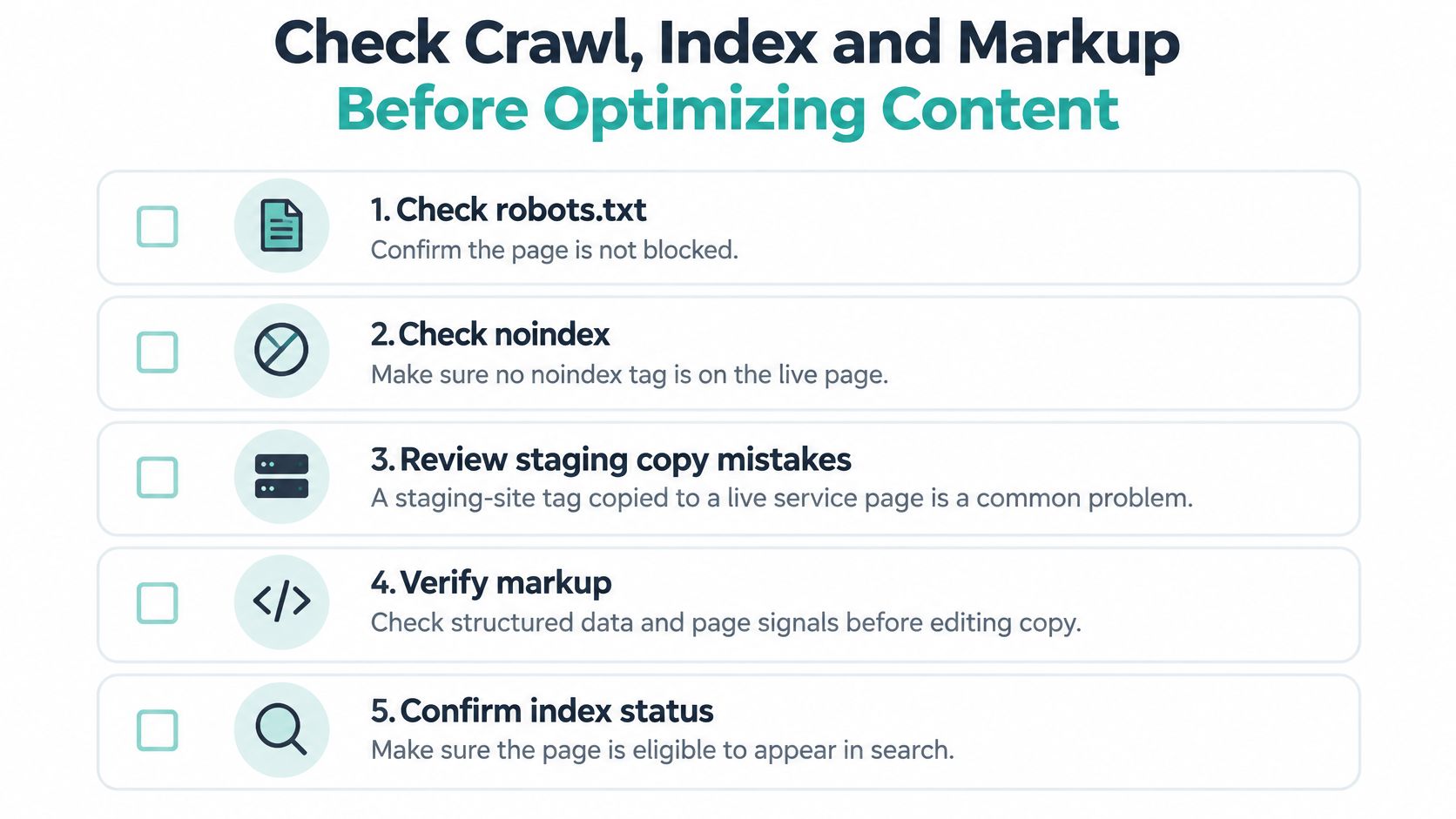
Run these checks before you touch any copy. Rewriting a page Google can't index wastes the whole effort, and most failures I would check for are boring technical leftovers, not content problems.
The Pre-Optimization Checklist
- Robots.txt and noindex: Confirm the page isn't blocked by robots.txt and doesn't carry a noindex tag. A staging-site tag copied onto a live service page is a common cause of invisible pages, and it takes thirty seconds to check in the page source.
- Indexable HTML: Make sure the main answer exists in plain HTML rather than being injected by scripts or hidden inside tabs and accordions that crawlers may skip. View the rendered HTML in Search Console's URL Inspection tool and search for your key sentence.
- Title and canonical: Check that the title tag is descriptive and unique to that page, and that the canonical URL points to the page itself. A canonical pointing at your homepage tells Google to credit a different page entirely.
- Structured data: Confirm Organization, LocalBusiness, and Service markup matches the visible text. Use FAQ markup only where those questions and answers are visible on the page, and run the page through the Rich Results Test to catch errors.
- Mobile rendering: Check mobile speed and layout, and confirm images carry descriptive alt text. Most local service searches happen on phones, and a page that renders slowly or shifts around loses both rankings and visitors.
- Index status: Verify in URL Inspection that the page is indexed, not just crawled. Also confirm you aren't blocking Googlebot or using nosnippet on pages you want cited, because AI features draw on the same crawl as regular search.
Practical rule: If URL Inspection can't show Google your answer text, an AI Overview can't quote it either.
Say a roofing company's new service page goes live with a noindex tag left over from staging. It can sit invisible for months while competitors get cited for the same storm damage questions, and no amount of copy editing fixes that.
A technical SEO audit checklist helps you work through these items in order. When you're done, you should have a pass or fail list for each URL and a priority order, starting with pages that already earn impressions for your target query. Expect several monthly cycles before you judge whether fixes moved citations.
How to Write Answer Blocks for Fan-Out Questions
Google doesn't always answer your target query from a single search. Google's documentation on AI features in Search states that AI features use publicly accessible, crawlable content and may apply query fan-out, issuing multiple related searches across subtopics and data sources to construct an answer. That's why one page optimized for one phrase isn't enough, because Google evaluates your coverage across the subquestions behind that phrase.

The Answer Block Method
- Pull real subquestions: Export Search Console queries containing how, what, cost, or whether, then add the People Also Ask questions shown for your target term. These are the questions buyers type, not ones you'd invent in a brainstorm.
- Sort each subquestion by type: Group them into service definition, eligibility, process, cost factors, risks and alternatives, and local proof. Sorting first stops you from writing six versions of the same pricing answer.
- Write a 40 to 60 word direct answer: Open each section with an answer that stands alone if Google lifts it without the surrounding paragraphs. Put the conclusion in the first sentence, then support it.
- Phrase the heading as the question: Use the searcher's wording as your H2 or H3 so the heading and passage match. "How long does a roof replacement take" beats "Our process" every time.
- Add one specific detail: Include a timeframe, a named cost factor, or a local credential that a generic summary wouldn't contain. Specifics are what separate your passage from a competitor's commodity copy.
- Link to depth: Point each answer block to the supporting page that covers that subtopic fully. The same discipline behind featured snippet optimization applies here, a short extractable answer on the surface with proof one click deeper.
Subquestion Types and the Answer Block Each Needs
| Subquestion type | Roofing example | Answer block to write |
|---|---|---|
| Service definition | What a full roof replacement includes | Two-sentence definition naming materials and removal steps |
| Eligibility | Whether a storm-damaged roof qualifies for an insurance review | Short list of conditions and who to contact first |
| Process | What happens from inspection to final invoice | Numbered stages with a typical timeframe for each stage |
| Cost factors | What moves a quote up or down | Named factors such as roof pitch, material and tear-off, with no invented single price |
| Risks and alternatives | Repair versus replacement trade-offs | Balanced pros and cons with a clear decision rule |
| Local proof | Service area, licensing and recent local jobs | City-specific details with verifiable credentials |
Answer blocks need evidence and specifics, not keyword repetition. Google says AI use itself provides no special gain, so AI-written text earns no ranking advantage. Each block still has to be useful and original, and show expertise, experience, authoritativeness, and trustworthiness. If your answer could appear unchanged on any competitor's site, rewrite it with something only your business can claim.
Build Entity and Authority Signals Across Your Site
Start with a mismatch audit, because it's the fastest win you'll find this month. List your business name, address, phone number, and service names as they appear on your website, your Google Business Profile, and major directories, then fix every variation.
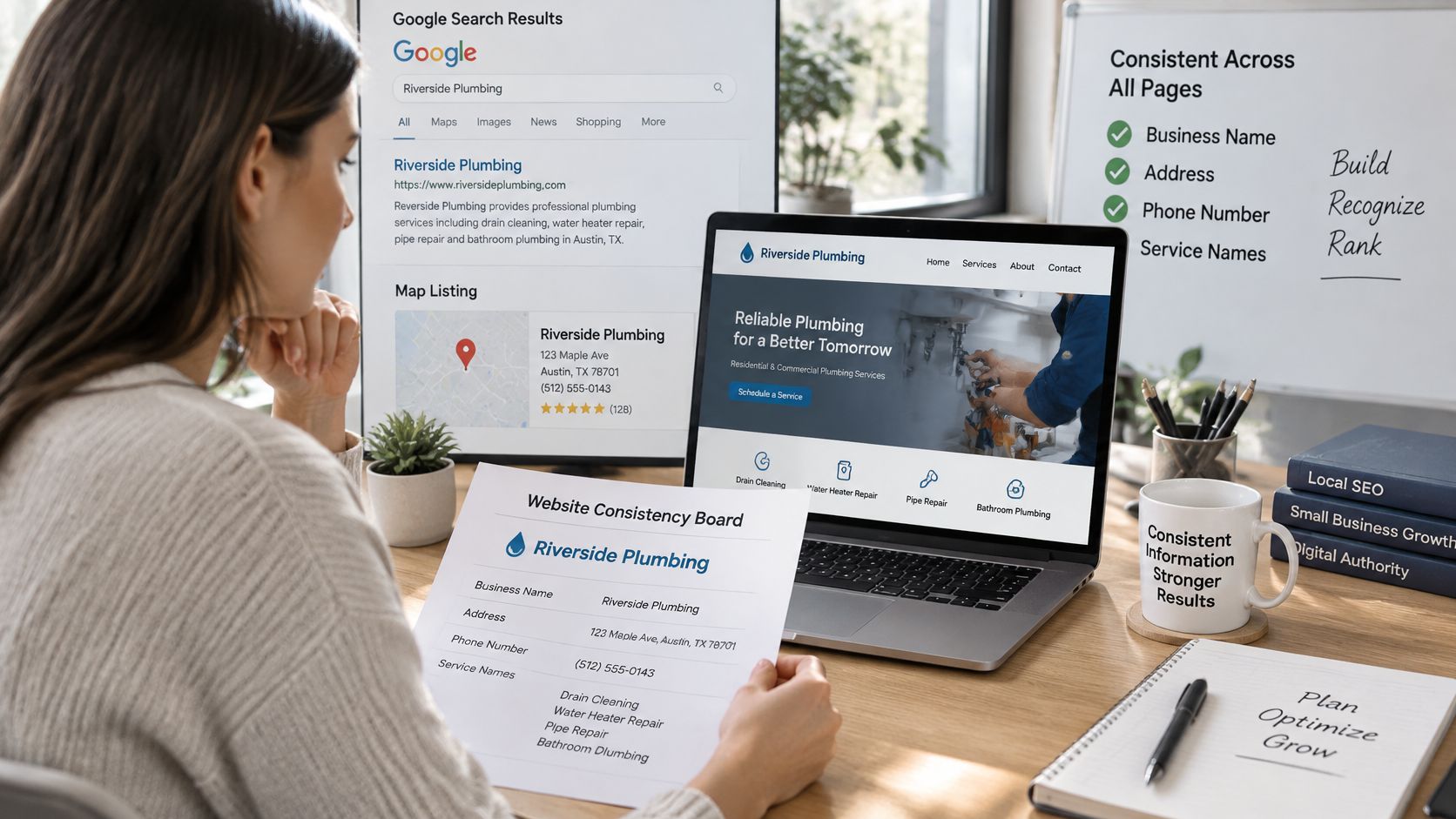
Service names drift constantly. A firm that says "DWI defense" on one page and "drunk driving attorney" on another, with a third version on its profile, gives search systems three fuzzy services instead of one clear entity. Pick one naming convention and apply it everywhere.
This consistency pays off twice. It raises the odds of being cited, and it means the searcher who does click through lands on a page that confirms what the Overview already told them. When citations deliver fewer clicks, the ones that arrive carry higher intent, and a page that matches the entity Google described is what turns that intent into a lead.
Markup and People
Add Organization and LocalBusiness structured data with sameAs links pointing to your verified profiles, so Google can connect your site to the same business it sees elsewhere. The principles behind knowledge graph optimization apply directly here: consistent facts repeated across trusted sources build a single, confident entity.
Then attach real people to your advice. Author bios and Person markup for whoever writes your content should list actual credentials: bar admission for an attorney, licence numbers for a contractor, certifications for a clinician. Anonymous advice from "the team" gives Google nothing to verify.
Evidence and Reviews
Original evidence beats generic claims. A page with a real case study, a measured result, or a photo of a completed job is far more citable than a summary anyone could write, and claims you make should link out to reputable sources instead of standing unsupported.
Reviews work the same way. Respond to every review, ask for one after each completed job while the experience is fresh, and reflect the language clients use in your service copy. If reviewers keep praising your cleanup or your callback speed, that phrase belongs on the page.
A business Google can describe in one sentence, who you are, what you do, and where, is a business it can cite with confidence.
For multi-location businesses, build one location page per city with unique local detail: named staff, service area boundaries, nearby landmarks, jobs completed in that city. A location page earns its place only when it says things that are true of that city and nowhere else. Duplicated text with the city name swapped gives Google no reason to trust any version.
The same entity discipline applies to anything else your business publishes. If you ship an AI tool or software product alongside your services, you can find directory backlinks for AI tools to give that product the same consistent footprint across directories, since every listing either reinforces or muddies the entity.
Your three-item checklist for this month:
- Fix one mismatch: Correct the most visible name, address, phone, or service-name inconsistency you found.
- Add one credential: Publish or complete an author bio with a verifiable qualification.
- Publish one proof asset: Add a case study, project photo set, or measured result to your highest-value service page.
Protect Leads When AI Answers Cut Clicks
Citation alone won't produce traffic, and the click data makes that plain. In 2025, users clicked a traditional organic result in 8% of Google searches containing an AI Overview, compared with 15% of searches without one, according to Pew Research Center's analysis of nearly 70,000 searches from about 900 U.S. adults, reported in Pew Research Center's AI Overview click analysis. Fewer clicks per citation means every visit you do get has to work harder.
Make the Cited Page Worth the Visit
- Show local proof immediately: Named service areas, credentials, and project examples belong near the top, not below three paragraphs of introduction.
- Keep a click-to-call button visible on mobile: A sticky call button means a ready buyer never has to hunt for your number mid-scroll.
- Publish transparent process steps: Show what happens after someone contacts you, with a realistic timeframe for each stage, so the next step feels low-risk.
- Add a fit checklist: A short self-assessment helps visitors judge whether they qualify before they call, which raises lead quality and cuts wasted intake time.
Say a dentist's cited FAQ answers the implant cost question well, but the page has no booking link anywhere. Visitors get their number and leave. Add a booking button beside the answer and one clear sentence about what the first consultation includes, and the same traffic starts producing appointments.
Track the delayed effect too. Test branded searches in Search Console as a signal of recall, since someone who saw your name in an overview may search for you by name days later. Put a unique call-tracking number on the cited page so you can tie calls to that URL specifically, and review assisted conversions across several sessions instead of crediting only the first click.
Some visits will never come back, and no layout change fixes that. Judge the work by leads per cited page, not clicks.
Run Your First Citation Baseline and Test It Monthly
You can't improve citation performance you haven't measured, and rankings alone won't tell you the story. A page can rank on page one and never get cited, while a page outside the top ten sometimes earns the citation instead. Build a baseline you can repeat.
The Monthly Test
- Choose 30 queries: Pick 10 core service terms, 10 subquestions from Search Console queries containing how, what, cost, or whether, and 10 branded or location searches. Fix this list and don't swap queries mid-test.
- Log a baseline: Search each query in a private browser window with a fixed location. Record whether an Overview appears, which URLs it cites, the exact passage used, and your page's organic position, all in one spreadsheet.
- Pull Search Console data: Export impressions and clicks by query and page for the same period. AI Overview appearances are included in overall Search reporting, so isolate them by query group rather than expecting a separate AI report.
- Fix one page well: Pick one high-value service page, rewrite its weakest subquestion as a 40 to 60 word answer block with one specific detail such as a timeframe, fix any structured data errors, and confirm it's indexed.
- Log qualified leads: Record calls and form submissions tied to each cited page through call tracking and your CRM, not just total sessions.
- Repeat on the same date monthly: Compare citation rate, cited-page share, and branded search volume against your baseline. This monthly rhythm is how we work too, since Digital Skyrocket meets with clients every month to review their rankings, traffic, and strategies.
If you want to extend tracking beyond Google, you can compare ChatGPT mention tools with Mojolin to see how other answer engines mention your brand. Keep Google citations as your primary scoreboard for this test, since that's where your baseline lives.
Metrics to Track Alongside AI Overview Citations
| Metric | Where to find it | What it tells you |
|---|---|---|
| Citation rate | Manual log of tracked queries | Share of tracked queries that cite your domain |
| Cited passage match | Manual review of the cited text | Whether the passage actually answers the subquestion |
| Organic position | Search Console average position | Whether the cited page still holds page one |
| Impressions and clicks | Search Console Performance report | Trends by query and page over time |
| Branded search volume | Search Console branded queries | Rising brand queries suggest recall from answers |
| Qualified leads | CRM and call tracking | The number that actually pays for the work |
Read your first results with a simple rule. A page that ranks and is cited needs conversion work, one that ranks but isn't cited needs better answers and entity signals, and one that doesn't rank needs eligibility fixes before anything else. A rank drop doesn't always mean lost citations, and a citation gain doesn't always mean more traffic, which is exactly why leads sit at the bottom of that table as the deciding number.
First action: Build the 30-query spreadsheet today and log the baseline before you change a single page, or you'll never know what your changes did.
If you're evaluating help with this, expect honesty about fit. If Digital Skyrocket cannot help a prospect win online, it tells the prospect so. When a Fit Meeting goes well, a Discovery Meeting follows, which includes an in-depth analysis of the client's Google search traffic, a report of existing keyword rankings and which ones bring traffic, and a consideration of the clients the business could reach with improved rankings. That same evidence-first habit is what your citation baseline gives you on a smaller scale.
If your service pages rank but don't earn citations, or earn citations that don't turn into calls, Digital Skyrocket builds lead-generating websites with the technical SEO, answer-ready content, and conversion paths this work requires. Start with a Fit Meeting so we can look at your current rankings, traffic, and citation gaps together before recommending anything. Visit Digital Skyrocket to see how our web design and SEO process connects AI Overview visibility to qualified inquiries.