A homeowner searches for an emergency plumber, sees two companies serving the same city, and calls the one Google presents first. Both businesses may have similar websites, review counts, and backlinks. Yet one appears in the local pack and earns stronger branded visibility, while the other sits deep in the organic results and depends heavily on repeat customers.
That gap often comes from more than content quality. Google needs to understand which business exists, what it does, where it operates, who represents it, and why external sources confirm those facts. Knowledge graph optimization turns that understanding into a practical business system, connecting structured data, entity pages, citations, search visibility, and qualified leads.
Table of Contents
- Why Your Service Business Is Invisible to Google
- What Knowledge Graph Optimization Actually Means
- The Signals That Feed the Knowledge Graph
- How to Implement KGO for a Service Business
- What Optimization Looks Like in Practice
- Measuring Results That Actually Matter
- Common Pitfalls and False Shortcuts
- Your Next Steps and a Quick Decision Checklist
Why Your Service Business Is Invisible to Google
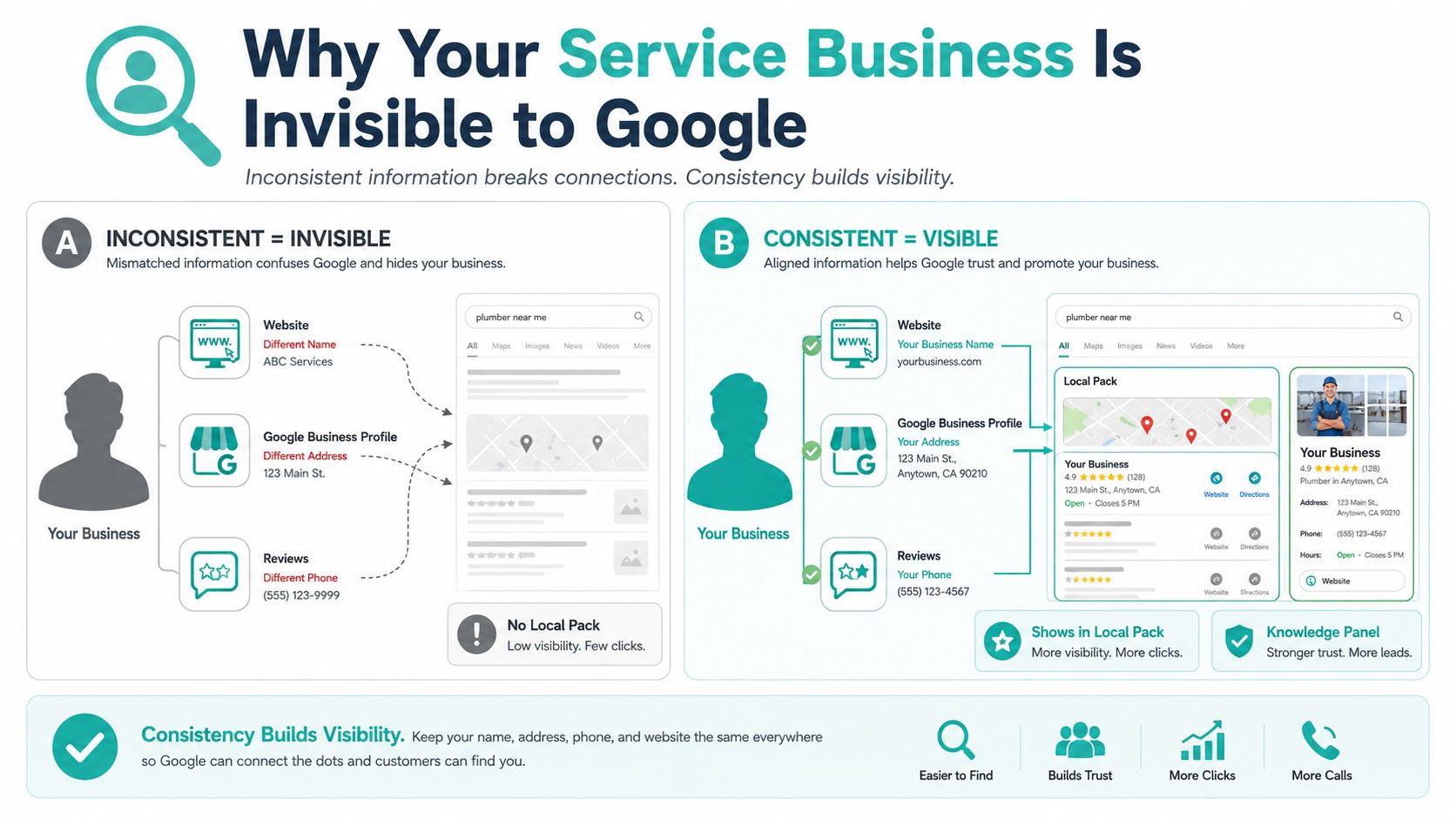
Two plumbing companies can publish nearly identical service pages and still receive very different search exposure. Company A has a clearly defined business name, consistent address and phone details, dedicated pages for emergency plumbing and water heater repair, and profiles that reinforce the same information. Company B uses slightly different business names across directories, describes its service area inconsistently, and mentions important credentials only in scattered blog posts.
Company A is easier for search systems to identify and connect to a real-world entity. Google can associate it with a place, a service category, a geographic area, and supporting references. Company B may not have received a penalty. Google has less confidence about which signals belong together.
Search has moved beyond matching words
Traditional SEO often begins with a phrase such as “emergency plumber near me.” That phrase still matters, but search systems also need to interpret the entities behind it:
- The business: Is this a legitimate plumbing company with a stable identity?
- The service: Does it provide emergency plumbing, rather than merely mentioning the phrase?
- The location: Does it serve the searcher's area, and do other sources support that connection?
- The people: Are owners, licensed professionals, attorneys, dentists, or technicians clearly associated with the company?
- The evidence: Do reviews, directories, associations, and other references corroborate the same story?
A service business becomes difficult to retrieve when these relationships remain vague or contradictory. A city page might claim broad coverage, the Google Business Profile might list different services, and the website might omit the practitioner who gives the company its credibility.
Practical rule: If a human can't quickly explain what your company is, where it operates, and which services connect to it, search engines may struggle to do the same.
Knowledge graph optimization addresses that missing layer. It doesn't replace technical SEO, useful content, or a strong offer. It makes those assets easier to interpret as one coherent business rather than a collection of disconnected pages and listings.
What Knowledge Graph Optimization Actually Means
Think of Google's Knowledge Graph as a vast address book. Each entry represents a distinct thing, called an entity, and each entry connects to related entries through labeled relationships.
A business is an entity. So are a city, a service, a founder, a professional credential, and an industry association. “Roof repair” is not only a keyword. It can represent a service that belongs to a roofing company, operates in a service area, and relates to a particular type of property problem.
Knowledge graph optimization is the practice of making those entities clear, accurate, and connected. You define the business, connect it to its services and locations, identify the people behind it, and reinforce those relationships through the website and trusted external references.
Keywords describe pages, entities describe businesses
On-page SEO asks whether a page clearly addresses a search topic. KGO asks whether Google can confidently understand the business behind that page.
For example, a dental practice may have a page targeting “cosmetic dentistry.” Entity-focused optimization strengthens that page by clarifying:
- The practice's official name and location.
- The exact service offered.
- The dentists associated with the practice.
- The credentials and professional profiles connected to those dentists.
- The internal relationship between the practice, the service page, and relevant location pages.
That distinction matters for local packs, voice searches, and AI-generated search experiences. These systems need relationships and context, not just repeated words. A page can target a phrase correctly and still fail to communicate which business should be associated with it.
The objective isn't to manipulate a hidden database. It's to publish a consistent, machine-readable version of the business that matches what customers, directories, and professional sources already understand.
The Signals That Feed the Knowledge Graph
Google builds confidence from several kinds of evidence. No single signal defines a service business on its own. Structured data declares facts, entity pages explain them, citations corroborate them, and authority signals help establish importance.
Structured data makes relationships explicit
Schema markup uses a shared vocabulary to identify an Organization, LocalBusiness, Service, Person, Review, or other entity. JSON-LD is often the most maintainable format because it separates structured information from visible HTML. The schema markup guidance for contractors offers a practical starting point for businesses that need to connect company, service, and local information.
For a local company, useful properties can include the official name, URL, telephone number, address, opening hours, logo, service area, and sameAs references. Structured data won't rescue inaccurate content, but it can reduce ambiguity when it accurately reflects the page.
Entity pages provide context
A dedicated service page can explain what the service includes, who performs it, which problems it addresses, and where it's available. An About page can identify the company and its history. Team or practitioner pages can connect professionals to credentials and services.
These pages give search systems language and context that a schema object alone can't provide. Internal links then show the relationships between the business, its services, locations, and people. A useful implementation reference is this guide to local business schema markup.
Citations validate the identity
Third-party references help confirm that the business exists beyond its own website. Relevant sources may include established directories, professional associations, local organizations, industry publications, and legitimate news coverage.
The priority is consistency and relevance, not a large directory count. A citation with the wrong phone number or an outdated business name can create another conflicting version of the entity.
Authority signals add weight
Backlinks, service-specific reviews, and topical references help establish the business's standing. A law firm connected to legal associations and consistently reviewed for a specific practice area presents a stronger topical identity than a firm with only generic mentions.
| Signal Category | What It Contributes | Primary Location |
|---|---|---|
| Structured data | Defines entities and their attributes in machine-readable form | Website code |
| Entity pages | Explains services, people, locations, and relationships | Website content |
| Citations and references | Confirms business identity across external sources | Directories and publications |
| Authority signals | Reinforces importance and topical relevance | Links, reviews, associations |
Weakness in one category can make the whole entity less certain. A business may have excellent reviews but inconsistent contact details, or perfect schema attached to thin pages. KGO works best when the signals tell the same story.
How to Implement KGO for a Service Business
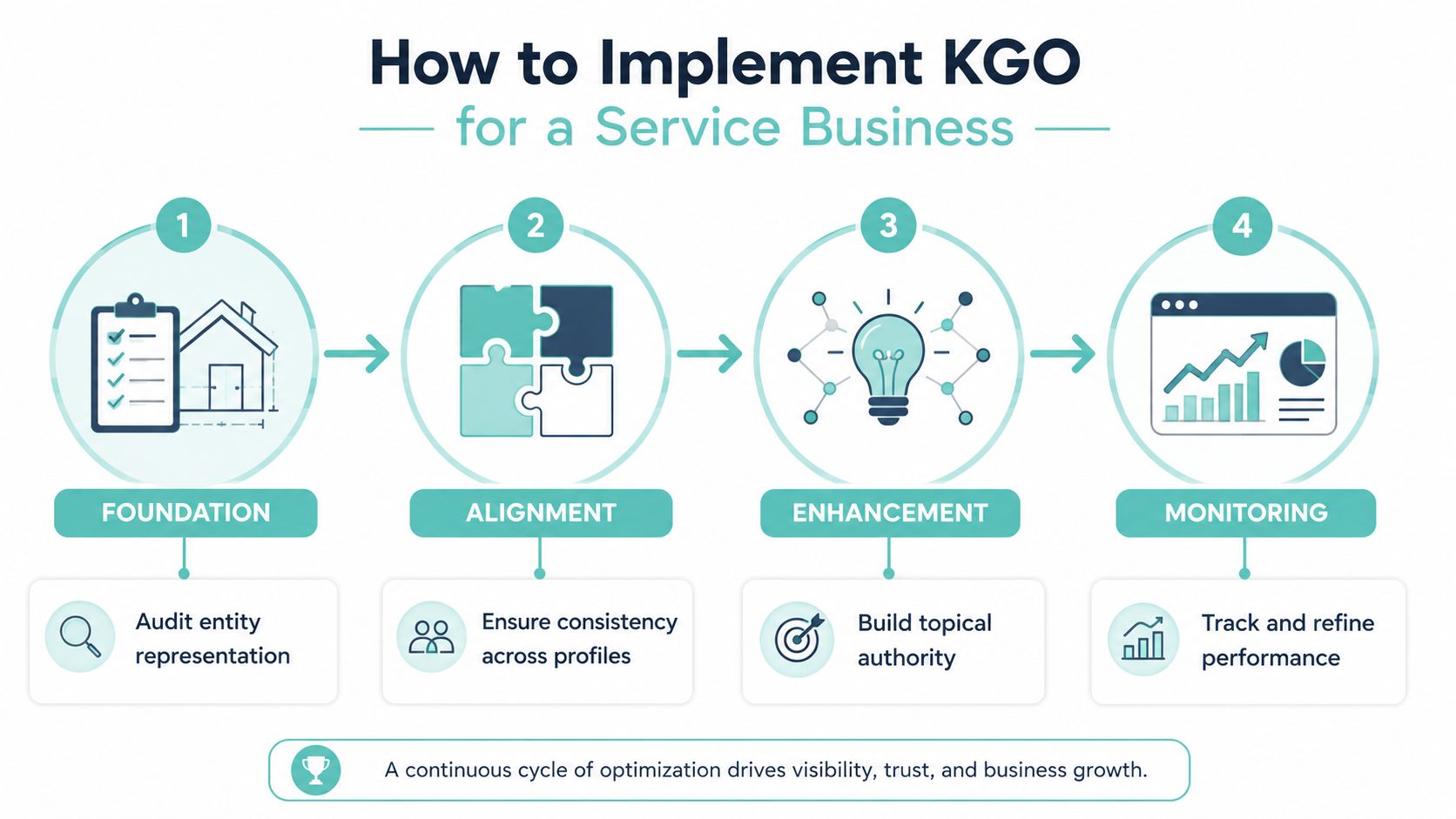
Implementation works best as a sequence. Start with identity, then build the site's entity structure, add machine-readable data, and reinforce the result externally.
Start with an entity audit
Collect the business name, address, phone number, website URL, hours, service areas, primary categories, and practitioner information from the website, Google Business Profile, directories, association pages, and social profiles. Mark every difference, including abbreviations, missing suite details, old phone numbers, and inconsistent service descriptions.
Then define the canonical version of the business. Decide which LocalBusiness subtype fits, which services deserve dedicated pages, and which locations are actually served. Don't create location pages for areas the company doesn't serve just to expand a keyword footprint.
Build the website around real entities
A service business usually needs a clear Organization or LocalBusiness identity, individual service pages, relevant location pages, and practitioner or team profiles. Each page should have one dominant purpose.
Connect the pages deliberately:
- Business to services: Link the main company page to core services.
- Services to locations: Explain where each service is available when that relationship is genuine.
- People to expertise: Connect practitioners to their credentials and services.
- Supporting content to hubs: Link educational articles back to the service they support.
A contractor might connect “roof replacement” to “storm damage repair,” a service area, and the licensed professional responsible for the work. An accounting firm might connect “tax preparation” to a partner profile and the cities served.
Add schema after the content is accurate
Layer Organization or LocalBusiness markup with Service, Person, FAQPage, and BreadcrumbList markup where those types accurately describe the visible page. A practical minimum for Organization markup is name, url, and @type. Stronger implementations can add logo, sameAs, description, foundingDate, founder, and mainEntityOfPage, as described in this Organization schema guide.
Use sameAs for authoritative profiles such as Wikidata, Wikipedia where appropriate, and verified social profiles. Google Cloud's entity reconciliation documentation also illustrates why identity matching involves schema mapping and reconciliation, not just adding markup to a page.
Validate the implementation with Google's Rich Results Test. Check that the markup parses, matches visible content, and uses the correct entity relationships.
Reinforce the graph off-site
Correct important citations first. Then seek relevant digital PR, professional association references, and service-specific reviews. Review requests should encourage customers to describe the work they received naturally, without scripting or manufacturing language.
For local visibility, connect the technical work to the broader Google Maps ranking factors. The exact order matters because external reinforcement is more useful when the website already presents a stable entity.
What Optimization Looks Like in Practice
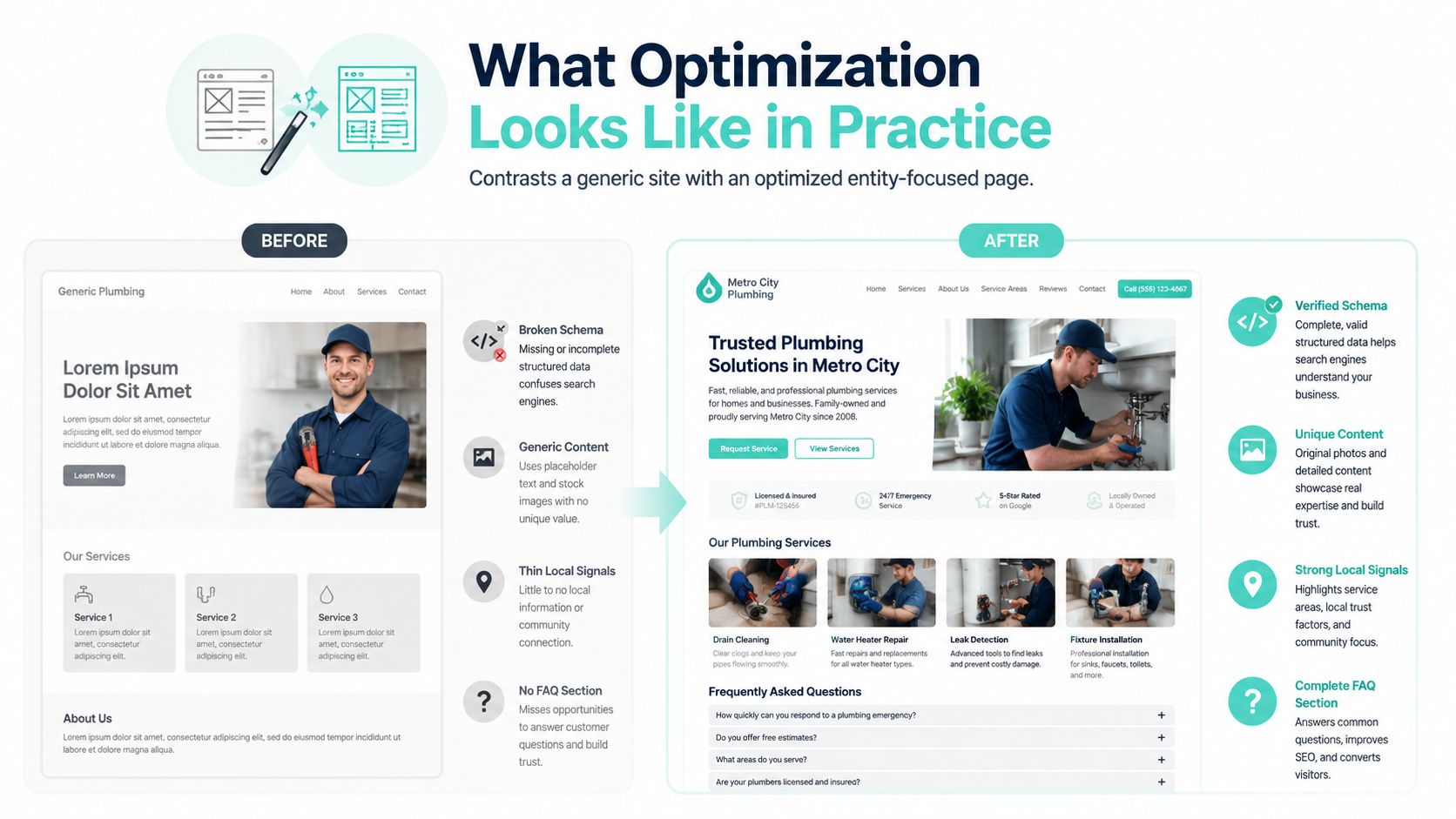
A generic service website often begins with a broad homepage, stock imagery, and a sentence such as “We provide quality solutions for all your needs.” It may mention several cities in a footer, use no meaningful service taxonomy, and include no clear connection between the company, its professionals, and its offerings.
Google can crawl that website, but crawling isn't the same as understanding. The site may produce a weak business entity because the information doesn't clearly identify what the company does or how its pages relate.
The stronger version has an identifiable structure
Consider a composite plumbing company. The rebuilt site has an authoritative homepage, a dedicated emergency plumbing page, separate water heater and drain cleaning pages, and location pages that describe actual service coverage. Each page uses consistent business information and links to the relevant related entities.
The company's team page identifies the owner and technicians, explains relevant qualifications, and connects each person to the services they perform. LocalBusiness and Service markup reflects those visible facts, while external profiles use the same business name, phone number, address, and service categories.
The same pattern applies across industries:
- A law firm: Practice-area pages connect to attorney profiles, jurisdictions, and professional references.
- A dental office: Treatment pages connect to dentists, the practice location, and patient-facing explanations.
- An HVAC company: Heating, cooling, and maintenance pages connect to service areas and technicians.
- An accounting firm: Tax, bookkeeping, and advisory pages connect to partners, industries, and locations.
A strong entity hub doesn't make the business look larger than it is. It makes the existing business easier to identify.
Before optimization, Google may see several loosely related pages and listings. Afterward, it has a clearer path from the company to its services, people, and locations. That can support more confident retrieval for branded and non-branded searches, although no markup guarantees a specific ranking or Knowledge Panel result.
Measuring Results That Actually Matter
A rich result or Knowledge Panel appearance can feel like progress, but visibility alone isn't the business outcome. A service company needs to know whether better entity understanding leads to more relevant calls, form submissions, consultations, and booked work.
Start with a baseline for each service line. Track branded searches, map pack visibility, non-branded impressions, calls, contact forms, consultation requests, and qualified leads. Separate emergency plumbing from routine plumbing, or personal injury from other legal services, because an aggregate number can hide which entity relationships are producing demand.
The enterprise measurement guidance from PingCAP's knowledge graph optimization guide recommends looking across query response time, traversal efficiency, indexing, storage, scalability, GraphRAG accuracy, user satisfaction, infrastructure cost, and business KPIs. For a service business, the same principle means pairing technical visibility with lead quality.
| KGO Signal | Technical Metric | Business Outcome |
|---|---|---|
| Business identity | Branded search visibility and entity references | More direct discovery |
| Service entity | Rankings and impressions for service-specific queries | More relevant inquiries |
| Location relationship | Map pack presence and location-query visibility | More local calls |
| Reputation connection | Review themes and profile consistency | Greater trust before contact |
| Conversion path | Calls, forms, and consultation tracking | Qualified opportunities |
Don't treat ranking movement as revenue. A page may gain impressions while attracting people outside the service area, looking for a different service, or unable to become customers. Pair Search Console and analytics data with call tracking, form source data, and a simple lead-quality review.
A recurring review also matters because services, staff, hours, locations, and external profiles change. Businesses that want help connecting local schema, reputation signals, and lead reporting can evaluate online reputation management for small businesses as part of a broader measurement process.
Common Pitfalls and False Shortcuts
The most expensive KGO mistake is treating markup volume as proof of optimization. A company can add Organization, Service, FAQPage, and Review objects while leaving the underlying pages thin, duplicated, or contradictory. Search systems need visible, consistent facts, not a large block of JSON-LD.
Symptoms reveal the shortcut
- Flat rankings after schema deployment: Fix the page content, entity relationships, and internal links before adding more types.
- Many listings but few qualified calls: Remove attention from low-trust directories and focus on relevant, authoritative references.
- Conflicting local pack visibility: Reconcile business name, address, phone number, hours, and service descriptions across profiles.
- A strong brand presence but weak service visibility: Build and connect the service and location entities that match customer intent.
- A dashboard full of listing completions: Compare those listings with actual calls, forms, and qualified inquiries.
- Visibility that fades after a launch project: Schedule recurring checks for staff, services, hours, citations, and page relationships.
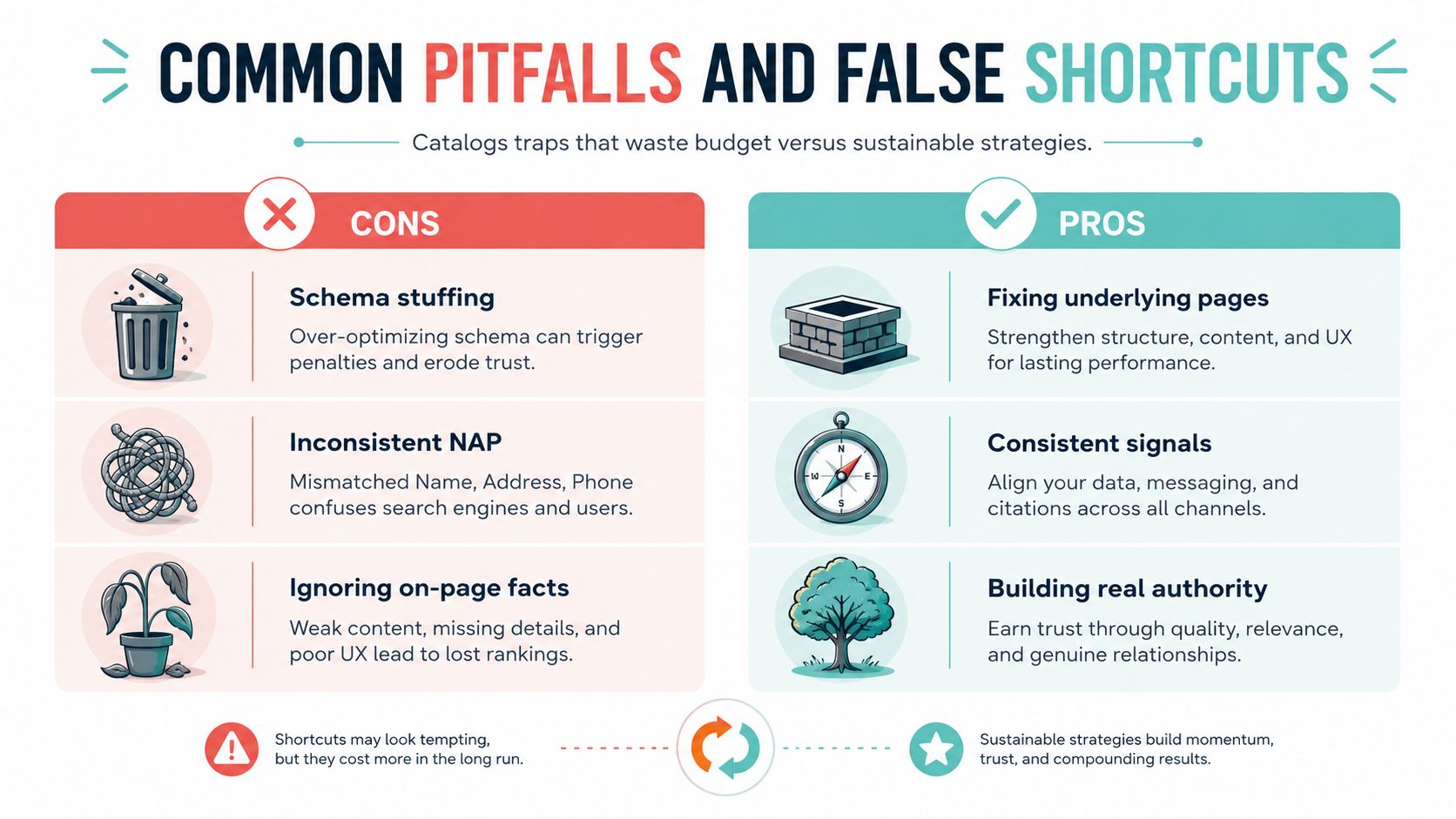
Another mistake is optimizing only the company entity. Customers often search for a specific service in a specific place, so the graph must connect the business to those narrower entities. A roofing company needs more than a brand name. It needs clear relationships among roof replacement, storm repair, inspection, neighborhoods served, and the people responsible for the work.
KGO is an alignment process, not a one-time upload. Every new service page, office, practitioner, profile, or review creates an opportunity to strengthen or fragment the entity.
Your Next Steps and a Quick Decision Checklist
Run this diagnostic before investing in advanced optimization:
- Is the primary business entity clearly defined and internally connected?
- Does every relevant page template use accurate schema?
- Do important citations show the same business facts?
- Does each core service and genuine service area have a useful page?
- Do your reports connect visibility to calls, forms, and qualified leads?
Use the next three weeks to create momentum:
- Week one: Audit the website, Google Business Profile, citations, hours, service categories, and practitioner details. Fix the most important inconsistencies.
- Week two: Publish or improve entity pages, connect them with internal links, and deploy accurate schema.
- Week three: Strengthen authoritative citations and review your analytics, call tracking, and lead-quality data.
If any diagnostic answer is no, fix that block before chasing advanced signals. A clear business identity and reliable measurement give every later optimization a stronger foundation.
Digital Skyrocket plans and builds lead-generating websites for service businesses, combining technical SEO, answer engine optimization, schema guidance, local SEO, reputation management, and conversion-focused improvements. Visit Digital Skyrocket to discuss a website and ongoing SEO plan that connects knowledge graph clarity with qualified inquiries.