Local SEO is the practice of improving a business's visibility when someone searches for products or services connected to a geographic area. It isn't ordinary SEO with a city name added to a page.
You check your phone, search for the service you sell, and see a map, competing businesses, reviews, and perhaps an AI answer before your website appears. For an owner or marketing director, the practical question isn't just where you rank. It's whether the right prospective customer can find you, understand what you offer, and contact you.
Table of Contents
- Why a City Name Is Not Local SEO
- How Google Matches a Business to a Place
- What Separates Local SEO from General SEO
- Local SEO Examples for Service Companies
- What You Can Control When Distance Limits Rankings
- How to Measure Local SEO Beyond the Map Pack
- How to Choose the Right Local SEO Plan
Why a City Name Is Not Local SEO
An HVAC owner searches from home and sees different businesses than the office manager sees across town. A law-firm marketer finds the firm immediately by name but struggles to find it through a service search. Neither experience, by itself, tells you whether the business has an effective customer-acquisition system.
When owners ask what is local SEO, they're usually asking why nearby prospects find competitors first. The answer involves more than the wording on a website. Customers encounter a business through several surfaces, and they need those surfaces to tell a coherent story.
Your customer may never start on your homepage
The scale matters: 80% of consumers search online for local businesses at least weekly, 32% search daily or several times daily, 73% of local searches begin on mobile, 52% of the most recent searches began on Google Search, and another 9% began on Google Maps, according to the local-search consumer research summarized by BlazeHive.
That same research reports that 61% consult business-information sites when evaluating an unfamiliar business, with reported trust distributed across Google at 66%, Google Maps at 45%, and business websites at 36%. Those figures describe separate discovery and trust behaviors, not a single funnel every customer follows.
Consider someone trying to find roofers in Port St. Lucie through JA Edwards of America Roofing. The useful connection is between a specific service, a recognizable place, and a business the homeowner can evaluate. Repeating the city throughout unrelated copy wouldn't answer whether that roofer can help with the homeowner's actual situation.
Local visibility is useful only when the person finding you can tell whether you're the right business to contact.
Clarity matters more than geographic repetition
A page can mention a city repeatedly while leaving basic questions unanswered. Does the company serve this address? Does it handle this type of work? Is the displayed phone number the right place to start?
Useful location landing pages should resolve those uncertainties rather than function as interchangeable city-name templates. That distinction makes local SEO a customer-acquisition discipline, not a rankings hobby.
The immediate objective is a credible match between the customer's need and the business's offer. A ranking without that clarity is an incomplete result.
How Google Matches a Business to a Place
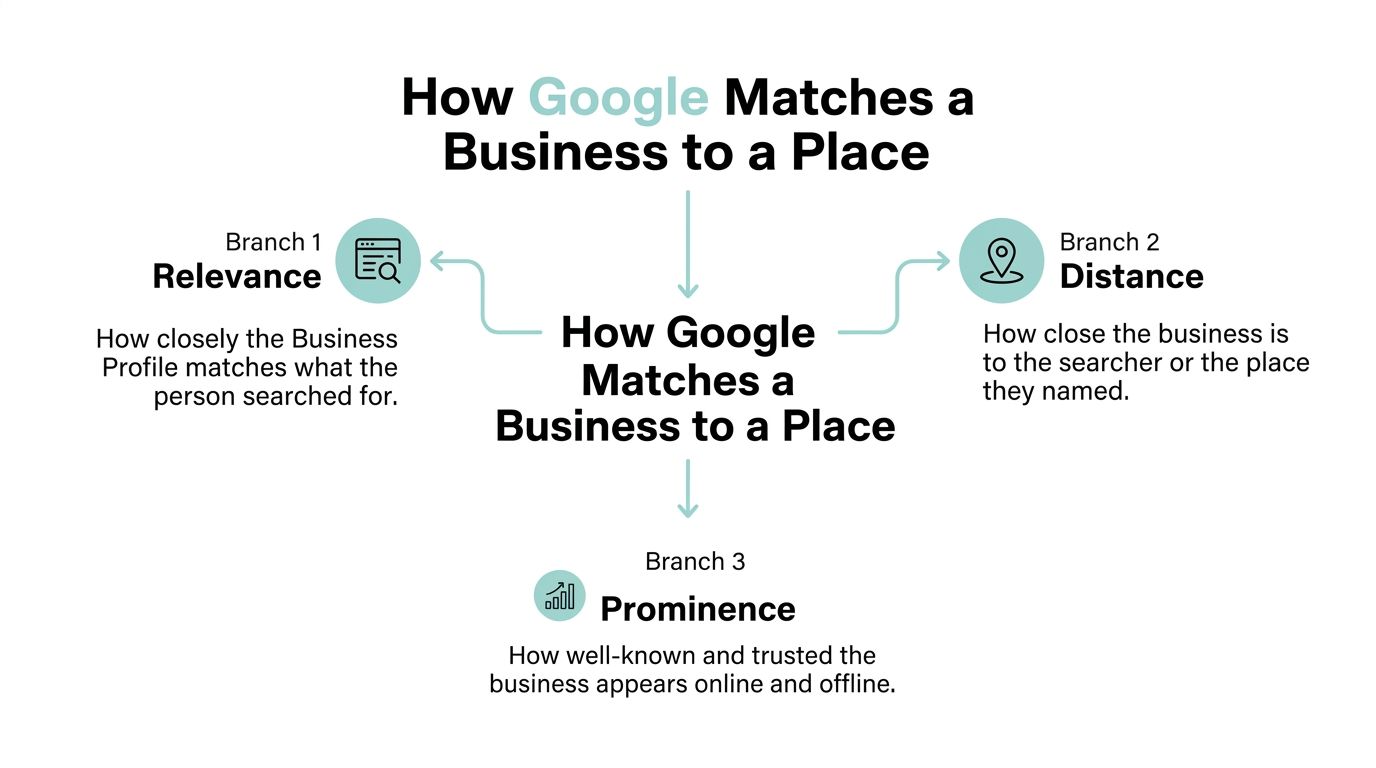
Google describes local ranking through relevance, distance, and prominence in its guidance on improving local rankings. Treat them as different tests, not interchangeable optimization tasks.
- Relevance concerns how closely a Business Profile matches the search.
- Distance concerns the relationship between the business and the searcher, or the location specified in the query.
- Prominence concerns how well-known the business is, using information such as links, reviews, and other material across the web.
Why maps and profiles have their own role
This environment developed alongside Google's local products. Google Maps launched in February 2005, Local Business Center followed in March 2005, and Maps business listings appeared in main search results through Local OneBoxes by July 2006, as documented in this history of Google Places and local search.
The same history records a ten-listing block in January 2008, its reduction to seven listings in October 2009, and the 2010 rebrand from Local Business Center to Google Places. Those changes preceded the map-based local pack businesses recognize today.
The practical lesson isn't that owners need to memorize product names. It's that the website and the business listing are distinct assets. Improving one doesn't automatically complete the work on the other.
Separate the service from the place
For a service company, categories and service descriptions help explain what the business does. Address, service-area information, and hours explain where and when it operates. Website content should support that identity instead of introducing contradictory details.
A useful planning exercise is to separate the customer's service question from the location question. A search for emergency dentistry names a need; a search specifying a city adds a geographic requirement. Your verified profile, business identity, and relevant website page need to agree about both.
Reviews require an operational owner, too. For legal marketers deciding who will manage client reviews on Google, Lighthouse Legal provides an industry-specific resource to consider alongside the firm's intake and privacy procedures.
Don't interpret a stronger profile as permission to promise visibility everywhere. Geographic constraints remain, even when the website and profile are well maintained.
What Separates Local SEO from General SEO
General SEO focuses on earning organic visibility for relevant subjects and searches. Local SEO adds the job of identifying a specific business in a geographic, map-and-profile environment.
These jobs overlap, but a vendor can perform ordinary website optimization without meaningfully addressing local business data. Conversely, maintaining a profile doesn't replace a useful, technically sound website.
General SEO and Local SEO Side by Side
| Factor | General SEO | Local SEO |
|---|---|---|
| Query intent | Find information, evaluate options, or buy | Find a suitable business connected to a place |
| Primary asset | Relevant website pages | Website plus a complete Google Business Profile |
| Location data | Included where relevant to the topic | Consistent business name, address, phone, and hours |
| Reviews | Supporting evidence where appropriate | Business-specific reputation that supports evaluation |
| Page strategy | Pages organized around useful topics and services | Service pages plus pages for genuine offices or service areas |
| Success signal | Relevant organic visits and resulting actions | Qualified inquiries from the markets the business serves |
The distinction is especially important during a redesign. A polished homepage may communicate the brand well while leaving individual services vague. A thorough business listing may explain the location while sending visitors to a page with no obvious appointment or inquiry path.
Give machines and people the same business details
LocalBusiness structured data provides a machine-readable representation of business information. Google's LocalBusiness structured-data documentation recommends applicable properties, validation with the Rich Results Test, URL inspection, and sitemap submission, with markup that accurately represents visible page content.
That means a genuine location should connect to its corresponding page and actual business details. Fabricated addresses and duplicate location entities aren't a substitute for an operating presence. Markup should clarify reality, not invent it.
Use these questions to distinguish the work your provider is doing:
- Website work: Are service descriptions, page organization, mobile usability, and inquiry paths being improved?
- Local entity work: Are the profile and business details complete, accurate, and aligned with the website?
- Technical verification: Has someone checked the deployed structured data rather than merely installed a plugin?
The website still needs to load promptly on a phone and make the next action obvious. A visitor shouldn't have to hunt through navigation to find the service, determine whether the company serves them, or request help.
City-name stuffing fails this practical test. It adds repetition without improving either the customer's understanding or the accuracy of the business representation.
Local SEO Examples for Service Companies
The following are illustrative search situations, not client case studies. Each shows why the right page depends on what the person needs, not merely which city appears in the query.
Legal and dental searches need different paths
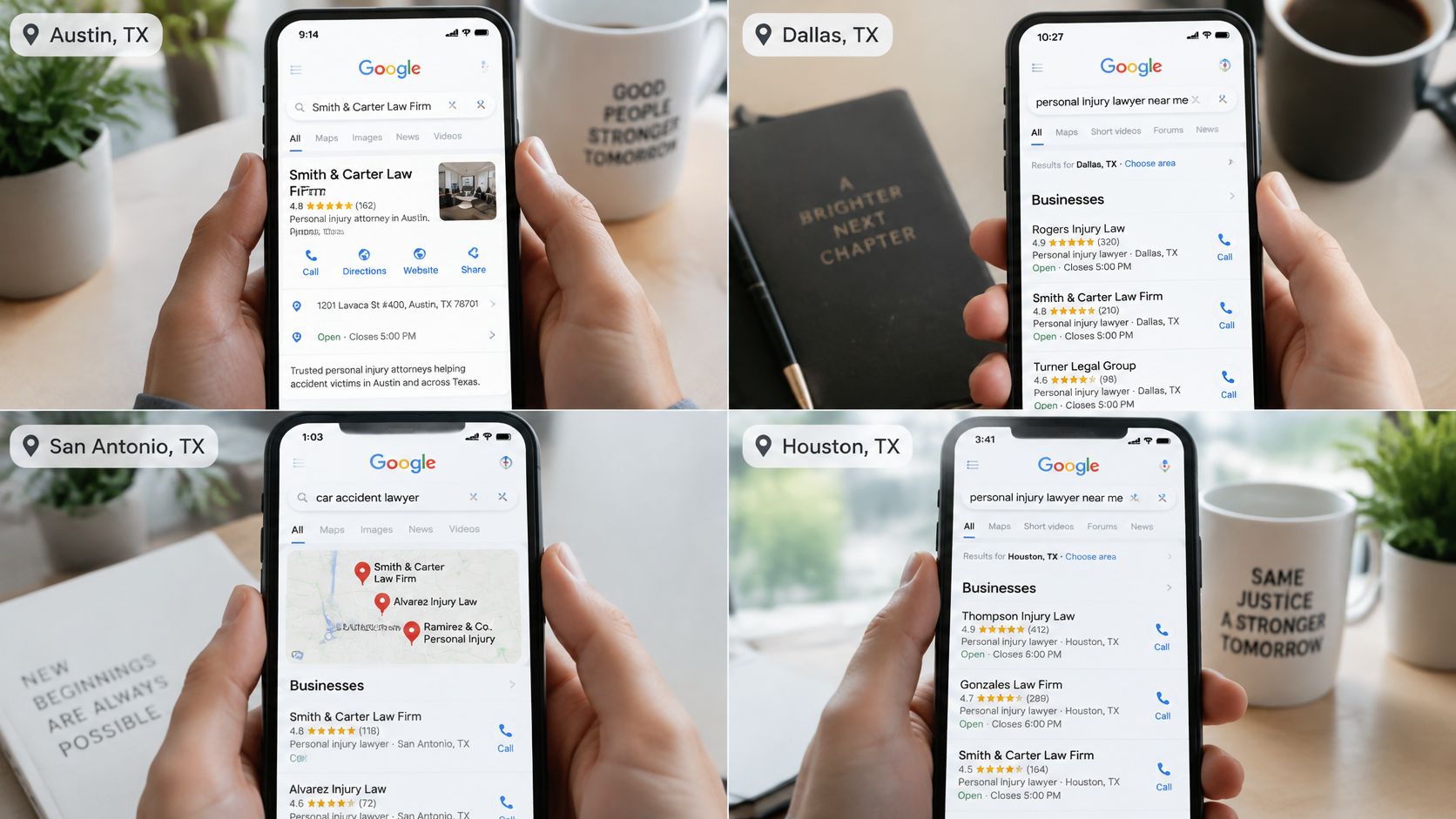
Someone searching for a personal-injury firm by name is trying to reach a known business. Accurate contact information and a clear intake link should help them finish that task.
Someone searching for a lawyer after a wreck near a particular city has a different problem. The relevant practice-area page should explain the type of matter the firm handles, its geographic coverage, and how to request a case review. Sending both visitors to a vague brand statement wastes an opportunity to answer the second person's questions.
A dental search can be equally different within the same practice. A person seeking an emergency appointment needs current hours, an appropriate service page, and a direct way to call. Someone researching what to expect with a crown can use All Stars Dental's procedure-focused resource as a starting point for learning about the treatment before contacting a practice.
Match the next step to the searcher's decision, not to the action your template happens to feature.
Roofing and HVAC searches reveal urgency and coverage
A homeowner concerned about storm damage needs to understand the roofer's inspection process and how to request an assessment. Another homeowner may already understand the service but need confirmation that the crew travels to their neighborhood. A clear coverage page answers that second question more directly than a general roofing article.
For HVAC, a no-cool search calls for an accurate service description, truthful availability information, and an obvious phone option. A replacement-planning query needs an explanation of the assessment and installation process, including the factors that affect scheduling. The intended inquiry is a planning conversation, not necessarily an emergency dispatch.
Owners and marketing directors can apply the same distinction when selecting a website partner. A reference to a web design agency in Longview, TX belongs on the actual Longview location page. References to web design in Tyler, TX belong on the homepage.
For other markets, start with the web design service-area directory rather than assuming a dedicated city page exists. Specificity should reflect a real destination and a useful answer.
What You Can Control When Distance Limits Rankings
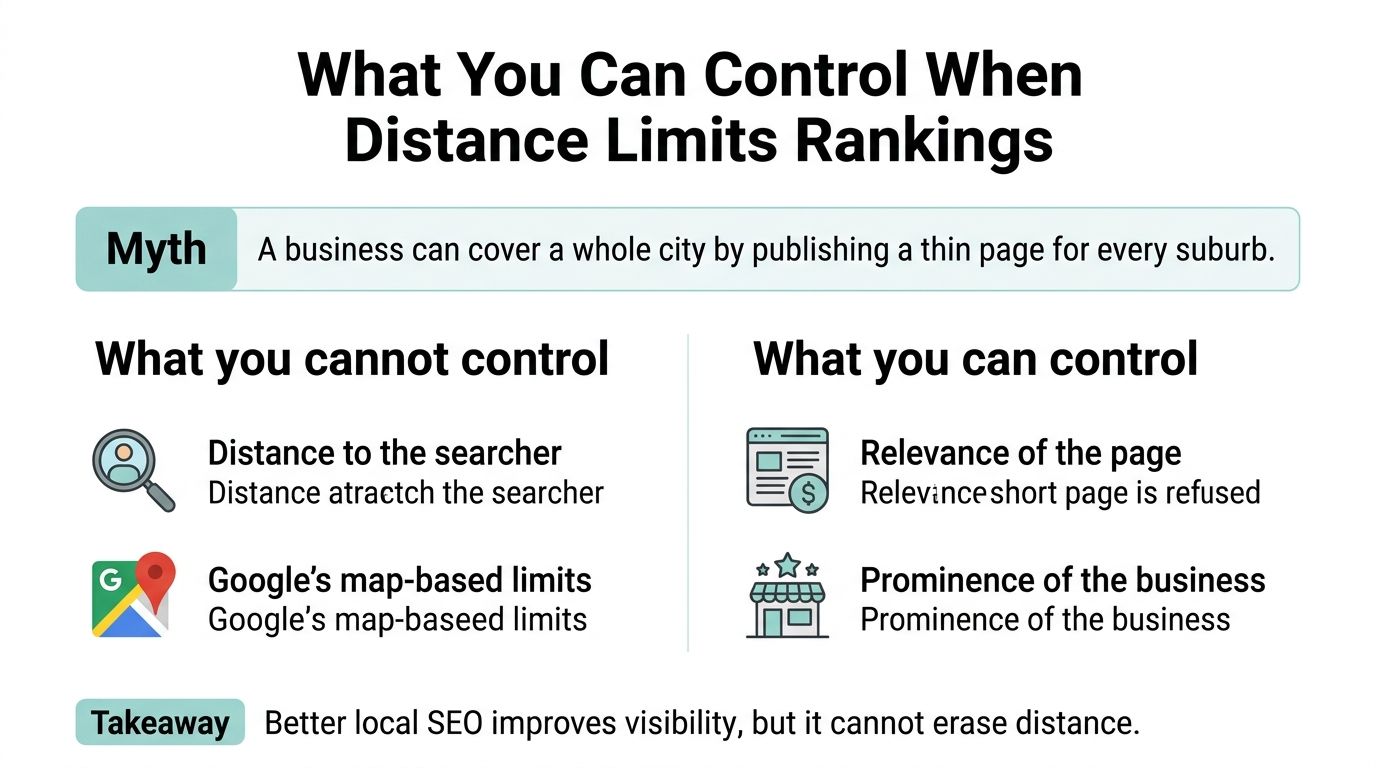
Publishing a thin page for every suburb won't give a business dependable map visibility across an entire city. That promise confuses the ability to publish content with the ability to change geography.
Google's explanation of distance and prominence in local results says distance relates to the searcher or named location, while review count and score can influence local ranking. Prominence also draws on information across the web, including links, articles, and directories.
Make a coverage decision before ordering more pages
The controllable work is straightforward, although it requires follow-through. Describe the business accurately, explain legitimate coverage, publish location content with a real purpose, and earn credible recognition.
- Finish the profile: Use the Google Business Profile optimization guide to review incomplete business information.
- Align operations and presentation: Make website services and hours agree with what the business offers.
- Justify location content: Include meaningful service details or a genuine local service story, not a swapped city name.
- Develop credible mentions: Pursue relevant relationships and coverage rather than treating directory submission volume as the strategy.
A broader regional website strategy may be appropriate when the company serves customers beyond its immediate map visibility. That strategy should stand on useful service and coverage information, without promising that organic page visibility and map rankings will behave identically.
A second legitimate office deserves consideration only when the business has an operational reason to open it. Don't take on premises just to satisfy an SEO sales pitch.
Keep review requests honest
Ask customers for candid feedback after completed work and respond thoughtfully to positive and negative experiences. Don't write the sentiment for them or make a reward dependent on praise.
The FTC Consumer Reviews and Testimonials Rule took effect October 21, 2024, prohibiting practices including buying or selling fake reviews, reviews from people without actual product or service experience, and incentives conditioned on a particular sentiment, according to the FTC's announcement of the final reviews rule.
Coverage rule: Expand where you can genuinely serve and compete. Don't confuse additional URLs with additional physical presence.
The useful outcome is a defensible coverage plan. Sometimes that means improving the existing footprint before expanding it.
How to Measure Local SEO Beyond the Map Pack
Map rankings and organic clicks are useful indicators, but neither tells the whole acquisition story. A prospective customer may encounter a business in an answer, investigate its reputation, and contact it through another route.
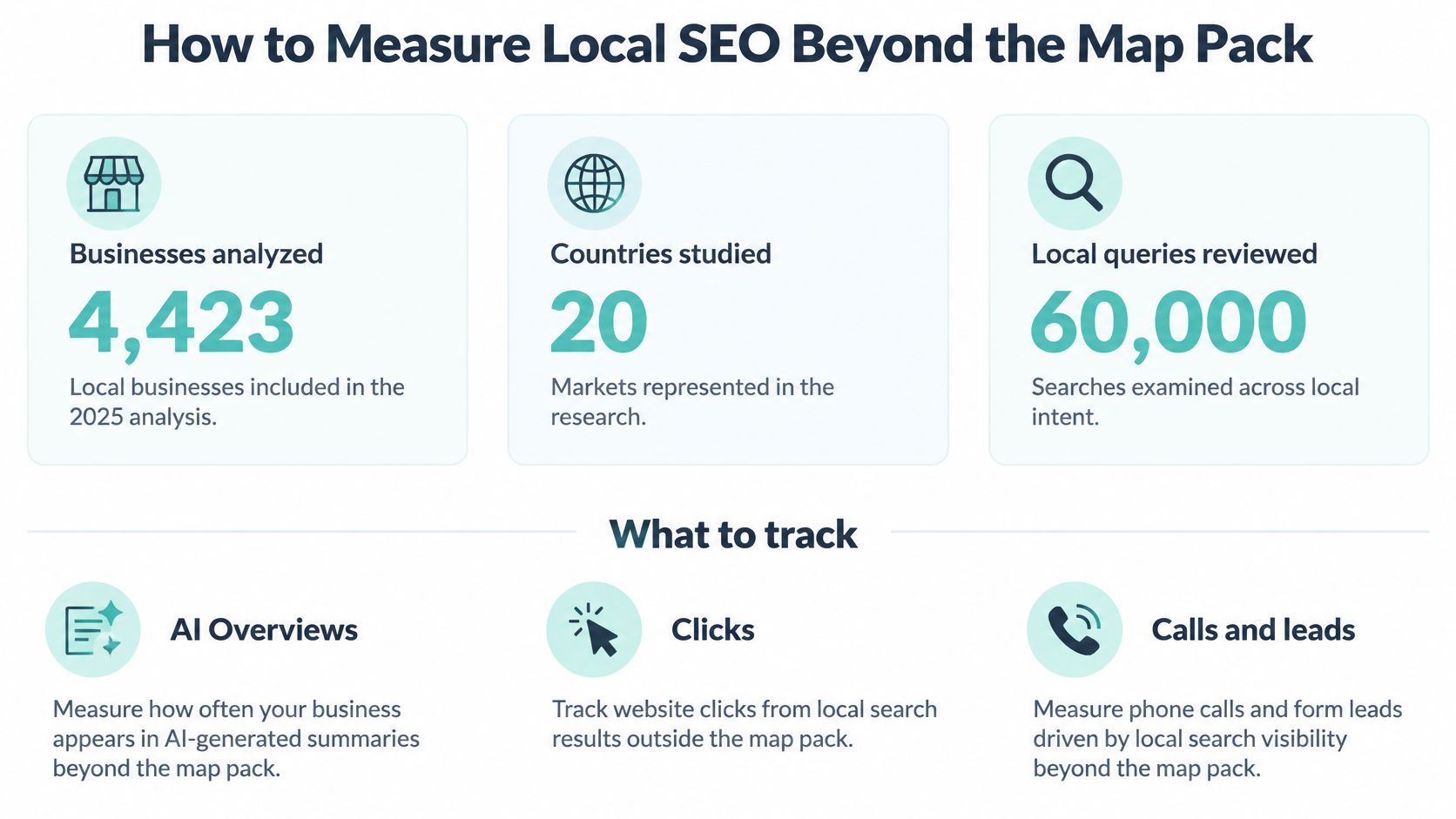
A 2025 analysis of 4,423 businesses across 20 countries and 60,000 local queries found AI Overviews in 40.2% of tested queries as of April 7, 2025, including 59.9% of reason queries, 58.3% of informational queries, 17.2% of commercial queries, and 10.5% of navigational queries, according to Local Falcon's research on AI Overviews and local-business visibility.
Those findings describe that analysis, not a universal rate for every business or search market. The intent differences are the useful planning signal.
Answer visibility and website traffic aren't identical
For high-consideration services, answer-oriented content should address diagnosis, eligibility, process, pricing factors, timelines, and the appropriate next step. Keep those explanations consistent with the business's actual services and public reputation. Publishing an answer doesn't guarantee inclusion in an AI response.
A traffic decline can coexist with continued visibility if a search answer satisfies the user without a website visit. It can also reflect a genuine performance problem. Don't assume either explanation without checking the search results and inquiry records.
Traditional rank reports may not capture citations inside AI-generated answers. Treat those appearances as a separate visibility observation, not as booked revenue.
Build a monthly owner's report
A practical report connects discovery to business outcomes:
- Calls and forms: Record completed inquiries, not just clicks on contact buttons.
- Qualified opportunities: Identify whether the person needs an offered service and falls within the actual coverage area.
- Branded searches: Watch whether more people are looking for the business specifically, without assuming SEO caused every change.
- Geographic visibility: Check rankings from multiple locations across the service area rather than relying on a downtown search.
- Answer appearances: Note relevant citations and whether the business information is accurate.
Use a consistent process for measuring SEO return on investment so reporting distinguishes activity from commercial value.
The management question is whether search is helping produce suitable inquiries. Better rankings with unsuitable leads call for a different response than steady qualified inquiries with fewer informational clicks.
How to Choose the Right Local SEO Plan
Choose a plan around the business problem, not the longest deliverables list. A company with an unclear website needs different work than one with useful pages but inconsistent business information. A provider should explain that distinction before prescribing an ongoing engagement.
Freelancers, specialist consultants, agencies, and an internal marketing team can each have a role. The right choice depends on who can execute the necessary work and who will remain accountable after launch.
Ask for decisions, not just deliverables
A credible proposal should connect the website, local and answer-focused content, technical implementation, and inquiry reporting. It should also identify what the provider won't promise.
- Demand a lead path: Ask which pages will support calls, forms, and appointments, and how those actions will be measured.
- Test the coverage promise: Ask where visibility is realistic and what geographic limitations remain.
- Reject reputation shortcuts: Fake reviews and purchased sentiment shouldn't appear in the plan.
- Clarify the service boundary: Ads and social media may support a business, but they aren't substitutes for local SEO work.
Ask what happens when the report looks better but the intake team sees no improvement. The answer should involve investigating service fit, geography, contact friction, and lead handling, not producing more ranking screenshots.
Match the provider's model to your commitment
Digital Skyrocket is one option for businesses seeking a new website and ongoing SEO together. The Tyler and Dallas agency builds and optimizes lead-generating WordPress websites for law firms, dentists, roofers, HVAC contractors, and other service companies, combining local SEO and answer-engine optimization with conversion improvements.
Its work includes content planning, technical fixes, responsive development, and reporting on rankings, organic traffic, and lead activity. It doesn't provide paid advertising, social media management, or general marketing services, although it collaborates with nearby specialists where appropriate.
The agency accepts clients only when they want a new website plus ongoing SEO. It also limits engagements to one client per industry and service area. Because it already serves a personal-injury firm targeting Texas, the relevant fit for another personal-injury engagement is outside Texas.
Those boundaries matter more than a broad promise to help everyone. If you only need a profile correction or an advertising campaign, choose a provider whose engagement matches that need.
For a redesign-and-search commitment, the next step should be a fit conversation grounded in current traffic, rankings, service coverage, and the business's capacity to handle inquiries.
For a new lead-generating website backed by ongoing local SEO, answer-engine optimization, and conversion improvements, visit Digital Skyrocket. Book a fit conversation to review your current traffic, rankings, and service area, then decide whether a new site plus ongoing search work is the right commitment.