

Organic traffic isn't SEO ROI. It's an input.
A service business can publish impressive traffic charts while missing the phone calls, consultations, qualified leads, and signed work that determine whether SEO is paying off. The popular advice, “track organic sessions and form submissions,” is incomplete for law firms, roofers, HVAC companies, and other businesses where prospects often return several times, call from a mobile device, and close offline.
A better approach connects organic visibility to revenue attribution. That means combining GA4, call tracking, CRM close rates, assisted conversions, customer lifetime value, and newer visibility signals such as branded search lift and AI citations. The standard formula still matters, but the quality of the revenue input matters more than the arithmetic.
Table of Contents
- Why Most SEO ROI Reports Miss the Real Picture
- Defining Conversion Values and Customer Lifetime Value
- Setting Up Analytics and Call Tracking for Accurate Attribution
- Calculating SEO ROI with Real Numbers
- ROI Examples for Law Firms and Home Service Companies
- Common Measurement Mistakes and How to Fix Them
- Building a Monthly SEO ROI Dashboard
Why Most SEO ROI Reports Miss the Real Picture
The most common SEO report starts with organic sessions, keyword rankings, and form fills. Those metrics can reveal whether visibility is moving in the right direction, but they don't prove that the business is earning more from its SEO investment.
A prospect may find a personal injury firm through an informational article, return through a branded search, call from a service page, and sign a case after an intake conversation. A homeowner may read a roofing guide, visit a location page later, and call directly after seeing the company name again. If the final call or direct visit receives all the credit, the earlier organic interactions disappear from the revenue report.
Practical rule: If your report can't connect a search-driven lead to a qualified opportunity and eventual revenue, it measures activity, not ROI.
Why last-click reporting undervalues service SEO
Last-click attribution works best when a customer converts in one trackable session. Service businesses rarely follow that pattern. Calls, multiple visits, consultation bookings, offline follow-up, and delayed decisions create gaps between the first meaningful search interaction and the final conversion.
Google Analytics 4 is designed to distribute credit across touchpoints, including early-touch and mid-touch interactions, rather than relying only on the final click. That makes assisted conversions important when SEO introduces a prospect who later converts through direct traffic, email, paid search, or a phone call. Google Analytics 4's attribution approach and assisted-conversion reporting provide a more useful foundation than a last-click-only dashboard.
The issue isn't that last-click data is useless. It's that it answers a narrower question: “Which source received credit immediately before conversion?” It doesn't answer, “Which channels helped create demand, educate the prospect, and move the opportunity toward a sale?”
The complete ROI mental model
A credible service-business SEO dashboard follows the customer journey:
- Visibility: Organic impressions, rankings, branded search lift, and AI citation visibility.
- Engagement: Organic sessions, landing pages, return visits, and important page interactions.
- Conversion: Phone calls, form submissions, consultation bookings, and other qualified actions.
- Pipeline: Lead status, qualification, sales follow-up, and close rate in the CRM.
- Revenue: Signed work, collected revenue, repeat business, referrals, and attributed lifetime value.
- Investment: Agency fees, internal labor, content, development, tools, and implementation costs.
Zero-click behavior makes this broader model more important. A prospect may discover a firm in search results or an AI-generated answer without clicking immediately, then perform a branded search later. Recent guidance on measuring SEO ROI in AI search recommends connecting SEO to CRM revenue, assisted conversions, branded search lift, and emerging AI visibility metrics instead of treating sessions and form fills as the entire return.
Defining Conversion Values and Customer Lifetime Value
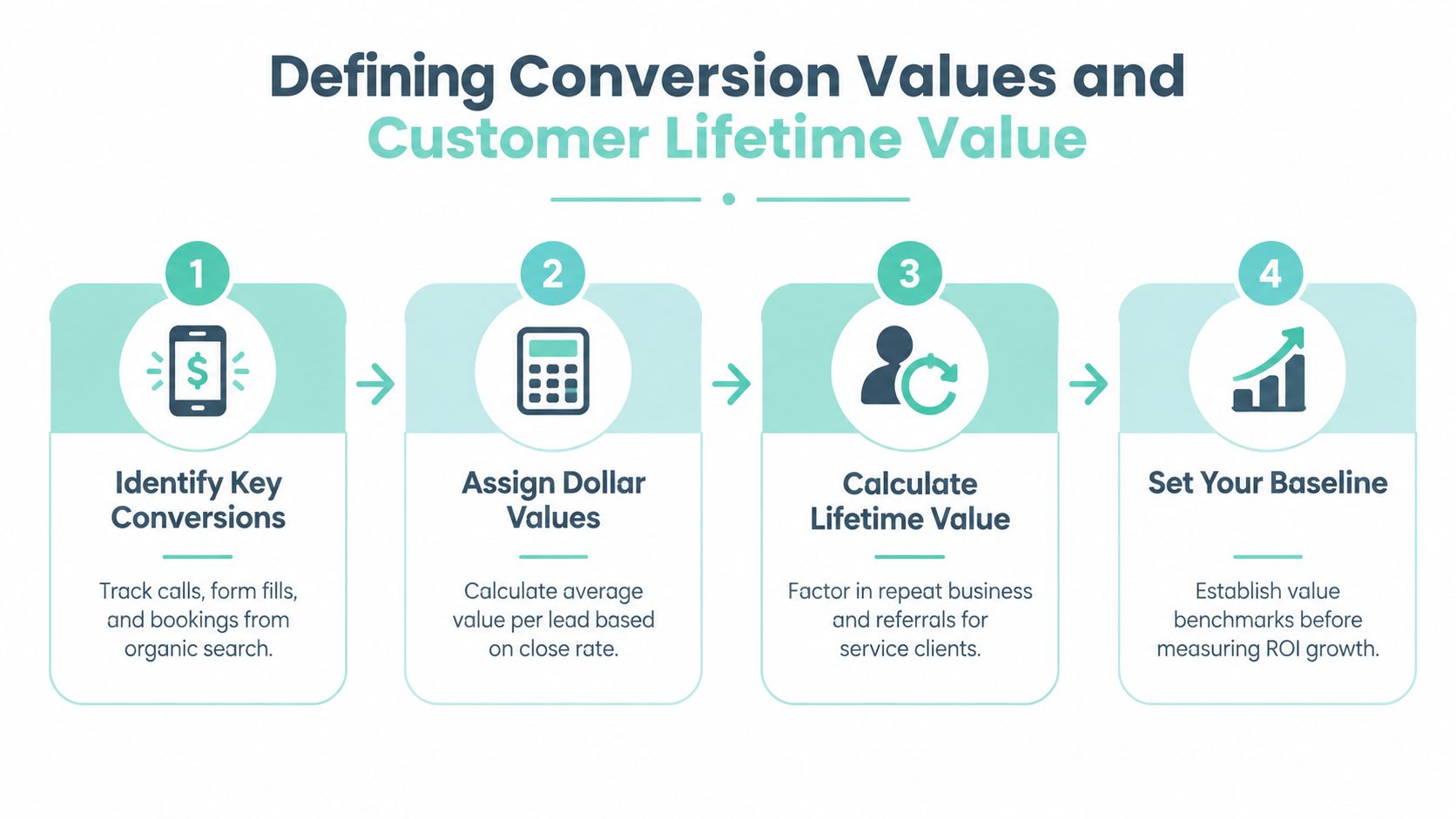
You can't calculate meaningful SEO ROI until you know what each conversion is worth. A form submission, a qualified intake call, and a signed project aren't interchangeable events, so assigning the same value to all of them will distort performance.
Start by listing every action that can create business value:
- Phone calls: Separate short nuisance calls from calls that meet your qualification criteria.
- Forms: Distinguish general inquiries, service requests, estimate forms, and high-intent consultation forms.
- Bookings: Track scheduled consultations, inspections, estimates, and appointments.
- Qualified opportunities: Record when a salesperson or intake team confirms that the lead fits the business.
- Closed customers: Import signed work and actual revenue from the CRM.
Assigning a value to each lead
The basic lead value calculation is:
Average revenue per customer × close rate = average revenue per lead
For a law firm, a qualified intake call may deserve a different value from a general contact form because the call can contain more information about case type, location, urgency, and eligibility. The firm should use its own historical close rate and accepted case value, rather than copying an industry benchmark.
A roofing company can apply the same logic to estimate requests. If the business knows how often qualified estimates become jobs and what an average job produces, it can assign an estimated value to an estimate request. Keep unqualified requests separate, because including every form or call in the same pool makes organic traffic look more valuable than it is.
Calculating customer lifetime value
Single-sale revenue can understate service-business SEO. A home services customer may return for maintenance, use the company for another project, or refer a neighbor. A law firm may have a different revenue pattern, but the principle remains the same: measure the economic value the customer creates after the initial conversion.
A practical lifetime value model includes:
- Initial project or case revenue
- Expected repeat business
- Probability of referral
- Revenue from those future interactions
- Gross margin, if you're measuring profit rather than revenue
Avoid assigning speculative referral value without a defensible basis. Start with recorded CRM data, then update the assumptions as more closed-lead information becomes available. Your values don't need to be perfect on day one, but they must be consistent and transparent.
For the website side of the equation, review how to increase conversion rate on a website alongside your lead-value model. Better calls to action and clearer forms can increase the value extracted from existing organic demand, but the resulting conversions still need to flow into GA4 and the CRM.
Setting Up Analytics and Call Tracking for Accurate Attribution
A clean attribution setup begins with event design, not dashboards. Decide what counts as a meaningful organic action, define the required parameters, and verify that every event reaches the systems used by sales and operations.
Build the GA4 foundation
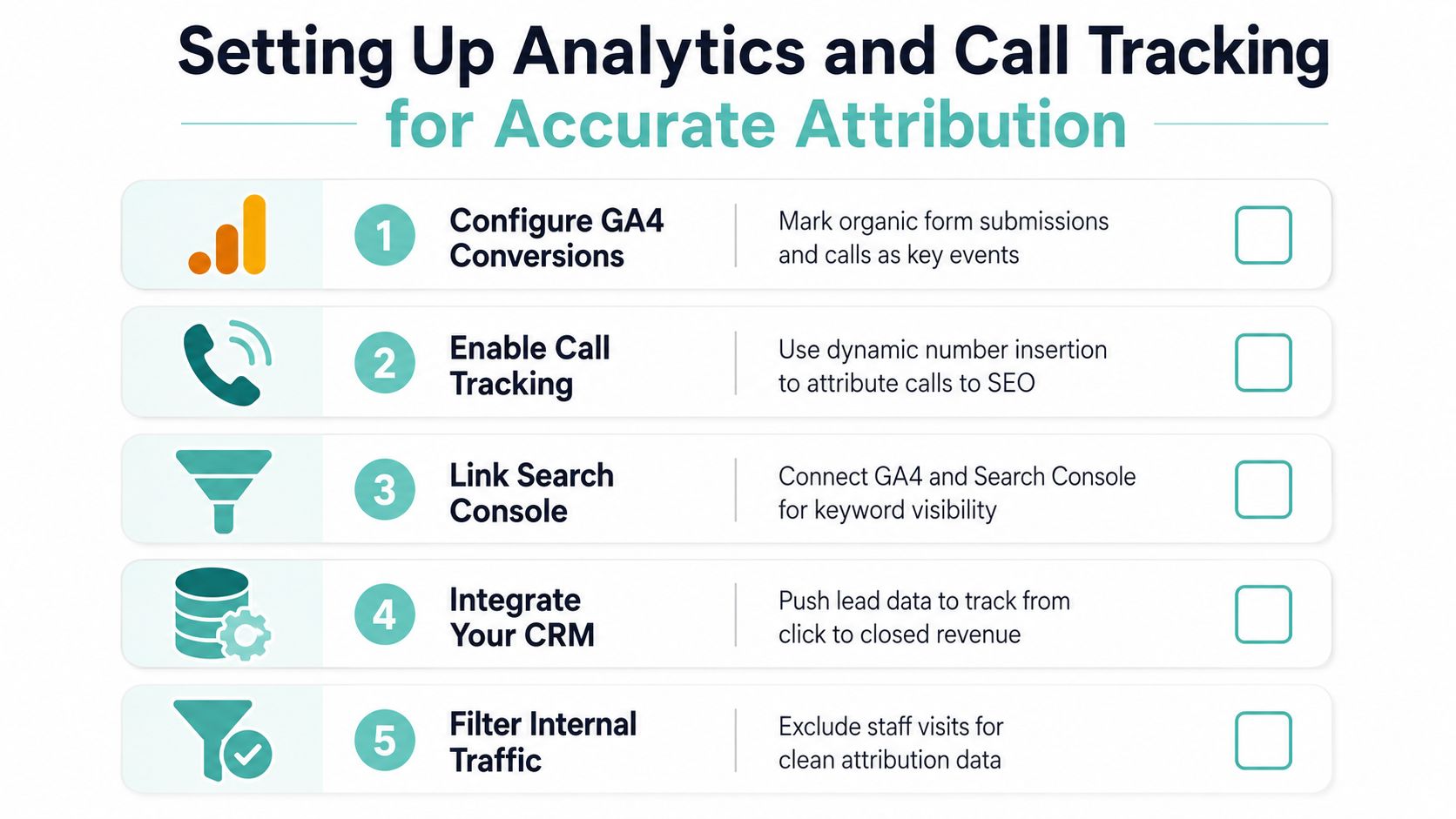
Configure GA4 events for the actions that matter to the business. Common examples include completed contact forms, click-to-call interactions, consultation bookings, estimate requests, and appointment confirmations.
Then:
- Mark important events as conversions: Treat qualified actions as key events, not every minor interaction.
- Pass value parameters: Add a value where the business has a reasonable estimate for the action.
- Capture source information: Preserve organic source, landing page, campaign details, and relevant user or session context.
- Test the full path: Submit forms, click phone numbers, and complete bookings in a test environment before trusting reports.
- Connect revenue data: Push lead status and closed revenue from the CRM into the reporting process.
The practical GA4 workflow is to convert key organic actions into conversion events, assign a value parameter where possible, and review Reports → Advertising → Attribution → Model comparison with Data-driven selected as the primary model. This GA4 SEO ROI setup guide outlines that reporting path and event-value workflow.
Treat phone calls as first-class conversions
Service businesses often lose attribution at the moment a visitor picks up the phone. A click-to-call event only tells you that someone tapped a number. It doesn't confirm whether the call connected, whether the caller was qualified, or whether the opportunity became revenue.
Call tracking should connect the call to the visitor's source and relevant landing page. Dynamic number insertion can display a tracking number to visitors arriving through organic search while preserving the company's primary number for other contexts. The call platform should also send call outcomes into the CRM, where staff can mark calls as qualified, unqualified, booked, lost, or won.
The test is simple: Every serious call should have a source, an outcome, and a path to revenue.
Connect Search Console for query and visibility context, then integrate the CRM so marketing data doesn't stop at the lead record. Exclude internal traffic, document changes to tracking, and audit event counts against actual submissions and call logs.
A useful companion is Google Analytics for website visitors, especially when teams need to understand how organic visitors interact with service pages before contacting the business.
Calculating SEO ROI with Real Numbers
The standard formula is:
SEO ROI = (Organic Revenue − SEO Investment) / SEO Investment × 100
The hard part is defining organic revenue accurately. For ecommerce, one common estimate is:
Organic visits × conversion rate × average order value
That model becomes less reliable for service businesses because the website usually generates leads, not immediate transactions. A service-business model should account for qualified leads, close rate, revenue per closed customer, and, where appropriate, customer lifetime value.
Suppose an organic campaign produces qualified calls and forms. You'd calculate the value of those leads by applying the business's historical close rate and average customer revenue. Then compare the resulting attributed revenue against the complete SEO investment, including strategy, content, technical work, development, tools, and internal implementation time.
SEO ROI calculation components
| Variable | Law Firm Example | Home Services Example |
|---|---|---|
| Primary conversion | Qualified intake call or consultation | Estimate request or service call |
| Revenue input | Accepted-case revenue or documented case value | Closed-job revenue |
| Quality adjustment | Intake qualification and signed-case rate | Estimate-to-job close rate |
| Extended value | Repeat representation or documented referrals | Maintenance, repeat projects, or referrals |
| Cost base | SEO, content, technical work, and intake-related implementation | SEO, content, website work, and tracking implementation |
A widely cited historical benchmark reports a median SEO campaign return of 748% over three years, equivalent to about $7.48 in net profit for every $1 invested. The same dataset indicates that many campaigns reach positive ROI within 6–12 months, with the strongest returns often appearing in the second or third year. The cited SEO ROI benchmark and break-even context are useful comparison points, not promises.
The time horizon matters. A month-one report may show costs before rankings, lead quality, and close data have matured. Evaluate cumulative investment and cumulative attributed revenue, then review monthly movement as a diagnostic rather than treating every month as a standalone verdict.
Organic search quality also affects the result. Historical benchmarks report organic conversion around 2.4% overall and 2.6% for B2B organic traffic, while SEO leads have been cited as closing at 14.6% compared with 1.7% for outbound marketing. The organic search conversion and close-rate benchmarks reinforce why qualified traffic and lead quality matter more than raw session volume.
ROI Examples for Law Firms and Home Service Companies
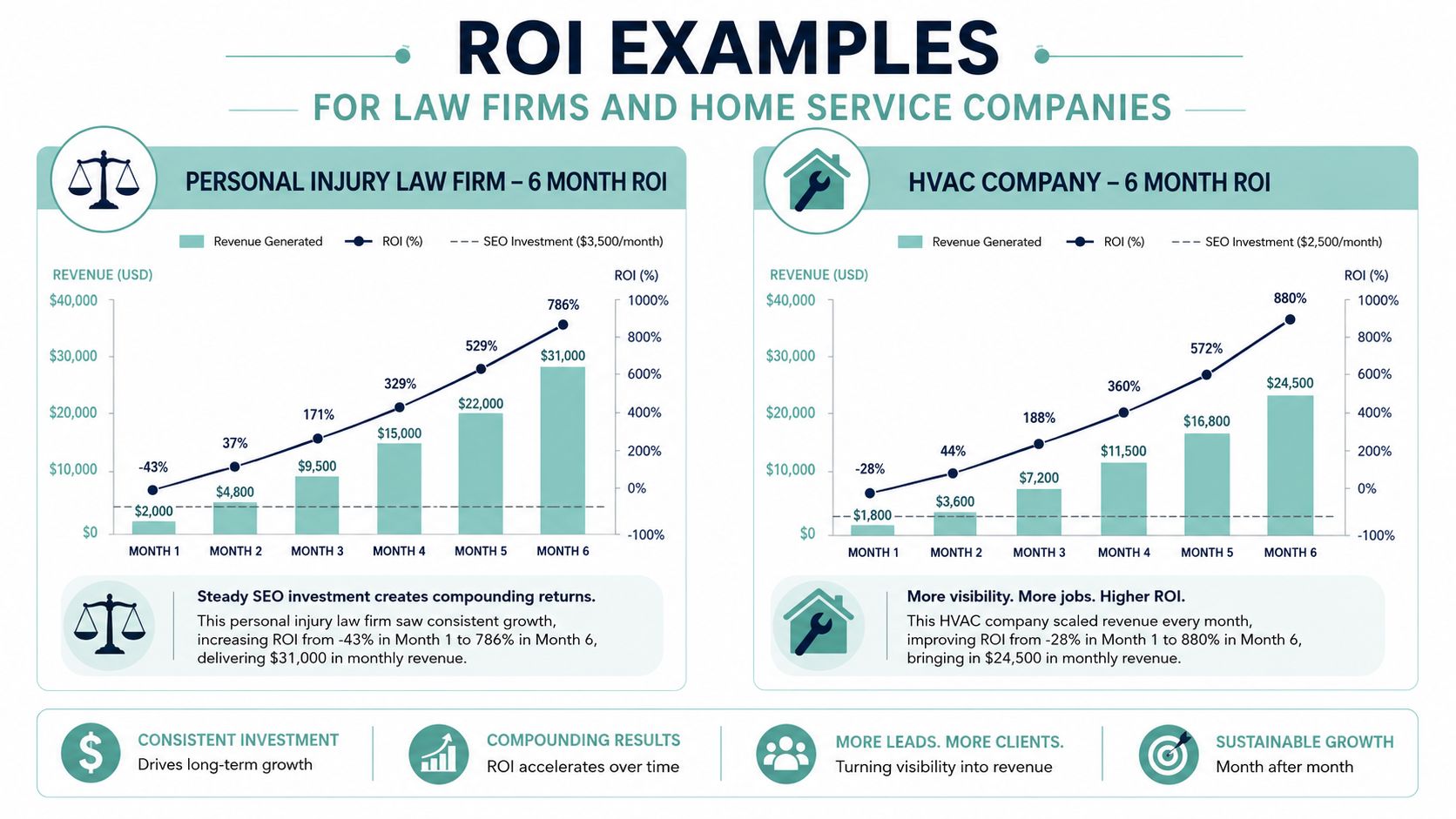
The following examples use the figures supplied in the accompanying visual. They illustrate the mechanics of cumulative ROI, not guaranteed outcomes for any law firm or HVAC company.
A personal injury firm invests $3,500 per month in SEO. The campaign produces the following attributed revenue:
| Month | SEO investment | Organic revenue | Monthly ROI |
|---|---|---|---|
| 1 | $3,500 | $2,000 | -43% |
| 2 | $3,500 | $4,800 | 37% |
| 3 | $3,500 | $9,500 | 171% |
| 4 | $3,500 | $15,000 | 329% |
| 5 | $3,500 | $22,000 | 529% |
| 6 | $3,500 | $31,000 | 786% |
The monthly calculation is revenue minus investment, divided by investment. In the first month, the firm hasn't recovered the full spend. By the second month, the attributed revenue exceeds the monthly investment, but the firm should still review cumulative ROI because earlier costs remain part of the investment base.
For a legal practice, the CRM must distinguish a raw intake from an accepted case. A call that lasts several minutes may still be unqualified, while a later signed matter may generate revenue after multiple conversations. The firm should connect the original organic touchpoint to the intake record and final case value wherever its systems allow.
A seasonal home services example
An HVAC company invests $2,500 per month and records these attributed revenues:
| Month | SEO investment | Organic revenue | Monthly ROI |
|---|---|---|---|
| 1 | $2,500 | $1,800 | -28% |
| 2 | $2,500 | $3,600 | 44% |
| 3 | $2,500 | $7,200 | 188% |
| 4 | $2,500 | $11,500 | 360% |
| 5 | $2,500 | $16,800 | 572% |
| 6 | $2,500 | $24,500 | 880% |
Seasonality makes monthly interpretation even more dangerous. A slower service period can produce weaker immediate revenue while rankings, reviews, pages, and branded demand continue building. The company should compare cumulative results with its own historical seasonality and examine whether organic leads are qualified, booked, and closed.
For a roofing or HVAC business, lifetime value can change the picture when customers return for maintenance or recommend the company. Include that value only when the CRM can support the assumption, and label estimated revenue separately from collected revenue.
Common Measurement Mistakes and How to Fix Them
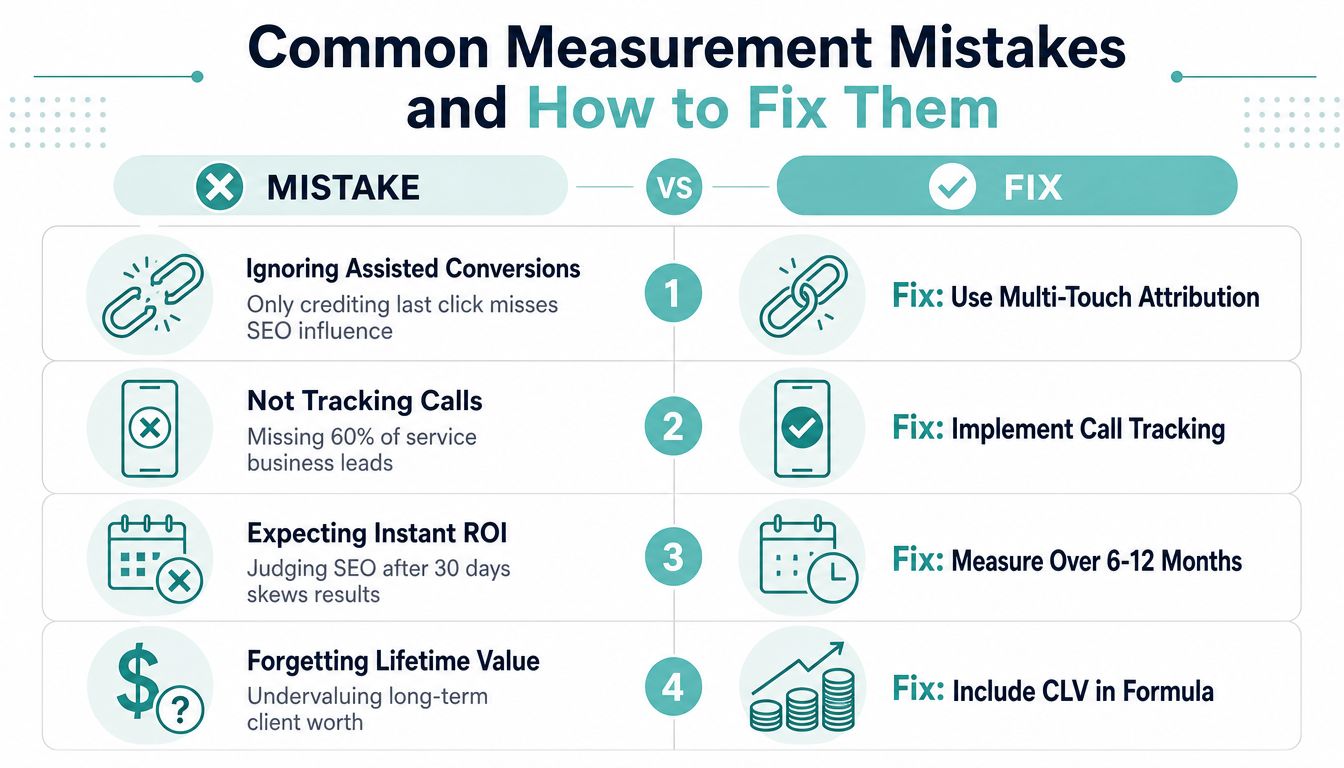
Most reporting failures come from gaps between systems, not from the ROI formula. A dashboard can look precise while hiding missing calls, duplicate leads, unqualified inquiries, and revenue that closed offline.
Mistake one, counting only the final conversion
Last-click reporting assigns all value to the touchpoint closest to the sale. That can erase the organic article, service page, or location page that introduced the prospect.
Fix: Review data-driven attribution, assisted conversions, early-touch credit, and mid-touch credit. Keep last-click available as a comparison, but don't make it the only model.
Mistake two, leaving phone calls outside the funnel
A call that never becomes a GA4 form event won't appear in a form-based ROI report. The missing value is especially damaging for businesses whose sales process depends on conversations.
Fix: Use call tracking, dynamic number insertion, call qualification, and CRM outcome fields. Match the call source with the landing page and record whether the lead became a real opportunity.
Mistake three, judging SEO on a short reporting window
SEO behaves like a compounding investment. The cited benchmark indicates that many campaigns reach positive ROI within 6–12 months, so a month-one or quarter-one view can understate the eventual return. The historical SEO ROI timeline supports using cumulative and longer-term reporting.
Fix: Monitor leading indicators monthly, but evaluate financial performance across a longer window. Track cumulative costs, cumulative attributed revenue, pipeline velocity, and changes in close rate.
Mistake four, ignoring AI and zero-click visibility
Organic clicks can flatten when search engines answer more questions directly. That doesn't automatically mean SEO has stopped creating value. Branded search lift, AI citation rate, generative share of voice, and revenue per visitor can reveal influence that click-only reporting misses.
Fix: Establish a baseline for branded queries and monitor whether the business appears in relevant AI-generated answers. Treat AI citations as an emerging visibility KPI, not as settled revenue attribution. Recent guidance on AI-search ROI measurement describes these signals as increasingly relevant in zero-click journeys.
Finally, separate revenue from pipeline. A lead that has not closed shouldn't be reported as collected revenue, while a closed customer that began with organic search shouldn't disappear because the final interaction was a phone call or direct visit.
Building a Monthly SEO ROI Dashboard
A useful dashboard tells a revenue story from left to right. It starts with visibility, shows visitor behavior, records conversions, and ends with qualified pipeline, closed revenue, and cumulative ROI.
Include these blocks:
- Visibility: Organic impressions, target-query movement, branded search activity, and AI citation observations.
- Landing pages: Organic sessions grouped by service, location, and informational page type.
- Conversions: Forms, calls, consultations, bookings, and qualified actions by source.
- Sales quality: Organic lead status, close rate, average customer value, and CRM revenue.
- Attribution: Last-click revenue, assisted credit, and data-driven attribution.
- Investment: Agency or internal costs, content, development, tools, and other SEO expenses.
- Return trend: Monthly ROI, cumulative ROI, and revenue by landing page group.
The dashboard should help you make decisions, not just deliver a score. If a service page attracts qualified calls but has weak completion rates, improve its conversion path. If a blog page earns visibility but produces no meaningful engagement, examine search intent and internal links. If one location page consistently creates signed work, use its structure to guide other locations without copying content blindly.
A reporting platform or SEO reporting dashboard framework can organize these views, but the underlying data quality matters more than the interface. Review the dashboard monthly, investigate anomalies, and use quarterly and annual views to judge the compounding investment.
SEO ROI measurement isn't a one-time report. It's an operating practice that improves as call outcomes, CRM stages, conversion values, and attribution rules become more accurate.
Digital Skyrocket builds and optimizes lead-generating websites for service businesses, connecting technical SEO and answer engine optimization with forms, calls, CRM tracking, and conversion improvement. Visit Digital Skyrocket to discuss a measurement system that ties organic visibility to qualified inquiries and signed work.