
You open Google after a rough week and find the review you didn't expect sitting near the top of your business profile. The complaint is inaccurate, your strongest competitor appears beside it with polished answers, and a new lead tells you the website “didn't feel trustworthy.” Nothing changed inside your business overnight, but the public evidence prospects use to judge you did.
That's the operating reality of online reputation management for small businesses. Reviews, business listings, customer language, public responses, and search visibility now work together as a revenue and risk system. A strong program protects qualified leads before they call, while a weak one leaves your pipeline exposed to stale information, unanswered complaints, and manufactured review activity.
Table of Contents
- The Reputation Reality Most Small Businesses Miss
- Where Your Reputation Actually Lives Online
- Building a Weekly Monitoring Routine That Catches Problems Early
- Getting More Reviews Without Sounding Desperate
- Writing Responses That Turn Reviews Into Revenue
- Optimizing Google Business Profile and Local Citations
- Crisis Response, Measurement, and Knowing When to Hire Help
The Reputation Reality Most Small Businesses Miss
The owner in that scenario usually reacts in the wrong order. They ask a few loyal customers for reviews, argue with the unhappy reviewer, and update the website weeks later. Those actions may help, but they don't address the system prospects are seeing across Google Business Profile, map results, review platforms, social posts, and answer engines.
Review behavior became mainstream in local commerce years ago. Wharton's summary of BrightLocal's 2018 Local Consumer Review Survey reported that 86% of consumers read reviews for local businesses, while 95% of people ages 18 to 34 did so. Consumers read an average of 10 reviews before trusting a business, and 57% would only buy from a business with four or more stars. The same summary reported that 40% only considered reviews written within the past two weeks. Wharton's overview of small-business reputation management shows why rating, volume, and recency became operating inputs rather than vanity metrics.
The old playbook, “ask happy customers for reviews,” is incomplete because buyers may now encounter an AI-generated summary before they read individual comments. Coverage of current review behavior reports that 82% of consumers read an AI-generated review summary before individual reviews, and 23% rely solely on that summary. It also reports that 53% don't trust reviews that seem generated by AI, while 52% distrust reviews without enough context. The review and ratings playbook for AI-driven reputation management points to a critical shift. Your business needs specific, credible customer language, not just a larger pile of generic praise.
The six parts of a working system
A practical program has six connected jobs:
- Monitoring: Find new reviews, mentions, ranking changes, and suspicious activity early.
- Acquisition: Ask real customers for honest feedback at the right moment.
- Response: Acknowledge public feedback quickly and specifically.
- Optimization: Keep profiles, citations, services, and proof assets accurate.
- Defense: Document and report policy violations, fake reviews, and coordinated attacks.
- Measurement: Connect reputation signals to visibility, inquiries, and conversion behavior.
That framework changes the question from “How do we get more stars?” to “Which reputation signals are helping or blocking qualified prospects?” Resources such as ViralRef for better ratings can support the review-management portion of that workflow, but acquisition alone won't repair inaccurate listings, weak service pages, or an unanswered public complaint.
Where Your Reputation Actually Lives Online
Your reputation isn't stored in one dashboard. It's distributed across surfaces that buyers, search engines, and answer engines interpret differently.
Google Business Profile usually deserves first attention for local service companies because it connects business details, map visibility, reviews, photos, questions, and owner responses. Apple Maps and Bing Places matter because customers use different discovery ecosystems. Yelp can carry particular weight for consumer services, while industry directories may influence buyers who want specialized credentials or location-specific providers.
Your own website is the first-party layer. You control testimonial placement, service descriptions, case evidence, review markup where appropriate, contact details, and the context around customer outcomes. Third-party platforms, forums, social networks, news coverage, and directory listings form the earned layer. You can respond and correct information there, but you can't control the publishing environment.
Prioritize by buyer journey
A law firm should inspect Google Business Profile, legal directories, local news, and public discussions where potential clients evaluate credibility. A dentist should prioritize Google, Yelp, health-related directories, and location pages that explain services clearly. A roofer or HVAC company should focus on Google Maps, contractor directories, neighborhood conversations, and the consistency of service-area information.
Niche reviews shouldn't be dismissed because they don't sit on Google. Search systems can discover language from multiple sources, and answer engines may use those references when forming summaries. The practical priority is not to appear everywhere. It's to maintain accurate, credible information on the platforms your customers and search systems already use.
Review velocity, recency, rating, and response behavior contribute to the trust context around local search. Consumer research cited by Moz found that 96% of people read reviews, 86% considered reviews either the most important or somewhat important trust factor, and more than 90% said owner responses influence them to a moderate or extreme degree. Moz's local business review survey summary supports treating responses as visible conversion content, not administrative housekeeping.
Building a Weekly Monitoring Routine That Catches Problems Early
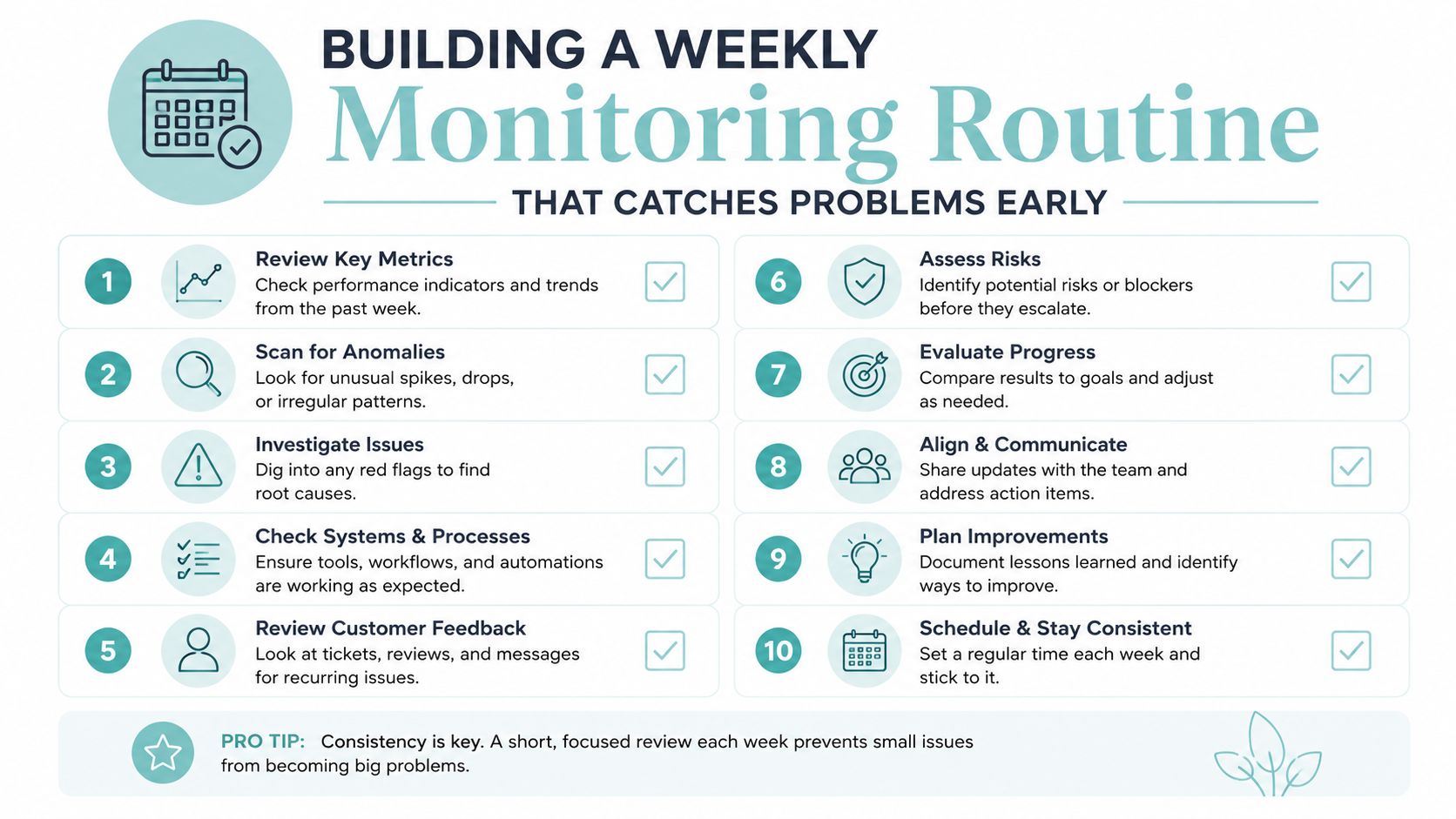
Monitoring shouldn't begin after a complaint goes viral. A small business can run a disciplined weekly review without building a complicated command center.
Start with a shared intake queue. This might be a reputation platform, a structured spreadsheet, or a project-management board with one row per review, mention, listing issue, and escalation. Native platform apps are useful, but relying on one app creates blind spots across Yelp, social channels, directories, and search results.
Run the review in a fixed sequence
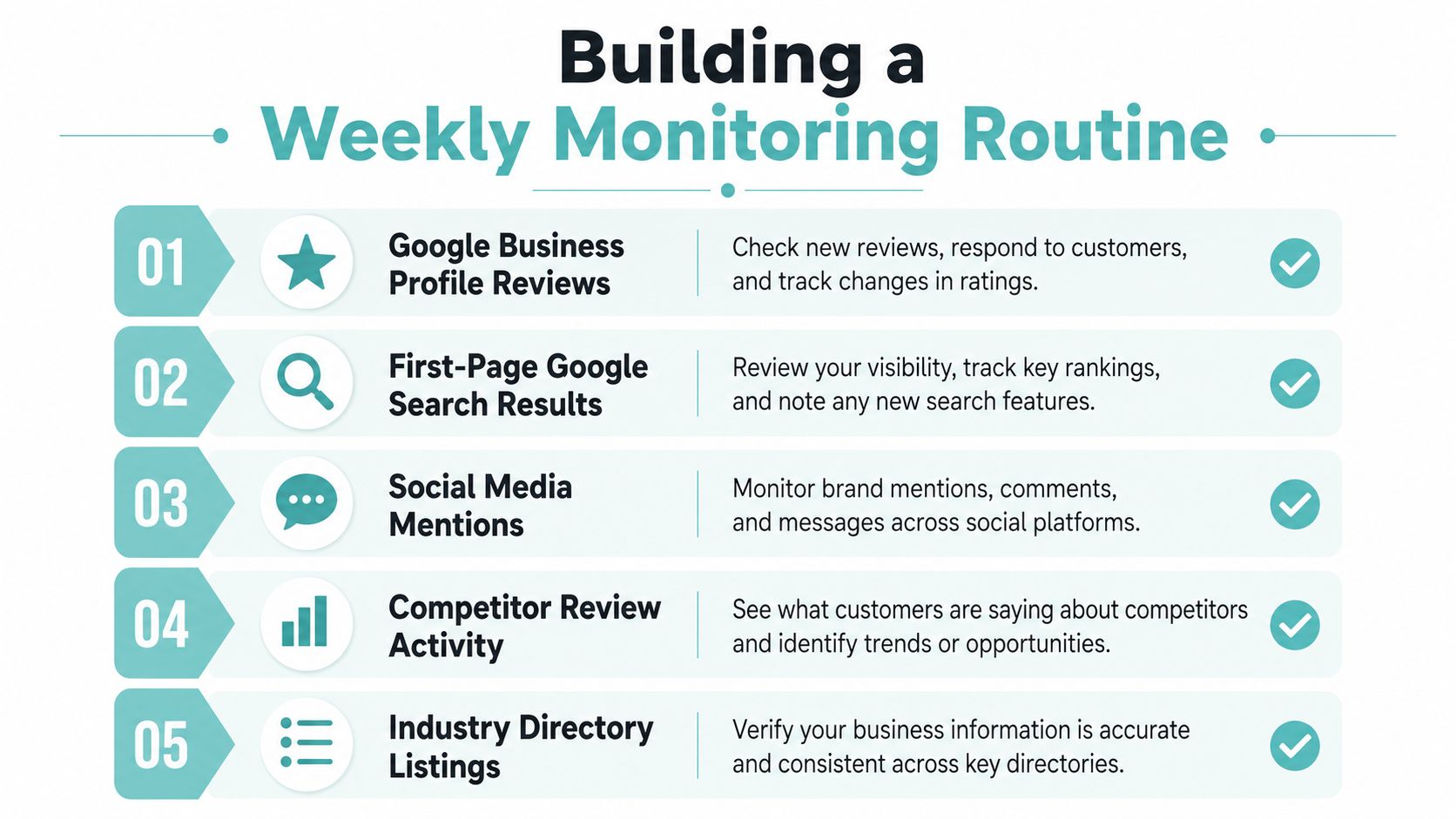
Use the same order each week so the process doesn't depend on memory:
- Check Google Business Profile reviews. Record new ratings, unanswered reviews, recurring complaints, and changes in reviewer behavior.
- Search the brand name. Review the first page for inaccurate pages, hostile commentary, outdated profiles, and competitor comparisons.
- Check major review platforms. Include Yelp and the industry directories that matter to your service category.
- Scan social mentions. Look for tagged posts, public complaints, neighborhood discussions, and customer praise that could become testimonial material.
- Inspect AI summaries manually. Search important branded and service queries, then compare the summary language with your actual customer feedback and website content.
Set Google Alerts for the business name, owner name, major services, and distinctive product or location terms. Turn on platform notifications where available, then route alerts to the person responsible for triage. A single owner can manage this process; a larger team should assign ownership by platform and location.
Use a simple triage ladder
- Green: Positive or clearly resolved feedback. Respond within 24 hours when possible.
- Yellow: Neutral, unanswered, or unclear feedback. Investigate and respond within 12 hours where practical.
- Red: Negative, factually disputed, threatening, or suspicious review activity. Capture evidence, respond the same day, and escalate internally.
Operational rule: Every alert needs an owner, a status, a next action, and a deadline. If one of those fields is missing, the issue can disappear inside the inbox.
End the weekly meeting by reviewing unresolved items, response quality, listing changes, emerging complaint themes, competitor activity, and the next request campaign. That turns ORM into a recurring operating review instead of a series of emotional fire drills.
Getting More Reviews Without Sounding Desperate
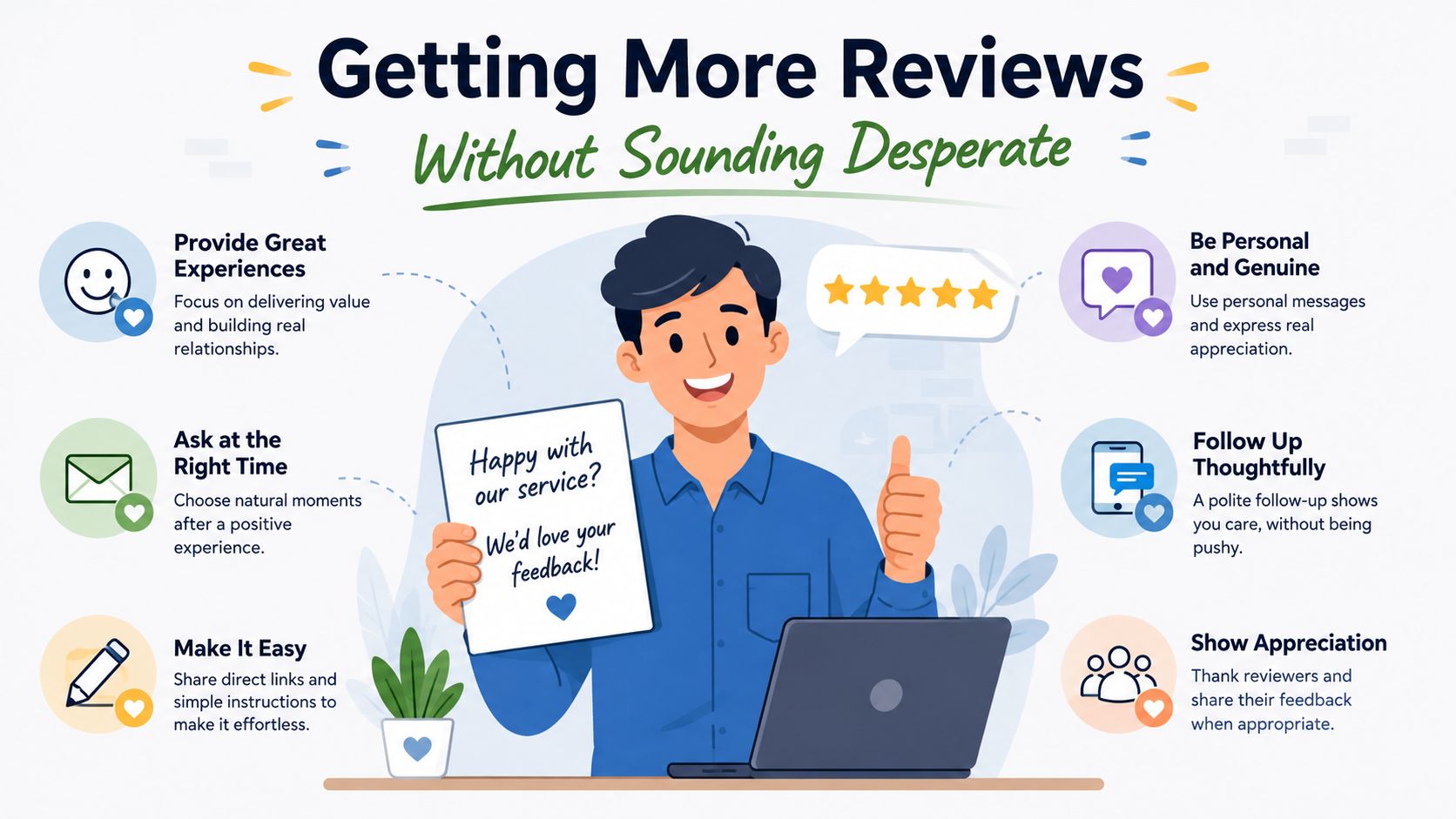
Review acquisition works best when it follows the customer experience instead of interrupting it. Don't ask every customer at random, and don't make the request sound like a favor that keeps your business alive. Build the ask into moments when the customer has already confirmed that the service helped.
The strongest moments are usually immediately after a successful service call, after a positive phone or text confirmation, and when a customer volunteers a compliment. A technician can ask at the end of a completed job. A receptionist can follow up after a patient confirms satisfaction. A case manager can request feedback after a client acknowledges a meaningful milestone.
Use direct, neutral language
Adapt scripts to the actual interaction:
“Thanks for letting us know the repair solved the issue. Would you share an honest review of your experience? This direct link takes you to Google.”
“We're glad the appointment went smoothly. If you have a moment, your feedback about the scheduling and care would help future patients understand what to expect.”
“You mentioned that the project stayed on schedule. If you're comfortable sharing that experience publicly, here's the review link.”
The request should ask for an honest review, not a positive review. Don't offer incentives unless you've checked the platform's rules and applicable regulations. Review filtering and enforcement can create more damage than a slower, authentic acquisition process.
Use short text follow-ups, email with one direct link, and QR codes at the point of service. Build a direct Google review link and a Yelp deep link, then route customers to the platform that matches the buyer journey. A location-specific link helps a multi-location business avoid sending feedback to the wrong profile.
Ask for useful detail without scripting praise
AI summaries and answer engines need context. Encourage customers to describe the service, problem, location, process, or result in their own words. You can prompt memory without dictating the conclusion:
- What service did you use?
- What problem were you trying to solve?
- What part of the process stood out?
- What should another customer know before contacting us?
Never write reviews for customers, submit reviews on their behalf, or pressure staff and clients to use identical wording. This guide to asking for customer reviews offers additional practical guidance on timing and phrasing. The objective is a steady stream of genuine, specific feedback that strengthens both trust and the language search systems associate with your services.
Writing Responses That Turn Reviews Into Revenue
A public response is a small landing-page element. Prospects read it to judge whether the business listens, understands its work, and handles friction without becoming defensive. Enterprise benchmark data reported by ReviewTrackers found that businesses replying to at least 32% of reviews achieved 80% higher conversion rates than businesses replying to only 10%. ReviewTrackers' customer-retention benchmark makes the commercial point clearly, although the benchmark shouldn't be treated as a guarantee for every small business.
Use a response structure that takes less than five minutes: thank the reviewer by name, mirror the specific service, reinforce one credible proof point, and invite a next step. Keep the wording human. A templated skeleton saves time, but the details must change.
Match the response to the review
For a glowing review, mention the service detail the customer supplied. For a vague or mixed review, acknowledge the feedback and invite a direct conversation so you can understand what happened. For a negative review, recognize the concern without admitting facts you haven't verified, then move the case into a private channel.
| Review Type | Do | Don't |
|---|---|---|
| Positive | Thank the customer by name and reference the specific service. | Paste the same generic praise under every review. |
| Mixed or vague | Acknowledge the experience and invite details privately. | Challenge the customer to prove the complaint publicly. |
| Negative | Stay factual, show concern, and provide a direct contact path. | Argue, reveal private information, or blame the customer. |
A safe negative-review response might read:
“Thank you for sharing your concern, Jordan. We take the experience you described seriously and would like to review the details with you. Please contact our office at the number on our profile and ask for the service manager so we can discuss what happened directly.”
That response doesn't confirm an unverified allegation or turn the review into a public argument. If the customer presents a resolvable service issue, move quickly toward a redo, refund, clarification, or other appropriate remedy. If the review contains threats, private information, discriminatory content, or a factual pattern that suggests manipulation, preserve the evidence and escalate.
Respond publicly when the answer can help future customers. Use a private message for account details, scheduling, billing, or personal information. Stop public exchanges when the conversation becomes repetitive, hostile, or legally sensitive.
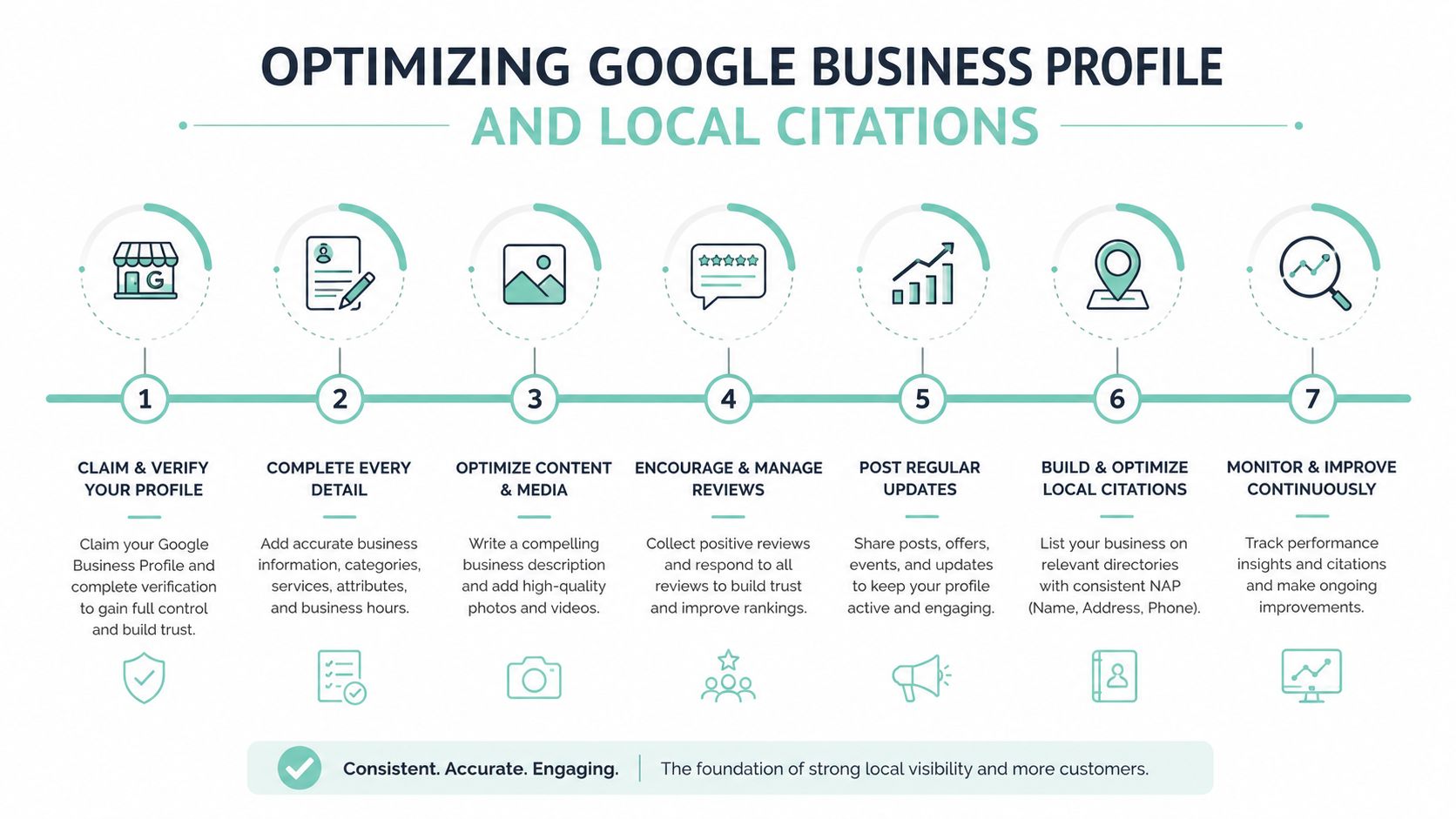
Optimizing Google Business Profile and Local Citations
A Google Business Profile is often the most visible reputation asset for a local service business, but optimization isn't a matter of stuffing every available field with keywords. The profile should make the business easy to identify, compare, contact, and trust.
Select the category that most accurately describes the primary service. Add legitimate secondary categories only when they represent real offerings. Write service descriptions in plain language, explain the customer problem each service addresses, and keep the profile aligned with the corresponding website pages. Stale hours, duplicate listings, mismatched names, and outdated phone numbers create friction before a prospect ever reads a review.
Tune the profile as a search and trust asset
Use a practical checklist:
- Category accuracy: Choose the primary category that best represents the business, not the category with the most attractive keyword.
- Service clarity: Describe actual services using the language customers use when searching.
- Photos: Add current images that show the team, work environment, equipment, finished work, or location.
- Questions and answers: Seed useful questions based on real customer concerns, then answer them precisely.
- Owner replies: Respond to reviews and questions in a way that demonstrates active management.
- Contact consistency: Match the business name, address, phone number, hours, and service-area details across major profiles.
- Website alignment: Link each important service to a page with clear information, proof, and a direct next step.
Local citations reinforce the same business identity across the web. Prioritize the directories your customers recognize, along with credible industry listings and local organizations. For a law firm, that may include legal directories and bar-related profiles. For a dentist, healthcare and local directories may matter more. For a roofer or HVAC company, contractor directories and regional service listings can provide useful discovery and corroboration.
Don't create thin listings everywhere just to increase citation count. Duplicate records, inconsistent descriptions, and abandoned profiles can spread conflicting information. Audit the top directories that matter to your industry, then document the listing URL, owner access, business details, category, description, and last review date.
Connect local SEO with AEO
Your website should support the reputation signals shown in third-party profiles. Publish service pages that answer practical questions, explain process and qualifications, and display testimonials with clear context. Use appropriate structured data, but don't mark up content that users can't see or claim ratings you can't substantiate.
Answer engines need consistent entities and clear relationships. The business name, service area, services, contact details, credentials, and customer language should agree across the profile, citations, and website. This consistency doesn't guarantee inclusion in an AI answer, but it gives search systems cleaner material to interpret.
Defend against manufactured review activity
Not every negative review is fake, and a harsh review may identify a real operational failure. Still, small businesses should look for patterns that deserve investigation, including similar wording across accounts, profiles with no meaningful history, sudden rating changes, and timing that coincides with a dispute, promotion, or competitor campaign.
Keep an incident file containing:
- Screenshots of the review and business profile
- Publication dates and timestamps
- Reviewer profile snapshots
- URLs and platform notifications
- Related customer records, without exposing private data
- A chronological incident log
- Notes from staff who handled the underlying interaction
Google says only reviews that violate its policies are eligible for removal. To report one, open the Business Profile, select Read reviews, choose Report, select the reason, and submit the report through the stated process. Google's review-removal guidance explains that flagged policy-violating reviews may be removed from Maps and Search, but reporting doesn't guarantee removal.
Use the same evidence-led approach with Yelp and other platforms. Consult legal counsel when the content involves provably false factual claims, impersonation, threats, confidential information, or coordinated harm. A lawyer can assess whether a defamation claim or another legal remedy is appropriate. Don't threaten customers casually, and don't use a DMCA process for content that isn't a copyright issue.
Defense principle: A documented pattern gives a platform or attorney something concrete to evaluate. Anger alone doesn't.
Run a quarterly audit for sudden rating shifts, suspicious reviewer histories, repeated language, unusual review timing, unresolved duplicate listings, and policy-report status. Then complete the profile work with local map optimization guidance that connects listing accuracy with broader local search performance.
Crisis Response, Measurement, and Knowing When to Hire Help
More reviews won't solve a crisis if the business can't detect, classify, and respond to risk. A coordinated complaint, news mention, or suspicious review cluster needs a controlled operating response.
Use the first 72 hours carefully
First response: Preserve screenshots, timestamps, account details, URLs, and internal records. Pause improvised replies from staff and appoint one person to approve public language.
Public communication: Acknowledge the concern without arguing, revealing private information, or repeating inflammatory claims. State what the business is reviewing and provide a direct contact route.
Internal coordination: Tell reception, sales, technicians, attorneys, and leadership what they should say if prospects ask questions. Keep one factual timeline so every channel uses consistent information.
Platform and legal action: Report policy violations through the platform's process. Ask counsel to assess serious defamation, threats, impersonation, or confidential-data exposure. Don't promise removal, and don't publish evidence that compromises customer privacy.
Measure the system monthly with a compact dashboard: review velocity, average rating, response rate, response time, branded search visibility, and the share of important searches where the business appears in the local pack. Add qualified calls, form submissions, and booked consultations when tracking allows. The point is to connect reputation activity with lead behavior, not to celebrate review volume in isolation.
Clutch found that 88% of small businesses monitored their online reputation at least quarterly, 66% used social media for monitoring, and 44% relied only on human resources such as in-house staff or PR agencies. Clutch's small-business reputation monitoring survey illustrates why ownership and workflow matter more than buying another disconnected tool. More recent coverage reports that 74.5% of small and midsize businesses consider reputation management critically important, while 62.6% still depend on fragmented native review platforms. Coverage of current SMB reputation data reinforces the operational gap.
Decide whether to stay in-house
DIY management works when one person can monitor every relevant surface, write responses, maintain listings, and investigate incidents without delaying core operations. Bring in specialized help when multiple locations, high-risk services, legal exposure, staff turnover, or a complex search market make missed signals expensive.
An agency should provide clear ownership, documented escalation rules, reporting tied to leads, and access to the underlying profiles. It shouldn't promise to erase legitimate criticism or manufacture praise. Digital Skyrocket is one option for businesses that need a new lead-generating website alongside ongoing SEO, AEO, local optimization, and reputation work, particularly service companies such as law firms, dentists, roofers, and HVAC businesses.
Common questions after the first audit
How long do results take? Accurate listings and thoughtful responses can improve the customer experience quickly, but search visibility and review patterns develop over time. Track directional changes instead of expecting an instant reversal.
Should you answer every review? Aim for consistent coverage. Prioritize unanswered, recent, detailed, and negative reviews, then maintain a human response standard for positive feedback.
What about a former employee's public complaint? Don't disclose employment details or retaliate publicly. Preserve the post, assess whether it violates platform rules, respond only to verifiable business concerns, and seek legal advice if the content makes serious false claims.
Start the next 30 days by auditing every major profile, creating the shared intake queue, assigning response ownership, requesting honest feedback from recent customers, and recording baseline visibility and lead metrics. If reviews aren't appearing as expected, use this troubleshooting guide for Google reviews that aren't showing up before assuming customers failed to submit them.
Digital Skyrocket builds and optimizes lead-generating websites for service businesses, combining web design, local SEO, AEO, conversion optimization, and reputation management into one measurable system. Visit Digital Skyrocket to discuss a website and ongoing SEO plan designed to turn stronger search trust into qualified inquiries.