A position-one organic result can receive 20.02% of clicks across result types, but that average falls to 9.69% when an AI Overview appears on the page, according to anonymized Google Search Console data reported in July 2026 (Visionary Marketing's analysis). Ranking still matters, but ranking alone no longer determines how much traffic your service business receives.
Click-through rate, or CTR, measures how often people choose your result after seeing it. For a law firm, roofer, dentist, or HVAC company, the commercial question is more important than the metric itself: does the search result attract the right person, and does the visit become a call, form submission, consultation, or booked service?
The practical answer to how to improve click through rates is broader than rewriting a title tag. You need to understand the search page, segment your data, make a precise promise, preserve that promise on the landing page, and measure qualified leads rather than clicks in isolation.
Table of Contents
- Why Ranking First Is No Longer Enough
- Understanding How Position Affects Your Clicks
- Executing a Controlled Title and Snippet Optimization
- Adapting Your CTR Strategy to SERP Features
- Prioritizing Post-Click Experience and Lead Quality
- Building Your Continuous CTR Improvement Process
Why Ranking First Is No Longer Enough
A large analysis of 5,079,491 Google searches covering 874,929 pages found that the first organic result received an average CTR of 31.7% and was about 10 times more likely to receive a click than the result in position 10 (Advanced Web Ranking's organic CTR analysis). That is still strong evidence that rankings matter. It is also why so many service businesses overestimate what position one will deliver once the page is live in search.
The modern results page competes with ads, local packs, featured snippets, review blocks, videos, “People also ask” panels, and AI-generated summaries. A searcher may get enough context from those elements to delay or skip an organic click, even if your page holds a top spot.
A local service business has to read that page, not just the ranking. For a plumber, solicitor, roofer, dentist, or HVAC company, the question is not only whether the listing is visible. It is whether the searcher still needs to visit.
The local search implication is straightforward.
Someone searching for “emergency roof repair near me” usually wants a phone number, service area, proof of availability, and a fast next step. Someone searching for “how long does a roof inspection take” is often looking for an answer before deciding whether to call. The same keyword class can produce very different click behavior, and the page has to match that intent.
That choice affects the title you write, the page you build, and the lead quality you measure. A broad informational title can raise CTR while bringing in visitors who are less ready to buy. A tighter title may generate fewer clicks, but the inquiries can be stronger.
Practical rule: Treat ranking as a chance to earn attention, not proof that attention has already been won.
For local companies, better relevance usually starts with pages built around precise intent. An injury page should address the injury type and the intake need. A dentist page should reflect the treatment. A roofer page should match the repair or replacement problem. A service-area page should name the location only when the business serves it.
Searchers are also interacting with answer systems before they ever reach a blue link. Businesses that want to adapt that behavior need to understand answer engine optimization, because visibility now includes being a useful source for answers, not only earning the click.
Understanding How Position Affects Your Clicks
Ranking position remains a strong CTR signal, but its value depends on what surrounds the organic results. In July 2026, average organic CTR across all result types was 20.02% for position one, 10.36% for position two, and 3.89% for position three. On pages displaying an AI Overview, those averages fell to 9.69%, 3.69%, and 1.70%, respectively, according to the Google Search Console analysis reported by Visionary Marketing.
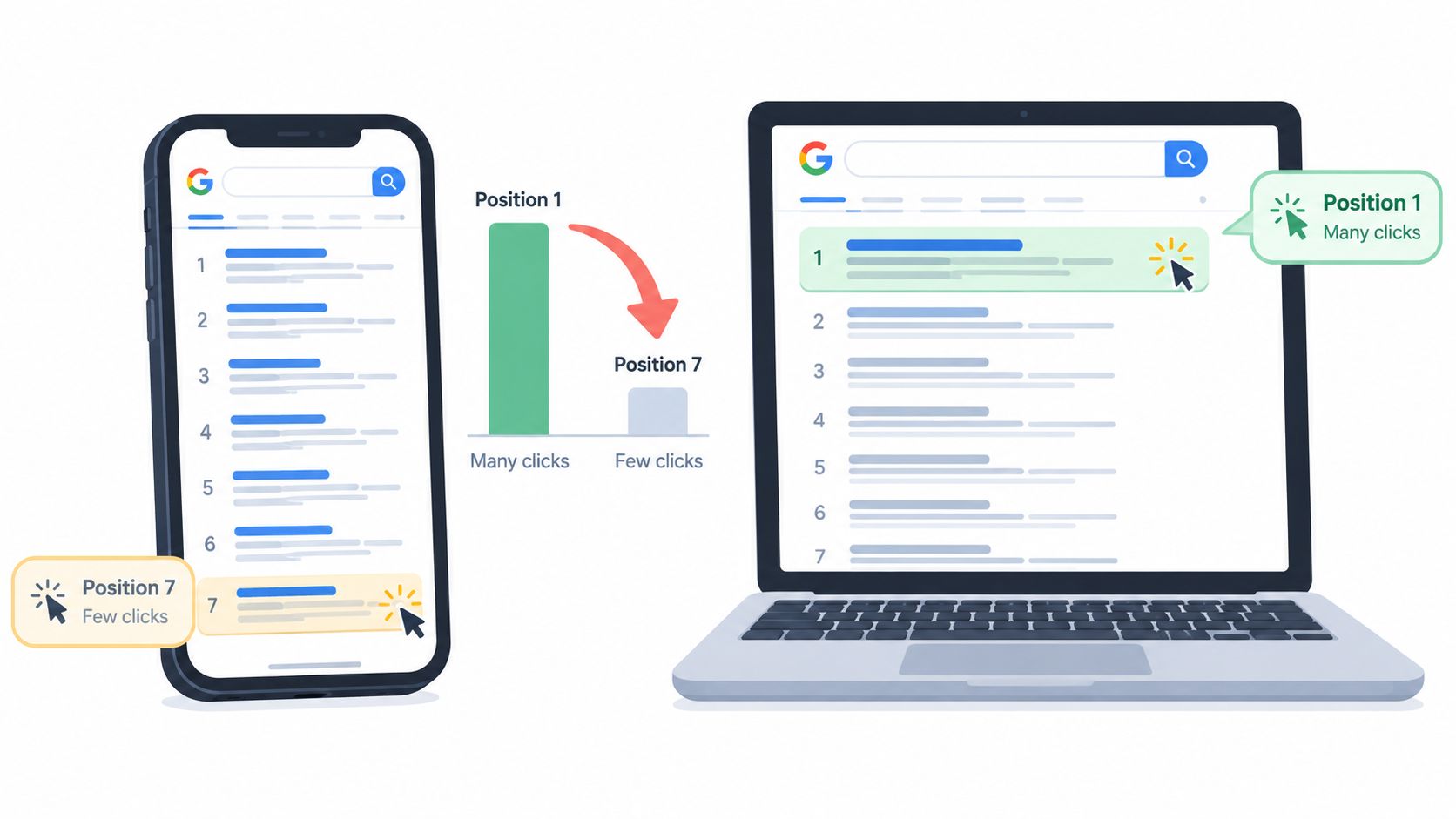
Use these figures as context, not as a target for every page. Compare URLs within the same position band, device category, query type, and SERP layout. A position-two service query beside a local pack has a different click opportunity from a position-eight research query with no additional features.
AI Overviews make this segmentation more important. An organic listing can rank first while competing with an AI-generated summary, ads, maps, featured snippets, or sitelinks. The ranking number alone cannot explain whether weak CTR comes from poor messaging or reduced visibility within a crowded result page.
Device behavior adds another layer. An SEOclarity study reported desktop CTR falling from 8.17% at position one to 0.44% at position 10, while position-one CTR declined to 6.74% on mobile. Across the top 20 positions, average mobile CTR was 2.47%, compared with 1.95% on desktop (SEOclarity's CTR study). A site-wide average can therefore hide pages that perform well on one device and poorly on another.
Where the practical opportunity sits
Prioritize pages that already receive impressions but earn fewer clicks than comparable results:
- High-impression pages: A stronger title or snippet can affect enough searches to produce a measurable difference.
- Positions near the top: Improving a result from position three to position two may matter more than refining a page buried near the bottom.
- Device-specific weakness: Mobile results offer less space, so wording that works on desktop may lose appeal on smaller screens.
- Feature-heavy queries: Ads, maps, snippets, and AI summaries can reduce attention available to an organic listing.
Segment Google Search Console data by branded status, device, service, location, intent, and SERP features. Then inspect the live results. If rankings are weak, address relevance, content, authority, or technical quality. If rankings are strong but CTR is weak, examine the result language and surrounding features before rebuilding the page.
Executing a Controlled Title and Snippet Optimization
Title and snippet work should operate like a controlled optimization loop, not a sequence of guesses. Start by exporting at least 8 to 12 weeks of Google Search Console data by page and query, then segment impressions by device, branded versus non-branded intent, country, and average-position band (Google's guidance on improving search presentation).
Prioritize URLs with substantial impressions, stable rankings, and CTR below the relevant comparison group. Don't compare every query attached to a page as if it had the same intent. A page may rank for emergency service searches, research questions, and branded terms, each with a different reason to click.
A reliable testing sequence
Establish the baseline. Record impressions, clicks, CTR, average position, device, query category, and qualified leads. Save the actual title and description currently shown in the SERP when possible.
Write for the query's decision. A local service title should identify the service and location when those details are directly relevant. “Emergency Roof Repair in Dallas | Same-Day Estimates” communicates more than a generic title repeating the company name and service category.
Keep the promise consistent. The title, H1, opening copy, and page intent should describe the same offer. If the snippet promises emergency repair but the landing page opens with a general roofing overview, the click may become a bounce rather than an inquiry.
Improve the description. Use the meta description to clarify the benefit and next step. Avoid unsupported pricing, guaranteed response times, or outcomes the business can't provide. More guidance on writing clear, useful descriptions is available in this resource on how to write meta descriptions.
Change one variable cluster. Test the title and description as one intentional message, or test one of them separately. Record the launch date so later ranking changes, seasonality, and service demand don't get mistaken for a copy improvement.
Allow a comparable period. Compare the same query-page pairs for 28 to 56 days, using the same segments where possible. A short burst of clicks isn't enough evidence if impressions or rankings also changed.
Judge commercial quality. Report impressions, average position, CTR, calls, form completions, booked consultations, and qualified-lead rate together. A higher CTR that attracts unsuitable visitors isn't a successful experiment.
Google states that more relevant alternative titles can substantially improve clickthrough, but title links may be generated from multiple page signals, so the displayed title isn't always identical to the HTML title (Google's documentation on title links). That makes clarity across the whole page important. If the H1, visible copy, structured content, and title send conflicting signals, Google may choose a different title.
For broader copy work, these headline writing tips for professionals can help your team develop stronger information scent without resorting to clickbait. The standard remains simple: make the result attractive because it is relevant, not because it exaggerates what the visitor will find.
Adapting Your CTR Strategy to SERP Features
A CTR report without SERP context can misdiagnose performance. A local pack can draw attention away from a nearby organic listing. A featured snippet may answer the query before a searcher visits any page. An AI Overview can summarize several sources and reduce the reason to inspect each traditional result.
Service businesses should classify the results page before changing titles or descriptions. Record the visible features, query intent, location, device, and commercial purpose. Then choose the outcome that matters: a standard organic visit, visibility in a cited answer, local pack exposure, or a highly specific visit that can produce a qualified inquiry.
Match the tactic to the search environment
Map-led queries usually reward accurate business information, strong reviews, clear service coverage, and local relevance. Publishing another generic article may contribute less than improving those signals. Answer-led queries need concise explanations, descriptive headings, and content that search systems and readers can interpret quickly. Commercial queries should lead with proof, a clear difference from competitors, and an obvious next action.
Featured snippet targeting should support the commercial page rather than replace its purpose. Answer the immediate question directly, then guide the visitor toward a useful next step. These featured snippet optimization recommendations offer practical guidance for structuring content around answer-focused results.
Decision point: If an AI Overview resolves the basic question, give searchers a specific reason to visit your page. Add original proof, service detail, local context, or a next step that the summary cannot provide.
The shift in AI Overview results changes the value of position alone. Ahrefs' analysis found that position-one pages for queries with AI Overviews averaged 1.6% CTR in December 2025, compared with 7.3% in December 2023, a 58% decline (Ahrefs' analysis of AI Overviews and organic clicks). Lower click volume may be acceptable when the remaining visitors show stronger commercial intent. A business can also create content that earns visibility inside the answer experience while retaining a useful organic listing.
Measure each outcome separately. Segment Search Console by query intent, location, device, branded status, and visible SERP features. Connect those segments to calls, form completions, booked consultations, and qualified inquiries. A lower CTR may indicate lost demand, or it may show that the page now filters out visitors who were unlikely to become customers.
Prioritizing Post-Click Experience and Lead Quality
A click has little commercial value if the visitor lands on a slow, confusing, or mismatched page. The result and landing page should function as one message. If the snippet names a service and city, repeat that service and city prominently on the destination page, then show proof and a clear route to contact the business.
Google's mobile-speed research, based on testing 900,000 mobile sites globally, found that the average mobile page took 22 seconds to fully load, and that 53% of mobile visitors leave when a page takes longer than three seconds (Google's mobile site speed research). Test the mobile experience, not only a desktop preview. Make the phone number usable, keep the primary form visible, and remove scripts or design elements that delay meaningful content.
Key Post-Click Performance Benchmarks
| Metric | Target Benchmark |
|---|---|
| Message continuity | The title, snippet, H1, and opening copy make the same service and location clear |
| Mobile loading | Usable content appears quickly, with priority given to the first meaningful interaction |
| Primary action | One obvious next step, such as calling, requesting an estimate, or booking a consultation |
| Form recovery | Field-specific errors explain what went wrong and how to fix it |
| Lead quality | Calls and form submissions are reviewed for service fit, location, and buying intent |
Form mechanics often decide whether search traffic becomes an inquiry. Baymard reports that 98% of sites fail to provide error messages that clearly state what went wrong and how to fix it (Baymard's checkout usability research). Lead forms should preserve entered information after an error, validate fields at the right moment, and direct the visitor to the exact problem instead of forcing them to search the form.
Don't optimize CTR with misleading claims. A title that promises an unavailable discount, instant response, or guaranteed legal outcome may earn attention but damages trust after the click. For service companies, qualified-lead rate per impression and per click is a better decision metric than raw CTR because it connects search visibility to actual revenue opportunities.
Use recordings, heatmaps, analytics instrumentation, and call tracking to identify where visitors hesitate. Then adjust page layout, proof, form length, and calls to action in a controlled cycle. The best CTR strategy often ends with making fewer clicks more valuable.
Building Your Continuous CTR Improvement Process
CTR improvement works best as a repeating operating process. Search behavior changes, Google changes the result page, and service demand changes by location and season. A title that performs well for one intent may become less useful when an AI Overview, local pack, or new competitor changes the page around it.
Start with a practical review rhythm:
- Find the opportunity: Export Search Console data and identify pages with high impressions, stable positions, and weak CTR relative to comparable queries.
- Inspect the SERP: Search the terms on mobile and desktop. Record ads, map results, snippets, AI summaries, reviews, and competing messages.
- Form one hypothesis: Decide whether the problem is weak specificity, poor intent alignment, unclear benefit, missing local relevance, or a post-click mismatch.
- Make a focused change: Update the title, description, page opening, or conversion path according to the hypothesis. Avoid changing the entire site at once.
- Annotate the launch: Record the URL, query group, device segment, date, wording, and reason for the change.
- Measure beyond clicks: Compare impressions, position, CTR, calls, forms, booked consultations, and qualified-lead rate over a comparable period.
- Keep, revise, or reverse: Retain changes that improve the commercial outcome, refine inconclusive tests, and roll back changes that attract poor-fit traffic.
What to review during each cycle
Check pages ranking near the top before investing all your effort in pages with limited visibility. Revisit titles that use boilerplate language, descriptions that fail to explain the next step, and service pages whose SERP promise doesn't appear above the fold.
Review device performance separately. Then examine lead quality by service and location. A local HVAC page may receive plenty of clicks but weak inquiries because it attracts visitors outside the service area. A law firm page may earn fewer visits but produce stronger consultations because the title filters for a specific injury or legal need.
The process should also include technical and usability checks. Slow mobile loading, unclear forms, broken calls to action, and weak proof can waste the demand your title work creates. Search-result optimization and conversion optimization aren't separate projects when the objective is qualified business.
If you want a partner to connect technical SEO, local search, answer engine optimization, website design, and conversion improvements, visit Digital Skyrocket. Its team works with service businesses on search-focused websites, ongoing SEO, reporting, and refinements that connect organic visibility to calls, emails, and form submissions.