Answer engine optimization is the practice of structuring content so AI-powered search engines like ChatGPT, Perplexity, Gemini, and Google AI Overviews can extract, cite, and surface your business as a direct answer to user queries. In practical terms, it became especially prominent in May 2024 as Google launched AI Overviews and more people started getting synthesized answers instead of only blue links.
A local business owner feels this shift fast. A homeowner asks an AI assistant for a roofer, a dentist, or a personal injury lawyer nearby, and the answer comes back as a short recommendation, often with a few cited names, not a page of search results to browse. If your site isn't built for that kind of extraction, your competitor may become the answer.
Table of Contents
- How AI Search Is Changing the Way Clients Find You
- Answer Engine Optimization vs Traditional SEO
- Why Local Service Businesses Cannot Ignore AEO
- How to Structure Your Content for Answer Engines
- Measuring AEO Success Beyond Traffic and Rankings
- Common AEO Mistakes That Undermine Your Results
- Building a Lead Generation Strategy That Combines SEO and AEO
How AI Search Is Changing the Way Clients Find You
A homeowner who needs a roof repair doesn't always start with Google's classic results page anymore. They might ask ChatGPT, Perplexity, Gemini, or Copilot who the best roofer is in their city, then get a synthesized answer that names a few businesses, summarizes why they fit, and gives the user enough confidence to move forward without clicking through a dozen websites. That's a very different buying moment from the old blue-link routine.
Answer engine optimization is the discipline of making your site easy for those systems to quote. The goal isn't just to rank a page. It's to make specific passages quotable, extractable, and citation-ready so an AI answer layer can use your content as the basis for a direct response. CXL describes this shift clearly, and the practical implication is simple, the machine needs a clean answer it can lift quickly and trust (CXL's comprehensive AEO guide).
What changes for a service business
For a law firm, dentist, roofer, or HVAC company, the fundamental change is that the first impression may happen inside an AI answer, not on your homepage. That means the page has to do more than persuade a human reader. It has to give the system a tight definition, a clear service explanation, and enough structure to understand where the answer begins and ends.
Practical rule: if the answer to the query can't be lifted from your page in a few lines, the AI engine will usually find a better source.
That's why AEO is often described as optimizing for the answer, not the page. It borrows from featured snippet tactics, but it goes further because the output isn't just a search snippet. It's a synthesized response that may cite your business as part of the recommendation set.
One useful way to inspect whether your pages are readable by machines is to review the way the content is presented, not just what it says. A tool like validate portfolios with this scanner can help you think more critically about whether your site is being surfaced in AI contexts or just looking polished to human visitors.
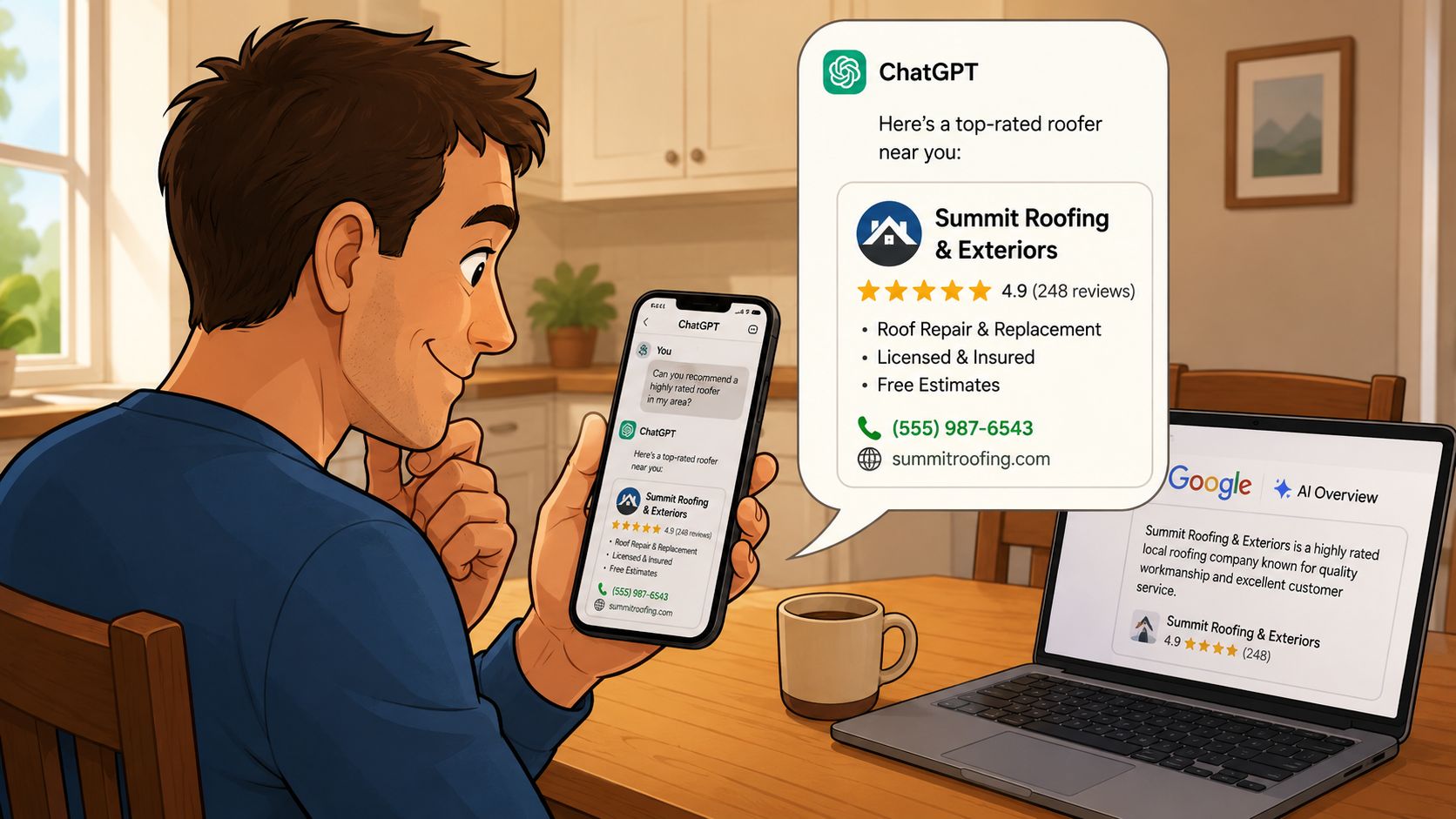
The biggest mindset change is this. Your page isn't just a destination anymore. It's also a source document for answer engines, and that changes how you write, structure, and format every important section.
Answer Engine Optimization vs Traditional SEO
A local roofer can rank well for “roof repair near me” and still lose the first call if an AI answer names competitors before the visitor ever reaches the site. That gap highlights the key difference between traditional SEO and AEO. SEO is built to win a results-page click. AEO is built to get your content selected, condensed, and cited inside an AI-generated answer layer, where the user may get what they need without visiting your page (PwC's overview of answer engine optimisation).
That trade-off can work for lead generation, but only if the citation does something useful for the business. I've seen service pages gain visibility in Perplexity or similar tools while website visits drop because the answer satisfied the searcher on the spot. I've also seen the opposite, where a company gets cited, the user remembers the name, and the lead comes through a branded search, a phone call, or a direct visit later. The point is not to chase visibility by itself, it is to know whether the visibility is creating remembered demand or just replacing a click you would have earned.
Side-by-side comparison
| Dimension | Traditional SEO | Answer Engine Optimization |
|---|---|---|
| Primary goal | Rank on a results page and earn clicks | Be cited inside an AI-generated answer |
| Target system | Search engine results page | Answer layer or synthesized response layer |
| Content unit | Page-level optimization | Passage-level, fact-level optimization |
| Best structure | Broad topical coverage | Clear headings, direct-answer blocks, machine-readable chunks |
| Success signals | Rankings, traffic, CTR | Citations, mentions, branded inclusion |
| User behavior | Browse, compare, click | Ask, read, decide, sometimes never click |
AEO is not a replacement for SEO. The same fundamentals still matter, technical health, logical site architecture, and content that shows clear topical authority. The difference is that answer engines need a section they can isolate and reuse without guessing, so the writing has to be tighter and the structure has to be easier to parse. For firms that want help with this kind of structure, website optimization for law firms often becomes part of the same project because the site has to support both search visibility and lead capture.
Where the work overlaps and where it doesn't
A well-optimized site helps both systems. Clean HTML, descriptive headings, and strong topical depth support traditional rankings and AI retrieval. AEO asks for a stricter kind of clarity, because the answer engine is looking for text it can lift with minimal ambiguity.
A plumber's service page can rank for drain cleaning, then get quoted in an AI answer that answers the same question without a click. That can still be a win if the citation leads to stronger recall, a branded search later, or a phone call from a homeowner who already trusts the company name. It is a loss if the page was written to attract and convert visitors, but the answer engine consumes the key explanation and leaves no reason to click.
The practical test is simple. If the page only works when a person reads it top to bottom, it is weak for AEO. If the page also gives an answer engine a clean summary, a specific service definition, and a clear path to the next step, it can serve both channels without pretending they behave the same way.
Why Local Service Businesses Cannot Ignore AEO
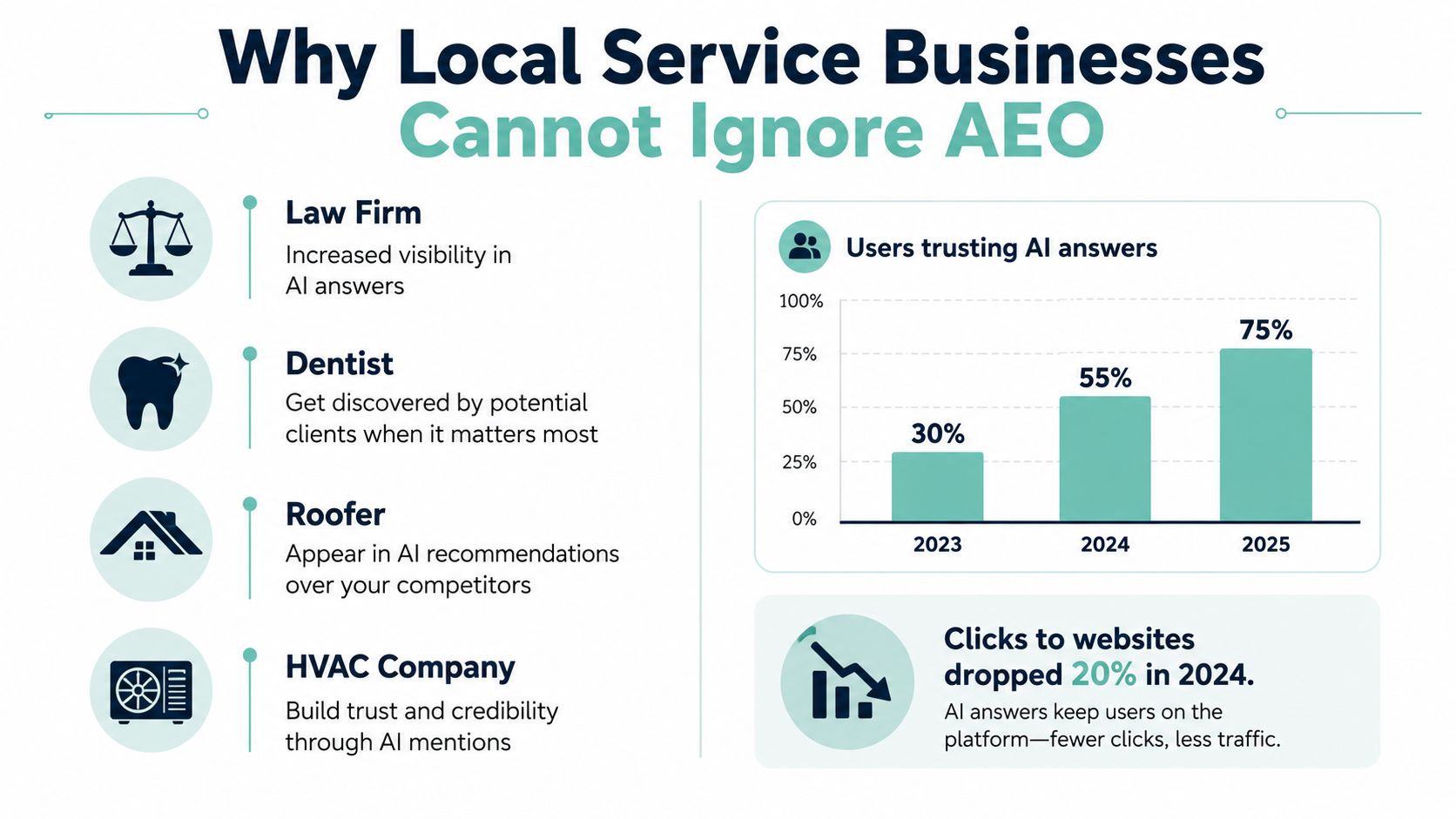
Local service businesses live or die on trust. That's exactly why AEO matters so much for law firms, dentists, roofers, HVAC companies, and other providers whose buyers ask high-intent questions before they call anyone. OpenAI reported in 2024 that ChatGPT had about 100 million weekly active users, which shows how large the answer-engine audience already is (Omnibound's AEO statistics overview).
When someone asks which personal injury lawyer to hire in a specific city, the answer engine may cite a short list of firms and summarize why each one belongs there. If your content isn't structured for extractability, the model can't use it confidently, and your competitor gets the mention instead. For service businesses, that's not a branding nicety, it's a competitive filter.
Why the local-intent use case is so strong
High-consideration services are a natural fit for AEO because the user wants confidence, not just options. A concise, authoritative explanation of who you serve, what you do, and where you operate can be enough to make your business the cited source in an answer. That early trust can matter more than a click from a generic results page.
What changes in practice
The businesses that benefit first are usually the ones that already answer customer questions well. Their service pages name the problem, describe the process, and speak in plain language that a model can parse. The businesses that struggle are the ones hiding their value behind vague marketing copy, sliders, or dense design patterns that never give the engine a clean answer to quote.
AEO is already becoming part of local discovery in major markets, and the gap between teams that publish machine-readable answers and teams that don't will keep widening. If a competitor is easier to cite, it's easier to recommend. That's the entire game.
For law firms specifically, a focused local strategy often starts with strong service-page structure and location clarity, and a useful reference for that kind of work is this guide on website optimization for law firms.
How to Structure Your Content for Answer Engines
AEO works best when a page is easy to retrieve, easy to parse, and easy to trust. For service businesses, that usually means writing for machines without making the page feel mechanical to a person reading it. The strongest pages lead with the answer, then add the detail a buyer needs to decide whether to call, request a quote, or keep comparing options.
Build the page around question-led sections
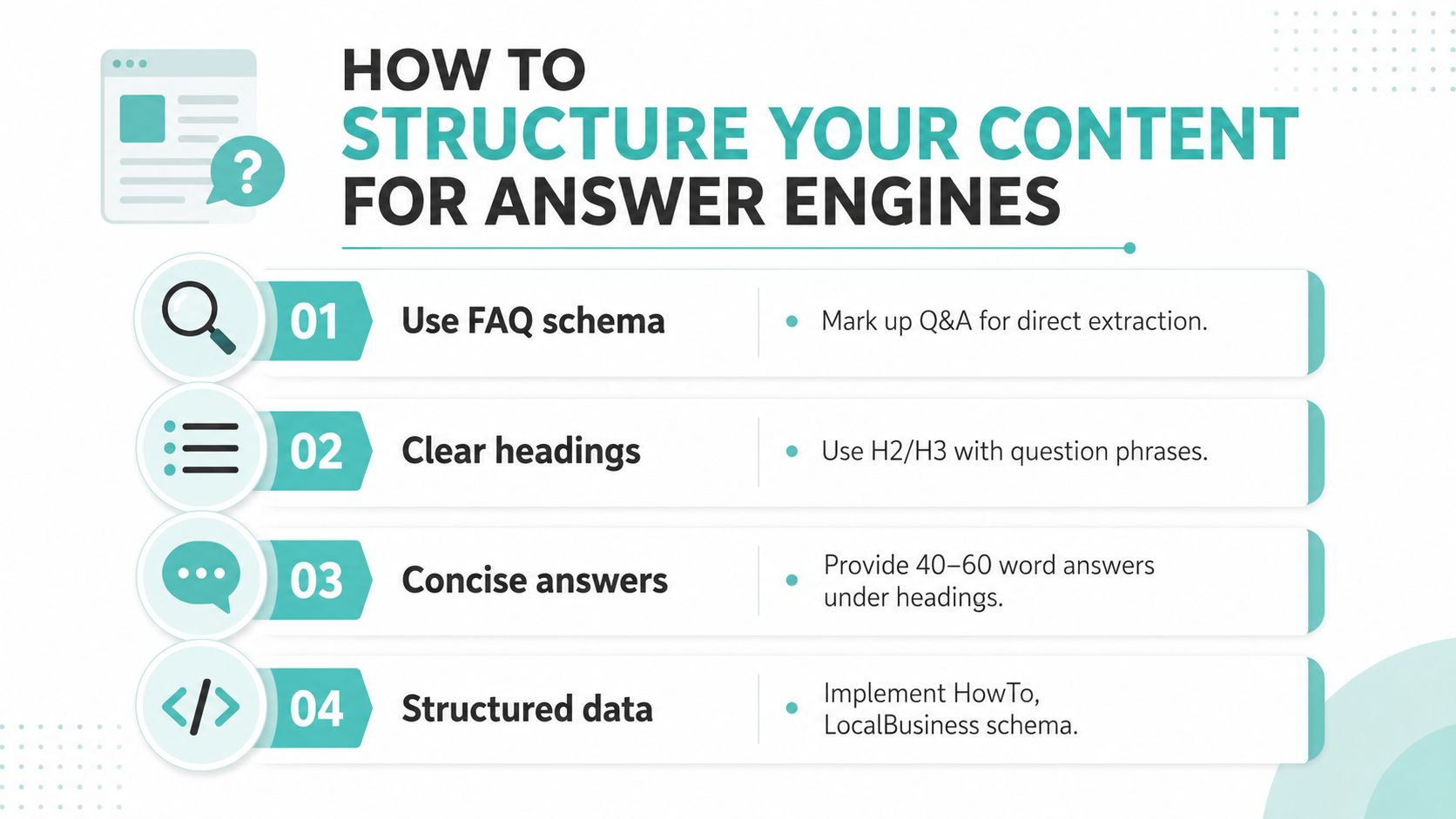
Start with headings that match the way clients ask questions. “What is answer engine optimization” is stronger than a vague marketing label because it mirrors query language and gives the engine a clear topic to pull from. Put a concise answer directly under the heading, before the page adds context or supporting detail.
That opening block should be easy for both readers and crawlers to isolate. Clean HTML matters because AI systems have a harder time with important copy buried in JavaScript-heavy layouts, pop-ups, or layered design elements that hide the main point (HubSpot's AEO guide).
Use schema and plain-language formatting
Structured data helps answer engines understand what the page is. FAQPage, HowTo, Article, and LocalBusiness schema are the most practical starting points for service sites, especially when the page covers questions, steps, or location-specific service details. If the page reads like a knowledge asset, the engine has a better chance of quoting it accurately. A service-site outline can help your team map that structure, and this sample sitemap for website planning is useful when you are planning those pages into a broader site architecture.
A simple working pattern looks like this:
- Question heading: write the heading in plain customer language.
- Direct answer: place a short answer immediately below it.
- Supporting detail: add proof, examples, or context after the direct answer.
- Schema markup: label the page type so the engine understands the structure.
Field-tested rule: keep the important answer in raw HTML, not hidden inside a tab, accordion, or script-heavy module if you want it to be picked up consistently.
Local content should be built around the exact service problem, the area you serve, and the question the page answers. A plumber who serves one city should not write a generic “services” page that could belong to any contractor. A cleaner answer with location context gives the engine less room to guess and more reason to cite your page.
AEO also raises a practical trade-off for local service businesses. A page can win visibility in an answer engine and still lose clicks if the answer fully satisfies the searcher. That does not mean AEO is a bad bet. It means the page should be designed to capture the high-intent action, whether that is a phone call, form fill, or quote request, rather than chasing traffic for its own sake.
For teams planning that balance, it helps to organize pages around the questions buyers ask before they choose a provider. If you want a starting point for that kind of site structure, browse the Starter App and compare how the content hierarchy maps to real service questions.
AEO does not reward bloated copy. It rewards clarity, clean headings, and passages that a machine can quote without losing meaning. That is a different writing discipline, and most service sites still have not adapted it.
Measuring AEO Success Beyond Traffic and Rankings
AEO measurement is where a lot of teams get stuck. If an AI answer satisfies the user before the click, then traffic can stay flat or even fall while visibility improves. That's why traditional reporting can miss the full story when you're trying to understand whether your content is being used in answer engines (Siteimprove's AEO measurement discussion).
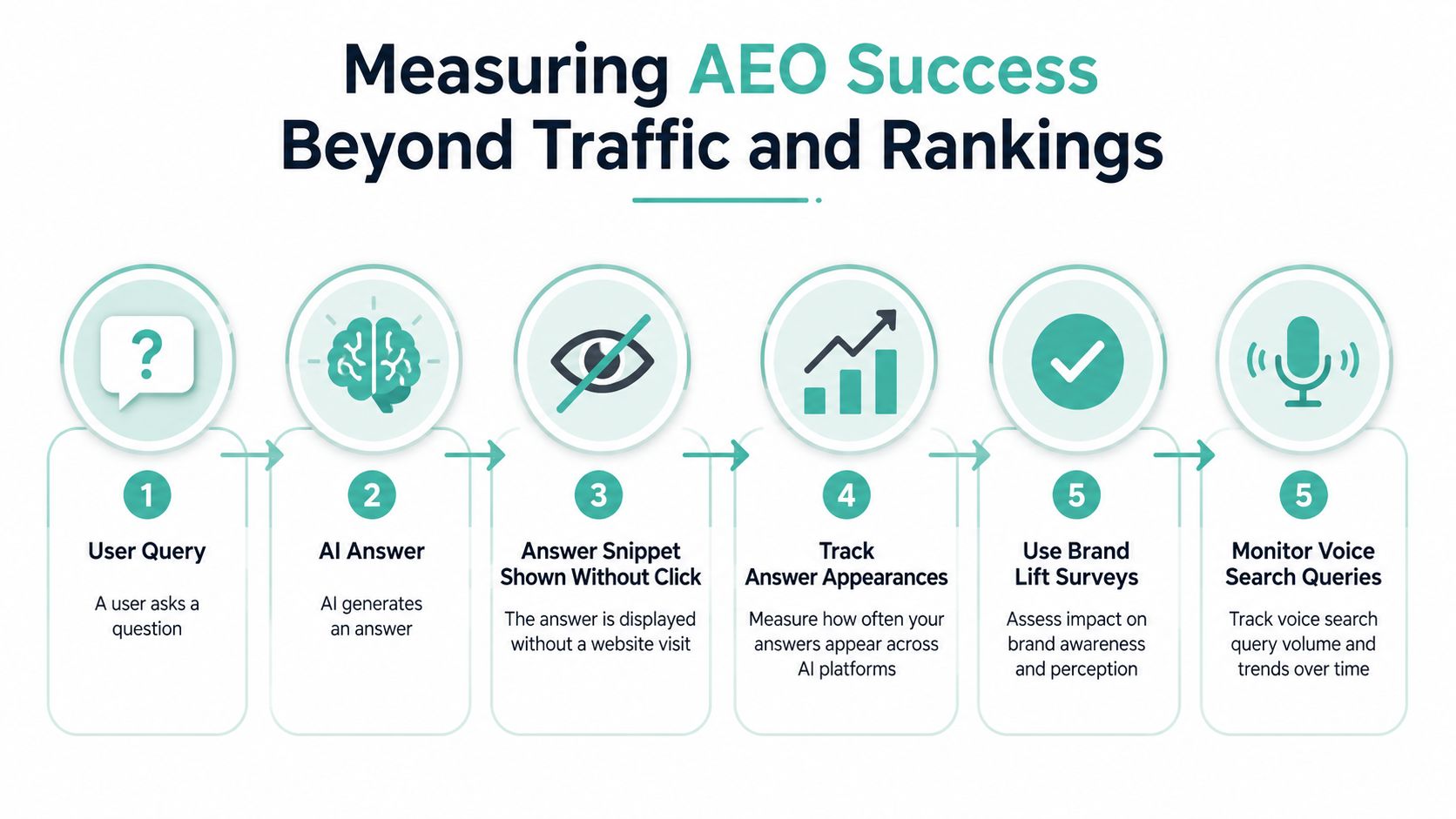
The right question isn't only “Did traffic go up?” It's “Did the brand show up in the answer?” That means testing prompts directly in ChatGPT, Perplexity, Gemini, and Google AI Overviews, then checking whether your business is named, cited, or omitted. If your site is being used in the response layer, that's a visibility signal even if the click never materializes.
What to track instead
The most useful AEO signals are usually qualitative at first, then repeatable over time. Look for branded mentions, citation frequency, and query patterns that suggest the answer engine recognizes your content as relevant. High-impression, low-click patterns can also be a clue that people are getting the answer without needing the visit.
A practical tracking routine looks like this:
- Test target questions regularly. Use the same service and location queries your buyers ask.
- Record whether your brand appears. Note whether you're cited, named, or left out.
- Watch query themes. Question-style searches often behave differently from product or navigation searches.
- Compare visibility to leads. If citations rise but calls don't, the site may be informing the market without converting it yet.
Chat-driven platforms are also changing how people search for recommendations, so teams should watch conversational behavior alongside traditional search data. A good reference point for that broader stack is this guide to find conversational marketing tools.
How to interpret the data
If your brand starts appearing in answers but traffic dips, that doesn't automatically mean the strategy failed. It may mean the answer engine is doing more of the educational work for you. The harder question is whether that exposure creates enough trust to improve lead quality later in the funnel.
That's where lead activity matters. Calls, form fills, booked consultations, and branded search lift tell a fuller story than pageviews alone. AEO success should be measured as a mix of answer visibility and downstream intent, not as a vanity traffic spike.
Common AEO Mistakes That Undermine Your Results
The most common AEO mistakes are surprisingly basic. Teams treat it like a standalone trick, then wonder why nothing changes. In reality, answer engine optimization only works when technical SEO, content structure, and conversion design all support the same objective.
One mistake is building pretty pages that AI crawlers can't parse well. Heavy JavaScript, overlays, and hidden content make it harder for answer engines to find the passage they need. Another is writing long persuasive copy without any concise answer blocks, which leaves the model with nothing clean to quote.
If a page sounds persuasive to a human but never states the answer plainly, it often underperforms in AI search.
The four errors that show up most often
- Treating AEO as separate from SEO: the symptom is weak visibility despite good writing. The cause is missing technical foundations. The fix is to keep crawlability, structure, and authority in place.
- Hiding core content: the symptom is that the page looks complete to visitors but gets ignored by answer engines. The cause is content trapped in complex design. The fix is raw HTML and simple structure.
- Writing only for persuasion: the symptom is a page that sounds polished but lacks extractable facts. The cause is no direct-answer blocks. The fix is to lead with a clear definition or answer.
- Expecting traffic to rise automatically: the symptom is disappointment when clicks don't increase. The cause is misunderstanding zero-click behavior. The fix is to measure citations, mentions, and leads together.
Another error is optimizing for citations without fixing the site that receives the visit. If the page wins the answer but the contact path is confusing, the opportunity leaks out of the funnel. AEO can create demand, but it can't rescue a broken intake flow.
The businesses that do best are the ones that treat AI visibility as one piece of a broader conversion system. They want citations, yes, but they also want a site that helps the visitor take the next step quickly once they arrive.
Building a Lead Generation Strategy That Combines SEO and AEO
The strongest lead-gen strategy for service businesses is layered. Traditional SEO still captures people comparing options on a results page, while AEO builds early trust in answer engines where the buyer may never see a classic SERP. Used together, they cover more of the decision path than either one can alone.
That combination matters because user intent isn't uniform. Some people want a list of options and reviews. Others want the single best answer to a location-specific question. AEO is usually strongest when the service is high-consideration and trust matters early, while SEO remains essential for the comparison and discovery phase.
A practical way to prioritize
Use AEO first when the query is question-based, local, and trust-heavy. That's where cited answers can shape who gets remembered. Use classic SEO first when the searcher is still comparing providers, pricing, or service features and is more likely to click around.
Conversion still closes the loop either way. Whether the visitor arrives from an AI citation or a traditional search result, the website has to make the next step obvious, whether that's a call, a form, or a booked consultation. Strong content without strong intake just shifts the problem downstream.
For businesses that want a lead-focused content system instead of isolated pages, this resource on content marketing for leads can help frame the bigger picture.
A good rule is simple. Build the site so it can win the answer, then make sure it can win the inquiry. That's the balance service businesses need if they want AEO to support revenue instead of just visibility.
If you want a website that can rank, get cited in AI answers, and turn that visibility into real inquiries, contact Digital Skyrocket to talk through a lead-focused SEO and AEO plan for your service business.