
Most guides on how to choose an SEO agency tell you to compare rankings, skim case studies, and pick a retainer you can stomach. That advice is how owners end up paying for keyword charts while the phone stays quiet.
Treat the hire as procurement. Score review governance, account ownership, and conflict controls with the same seriousness you give rankings. A polished deck does not tell you who owns your Google Business Profile, whether a stranger writes your pages, or how a sudden rating jump was produced.
If you run a law firm, a dental office, a roofing company, or an HVAC shop, the wrong partner can get a listing suspended or lock you out of analytics. The right one connects visibility to qualified calls. Write the brief the agency has to beat before you collect a single proposal.
Table of Contents
- Build the Brief Before You Talk to Agencies
- Red Flags That Should Rule an Agency Out
- Interview Questions That Expose Real Capability
- Pricing Models and the Contract Terms Behind Them
- Local, AEO and CRO Checks for Service Businesses
- Score, Screen and Shortlist Agencies in One Week
Build the Brief Before You Talk to Agencies
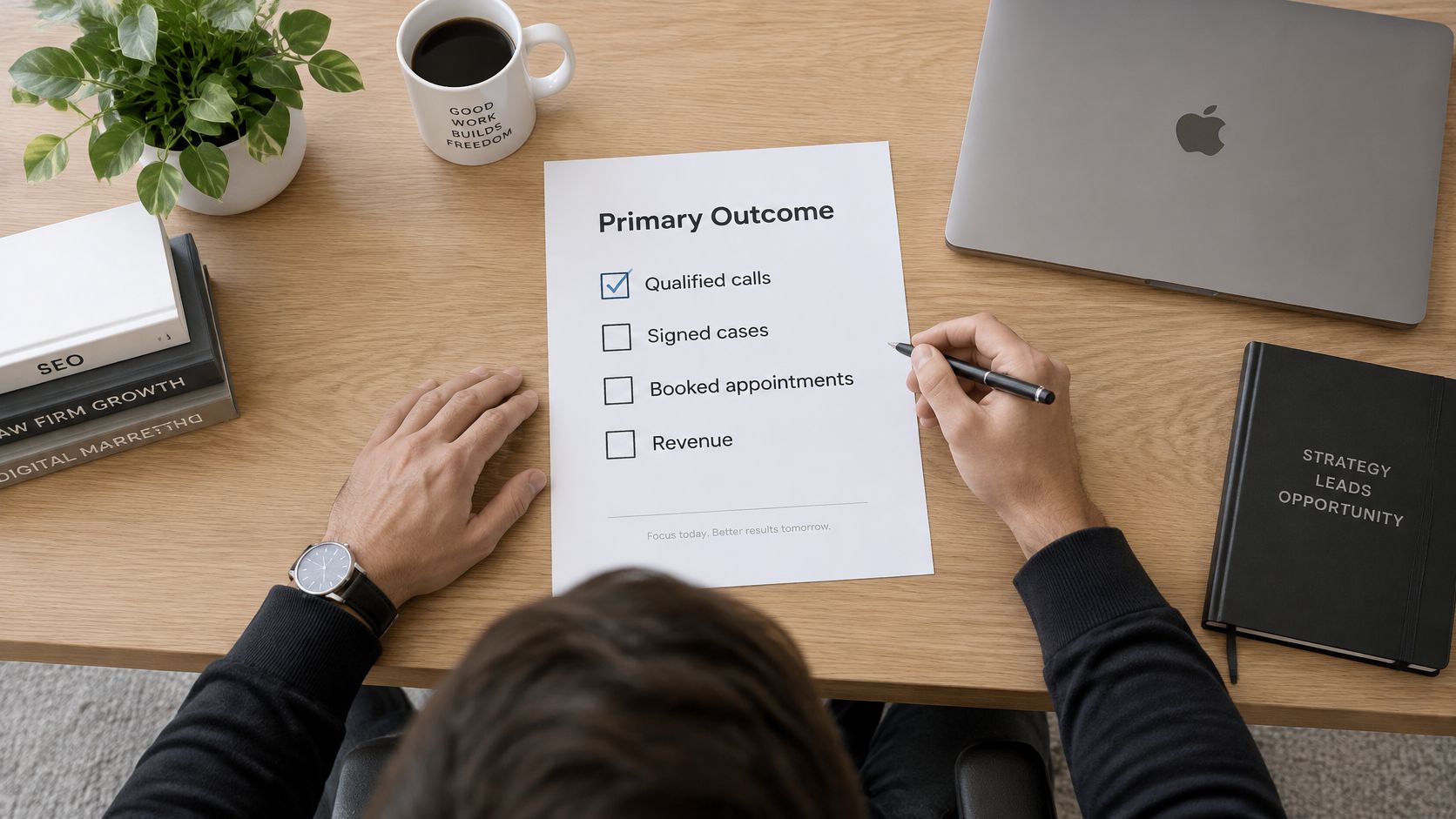
A weighted, evidence-based selection process beats picking an agency from a ranking list or a promise. Every proposal should be judged against one decision you already wrote down.
- Name one primary outcome. Choose qualified calls, signed cases, booked appointments, or revenue. Two goals at once let an agency report the one that looks better.
- Document the market you sell in. Write the geography, service lines, named competitors, baseline organic traffic, current conversion rate, and technical constraints such as slow templates or an upcoming site move. A roofing company in Tyler with 40 form fills a month and no call tracking should flag that gap for prospective agencies, not discover it in month six.
- Pull Search Console and reconcile it. Google Search Console supplies impressions, clicks, queries, and click-through rate. Those are diagnostic numbers. Match them to analytics, your CRM, call tracking, or appointment records where you can do so lawfully.
- Send the same information to every shortlisted agency. Identical inputs are the only way answers stay comparable.
- Require a prioritized diagnostic. It must separate observations from hypotheses, then list each fix with an owner, the effort, and the expected business effect.
What a usable case study looks like
Reject any story that is only a percentage and a keyword position. A credible case study discloses the baseline, the market, the measurement period, the site condition, the work performed, and the business result.
Paste this into the email:
One-page brief: Primary outcome, cities and services, three competitors, last-90-day organic sessions and conversion rate, known technical limits, and the tracking you do or do not have. Ask for a diagnostic that ranks fixes by business effect, not by page count.
Red Flags That Should Rule an Agency Out
A polished ranking report cannot make up for risky review practices or an agency that controls your accounts. Treat this decision as procurement: assess conduct, ownership, and conflict controls alongside rankings and case studies.
The Federal Trade Commission says a business can be held responsible when an agency creates fake positive reviews or fake negative reviews of competitors. Platforms may also suspend or remove listings for that conduct. The FTC warns against soliciting reviews only from customers expected to be positive, tying incentives to positive sentiment, and hiding paid relationships.
Fast rating growth can carry more downside than slower, policy-compliant growth. Reject any agency that cannot show how it prevents review manipulation and handles complaints.
| Red flag | Why it hurts you | Ask for instead |
|---|---|---|
| Guaranteed first-page rankings | Competitors and search changes are outside the agency's control | A written plan with measured targets and a stated testing method |
| Vanity-keyword proposals | High-volume terms may bring visitors who never call or sign | A target list focused on service and city searches tied to hiring |
| No path from sessions to leads | Traffic can rise while revenue stays flat | Named tracking for calls, forms, and close rate from the start |
| Promises of fast review growth | Fake or selectively solicited reviews risk listing suspension and FTC exposure | A written request workflow and a process for negative feedback |
| Accounts held in the agency's name | You can lose access to your Business Profile and analytics if you leave | Client-owned Business Profile, Search Console, and analytics access |
| Vague subcontracting | You cannot assess the people handling your work or data | Subcontractors named in the contract, with their responsibilities disclosed |
The review question to ask out loud
Ask the agency to show its exact review-request workflow. Have it explain how staff handle negative feedback, identify who owns each account, and confirm in writing that it does not fabricate reviews, solicit only likely positive reviewers, or reward positive sentiment. Require separate reporting for review volume, response rate, sentiment, and listing-policy incidents. These controls belong in your evaluation, not just a sales-call promise.
Also reject guaranteed inclusion in an AI answer. Search interfaces change, and no vendor controls them. Ask the agency to explain its methods and identify practices that cross into manipulation, including the differences between white hat and black hat SEO.
Keep every red flag open until the agency answers in writing. “We would never do that” is not a control.
Interview Questions That Expose Real Capability
Use these on a live call. A strong answer names a page, a person, or a metric. A weak one names a process and stops.
- Show me a template you flagged and the Core Web Vitals metric that failed. A strong answer cites Google's "good" thresholds: Largest Contentful Paint at 2.5 seconds or less, Interaction to Next Paint at 200 milliseconds or less, or Cumulative Layout Shift at 0.1 or less. Search Console field data reports the experience of at least 75% of visits in that URL group, not a single lab speed score. Worry if they hand you a Lighthouse number and cannot name the template.
- Walk me through a project that missed its target. Listen for what they changed, not a story about the client's market being "tough."
- Who does the work each week, and who is my day-to-day contact? You should be able to meet that person. "Our team" is not a name.
- How do you prioritize when the budget covers only ten fixes? Impact, confidence, effort, and dependency should come out unprompted. A page-count target should not.
- What will you report in month one, and where will I see it? Rankings alone are a bad answer. Calls, forms, and the queries behind them belong in the same view.
- Which accounts, assets, and code will I own when we part ways? Client ownership of the Business Profile, Search Console, analytics, content, and theme files is the only acceptable answer.
- How do you build service-area pages without thin or duplicate content? Each page needs a real service, a real area, and distinct proof. City names pasted onto one template fail this test.
- How do new pages get discovered? Google primarily finds new pages through links from pages it has already crawled, and it treats links as an essential resource for discovery. Ask them to show internal-link structure, orphan pages, and crawl paths. A nofollow annotation belongs on outbound links they do not trust.
Answers that should end the call
A speed score with no template, a strategist who cannot be introduced, and a content plan that is only a keyword spreadsheet are three separate reasons to stop. You are buying judgment under a budget, not a menu of deliverables.
Pricing Models and the Contract Terms Behind Them
Choose an SEO agency like a procurement decision: compare the work, control who owns it, and put clear limits on what you are buying. A monthly fee means little until the scope, account ownership, review process, and exit terms are written down.
| Model | How it is billed | What it usually covers | Watch for |
|---|---|---|---|
| Monthly retainer | Flat monthly fee, often with a 6 to 12 month minimum | Ongoing SEO, reporting, and content support | Confirm exclusions, who reviews the work, and who owns it after you leave |
| Website project fee | One price for redesign, build, and launch, with SEO billed separately | Design, development, launch, redirects, and baseline SEO | Check whether post-launch SEO is included or requires a new contract |
| Hourly or audit only | Billed by hour or as a fixed audit fee | Diagnosis, roadmap, and one-time fixes | Set a spending cap and define the deliverable |
| Performance-based | Bonus or fee tied to rankings or leads | Varies by agreement | Tie bonuses to qualified inquiries, not rankings alone |
| Hybrid | Project fee plus monthly retainer | Build plus ongoing SEO and conversion work | Set post-launch scope and a review point |
Match the payment model to the work. A retainer suits ongoing optimization; a project fee suits a redesign and launch. Hourly or audit-only billing can work for a one-time diagnosis if the hours and cost are capped. Performance fees can reward traffic that does not turn into business, so define a qualified inquiry and the attribution rules before agreeing to any bonus.
Ownership, exit, and the first 30 days
Treat the contract as a control document, not paperwork to skim after choosing a vendor. Check three areas before signing:
- Ownership: The Business Profile, Search Console, analytics, domain, content, and code stay in your name. Agency access should be revocable without putting your assets at risk.
- Exit: Write down the term, notice period, and what transfers to you when notice begins. A website project must not roll into an ongoing retainer unless you agree.
- First 30 days: Define analytics, call and form attribution, conversion terms, crawl and indexation baselines, priority landing pages, and the person accountable for reporting.
Ask for a sample deliverable and a written review process. You need to know who prepares the work, who checks it, how issues are escalated, and how often you approve changes. A useful marketing proposal format makes scope, owners, exclusions, and review responsibilities visible before the contract starts. If those details are vague in the proposal, expect the same ambiguity in delivery.
If the agency cannot explain how organic visits connect to qualified leads and revenue, do not sign, whatever the fee.
Local, AEO and CRO Checks for Service Businesses
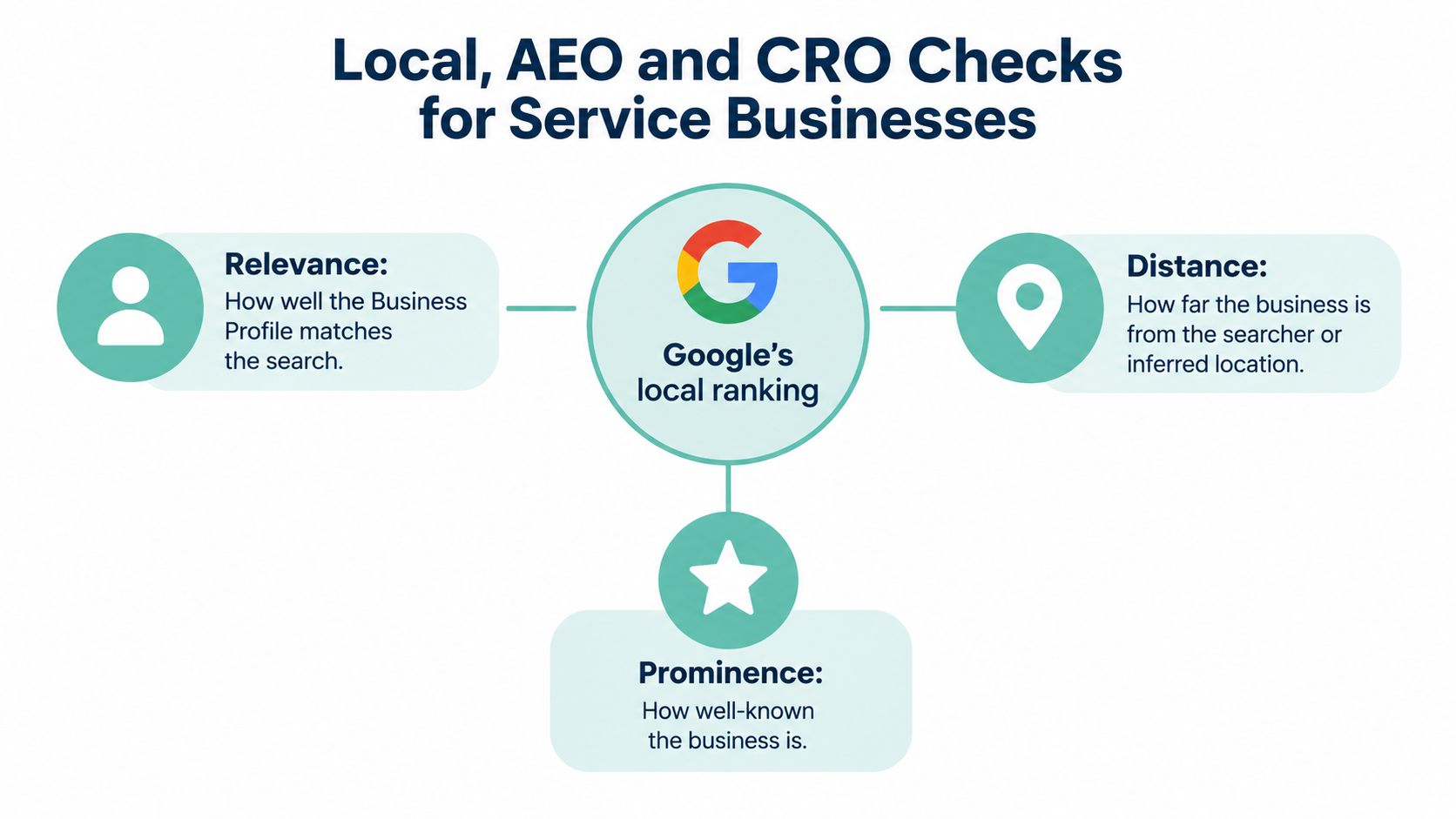
Treat local search as a set of distinct procurement checks, not a promise to “rank locally.” Google describes local results through relevance, distance, and prominence, and each calls for different work.
- Relevance measures how well the Business Profile matches a search.
- Distance reflects how far the business is from the searcher or the location Google infers.
- Prominence reflects how well known the business is. Links, articles, directories, and reviews can contribute.
Ask the agency to show how its roadmap handles profile completeness, service relevance, accurate location data, local authority, and review acquisition. Reject plans built around adding city names to pages. If you are comparing a web design agency in Longview, TX with a firm elsewhere in East Texas, use the same standards. The agency should explain what local SEO actually covers through specific tasks, owners, and reporting, not a slogan.
Reviews and answers people never click
Reviews need governance, not just volume. Ask who can respond, how negative reviews are escalated, and whether responses follow approved policies without sounding copied. Request reporting that separates review count, rating, response activity, and inquiries. Also ask which platforms matter to your customers and how the team will keep business details consistent across them.
Search answers can appear without a visit. Do not accept an “AEO” package that guarantees inclusion in AI summaries. Ask the agency to establish a baseline for real service-and-location questions, improve the accuracy of your first-party and local business information, and test visibility over time. Require reporting that tracks branded searches, calls, forms, direction requests, mentions, and citations, including cases where a searcher gets an answer without clicking through. Confirm who owns the monitoring and who approves changes to business information.
Then test the conversion path yourself. On a phone, check whether click-to-call works, the number is correct, and the form is easy to find and complete. Ask how the agency checks mobile load speed and whether each form field earns its place. Confirm that calls and forms are tracked as inquiries, with test submissions used to verify attribution. Ask: “How do you test calls to action, what do you change, and how do you tell whether the change brought more qualified inquiries?” A vague answer means the visibility work may never become measurable business.
Score, Screen and Shortlist Agencies in One Week
Treat agency selection as procurement, not a popularity contest. Score how the work will be governed, who owns your account, and how conflicts are controlled, alongside case studies and technical skill. Compare fees only after scoring. Selection guidance for local service businesses recommends reviewing the operating model and conflict controls before price, and treating retention as context rather than proof. Contracts, seasonality, budgets, and completed projects all affect retention. Its review sample found that 5% of clients chose an agency after cold outreach, so verify the work and ask for referrals before trusting a pitch.
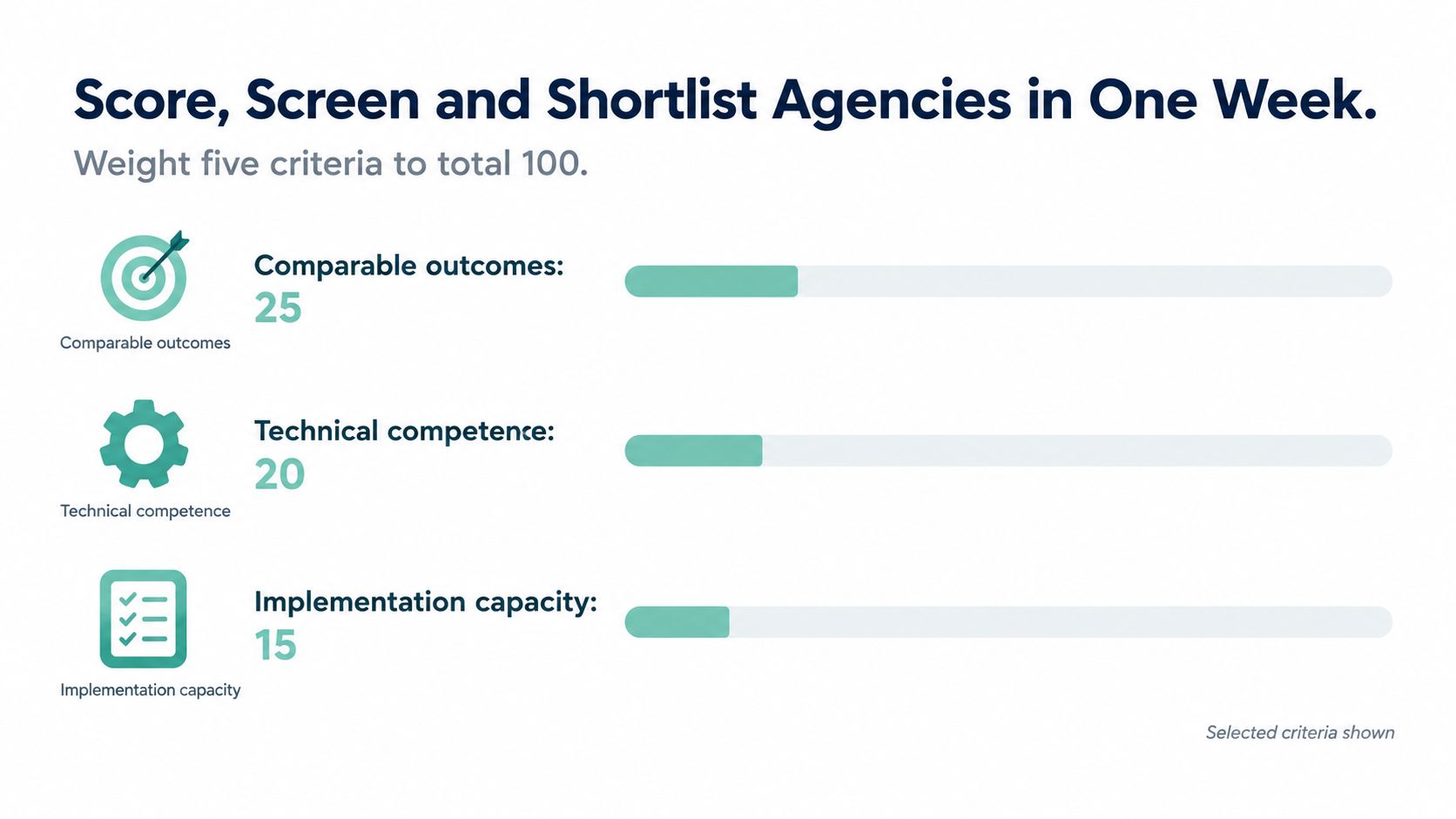
Rate each agency from 1 to 5, multiply each score by its weight, and compare totals. Complete the scoring before looking at fees.
| Criterion | Weight | What a 5 looks like | What drops it to 1 or 2 |
|---|---|---|---|
| Comparable outcomes | 25 | Named case studies in your market with baseline, measurement period, and business result | Traffic percentages with no baseline or market context |
| Technical competence | 20 | Fixes ranked by impact, confidence, effort, and dependency; Core Web Vitals checked against thresholds | Proposals built on page counts or backlink targets |
| Implementation capacity | 15 | Named staff, written 90-day and 12-month roadmap, subcontractors disclosed | Cannot say who does the work each week |
| Transparency and reporting | 20 | Rankings, traffic, calls, and forms reported in one view; references you can call directly | Reports that show only rankings |
| Measurement and attribution | 20 | Organic visits connected to calls, forms, and close rates, with agreed conversion definitions | Cannot explain how sessions become revenue |
Evidence behind each score
Do not award points for a polished presentation. Ask for three pieces of evidence:
- A written roadmap covering the first 90 days and the 12-month direction. It should address discovery, information architecture, service-area page rules, internal linking, structured data, mobile performance, indexation, local profiles, review workflows, conversion tracking, and post-launch testing.
- A prioritization method that ranks fixes by impact, confidence, effort, and dependency. Page and link counts are not a strategy.
- Reference calls with named clients. Ask what was delivered, how progress was reported, and what the agency did when results were slow.
Put governance in writing before signing. Require confirmation of whether the agency accepts another client in your industry and service area, disclosure of subcontractors, account ownership that stays with you, and reporting that connects visibility to calls, forms, qualified inquiries, and close rates. If ownership or conflict terms remain vague, lower the score or rule the agency out.
One week, then a signature
Use the same process for every finalist. Compare three to five agencies at most, and keep the deadline tight:
- Remove any agency with an unanswered red flag.
- Send the same brief to the remaining candidates and give them one week to respond.
- Hold a 60-minute interview with each, focused on your site and business needs.
- Call two named references per agency.
- Compare roadmaps side by side, then confirm conflict controls, account ownership, and exit terms in writing.
Sign only when the contract defines the first 30 days of work and how progress will be checked. A Tyler service business could include a web design partner such as Digital Skyrocket among its candidates, but only if it accepts the same scoring process and confirms the same terms in writing. Apply the same standard to every agency.