
Most marketing proposal advice starts in the wrong place. It tells you to add an executive summary, list your services, insert a timeline, show pricing, and finish with a polished call to action. That format may produce an attractive document, but it doesn't answer the question a law firm, roofer, dentist, or HVAC contractor is asking: How will this work generate better inquiries, and how will we know?
A commercially useful marketing proposal sample format begins with diagnosis. It identifies the business problem, the information needed to understand it, the research method, the analysis, and the deliverables that follow. The strongest proposals separate what an agency controls, such as page architecture, technical implementation, and conversion testing, from outcomes influenced by competition, approvals, market demand, and search behavior.
Table of Contents
- Why Generic Marketing Proposal Formats Fail Service Businesses
- Structuring the Discovery and Executive Summary
- Defining Measurable Goals and KPIs for Local Leads
- Detailing the Strategy, Deliverables, and Project Timeline
- Presenting Pricing, Terms, and Commercial Accountability
- Finalizing the Proposal with Case Studies and Next Steps
Why Generic Marketing Proposal Formats Fail Service Businesses
Generic templates fail because they present a service menu before establishing a reason to buy. “Technical SEO, content marketing, website design, reporting” may describe an agency's capabilities, but it doesn't tell a contractor why a new service-area page matters, or a law firm why its intake form is losing prospective clients.
Service businesses rarely reject a proposal because they dislike SEO. They reject it because the document makes the work feel interchangeable. A competitor can copy the same list, change the logo, and offer a lower price. The proposal becomes a comparison of fees rather than a decision about solving a specific commercial constraint.
Start with the decision problem
A rigorous proposal follows a traceable sequence: define the client's decision problem, specify the information required, document how research will be collected, explain the analytical techniques, and connect findings to objectives, deliverables, milestones, and measurement criteria. Marketing research guidance from the Food and Agriculture Organization supports this distinction between a real research plan and a list of tactics.
For a regional contractor, the opening diagnosis might reveal strong branded visibility but weak coverage for high-intent service and location searches. For a personal injury firm, the problem might be less about traffic than about unclear practice-area architecture, weak trust signals, and an intake path that creates friction on mobile devices.
Practical rule: Never recommend a deliverable unless you can name the diagnosed problem it addresses.
That rule changes the proposal's tone. Technical remediation becomes a response to crawl, indexation, or performance issues. Location pages become a response to geographic opportunity. Form, phone, and call-flow improvements become a response to conversion leakage. The client sees a connected investment, not a pile of activities.
A useful example of tailoring a service-business proposal is this guide to how solo cleaners win bids. Its relevance isn't the cleaning niche itself. It shows why a proposal must reflect the buyer's operating reality, service scope, and decision criteria instead of relying on a universal agency brochure.
Separate deliverables from outcomes
Your agency can commit to a content plan, a redesigned page template, analytics instrumentation, technical fixes, and a reporting process. You can't guarantee a ranking position or a fixed number of leads. Search competition, market demand, client approvals, reputation, and sales follow-up all influence outcomes.
A credible format makes that distinction visible. It states the controllable outputs, the expected business relevance, the dependencies, and the measurement rules. That honesty usually makes the proposal more persuasive because the client can see how decisions will be made when results differ from the initial hypothesis.
Structuring the Discovery and Executive Summary
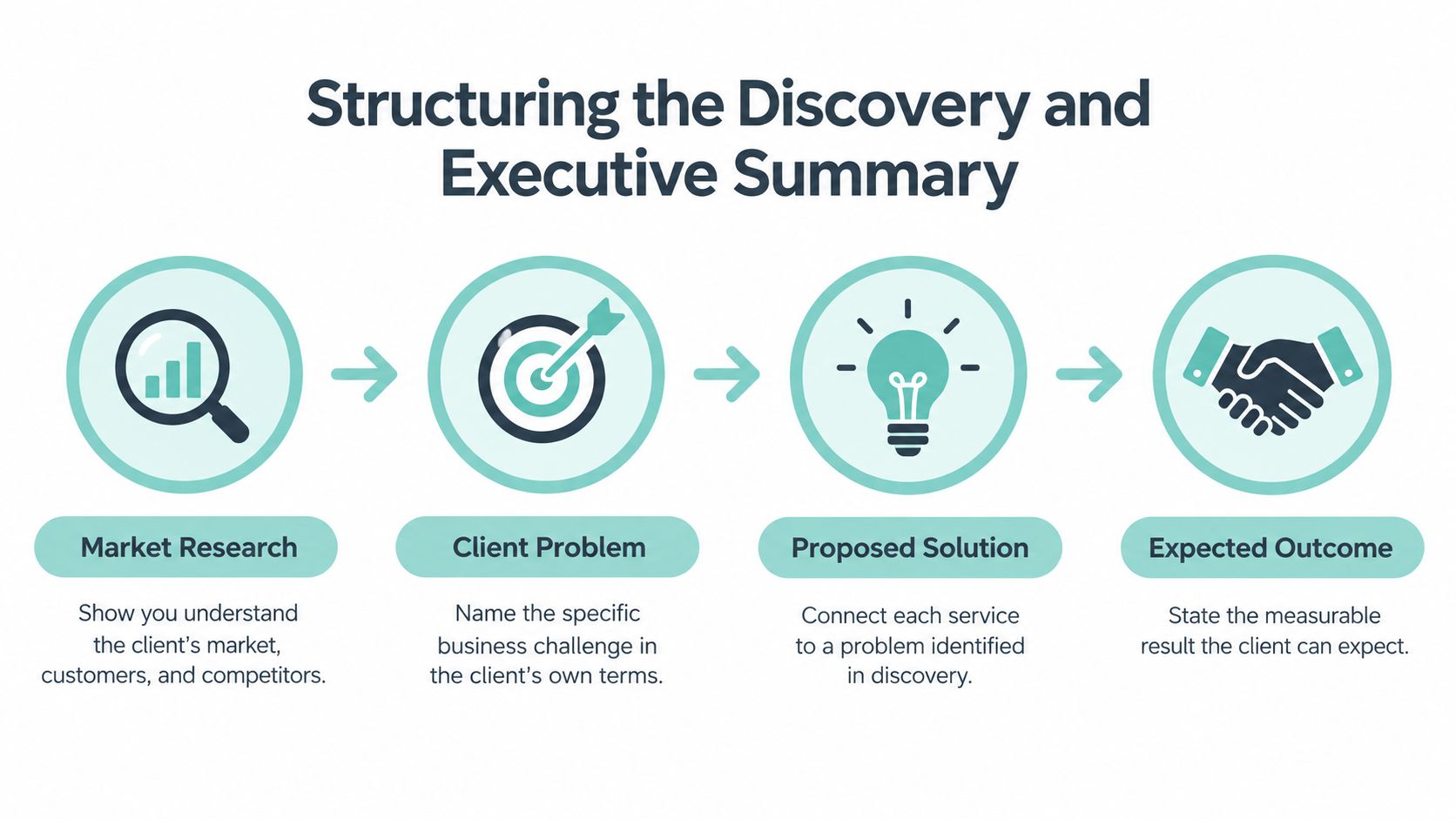
The executive summary should prove that you understand the client's market before it explains your agency. Skip the long history of your team unless a specific credential directly reduces the client's risk. A decision-maker wants to know what is limiting qualified inquiries, why the limitation exists, and what the proposed engagement will change.
Use discovery evidence to build a concise narrative around four questions:
- What does the business want to improve? Define the commercial objective in the client's language, such as more qualified calls from a service area or fewer abandoned intake forms.
- What is happening now? Review organic visibility, non-branded rankings, service-area coverage, conversion paths, calls, forms, and competitor gaps.
- Why is the current system underperforming? Identify structural, technical, content, local-search, or user-experience causes.
- What work follows from those findings? Map each proposed deliverable to a specific diagnosis and define how progress will be evaluated.
Turn evidence into a point of view
Raw data isn't an executive summary. “You have pages ranking beyond the first page” is an observation. “Your strongest commercial services lack dedicated, locally relevant paths, so existing authority isn't being directed toward the searches most likely to produce inquiries” is a diagnosis.
That distinction matters because the diagnosis determines the information architecture. A contractor may need separate pages for emergency repairs, replacement work, and nearby communities. A law firm may need clearer practice-area grouping, attorney credibility content, case-result context where appropriate, and a shorter intake route. The proposal should show the logic without pretending that a recommendation is already a proven result.
A discovery report can contain:
- Market context: Service areas, customer types, priority services, seasonality, and competitor positioning.
- Visibility findings: Branded and non-branded search performance, technical obstacles, local profile consistency, and content gaps.
- Conversion findings: Calls to action, form length, phone prominence, trust elements, page speed, and mobile usability.
- Opportunity map: Which pages, technical fixes, local assets, and experiments deserve priority.
- Decision criteria: What must be approved, supplied, tested, or measured before the next phase begins.
For a more formal market diagnosis, agencies can link the executive summary to a market opportunity assessment, then translate its findings into a short client-facing narrative. The summary should make the proposal feel inevitable: once the problem is clearly defined, the recommended sequence should follow naturally.
Defining Measurable Goals and KPIs for Local Leads
“More traffic” is not a sufficient goal for a service business. Traffic can rise while qualified inquiries remain flat, or come from searches unrelated to the services the company sells. A commercially accountable proposal starts with baselines, defines a lead clearly, and shows how a visitor becomes a measurable business action.
Separate established organic performance from emerging answer-engine visibility. Rankings, organic sessions, calls, and form submissions describe one part of acquisition. Mentions, citations, referral sessions, and assisted conversions from AI answer engines describe another. Combining both into one “SEO and AEO traffic” figure hides channel differences and makes budget decisions less reliable.
Build the measurement layer before implementation
Google Analytics 4 defines a conversion as an Analytics event used to measure an important business action across Analytics and Google Ads. For lead generation, Google uses the generate_lead event for a completed signup or lead form, rather than a weaker signal such as form scrolling. The recommended sequence is Event → Key Event → Conversion, as explained in Google's GA4 conversion documentation.
A proposal should name the owner of instrumentation, define which actions count as qualified, and explain how calls will be reconciled with form records and CRM outcomes. It should also state reporting limits. A completed form is not automatically a qualified opportunity, and a ranking improvement does not prove that revenue increased. For a law firm, a qualified lead may require the right case type and service area. For a contractor, it may require a valid project location, service fit, and reachable contact.
| Metric Category | Specific KPI | Measurement Tool | Business Impact |
|---|---|---|---|
| Visibility | Non-branded rankings for priority services and locations | Rank tracking and search data | Shows whether the site reaches people beyond existing brand awareness |
| Demand | Organic sessions to commercial landing pages | GA4 and Search Console | Indicates whether relevant searchers reach the site |
| Lead actions | Completed forms using generate_lead, tracked calls, and qualified inquiries |
GA4, call tracking, CRM | Connects search activity to actual opportunities |
| Conversion quality | Form completion rate, call quality, and lead disposition | Analytics, recordings, CRM review | Distinguishes activity from useful business outcomes |
| Local reputation | Review presence, response workflow, and platform accuracy | Business profile and reputation tools | Supports trust during local purchase decisions |
| AEO testing | Citations, mentions, referral sessions, and assisted conversions | Manual monitoring, referral analytics, CRM notes | Measures an emerging channel without overstating its scale |
Local reputation belongs in the KPI framework, not in a footnote. BrightLocal's 2025 Local Consumer Review Survey found that 83% of consumers use Google to read local-business reviews, while 74% check at least two review platforms before making a purchase decision. The survey used a representative panel of 1,026 U.S. adults. BrightLocal also reported that 89% would use a business that responds to all reviews, compared with 44% for a business that doesn't respond at all.
Treat AEO as a measured experiment
The available evidence supports separation rather than hype. BrightEdge reported that AI referrals represented less than 1% of referral traffic through August 2025, while traditional organic search remained the stronger conversion source, as stated in its AI search traffic analysis. Different reporting periods can show rapid growth in AI referrals without making the channel large enough to replace organic search as the operating foundation.
An Ahrefs study of 3,000 websites found that 63% received some AI traffic, but AI visitors averaged only 0.17% of website traffic. ChatGPT, Perplexity, and Gemini generated 98% of that AI traffic, according to the Ahrefs AI traffic study. These figures justify testing, not an inflated forecast.
Use core organic and local visibility as the foundation. Add answer-oriented content, structured data, and citation monitoring when they support genuine customer questions. Define the hypothesis, record the starting point, assign an owner, and set a review date. A proposal should show what would justify more investment and what would stop an unproductive test.
For a practical lead-attribution model, use this guide to measuring SEO ROI as a reference point, then adapt its fields to the client's sales process. Cost per qualified inquiry, booked consultation rate, and revenue by source give the client a clearer commercial view than traffic totals alone.
Detailing the Strategy, Deliverables, and Project Timeline
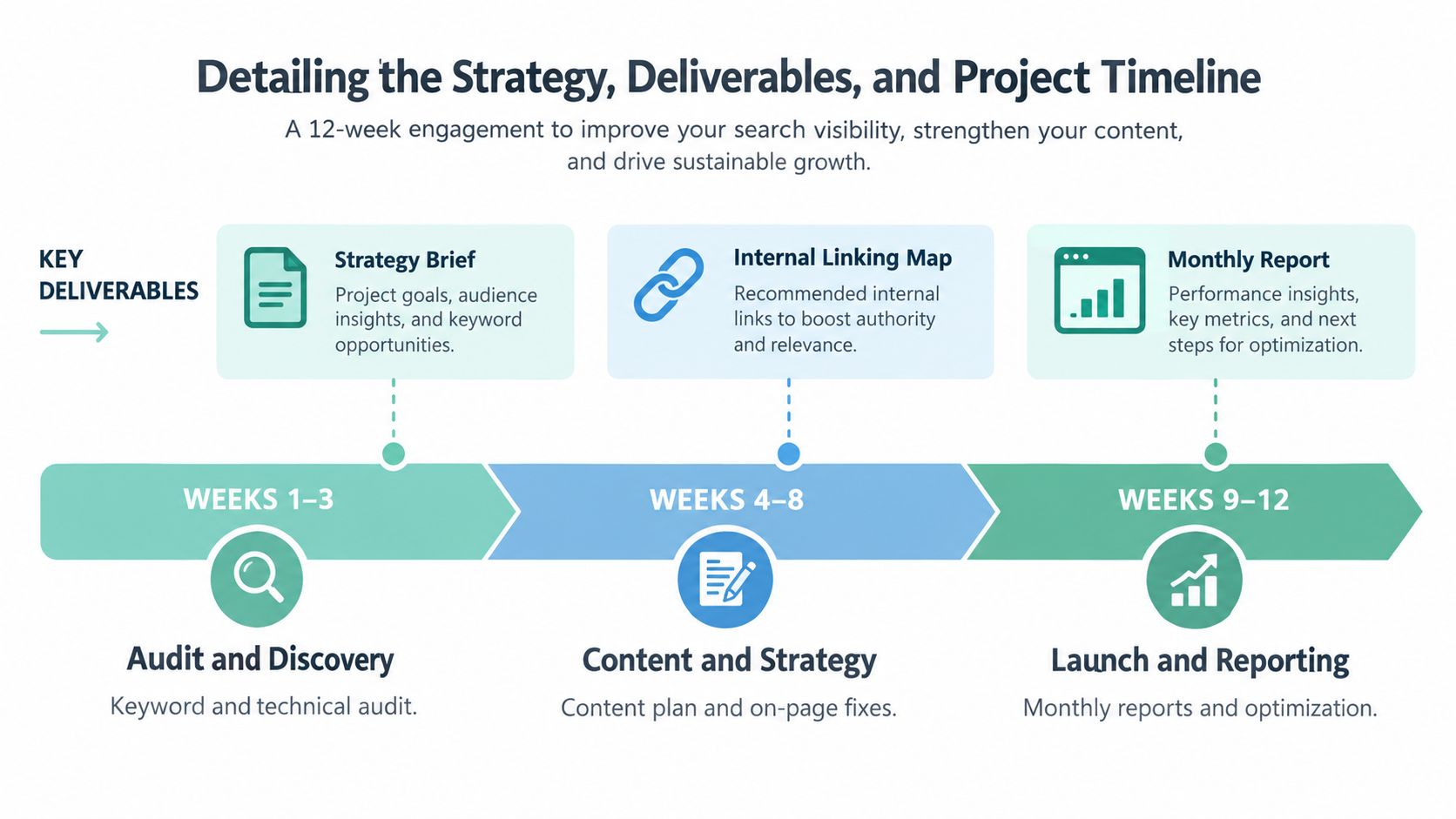
The strategy section should read like an operating plan, not a catalogue of capabilities. Every deliverable needs a purpose, an owner, a dependency, and an acceptance criterion. If the discovery identifies weak service coverage and a confusing intake path, the proposal should show how content architecture, design, development, technical SEO, and CRO address those problems in sequence.
Use phases that reduce execution risk
A workable sequence includes:
- Discovery and baseline: Review analytics, rankings, competitors, service areas, existing content, technical conditions, and lead paths. Agree on definitions before implementation begins.
- Information architecture and content strategy: Map services, locations, supporting topics, internal links, conversion paths, and content responsibilities.
- Design and development: Create responsive layouts, reusable page patterns, clear calls to action, accessible interactions, and a WordPress build that supports future optimization.
- Technical SEO and local implementation: Resolve crawl, indexation, performance, structured-data, internal-linking, local-profile, and citation issues identified during discovery.
- Launch validation: Test redirects, forms, calls, analytics events, metadata, templates, mobile behavior, and key user journeys before release.
- Ongoing optimization: Review performance and lead quality, prioritize experiments, update content, refine calls to action, and report decisions rather than merely sending charts.
Client responsibilities must sit beside agency tasks. Content approvals, legal review, access to analytics, photography, service details, location information, CRM feedback, and timely decisions can affect delivery. State what happens when those inputs arrive late.
Present CRO as part of the build
CRO shouldn't be an optional layer added after rankings improve. A page that attracts a searcher but buries the phone number, obscures the service area, or asks for unnecessary information has failed commercially even if its visibility grows.
A proposal might connect a diagnosed issue to a deliverable like this:
Observed friction: Mobile visitors reach a service page but encounter a long, unclear form.
Response: Rework the hierarchy, clarify the call to action, simplify the form path, instrumentgenerate_lead, and review completed actions after launch.
That level of specificity lets the client evaluate the work without understanding every technical term. It also gives the agency a defensible basis for prioritization. A useful SEO approach for lead generation should connect search visibility to the pages and actions that create opportunities.
Presenting Pricing, Terms, and Commercial Accountability
Pricing becomes uncomfortable when the scope is vague. A monthly fee attached to “ongoing SEO and website support” leaves both parties guessing about priorities, availability, revisions, and what counts as extra work. The solution isn't a longer disclaimer. It's a proposal that makes the commercial model operational.
Separate fixed deliverables from variable requests. A fixed phase might include an approved information architecture, a defined set of page templates, technical remediation, launch testing, and a reporting setup. Variable work might include additional locations, new integrations, major copy rewrites, photography coordination, or requests outside the agreed service area.
Make the boundaries visible
Each phase should state:
- Assumptions: Existing platform access, client-supplied business information, available brand assets, and agreed approval contacts.
- Client responsibilities: Feedback deadlines, legal review, content sign-off, system access, and lead-quality feedback.
- Acceptance criteria: What must be delivered and how the client confirms that it meets the agreed scope.
- Exclusions: Paid advertising, social media management, unrelated graphic design, third-party subscription fees, and work assigned to outside partners.
- Dependencies: Hosting, CRM, call tracking, analytics access, developer access, and external approvals.
- Change control: How a new request is assessed, estimated, approved, scheduled, and documented.
A risk register signals maturity. Include missing content, delayed approvals, analytics defects, migration errors, unavailable stakeholders, and third-party dependencies. For each risk, name the owner, the trigger, the mitigation, and the effect on schedule or scope.
Project-budget guidance from TimeRewards on project budget management highlights why this discipline matters. Projects frequently exceed original budgets, and unanticipated scope changes are a major source of overruns. Estimating work from comparable historical tasks, separating fixed deliverables from variable requests, and reviewing estimated against actual effort creates a practical control system.
Price the decision, not just the labour
A clear investment table can show phase, deliverable, payment trigger, owner, and status. Avoid presenting a large bundle with every possible service included. The client should understand what they receive now, what remains optional, and which decision enables the next phase.
Volume pricing can make sense when the client adds comparable work, such as location pages or repeatable service templates. It shouldn't be used to disguise an unprofitable scope. This discussion of implementing volume discounts that scale is useful background, but the proposal still needs its own assumptions and approval rules.
Don't guarantee rankings or leads. Define controllable outputs, baseline metrics, reporting cadence, and thresholds that trigger iteration. That protects the client from inflated promises and protects the agency from being judged against variables it cannot control.
Finalizing the Proposal with Case Studies and Next Steps
The strongest case study is not the most impressive one. It's the one that resembles the prospect's problem closely enough to make the proposed method credible.
For a personal injury law firm, lead with a documented engagement involving local organic visibility, practice-area structure, intake friction, and qualified inquiry tracking. For a multi-location roofer, choose evidence involving regional service coverage, location architecture, local reputation, and conversion paths. A case study that only reports traffic growth may not answer the buyer's commercial question.
Show the chain from problem to outcome
Use a compact structure:
- Situation: Describe the market, service model, and diagnosed constraint.
- Intervention: Identify the strategic, technical, content, design, and CRO work that addressed it.
- Measurement: State the baseline, timeframe, source, and definitions used.
- Result: Report only documented outcomes, distinguishing organic traffic from qualified leads and noting any relevant limitations.
- Application: Explain which parts of the method are transferable and which depend on the prospect's conditions.
Don't attach a number to an outcome unless you can show where it came from and what it measures. “More traffic” may hide irrelevant queries. “More leads” may count duplicate submissions or unqualified requests. Commercial proof requires definitions.
The final page should remove uncertainty about starting. State the approval action, contract step, payment trigger, access checklist, kickoff agenda, first audit activities, and expected client inputs. A prospect shouldn't have to email you to discover what happens after signing.
A practical next-step sequence can include:
- Confirm scope, assumptions, exclusions, and decision-makers.
- Sign the agreement and provide approved access.
- Hold the kickoff meeting with business, marketing, and technical stakeholders.
- Complete the initial audits and validate baseline tracking.
- Approve the first priority set, then begin implementation against the agreed acceptance criteria.
A polished design helps, but clarity closes the engagement. The right marketing proposal sample format makes the transition from prospect to client feel controlled because both parties understand the problem, the work, the measures, and the decisions ahead.
Digital Skyrocket designs and builds lead-generating websites, with ongoing SEO, local search, AEO, reputation management, and CRO for service businesses. If your firm or contracting company needs a discovery-led proposal tied to qualified inquiries rather than vanity metrics, visit Digital Skyrocket to discuss a website and SEO engagement.