
A year into SEO, the owner of a roofing company opens the monthly report and sees better rankings, more impressions, and a handful of new visitors. The phone still isn't ringing often enough. A dentist sees the same pattern with “informational” traffic that never books. A law firm ranks for broad legal questions, yet its intake team receives few cases that fit its practice and service area.
That isn't a ranking problem. It's a pipeline problem. Search engine optimization for lead generation only works when search intent, local visibility, page persuasion, technical accessibility, answer-engine retrieval, and follow-up all connect to one commercial outcome, a qualified inquiry.
Table of Contents
- Why Most SEO Campaigns Never Produce Real Leads
- How Search Became a Pipeline Instead of a Traffic Source
- Choosing the Keywords That Actually Bring Buyers
- Owning Your Service Area With Local SEO
- Technical Foundations and Answer Engine Optimization
- Turning Visitors Into Inquiries With Conversion Paths
- Measuring What Matters Beyond Rankings
- Your 90-Day SEO and AEO Growth Playbook
Why Most SEO Campaigns Never Produce Real Leads
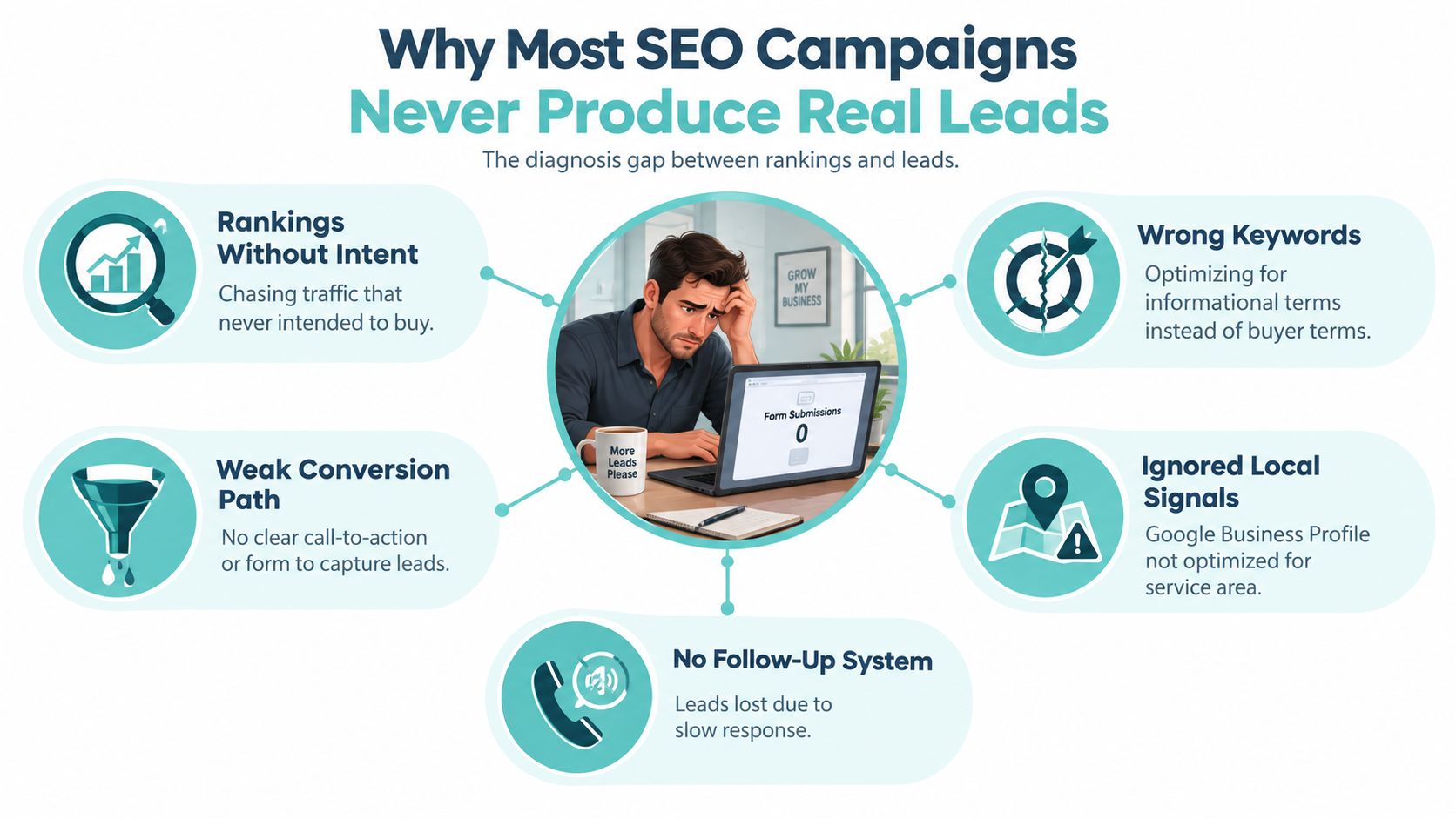
The recurring mistake across law firms, roofers, and dental practices is treating rankings as the deliverable. Rankings matter, but they're only useful when they put the right page in front of someone who needs the service and can take the next step.
A campaign can fail in three predictable ways:
- The visitor never intended to buy: A page about “how to fix a leaky roof” may attract research traffic while missing the person searching for an emergency roofer.
- The inquiry isn't qualified: Broad visibility can generate questions from people outside the practice area, service radius, budget, or case type.
- The page doesn't persuade: A visitor may land on a ranking page and find no clear phone number, booking path, proof of experience, service-area detail, or reason to trust the business.
Rankings are not the product
Look at the page behind the ranking report. Does it match a buyer's query? Does it make the service understandable? Does it show who serves the searcher's location? Does it offer one obvious action, such as calling, booking, or requesting an evaluation?
If the answer is no, publishing more articles won't repair the leak. A service business should measure the journey from query to landing page, from landing page to call or form, and from inquiry to accepted opportunity. Resources on how to generate more leads effectively can add useful perspective, but the central discipline remains the same: optimize for the inquiry your team wants.
SEO and AEO belong in one budget
Separating traditional SEO from Answer Engine Optimization creates unnecessary planning gaps. A page that answers a service question clearly can rank in classic results, become useful source material for AI summaries, and direct a local searcher toward a call from the Google Business Profile ecosystem.
The rebuild starts with intent. Choose terms connected to real services, build pages that answer and persuade, make the local signals credible, and track outcomes beyond position changes. Traffic is an input. Qualified inquiries are the output.
How Search Became a Pipeline Instead of a Traffic Source
Organic search earns its place in a lead-generation strategy because searchers often reveal a need before a company interrupts them. Industry compilations report that organic search accounts for about 53% of B2B inbound leads, while SEO-generated leads close at 14.6%, compared with 1.7% for outbound leads, according to industry summaries of organic lead-generation benchmarks. The close-rate difference is roughly 8.6 times, but the important lesson isn't the multiplier. It's the intent behind the interaction.
A useful search funnel has three layers:
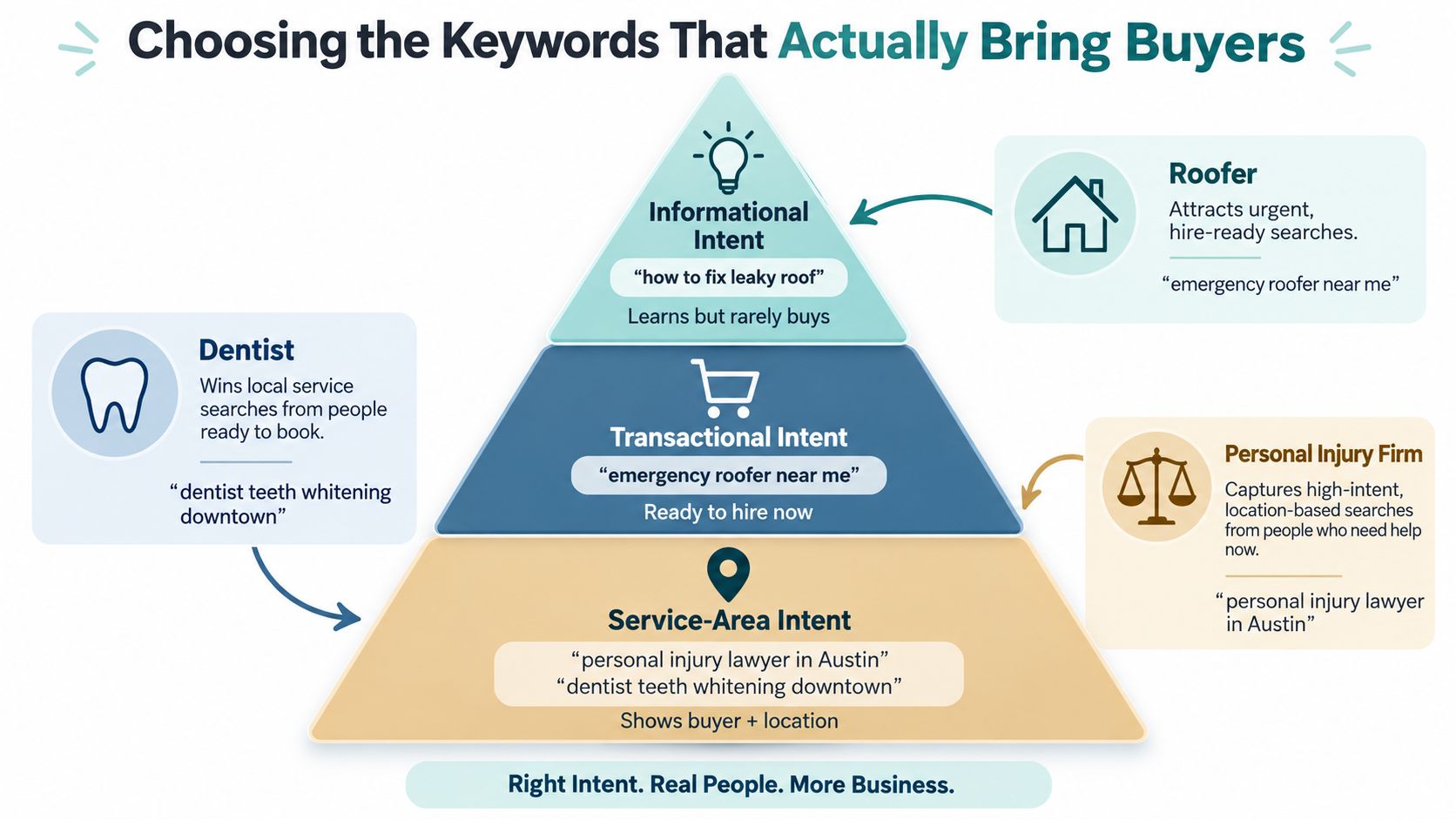
- Awareness: “What causes a roof leak?” or “What does a personal injury lawyer do?” These queries need concise education and a route toward relevant services.
- Consideration: “Roof repair versus replacement” or “best dentist for dental implants.” These searchers need comparisons, process explanations, proof, and qualification details.
- Decision: “Emergency roofer near me,” “personal injury lawyer in Austin,” or “dentist accepting new patients.” These pages should make contacting the business easy.
The conversion path must change with the intent. An awareness page might offer a related guide or consultation. A consideration page should lead to proof, pricing context, or a service comparison. A decision page needs a prominent call, form, booking option, location confirmation, and trust evidence.
The benchmark is not one universal rate
A 2026 benchmark from Ruler Analytics' conversion-rate data reports an average organic search conversion rate of 4.9%. Separate benchmark sets place SEO lead conversion around 2.6%, with typical SEO lead-generation performance at roughly 2.9% median, above 4% considered good, and above 7% in the top quartile. These figures shouldn't become a vanity target. They show why teams need to separate branded, non-branded, informational, transactional, and local traffic.
| Channel / Intent | Typical Close Rate | Visitor-to-Lead Rate | Notes |
|---|---|---|---|
| SEO-sourced leads | 14.6% | Varies by intent and site | Industry summaries associate SEO leads with stronger close quality |
| Outbound-sourced leads | 1.7% | Varies by campaign | Interruption-based acquisition typically starts farther from active demand |
| Organic search overall | Not specified | 4.9% average benchmark | Ruler Analytics benchmark |
| SEO lead generation | Not specified | 2.6% benchmark | Separate benchmark set |
| Informational intent | Not specified | Usually weaker than buyer intent | Needs education and a next-step offer |
| Transactional or service-specific intent | Not specified | Usually stronger than mixed traffic | Needs a direct conversion path |
Local intent should be the default for any business that books appointments, dispatches crews, or serves a geographic market. SEO and AEO are one pipeline when the same page answers the query, proves relevance to the area, and gives the visitor a measurable way to contact the business.
Choosing the Keywords That Actually Bring Buyers
Keyword research starts with a commercial question, not a volume question: would the right person contact this business after finding this result?
For a dentist, “how to whiten teeth naturally” is awareness intent. “professional teeth whitening near me” is transactional and local. For a roofer, “how to fix a leaky roof” may educate a homeowner, while “emergency roofer near me” signals immediate need. For a personal injury firm, “what should I do after a car accident” supports consideration, while “personal injury lawyer in Austin” names both the service and location.
Build a query map by intent
Assign each worthwhile query to a page type:
- Core service pages: Create one strong page for each major buyer service, such as dental implants, storm damage roofing, or car accident representation.
- Service-area pages: Build pages for relevant cities and neighborhoods when the business serves them. Each page needs distinct proof, local context, service details, and a clear route to contact.
- Comparison and FAQ pages: Use these for consideration queries where the visitor needs to evaluate options, costs, timelines, or suitability.
- Awareness articles: Publish these selectively. They should earn links, support internal navigation, or answer questions that sales teams hear repeatedly.
A keyword deserves a page when it passes four filters: intent, commercial language, local relevance, and SERP format. If the results are dominated by forums, definitions, or national publishers and the query has no realistic service connection, skip it. A large audience isn't automatically a valuable audience.
For a practical local research workflow, use the guidance in this keyword research resource for local SEO, then validate the findings against actual calls, intake notes, Search Console queries, and sales language.
Make every target answerable
AEO changes the page requirement. A target query should have a direct answer near the top, a scannable list or comparison, supporting detail, and structured data where appropriate. Don't bury the answer under a long introduction.
For example, a roofer's page can answer what qualifies as emergency damage, list immediate steps, compare repair and replacement, and explain when a professional inspection is appropriate. The same content can serve a traditional result and an AI answer engine because it is clear, extractable, and connected to a real service.
Owning Your Service Area With Local SEO
Local SEO isn't an add-on for a service business. It's the operating system for visibility when customers search from a place, search with “near me,” or expect a nearby provider to answer quickly.
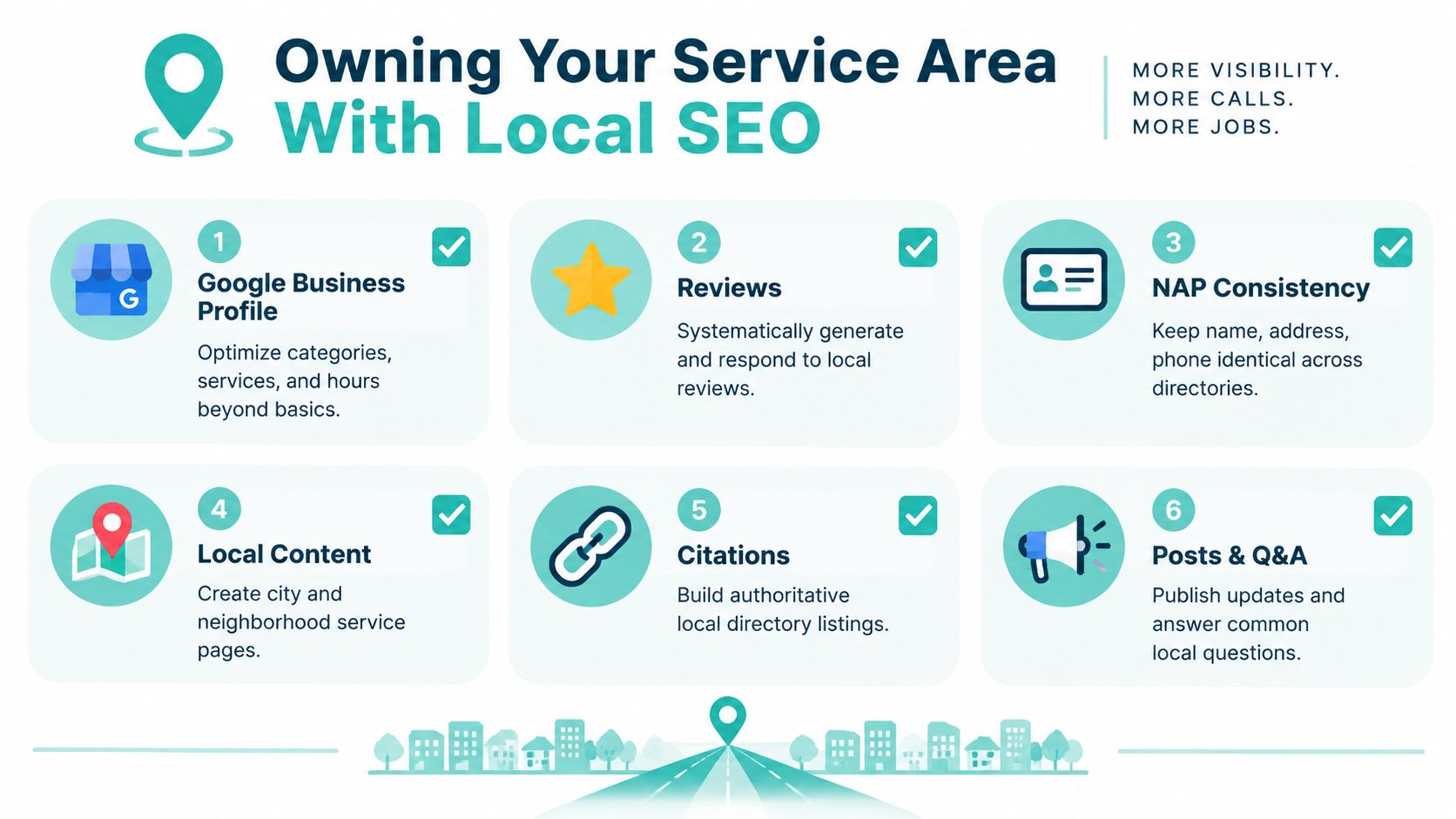
Google describes local results through three factors, relevance, distance, and prominence, as summarized in Google's local search guidance. Your job is to improve each factor without pretending you can control distance. Relevance comes from accurate categories, services, attributes, business descriptions, and useful content. Distance depends on the searcher's location and the legitimate service area. Prominence grows through reputation, references, reviews, and recognizable business information.
Treat the Business Profile as a conversion asset
Complete the Google Business Profile beyond the minimum. Choose the most accurate primary category, add relevant services, maintain hours, publish authentic photos, answer Q&A with customer language, and make the phone and website paths obvious. A profile that matches the query but gives no confidence or next step wastes local visibility.
One data-backed summary attributes about 32% of local ranking influence to profile completeness and related signals, about 16% to review volume and recency, and about 10% to behavioral signals such as calls, clicks, and direction requests, as reported in this local SEO signal summary. Use those figures as directional priorities, not as a promise of a fixed ranking formula.
Review acquisition should be systematic and ethical. Ask satisfied customers for honest feedback, make the process easy, and respond with specific language. A local study summarized by Localo's review visibility analysis found top-three visibility ranging from 39.3% for businesses with 1 to 5 reviews to 73.0% for businesses with 201 to 500 reviews. The study also connected business descriptions with added value alongside review volume.
Build legitimate location depth
Service-area businesses shouldn't publish city pages that swap place names inside identical templates. Create distinct pages with real service evidence, named towns, local permitting considerations, neighborhood references, travel expectations, and relevant customer questions. Keep business name, address, and phone information consistent across the site and reputable directories, then use industry-specific citations where they make sense.
The guide to building location landing pages is useful for planning that hierarchy. Local content also gives human visitors and AI assistants stronger evidence that the business operates in the area.
Technical Foundations and Answer Engine Optimization
A technical fix can affect lead performance before it changes a ranking. Google's commissioned study, summarized in this speed and conversion report, found that a 0.1-second improvement in load time increased conversions by 8% for retail sites and 10% for travel sites on average. Those sectors aren't service businesses, but the principle carries over: speed affects the entire user journey, including the moment someone tries to call or submit a form.
Technical SEO now has two jobs. It must help crawlers discover and interpret the page, and it must help search systems retrieve a concise, trustworthy answer. AEO means structuring content so AI search engines and Google AI Overviews can extract, understand, and cite useful passages without losing the conversion path.
Fix the technical barriers first
Use a focused checklist:
- Performance: Monitor Core Web Vitals, including LCP under 2.5 seconds and INP under 200 milliseconds. These are implementation targets, not claims about guaranteed lead growth.
- Crawl hygiene: Remove unnecessary duplicate paths, repair broken internal links, control indexation, and keep important service pages easy to reach.
- Canonicalization: Consolidate service variants and location duplicates so search engines understand which URL represents the primary page.
- Structured data: Use appropriate LocalBusiness, Service, FAQPage, and Review markup when the visible content supports it.
- Entity clarity: Keep the business name, services, locations, practitioners, attorneys, and contact details consistent across pages.
- Heading hierarchy: Put the direct answer and page purpose in clear headings, then support them with concise sections.
| Element | Traditional SEO Focus | AEO Focus |
|---|---|---|
| Content | Relevance, depth, internal links | Direct answers that can be extracted |
| Headings | Organize topical sections | Make question-and-answer relationships obvious |
| Schema | Help interpret entities and page types | Reinforce machine-readable context |
| Performance | Support crawling and user experience | Reduce friction before and after an answer click |
| Local signals | Establish geographic relevance | Help assistants identify a credible provider |
| Conversion path | Turn a visit into an inquiry | Keep the source page commercially actionable |
Technical SEO isn't separate from conversion work. A fast page with clear entity signals, valid markup, useful answers, and a visible CTA can serve classic search and answer engines at the same time. For a deeper technical framework, review what technical SEO includes.
Turning Visitors Into Inquiries With Conversion Paths
Many businesses respond to weak lead volume by adding keywords. That often treats the symptom instead of the constraint. Independent B2B benchmarks place median visitor-to-lead conversion at 2.3%, while top-quartile programs reach 4.7% or higher, according to B2B inbound demand-generation benchmarks. The gap points to intent matching, offer design, page structure, and trust, not just content volume.
A landing page should continue the searcher's thought. Someone searching for emergency plumbing needs a rapid contact path, service-area confirmation, and response expectations. Someone comparing law firms needs relevant case experience, process clarity, attorney identity, and intake qualification. Someone researching dental implants may need candidacy information, financing context, and a consultation route.
Match the offer to the query
Use the offer that removes the next objection:
- Price-driven query: Provide a cost guide, calculator, or assessment that explains the variables behind the estimate.
- Emergency query: Put a same-day booking or immediate call option above the fold.
- Comparison query: Offer a case study, service comparison, or consultation that helps the visitor make a decision.
- High-trust service: Show licensing, insurance, guarantees where applicable, response expectations, and named professionals.
The page should have one primary CTA. Keep secondary navigation available, but don't make the visitor choose among a dozen competing actions. Put the phone number and form where mobile users can act without hunting.
Trust must be specific
Generic claims such as “quality service” don't persuade serious buyers. Use named locations, real customer language, recognizable credentials, relevant reviews, photos of the team or completed work, and clear information about what happens after submission. The form should identify the business, explain the expected response, and ask only questions that help qualification.
Conversational tools can support capture when staffed and routed properly. Practical chatbots for lead generation tips can help teams think through qualification, escalation, and handoff. A chatbot that delays a ready buyer or collects inquiries nobody follows up with is not an improvement.
Fixing the path on existing commercial traffic often beats publishing another batch of weak articles. More visitors won't compensate for a page that gives qualified visitors no confident next step.
Measuring What Matters Beyond Rankings
A service business doesn't need a forty-tab spreadsheet. It needs a reporting stack that shows whether the right searchers become conversations, whether those conversations fit the business, and where the path breaks.
Review organic sessions by intent, not as one total. Separate branded from non-branded traffic, service pages from educational pages, and local queries from broad research. Then connect those visits to calls, forms, booked appointments, consultations, and accepted opportunities in the CRM.
Use the right cadence
| Cadence | Primary Metrics | Source | Decision It Answers |
|---|---|---|---|
| Weekly | Qualified calls, form submissions, missed calls, response time | Call tracking, CRM, form records | Are ready buyers reaching and receiving the team? |
| Monthly | Organic sessions by intent, tracked-phrase conversion rate, form-to-call ratio | Search Console, analytics, call tracking | Which pages and queries create useful inquiries? |
| Quarterly | Organic cost per lead versus paid, accepted-opportunity rate, location performance | CRM, finance records, analytics | Where should the next investment go? |
Use Google Search Console to identify queries and landing pages, then connect those URLs to analytics events and CRM records. UTM tagging helps preserve campaign and page context, while offline import or CRM reconciliation can connect the original search interaction to a later sales outcome. Don't treat Search Console as a revenue system. Treat it as the discovery layer that needs to be joined with intake data.
Separate signals from outcomes
Raw traffic growth is a visibility signal, not proof of pipeline growth. Ranking screenshots are even weaker because they can hide personalization, location differences, intent mismatch, and poor conversion paths.
Predictive signals include branded search lift, repeat visits, engagement with commercial pages, calls from service-area pages, and movement from informational content into service pages. Lagging indicators include monthly traffic totals and closed revenue. Owners should review both, but they should make budget decisions using qualified inquiries and accepted opportunities.
Reporting rule: If a ranking improvement doesn't produce a useful action, it belongs in the diagnostic report, not at the center of the business dashboard.
Your 90-Day SEO and AEO Growth Playbook
A good rollout gives every task an owner, a deliverable, and a lead-stage signal. Don't launch content, technical work, local optimization, and CRO as disconnected projects. Sequence them so each phase makes the next phase easier to evaluate.
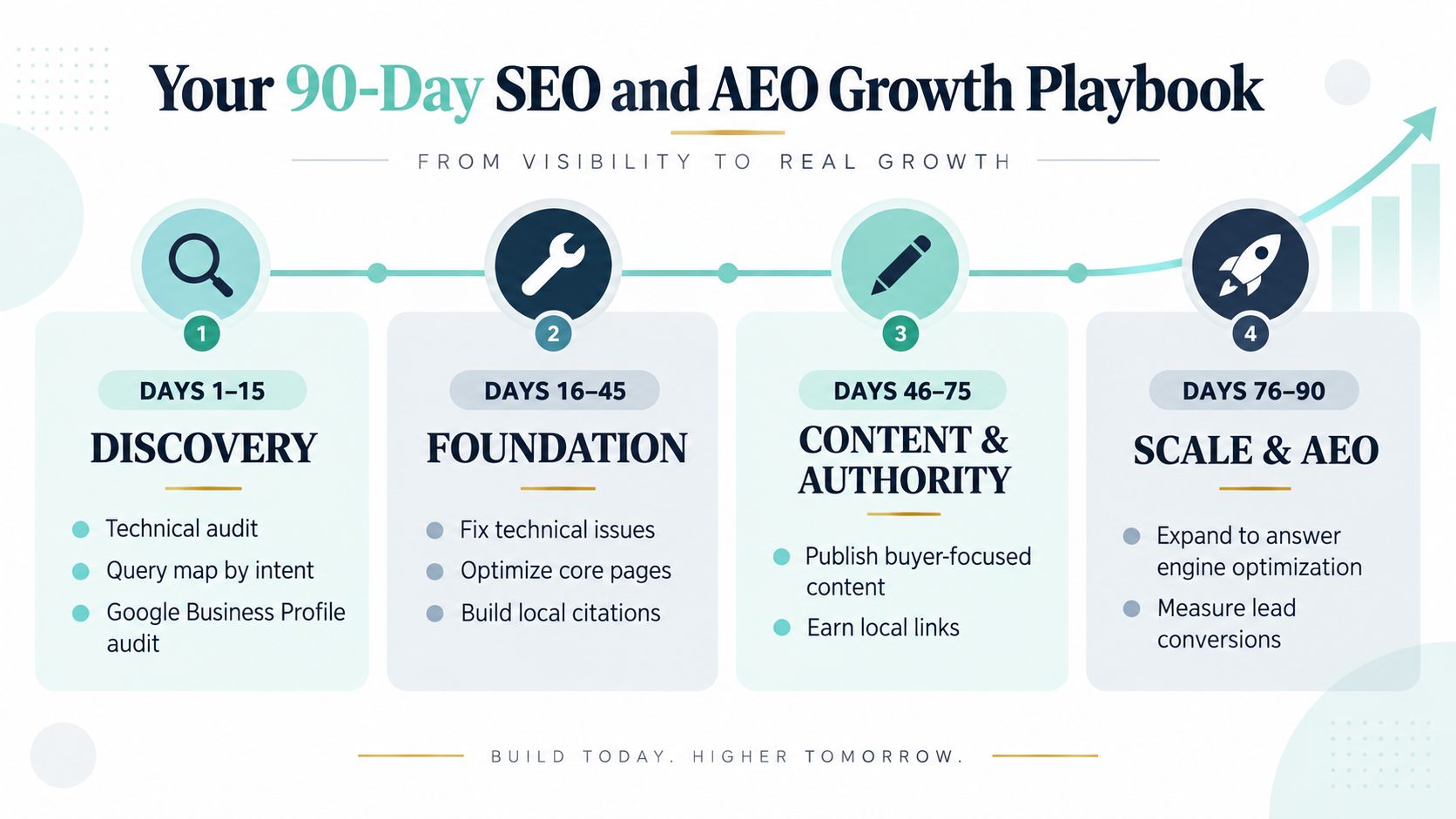
Days 1 to 15 focus on discovery
The SEO lead or agency should complete a technical audit, query map, Google Business Profile audit, service-area review, and conversion-path inspection. The owner and intake team should validate which inquiries count as qualified and identify common objections.
Deliverables: prioritized issue register, intent-mapped query sheet, page hierarchy, profile audit, call and form baseline.
Readiness signal: the team can identify which services, locations, and inquiry types deserve priority, and it has a reliable way to record calls and forms.
Days 16 to 45 establish the foundation
The developer fixes major performance and crawl issues. The content lead publishes or rebuilds priority service pages and legitimate location pages. The conversion owner tightens forms, phone placement, CTAs, trust elements, and thank-you routing. The local SEO owner improves profile categories, services, photos, Q&A, citations, and the process for requesting reviews.
Deliverables: functioning core pages, cleaner technical architecture, improved local profile, defined intake flow, and review outreach process.
Readiness signal: priority pages are indexable, relevant to their target intent, usable on mobile, and connected to a measurable contact action.
Days 46 to 75 add answer-engine assets
Create FAQ blocks from real customer questions, comparison pages for consideration queries, concise definitions, process lists, and supporting structured data. Subject-matter experts should review accuracy, especially for legal, medical, roofing, and regulated services.
Deliverables: answer-ready sections, comparison content, FAQ implementation, schema validation, and internal links from awareness pages to commercial destinations.
Readiness signal: important pages answer core questions directly while preserving a clear route to call, book, or submit an inquiry. Video can support trust and explanation, and teams can optimize your channel using ViewsMax insights when video is part of the broader search presence.
Days 76 to 90 measure and iterate
The analyst connects Search Console, analytics, call tracking, forms, and CRM outcomes. The CRO owner reviews recordings, form abandonment, call quality, and page-level performance. The content lead sets a quarterly cadence based on conversion evidence rather than a generic publishing quota.
Deliverables: one-page reporting dashboard, CRO test backlog, qualified-lead definitions, content priorities, and a quarterly optimization schedule.
Readiness signal: the business knows which pages generate qualified inquiries, which queries produce poor-fit traffic, and which conversion barriers deserve the next round of work.
Digital Skyrocket builds lead-generating websites around technical SEO, local SEO, AEO, and conversion tracking for service businesses, including law firms, dentists, roofers, and HVAC companies. If your site ranks without producing the right calls and forms, visit Digital Skyrocket to discuss a website and ongoing SEO plan built around qualified inquiries.