
Most SEO advice reduces semantic keyword grouping to a tidy rule: keywords that mean the same thing belong on one page. That rule is useful for generating ideas, but dangerous when it becomes your architecture.
A personal injury firm might group “car accident attorney” and “auto collision lawyer” because the phrases describe a similar service. Yet the right destination could change with the city, the user's urgency, the accident type, or whether the visitor wants legal help or a settlement estimate. A roofing contractor faces the same problem with “roof repair,” “roof replacement,” and “emergency roof repair near me.” The concepts overlap, but the page promise, proof, call to action, and commercial value can differ sharply.
A semantic cluster is a planning hypothesis, not a page assignment. Good SEO teams filter similarity through intent, geography, audience, service line, and the actual pages appearing in search. That discipline prevents cannibalization and protects the qualified leads that traffic reports often hide.
Table of Contents
- Why Semantic Similarity Does Not Always Mean One Page
- The Mechanics of Semantic Keyword Clustering
- A Practical Workflow for Intent-Based Grouping
- Lexical Matching Versus Semantic Understanding
- Translating Clusters into On-Page Structure and Links
- Adapting to AI Search and Query Fan-Out
- Treating Automation as a Hypothesis Generator
Why Semantic Similarity Does Not Always Mean One Page
Search engines can understand that “car accident attorney” and “auto collision lawyer” describe related legal help. A local law firm still shouldn't assume those phrases automatically deserve one URL. One query may be broad service discovery, while another may arise from a person looking for a lawyer after a specific collision, in a particular city, at a particular point in the intake process.
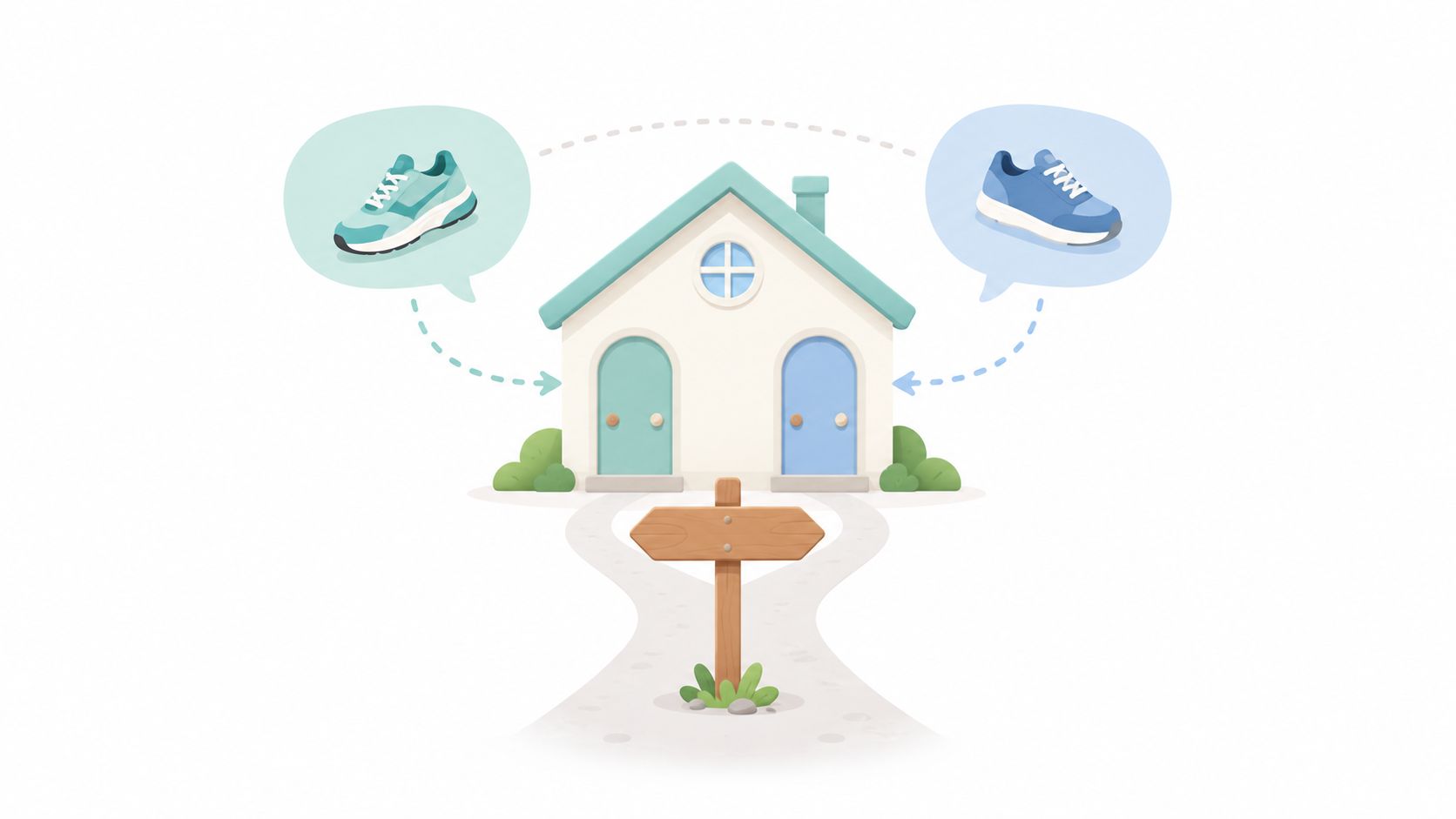
Similar words can signal different jobs
A query such as “personal injury lawyer near me” carries a local and often transactional expectation. “Personal injury lawyer settlement calculator” is closer to research. The searcher may want a calculation framework, not a consultation form. Combining both on a single conversion page forces the content to serve competing needs, and the calls to action become less precise.
Roofing illustrates the same distinction. “How much does a roof replacement cost” calls for explanations about materials, scope, and variables. “Emergency roof repair near me” calls for speed, service area confirmation, phone visibility, and reassurance. Both relate to roofing, but they don't belong to the same page merely because a language model places them near each other.
Practical rule: Group terms together only when one page can satisfy the same need, for the same audience, in the same geography, at the same stage of decision-making.
Cannibalization starts with a planning mistake
Over-consolidation can produce a page that mentions every related phrase but answers none of them decisively. Under-consolidation creates several pages with overlapping promises, leaving search engines to choose between URLs while visitors encounter repetitive content and inconsistent next steps.
The right question isn't “Are these keywords semantically close?” Ask instead:
- Page purpose: Would the same page format satisfy both searches?
- Local intent: Do the queries target the same city, service area, or local pack?
- Service distinction: Are the visitors asking for the same service, or adjacent services with different economics?
- Conversion stage: Should the visitor read, compare, calculate, call, or submit an intake form?
- SERP agreement: Do the prominent results offer the same type of answer?
This matters for Answer Engine Optimization as well. A system generating an answer needs clear, extractable relevance. A page that blends urgent repair, replacement education, pricing research, and several cities may offer broad topical coverage while giving neither traditional search nor AI systems a clean answer.
The Mechanics of Semantic Keyword Clustering
Semantic keyword clustering did not start with SEO tools. In information retrieval, researchers were already testing whether grouped related terms could improve search performance. The useful takeaway came early. The tested expansions did not produce statistically significant retrieval gains, even though the amount of added language varied widely. (The 1972 information-retrieval study shows both the appeal and the limit of query expansion.)
The spread in expansion size helps explain why that matters:
- One method added an average of 0.47 terms per query, or 4.0% growth.
- Another added 27.96 terms per query, or 238.7% growth.
More related terms can broaden a query. They do not automatically improve the result set. That matters in SEO because clustering software often makes the same basic promise in a newer interface: find terms that belong together, then build around the group. The math can be useful. The page decision still needs judgment.
Modern systems make that judgment call look deceptively tidy. They convert a query, phrase, or document into a vector in a fixed-dimensional space. Terms with similar meaning tend to sit in nearby directions, even if they do not share many words. That is why “fixing a leaky roof” and “roof repair” can surface as likely matches even with limited lexical overlap.
What cosine similarity measures
Cosine similarity measures the angle between vectors, not their raw size. If two vectors point in a similar direction, the system treats them as semantically close. A value of 1 commonly means identical direction, while values near 0 usually indicate weak directional similarity, though preprocessing and representation affect the practical range. (This technical explanation of cosine similarity explains how vector comparisons work.)
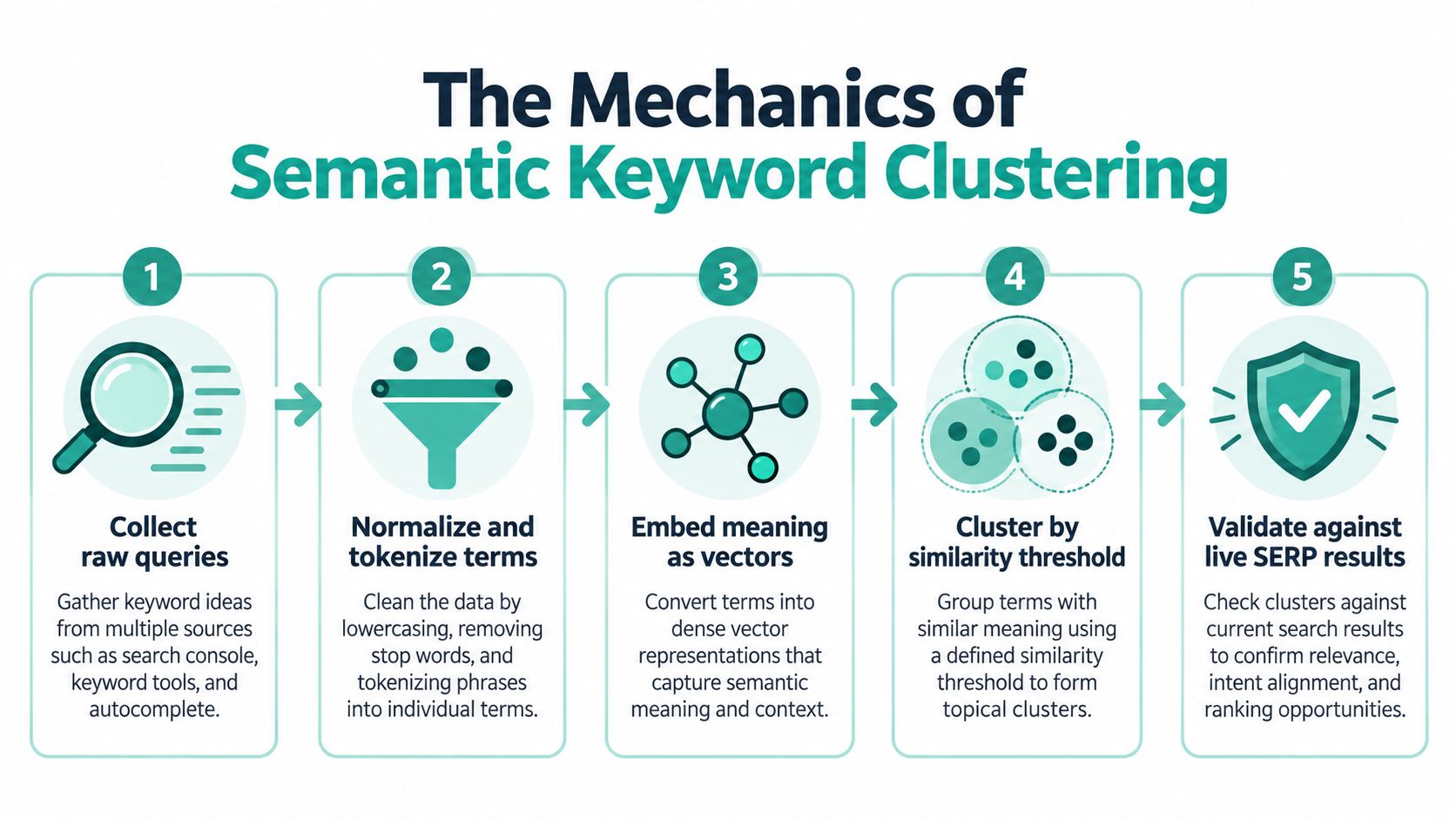
The mechanics are simple enough:
- Normalize the text. Systems may lowercase terms, parse text, remove stop words, and stem variants.
- Represent meaning numerically. The system creates embeddings or uses TF-IDF and related features.
- Compare proximity. Similarity scores surface candidate relationships.
- Apply a clustering rule. A threshold or algorithm groups terms.
- Review the output. Human review and SERP checks decide whether the group belongs on one URL.
Clustering earns its keep here, and here is where it fails. Similarity scoring is good at finding linguistic neighbors. It is weak at separating terms that are close in language but different in business value, conversion path, or page type.
I see this mistake constantly on service sites. “Roof repair” and “roof replacement” often land near each other in vector space because both belong to the same topic area. That does not mean they should live on one page. The customer may expect a different scope of work, a different pricing conversation, and a different next step. A model sees semantic proximity. It does not see how merged intent can blur a service line and hurt lead quality.
By 2019, the process had become more formalized. One peer-reviewed workflow used k-medoids to create term clusters, k-means to calculate centroids, relevance filtering to keep useful groups, and ranking to select expansion terms before rerunning the search. (The 2019 peer-reviewed workflow outlines that sequence.)
That logic still holds for SEO. Collect language, find the topic center, remove weak associations, then review what remains with intent in mind. Filtering does the heavy lifting.
A Practical Workflow for Intent-Based Grouping
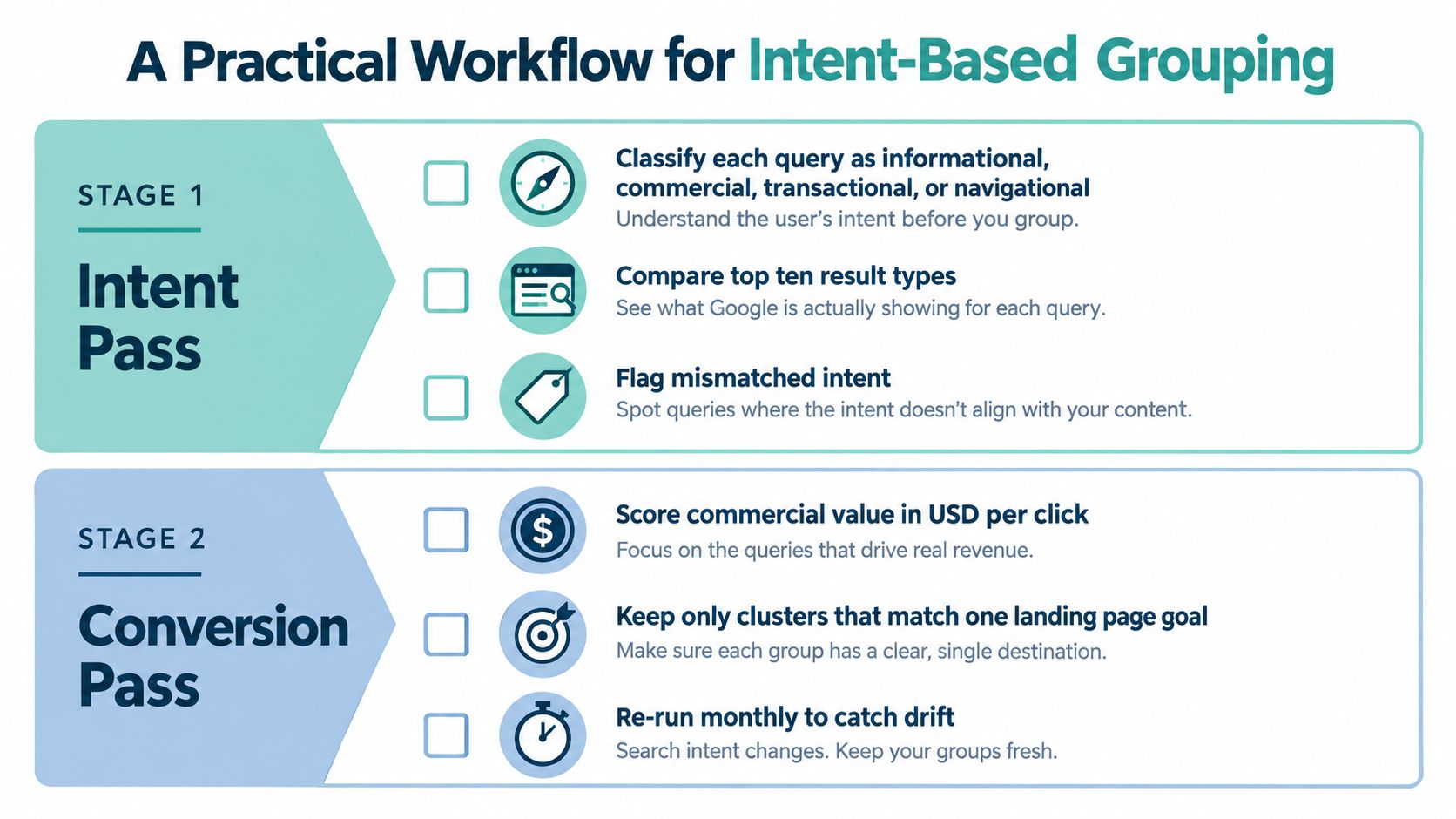
Start with automation, then make the architecture earn its place. The most reliable process uses embeddings to generate candidate groups and manual validation to decide whether those groups should map to URLs.
Stage one builds candidates
Export your keyword set from a research tool, Search Console, call transcripts, sales notes, and customer emails. Normalize obvious variants, remove duplicates, and preserve meaningful modifiers such as city names, “near me,” service types, audience terms, and urgency language.
Use embeddings or a clustering tool to surface semantic relationships. Don't treat the output as a final taxonomy. Mark each candidate with an initial intent label:
- Informational: The visitor wants an explanation, process, definition, or estimate framework.
- Commercial investigation: The visitor is comparing providers, services, methods, or costs.
- Transactional: The visitor is ready to contact, book, hire, or request an estimate.
- Navigational: The visitor is seeking a known business, brand, office, or page.
Then inspect the live results for representative queries. Compare result types, local-pack presence, service pages, guides, calculators, reviews, and location pages. The aim isn't to prove that two phrases are linguistically related. It's to determine whether search engines consistently return pages capable of satisfying both.
Stage two applies business filters
A group should survive five tests:
- Intent match: Can the same content answer both queries without awkward detours?
- Page-format match: Do both searches favor the same type of URL?
- Geographic match: Do they target the same market and service area?
- Entity and service match: Do they involve the same service, customer, and problem?
- Conversion match: Can one call to action serve both visitors naturally?
A strong grouping workflow must validate semantic similarity against retrieval performance, not embedding distance alone. Research comparing retrieval methods found Word2Vec with cosine similarity at 76.86% Mean Average Precision, versus 75.65% for Word Mover's Distance and 72.06% for regular-expression keyword matching, using 2,813 news articles and 25,951 unique words. (The comparative retrieval experiment supports evaluation rather than blind trust in vector proximity.)
For local businesses, practical validation can be as simple as recording the overlap among representative search results, then checking whether the same URLs dominate. Don't merge queries merely because a tool labels them one cluster. If the results, page types, or lead expectations diverge, split the group.
Conversion check: A cluster is healthy when the same page promise attracts the right visitor and leads to the same next action.
A content gap review can expose where your existing URLs already compete for the same intent. For a broader planning reference, see this guide to content gap analysis. Teams working on property businesses can also compare the workflow with these 2026 realtor SEO tactics, while adapting the principles to their own market and service model.
Record the decision
Keep a working sheet with the candidate terms, intent, location, page type, representative SERP observations, target URL, and reason for any split. Revisit the sheet when Search Console reveals new language or when a page attracts impressions but weak inquiries. That record turns grouping from a one-time export into an operating process.
Lexical Matching Versus Semantic Understanding
Lexical grouping asks whether queries share words. Semantic grouping asks whether they express related meaning. TF-IDF is a common lexical representation, while semantic systems can use embeddings, ontologies, or concept relationships to connect language that doesn't share the same surface form. (This research overview distinguishes lexical matching from meaning-based clustering.)
Neither method deserves exclusive control over a service website. Exact wording protects important entities and modifiers. Semantic signals help discover the language customers use when they don't repeat your preferred terminology.
| Query Scenario | Lexical Grouping Result | Semantic Grouping Result | Best Approach for Service Sites |
|---|---|---|---|
| “Car accident attorney” and “auto collision lawyer” | May separate because several words differ | Likely recognizes related legal intent | Combine only after confirming location, service, and SERP alignment |
| “Slip and fall lawyer” and “premises liability attorney” | May separate despite related meaning | Likely identifies the shared legal concept | Use semantic grouping to discover the relationship, then verify page purpose |
| “Roof repair” and “fixing a leaky roof” | May separate because the phrasing differs | Likely places them near each other | Combine when the same service page answers both needs |
| “Plumber in Dallas” and “plumber in Fort Worth” | May preserve the location distinction | May merge them because the service is similar | Keep separate location targets when local results and service areas differ |
| “Roof replacement” and “roof repair” | May distinguish the service terms | May place them in one broad roofing group | Split when pricing, urgency, proof, or conversion paths differ |
Exact terms still carry business meaning
A city name isn't a decorative modifier. It can determine the local pack, office relevance, testimonials, service radius, and conversion expectation. Likewise, “replacement” can imply a larger project than “repair,” with different qualification questions and calls to action.
Entity constraints also matter for law firms. “Personal injury lawyer,” “workers' compensation attorney,” and “medical malpractice lawyer” may occupy a related legal vocabulary while representing different practice areas. A broad embedding model can suggest a relationship, but the website architecture must preserve the distinction a prospective client uses to choose counsel.
Semantic relationships reveal missed language
Pure string matching has its own blind spots. A customer may search “auto collision lawyer” while the firm consistently writes “car accident attorney.” A semantic system can identify that connection and suggest useful supporting language, headings, FAQs, or a separate research candidate.
The hybrid approach works best:
- Use lexical rules for fixed foundations: city, state, service line, audience, brand, and transaction stage.
- Use semantic models for discovery: synonyms, paraphrases, related problems, and customer language.
- Use SERP and conversion evidence for architecture: page format, result overlap, lead quality, and calls to action.
A semantic cluster should expand the vocabulary of a page, not erase the distinctions that make the page commercially useful.
Translating Clusters into On-Page Structure and Links
A validated cluster becomes valuable only after it receives a clear URL, page purpose, content outline, and conversion path. The common mistake is to publish a page for every label in a spreadsheet. The better approach maps each intent group to the narrowest page type that can answer it completely.
Assign the right page format
A service page should target a service decision. A location page should establish local relevance without copying another market page. An educational article should answer research questions and guide qualified readers toward the next appropriate step.
For example, “settlement calculator” queries may deserve an explanatory article with assumptions, limitations, and a restrained consultation prompt. “Hire an injury lawyer” belongs closer to a practice-area page with attorney credentials, case intake expectations, trust signals, and a direct contact route. The terms may sit in the same topical universe, but the visitor doesn't need the same experience.
Use headings to cover genuine subtopics rather than to repeat keyword variants. A roof replacement page might discuss materials, inspection, project scope, and what happens after an estimate. It shouldn't force emergency repair language into every heading just because a clustering tool placed those phrases nearby.
Make internal links carry context
Internal links should connect related pages while preserving their distinct jobs. A pillar page can introduce the broad topic and link to focused service, location, and educational pages. Supporting content can link back using descriptive anchors that accurately describe the destination.
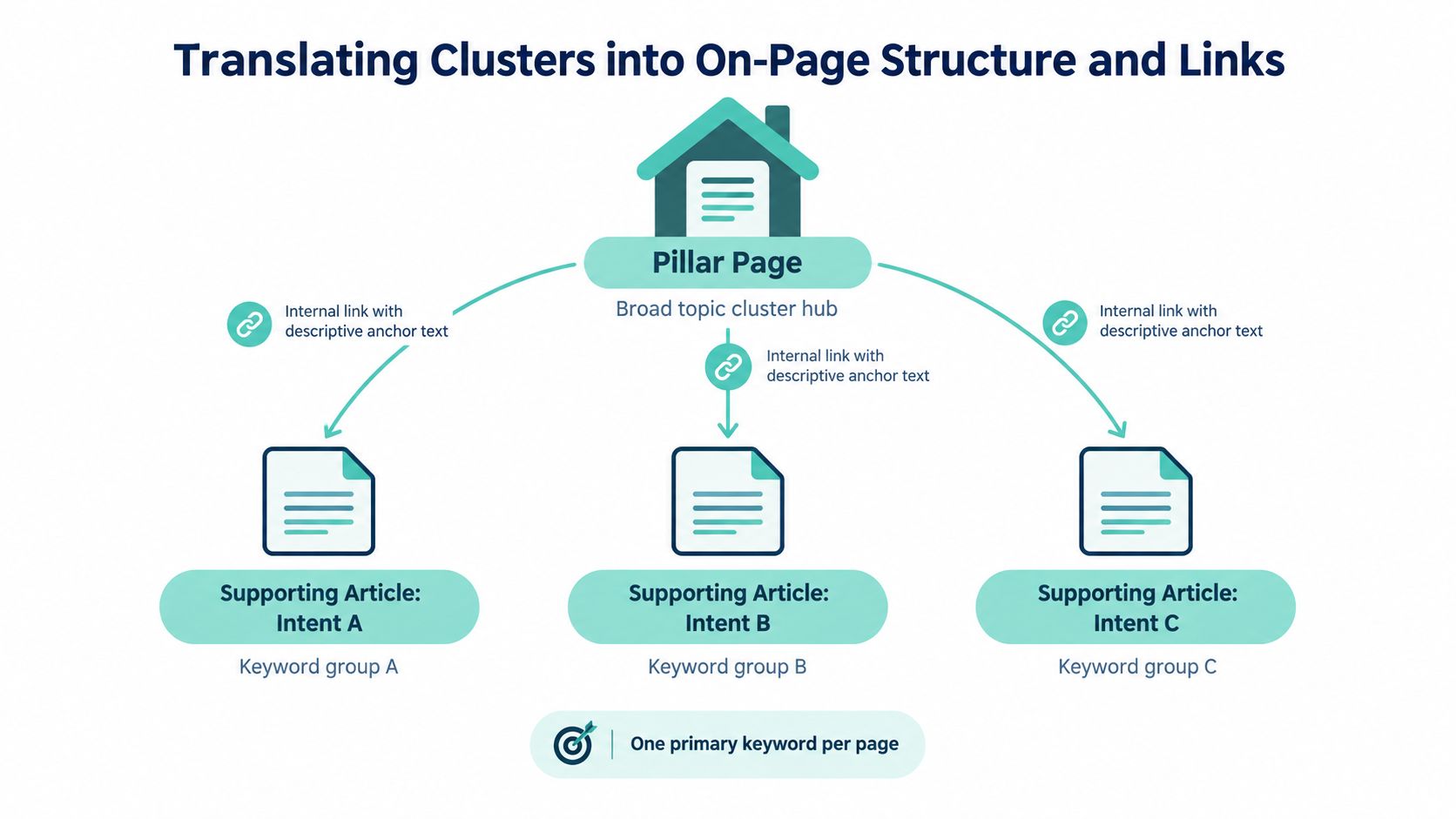
A practical link map might look like this:
- Pillar page: Broad “personal injury law” overview with clear practice-area pathways.
- Service page: Car accident representation with an intake-focused call to action.
- Educational article: Settlement factors, linked to the relevant practice page.
- Location page: A city-specific service page with local proof and geographic detail.
A useful reference for implementation is this guide to internal linking best practices. The important principle is alignment. Don't use internal links to force every page into every cluster. Link where the reader's next question and the destination's purpose match.
Match calls to action with intent
Conversion design should follow the cluster, not sit on top of it as a universal template. An urgent HVAC query may need a prominent call option and service-area confirmation. A comparative roofing query may need an estimate pathway plus proof of workmanship. An informational law article may earn a softer invitation to discuss the situation.
The page should make one primary promise. Secondary links can support exploration, but they shouldn't turn the page into a catalogue of loosely related services. Clear grouping produces clearer architecture, and clear architecture gives both visitors and search systems fewer reasons to hesitate.
Adapting to AI Search and Query Fan-Out
A user may type one concise question, while an AI-powered search system explores several related questions behind the scenes. Google documentation and industry analysis describe query fan-out as a process in which AI Search can expand a query into multiple related searches, making a static keyword list incomplete. (This discussion of query fan-out and keyword research connects that behavior with the need for ongoing query and conversion feedback.)
That change doesn't eliminate keyword grouping. It makes rigid grouping less dependable. A page that answers a narrow question clearly may appear across related searches because it covers the underlying entities, constraints, and user need. Conversely, a page built around a broad semantic label may be cited for adjacent questions it doesn't answer well.
Watch the language visitors actually use
Search Console query-to-page data is a practical starting point. Export the queries associated with important URLs and look for patterns:
- Unexpected geography: A service page attracts searches for cities outside its intended market.
- Wrong service line: A repair page receives replacement or installation queries.
- Research leakage: A commercial page attracts calculator, definition, or cost-explanation searches.
- Audience mismatch: The page gets impressions from homeowners, landlords, businesses, or another audience the offer doesn't serve.
- Weak lead quality: Visibility grows, but calls and forms don't reflect the intended customer.
A page can gain impressions while losing commercial focus. That makes lead quality more useful than rankings alone. Review form submissions, call recordings, qualification outcomes, and the questions sales staff hear repeatedly. Customer language often exposes a missing page distinction before a keyword tool does.
Re-cluster when the market changes
Suppose a roofing company has one page targeting roof repair. Search Console starts showing emergency modifiers, storm-damage questions, and replacement research. The right response isn't automatically to add every phrase to the existing page. Compare the associated result types, lead quality, service availability, and operational capacity. The company might need a storm-damage page, an emergency service page, an educational article, or no new URL at all.
For organizations investing in answer visibility, Answer Engine Optimization provides a useful framework for thinking beyond exact-match rankings. The operational lesson is simple: re-cluster from observed queries and outcomes, not from a frozen export.
Schedule periodic reviews around meaningful changes in query patterns, services, locations, or conversion quality. Keep stable clusters stable when the evidence supports them. Split them when one URL starts attracting multiple audiences with incompatible needs.
Treating Automation as a Hypothesis Generator
Automation helps at the sorting stage, not the final architecture decision. It can group paraphrases, surface adjacent entities, and expose modifiers a strategist might miss on a manual pass. It cannot judge whether two semantically close terms belong on one page if they pull different lead types, different cities, or different stages of the buying journey.
That gap matters most on service sites.
A tool may cluster "water heater repair," "emergency water heater repair," and "water heater replacement" because the language overlaps. On a real site, merging those terms can blur the offer. The emergency searcher wants immediate availability. The replacement searcher is comparing scope, price signals, and installation options. The business may even route those leads differently. Semantic similarity is useful input, but it is still only input.
Give every automated cluster a human decision
Each cluster needs a manual review against search results, service delivery, and conversion flow. For local service businesses, I would pressure-test every group with questions like these:
- Does this group describe one service or several?
- Does it belong to one geography or multiple markets?
- Does it reflect one audience and one decision stage?
- Do the same result types satisfy the queries?
- Can one page make one clear promise?
- Would the business want the leads this page is likely to attract?
Those answers determine the build. Sometimes one cluster becomes one page. Sometimes it splits into service pages, location pages, and supporting articles. Sometimes the right move is to keep the terms together but separate sections on the page. The automation label does not make that choice for you.
Measure architecture by qualified demand
Rankings and impressions are useful diagnostics, but they do not tell you whether the grouping is helping the business. Map target groups to URLs, then review organic visits, calls, form submissions, qualified inquiries, and the language prospects use during intake. A smaller cluster can deserve priority if it produces the right jobs. A broader cluster may need to split if it drives traffic that never turns into accepted work.
When keyword groups, page hierarchy, and lead tracking need to operate as one system, Digital Skyrocket handles that end to end for service businesses. The practical standard is simple. Let software suggest patterns. Let the live SERPs challenge them. Let sales outcomes decide whether the structure stays intact.
That is especially important during a site rebuild, which is usually the best point to apply an intent-based grouping workflow before cannibalization gets baked into the new architecture.