
A managing partner stares at a flat intake month and searches the firm's own practice area. A competitor appears in Google's local results, then turns up in ChatGPT when the partner asks which attorneys handle the same type of matter. The firm's site looks polished, the blog has new posts, and the rankings report looks respectable. Yet nobody can answer the question that matters: which search activity produced qualified consultations and signed matters?
That's the gap in most attorney search engine marketing programs. Visibility is treated as the outcome, even though prospective clients now move between Google, AI tools, directories, reviews, attorney bios, and the firm's intake process before they choose whom to contact.
Table of Contents
- The Problem Most Law Firms Are Trying to Solve
- What Attorney Search Engine Marketing Actually Includes
- Where Cases Actually Come From in 2026
- The Foundation Local SEO and AEO Share
- Why Most Attorney SEO Advice Stops at Rankings
- The Compliance Layer Most Vendors Skip
- A 90-Day Plan and the KPIs That Matter
The Problem Most Law Firms Are Trying to Solve
A partner reviews the monthly intake report and sees plenty of activity, yet cannot trace which discovery paths produced qualified consultations. The firm may appear in Google, surface in an AI answer, and receive visits from several directories. The operational question remains simple: can the firm connect that visibility to a serious inquiry and a signed matter?
Being found and being chosen are different jobs. A page can rank for a broad practice-area phrase while leaving the visitor unsure about the legal issue, jurisdiction, responsible attorney, or next step. A competitor with fewer visible assets can win the inquiry by making the decision feel safer and easier.
The research journey now moves through a verification loop. A 2025 U.S. consumer survey of 1,052 respondents found that 86.7% still used Google to research attorneys while 28.1% used ChatGPT, up from 9% in 2023, and 94% of ChatGPT users also verified the information on Google (Attorney at Work's 2025 report). AI may introduce the firm. Google results, reviews, directories, and the firm's website then determine whether that introduction holds up.
The partner-level question
Ask this before approving another content calendar:
If a prospective client discovers us through an AI answer or a search result today, what evidence will they find during the next five minutes?
Check the attorney profiles, firm details, relevant experience, reviews, explanations, and contact path. Each item should agree across platforms and make the next action obvious. Inconsistent details create doubt precisely when the prospect is deciding whether to call.
Use this five-minute checklist: confirm the firm's name, location, phone number, and practice areas; review the attorney biography tied to the matter; inspect recent reviews and directory listings; test the page on a phone; submit or call through the intake path. Record which source led to the visit and whether the inquiry met the firm's qualification criteria.
What Attorney Search Engine Marketing Actually Includes
Attorney SEM works as a connected system, not a collection of disconnected services. Local SEO helps a firm appear for geographic searches and map results. On-page and content SEO answer questions and match practice-area intent. Technical SEO makes those pages crawlable, indexable, and usable. Answer engine optimization, or AEO, makes the firm's information easier for AI and answer systems to interpret. Paid search supplies controlled visibility for urgent, high-intent queries. Conversion rate optimization turns qualified visits into calls, forms, and consultations.
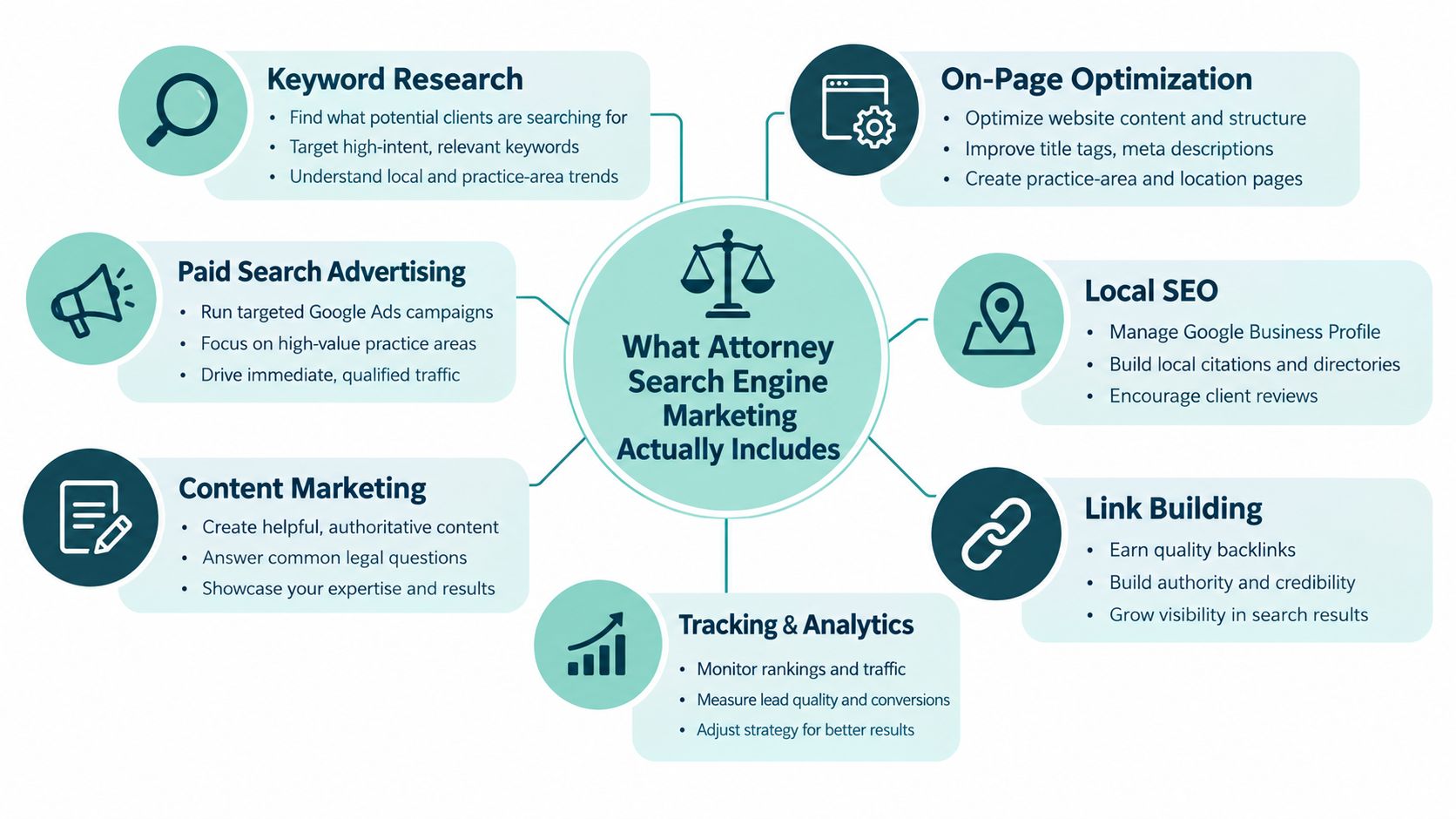
A firm that treats one channel as the entire strategy creates predictable gaps. Local SEO without useful service pages produces visibility without enough context. Content without conversion work produces reading sessions without inquiries. Paid search without landing-page discipline pays to send prospects into a confusing experience. AEO without consistent firm data gives AI systems fewer reliable facts to use.
The consumer journey requires all of these pieces to cooperate. A 2024 legal consumer report found that 92.4% of legal consumers research their legal issue online before contacting an attorney, while 93.3% want to conduct additional research into attorneys discovered through search engines before hiring, rising to 96.3% among those who ultimately hired (the 2024 legal consumer report). The implication is direct: your website must support both early education and attorney comparison.
Build the system around intent
Start with the matters the firm wants more of, then map each stage:
- Problem research: Explain eligibility, deadlines, procedures, risks, and next steps in plain language.
- Service evaluation: Build practice-area pages that establish jurisdiction, scope, attorney involvement, and how the firm handles the matter.
- Firm comparison: Present credentials, reviews, attorney identities, relevant experience, and consistent contact information.
- Intake action: Use clear calls to action, mobile click-to-call options, concise forms, and an explicit explanation of what happens after submission.
Technical work supports every stage. A focused technical SEO program for law firms should address crawlability, page relationships, indexing, performance, analytics, and the structural details that let search systems connect a query to the right resource.
The operating principle is simple: every visibility asset needs a credibility layer and an intake path. If a tactic can't be tied to one of those functions, question why it belongs in the budget.
Where Cases Actually Come From in 2026
Search-driven legal discovery isn't new. In January 2014, an estimated 509,584 people in the United States searched for legal solutions through LegalZoom and an estimated 184,703 through USLegal, for roughly 694,287 monthly searches on just two platforms according to Quantcast figures cited by the American Bar Association (the American Bar Association publication). Those figures covered specific platforms, not every search engine, but they established an important baseline: people were already using the web to investigate legal problems and possible providers.
The channel comparison is less about declaring one winner than assigning each channel the job it can perform well.
| Channel | Best Use | Typical Cost | Time to Cases | Trust Signal |
|---|---|---|---|---|
| Google organic | Durable discovery across practice areas and questions | Ongoing investment in content, technical work, and authority | Builds gradually | Useful, specific answers plus attorney proof |
| Local map pack | High-intent geographic searches | Profile management, local SEO, reviews, and location assets | Can support active demand once the foundation is sound | Accurate firm data, proximity, reviews, and relevance |
| Paid search ads | Immediate visibility for controlled queries | Direct media spend plus landing-page and management costs | Fastest route to testing demand | Clear ad promise, relevant landing page, and credible firm presentation |
| AI and answer engines | Discovery and early recommendations | Content, entity consistency, and evidence-layer work | Emerging and less controllable | Factual, consistent information verified elsewhere |
My recommendation for a typical firm
Put the largest share of sustained attention into organic and local foundations, because those assets support repeated discovery and give every other channel a stronger destination. Use paid search as a supporting instrument for urgent or commercially valuable queries, especially when organic visibility is still developing. Treat AI discovery as a verification and reputation program, not as a separate vanity race to collect chatbot mentions.
Paid search offers control, but the firm pays for each visit and still needs a persuasive landing experience. Organic search takes patience, but strong service pages, local entities, and useful educational content can support multiple stages of the same journey. AI tools can surface a firm unexpectedly, but the firm can't dictate every recommendation, so accurate third-party evidence becomes essential.
A firm handling technical or medically complex matters may also need content that helps prospects understand the underlying evidence. For example, a legal team researching working with forensic pathologists may need a resource that clarifies how specialized review fits into case preparation. That kind of relevant reference supports the reader without turning link acquisition into the strategy.
For teams evaluating the AI component, answer engine optimization should connect structured answers to verifiable firm information. Don't report AI visibility in isolation. Report whether branded searches, profile actions, calls, and qualified consultations improve after the evidence layer becomes more consistent.
The Foundation Local SEO and AEO Share
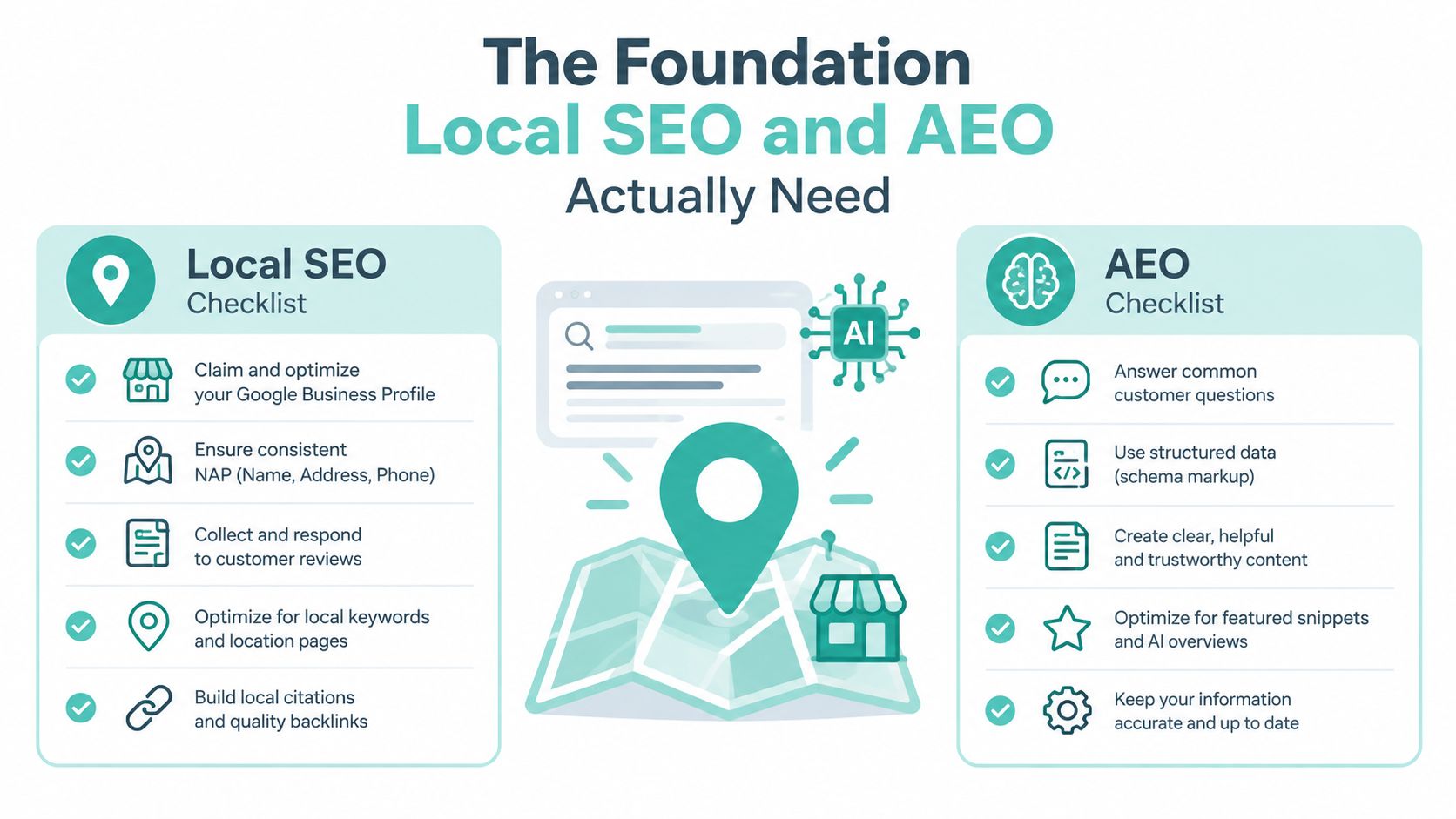
A law firm earns qualified intake when its public information describes one clear, consistent entity. The firm name, address, telephone number, website, attorney names, practice areas, service locations, and review profiles must match wherever a prospective client may look.
Start with the primary office, then build outward. Each location needs an accurate profile, a useful page, and attorney information that reflects who serves that jurisdiction. Multi-location firms should avoid cloned pages that change only the city name. Each page should explain the office, relevant services, jurisdiction, attorneys, contact route, and practical details a prospective client can use.
Make the entity legible
Google's local business documentation says structured data should accurately represent visible page content, define each location as a LocalBusiness entity, and follow search policies, with mismatched or hidden claims able to invalidate eligibility (Google's local business structured data guidance).
Schema supports the page. It does not replace it. Use JSON-LD to reinforce visible information, validate the implementation with Google's tools, confirm that crawlers can access it, and keep the business record current. Mark up only services, locations, hours, and claims that visitors can verify on the page. Check each location separately, especially after an office move, staffing change, or update to service areas.
The same evidence must work across Google and AI discovery. A prospective client may find a firm in an answer engine, then search the firm name and compare its website, profiles, reviews, and attorney biographies. Conflicting names, phone numbers, locations, or practice descriptions weaken that trust loop and can reduce the chance that discovery becomes a qualified consultation.
Write pages that answer before they sell
A strong practice page should lead with a concise answer, then explain:
- Eligibility and scope: Who the service is for and which matters the firm handles.
- Process and timing factors: What the visitor should prepare and what can affect next steps.
- Jurisdiction limits: Where the firm practices and where it does not.
- Attorney proof: Who handles the work, with credentials and relevant experience.
- Action path: How to request an evaluation and what happens after contact.
This format serves readers first and gives search systems clear, self-contained information to interpret. It also supports the connected trust loop: accurate local signals help discovery, while detailed pages give prospects a reason to verify the firm and contact it.
Local pages should earn their existence through distinct value, not mechanical city-name insertion. A page that clarifies the office, service, attorneys, jurisdiction, and next step has a better chance of producing useful inquiries than a thin location page built only to capture a query.
Why Most Attorney SEO Advice Stops at Rankings
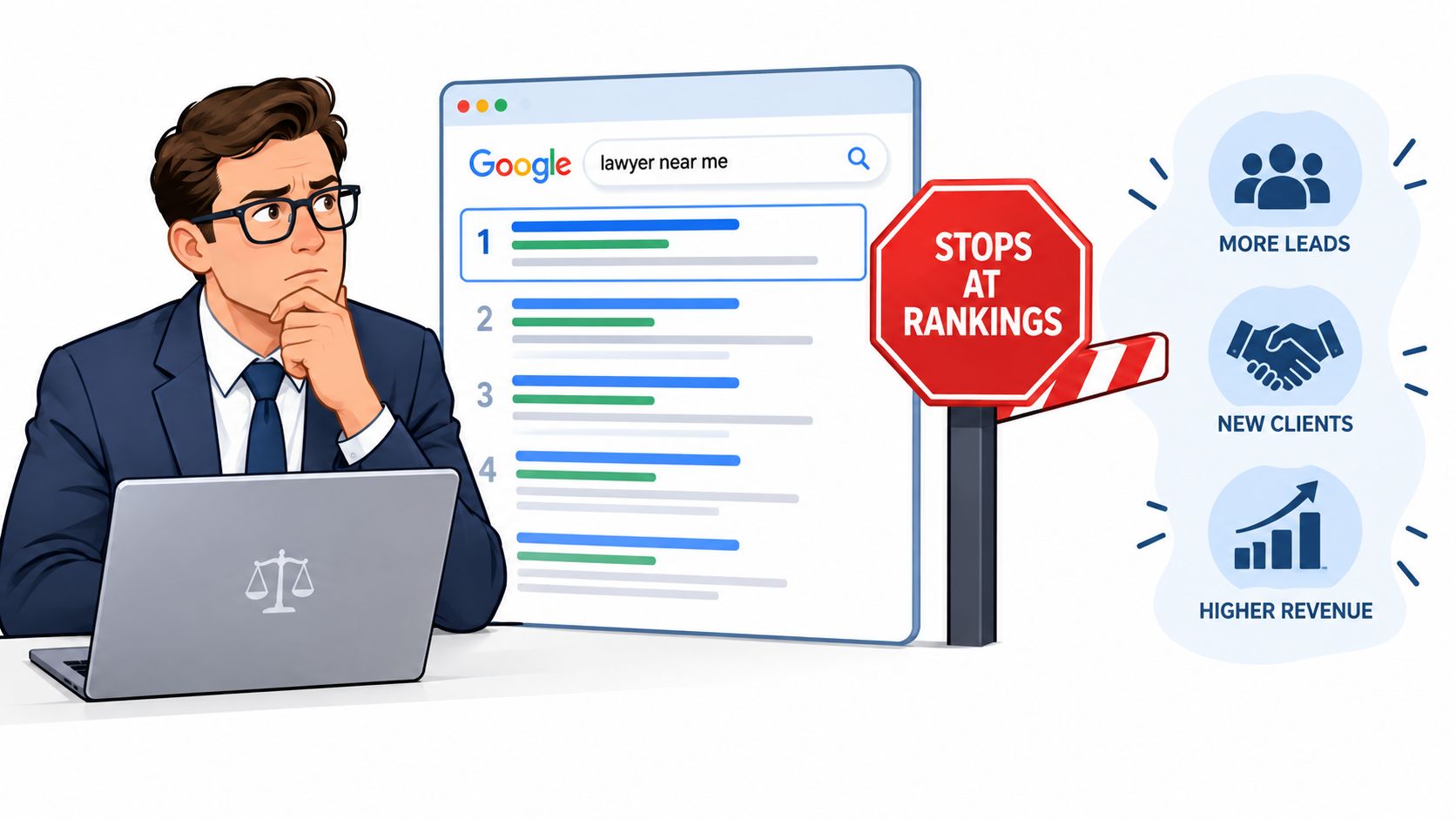
A firm can rank well and still lose the matter. A prospective client may find a result, search the firm's name, compare available information, and then abandon the process because the next step feels uncertain. Rankings create visibility. They do not prove that discovery will become a qualified consultation.
Audit the branded search journey
Treat the firm's name as a conversion path across Google and AI discovery. Run this five-step audit:
- Check identity: Do the firm name, attorneys, address, phone, and website match wherever the firm appears?
- Check relevance: Do visible profiles and search results describe the firm's current practice areas and jurisdictions?
- Check proof: Are reviews credible, recent enough to help, and answered professionally?
- Check experience: Do attorney biographies explain who will evaluate the matter and why that person is qualified?
- Check intake: Can a mobile visitor call, submit a short form, and understand what happens next?
The audit should follow the trust loop, not stop at a search position. AI systems and Google may introduce the firm through different surfaces, yet the prospect still decides whether the available evidence supports contact. A mismatch, vague practice description, unanswered review, or confusing intake step can break that loop after the firm has already earned visibility.
The practical test: Do not ask only whether the firm ranks. Ask whether a skeptical prospect finds a clear, consistent reason to contact it.
Fix the branded journey before commissioning another batch of generic posts. Strengthen the pages that explain the matter, attorney, jurisdiction, and next action. Improve review responses and remove unnecessary intake friction. Content earns its budget when it supports a service page, reinforces attorney credibility, and helps qualify the inquiry. Content that produces activity without a path to contact is a reporting win, not a marketing win.
Measure qualified consultations, completed intake actions, and signed matters attributed to organic discovery beside rankings. Traffic helps diagnose performance. Qualified intake shows whether the connected trust loop is working.
The Compliance Layer Most Vendors Skip
A law firm can lose trust before a prospect ever calls. A vendor may deliver guest posts, directory placements, automated outreach, or AI-written location pages, while the firm inherits compliance risk and weak evidence of expertise. Judge every deliverable by two standards: does it help a prospective client, and does it follow search and advertising rules?
Google classifies link spam to include buying or selling links, exchanging goods or services for links, excessive reciprocal linking, automated link-building, and partner pages created solely for cross-linking. It also warns that contractual requirements for outbound links can create problems (Google's spam policies). A citation to a medical, bar, government, or educational resource can clarify a legal issue. A paid placement presented as an independent editorial recommendation creates a different risk and can weaken the firm's trust loop across Google and AI discovery.
Recommendations and affiliate relationships require the same discipline. The FTC says material connections should be disclosed clearly and conspicuously near the endorsement, rather than hidden behind a hyperlink (the FTC's endorsement guidance). Google also asks sites participating in affiliate programs to qualify those links with rel="sponsored" (Google's link qualification guidance).
Use helpfulness as the compliance test
Google's people-first guidance states that using automation, including AI, primarily to manipulate search rankings violates its spam policies. It also warns against mass-produced doorway-style pages targeting many locations or practice areas with near-duplicate content (Google's people-first content guidance).
Require the vendor to identify who reviews legal content, how jurisdictional accuracy is checked, and what makes each location page distinct. “We generate hundreds of pages and insert the city” is a reason to walk away.
Useful content reduces confusion and helps a qualified prospect decide whether to contact the firm. Explanations of procedures, answers to common questions, and consistent profiles support the same trust signals that influence both search results and AI-generated recommendations. Tie each asset to a practice page, attorney evidence, or a clear intake path.
Ask vendors:
- Who owns the website and content? Avoid platforms that make departure difficult.
- How are links earned? Require examples and reject guaranteed placements.
- Who reviews legal claims? Ask for the attorney-review workflow.
- How are disclosures handled? Confirm sponsored links and material connections are labeled.
- What gets reported? Require a path from landing page to qualified consultation.
- How do you prevent duplicate pages? Demand a substantive local and practice-area plan.
For a broader view of compliant positioning and outreach, review this guide to the marketing of legal services. The right vendor shows how each asset serves a prospective client, supports accurate discovery, and improves the chance that visibility becomes qualified intake.
A 90-Day Plan and the KPIs That Matter
The first 30 days should repair the foundation. Clean up firm and location data, fix indexing and crawl issues, improve the practice pages most likely to generate cases, and remove intake friction. Connect calls and forms to source data before publishing more content. Without that connection, the firm cannot judge which changes produce qualified inquiries.
The next phase strengthens the evidence behind the firm. Improve attorney bios, build distinct location pages, organize review requests and responses, and publish answers a prospective client can trust. AI can assist with production, but attorney expertise and human review must control the result. Avoid automated content created mainly to manipulate rankings or produce near-duplicate doorway pages, as covered in the compliance section.
The final phase tests and refines acquisition. Use paid search for high-intent terms, shape AEO around questions the firm can answer credibly, and protect branded searches with accurate profiles and a clear first-contact experience. Google visibility and AI discovery reinforce each other when the same accurate evidence supports both.
Track these outcomes:
- Qualified consultations: Count inquiries that meet the firm's practice and jurisdiction criteria.
- Signed matters attributed to organic: Connect intake records to the originating landing page or search pathway.
- Cost per signed case: Include agency, content, technical, and related implementation costs.
- Branded search activity: Monitor whether prospects investigate the firm by name.
- Local visibility: Track map-pack presence for priority services and locations.
- Review velocity and quality: Measure new reviews and response discipline, not volume alone.
Require a monthly report showing leads by source, qualified consultations, signed matters, cost per signed case, top landing pages, branded search activity, local visibility, review changes, and unanswered intake calls. Digital Skyrocket provides SEO-focused websites and related services for law firms through its website.