In 2024, more than $2.5 billion was spent on over 26.9 million legal services ads in the United States, while spend rose about 39% even as ad volume fell about 4% ATRA legal services advertising report. That's not a side note about media buying. It's a signal that the marketing of legal services has become a hard-fought visibility contest where the firms that win are usually the ones that also build stronger websites, better local search presence, and smarter intake paths.
A mid-sized firm can feel that shift quickly. Referrals still come in, but they're slower, less predictable, and easier to lose when a competitor appears first in search, answers the right question on a service page, or makes calling simple on mobile. The firms that adapt stop treating marketing as a generic “get found” exercise and start treating it like a system, one that connects discoverability, trust, compliance, and conversion.
Table of Contents
- Why Marketing of Legal Services Matters Today
- Understanding Core Concepts of Legal Services Marketing
- Exploring Key Channels for Law Firm Growth
- Navigating Ethics and Bar Rules for Legal Marketing
- Optimizing Client Intake and Conversion Paths
- Measuring Performance and ROI Effectively
- Practical Tactics for Service-Based and Local Firms
- Conclusion and Next Steps
Why Marketing of Legal Services Matters Today
A law firm that depends mainly on referrals is like a great restaurant hidden on a street with no signage. The food can be excellent, but if people cannot find it when they are ready to decide, the table stays empty. Legal buyers do not wait patiently anymore, they search, compare, and contact the first credible option that matches their need.
That pressure shows up in legal advertising spend. The U.S. market spent more than $2.5 billion on legal services ads in 2024, and spending increased even as the number of ads declined. For a firm leader, that means the competition is not only about staying visible. It is about appearing in the right places with the right message, then guiding attention toward a qualified conversation.
A referral-heavy firm can still lose business
A common pattern looks like this. The firm has a respected name, a few loyal referral sources, and a website that was built years ago as a brochure. Then a competitor launches practice-area pages, strengthens local search visibility, and makes the call to action obvious on every page. The second firm becomes the easier choice for people who are already ready to hire.
That is why discoverability and conversion cannot be separated. Search visibility puts a firm in the conversation. Conversion architecture keeps that conversation from ending on a weak contact page or a generic form. A practice-area page should do more than describe services. It should answer the visitor's first questions, reduce hesitation, and make the next step obvious, much like a well-marked front desk in a busy office.
For firms that want to turn visibility into inquiries, content marketing for leads content marketing for leads plays a practical role. It helps a practice show up with useful answers, then directs the reader toward the intake path that matches the service and the urgency of the need.
Practical rule: if a prospect cannot tell what the firm does, where it serves, and how to reach it within a few seconds, the marketing is leaking value.
Understanding Core Concepts of Legal Services Marketing
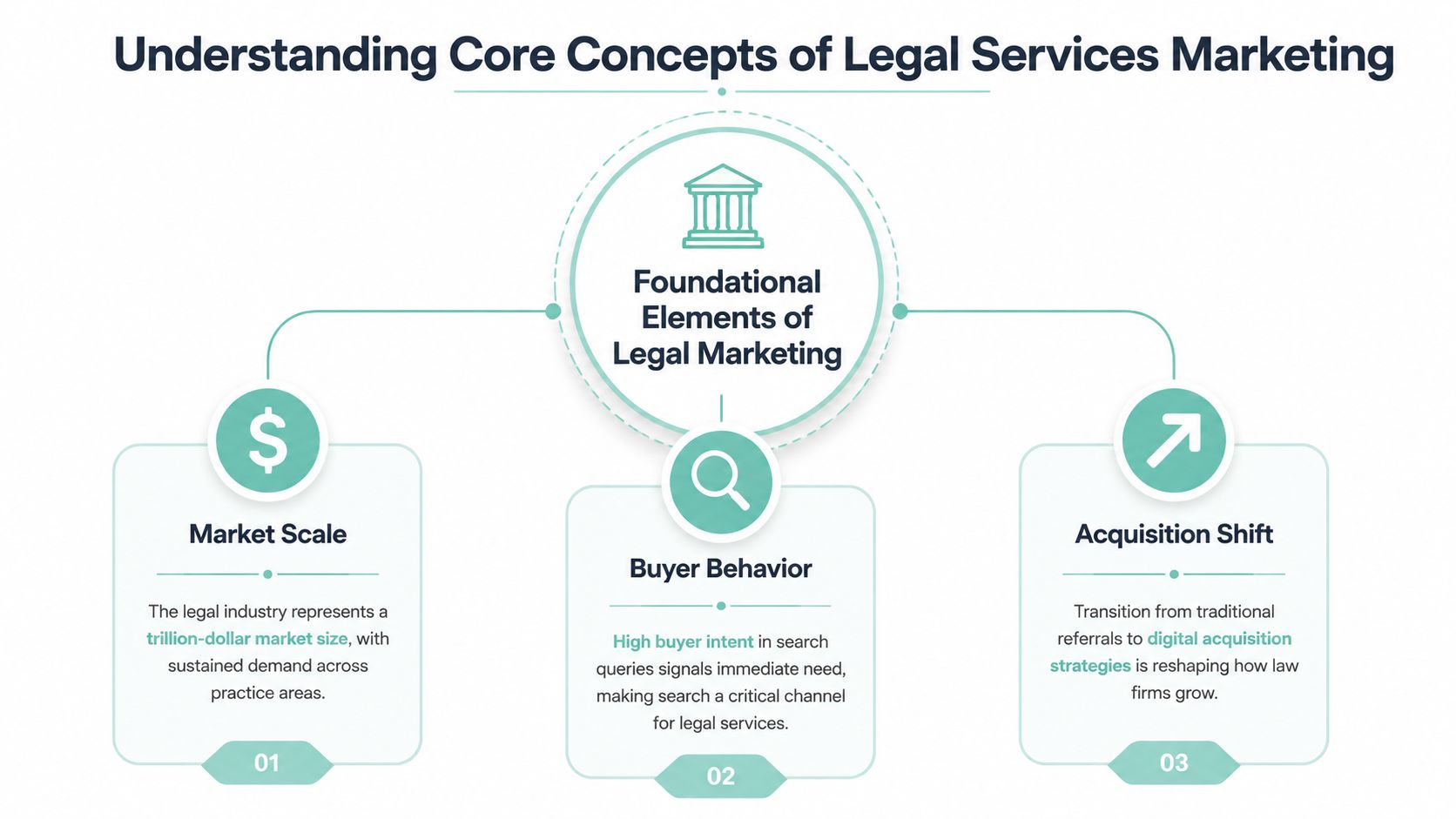
Legal services is not a small or static category. Grand View Research estimated the global legal services market at USD 1,052.90 billion in 2024 and projected it to reach USD 1,375.64 billion by 2030, which reflects a 4.5% CAGR Grand View Research market estimate. That scale explains why law firm marketing is not a side project. It is part of the core operating system for firms competing in large, local, high-trust markets.
Market scale changes the marketing job
A market this large creates more competition for attention, and more competition for trust. A firm cannot depend on name recognition alone. Prospective clients still want expertise, but they also want the easiest path to a confident decision. Websites, local profiles, and content have to work together the way a lobby, receptionist, and intake desk work together in a physical office. Each one has a different job, and each one affects whether the visitor stays.
The practical implication is direct. A firm needs to be visible where people search, persuasive where people compare, and consistent where people decide. That is why planning often starts with a simple question: what does the prospect need to believe before they will contact the firm?
Buyer intent is the most valuable asset
People searching for legal help usually are not browsing casually. They are looking for a specific answer, a specific practice area, or a specific lawyer in a specific place. Local-intent SEO works because it matches the way prospects type and think, especially for practice-area plus location searches Expert Law Firm on local-intent SEO.
Answer Engine Optimization, or AEO, serves the same purpose in a different format. Search systems increasingly try to answer directly, so firms need pages that are easy for both humans and machines to understand. A page that plainly explains the service, location, process, and next step has a better chance of meeting intent than a vague brand page full of legal jargon. Clear structure works like a well-labeled file drawer. It helps the right answer appear quickly.
Referral economics have changed
Referrals still matter, but they are no longer enough on their own in many markets. A strong referral source can introduce trust, yet that trust usually gets tested online before a prospect calls. If the website feels thin, outdated, or generic, referral momentum fades.
The firm then has to rebuild confidence in the last few moments before contact. That is why the core system now includes trust signals, local visibility, and a conversion path built around the matter type. For a closer look at how content supports that system, see this guide on content marketing for leads.
Exploring Key Channels for Law Firm Growth
Law firm growth works best when each channel has a clear job. Some channels help people find the firm, some help them trust it, and some help them take the next step. A stronger plan uses all three, but each one should support a different point in the client journey.
SEO and AEO for high-intent searches
Organic search matters because it reaches people who are already looking for legal help. For many firms, the strongest setup is practice-area pages tied to location signals, supported by a complete Google Business Profile and consistent local information. That kind of structure matches how prospects search, especially when they are comparing firms by service and place.
AEO adds another layer. Search systems increasingly try to surface direct answers, so a page needs to be easy to quote, summarize, and understand. That usually means plain headings, direct explanations, short FAQs, and service descriptions that answer the question before the reader has to hunt for it. For a practical overview of how those pages are built, see SEO for law firms.
Local search and profile optimization
Local search is the digital version of a firm's front desk. A well-built profile can put the practice in front of nearby prospects while they are still deciding who to call. The Google Business Profile, NAP consistency, and review management work together here. If one part is weak, the others have to do extra work.
Many prospects use local signals as a shortcut for trust. A clear profile, accurate contact details, and recent reviews make the firm easier to evaluate at a glance, which reduces friction before the first phone call or form submission.
Paid media and the legal ad arms race
Paid media can still produce leads, especially in crowded practice areas, but the economics are demanding. In the U.S., legal services ads absorbed a very large share of attention, and spending rose even as the total ad count fell in the ATRA report. That pattern suggests firms are competing harder for each impression, so lead quality and intake follow-up matter as much as the click itself ATRA legal services advertising report.
The practical lesson is simple. A paid campaign should not stop at traffic. It has to connect to a page, a form, and a call process that fit the matter type. Otherwise the firm pays for attention without creating a real intake path.
Content that supports trust and conversion
Content does more than help a page rank. It shows the prospect how the firm thinks about the problem, what the process looks like, and what happens after contact. A practice page, FAQ, guide, or location page can all do that work if the page answers a real question a client would ask before reaching out.
Conversion architecture starts to matter. A useful page does not just explain a service, it makes the next action obvious. If the content is about a personal injury matter, for example, the page should help the reader understand the case type, the intake path, and the kind of information the firm needs to start. That is the difference between a page that informs and a page that moves someone toward a call.
| Channel | Strengths | Best For |
|---|---|---|
| SEO and AEO | Captures high-intent searchers, builds durable visibility | Firms with clear practice areas and strong service pages |
| Local search | Connects nearby prospects to location-based intent | Firms that depend on regional clients and phone calls |
| Content marketing | Builds trust and answers common questions | Practices that need education before conversion |
| Paid media | Fast visibility and controlled targeting | Competitive markets with strong intake and budget discipline |
Each channel has a different job, much like different rooms in a clinic. The waiting room creates first impressions, the intake desk collects the right information, and the consultation room closes the loop. Law firm marketing works the same way, the channel has to match the client's stage of readiness.
Navigating Ethics and Bar Rules for Legal Marketing
Legal marketing is not the same as normal lead generation. Every claim carries more weight because the buyer is trusting the firm with a serious personal or financial problem. That's why compliance has to shape the copy before it shapes the disclaimer.
California's guidance is a good example. Lawyers may not advertise a fee or fee range that exceeds what they charge, and they can't claim “certified specialist” unless they're certified by the Board of Legal Specialization or another State Bar-accredited entity Advocate Magazine on ethics of law firm marketing. That means a fee callout, badge, or specialty label can't be treated like a casual marketing flourish. It has to be accurate, supportable, and used correctly.
Truthfulness is a design issue, not just a legal issue
Misleading marketing often starts with small shortcuts. A firm wants a stronger headline, so it softens the truth about who handles the work or overstates what a credential means. The problem is that the page may still “sound” polished while creating a compliance risk.
The safest approach is to make the page more specific, not more dramatic. Name the actual practice area, describe the actual process, and identify the actual credentials in plain English. If a claim can't be verified, it shouldn't be on the page.
Records matter as much as wording
Many bar rules expect firms to keep copies of marketing content as it was disseminated, and that often means archiving a new record when a website is launched or materially changed JD Supra marketing compliance guidance. That's easy to ignore until someone asks what the page said six months ago.
A simple record-keeping habit can save a lot of trouble.
- Save every major page version: Keep dated copies of homepages, service pages, and landing pages.
- Log the approval trail: Note who reviewed the copy before publication.
- Preserve fee and specialty claims: Archive any page that includes pricing, awards, or certification language.
Keep your marketing files as if you may need to explain them later, because sometimes you will.
Optimizing Client Intake and Conversion Paths
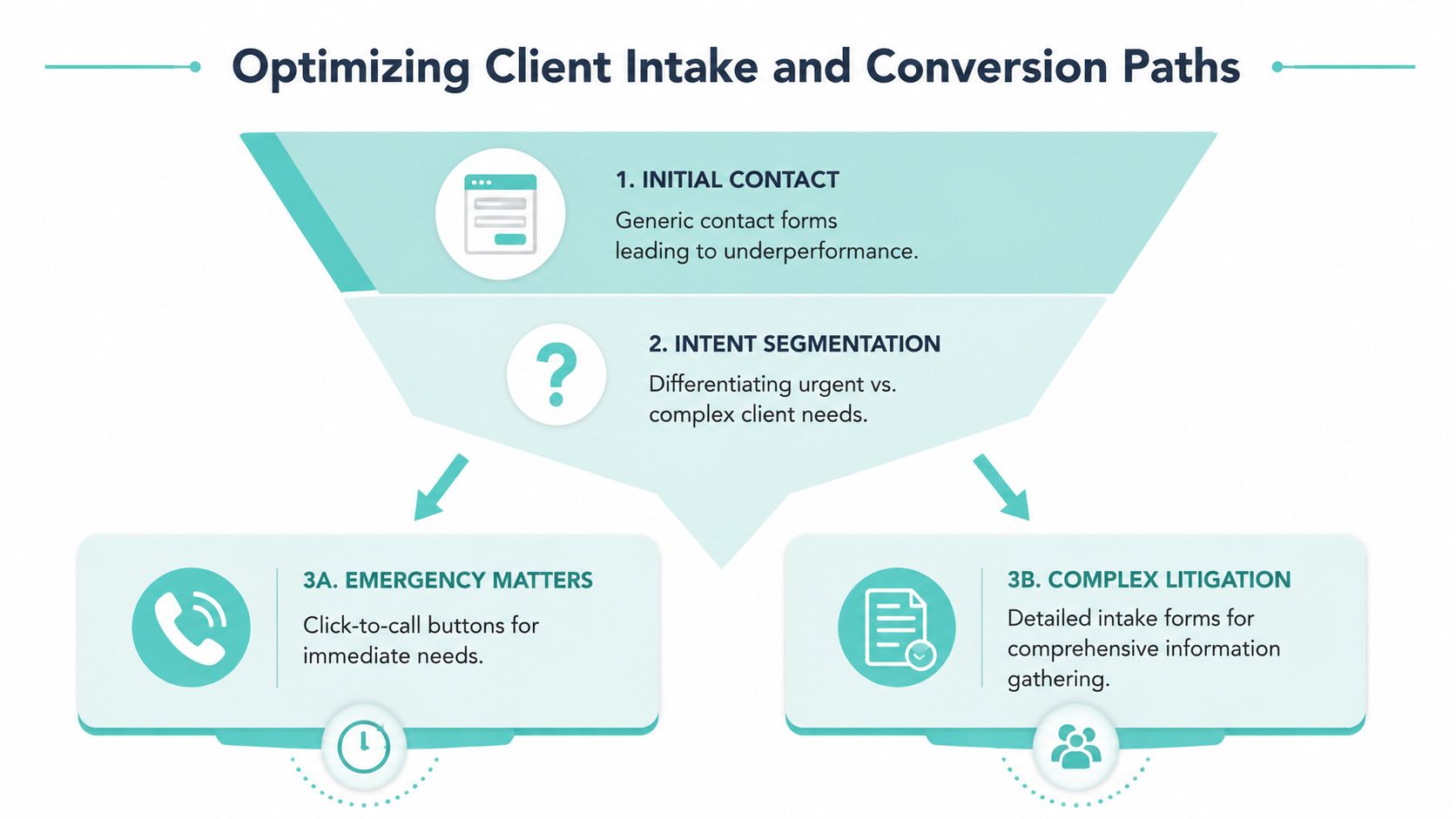
A generic contact form is often the weakest part of a law firm website. It assumes every prospect has the same urgency, the same questions, and the same tolerance for friction. In reality, a person searching for immediate help with an urgent matter behaves very differently from someone comparing counsel for a complex dispute.
Match the form to the matter
Recent legal-marketing guidance emphasizes creating separate conversion paths for different practice areas because one-size-fits-all pages can underperform for specialized services Attorney Journals on legal marketing trends. That makes sense. A family-law prospect wants different reassurance than a business-litigation prospect, and the page should reflect that difference.
For urgent matters, a visible phone button usually fits better than a long form. For complex litigation, a structured questionnaire can pre-qualify the inquiry and capture useful details. The page should meet the user where they are, not force every visitor through the same doorway.
Build the page like a guided path
A useful landing page acts like a conversation with stages. First it answers the basic question, “Is this the right firm?” Then it explains the issue in plain language. Then it gives the next step, with as little friction as possible.
If you want a deeper reference for page structure and conversion flow, this guide on strategies for marketers to improve landing pages is a helpful companion.
A practical layout can look like this:
- State the practice area clearly. Don't make people guess what type of help the firm offers.
- Answer the top three questions early. What kind of case is this, who is it for, and what happens next?
- Use one primary action. A call button, a short form, or a questionnaire should lead the visitor forward.
Reduce drop-off with better placement
Calls to action work better when they match the page's purpose. A page about a time-sensitive legal issue should make it easy to call now. A page for a more involved dispute can offer a consultation request, a case review form, or a document upload path.
For more on building acquisition systems that feed those pages, this internal resource on lead generation for law firms can help connect channel strategy with intake design.
Measuring Performance and ROI Effectively
A law firm can spend a lot and still not know what's working. That usually happens when rankings, traffic, and leads are tracked separately instead of as one funnel. The better approach is to connect visibility data with intake data so the firm can see which pages help generate qualified inquiries.
Start with the right metrics
The basic set is straightforward. Rankings show visibility. Organic traffic shows attention. Calls, form submissions, and consultation requests show action. CRM notes and intake outcomes show quality.
A dashboard in Google Analytics and the firm's CRM should make those connections visible. If a page brings traffic but few qualified calls, that page may need better calls to action, better intent matching, or a different practice focus. If a page produces fewer visits but stronger leads, that page may be more valuable than it first appears.
Track the journey, not just the click
Legal buyers rarely convert on the first visit. They may read a practice page, check reviews, return through branded search, and then call from mobile. That means attribution is messy, and simple last-click thinking can obscure the full value of content and local search.
A good reporting rhythm helps. Weekly reviews can catch broken pages or intake issues. Monthly reviews can compare channel performance. Quarterly reviews can guide larger decisions about content expansion, site structure, and service priorities.
Make the numbers useful for decision-making
Data only helps when the team knows what to do with it. If rankings rise but calls don't, the issue may be page relevance or conversion design. If calls rise but intake quality is weak, the issue may be message mismatch or lead qualification. If one practice area consistently outperforms the others, that often signals where the firm should deepen its content and local authority.
Bottom line: measurement should tell the firm where attention turns into revenue, not just where traffic appears.
Practical Tactics for Service-Based and Local Firms
Local and service-based firms usually grow by being more precise, not more theatrical. A useful tactic should help the firm show up in the right place, build trust quickly, and make it easy for a nearby client to take the next step.
Geo-targeted landing pages
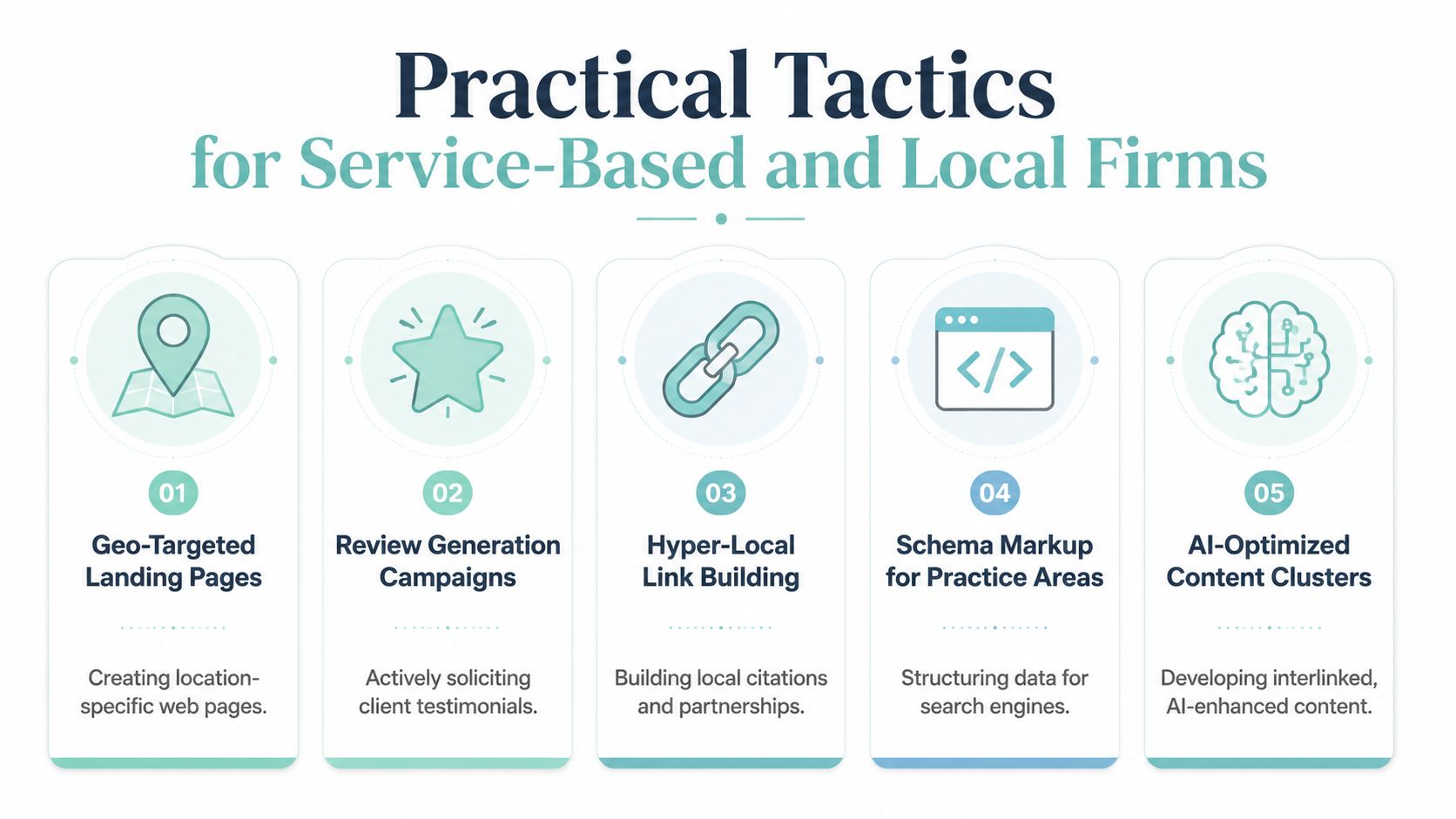
A location-specific page matches local search intent the way a neighborhood sign matches the street it sits on. A visitor searching for counsel in one city wants to see that city reflected in the page copy, the service scope, and the contact path. Practice-area plus geo pages often perform better than generic service pages in local markets because they answer the local question directly Expert Law Firm on local-intent SEO.
- Do: write for a real service area, not a pile of city names.
- Do: include office, phone, and map details where relevant.
- Don't: duplicate the same page across multiple locations with only the city swapped out.
Review-generation campaigns
Reviews help prospects feel safer before they call. They also support the firm's local presence when the business profile is complete and consistent. A simple post-matter request process usually works better than asking at random, because the timing is tied to a real client experience.
- Do: ask at the right moment, after a positive service experience.
- Do: make the request easy and respectful.
- Don't: script reviews so tightly that they sound artificial.
Hyper-local link building
Local citations, community partnerships, and relevant local references strengthen the firm's footprint. The goal is not volume for its own sake, but a local presence that feels real to both people and search systems.
- Do: pursue partnerships that make sense for the firm's practice areas.
- Do: keep contact information consistent across listings.
- Don't: buy low-quality links that don't relate to the firm's market.
Schema markup for practice areas
Schema helps search engines interpret what the page is about, much like labels on file folders help a busy office sort documents faster. That can support richer visibility for practice pages, location pages, and firm details D.C. Bar SEO fundamentals.
- Do: mark up attorney, local business, and legal service details where appropriate.
- Do: keep the structured data aligned with the visible page content.
- Don't: add structured data that doesn't match reality.
AI-optimized content clusters
AI and answer engines reward clarity and organization. A cluster of tightly related pages can help a firm cover a topic more completely than a single broad post, and it can make the site easier to understand for both users and systems. The structure matters because answer engines often pull from pages that state the core question and response early.
- Do: group related FAQs, service pages, and location pages together.
- Do: answer the core question early on the page.
- Don't: publish thin articles that repeat the same general advice.
Conclusion and Next Steps
The best marketing of legal services blends visibility, ethics, conversion, and measurement into one working system. A firm that only chases traffic can still lose leads. A firm that only focuses on compliance can stay invisible. The firms that grow usually do both, while making the intake path easier for the right client.
Start with a fit meeting, a discovery audit, and a roadmap that ties channels to practice priorities. Then review what the site says, what the search results show, and what intake captures. If the pieces don't connect, the strategy isn't finished yet.
A CTA for Digital Skyrocket.