

A lot of law firms are in the same spot right now. The attorneys do strong work, client outcomes are solid, and referrals still come in, but the pipeline feels uneven. One month the phones are busy. The next month, nothing feels predictable, and nobody can say with confidence whether the problem is visibility, lead quality, follow-up, or the website itself.
That uncertainty usually comes from treating marketing as a set of disconnected tactics instead of a single client acquisition system. Search visibility, Google Business Profile traffic, practice area pages, forms, call handling, follow-up, and consultation booking all affect whether a case gets signed. If one part breaks, the whole funnel underperforms.
The firms growing most steadily aren't just chasing more traffic. They're tightening the path from first search to signed retainer, and they're paying close attention to the quality of inquiries that enter the pipeline in the first place.
Table of Contents
- Why Your Best Lawyer Is Not Your Best Marketer
- Diagnosing Your Firm's Lead Generation Health
- Building Your High-Conversion Website Foundation
- Dominating Local Search with SEO and AEO
- Creating Content That Attracts High-Value Cases
- Optimizing Your Intake to Convert Leads into Clients
- Measuring Success and Budgeting for Growth
Why Your Best Lawyer Is Not Your Best Marketer
Strong legal work and steady firm growth aren't the same thing. A partner can be excellent in depositions, negotiations, and trial prep, and still have no reliable system for generating qualified new matters. That's normal. Legal expertise wins cases. Marketing infrastructure wins attention, trust, and action before a prospect ever speaks to an attorney.
The old model leaned heavily on reputation, networking, and referrals. That still matters, but it doesn't create consistent forecasting. Prospects now research on their own, compare firms privately, and make early judgments based on what they find in search results, maps listings, and websites.
The clearest shift is online behavior. 65% of law firms state that their website delivers the highest return on investment for lead generation, and 96% of legal consumers begin their search online, according to legal marketing statistics compiled by SEOProfy. That changes the role of the website completely. It isn't a brochure. It's the front desk, intake coordinator, credibility screen, and consultation prompt all at once.
The market has changed faster than many firms have
AI has accelerated the change, but it didn't create it. It amplified it. Prospective clients now get answers from search summaries, map packs, business profiles, and legal content before they ever land on a contact page. Firms that still treat the website as a static branding asset usually end up with one of two problems: low visibility, or decent visibility that doesn't turn into signed work.
A partner often sees marketing as a visibility issue. In practice, it's usually a systems issue. Traffic without message match produces weak inquiries. Good inquiries without disciplined intake go cold. Referrals without a strong website still leak because prospects validate the referral online before they call.
Practical rule: If a firm can't explain how a searcher becomes a signed client step by step, it doesn't have a marketing strategy yet. It has activity.
The website is the firm's highest-leverage asset
When firms ask where to focus first, the answer is usually less glamorous than they expect. Not a new logo. Not another ad experiment. Not posting more often on every platform. Start with the website because it sits in the middle of the entire acquisition funnel.
A high-performing site does three jobs at the same time:
- Ranks for the right searches: Practice area pages, local relevance, and technical SEO help the right prospects find the firm.
- Builds trust fast: Attorney bios, case-positioning copy, reviews, location detail, and clean design reduce hesitation.
- Channels action clearly: Calls, forms, consultation paths, and qualification prompts move prospects to the next step.
That's the modern playbook for lead generation for law firms. Less obsession with raw traffic. More focus on whether the right people arrive, recognize that the firm handles their problem, and enter an intake process that leads them to retainer.
Diagnosing Your Firm's Lead Generation Health
Most firms don't need more opinions about marketing. They need a diagnosis. Before changing vendors, rebuilding the site, or increasing spend, figure out where the leak is.
The benchmark that gets attention is conversion. The average law firm converts only 14% of its inbound leads into signed clients, while top performers reach 40% to 50%. The same dataset notes that 74% of consumers visit a firm's website before making any contact, based on law firm lead generation statistics from AgentzAP. If your conversion rate is weak, the cause may be poor traffic, weak pages, unclear calls to action, bad intake, or all of the above.
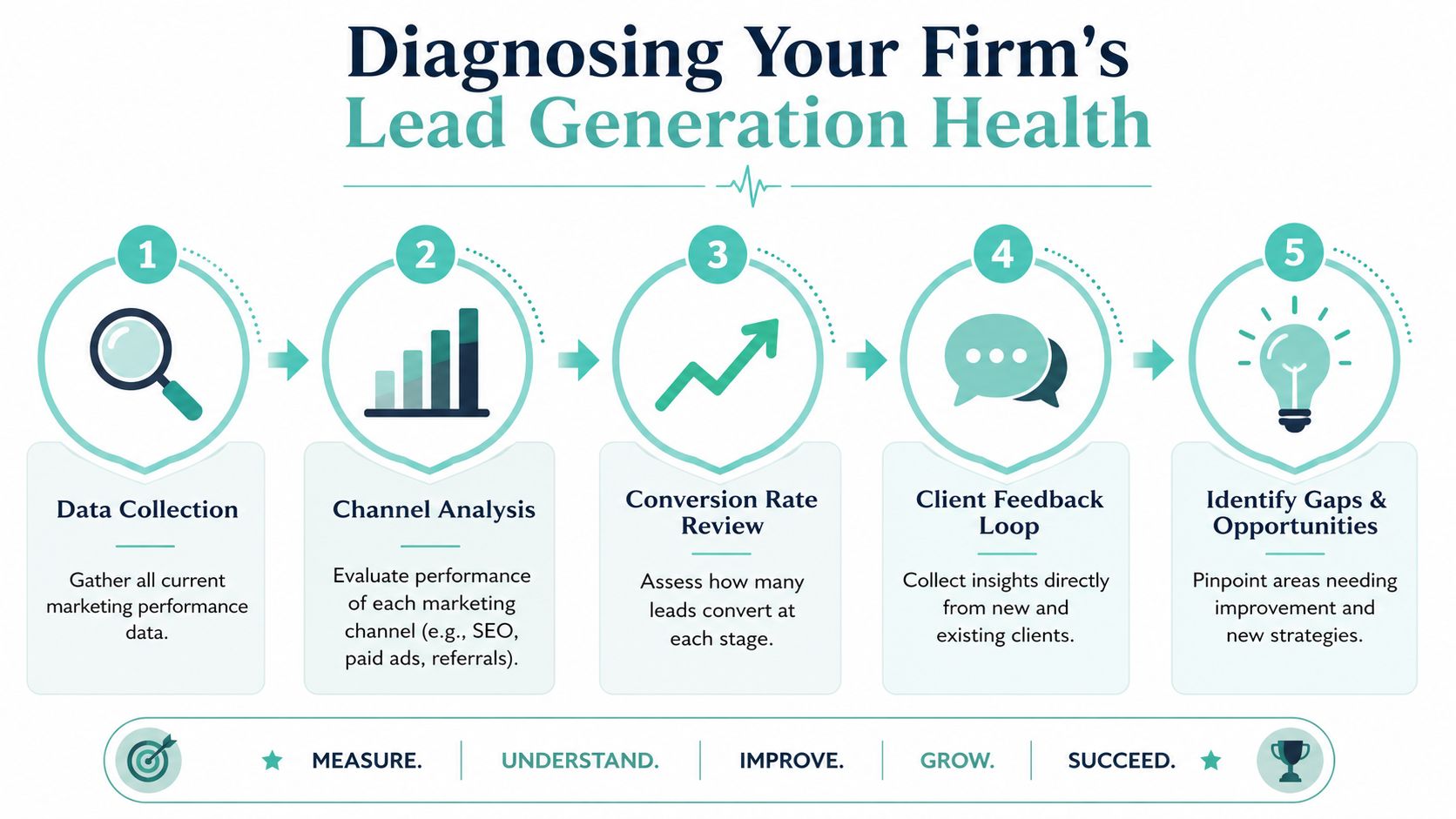
Start with the full funnel, not the channel report
A lot of law firms look at marketing in pieces. They ask how SEO is doing, whether Google Ads are expensive, or whether referrals have slowed down. Those are fair questions, but they don't tell you where revenue is getting lost.
Audit the full path:
- Discovery
- Are prospects finding the firm through branded searches, practice area searches, maps, referrals, or paid channels?
- Landing experience
- Do visitors land on a page that matches what they searched for, or do they hit a generic homepage?
- Inquiry
- Are calls and forms easy to complete on mobile and desktop?
- Intake response
- Does someone respond quickly and consistently?
- Consultation and retainer
- How many qualified inquiries book, show, and sign?
That sequence gives you a growth blueprint. It also forces the firm to stop hiding behind top-of-funnel metrics.
Build a practical scorecard
You don't need a huge dashboard to start. You need a short list of metrics the partners can review.
| Area | What to check | What it tells you |
|---|---|---|
| Website | Calls, form submissions, top landing pages, mobile usability | Whether the site converts attention into action |
| Search visibility | Rankings for core practice and city terms, Google Business Profile visibility | Whether qualified prospects can find you |
| Intake | Speed to first response, booked consultations, show rate, signed retainers | Whether leads are handled like revenue opportunities |
| Lead sources | Google Search, website, referrals, paid channels, social | Which sources drive quality, not just volume |
A solid self-audit often reveals a mismatch between what the firm thinks is happening and what clients do. I've seen firms blame SEO when the bigger issue was that intake treated every inquiry the same, including obvious poor-fit leads that should've been filtered before they ever reached an attorney.
When a partner says, "We need more leads," I usually ask a different question first. "How many of the leads you already have are being signed?"
For firms that want a useful external framework, Ares published an attorney lead generation playbook that helps map channels, conversion paths, and intake responsibilities without turning the process into a technical slog.
A good diagnosis should end with decisions, not just observations. Which pages need to be rebuilt. Which practice areas deserve local landing pages. Which sources produce weak leads. Whether intake needs scripts, routing, or ownership. That's where improvement starts.
Building Your High-Conversion Website Foundation
If your website looks polished but doesn't produce qualified inquiries, it's underperforming. Design matters, but in legal marketing, performance matters more. The site has to make a stressed, skeptical prospect feel that the firm is credible, relevant to their problem, and easy to contact.
This matters even more for local search traffic. Firms that link Google Business Profile traffic to location-specific service pages achieve 30% higher conversion rates than those linking to a generic homepage, according to BeaconLive's analysis of lead generation for lawyers. That single detail explains why so many firms get visibility from Maps but fail to turn it into signed matters.

What a law firm website must do on first contact
The first screen matters because most legal prospects don't read linearly. They scan. They check whether you handle their issue, where you practice, whether you look established, and how to take the next step.
That means your key pages need a few essential elements:
- Immediate practice fit: State the service clearly. "Car accident lawyer" is stronger than a vague litigation label.
- Location relevance: Show the city or region served so local search traffic knows it landed in the right place.
- Trust signals: Reviews, attorney profiles, bar admissions, results framing, and office details matter.
- Clear action paths: Call buttons, forms, and consultation prompts should be obvious without forcing a scavenger hunt.
A weak homepage can still rank for branded traffic and fail at everything else. Practice area pages are often where conversions occur.
Send local visitors to the page that matches their problem
Many firms lose momentum. Their Google Business Profile points to the homepage. Their paid traffic points to a broad service page. Their referral prospects land on an attorney bio with no clear next action. Every one of those choices increases friction.
A better setup connects source to intent. If someone searches for a bicycle accident attorney in a specific city, the click should land on a page about that service in that location. Not a generic homepage. Not a catch-all personal injury page. A focused page.
Here's the difference in practice:
| Traffic source | Weak destination | Better destination |
|---|---|---|
| Google Business Profile | Homepage | City-specific practice page |
| Local service query | General practice overview | Service plus location landing page |
| FAQ content click | Blog archive | Related service page with CTA |
For firms reworking site structure and page flow, this guide to website optimization for law firms is useful because it focuses on page hierarchy, conversion paths, and mobile-first decision points rather than cosmetic redesign advice.
One practical note. A site doesn't need flashy interactions to convert. It needs clarity, fast load times, strong internal linking, and pages that answer the exact question the searcher had when they clicked. That's what turns a website into a working intake asset instead of an online brochure.
Dominating Local Search with SEO and AEO
For most firms, the best matters come from local intent. Someone needs help now, wants a lawyer nearby, and searches with a city, neighborhood, or "near me" modifier. That's why local SEO still carries so much weight. It aligns with urgency and geography at the same time.
The firms pulling ahead aren't relying on one channel. The most successful law firms balance short-term paid ads with long-term organic growth from SEO and content marketing, optimizing for both traditional Google results and new AI-powered overviews to compensate for the declining reliability of traditional referral networks, according to the American Bar Association's analysis of legal lead generation trends for 2026.
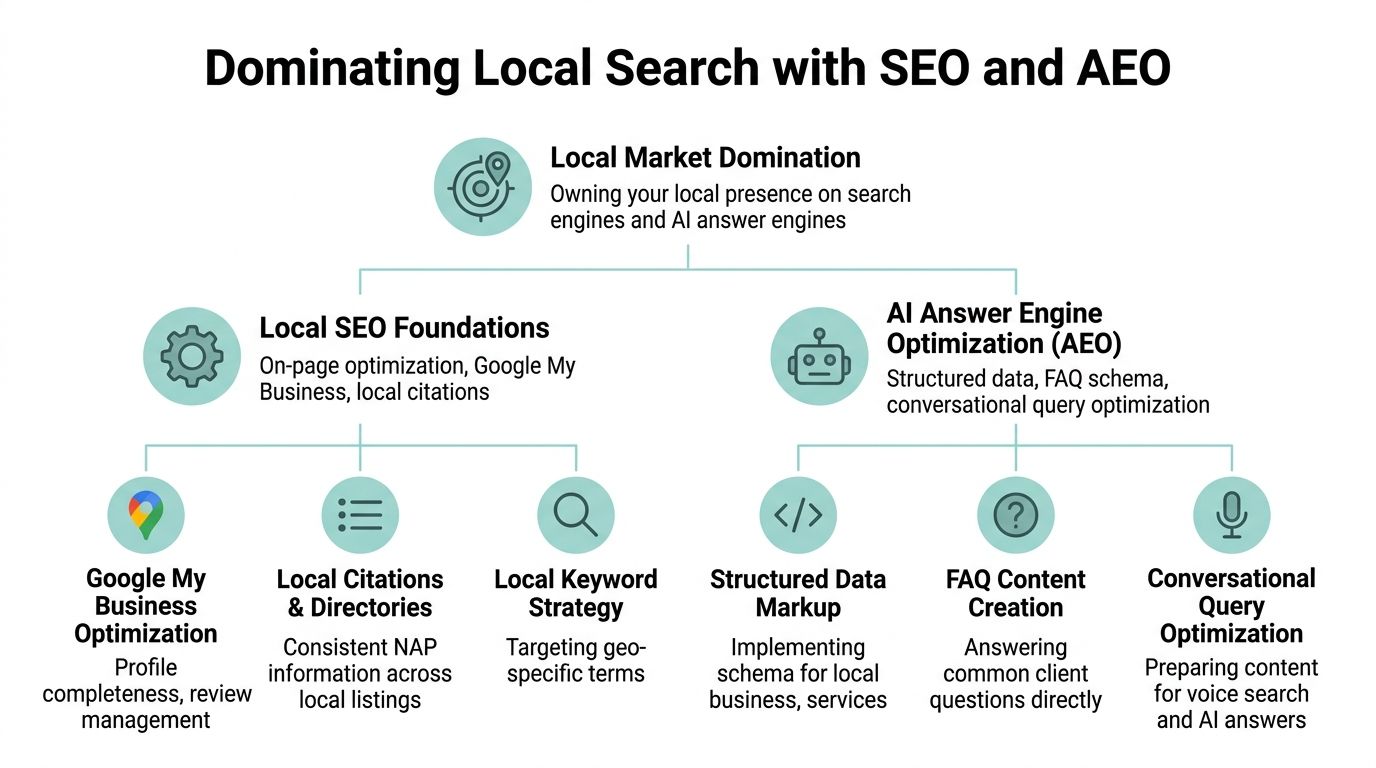
Local SEO still drives the highest-intent discovery
Local visibility starts with the basics, but the basics have to be done thoroughly. That means a complete Google Business Profile, consistent firm information across directories, practice area pages tied to real service areas, and a review strategy that reinforces trust.
What matters most in execution is alignment. Your Google Business Profile should reflect your actual services and office footprint. Your service pages should reinforce that same geography. Your on-page content should use the language prospects use when they search, not just internal firm terminology.
A workable local SEO checklist looks like this:
- Google Business Profile alignment: Categories, services, photos, hours, and descriptions should match the firm's real offerings.
- Location-specific pages: Build pages for the markets you serve, tied to real intent.
- Local authority signals: Earn relevant citations, local mentions, and links that reinforce geography and practice area relevance.
- Review management: Reviews influence both trust and click behavior, especially in map results.
For firms updating page structure and local relevance, Digital Skyrocket offers SEO for law firms focused on technical cleanup, content alignment, and local search architecture.
AEO changes how law firms structure content
AEO stands for Answer Engine Optimization. The concept is simple. Search engines and AI interfaces increasingly summarize answers instead of sending users straight to a list of blue links. If your content isn't structured clearly, it won't be selected as the source.
That shifts how legal content should be written. Not thinner. More precise. Pages need direct question-and-answer sections, clear service explanations, defined jurisdictional limits, and well-organized headings that match natural-language queries. If you want a useful primer on the concept outside legal marketing, MarTech Do has a solid overview of Account Engagement Optimization that helps frame how structured, intent-matched content improves discoverability across modern search experiences.
AEO doesn't replace SEO. It rewards the firms that already write clearly, structure pages well, and answer specific questions without burying the answer under generic copy.
Firms that dominate local search usually do the boring work well. They clean up page architecture. They tighten internal links. They expand location-service combinations carefully. They make it easy for Google and AI systems to understand who they help, where they help, and why the page deserves to surface.
Creating Content That Attracts High-Value Cases
A common mistake in lead generation for law firms is assuming that more inquiries automatically mean better marketing. They don't. A campaign can produce a high volume of form fills and still waste attorney time, overwhelm intake, and drag down close rates if the wrong people are entering the funnel.
The American Bar Association makes the quality problem explicit. It warns that lead provider quality is "highly variable." In the same discussion, the ABA notes that top-performing firms use SEO and content to target high-intent keywords and filter unqualified inquiries on their websites, reducing junk leads by 30% to 40% and achieving 2.5x higher ROI, as detailed in the ABA article on why not all leads are created equal.
More leads can make the firm less efficient
Many firms get trapped. They buy leads or broaden targeting because the phones need to ring. The numbers at the top of the funnel improve, but the attorneys complain that consultations are poor fit, price shopping increases, and staff spend too much time screening cases that were never viable.
Content should do some of that filtering before a prospect calls.
A weak content strategy attracts broad informational traffic. A better one attracts hiring intent. The difference usually comes down to topic choice, page purpose, and what the page asks the visitor to do next.
| Content type | What it often attracts | Better use |
|---|---|---|
| Broad legal explainer | Early research traffic | Use as support content that links into service pages |
| City plus service page | High-intent local prospects | Use as a primary conversion page |
| FAQ page | Question-driven traffic | Use to qualify expectations and route users correctly |
Build content for hiring intent
High-value content doesn't mean aggressive copy. It means precise positioning. The page should match a real legal problem, a real geography, and a real stage in the client's decision.
That usually includes:
- Service pages built around specific matters: Not just "Personal Injury," but the actual case types the firm wants.
- Local pages with substance: Give each market page its own facts, context, and conversion path.
- Qualification cues in forms and copy: Make it easier for a poor-fit prospect to self-select out.
- Resource content that supports the decision: FAQs, checklists, and process pages can help serious prospects move forward.
One of the most useful shifts a firm can make is moving from lead-first thinking to client-fit thinking. If a page attracts fewer inquiries but more retainers, that's better marketing. If it reduces time wasted on weak consults, that's better operations too.
For firms planning growth around better-fit cases instead of raw inquiry volume, this article on how to grow my law firm is a helpful reference because it connects search visibility, site structure, and conversion quality rather than treating growth as a traffic problem alone.
Optimizing Your Intake to Convert Leads into Clients
A lead is not revenue. The handoff after the call, form, or chat request decides whether the marketing investment pays off. Many firms spend serious time and money getting attention online, then lose the opportunity because nobody owns intake tightly enough.
The funnel becomes operational, not promotional. Clio's guidance is blunt: successful client intake requires a persistent follow-up sequence of 6 to 10 distinct phone calls and emails. Once lead volume exceeds 30 to 50 per month, hiring a dedicated intake specialist is essential to prevent conversion rates from dropping off, according to Clio's article on law firm lead generation and intake.
Most firms lose leads after the click
The typical breakdown isn't mysterious. A prospect submits a form after hours. Nobody responds until the next day. The follow-up is inconsistent. The intake questions are too loose, so the attorney walks into a consultation without enough context. Or the staff gives up after one missed call.
None of that feels dramatic in the moment. Collectively, it crushes conversion.
The firms that sign more cases usually aren't doing something magical. They're simply faster, more consistent, and less casual about follow-up.
A strong intake process needs clear ownership. Someone has to answer, route, document, and re-contact every viable lead. When that responsibility sits vaguely between receptionist, paralegal, and attorney, good inquiries get lost in the gaps.
What an intake system needs to include
Intake works best when it's treated like a defined workflow instead of an office habit. That workflow should connect website submissions, call tracking, email follow-up, consultation scheduling, and attorney handoff.
Core components include:
- Fast first response: The first contact should happen quickly and with enough context to move the conversation forward.
- Qualification before attorney time: Use forms, scripts, and routing rules to identify fit before a lawyer gets pulled in.
- Persistent sequence: The follow-up plan should continue across calls and emails instead of ending after one attempt.
- Central recordkeeping: Every conversation, note, and status change should live in one place.
If you're refining the documents and information flow that support intake, this guide to legal client intake is useful for thinking through forms, collection steps, and intake consistency.
The biggest intake mistake is assuming interested prospects will keep chasing the firm. Some will. Many won't. They contact multiple firms, and they usually hire the one that responds clearly, professionally, and without delay.
Measuring Success and Budgeting for Growth
A lot of firms still review marketing with the wrong lens. They ask whether traffic is up, whether rankings moved, or whether the firm got more calls this month. Those indicators matter, but they don't tell you enough to make budget decisions.
The better question is whether the firm is acquiring signed cases at a sustainable cost. That's the number partners can use to decide where to invest, where to cut, and what needs to be fixed operationally before another dollar goes out the door.
Track business outcomes, not vanity metrics
A useful reporting framework is simple enough to review monthly and specific enough to drive action. The point isn't to create more reporting. It's to connect marketing activity to signed revenue.
Track these in sequence:
- Qualified leads by source: Separate raw inquiries from viable matters.
- Consultations booked: This shows whether intake and page messaging are working together.
- Consultations held: No-shows expose workflow and expectation-setting problems.
- Signed cases by source: This identifies the channels that produce actual clients.
- Cost per signed case: Growth planning solidifies.
If the firm only tracks lead count, it will keep overvaluing noisy channels. A source that produces fewer inquiries but more retainers is usually worth more than a source that floods the office with weak prospects.
Use a budget split that supports both today and next year
A law firm can't build growth only on long-term assets, and it shouldn't rely only on short-term lead capture either. The healthiest setup balances both.
For 2026, a strategic law firm budget should allocate approximately 60% to building long-term organic assets like SEO and content, and 40% to capturing high-intent leads via paid channels like LSAs and PPC, according to Attorney at Work's guidance on lead generation budgeting for lawyers.
That split is useful because it forces discipline:
| Budget bucket | Purpose | What to expect |
|---|---|---|
| Organic investment | Build durable visibility and authority | Slower ramp, stronger long-term stability |
| Paid capture | Harvest high-intent demand already in market | Faster feedback, less durability without continued spend |
One caution matters here. If the website and intake process aren't solid, increasing ad spend usually magnifies waste. The firm buys more attention, but the same weak landing pages and inconsistent follow-up keep dragging down results. Fix the funnel first, then scale.
If your firm wants help tightening the path from search visibility to signed retainers, Digital Skyrocket builds law firm websites and ongoing SEO programs designed around local search, conversion flow, and answer-engine visibility. The fit is strongest for firms outside Texas that want a new website and sustained organic growth, not a general marketing bundle.