
Your phone isn't dead because people in your market stopped getting hurt. It's usually dead because your firm's website isn't showing up for the searches that matter, or it's attracting the wrong visitors and failing to turn them into consultations. That's the hard truth behind most conversations about SEO for personal injury law firms.
Partners often see the same pattern. The site looks fine. Someone is “doing SEO.” Rankings get reported. But signed cases don't move in a way that justifies the spend. Meanwhile, a competitor with a less polished brand keeps showing up in Google Maps, answers common questions better, and picks up the calls.
Search has changed again. A generic “car accident lawyer” page and a few scattered blog posts won't carry a serious PI firm in 2026. Google is rewarding firms that are locally relevant, technically sound, and able to answer the exact questions injured people ask right after an accident. That shift matters even more as AI Overviews reshape what users see before they ever click a traditional result.
Table of Contents
- Your SEO Playbook Starts with an Honest Audit
- Finding Keywords That Attract High-Value Cases
- Essential Technical Fixes That Build Google's Trust
- Winning the Near Me Search with Local SEO
- Creating Content for AI Search and Client Questions
- Measuring Success from Clicks to Signed Cases
Your SEO Playbook Starts with an Honest Audit
Most firms don't need more SEO activity. They need a clearer diagnosis.
That matters because PI search is expensive and crowded. In 2024, personal injury law firms allocated an average of $120,000 annually to SEO, which shows how seriously firms treat digital visibility in this category, according to Attorney Marketing Network's review of SEO for personal injury lawyers. If your firm is investing at anything close to that level, you can't afford to evaluate success by vague updates and rank screenshots.
Start with business reality, not SEO jargon
Open your audit with three blunt questions:
- Which case types are most valuable to the firm?
- Which cities or counties matter for intake?
- Which pages generate consultations now, if any?
That keeps the conversation tied to signed cases. A truck accident page in one city might matter far more than a broad personal injury page that draws unqualified traffic from all over the state.
Use a practical checklist, not a technical rabbit hole. A good reference point is this modern website audit process, which is helpful because it frames the audit around performance, usability, and search visibility rather than just a list of developer issues.
Practical rule: If a page ranks but doesn't bring qualified calls, it's not a win. If a page doesn't rank but consistently closes cases from referrals, it still has business value.
Review the search results like a client would
Search your top case terms the way an injured person would search them. Don't just type “personal injury lawyer.” Search phrases like “truck accident lawyer Dallas,” “slip and fall attorney near me,” or “wrongful death lawyer [city].” Then assess what appears.
Look at four things:
- Map Pack presence: Is your firm visible in the local results, or are rivals dominating the calls?
- Page quality: Do the ranking pages look local, specific, and credible, or thin and interchangeable?
- First impression: Does your homepage or location page look like a real law firm with real attorneys, or a template stuffed with city names?
- Content gap: Are competitors answering practical client questions that your site ignores?
A quick competitive review also tells you what not to copy. Many PI sites still rely on spun location pages, repetitive title tags, and generic city content. Those pages often survive for a while, but they don't build durable visibility or trust.
| Audit area | What to check | What usually goes wrong |
|---|---|---|
| Search visibility | Rankings for case type plus city terms | Firms track broad terms only |
| Local presence | Google Business Profile, reviews, NAP consistency | GBP is incomplete or neglected |
| Conversion path | Calls, forms, live chat, mobile usability | Visitors can't take the next step easily |
| Credibility | Attorney bios, verdicts, memberships, media, FAQs | Site looks anonymous and generic |
An honest audit should leave you with a short list of priorities, not a hundred-item spreadsheet. Usually that list includes missing city pages, weak practice area pages, poor local visibility, thin attorney credibility signals, and a site that loads too slowly on mobile.
Finding Keywords That Attract High-Value Cases
The biggest keyword mistake in personal injury SEO is easy to spot. Firms target the highest-volume phrase they can think of, then wonder why the page doesn't convert.
A person searching “personal injury lawyer” may still be researching, comparing, or not even sure what type of claim they have. A person searching “truck accident lawyer for spinal injury in Dallas” is much closer to hiring counsel. That's the difference between visibility and case-generating intent.
Stop chasing vanity terms
Broad keywords can still play a role, but they shouldn't be the center of your strategy. High-value PI SEO usually comes from specific combinations of injury type, accident type, and location.
Use this hierarchy when you build your keyword list:
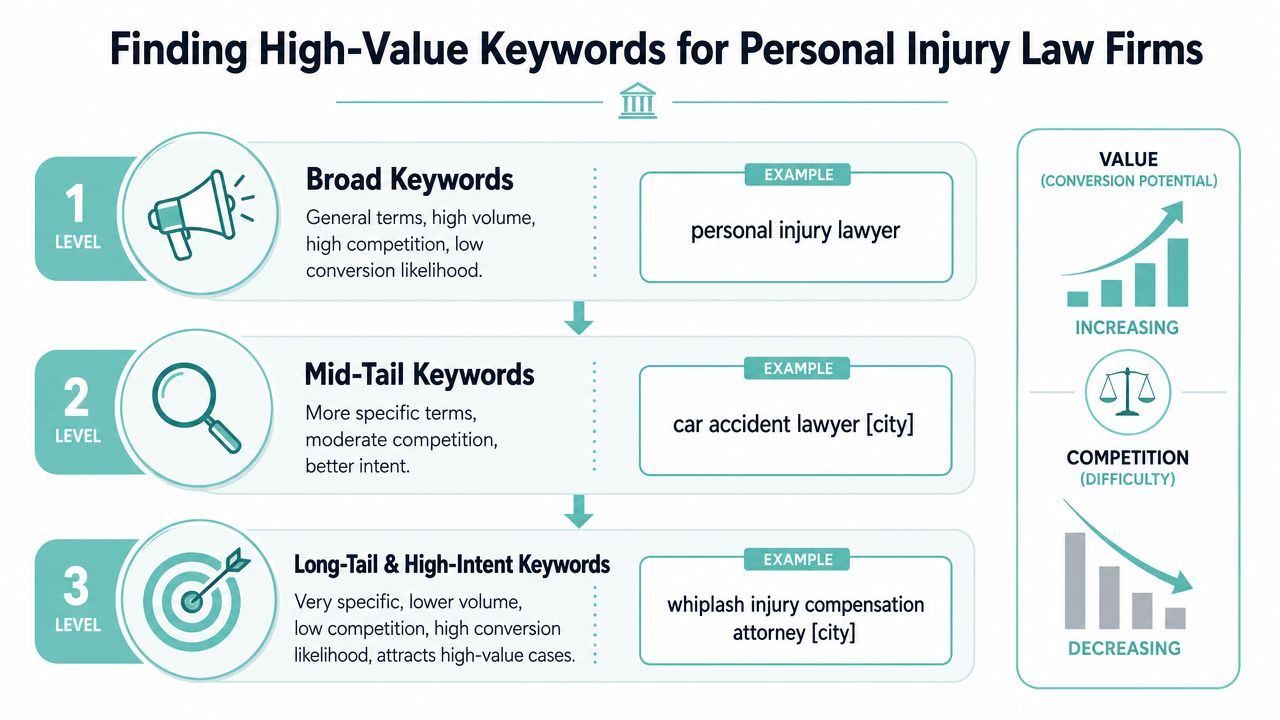
A strong keyword program usually pulls from:
- Practice terms: car accident lawyer, truck accident attorney, premises liability lawyer
- Injury terms: traumatic brain injury attorney, back injury claim lawyer
- Question terms: what if I was partly at fault, how long do I have to file after a crash
- Local modifiers: city, neighborhood, county, “near me”
If you want a useful refresher on how specificity changes search quality, this guide to long-tail SEO is worth reviewing because it lines up with how PI searches turn into real inquiries.
Map keywords to the right page types
Keyword selection only works when the page type matches the search.
A few examples make this clear:
- “Car accident lawyer” belongs on a practice area page
- “Car accident lawyer in Dallas” belongs on a city page tied to that practice area
- “What to do after a rear-end collision in Texas” belongs on a supporting article
- “Truck accident attorney for rollover crash injuries” may deserve a subpractice page if the firm actively pursues those matters
Many firms create internal competition by accident. They publish five pages that all target nearly the same phrase, then split authority across them. Google has to guess which page matters, and often chooses none of them.
According to Custom Legal Marketing's URL structure findings for multi-location PI firms, firms with “city” in the URL path achieve a 33.6% first-position ranking rate. That's a strong argument for pages such as /dallas/car-accident-lawyer/ or /houston/truck-accident-lawyer/, rather than vague, non-local slugs.
A Dallas car accident page should sound like Dallas, cite Dallas-relevant issues, and sit in a URL structure that makes the location obvious to both users and search engines.
A simple keyword map for PI firms
Here's a clean way to organize the site.
| Page type | Keyword example | Purpose |
|---|---|---|
| Core practice page | Car accident lawyer | Establish authority for the case type |
| City practice page | Car accident lawyer Dallas | Capture local commercial intent |
| Subtopic page | Rear-end collision lawyer Dallas | Target narrower, higher-intent terms |
| FAQ article | What if I was hit by an uninsured driver in Dallas | Answer urgent client questions |
| Resource article | Steps to take after a truck accident in Texas | Support top and mid-funnel search |
The trade-off is straightforward. Broad pages help establish category relevance. Specific pages bring in better leads. The firms that win usually have both, but they put far more effort into the specific pages that match actual hiring intent.
Essential Technical Fixes That Build Google's Trust
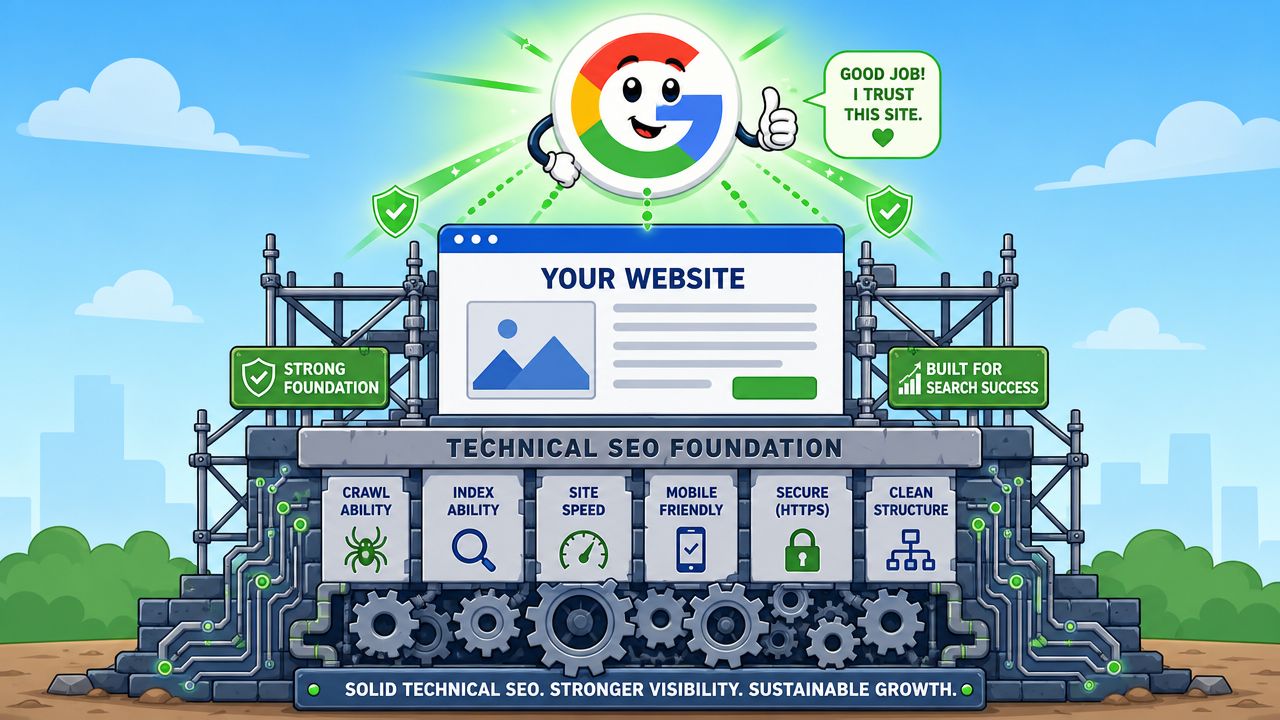
Technical SEO gets overcomplicated fast. For a PI firm, the issues that matter most usually fall into three buckets: speed, structure, and credibility signals.
If those pieces are weak, even strong content struggles.
Speed is a trust signal
Most PI searches happen in stressful moments. Someone is on a phone, in a waiting room, at home after a crash, or comparing firms between calls. If your site stutters, shifts around while loading, or buries the phone number, users leave.
For 2026 performance benchmarks, SEOPROFY's personal injury law marketing guidance says personal injury law pages must maintain LCP under 2.5 seconds, INP under 200 milliseconds, and CLS under 0.1. Those thresholds are practical standards to monitor in PageSpeed Insights, not vanity developer metrics.
A strong legal site should also have:
- HTTPS enabled across the site
- Mobile-first layouts with readable text and tap-friendly buttons
- Clean internal linking so Google can crawl practice and city pages
- An XML sitemap submitted through Google Search Console
If your current site fights you on those basics, the design may be the problem as much as the SEO. This overview of personal injury lawyer website design explains how structure, speed, and conversion paths work together on legal sites.
Schema helps Google understand your firm
Schema markup isn't a magic trick. It's a clarity tool.
For PI firms, the useful schema types usually include LawFirm and Person. They help search engines connect the firm to real attorneys, office locations, practice areas, and supporting business information. Done well, schema reinforces what the page is about and who stands behind it.
Here's the trade-off. Firms often spend weeks polishing blog copy while leaving structured data untouched. Google then has to infer more than it should. That's not fatal, but it wastes trust signals that your competitors may already be feeding directly.
E-E-A-T has to be visible
Legal SEO sits in a category where credibility matters more than cleverness. Google needs to see evidence that licensed professionals are behind the content.
That means your site should make attorney credentials easy to find. Don't hide bar admissions, practice focus, case experience, speaking appearances, legal memberships, office addresses, or media mentions in the footer or on a single bio page nobody visits.
Use a short technical checklist:
- Show authorship: Put attorney names on key legal content where appropriate.
- Support the claims: Add firm details, office information, and consistent contact data.
- Connect related pages: Practice pages should lead to attorney bios, FAQs, and relevant resources.
- Keep templates clean: Thin duplicate pages and bloated plugins create technical drag and trust issues.
What works: a fast mobile site with clear attorney identity, logical page structure, and structured data.
What doesn't: a flashy homepage, stock photos, and fifty near-duplicate city pages.
Winning the Near Me Search with Local SEO
For most PI firms, the most valuable search real estate isn't the organic blue link. It's the local result that gets tapped first on a phone.
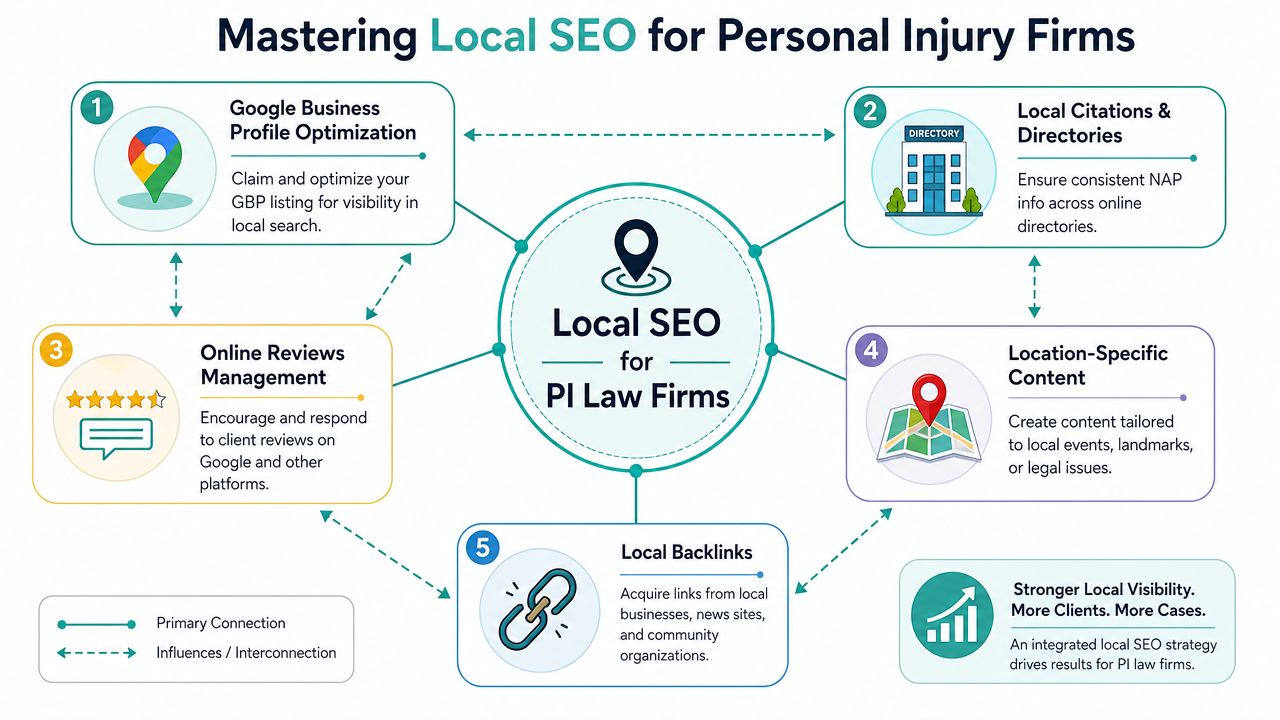
That's why the Google Business Profile deserves partner-level attention. A neglected profile can hold back a solid website. A well-managed one can drive consultations even while the broader SEO campaign is still maturing.
Your Google Business Profile pulls more weight than most firms realize
When someone searches for “injury lawyer near me,” Google often shows the map results before anything else that feels actionable. That puts your profile photo, category, reviews, and call button in front of your website.
This isn't just visibility. It's intake advantage.
Firms that integrate local SEO and CRO by optimizing Google Business Profile, publishing location-specific content, and encouraging reviews report 40–60% increases in qualified lead volume within 6–9 months. That's why local SEO should be treated as a case acquisition channel, not a side task delegated once a quarter.
What a strong local presence actually looks like
A good profile isn't achieved by claiming alone. It's maintained.
Focus on these assets:
- Primary category and services: Make sure the profile aligns with the firm's PI work.
- NAP consistency: Your name, address, and phone number must match across the website and directories.
- Photos that look real: Office, team, exterior signage, and attorney images beat generic stock visuals.
- Q&A and business details: Fill the profile with useful information a prospective client would want.
- Review response habits: A firm that responds clearly and professionally looks active and trustworthy.
If you want a useful outside perspective on how local visibility compounds across channels, this piece on local SEO and social media is helpful. Not because PI firms need to chase every platform, but because it shows how local signals reinforce discoverability and reputation.
Reviews and local pages need to work together
Many firms treat reviews and location pages as separate tasks. They shouldn't be.
Your city pages should reinforce the same local relevance your GBP is signaling. If the firm has an office in Miami, the page should mention local roads, courts, accident patterns clients recognize, and practical details about representation in that area. If it reads like a find-and-replace template, it weakens the whole local picture.
Use this audit lens for each office:
| Local asset | Strong version | Weak version |
|---|---|---|
| Google Business Profile | Complete, active, review-driven | Claimed but stale |
| Location page | Unique local details and clear CTA | Duplicate city swap page |
| Directory citations | Consistent NAP | Mixed phone numbers or addresses |
| Mobile experience | Click-to-call and fast load | Friction before contact |
A dedicated process for Google Business Profile SEO for personal injury firms helps tie those pieces together, especially when multiple offices are competing in nearby markets.
If your firm has three offices, treat each office like its own local search market. Shared branding is fine. Shared location copy usually isn't.
Creating Content for AI Search and Client Questions
A lot of personal injury content is still written like it's 2018. The page repeats “car accident lawyer” a dozen times, adds a few broad FAQs, and hopes that volume alone will carry it.
That model is losing ground.
Generic service pages are losing ground
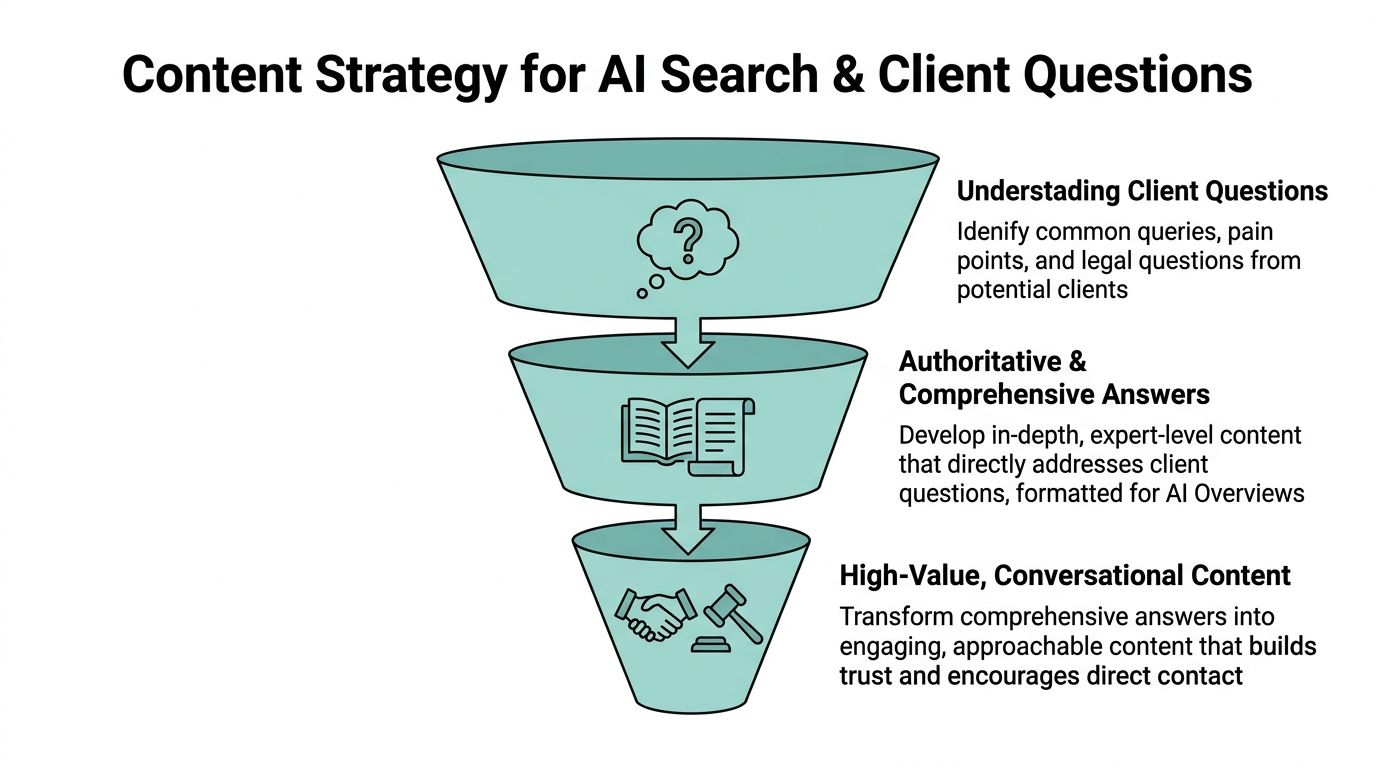
Google's AI search experience favors direct, well-structured answers. In the PI category, Scorpion's 2025 analysis highlighted by Nifty Marketing found that 78% of AI Overviews for personal injury queries contain direct answers to specific client questions, while only 12% of law firm blogs use that question-based framework.
That gap is the opportunity.
A firm that publishes “Car Accident Lawyer in Phoenix” and stops there is relying on old search behavior. A firm that also answers “Can I recover damages if I was partly at fault?”, “Should I talk to the insurance adjuster?”, and “What evidence matters after a trucking crash?” is building content that AI systems can extract and summarize.
Build content hubs around questions, injuries, and decisions
The right structure looks more like a hub than a stack of disconnected blog posts.
Start with a core practice area page, then support it with tightly related content:
- Hub page: Commercial Truck Accident Lawyer
- Question article: What are the hours-of-service rules for truck drivers?
- Decision article: Should I accept the insurer's first settlement offer after a truck crash?
- Injury article: Who pays for spinal injury treatment after a trucking collision?
- Evidence article: What black box data can help prove fault?
This structure does two things at once. It helps traditional SEO by building topical depth, and it helps AI-driven search by giving Google concise, extractable answers tied to a credible legal source.
For firms trying to adapt their editorial process, Algomizer's AI search blueprint is a useful reference because it pushes content planning toward answer quality and information structure instead of old keyword-density habits.
How to write for AI Overviews without sounding robotic
The shift isn't “write for robots.” It's “answer people clearly enough that search engines trust the answer.”
That means:
- Use the question as a heading when the query is specific.
- Answer it directly in the opening lines before expanding.
- Add jurisdictional context so the advice isn't vague.
- Show legal credibility through attorney identity and firm experience.
- Link deeper to related pages for readers who need more than a short answer.
A weak article dances around the point. A strong one answers first, explains next, and invites contact only after it has earned trust.
“Do I have a case if I was partly at fault?” is often a better content target than another generic city page because it reflects the actual question that stops a prospect from calling.
The firms that win in AI search won't necessarily publish more content. They'll publish more useful content, organized around the moments of confusion, urgency, and hesitation that define personal injury intake.
Measuring Success from Clicks to Signed Cases
A ranking report won't tell you whether SEO is helping the firm grow. It only tells you whether pages are appearing somewhere in search.
A PI firm needs a cleaner chain of accountability: search impression, click, call or form, intake qualification, consultation, and signed case. If that chain breaks, you need to know where.
Track the full intake path
At minimum, your dashboard should connect four layers:
- Visibility: Which practice and city pages are getting search impressions and clicks
- Lead actions: Calls, contact forms, chats, and click-to-call taps
- Intake quality: Which inquiries match your target case types and geographies
- Signed outcomes: Which source pages and queries correlate with retained matters
A lot of campaigns get fuzzy. Marketing reports show traffic gains, but intake staff report weak leads. That usually means the keyword strategy, local targeting, or page messaging is off.
A simple review every month can reveal more than most automated reports:
| Funnel stage | Question to ask |
|---|---|
| Search visibility | Which pages are earning impressions for valuable case terms? |
| Lead generation | Which pages actually prompt calls or forms? |
| Qualification | Are the leads in the right jurisdiction and case type? |
| Revenue relevance | Which pages influenced signed cases, not just inquiries? |
Use CRO to improve the traffic you already have
SEO and CRO should sit in the same conversation. If a page ranks but fails to convert, don't just chase more traffic. Fix the page.
Look at practical friction points:
- The CTA may be buried below too much introductory copy
- The mobile form may ask for too much too soon
- The page may lack trust cues such as attorney credentials, reviews, or case focus
- The wrong intent may be landing there because the keyword target is too broad
The most effective PI sites don't treat SEO as a traffic project. They treat it as an intake system. That is the definitive standard for SEO for personal injury law firms. Not whether the graph moved up, but whether the right people found the firm, trusted it, and contacted it.
If your firm needs a new site and ongoing SEO built around local visibility, AI-first content, and conversion performance, Digital Skyrocket is worth a look. They focus on websites, local SEO, and reputation management for service businesses, and for personal injury firms they work outside Texas so they don't compete with their existing PI client in that market.