

Your firm's website probably looks fine. The logo is polished, the attorney bios are there, the contact form works, and someone on your team says it feels professional. But the phone isn't ringing the way it should, intake quality is inconsistent, and too many competitors show up above you when someone searches for the exact cases you want.
That's the gap most firms are dealing with right now. They don't have a website problem in the design sense. They have a website optimization for law firms problem. The site exists, but it isn't built to rank, it isn't built to convert, and in many cases it isn't built to be understood by AI-driven answer engines that potential clients now use before they ever click a search result.
Most legal marketing advice still treats Google like the only gatekeeper. That advice is already behind. In 2026, firms need websites that work for human visitors, Google, local map results, and AI systems that summarize, cite, and recommend firms during the research process. That's the standard now.
Table of Contents
- Why Your Firm's Website Is Your Hardest Working Employee
- Discovering Your Baseline Performance
- Building for Search Engines and AI
- Winning Clients in Your City with Local SEO
- Turning Website Visitors into Signed Cases
- An Ongoing Plan for Sustainable Growth
Why Your Firm's Website Is Your Hardest Working Employee
A law firm website isn't a brochure. It's your intake desk after hours, your first consultation before a call starts, and your most visible business development asset.
When it underperforms, firms usually blame traffic. In our experience, that's only part of the story. Many firms have enough visibility to generate leads, but their site gives visitors no clear path to trust the firm, understand the next step, or contact someone quickly.
A website that ranks and converts changes the economics of marketing. The average law firm spends approximately $150,000 annually on SEO, typically breaks even after 14 months, and reaches approximately 526% ROI over 3 years, according to Revenue Memo's law firm marketing statistics. That matters because SEO compounds. Paid visibility stops when the budget stops. A strong site keeps working.
A good-looking site can still fail
We've seen this pattern over and over. A firm launches a redesign, gets compliments on the appearance, and assumes the job is done. Then the site stalls because the pages target broad terms, the internal links are weak, the practice area content is thin, and the mobile experience makes contacting the firm harder than it should be.
That's why website optimization for law firms has to start with business function, not aesthetics.
- A homepage must direct people fast: Visitors should know what you handle, where you handle it, and how to contact you within seconds.
- Practice area pages must answer hiring questions: Not just explain legal definitions.
- Attorney bio pages must build confidence: Credentials, case focus, and authority should be easy to verify.
- Every high-intent page must invite action: Call, form, consultation request, or chat.
Practical rule: If a visitor lands on a service page from search and can't tell within a few seconds whether you handle their matter in their city, the page is underperforming.
The website should carry the load when your staff can't
Your staff can't answer phones around the clock. Your website can still sort intent, pre-frame expectations, and move qualified prospects toward contact while your office is closed. That only happens if the structure is deliberate.
The firms that win online usually do three things better than everyone else:
| Website function | What works | What fails |
|---|---|---|
| First impression | Clear practice focus, location, trust markers | Vague slogans and generic stock copy |
| Search visibility | Strong technical foundation and focused pages | Thin pages targeting everything |
| Conversion | Repeated calls to action and low-friction contact paths | One buried contact page |
A well-optimized site doesn't just bring in more visits. It helps the right prospects call with better context, stronger intent, and fewer doubts.
Your website should reduce intake friction before a human ever joins the conversation.
Discovering Your Baseline Performance
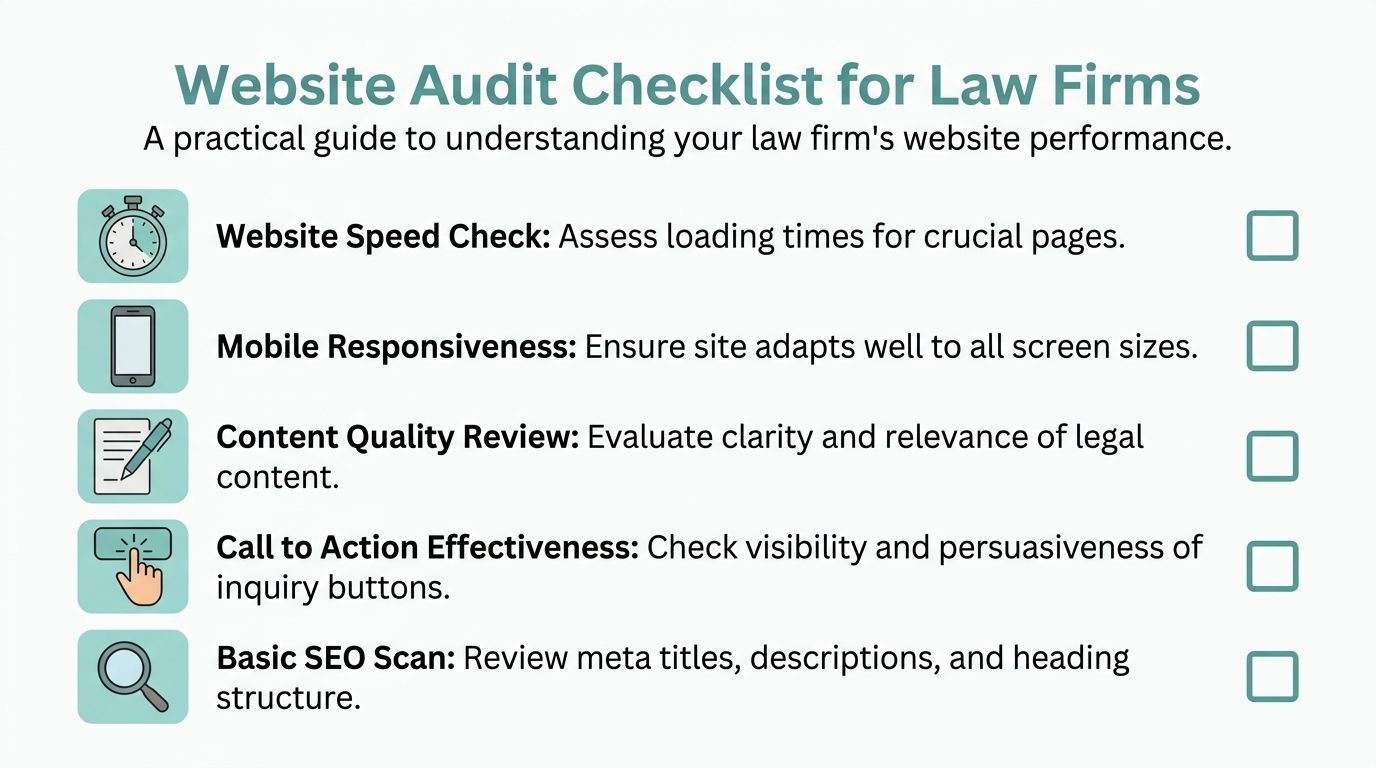
Before you change anything, find out what's already helping and what's getting in the way. Most firms don't need a massive audit on day one. They need a practical baseline.
A significant 35% of smaller law firms haven't updated their website design or content in the last 3 years, and that hurts both rankings and trust, as noted by Sixth City Marketing's legal SEO guidance. If your site hasn't had meaningful improvements in that window, assume parts of it are outdated until proven otherwise.
Start with the pages that should produce cases
Don't begin with blog posts. Start with the pages that should generate consultations.
Check these first:
Homepage
Is your main value proposition specific? A firm that says "trusted legal representation" tells prospects almost nothing. A firm that states the practice area and location immediately gives searchers context.Primary practice area pages
Review whether each page addresses a distinct service. If one page tries to cover car accidents, truck wrecks, wrongful death, and premises liability all at once, it usually won't rank or convert as well as focused pages.Location pages
Confirm that each office or city page contains local information. Thin city swaps with copied text tend to underperform and create trust problems.Attorney bio pages
These pages often close the credibility gap. If they're shallow, outdated, or missing practice focus, prospects hesitate.
Review the trust signals and technical basics
A baseline audit should also answer one question. Why would a cautious prospect trust this firm enough to call?
Use a short review checklist:
- Design freshness: Does the site feel current, or does it look untouched for years?
- Mobile usability: Can someone read, tap, and contact the firm easily on a phone?
- Speed on key pages: Test the homepage, main service pages, and contact page.
- Content clarity: Does the copy sound like a lawyer explaining the issue clearly, or like marketing filler?
- Calls to action: Are phone, form, and consultation prompts visible without hunting?
- Heading structure: Does each page use one clear H1 and logical supporting headings?
- Metadata quality: Do page titles and descriptions reflect the actual service and city?
- Internal linking: Do pages support each other, or sit isolated?
- Backlink profile: Are trusted sites referencing the firm, or is authority weak?
Don't audit the whole site evenly. Audit the pages that should make the phone ring.
A simple way to prioritize findings is to sort them into three buckets.
| Priority | Examples | Why it matters |
|---|---|---|
| Immediate fixes | Broken forms, wrong phone numbers, missing titles | Directly blocks leads or indexing |
| Near-term upgrades | Thin service pages, weak CTAs, outdated bios | Affects trust and conversion |
| Strategic work | Topic clusters, link building, AI-ready formatting | Builds authority over time |
If you're running a redesign or deeper rebuild, this baseline should also document what you won't keep. Old attorney pages, duplicate city pages, and empty practice sections often drag down the whole site. Optimization starts as much with cleanup as with creation.
Building for Search Engines and AI
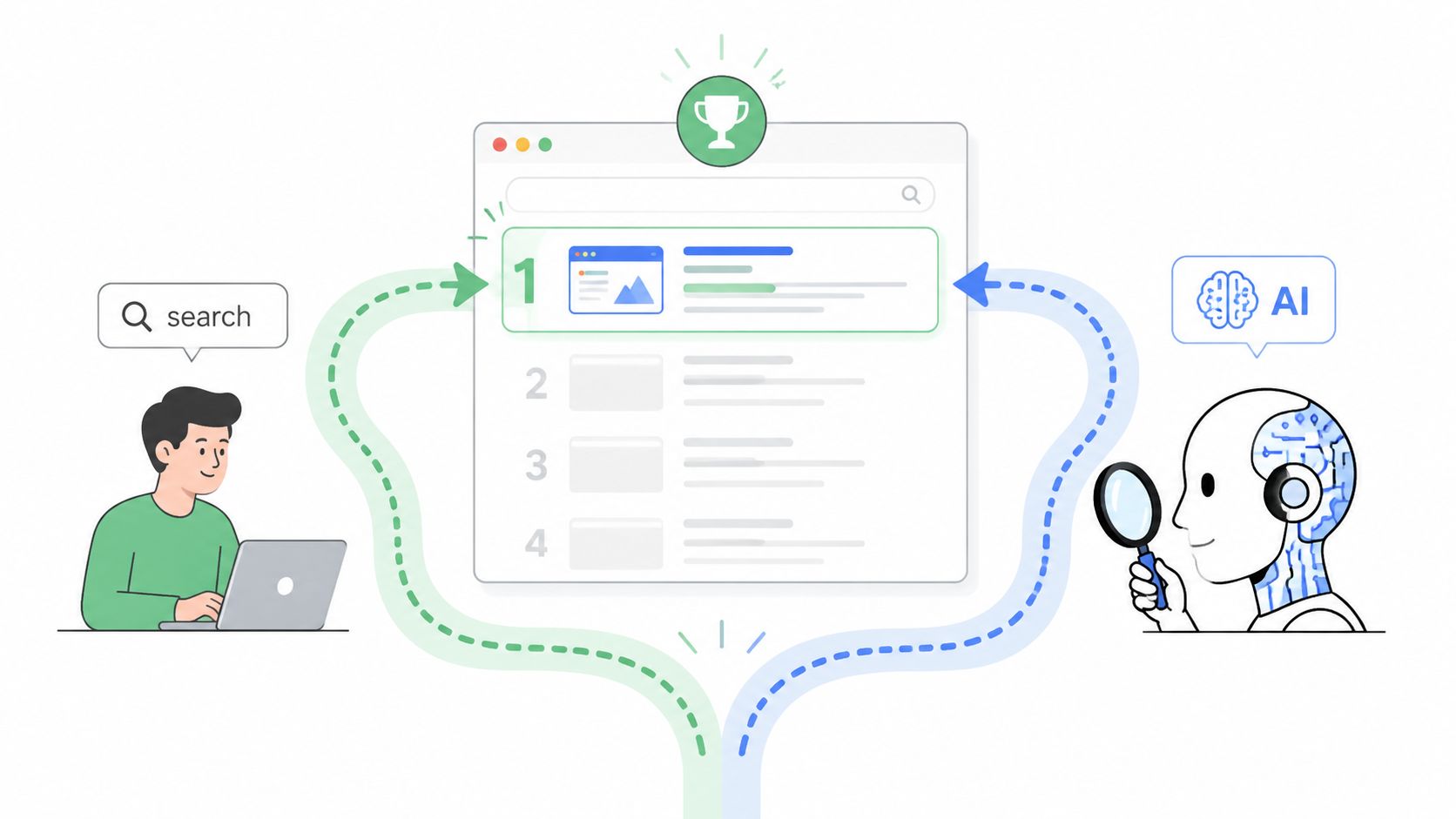
Modern legal SEO isn't split into two separate jobs. The same work that helps search engines crawl, understand, and trust your website increasingly helps AI systems do the same.
In 2026, technical health is mandatory. Sites need to pass Core Web Vitals checks, and their robots.txt files can't block AI user-agents such as Google-Extended or OAI-SearchBot. Content also needs semantic clusters and question-based headings so both humans and machines can understand it, according to Attorney at Work's law firm SEO strategy guidance.
Technical SEO and AI visibility now overlap
A lot of firms still treat AI discovery like a separate trend. It isn't. If your site is hard to crawl, slow on mobile, disorganized, or built around heavy scripts that hide important content, both search engines and AI systems have a harder time using it.
The overlap is practical:
- Fast pages help everyone: Users stay longer, crawlers waste less effort, and key content becomes easier to process.
- Clean hierarchy reduces ambiguity: Clear navigation, sensible folders, and internal links make legal topics easier to map.
- Schema adds context: Attorney, LegalService, and FAQPage markup help define who you are and what you do.
- Accessible HTML matters: Important information shouldn't depend on flashy front-end effects to appear.
For firms trying to understand how this shift changes SEO work, this overview of AI search optimization is useful because it frames optimization around how AI engines discover and cite content, not just how Google ranks blue links.
How to structure legal content so machines can use it
The biggest content mistake we see is writing pages around a keyword instead of a legal topic. Repeating "Dallas personal injury lawyer" over and over isn't strategy. It just signals weak writing.
A better structure looks like this:
- Start with the client's real question.
- Answer it clearly near the top.
- Expand into related subtopics with precise headings.
- Link to supporting pages that deepen the issue.
- Add attorney attribution and keep the content current.
For example, a real estate closing page shouldn't only repeat the head term. It should naturally include related concepts such as title insurance and escrow agent when those ideas belong on the page. That's what semantic coverage looks like in practice.
If AI tools are going to cite your firm, they need content that's easy to extract, easy to trust, and easy to attribute.
We also recommend treating attorney bios, office pages, and practice pages as part of the same authority system. A strong personal injury page should connect to attorney bios, relevant FAQs, and city-specific pages. That internal structure helps search engines understand topical depth and helps prospects move naturally through the site.
If you're evaluating build approaches, this guide to SEO web design for lawyers is relevant because it ties design decisions to technical performance, search visibility, and conversion instead of treating them as separate projects.
One final caution. AI can help draft outlines, FAQs, and first-pass copy. It shouldn't be the final voice on legal content. Firms need lawyer review, factual verification, and real editorial judgment before anything goes live.
Winning Clients in Your City with Local SEO
For most firms, the money isn't in national visibility. It's in showing up when someone nearby needs a lawyer now.
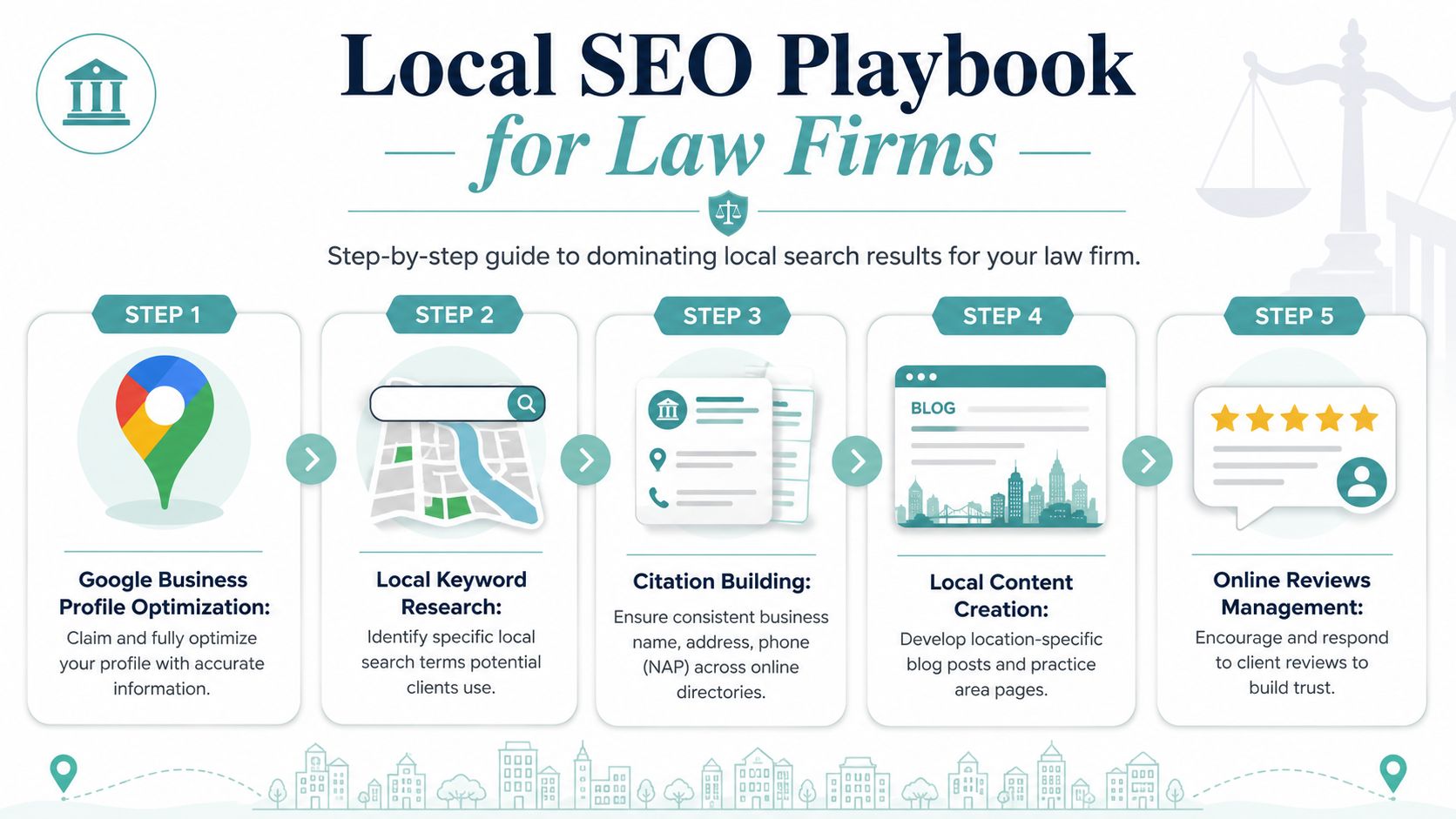
Google prioritizes geographic relevance in legal searches, so Google Business Profile optimization, consistent NAP data, and client reviews all directly support local rankings, as explained in Justia's law firm SEO fundamentals.
Treat your Google Business Profile like a second homepage
Most firms fill out a profile once and leave it alone. That's not enough. A personal injury firm in Phoenix, for example, should treat its profile like a living local asset.
A strong setup includes:
- Accurate firm details: Name, address, phone number, hours, and website must match your site and citations.
- Complete service categories: Use the profile to reinforce what the firm practices.
- Photos that look current: Exterior, interior, attorney photos, and branded materials help legitimacy.
- Review management: Ask for reviews consistently and respond thoughtfully.
- Posts and Q&A activity: These reinforce relevance and show the profile isn't neglected.
A weak profile sends mixed signals. An optimized one supports map visibility and trust before a prospect ever lands on your site.
A local prospect often decides whether you're worth contacting before they click your website at all.
For firms managing multiple city or office pages, tools that help standardize location-specific page production can save time. This overview of geo content automation software is worth reviewing if you're trying to scale local content without turning every page into duplicate filler.
Build city pages that deserve to rank
Location pages work when they combine legal relevance with local specificity. They fail when they're just find-and-replace versions of each other.
A strong city page should include:
| Element | Good implementation | Weak implementation |
|---|---|---|
| Title tag | Practice area plus city | Generic firm name only |
| H1 | Clear service and location | Vague branding headline |
| Body copy | Local court, road, neighborhood, or process context | Reused text with city swapped |
| Internal links | Links to related practice and attorney pages | No supporting links |
| CTA | Local phone prompt and consultation path | One generic footer form |
We usually advise firms to build these pages around actual case demand, office footprint, and nearby cities where the firm can credibly compete. That means fewer pages, but stronger ones.
If you want a more detailed breakdown of map pack tactics for this niche, this guide on Google Business Profile SEO for personal injury firms is a useful reference for how local profile work connects to website pages and intake.
Local SEO isn't about scattering city names across a page. It's about proving local relevance consistently across your website, your profile, your citations, and your reviews.
Turning Website Visitors into Signed Cases
Traffic doesn't pay the bills. Signed cases do.
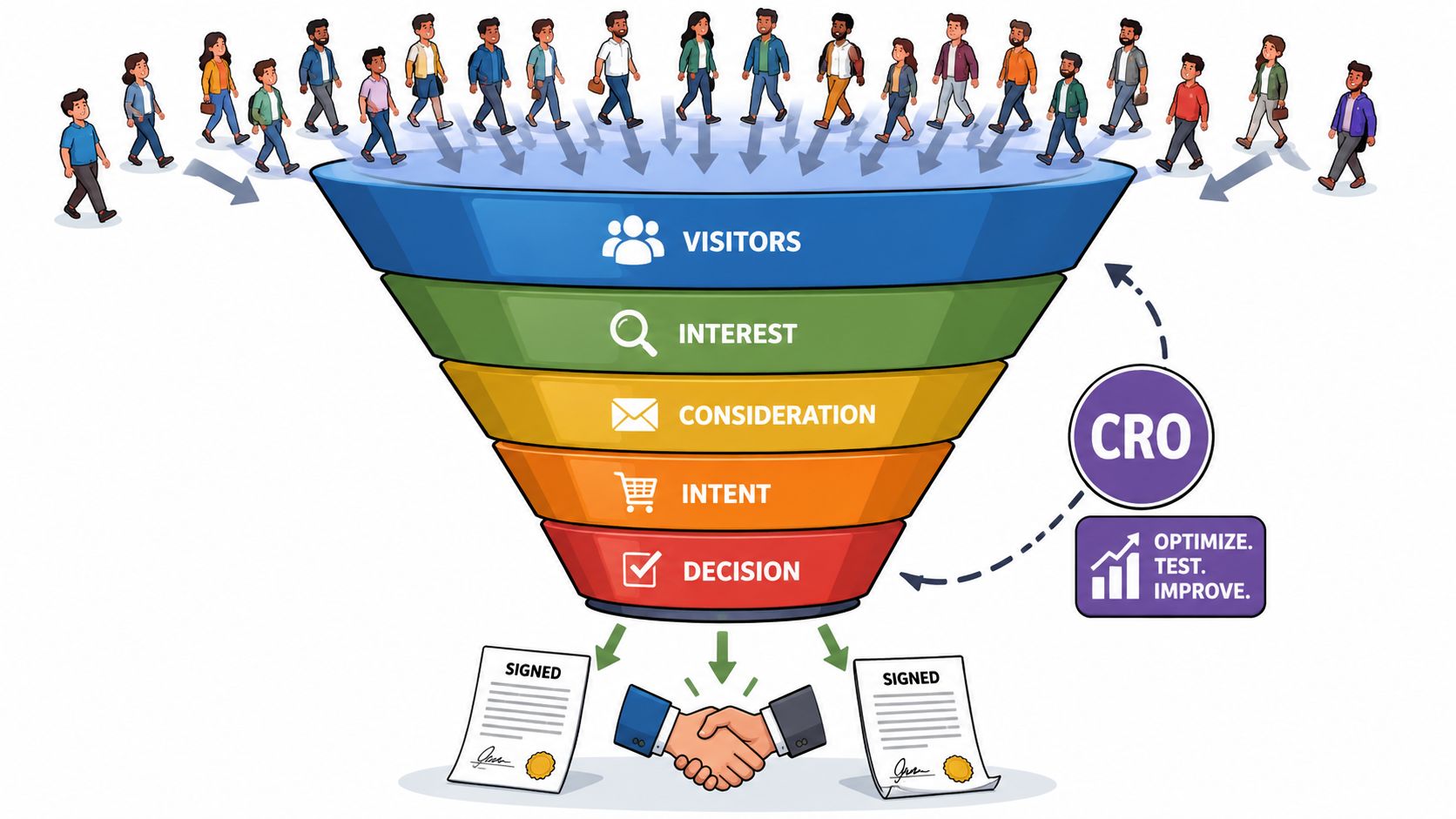
One of the worst assumptions in legal marketing is that a visitor who wants to contact you will naturally find the contact page and convert. Many won't. They get distracted, uncertain, or impatient. On mobile, they often leave.
Firms that neglect mobile-first conversion tactics such as embedding click-to-call buttons and using locally relevant keywords in subheadings see over 60% of mobile legal visitors abandon the site without making an inquiry, according to Josh Brown's analysis of SEO for lawyers.
Why a contact page isn't enough
A high-converting law firm website places calls to action where decision tension is highest. That usually means the top of service pages, after trust-building content blocks, inside sticky mobile elements, and near attorney credibility sections.
The contact path should feel obvious:
- Call now buttons on mobile: Especially on high-intent pages.
- Short forms: Ask only for the information intake needs.
- Repeated CTA placements: Don't make visitors scroll back up.
- Context-aware copy: "Speak with a car accident lawyer" outperforms generic "Contact Us" language in many legal contexts.
- Fast confirmation: Show users that the form worked and what happens next.
When firms hide action behind one navigation item, they lose people who were ready to reach out but not ready to hunt.
Trust elements that lift inquiry quality
Conversion isn't only about button placement. It's also about reducing skepticism.
Useful trust builders include attorney bylines, real office photography, verdict or case result pages where appropriate, client reviews, FAQ sections, and professional headshots that feel credible rather than stiff or outdated. For firms updating visual trust signals without scheduling a full photo shoot immediately, resources on powerful AI legal portraits can be helpful for understanding what makes attorney imagery look polished and consistent.
The highest-converting pages usually answer two questions quickly. Can this firm handle my problem, and can I trust them enough to call right now?
We also look closely at friction points that firms overlook:
- Too many required form fields
- Buried phone numbers
- Chat widgets that block content
- Long walls of text before any CTA
- No reassurance about response time
- No indication of service area
If you're working through the conversion side of website optimization for law firms, it's worth reviewing how conversion rate optimization services typically approach layout, CTA placement, and form flow testing on lead-generation sites.
A visitor who calls from a service page has usually already self-qualified to some degree. Your website's job is to support that momentum, not interrupt it.
An Ongoing Plan for Sustainable Growth
The launch isn't the finish line. It's the point where measurement starts to matter.
A law firm website grows when someone owns the maintenance rhythm. That doesn't mean endless tinkering. It means checking the few things that indicate whether the site is attracting qualified prospects and whether the user experience is holding up under real traffic.
What to validate before launch
Before a redesigned site goes live, run a final check that focuses on function over cosmetics.
Simple Launch Validation Checklist
| Check Area | Action Item | Status |
|---|---|---|
| Tracking | Confirm analytics, form tracking, and call tracking are recording correctly | Pending |
| Contact paths | Test every phone link, contact form, chat flow, and thank-you message | Pending |
| SEO basics | Review titles, descriptions, canonicals, headings, and indexability | Pending |
| Content quality | Verify attorney bios, practice pages, and location pages for accuracy | Pending |
| Mobile UX | Test key pages on phones for speed, tap targets, and CTA visibility | Pending |
| Internal links | Confirm related pages link logically and no dead ends exist | Pending |
| Local signals | Check NAP consistency on-site and alignment with listings | Pending |
| Media and assets | Compress images, review alt text, and remove broken files | Pending |
A pre-launch review catches the mistakes that waste the first few weeks after a site goes live. Wrong phone numbers, broken forms, no-index errors, and missing redirects are still common.
What to review every month
Most firms don't need a giant monthly report. They need a simple operating cadence.
A practical monthly checklist looks like this:
Review qualified leads
Look at calls, form submissions, and consultation requests. Review quality, not just volume.Check key landing pages
Watch the main service and city pages. Are they gaining visibility, holding rankings, and generating inquiries?Publish or improve one meaningful piece of content
This can be a new FAQ, a stronger city page, or a rewrite of a weak practice page.Scan technical health
Check for broken links, indexing problems, and page performance issues.Update local assets
Add fresh photos, respond to reviews, and keep firm details consistent.Refine conversion paths
Adjust CTA copy, form length, layout order, and trust elements where users hesitate.
You don't need to chase every ranking fluctuation. You do need to track whether the site is producing better inquiries over time. That's the metric that matters.
The firms that get durable results usually stick to boring discipline. They keep pages current, protect technical health, expand topical coverage carefully, and improve conversion paths based on actual behavior. That's how website optimization for law firms becomes a compounding asset instead of a one-time project.
If your firm is planning a redesign or needs ongoing SEO tied to actual lead generation, Digital Skyrocket builds and optimizes law firm websites around technical SEO, AI visibility, local search, and conversion paths that support qualified inquiries.