A managing partner gets a call from a prospective client who says, “I asked an AI assistant for the best car accident lawyer near me, and it named three other firms.” A plumbing company owner hears the same story from someone who searched for a contractor who could fix a slab leak fast. The prospect had urgent intent, but the business never entered the conversation.
That's the practical reason AI search optimization services now matter to law firms, roofers, HVAC companies, plumbers, and other local service providers. Traditional SEO still earns rankings, but Google AI Overviews, ChatGPT, Perplexity, and similar tools increasingly shape which businesses a prospect notices first. The work isn't about chasing a novelty. It's about making the business clear, credible, technically accessible, and worth citing when an answer engine assembles a recommendation.
Table of Contents
- The Search Moment Every Service Business Is Missing
- What AI Search Optimization Services Actually Are
- The Five Core Components Inside an AI Search Optimization Engagement
- How AEO Technical SEO and CRO Work Together on a Service Site
- Measurable Outcomes and What to Track Each Month
- Common Misconceptions That Derail AI Search Optimization Services
- Vendor Selection Criteria and a 90 to 180 Day Engagement Roadmap
- Your Next Step as a Service Business or Law Firm
The Search Moment Every Service Business Is Missing
For years, the local SEO win was straightforward. A personal injury firm wanted a page-one position for “car accident lawyer Dallas.” An HVAC company wanted to appear when someone searched “AC repair near me.” If the website reached position three, earned a strong snippet, and generated a click, the campaign was working.
That win condition has changed. A prospect may now ask an AI assistant to compare firms, identify a nearby roofer, or explain what to do after a burst pipe. The assistant can summarize options before the prospect visits a traditional results page. If the business isn't named or cited, the owner may never know a qualified lead was lost.
Google's own product announcements show how quickly answer-first search expanded. Google began rolling out AI Overviews to everyone in the United States on May 14, 2024, saying “hundreds of millions” of users would receive access that week and that it expected to reach more than a billion people by the end of that year, as described in Google's AI Overviews announcement. Google later announced expansion to more than 100 countries and territories, which made this an international search development rather than a U.S.-only experiment.
The market signal is even clearer in a 2026 synthesis of AI search statistics. Search-related AI prompting reached 28% of the size of worldwide search, monthly AI sessions reached 56% of worldwide search, and combined traditional plus LLM search usage increased by 26% worldwide. The same synthesis reports that 70% of consumers said their AI use for search increased over the prior year, while only 4% said they'd never used AI tools for search.
Practical rule: If competitors are being named in answers your prospects trust, your ranking report is incomplete.
The quiet risk isn't that Google disappears. It's that a competitor becomes the recommendation before your firm gets a chance to make its case. AI search optimization gives service businesses a practical way to address that shift through stronger entity signals, answer-focused content, technical SEO, local consistency, and lead attribution.
What AI Search Optimization Services Actually Are
AI search optimization services improve how a business is discovered, understood, summarized, and cited across AI-assisted search experiences. The work can include Google AI Overviews, ChatGPT, Perplexity, Microsoft Copilot, voice assistants, and traditional search results that feed those systems.
This isn't a replacement for SEO. Google says AI Overviews use a customized language model integrated with its core web ranking systems, and that the feature performs classic search tasks such as identifying relevant, high-quality results from its index, according to Google's explanation of AI Overviews and web ranking. A page that can't be crawled, indexed, interpreted, or trusted still has a weak foundation for AI visibility.
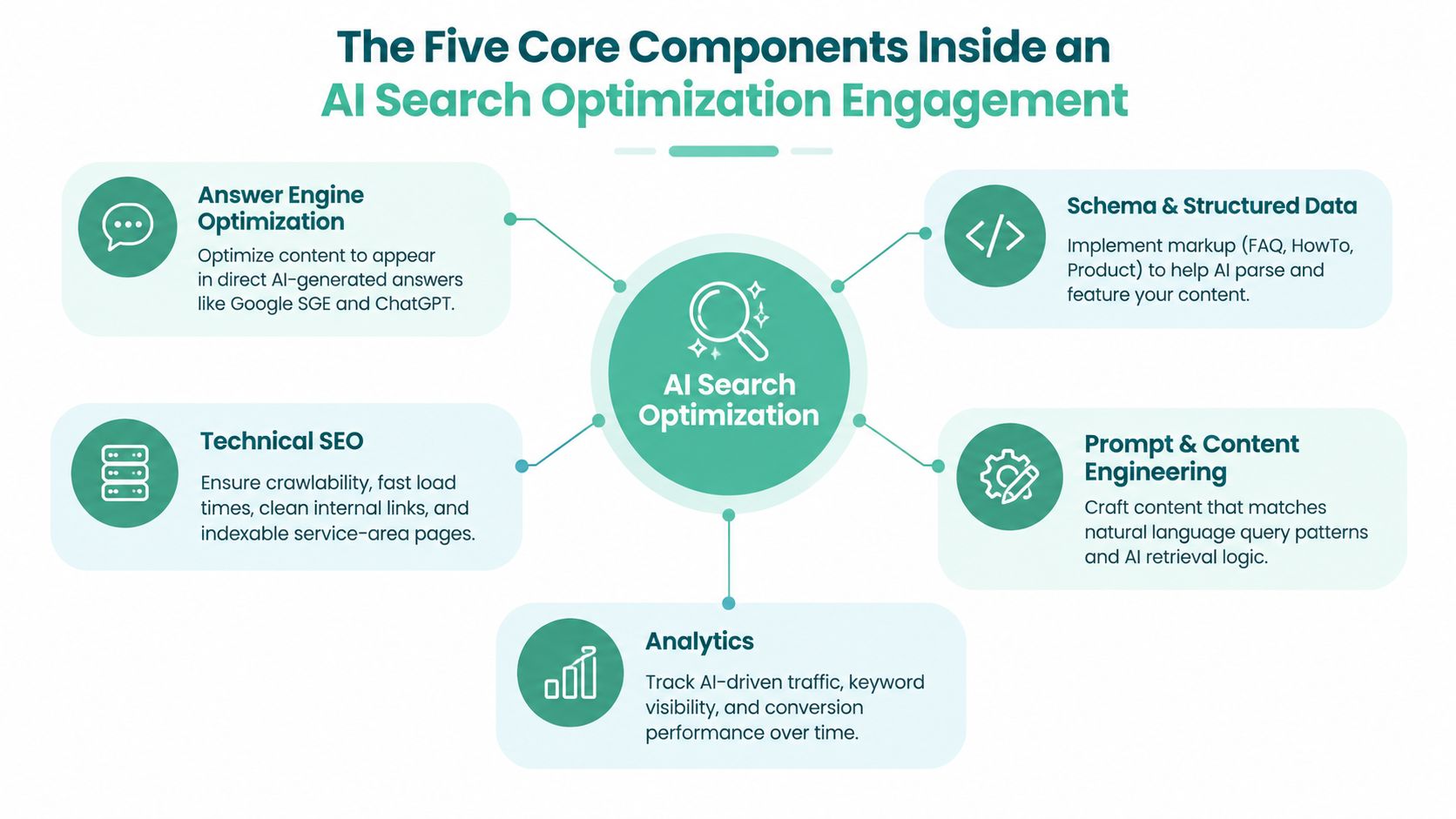
A credible engagement usually combines five connected areas:
- Answer engine optimization: Content is organized around the questions prospects ask, with direct answers that an assistant can extract without losing context.
- Schema and structured data: Markup helps search systems interpret entities, services, professionals, locations, reviews, FAQs, and other page details.
- Prompt and content engineering: Writers build pages around natural-language scenarios, case types, service problems, locations, and decision criteria rather than repeating a single keyword.
- Technical SEO: The site receives improvements to crawlability, internal linking, mobile usability, indexation, and performance.
- Analytics: Reporting connects AI visibility and organic search activity to calls, forms, consultations, qualified inquiries, signed cases, and booked jobs.
Who needs this work most
A multi-location home-service company may have excellent service delivery but inconsistent city pages, business information, and service descriptions. A law firm in a saturated metro may publish generic practice-area copy while competitors answer specific questions about injuries, deadlines, eligibility, and next steps. A regional contractor may rank for broad terms yet remain invisible for the detailed problem descriptions that signal immediate buying intent.
AI search optimization is most useful when the business has a defined service area, a high-value conversion, and enough operational clarity to explain who it serves and what it does. The provider should connect every optimization decision to that commercial reality.
The Five Core Components Inside an AI Search Optimization Engagement
The five components below work as a system. Schema won't rescue unclear content, and a polished FAQ won't compensate for a page that search engines can't reliably access.
1. Answer engine optimization
AEO turns service pages into useful answer sources. For a personal injury firm, that may mean rewriting a practice page to answer who qualifies for a consultation, what evidence matters, how fault is evaluated, and what a prospective client should do next. For a plumber, it might mean separating emergency symptoms, likely causes, service-area coverage, and booking instructions.
The page should make each answer understandable when extracted on its own. Clear headings, short explanatory passages, lists, and carefully written FAQs help both readers and retrieval systems.
2. Schema and structured data
Schema gives machines additional context about what a page represents. A law firm may need accurate organization, attorney, and legal service relationships. A home-service business may need service, local business, location, and FAQ relationships where they accurately describe visible page content.
Markup is an interpretation aid, not a citation guarantee. It has to match the page, follow search-engine guidelines, and sit alongside strong content and authority signals.
3. Prompt and content engineering
Prompt research starts with real language. Ask intake staff which questions callers repeat, review consultation forms, listen to sales conversations, and examine the service terms that produce qualified inquiries. A content-gap review, such as this content gap analysis framework, can identify missing pages and unanswered questions.
The output shouldn't be a pile of generic blog posts. It should be a connected set of pages around valuable services, practice areas, locations, and buyer concerns.
4. Technical SEO
Technical work keeps the content available and usable. It can include indexation checks, canonical review, internal-link improvements, JavaScript rendering checks, mobile layout fixes, redirects, XML sitemap maintenance, and service-area page cleanup.
Google's Core Web Vitals guidance gives clear performance targets: Largest Contentful Paint within 2.5 seconds, Interaction to Next Paint under 200 milliseconds, and Cumulative Layout Shift below 0.1, as documented in Google's Core Web Vitals guidance. These are useful implementation benchmarks, not promises of a particular ranking.
5. Analytics
Analytics should record which prompts mention the brand, which pages receive citations, which organic sessions assist a conversion, and which calls become qualified opportunities. The best dashboard joins search visibility with call tracking, form submissions, intake outcomes, and revenue data.
A provider offering only impressions or rankings is measuring exposure, not business impact. The components are interlocking, so the engagement should be managed as one operating system rather than five unrelated tasks.
How AEO Technical SEO and CRO Work Together on a Service Site
A service website earns leads only when three systems support the same customer journey. Technical SEO makes the page crawlable and usable. AEO makes its answers clear enough for search systems to extract and cite. Conversion rate optimization turns that qualified visit into a call, form submission, consultation, or booked appointment.
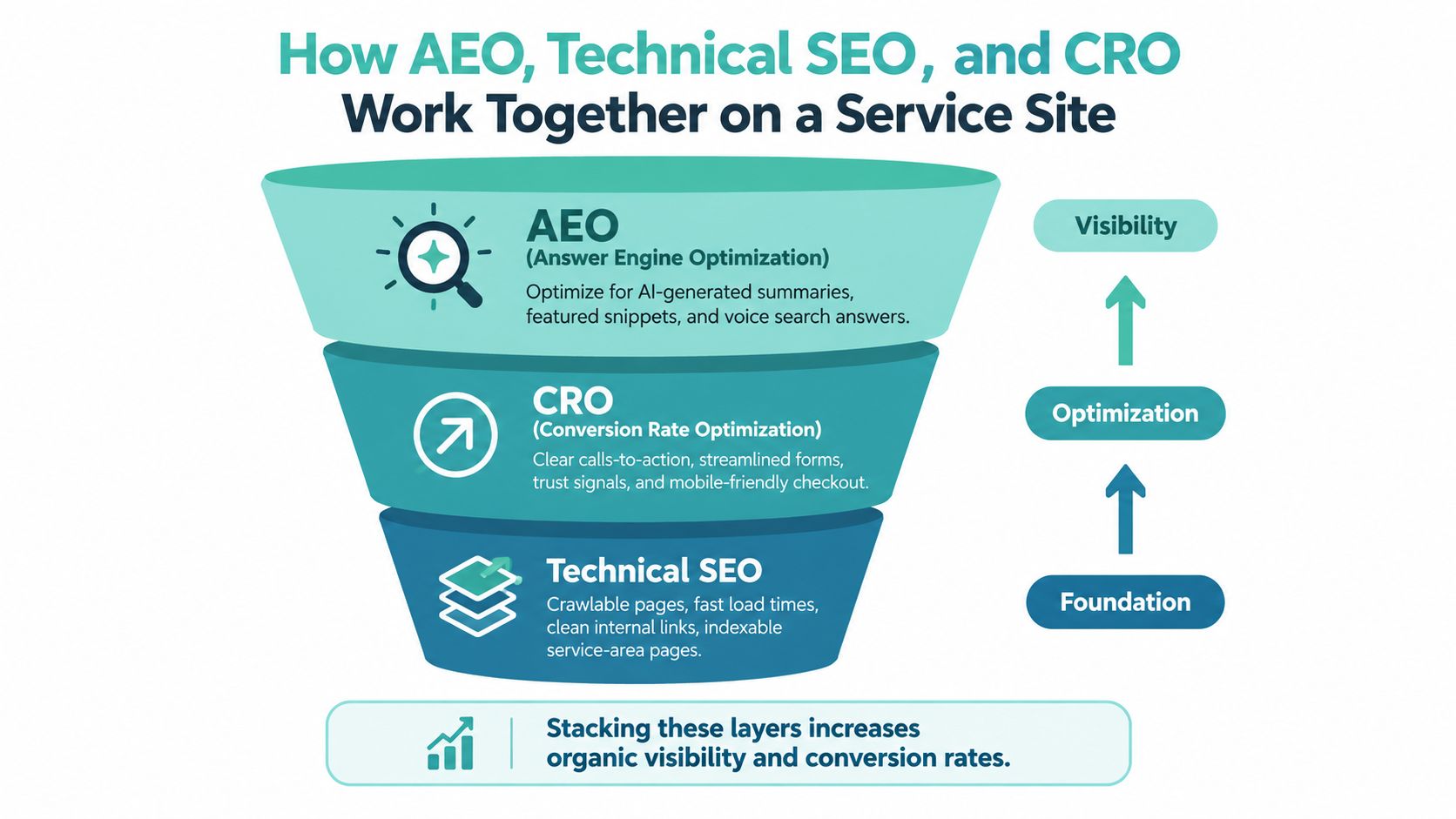
Technical SEO is the foundation
A city page cannot generate much business if search engines cannot crawl it, internal links barely support it, mobile performance is poor, or several near-duplicate pages compete for the same search. A law firm needs clear paths from the main navigation to practice-area pages and related services. An HVAC company needs distinct service and location pages with information that helps a customer decide what to do next.
The audit should follow the customer path, not just a checklist. Can a search engine reach the page? Can a visitor understand the service quickly? Does the page load without layout movement that pushes the call button away from the user's thumb?
AEO gives the page quotable substance
Once the foundation works, AEO organizes the page around direct questions and identifiable entities. A personal injury page can state the firm's practice area, service location, attorney identity, consultation process, and relevant case questions in plain language. An HVAC page can explain which symptoms require urgent service, what information a technician needs, and how a customer can request an appointment. For the broader framework, see this guide to what answer engine optimization is.
Google's local guidance says businesses with complete and accurate information are more likely to appear in local results. It recommends keeping the Business Profile accurate and complete, including the address, hours, category, and other applicable details, as explained in Google's local business guidance. Matching details across the website, profile, signage, and other business materials helps search systems connect the business to the right entity.
CRO closes the gap between visibility and revenue
A cited page still needs to earn trust. Attorney bios, reviews, clear service explanations, prominent click-to-call controls, concise forms, and realistic next steps give a qualified visitor a reason to act. The layout should reflect the service, but the requirement stays consistent: the prospect should not have to hunt for the action that brought them to the page.
An AI Overview citation might introduce a personal injury firm. A fast mobile practice page can answer the prospect's question. A visible call button and credible attorney profile can turn that visit into an intake conversation. Without CRO, the campaign may create visibility while leaving the revenue opportunity untouched.
Measurable Outcomes and What to Track Each Month
AI visibility is harder to measure than a traditional ranking, but that isn't an excuse for vague reporting. A service business should track the path from being mentioned, to being visited, to generating a qualified opportunity, to producing revenue.
Industry reporting identifies a substantial measurement gap, while also showing why attribution deserves attention. AI referral traffic across the web grew by more than three times between September 2024 and September 2025, Perplexity handled about 780 million queries in May 2025, and ChatGPT web visits rose 84% in the same period, according to this industry reporting on generative-engine optimization. Those figures describe the wider market, not a guaranteed result for an individual firm.
Early, middle, and late signals
Early reporting should include AI Overview appearances, branded search activity, cited pages, prompt visibility, and accurate business mentions. Mid-stage reporting should connect organic sessions to call tracking, form fills from informational pages, consultation requests, and assisted conversions. Late-stage reporting should tie qualified inquiries to signed cases, booked jobs, retained matters, or revenue.
The following table gives owners a decision framework rather than a promise of when rankings will change.
| Stage | Primary Metrics | What Good Looks Like |
|---|---|---|
| 30 days | Baseline prompt set, cited pages, indexation, technical errors, call and form tracking | The business has a documented starting point and reliable conversion instrumentation |
| 90 days | AI mentions, organic calls, informational-page conversions, branded search activity, priority-page engagement | The team can identify which pages and queries are earning attention and qualified actions |
| 180 days | Assisted conversions, qualified calls, signed cases or booked jobs, revenue attributed to organic, citation growth | Reporting connects visibility to intake and commercial outcomes, with clear optimization priorities |
A vendor should explain attribution limits instead of pretending every lead came from one channel. Use first-touch and assisted-conversion views together, ask new callers how they found the business, and reconcile marketing records with intake or scheduling outcomes. The practical principles in this guide to measuring SEO ROI apply here, with AI citations added as an additional visibility layer.
Common Misconceptions That Derail AI Search Optimization Services
Schema alone doesn't earn citations. Markup can clarify that a page discusses an attorney, legal service, business location, or FAQ. It can't create authority where the content is thin, the business information conflicts across platforms, or the page doesn't answer the user's question.
More Google Business Profile posts aren't a substitute for AEO. Local profile activity can support freshness and customer engagement, but it doesn't replace strong service pages, consistent business details, reviews, technical accessibility, and third-party authority. Google recommends complete and accurate business information, not a publishing volume contest.
Paid search doesn't solve organic answer visibility. Ads can place an offer in a paid position while the business remains absent from an AI-generated recommendation. Paid campaigns and AEO serve different purposes, so one shouldn't be presented as proof that the other is working.
AI answers aren't a passing trend. Google's rollout and international expansion, combined with growing consumer use reported in the AI search market synthesis, make ignoring the channel a strategic choice rather than a neutral position.
Broad keywords aren't always the best targets. “Lawyer” or “plumber” describes a category, not necessarily a buying situation. A query about a specific collision, roof problem, water-heater failure, or service area often gives the content team a clearer route to relevance and gives the prospect a more useful answer.
Retrieval systems need identifiable, supportable information. A page stuffed with keywords, schema, and promotional language may look optimized in an audit while giving an assistant little reason to cite it. Ask a current vendor to show the connection between content changes, cited prompts, qualified calls, and actual intake outcomes.
Vendor Selection Criteria and a 90 to 180 Day Engagement Roadmap
A vendor should be able to explain what it will change, why the change matters, and how the team will know whether it helped. Request examples of AI citations, sample reporting, technical audit findings, content briefs, schema implementation notes, and deliverables tied to your highest-value services.
Score the provider before signing
Use these criteria during interviews:
- AEO fluency: Can the provider distinguish a citation, a ranking, a referral, and a conversion?
- Technical depth: Does the audit cover crawlability, indexation, internal links, rendering, mobile experience, and Core Web Vitals?
- Content engineering: Does the process use intake questions, real customer language, entities, service areas, authorship, and source-backed claims?
- Industry fit: Can the team show relevant work for law firms, contractors, home services, or another regulated or local business?
- Reporting clarity: Will the dashboard show prompt visibility, cited pages, calls, forms, qualified leads, and downstream outcomes?
- Monthly accountability: Are the exact pages, fixes, content assets, tests, and meetings defined in writing?
The roadmap should start with evidence, not a long contract. Weeks one through four establish the baseline and address clear technical, schema, FAQ, business-profile, and conversion issues. Weeks five through ten focus on priority service and practice pages. Weeks eleven through sixteen add prompt monitoring, citation review, and CRO alignment. Weeks seventeen through twenty-six build on the winners through iterative optimization, legitimate authority development, and revenue-focused dashboards.
| Phase | Weeks | Owner | Success Signal |
|---|---|---|---|
| Audit and quick wins | 1 to 4 | Agency with client access | Baselines documented, tracking works, priority technical and content issues assigned |
| Priority content engineering | 5 to 10 | Agency and subject-matter client | Service and practice pages answer high-intent questions with clear entities and actions |
| Prompt and conversion monitoring | 11 to 16 | Agency, intake team, client leadership | Cited prompts, qualified calls, forms, and page-level conversion behavior are reviewed |
| Compounding optimization | 17 to 26 | Agency and client | Successful pages receive refinement, authority work, and dashboards tied to qualified outcomes |
A focused provider may be a better fit than a general marketing firm if the business needs a new lead-generating website, local SEO, AEO, and CRO working together. Digital Skyrocket is one Texas-based option that combines website design, WordPress development, SEO, AEO, local search, reputation management, analytics, and conversion optimization for service businesses, with offices in Tyler and Dallas. Its working model requires a new website and ongoing SEO, so that qualification matters before any proposal is considered.
Your Next Step as a Service Business or Law Firm
Choose one high-intent service or practice area, not the entire website. Ask two recent prospects what they searched, whether they used an AI assistant, which questions they wanted answered, and what made them contact your business.
Then use those answers to pressure-test a 30-day pilot. Require a baseline prompt set, a technical and content audit, specific schema or page improvements, conversion tracking, and a report that distinguishes AI mentions from qualified calls. You don't need to approve a year-long engagement before a provider proves it can connect visibility to intake.
The right proposal should make the commercial path visible. It should explain which page serves which customer problem, how an assistant could understand that page, where the visitor should convert, and how your team will verify the outcome.
Digital Skyrocket builds and optimizes lead-generating websites for law firms, roofers, HVAC companies, dentists, and other service businesses, combining technical SEO, AEO, local search, and CRO around qualified inquiries. Visit Digital Skyrocket to discuss a website and ongoing SEO engagement tied to calls, forms, and measurable search visibility.