
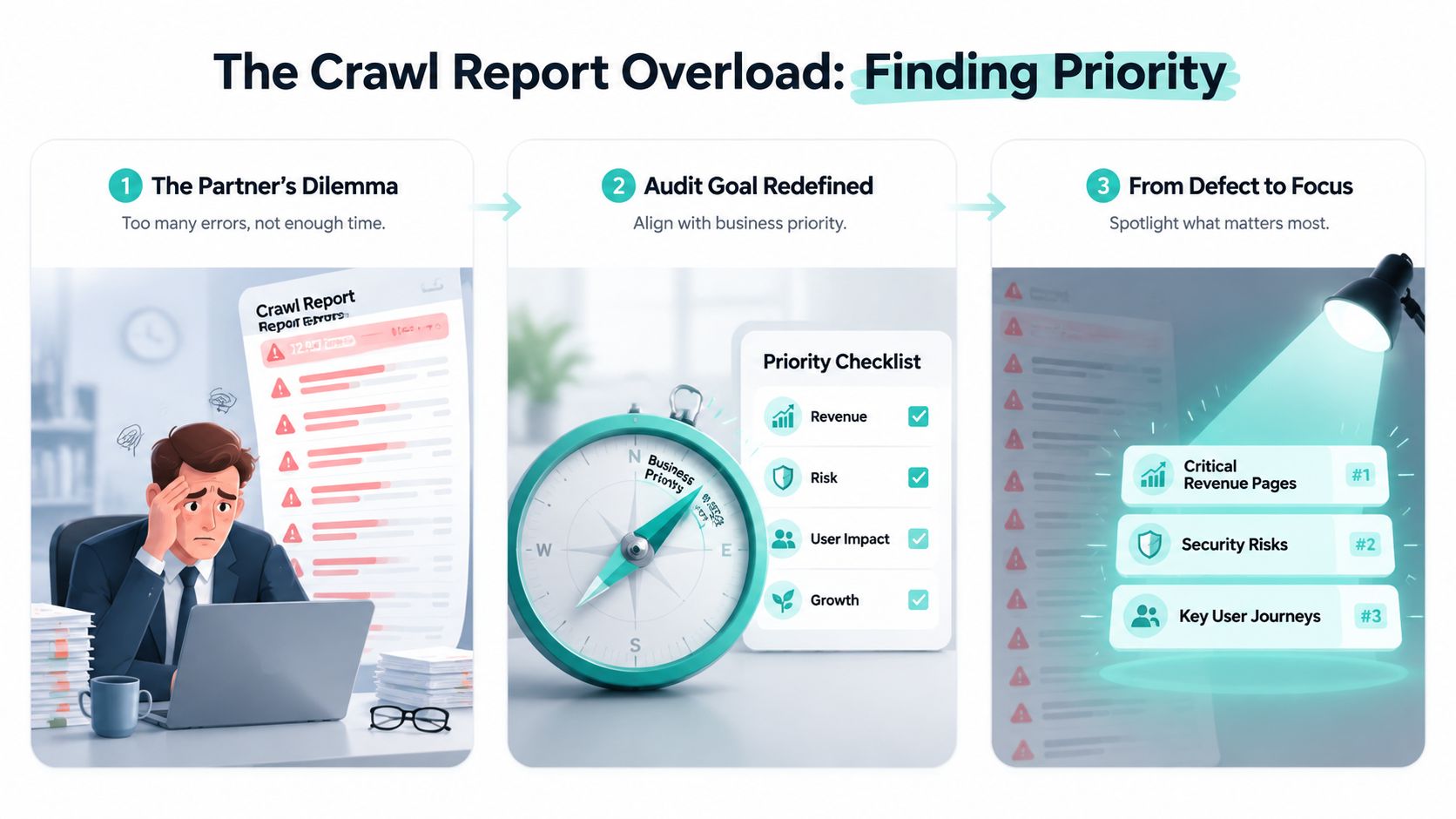
Most law firm websites don't have a visibility problem, they have a triage problem. The partner sees a crawl report full of red flags, the marketing manager sees a homepage that looks fine on a laptop, and the developer says the site already “passes” on speed. In practice, technical SEO for law firms is about deciding which issues block indexing, which ones blur snippets, and which ones just burn budget.
That's the lens that matters on case-value pages. If Google can't crawl the page, if the snippet assets are thin, or if the mobile template keeps key content buried under heavy scripts and banners, the firm pays for traffic that never turns into inquiries. The right fix is rarely “rebuild everything.” It's usually a tighter sequence, a cleaner information architecture, and a willingness to stop once the page is good enough.
Table of Contents
- The Law Firm Homepage Problem Most Audits Miss
- Running a Crawl and Index Audit That Actually Matters
- Prioritizing Fixes by Impact, Not by Audit Count
- How Much Speed Work Is Enough for a Law Firm Site
- Schema and Local Signals for Multi-Office Law Firms
- Structuring Content So AI Engines Can Quote You
- Tracking the KPIs That Connect Rankings to Retainers
The Law Firm Homepage Problem Most Audits Miss
A lot of audits start with a flood of warnings and end with a vendor trying to sell a full redesign. That's the wrong mental model. A homepage audit should begin with one question, what is stopping search engines and users from seeing the firm clearly enough to trust it and contact it?
Start with the four signal families
On a law firm site, I look at crawl and index, render performance, structured data, and snippet assets. Those four families tell you whether the homepage can be found, understood, loaded, and presented well in results. The 2026 audit of law-firm sites found the average homepage loads 6.4 CSS files in the head plus 1.5 blocking scripts, meaning browsers have to fetch about 8 render-blocking resources before painting a single pixel. That doesn't automatically mean the site is broken, but it does show how much friction can sit in the first render path on a homepage that needs to do a lot of work fast. technical SEO law firm audit data
The same audit found that 22.1% of sites still lack meta descriptions, 48.2% have complete Open Graph tags, and only 13.9% use font preload tags. That mix matters because homepage snippets and social previews often shape whether a visitor clicks, shares, or bounces. The point isn't to collect every possible fix, it's to identify where the site is incomplete in the places that affect discovery and first impressions. technical SEO law firm audit data
Judge the homepage like a business asset
A law firm homepage usually carries image-heavy partner bios, multi-state practice-area lists, and a cookie banner that can slow rendering or crowd above-the-fold content. If the homepage is visually busy, the first pass should test what search engines can render, not just what a designer sees in Figma. You want the key practice areas, the office location, and the primary contact path to be obvious in the source and in the rendered HTML.
Practical rule: if a homepage element does not help a prospective client choose the firm, contact the firm, or help Google understand the firm, it belongs lower on the page.
That's why a homepage audit shouldn't be a defect dump. It should end with a business-priority map that separates urgent crawl blockers from cosmetic cleanups. If the site needs design and SEO coordination, a useful starting point is a legal-focused web build process like SEO web design for lawyers, because the technical foundation and the conversion path need to be planned together, not patched later.
Running a Crawl and Index Audit That Actually Matters
The most common quiet failure on law firm sites is invisible duplication and accidental exclusion. Google sees a page twice, or not at all, and the firm keeps publishing new pages without noticing that the old ones are still controlling how signals split. That's why the first meaningful audit is not a dashboard review, it's a crawl and index check built around the actual site structure.
Use Search Console and a crawler together
Start in Google Search Console, then cross-check with a crawler such as Screaming Frog or Sitebulb. If log files are available, they help confirm which URLs Googlebot hits and how often. In practice, I look at the Pages, Links, and Enhancements reports first because they surface index coverage issues, internal discovery patterns, and structured-data problems that matter on practice-area and location pages.
The sequence matters. Fix robots.txt blocks, stray noindex tags, canonical conflicts, and broken redirects or 404s before worrying about sitemap polish. If an old redesign left a noindex tag on a core practice page, no amount of schema tuning will rescue it. If a city page canonicals to a broader practice page by mistake, that city page may never earn its own visibility.
Clean the site graph before asking for more crawl
Law firm sites often develop orphan pages, especially after location expansion, blog migrations, or practice-area refreshes. Those pages still exist, but no internal link points to them, so they waste crawl budget or sit outside the site hierarchy. The same is true for near-duplicate pages built around city names that differ only in a few words. You don't need more pages if Google can't tell which one is canonical.
A clean workflow looks like this:
- Blockers first. Remove accidental crawl barriers, fix noindex mistakes, and validate that the important pages are accessible.
- Canonical conflicts next. Resolve duplicate signals between practice-area and city combinations.
- Redirects and 404s after that. Repair broken paths so old equity isn't lost.
- Schema and sitemap last. Resubmit a clean XML sitemap only after the indexable set is stable. A practical reference for sitemap structure is sample sitemap for website.
If the site can't be crawled cleanly, every later optimization sits on a weak foundation.
Prioritizing Fixes by Impact, Not by Audit Count
The easiest way to waste a budget is to treat every audit item as equally important. A list of forty issues sounds serious, but a firm doesn't need forty fixes. It needs the few changes that unblock indexation, preserve rankings, or improve the pages that attract cases.
Separate blocking issues from polish
I use a tiered framework. P0 covers anything that blocks indexing or rendering. P1 covers snippet quality and structured data gaps. P2 covers performance and hygiene. P3 is polish. That ordering sounds simple, but firms often reverse it and spend hours on visual refinements while core pages are still trapped behind bad canonicals or stale redirects.
Canonical tags on near-duplicate car accident pages in Dallas and Fort Worth belong in P0 or P1 depending on how they're built. If both pages serve different intent, they need to stay distinct. If they only differ by city name, then a single stronger page usually beats two diluted ones. The same logic applies to hreflang on firms with cross-border practices. If the audience spans jurisdictions, the markup needs to be precise. If not, it creates more confusion than value.
Use page value to decide where to spend engineering hours
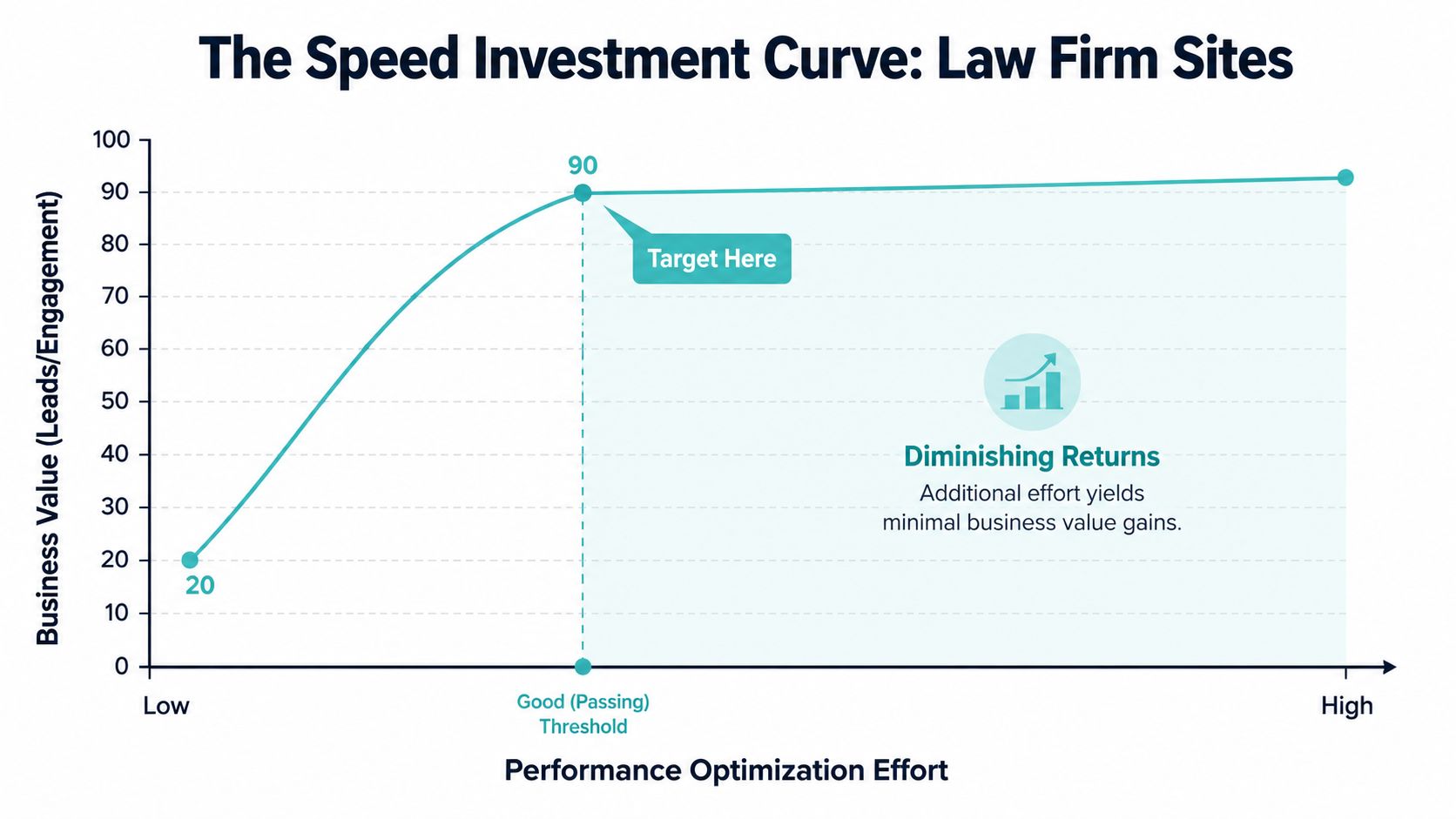
Image alt coverage on attorney headshots is useful, but it's not where I'd sink serious budget once the basics are in place. It's a hygiene item that helps accessibility and topical clarity, but it won't matter if the wrong pages are indexed or if the primary city page is canonicalized away. That's where diminishing returns come in. The engineering time spent chasing tiny speed gains on already-acceptable templates usually produces less value than fixing the page graph behind the money pages.
Budget rule: fix the page that can win the case first, then the page that can support the case, then the page that only improves presentation.
If a firm is still deciding how much process and tooling to put around technical work, a general optimization service like website optimization for law firms can help frame the work around the pages and workflows that affect leads, not just prettier dashboards. The win is discipline, not volume.
How Much Speed Work Is Enough for a Law Firm Site
Performance work is where law firms most often overreach. Teams start with a few slow pages, then drift into endless optimization because a report still has yellow and gray scores. That approach ignores the business reality. Once the site is fast enough to be usable and crawlable, extra engineering often produces small gains that don't justify the time.
Target the templates that drive cases
The accepted Core Web Vitals thresholds are a useful line in the sand, LCP under 2.5 seconds, CLS under 0.1, and INP under 200ms. Google's Core Web Vitals guidance notes that INP replaced FID in 2024, and current law-firm technical SEO guides now include INP alongside LCP and CLS. That matters because responsiveness is no longer a vague “site feels fast” metric, it's a concrete signal tied to user experience. technical SEO law firm Core Web Vitals guidance
The question is which pages deserve the work. Practice-area landing pages, city combinations, and contact pages usually carry the highest case value. Blog posts can still earn useful awareness, but they often don't deserve the same engineering effort as a page that directly supports intake. If a template already passes the thresholds, broad refactoring can wait while the firm spends time on the pages with actual conversion weight.
Apply speed fixes where they still move the needle
Lazy loading, font subsetting, and image CDN delivery are worthwhile when they remove obvious waste from heavy templates. They're less worthwhile when the site already loads cleanly and the remaining delay comes from broader CMS architecture or template bloat. At that point, smaller tweaks won't get you much further. The only durable improvement may be a template rewrite or a cleaner component model.
The structure around the speed work matters too. A strong practice-area page should pair the main content with schema and clear NAP details, while the city page should carry the office context, local trust signals, and a direct conversion path. Keep the details consistent across the template, then stop polishing once the page is fast and usable.
Schema and Local Signals for Multi-Office Law Firms
Schema is still one of the easiest places for law firms to leave visibility on the table. Search engines want structured signals, not guesswork. If the site says one thing, the Google Business Profile says another, and the directory listings say a third, the firm creates avoidable uncertainty about location and jurisdiction.
Build schema around the firm, the office, and the page
For law firms, the useful structured data set starts with LegalService and Attorney schema, then adds LocalBusiness where it helps anchor NAP consistency. FAQPage can be useful when the questions are specific and the answers are clean. Review or AggregateRating markup needs caution because the policy environment matters, and bad implementation can create more problems than it solves.
The important thing is that each practice-area and city combination should be a unique landing URL, not a parameter soup. If a firm serves multiple offices, the page architecture needs to make that obvious without relying on query strings or duplicate clones. NAP consistency should match across the site, Google Business Profiles, and legal directories. That alignment gives search engines a clearer local map to work from.
State the jurisdiction clearly
For answer engines and Google alike, jurisdiction clarity matters. If the firm practices in specific states, say so in the page copy and the schema. That helps both the crawler and the reader understand the legal context before they have to dig for it. It also reduces the risk of a page being interpreted as generic when it should be region-specific.
Practical rule: the office page should answer who the firm is, where it practices, and which legal matters belong there.
I'll also mention one resource that fits naturally for firms exploring a GEO-first approach to technical structure, GEO-first technical SEO from AY Rank. It's worth reviewing alongside your own page templates because local signal clarity and structured markup are now tightly linked to how visible a firm is in map and answer-style results.
Structuring Content So AI Engines Can Quote You
Answer engines don't read a law firm page the way a partner does. They pull the paragraph that directly answers the question, then they move on. That changes how headings, intros, and FAQ blocks should work. If the answer is buried halfway down a long page, the model has less reason to quote it cleanly.
Put the answer in the first sentences
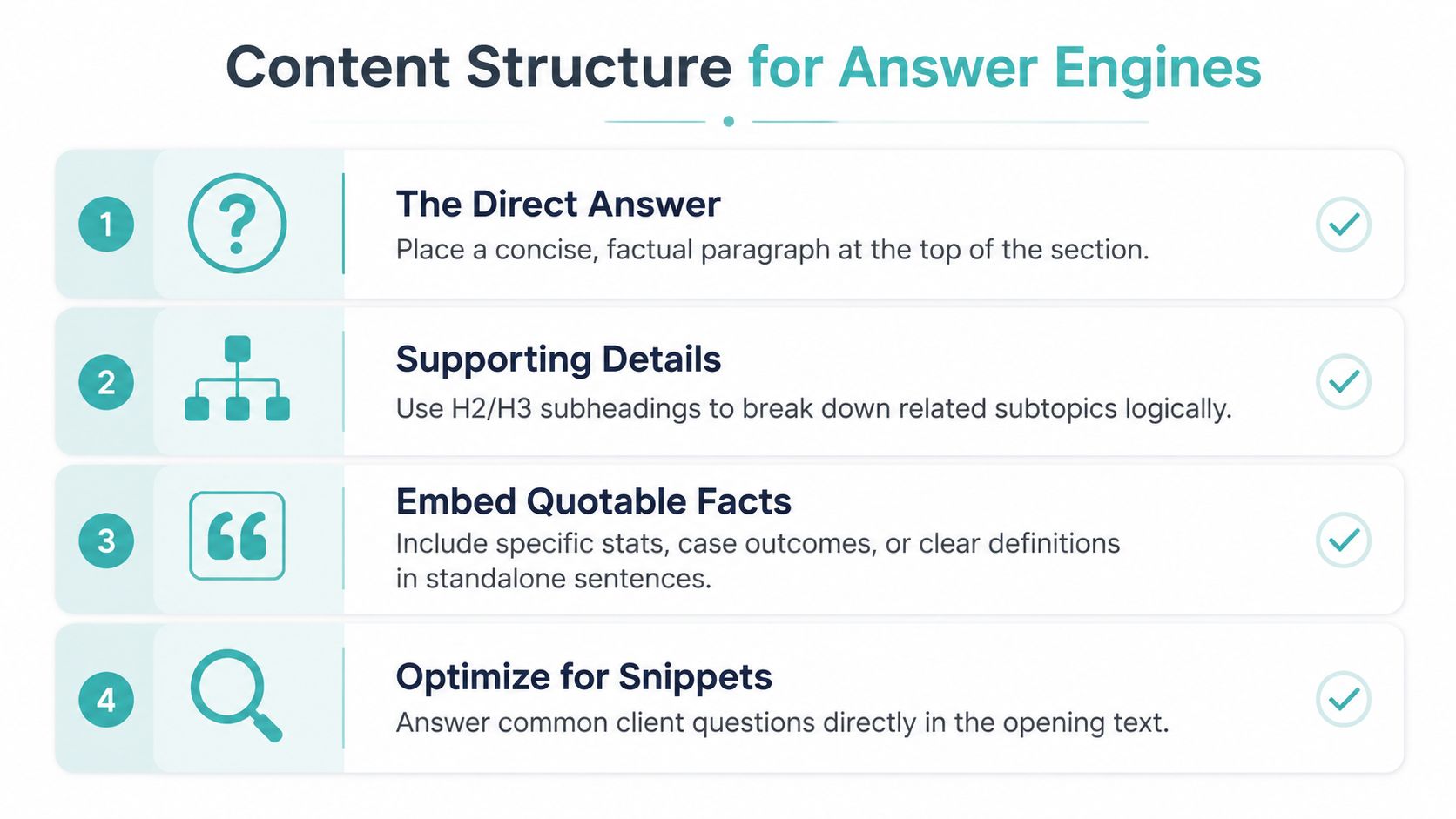
Each H2 should answer one question in the first one or two sentences. Then the next paragraphs can add context, exceptions, or examples. That structure makes the section useful for both humans and answer systems. It also keeps the page from becoming a wall of narrative that never quite lands on the point.
For a car accident lawyer in Dallas page, a section on fault rules should open with the direct rule, then support it with plain language and a jurisdiction name. If the page discusses limitation periods or comparative negligence, the answer needs to stand alone without requiring the reader to parse the rest of the page. The same logic applies to attorney bios. A short credentials paragraph at the top, followed by structured experience and admissions, is easier to extract and easier to trust.
Make FAQ blocks do real work
FAQ sections help when the questions are common and the answers are direct. They fail when they're filled with marketing filler or vague summaries. If the firm cites statutes, court decisions, or government sources, those references should sit inline with the jurisdiction stated clearly. That keeps the content verifiable and reduces ambiguity for both readers and AI systems.
A useful structural pattern is simple:
- Direct answer first. Start with the sentence a client needs.
- Supporting detail second. Add a concise explanation or caveat.
- Quote-worthy fact third. Use a standalone sentence if the point needs emphasis.
- Snippet alignment last. Use common question language in the opening text.
For teams that want a broader operating model around this, Digital Skyrocket plans and builds lead-generating sites with technical SEO and answer engine optimization baked into the structure, which is the right kind of workflow when content and crawlability need to support intake at the same time.
Tracking the KPIs That Connect Rankings to Retainers
Technical SEO is not finished when the sitemap is clean. It's finished when the right pages are getting indexed, clicked, and turned into qualified conversations. That's why I don't trust ranking reports on their own for law firms. A page can rank and still fail to generate intake if the form flow is clumsy, the call tracking is missing, or the page never shows up in the right segment.
Measure the right business signals
The bridge between engineering and intake starts with indexable practice-area page coverage, organic click-through rate on branded and non-branded queries, assisted conversions from organic, qualified form submissions, and phone calls attributed to organic landing pages. Search Console shows whether the pages are being seen and clicked. Analytics shows whether the visits behave like prospects. Call tracking and form attribution show whether the visitor became a lead.
The average law-firm SEO budget sits at $120,000 per year, and benchmark data places the point of diminishing returns near $550,000 annually. The average law-firm SEO benchmark also shows 526% three-year ROI, an average 14-month break-even period, annual organic traffic growth of about 21%, and an average cost per SEO lead of $456. Those figures matter because they frame technical work as part of a broader investment curve, not as a standalone cleanup project. law firm SEO benchmark data
Build a review cadence that catches regressions early
Quarterly reviews are the minimum if the site is active. I look for four things, GSC coverage and enhancement error spikes, Core Web Vitals regressions after plugin or theme updates, NAP drift across directories after office moves or new hires, and schema validation failures after CMS upgrades. A lot of firms only notice these issues after traffic slips. By then, they've already lost time and, often, case opportunities.
A practical partner-facing report should be short and plain. Show the pages that were added to indexable coverage, the pages that lost clicks, the calls and forms tied to organic, and the fixes queued for the next cycle. Then tie each item to a business outcome. Partners care about cost per qualified lead, lead-to-consultation rate, and case value by source, not whether a tag lived in the right template file.
There are also moments when a full audit shouldn't wait for the calendar. Site migrations, rebrands, a new practice area, or changes in advertising rules all justify an unscheduled review. Technical SEO for law firms works best when it's treated like ongoing maintenance on a revenue asset. The firm doesn't need perfect reports. It needs stable systems that keep pages visible, usable, and worth the click.
If you want a technical SEO and AEO plan built around law firm intake, Digital Skyrocket can help map the pages, templates, and tracking that connect search visibility to real leads. Visit Digital Skyrocket to review their law-firm web design and SEO approach, then talk with a team that builds for crawlability, local visibility, and conversions instead of just prettier traffic charts.