

A service owner can feel the fork in the road before the spreadsheet is even open. One market looks bigger, another looks closer, and both seem like they deserve the next website, the next SEO push, and the next hire. That's usually where the guessing starts, and guessing is how teams end up rebuilding pages for the wrong geography, chasing leads that never close, and burning a quarter before they realize the market was never the problem.
Market Opportunity Assessment gives you a cleaner way to decide. Instead of treating expansion like a branding exercise, it turns demand, competitive pressure, customer economics, and conversion fit into a structured go or no-go judgment, which is the whole point of the discipline in the first place (foundational global-market framework). For service businesses, that matters because a bigger city can still be the worse bet if reachability is weak, the local listings are crowded, or the website can't carry the lead. If you want a practical decision lens while you read, this guide to smarter decisions is a useful complement to the same kind of disciplined thinking.
Table of Contents
- Why Most Service Businesses Guess When They Should Be Scoring
- The Five-Stage Assessment Workflow That Holds Up
- Sizing TAM, SAM, and SOM with Search and Listing Data
- Mining Search Intent and Reviews for Real Demand Signals
- The Weighted Scoring Model That Replaces Gut Calls
- Why Conversion Fit Is the Variable Most Assessments Ignore
- Turning the Assessment into a 30/60/90-Day Action Plan
Why Most Service Businesses Guess When They Should Be Scoring
A roofing owner in East Texas looks at Dallas, Fort Worth, and Tyler and sees three different versions of the same question. Which market has enough demand, enough reachable buyers, and enough room to win without overbuilding the site and sales process? A personal injury firm sees a new metro and reads volume, prestige, and a chance to push past its current intake ceiling. The temptation is to choose the market that feels bigger or more obvious, then ask the team to build around it. That is usually the expensive move.
Bigger does not automatically mean better
TAM alone doesn't tell you whether the market will convert. A larger market can still be a bad bet if the local SERP is crowded, the top map listings are locked up by entrenched competitors, or the brand trust gap is too wide for a new entrant to close quickly. Opportunity assessment works better when it screens for demand, fit, and sales potential together, which is the point of the global-market framework.
Practical rule: if a market looks attractive on paper but the business cannot explain how it will win the click, the call, and the form fill, the market is not ready for investment.
Desk research misses the signals that matter most for service firms. It can tell you a city is large, but it will not show whether search behavior matches the service you sell, whether review volume supports real buyer activity, or whether your own site and intake process can close the inquiry once the visitor arrives. A guide to smarter decisions starts with those behavioral signals, because a market with weak intent keywords and thin review activity is usually harder to convert than the size of the metro suggests.
The cost of skipping the first pass
Skipping assessment forces a company into a rebuild cycle that burns time and budget. A service firm may launch a new location page, hire around the wrong service area, and then discover that the leads do not match the sales motion. The team keeps spending on content, design, and local visibility while correcting a geography that never should have been prioritized in the first place.
A better first pass is direct. Screen for demand, reachability, competitive pressure, and fit with the business model. For service teams planning a new website or a local SEO program, that screen should happen before the content calendar, before the redesign, and before anyone starts promising growth.
The Five-Stage Assessment Workflow That Holds Up
Good opportunity work moves in a funnel, not a brainstorm. The sequence holds up because it starts broad, narrows with evidence, and ends with a ranked decision instead of a pile of notes. One widely used five-stage model starts with defining the decision, then gathering demand signals, then mapping the competitive environment, then pressure-testing with validation, and finally prioritizing with a scoring model (five-stage process).
What each stage should produce
Stage one should end with a decision statement you can act on, like “expand into one of these two metros” or “test this service line in one vertical before building a new site section.” Stage two should produce a shortlist of geographies or service lines backed by demand signals, not just a broad category label. Stage three should give you a competitor matrix that shows who already owns visibility, trust, and local intent, because those three signals often tell a different story than TAM alone.
Stage four should create a validation log. That log should capture interviews, surveys, message tests, offer tests, and channel tests, because the point is to see whether real buyers respond, not to admire the market from a distance. A practical framework recommends using at least three experiment types early on, message tests, offer tests, and channel tests, so assumptions turn into evidence while the stakes are still low (hypothesis-driven workflow).
Demand without competition isn't always a gift. Sometimes it signals a market that is hard to reach, expensive to serve, or too thin to support a repeatable lead-gen model.
Stage five should leave you with a ranked shortlist and a go, no-go flag for each option. A Texas personal injury firm, for example, might start with three possible metros, narrow to two after looking at search demand and competitor coverage, then drop the one that looks large but fails the validation tests. That is the kind of paper trail leadership can defend because every step has an output, and every output reduces uncertainty.
A service team can also use this workflow to compare new geographies, verticals, or service lines before it invests in a website or SEO build. In HVAC, for example, the core question is often whether the market can support enough qualified demand and enough closeable jobs to justify a new push, which is where a local SEO review like HVAC local SEO strategy becomes a useful reference point.
Sizing TAM, SAM, and SOM with Search and Listing Data
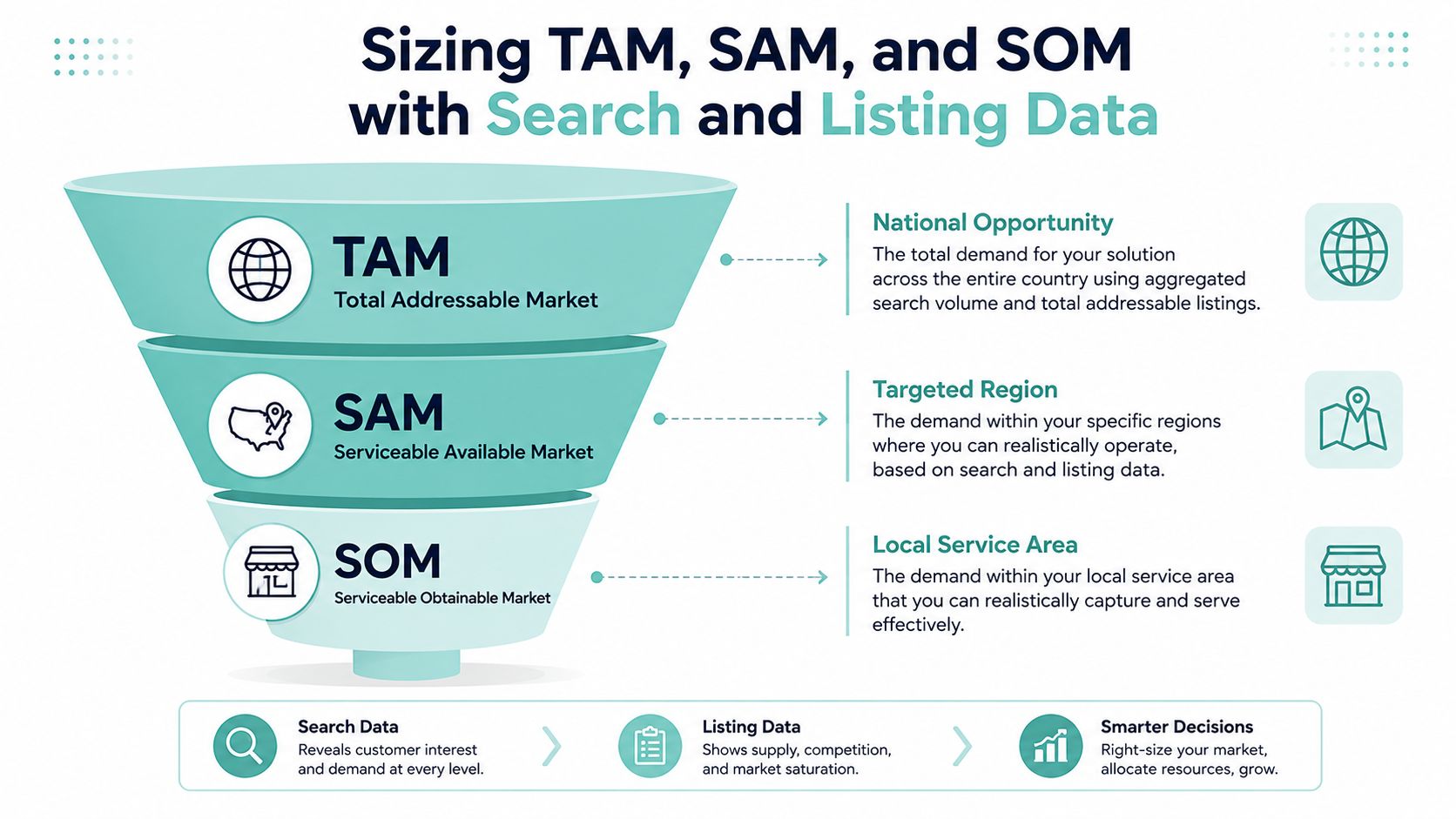
Top-down market reports make service businesses feel safer than they are. The category may look huge in a slide deck, but your actual service area, your page footprint, and your ability to win local clicks are what matter. For lead-gen firms, bottom-up sizing works better because it starts with the signals buyers already leave behind, then filters them into a realistic opportunity.
Start with demand you can observe
A practical way to estimate TAM is to look at search demand on root keywords that match the service. Then refine that into SAM by layering geography and service-line filters. From there, SOM should be the share of qualified calls or form submissions a site can reasonably capture based on current authority, content depth, and local presence.
That distinction matters because SOM is not the same as market share for a service business. A local firm does not need to own the entire category to win, it needs enough of the qualified clicks and inquiries to justify the build. A useful internal check is whether the business can appear in the Map Pack, sustain visible competitors in the local results, and still create enough trust to convert.
Use listings as a ceiling check
Google Business Profiles, Map Pack presence, review volume, and the strength of competitor listings help you sanity-check the ceiling before you get attached to a number. If the local results are crowded with established firms and review-heavy competitors, your SOM is probably tighter than the raw search demand suggests. If the listings are weak but the demand signal is real, that can be promising, but only if the conversion path on your side is strong.
The internal logic should be simple. Search demand tells you people want the service. Listing data tells you how hard it is to win attention. Review volume and complaint patterns tell you whether competitors are satisfying the market or merely occupying space. If you're working on local service pages, the structure behind local SEO for HVAC is a good example of how geography and service intent should line up in the page plan.
A quick sanity rule
Rule of thumb: if the market size looks exciting but the local listings, trust signals, and conversion path are weak, assume the opportunity is smaller until proven otherwise.
That is the main discipline here. Don't let a national report define a local market. Let search, listings, and buyer behavior define it first.
Mining Search Intent and Reviews for Real Demand Signals
Demand shows up in layers, and the easiest layer to count is usually the least useful. Pure informational volume can make a market look lively while the buyers themselves remain undecided. What matters more for a service business is whether people are asking the kind of questions that lead to calls, forms, and estimates.
Read the query the way a buyer would
A query like “how much does a roof replacement cost in Tyler TX” carries a very different intent from “best roofer near me”. The first one signals pricing curiosity plus local relevance. The second one signals active comparison and likely hiring behavior. For SEO and lead generation, those commercial-investigation and transactional terms matter more than vanity traffic.
Competitor reviews help sharpen that picture. If buyers repeatedly complain about slow follow-up, weak communication, or confusing pricing, that can point to unmet demand. But the complaint only matters if the segment is reachable and profitable. Loud frustration does not automatically equal a workable market.
Build a signal list, not a mood board
Pull signals from four places. Search behavior shows what people type. Reviews show what they dislike. Q&A sites and community threads show the questions buyers keep asking. Competitor pages show what the market is still failing to answer.
- Search intent terms: prioritize phrases that imply buying, comparison, or local selection.
- Review complaints: note patterns, not one-offs, especially around responsiveness, trust, and clarity.
- Community questions: capture repeated objections and pre-sale concerns from real people.
- Competitor content gaps: record the questions their pages skip or answer poorly.
This is also where many teams get trapped by the underserved-market story. A segment can be underserved and still be a bad bet if the leads are low-value, hard to close, or operationally messy. That nuance matters in service businesses because profitable opportunity is about repeatability, locality, and fit, not just unmet need.
For teams that are starting to connect search demand with AI-assisted content discovery, the thinking behind answer engine optimization is useful, because it pushes you to answer the questions people ask instead of the phrases you wish they used.
The Weighted Scoring Model That Replaces Gut Calls
Once the signals are in one place, the job is to compare them without turning the review into a debate about whose intuition is better. A weighted scoring model does that. One practical framework gives market size 30%, strategic fit 25%, validation signal 25%, and competitive advantage 20%, then uses the total score to support prioritization (weighted framework). Another model scores six factors on a 1-to-5 scale and uses at least 3.5 for a go, below 3.0 for no-go, with no single factor below 2.
A practical template for leadership
| Factor | Weight | Market A Score | Market B Score | Anchor for a 4 |
|---|---|---|---|---|
| Market size | 30% | Strong, clearly addressable demand | ||
| Strategic fit | 25% | Fits service model, team, and geography | ||
| Validation signal | 25% | Clear evidence from interviews, searches, or tests | ||
| Competitive advantage | 20% | Defensible position against current competitors |
Market A may be the larger city, while Market B may be the smaller one with cleaner intent and a better fit. If Market A wins on size but loses on validation and competitive advantage, the bigger TAM does not rescue it. If Market B comes in a little lower on scale but stays above the threshold and avoids fatal blind spots, it is often the safer investment.
The key is that the score has to reflect what buyers do, not just how many people live there. Search demand, review volume, intent keywords, and local listing depth should all feed the validation line, because those signals show whether the market is active enough to support a service business. That is also where conversion rate optimization matters, since a strong market can still underperform if the site and intake flow cannot turn interest into leads.
Why the thresholds matter
Thresholds keep teams from greenlighting attractive disasters. A market can look promising overall and still fail because one category is weak, such as poor validation or a service model that does not match how buyers want to buy. The no single factor below 2 rule is especially useful for service firms, because a severe weakness in one area usually shows up later as wasted spend, poor lead quality, or operational strain that is expensive to fix.
Good scoring does not remove judgment. It makes the judgment visible, repeatable, and harder to romanticize.
The best version of this model is simple enough to run in a spreadsheet and strict enough to end the debate. If the score says no, the team should know exactly which factor pulled it down.
Why Conversion Fit Is the Variable Most Assessments Ignore
A market can look promising and still fail if the site can't turn attention into intake. That's the part many opportunity reviews miss. They compare demand and competition, then assume the website will do the rest, but the destination page is part of the market decision too.
Audit the page before you commit budget
Look at the above-the-fold message first. It should say who the business serves, what problem it solves, and why a buyer should trust it. Then look at the hierarchy of service pages, the proof elements, the call to action, and the form flow. If a page forces visitors to hunt for the next step, or buries trust signals below the fold, the market will underperform no matter how good the demand looks.
A quick conversion audit can stay lightweight:
- Clarity: can a first-time visitor tell what's offered in one glance?
- Specificity: are there service-specific pages for the target market?
- Trust: are reviews, case signals, credentials, or local proof visible?
- Mobile behavior: does the form work cleanly on a phone?
- Speed and friction: does the page feel easy to use, or does it fight the visitor?
You don't need a full redesign to test fit. Run a message test with two value propositions. Run an offer test with something like a free consult versus a checklist or estimate prompt. Run a channel test by comparing how the audience responds to organic landing pages versus paid traffic. That sequence tells you whether the market can absorb the offer before you rebuild the whole site.
The CRO lens matters because a site that ranks but doesn't convert is just an expensive brochure. If you want a deeper conversion framework, conversion rate optimization is the right lens for pressure-testing the page before you commit to a full launch.
Turning the Assessment into a 30/60/90-Day Action Plan
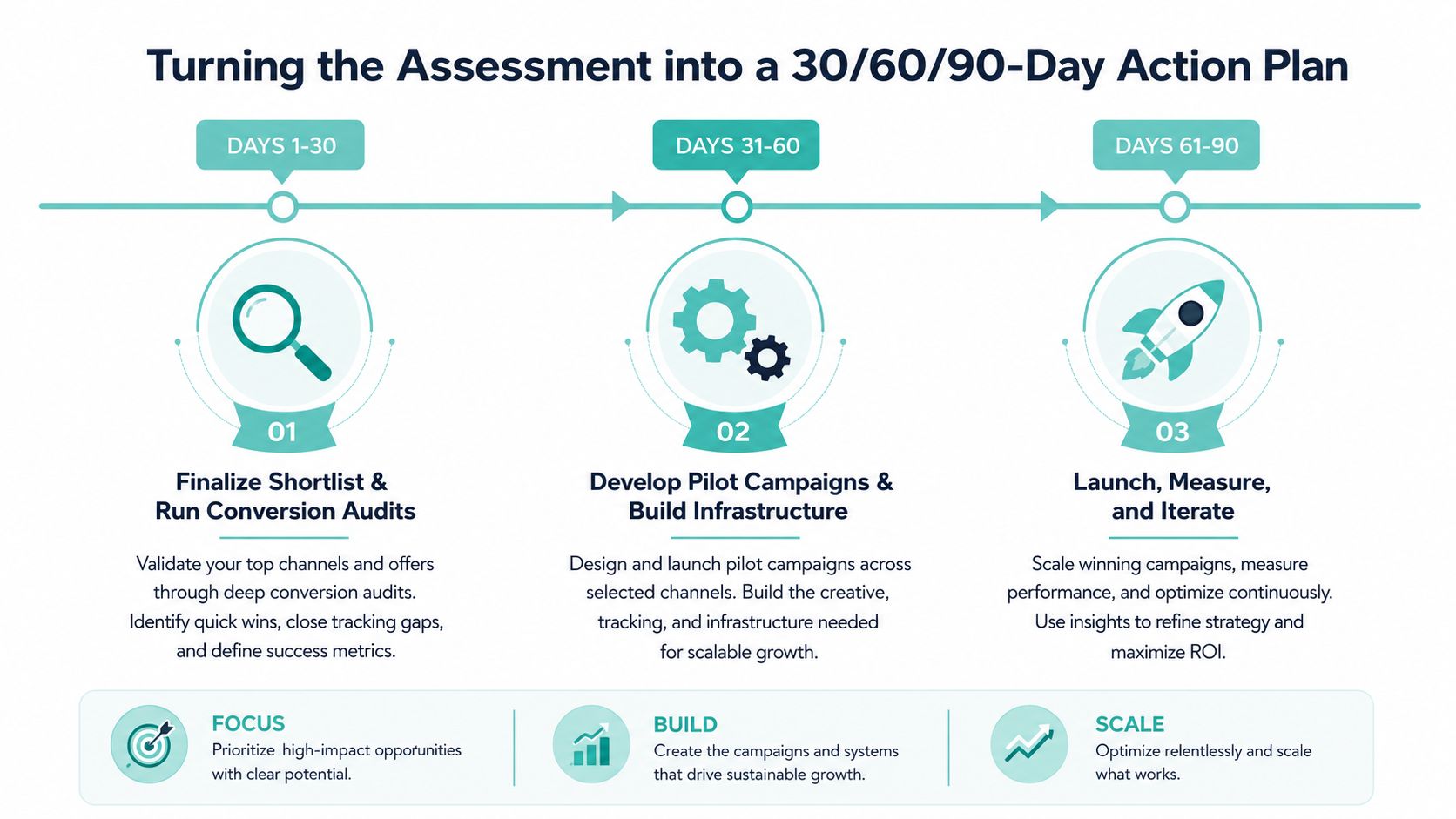
A market opportunity assessment only has value if it changes what gets built next. If the numbers point to a clear winner, the next step is not a broader brainstorm, it is a tighter plan. In the first 30 days, narrow the shortlist and run conversion audits on the best candidates. In the next 30 days, launch validation tests and challenge the assumptions behind the score. By day 90, commit budget to the strongest opportunity and shape the SEO or website program around that choice.
Keep the checkpoints blunt
If search demand drops, competitors become harder to displace, or intent shifts away from the service line, the assessment needs to be revisited instead of defended. If the score rests on one strong signal and two weak ones, cut the option early. If a market sits in the middle, extend validation and collect more proof rather than treating uncertainty like conviction.
For service firms, the review should happen on a regular revisit cadence. Local search behavior, customer expectations, and competitor visibility do not stay fixed, and the opportunity score should move with them. That is especially true when you are testing a new geography, a new vertical, or a new service line before committing to a site build or SEO program.
An assessment is not a report to file away. It is the operating system for deciding where the next dollar should go.