

Your phone isn't ringing enough from Google, even though you know people in your area need AC repair, furnace service, and emergency calls every day. You've probably claimed your Google Business Profile, built a decent website, and maybe even paid for SEO before. But local visibility for HVAC isn't won by doing generic “SEO stuff.” It's won by tightening the signals Google trusts for local intent, then adapting your site so AI-driven search results can pull your business into answers.
That last part matters more than most HVAC owners realize. A lot of local SEO advice still stops at map rankings, reviews, and city pages. Those still matter. But search behavior is shifting. If your business only competes for blue links and the Map Pack, you're already behind on high-intent searches like “emergency AC repair near me” and “how fast can an HVAC company come out tonight.”
Table of Contents
- Mastering Your Google Business Profile
- Building Trust with Citations and Reviews
- Dominating Local Search with Service Area Pages
- Essential Technical SEO for HVAC Websites
- Crafting Content Beyond Service Pages
- Optimizing for AI and Answer Engines
- Turning Rankings into Revenue with CRO and Reporting
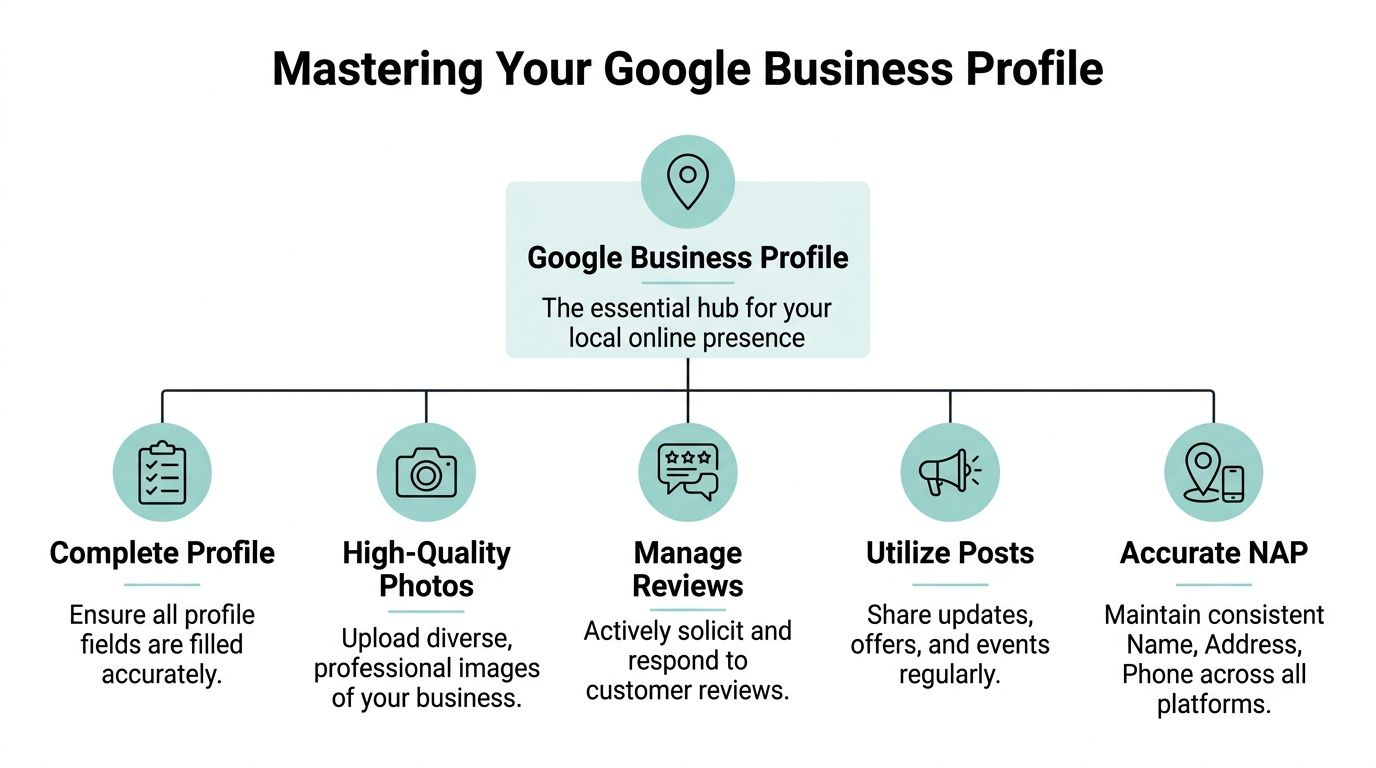
Mastering Your Google Business Profile
A homeowner's AC quits at 6:40 p.m. They search “emergency AC repair near me,” scan the Map Pack, and call one company within minutes. In that moment, your Google Business Profile is doing two jobs at once. It has to win the click from the homeowner, and it has to give Google and emerging AI answer engines clear, reliable business data they can surface with confidence.
That shift matters. A strong profile no longer helps only with map visibility. It also feeds the business details, service cues, review sentiment, and engagement signals that can influence which HVAC companies show up in AI-generated recommendations.
Set your core profile data the way you really operate
Start with category selection.
For most companies, HVAC contractor is the right primary category because it matches the broadest commercial intent. If your business is known first for heating work and that is how customers search for you, Heating contractor can be the better choice. The point is alignment. Your primary category should reflect the service line that drives the business, not a guess at what might rank faster.
Secondary categories should support real offerings such as air conditioning repair service, furnace repair service, or air duct cleaning service if those are active parts of your operation. Adding every possible category creates noise and can weaken relevance.
Service areas need the same discipline. Set them based on where your team can respond fast, profitably, and consistently. If your dispatch board gets shaky once calls come from 35 miles out, do not tell Google you cover half the state. That hurts lead quality, and it weakens your local relevance in the cities that matter most.
If your office moves or your listing shows the wrong location details, fix that before anything else. This guide on changing your business address on Google walks through the update process.
Build a profile that can win both clicks and AI mentions
A filled-out profile is the baseline. What matters is whether the profile answers the questions a stressed homeowner has before they call.
Use your description, services, photos, Q&A, and updates to make these points obvious:
- What you repair
- Whether you offer emergency service
- Which systems you work on
- Where you operate
- How fast a customer can expect a response
- Whether financing, maintenance plans, or after-hours dispatch are available
Many HVAC companies often stumble here. Their profile says they do “quality heating and cooling services” and leaves it at that. A better profile names the work plainly: emergency AC repair, no-cool calls, furnace diagnostics, thermostat replacement, heat pump service, mini-split installation.
That language helps on standard local searches. It also gives AI systems more specific material to pull from when someone asks a conversational query like “Who does same-day AC repair near me?” or “Which HVAC company fixes Lennox systems in my area?”
Keep the profile active with updates a homeowner would care about
An inactive profile looks neglected. So does one filled with stock photos and generic sales copy.
Use real photos from your field work. Show service vans, technicians in uniform, condenser replacements, furnace installs, drain line repairs, thermostats, air handlers, and your office or warehouse if customers visit it. Real-world images build trust faster than polished graphics because homeowners can tell the difference.
Posts still have value when they reflect current demand. I use them to reinforce seasonal services, after-hours availability, promotions that affect close rate, and weather-driven issues. During a heat wave, a post about emergency cooling response and common no-cool failures is more useful than a generic “Call us today” message.
Q&A is underused. Add and answer the questions your CSRs hear every week:
- Do you offer 24/7 emergency AC repair?
- Do you service my brand?
- Do you give estimates before major repairs?
- Do you serve my city?
- Do you offer financing on replacements?
Clear answers help conversion. They also create structured, reusable language that fits the way people ask AI tools for local recommendations.
Reviews need a system, not a burst of effort
Review growth usually stalls because the company treats it like a side project. The businesses that keep gaining visibility ask for reviews as part of the job closeout process.
The target is steady review velocity, not one big push in spring and silence after that. For most HVAC businesses, the best pattern is simple. Ask after successful repair calls, maintenance visits, and install jobs. Send the link while the customer still remembers the technician's name and the problem that got solved. Train techs on a short, natural ask. Have office staff follow up once if needed. Respond quickly.
Here is the standard I use with clients:
- Ask after the problem is solved, not days later.
- Text or email the direct review link before the tech leaves.
- Mention the specific service performed so the customer has context.
- Respond to every review, including the negative ones.
- Keep requests consistent across the whole year.
Strong review profiles do more than improve click-through rate. They give searchers and AI systems repeated evidence that your business is active, local, and trusted for the exact jobs you want more of. If you want an example of how review proof looks on a live brand, see Heatwave Air Conditioning reviews.
Avoid the mistakes that suppress good profiles
I see the same profile problems over and over:
- Keyword stuffing the business name with cities or services
- Choosing categories that do not match the core business
- Listing a service area your team cannot cover well
- Leaving holiday hours outdated
- Using call tracking numbers that create inconsistency
- Uploading low-trust stock imagery instead of real jobsite photos
- Ignoring Q&A until a random user answers incorrectly
None of these issues look dramatic on their own. Together, they make the profile less credible, less useful, and less likely to earn visibility for urgent, high-intent searches.
A well-run Google Business Profile works like an operating asset. It supports Map Pack rankings, improves lead quality, and gives answer engines better material to cite when homeowners ask who can fix the problem right now.
Building Trust with Citations and Reviews
A homeowner asks ChatGPT or Google, “Who does emergency AC repair near me?” The systems that answer do not rely on your website alone. They look for repeated agreement across your business data, review signals, and third-party mentions. If your phone number, address, or business name keeps shifting across the web, you give search engines and answer engines a weaker case for trusting your business.
That is why citation work still matters.
Fix your NAP before you do anything else
Your Name, Address, and Phone number need to match everywhere your business appears. Small differences create friction. I see this all the time with HVAC companies that changed offices, started using a tracking number, or let old directory listings sit untouched for years.
For HVAC companies, a foundational requirement for Map Pack visibility is Local Business schema plus 100% consistent NAP across citations, and discrepancies can suppress rankings in up to 40% of local HVAC listings that fail audit checks, according to Nopio's HVAC SEO guide.
Start with the sources Google and AI tools are most likely to cross-check first.
| Priority | What to check | What breaks trust |
|---|---|---|
| Highest | Google Business Profile | Wrong address, outdated phone, old hours |
| High | Website footer and contact page | Tracking number mismatch, alternate business name |
| High | Major directories | Duplicate listings, former address, wrong URL |
| Medium | Industry directories | Old service areas, inconsistent abbreviations |
| Medium | Local chamber and BBB-type profiles | Name variations, bad website link |
One bad citation will not sink performance on its own. A messy pattern can keep you out of the Map Pack, reduce confidence in your entity data, and make it harder for AI-generated answers to cite your business for urgent searches.
Use citations that reinforce real local authority
Do not spend time on low-value directory blasts. HVAC companies get better results from listings that either rank themselves, confirm business identity, or show clear local relevance.
Prioritize these:
- Core business platforms: Yelp, Apple Maps, Bing Places, and major local directories
- Home service platforms: Angi, HomeAdvisor, and other sites homeowners use to compare contractors
- Trust profiles: BBB, chamber of commerce listings, and supplier or distributor partner directories
- Local mentions: Sponsorship pages, neighborhood association pages, and trade organization member profiles
This is also where the shift toward AEO starts to matter. If an AI assistant is building an answer for “best emergency AC repair near me,” it needs corroboration. A clean footprint across recognized platforms gives it more confidence that your company is established, local, and active.
Try Decoding notes in its SEO for HVAC guide that consistency across local business information supports stronger local trust signals. In practice, that means your citations are not just there for directory traffic. They help validate the business entity behind your site and profile.
If you want to see how visible review proof can look in practice, the Heatwave Air Conditioning reviews example is a good reminder that homeowners notice rating volume quickly. The lesson is not the badge itself. The lesson is consistent review collection and visible proof where buyers make decisions.
Reviews help rankings, conversions, and AI visibility
Reviews do more than improve click-through rate. They give searchers concrete evidence that you solve real problems in specific places. They also give answer engines language to work with.
A review that says, “They got our AC running again in Plano at 9 p.m.” is stronger than “Great service.” It confirms the service, urgency, and location in the customer's own words. That kind of detail can support visibility for high-intent searches, including the emergency jobs HVAC owners care about most.
The trade-off is simple. More detail helps, but forcing every customer into a long scripted review usually backfires. Ask for honest feedback and make it easy.
How to respond to reviews without sounding canned
A weak reply wastes the opportunity. A good reply adds context without sounding like SEO copy.
Use this pattern:
- Positive reviews: Thank the customer and mention the completed service in plain language
- Negative reviews: Acknowledge the issue, state the next step, and move the resolution offline
- Short reviews: Reply anyway so the profile stays active
- Detailed reviews: Match the level of detail and reflect the specific job type back naturally
For example, if someone says your tech fixed a failing capacitor during a same-day AC call, your reply can confirm that service and thank them for trusting your team. That helps future customers. It also gives search systems more evidence about what your business does and where you do it.
The best-managed profiles sound like a real company paying attention. That matters to homeowners, and it matters to the systems deciding which HVAC businesses deserve to be surfaced first.
Dominating Local Search with Service Area Pages
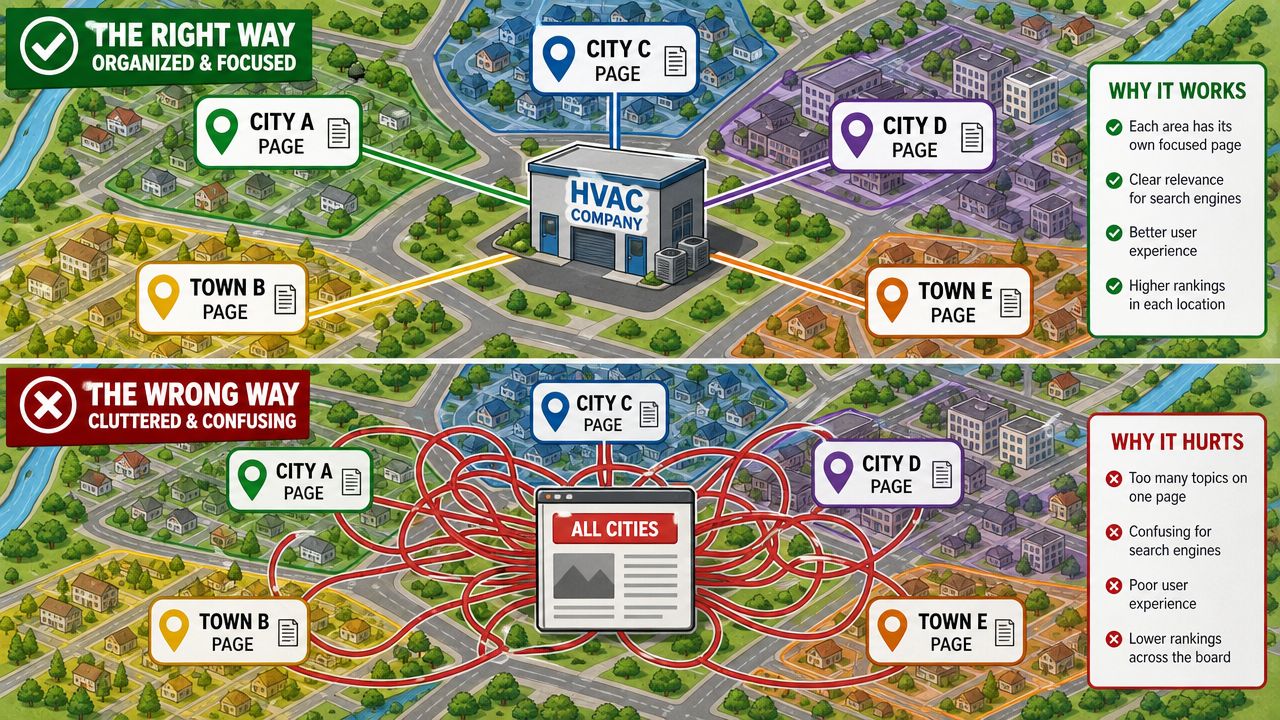
A single “areas we serve” page almost never carries enough relevance for competitive HVAC searches. It's too broad, too thin, and too easy for competitors to beat with pages built around actual cities and services.
If your company works across multiple towns, your site structure has to prove that each area matters. That's where a service cluster approach wins. Instead of forcing one page to rank for everything, you build dedicated city pages tied to real services and real local context.
Why generic service area pages fail
Google doesn't reward placeholder geography. If you publish a page that lists ten cities with the same boilerplate paragraph and a stock photo, you're not sending a strong local signal. You're creating diluted relevance.
For HVAC businesses serving multiple cities, dedicated landing pages should include at least 51% unique content specific to that city, including landmarks, neighborhood names, and area-specific HVAC conditions like coastal humidity or mountain elevation impacts, according to Digital Coast Marketing's local HVAC SEO guide.
That requirement is more useful than it sounds. It forces you to answer a basic question: why should Google believe this page belongs to this city?
A page for a humid coastal market should read differently than a page for a dry inland suburb. A page targeting a mountain town should address altitude-related load issues differently than one focused on older homes in a lowland city.
What a real location page should include
Good location pages aren't spun content. They're local sales pages with operational detail.
Each city page should usually have:
- A unique intro: Mention the city naturally and lead with the service intent customers seek there.
- Neighborhood references: Include relevant communities, subdivisions, or nearby areas you serve.
- Local HVAC context: Talk about the climate, housing stock, common system issues, or seasonal service demand in that market.
- Mapped relevance: Embed a Google Map or service-area visual that supports the area covered.
- Proof elements: Use reviews, testimonials, or project references tied to that location when possible.
- Clear internal links: Connect city pages to core service pages like AC repair, furnace repair, replacement, heat pump service, and maintenance.
For some teams, it helps to study how a region-specific service page frames local conditions. This example of Big Bear HVAC repair services is useful because it reflects a place-specific HVAC context instead of pretending every service market behaves the same way.
A city page also needs enough substance to stand on its own. Thin pages rarely hold up for long, especially in competitive areas.
When fewer location pages perform better
Many HVAC SEO recommendations miss the mark. More pages aren't always better pages.
If you create a separate page for every tiny town around your main market, you can end up with cannibalization. Several pages target nearly identical service intent, none becomes clearly authoritative, and rankings bounce around.
A practical way to decide page viability is to ask:
- Do you actively service this area?
- Can you write a distinct page for it?
- Does it represent a meaningful service hub or repeat demand area?
- Will the page support multiple service intents over time, not just one keyword?
If the only local detail you can add is the city name in the H1, that location probably doesn't deserve its own page yet.
Strong service clusters usually start with your main office city, your highest-revenue surrounding markets, and a clear internal linking structure from core service pages. Expand from there based on actual coverage and actual search behavior, not optimism.
Essential Technical SEO for HVAC Websites
A lot of HVAC websites don't lose because the branding is bad. They lose because search engines can't read the business cleanly, and mobile users hit friction before they ever call.
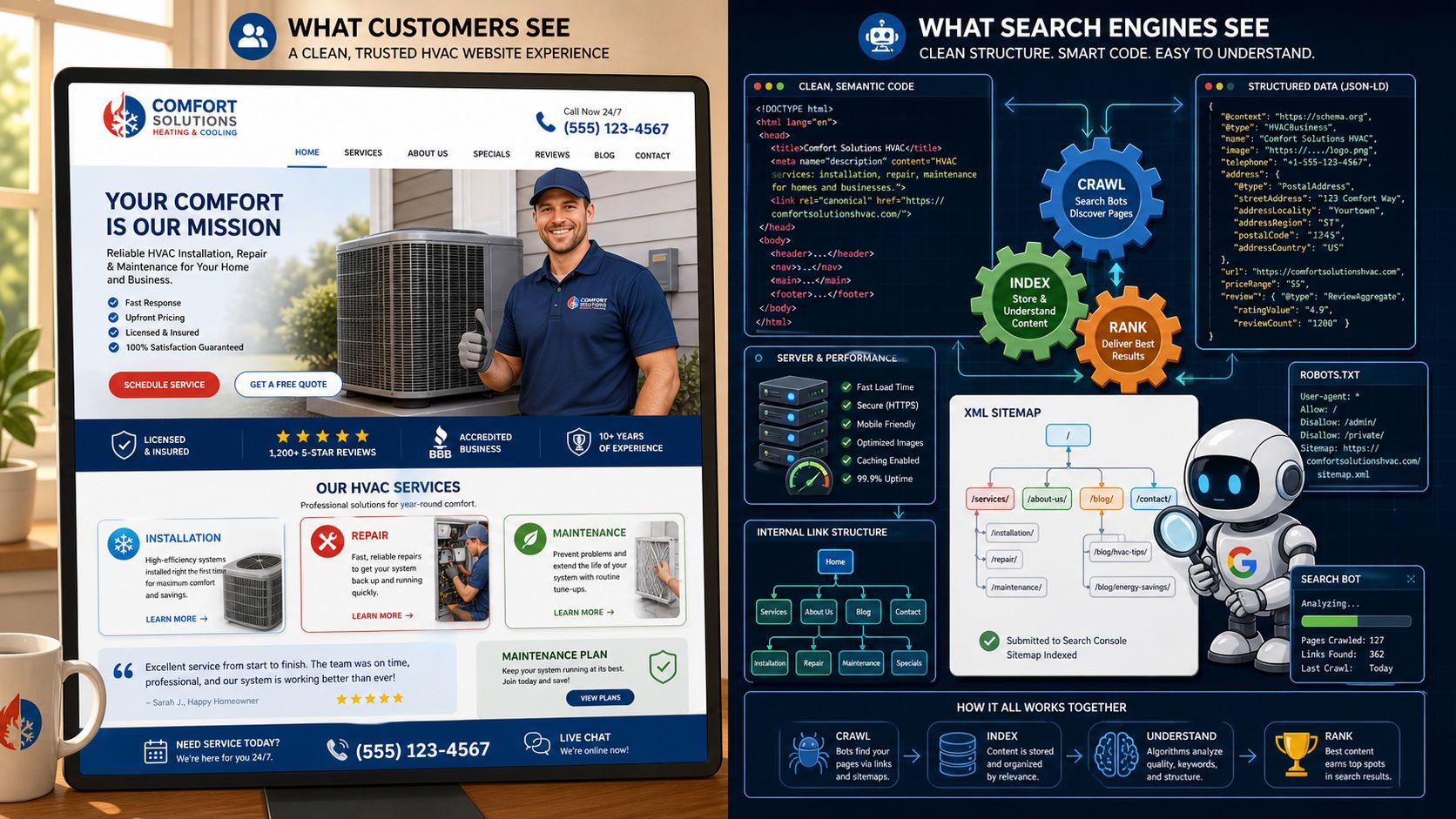
Technical SEO matters most when it removes ambiguity. For local SEO for HVAC, the two technical priorities with the biggest payoff are schema markup and mobile usability.
Add schema that matches how you actually operate
Schema markup helps search engines interpret your business without guessing. For HVAC companies, that usually means implementing LocalBusiness on the main business pages and pairing it with service-specific context where relevant.
At minimum, your schema should reinforce:
- Business identity: Name, address, phone, website
- Operating details: Hours, service area, business type
- Page relationships: Which pages are about services, reviews, and locations
- Trust signals: Review markup where appropriate and supported by visible content
Keep the data aligned with what users can see on the page. If your schema says one thing and the page says another, you've created a trust problem.
A simple example looks like this:
<script type="application/ld+json">
{
  "@context": "https://schema.org",
  "@type": "LocalBusiness",
  "name": "Your HVAC Company",
  "telephone": "Your Primary Phone Number",
  "address": {
    "@type": "PostalAddress",
    "streetAddress": "Your Street Address",
    "addressLocality": "Your City",
    "addressRegion": "Your State",
    "postalCode": "Your ZIP"
  },
  "areaServed": ["City One", "City Two"],
  "openingHours": ["Mo-Fr 08:00-17:00"]
}
</script>
You don't need fancy markup everywhere. You need accurate markup in the right places.
Make the mobile experience frictionless
Emergency HVAC searches happen on phones. Usually when someone is hot, stressed, and trying to hire the first company that feels credible and available.
That means mobile UX is part of SEO, even when people try to separate them.
Check these first:
- Tap targets: Phone buttons should be obvious and easy to hit with one thumb.
- Header behavior: Keep call buttons visible without taking over the screen.
- Page speed basics: Compress oversized images, reduce bloated scripts, and avoid decorative elements that slow the mobile experience.
- Form design: Ask only for what dispatch needs to make contact.
- Above-the-fold clarity: State what you do, where you work, and how to contact you immediately.
Your mobile site doesn't need to impress a designer. It needs to help a homeowner call you before they call the next company.
If you're using WordPress, practical setups often include lightweight themes, image compression plugins, caching, and careful control of third-party scripts. Some agencies also build this into a broader search and content stack. For example, Digital Skyrocket offers website builds and ongoing SEO work that includes technical implementation, local SEO, and AEO foundations for service businesses through its home services web design and SEO approach.
Crafting Content Beyond Service Pages
Service pages and city pages capture high-intent traffic. But they don't answer every question a homeowner has before hiring you. If your content strategy stops there, you miss the searches that shape trust before the phone call.
You also risk overbuilding location pages just because that's what every HVAC SEO checklist says to do.
Stop publishing pages for every town by default
This is one of the worst habits in local SEO for HVAC. Owners hear they need more local pages, so they publish dozens of nearly identical city pages. Then rankings get unstable and nobody understands why.
Data cited by Freitag Marketing shows that 30% of HVAC sites with excessive location pages suffer from ranking volatility because Google struggles to distinguish primary service hubs from peripheral areas. That's the missing nuance in most advice.
Instead of asking, “Can we make a page for this town?” ask, “Can we make a page that deserves to rank for this town?”
Use this decision filter:
| Build a dedicated page when | Group it into a broader page when |
|---|---|
| You serve the area consistently | You only take occasional jobs there |
| You can write distinct local content | The page would mostly repeat nearby city content |
| The market has clear service demand | The area is peripheral to your core footprint |
| You have proof tied to that location | You have no testimonials or examples from there |
That shift alone cleans up a lot of weak HVAC sites.
Content that helps you win before the call
The best HVAC blog content usually comes from sales calls, dispatch questions, and technician conversations. Write the things homeowners ask.
Useful examples include:
- Pricing expectation content: What affects AC replacement cost in your area, without pretending every home is the same.
- Urgency content: What to do before calling for emergency AC repair at night.
- Seasonal problem content: Why systems freeze up during humid spells or short-cycle during heat waves.
- Homeowner education content: Filter issues, thermostat misreads, airflow problems, and when repair stops making sense.
This kind of content also supports AEO later, because AI systems prefer pages that answer specific questions clearly.
If you want a simple model for adjacent educational content, an article on enhancing your home's indoor air quality works as a useful example of topic alignment. It meets homeowners where their concerns start, not just where your sales pitch begins.
You should also connect blog strategy to lead generation, not just traffic. This guide on content marketing for leads is a helpful reference for shaping educational content around inquiry intent rather than vanity publishing.
Some content won't rank fast. That's fine. Good content earns trust, supports internal linking, and gives you material AI systems can summarize later.
Optimizing for AI and Answer Engines
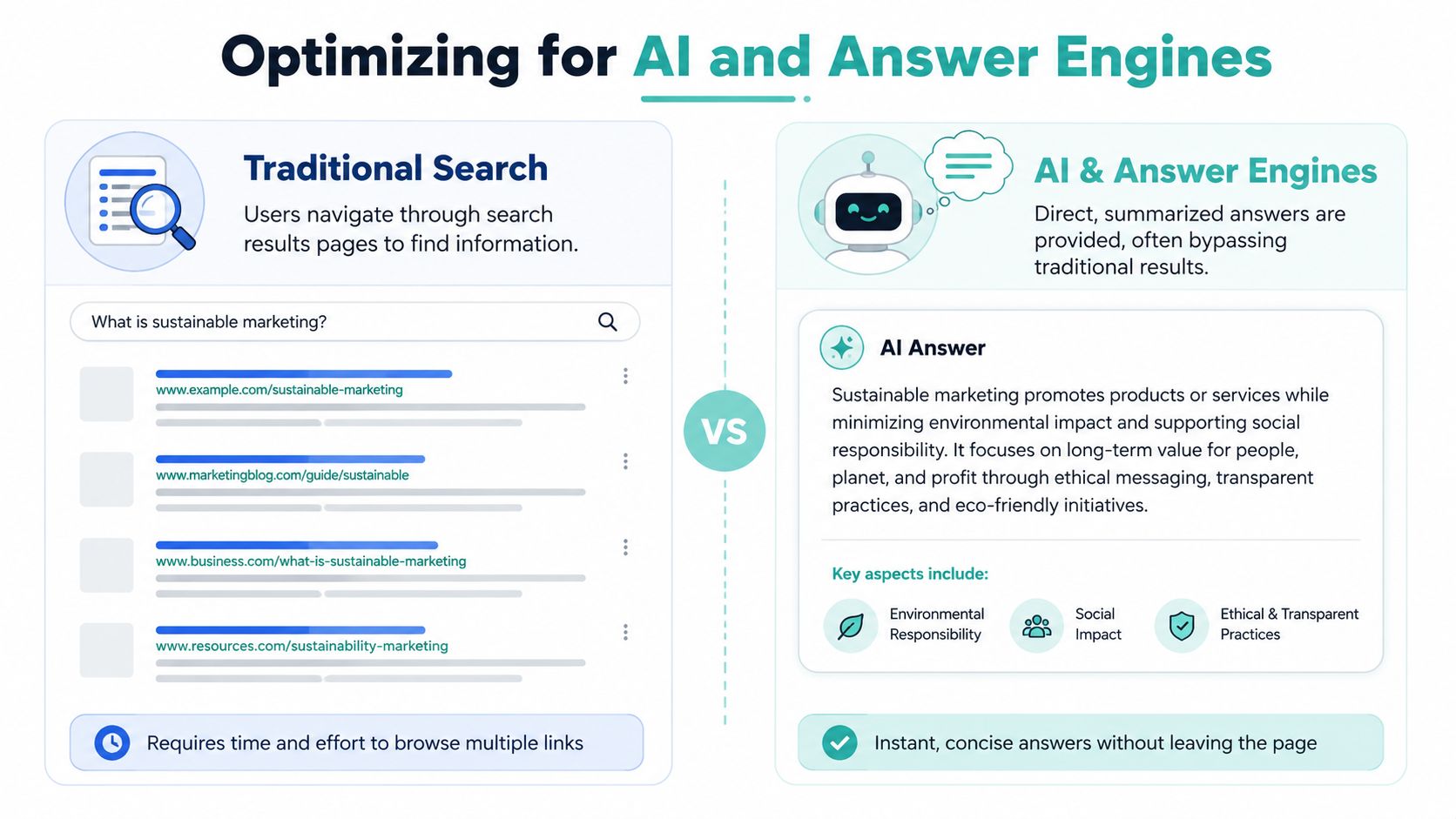
The biggest shift in HVAC search isn't that local SEO stopped mattering. It's that local SEO now feeds a second layer of visibility. Answer Engine Optimization, or AEO.
That means your content has to do more than rank. It has to be structured well enough for AI-generated answers to pull from it when someone asks a direct question about emergency service, pricing, service coverage, or repair timing.
What AEO changes for HVAC companies
Recent industry shifts show that 42% of “AC repair near me” queries now trigger AI-generated summaries that bypass traditional map packs, according to the cited industry discussion in this YouTube source. If your visibility plan ends with map rankings, you're exposed.
This matters most on urgent searches. A homeowner may never reach the ten blue links. They may read an AI summary that mentions what businesses typically offer, what response times to expect, whether after-hours service exists, or how pricing is usually framed.
If your site doesn't answer those questions clearly, AI systems have less to work with.
The HVAC companies that win the next phase of local search will publish content that's easy for both humans and machines to extract.
How to make your content usable for AI answers
AEO for HVAC isn't complicated. It just requires more precision than old-school SEO content.
Focus on these moves:
- Answer exact questions on-page: Create short, direct sections for questions like “Do you offer emergency AC repair?” and “How quickly can a technician come out?”
- Use structured headings: Clear H2s and H3s help AI systems isolate answers.
- Support claims with visible context: If you mention emergency service areas, list the cities or regions clearly.
- Add schema where relevant: Service, review, and local business markup help reinforce entity and service understanding.
- Write concise answer blocks: A short paragraph under a question often performs better for AEO than a long rambling explanation.
- Keep availability details current: AI summaries are only useful if the source page reflects your real operations.
An HVAC page built for AEO usually looks more like a knowledge base merged with a sales page. It still converts. It just answers before it persuades.
Turning Rankings into Revenue with CRO and Reporting
A top ranking that doesn't produce calls isn't a win. It's just visibility without capture.
Once your local SEO for HVAC starts improving, your job shifts from “how do we rank?” to “where are leads leaking out?” That means watching behavior on your top pages and tightening the conversion path.
What to watch after rankings improve
The most useful signals are straightforward:
- Which pages generate calls or form fills: Don't assume traffic-heavy pages are your best lead pages.
- Which service areas convert: Some location pages attract interest but weak lead quality.
- Which devices drive inquiries: HVAC demand often skews mobile, especially for repair intent.
- Which calls to action get used: Phone clicks, short forms, financing clicks, and emergency request buttons can perform differently.
If reporting doesn't connect rankings to inquiries, it's incomplete.
Small CRO fixes that change lead flow
Most HVAC sites don't need a redesign first. They need friction removed.
Start here:
- Put click-to-call buttons high on mobile pages: Don't make people hunt for the phone number.
- Show trust markers early: Review snippets, certifications, financing options, and service guarantees help reduce hesitation.
- Shorten forms: Name, phone, service need, and location are usually enough for a first touch.
- Match CTA language to urgency: “Schedule service” works differently than “Call now for emergency repair.”
- Keep dispatch information visible: Service hours and service area clarity prevent wasted leads.
If you're reviewing site performance after traffic improves, this guide on how to increase conversion rate on a website gives a useful framework for tightening the path from visit to inquiry.
If your HVAC company needs more than generic SEO advice, Digital Skyrocket is one option to consider for a website rebuild paired with ongoing local SEO, AEO, and conversion work. The fit is strongest for service businesses that want a new site, tighter local visibility, and a reporting process tied to qualified inquiries rather than vanity metrics.