A familiar problem shows up in service businesses every week. A law firm pays for clicks, publishes service pages, and sees traffic in analytics, yet the phone stays quiet. An HVAC company gets visits from local search, but estimate requests barely move. The website isn't invisible. It just isn't persuading enough of the right visitors to act.
That gap is where conversion rate optimization matters. Traffic gets people to the door. CRO helps more of them walk in, call, book, or fill out the form. For service businesses, that distinction is huge because a site doesn't need vague engagement. It needs qualified inquiries from people ready to hire someone.
Table of Contents
- Introduction to Conversion Rate Optimization
- Understanding Core Concepts of Conversion Rate Optimization
- Why Conversion Rate Optimization Matters for Service Businesses
- The CRO Process and Key Metrics to Track
- High Impact CRO Tactics and Experiment Guidelines
- Service Industry Case Studies and Examples
- Measuring CRO Success and When to Hire an Agency
- Conclusion and Next Steps
Introduction to Conversion Rate Optimization
A website can look polished and still underperform.
That's common in service industries because owners often judge the site by appearance, while prospects judge it by clarity. A visitor lands on a personal injury page, sees generic copy, hunts for the next step, wonders whether the firm handles cases like theirs, and leaves. Another visitor reaches a plumbing page on mobile, tries to complete the form, gets annoyed by too many questions, and backs out. Nothing is “broken” in the dramatic sense. But friction keeps blocking the inquiry.
Conversion rate optimization, usually shortened to CRO, is the practice of improving a website so a higher share of visitors take a desired action. For a service company, that action is usually a call, form submission, consultation request, or booked appointment.
Service businesses need a slightly different lens than online stores. A buyer isn't tossing a product into a cart. They're deciding whether to trust a dentist, lawyer, roofer, or contractor. That means your message, layout, credibility signals, and intake path all carry more weight.
Practical rule: If people reach your site but hesitate before contacting you, you likely have a conversion problem, not just a traffic problem.
Owners often get confused here because they think CRO means constant button tests or cosmetic tweaks. It doesn't. Good CRO starts with buyer intent, follows user behavior through the funnel, and removes the exact obstacles that stop qualified visitors from becoming leads.
Understanding Core Concepts of Conversion Rate Optimization
Most confusion starts with the term itself. People hear “optimization” and picture technical jargon, advanced software, or endless experiments. The simpler explanation is this. CRO is the discipline of helping more of your existing visitors take the action you want them to take.
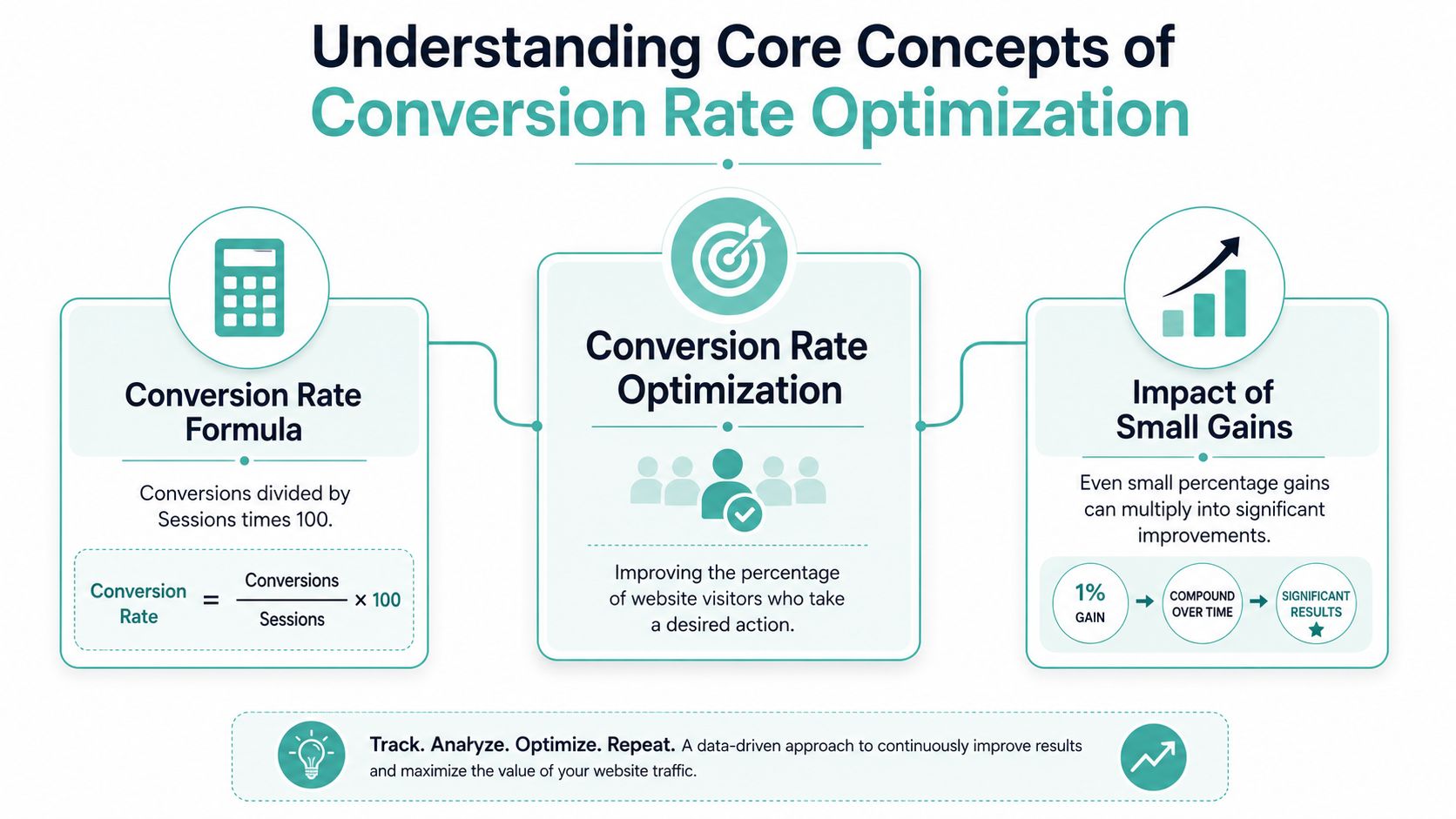
According to ClickMinded's CRO statistics guide, Conversion Rate Optimization (CRO) is defined by the precise mathematical formula Conversion Rate = (Total Conversions ÷ Total User Sessions) × 100, where industry benchmarks for typical websites fall between 1–4%, with a 2–3% baseline considered the standard target for most businesses aiming for qualified inquiries rather than generic traffic.
What counts as a conversion
For a service business, a conversion should be tied to real business value. That usually means actions like these:
- Contact form submissions that reach your intake team
- Consultation requests from people evaluating your service
- Call clicks from mobile visitors ready to talk now
- Appointment bookings for practices or local service providers
A page view isn't a conversion. Time on site isn't a conversion. Even a click to another page usually isn't the main conversion. Those can be useful signals, but they're not the finish line.
Why the formula matters
The formula sounds basic, but it changes how you think. Instead of asking, “How many visitors did I get?” you ask, “What percentage of visitors took the next meaningful step?”
That shift matters because traffic by itself can hide waste. Two firms can get similar traffic and produce very different lead volume because one site gives visitors a clear path and the other creates hesitation.
A good analogy is a front desk at a busy office. Traffic is how many people walk in. Conversion rate is how many of those people successfully check in and get routed to the right person. If the sign-in sheet is confusing, the desk is understaffed, or the directions are unclear, more people leave without help. The problem isn't foot traffic. The problem is the process.
CRO also isn't just testing headlines. It combines numbers and observation. Analytics tell you where people drop off. User behavior tells you why they might be dropping off. Messaging shows whether your offer matches intent. Technical performance affects whether visitors stick around long enough to decide.
CRO is part math, part psychology, and part usability work.
That's why experienced teams treat it as a whole-system discipline. The traffic source matters. The landing page matters. The next step matters. The device matters. Each element influences whether someone feels confident enough to contact you.
Why Conversion Rate Optimization Matters for Service Businesses
Service businesses don't buy attention for fun. They buy or earn traffic because they want calls, consults, booked jobs, and signed cases. That makes CRO more than a nice add-on. It determines whether your website acts like an intake asset or a brochure.
Service businesses don't live by ecommerce rules
Many generic CRO articles lean on ecommerce examples. That can confuse service owners because a lead form for a law office or HVAC contractor behaves differently than a product checkout page.
The benchmark gap proves the point. The AMW Group conversion benchmark summary notes that the global average website conversion rate across all industries in 2026 is 2.35%, yet the top 25% of businesses achieve a 5.31% conversion rate while service sectors like personal injury law often see 10–20%+ for qualified lead forms.
That single comparison clears up a common misunderstanding. If you run a service business and hear that “2% is normal,” you might accept underperformance that should be fixed. In some service categories, especially high-intent local ones, visitors arrive with a stronger decision trigger. They may need help now, not later. Your site should be built for that urgency.
Here's where local nuance matters:
| Context | What the visitor is thinking | What the page must do |
|---|---|---|
| Emergency service | “Can this company help today?” | Show trust, availability, and an easy contact path |
| High-trust professional service | “Can I trust this firm with a serious problem?” | Reduce doubt and make expertise obvious |
| Comparison shopping | “Why choose this provider over others nearby?” | Clarify differentiators and next steps |
Why agency buyers pay attention to CRO
Owners and marketing managers usually turn to CRO when one of three things happens:
- Traffic is rising but leads aren't. SEO or local visibility improves, yet inquiry volume doesn't follow.
- Lead quality feels uneven. The site attracts the wrong people or leaves good prospects uncertain.
- The redesign didn't fix the business problem. A cleaner site launched, but intake stayed flat.
That's when CRO becomes a decision trigger for hiring help. It connects design, content, UX, and analytics to actual inquiry performance. For agencies working with local service firms, this is often the difference between vanity metrics and useful business outcomes.
The CRO Process and Key Metrics to Track
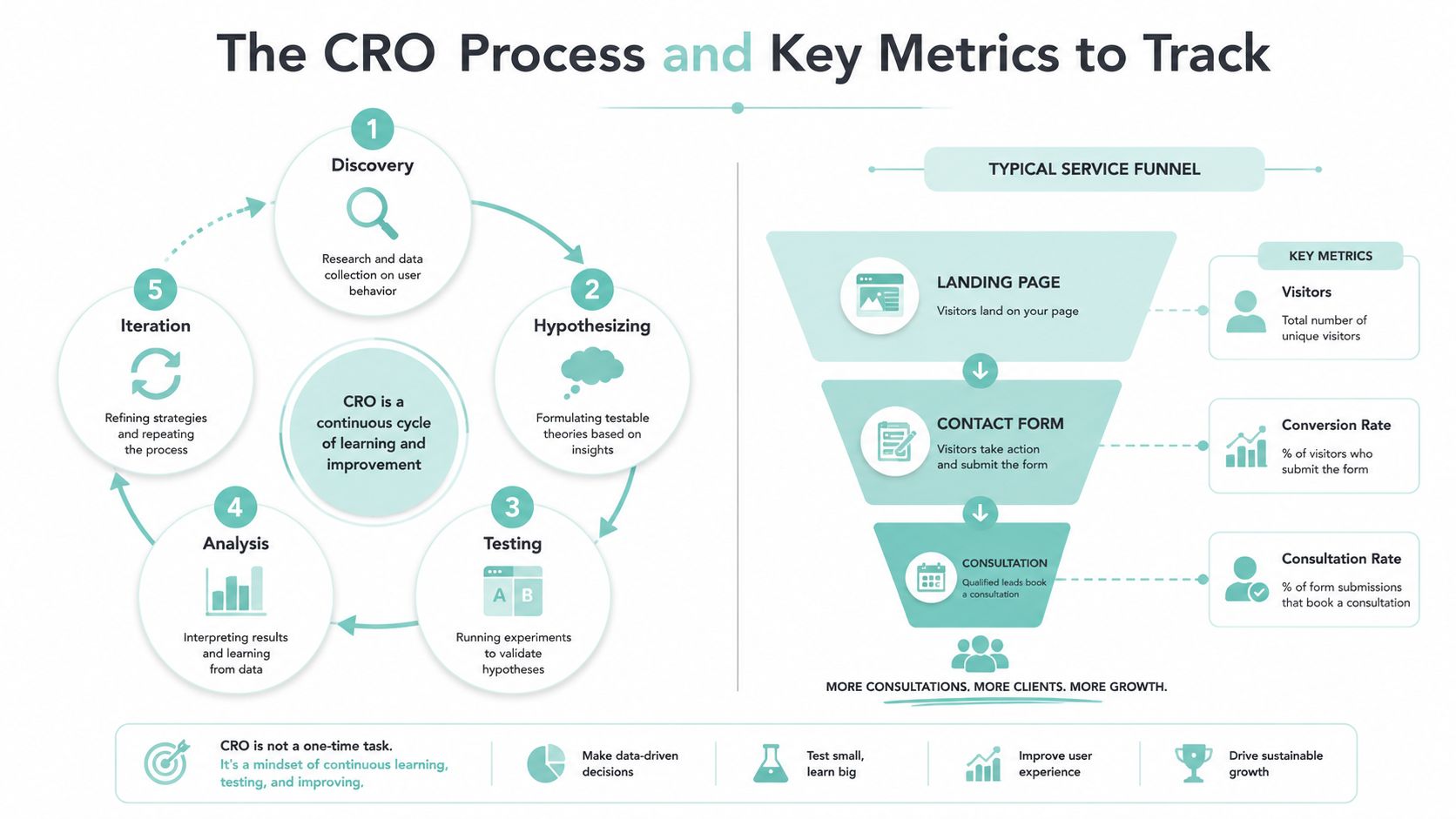
A strong CRO program doesn't start with random tests. It starts with a funnel and a question: where are qualified visitors getting stuck?
A simple service business funnel
For most service companies, the funnel is shorter than people think:
- Landing page
- Contact form or call click
- Consultation, estimate request, or intake conversation
That simplicity is helpful because it makes diagnosis easier. If traffic lands on the page but very few people start the form, your issue may be message clarity, trust, or CTA placement. If many start the form but fewer finish, the form itself may be the friction point.
One practical resource for spotting these issues is Samuel Woods on CRO, which gives a solid checklist mindset for reviewing pages, forms, and user pathways without turning the process into guesswork.
The five-part workflow
A disciplined CRO workflow usually looks like this:
- Discovery means gathering evidence. Review analytics, device splits, page behavior, intake feedback, and the wording on key pages.
- Hypothesizing means turning observations into a testable statement. Example: shortening the contact form may increase completions because visitors won't feel interrogated.
- Testing means changing one meaningful thing and tracking the result.
- Analysis means checking whether the result improved the desired action.
- Iteration means keeping the win, documenting the loss, and moving to the next bottleneck.
The biggest drop-off in your funnel is usually the most useful place to work first.
That point aligns with the benchmark-focused view from the earlier section. Don't optimize what feels interesting. Optimize where visitors abandon the process.
Metrics that deserve your attention
Some metrics matter more than others for service firms.
The DesignRush CRO statistics roundup notes that device behavior significantly influences CRO metrics, with desktop devices converting at 3.5–4.0% compared to mobile's 1.8–2.5%, prompting high-performing brands to benchmark by channel and device in disciplined 90-day testing cycles.
That matters because many local service sites get large mobile audiences. If your forms are hard to complete on a phone, you're leaking leads where intent may be strongest.
Focus on these metrics first:
- Overall conversion rate to measure the primary action
- Page-to-form click rate to see whether the page motivates action
- Form completion rate to identify friction in the intake step
- Device split to spot mobile-specific problems
- Channel pattern to compare how visitors from search, email, or referrals behave
The same DesignRush source also notes that email remains the highest-performing channel for conversions at 19.3%, which is useful context when you compare high-intent traffic against colder visits from broader channels in that same DesignRush analysis.
If you want agency support for this kind of analysis and implementation, one option is Digital Skyrocket's CRO services, which focus on improving layouts, calls to action, and form flows as part of lead-generation websites for service companies.
High Impact CRO Tactics and Experiment Guidelines
Once you know where friction lives, tactics get more practical. You're no longer “trying CRO.” You're testing specific fixes against specific problems.
Start with the friction you can see
The highest-impact changes on service sites are usually ordinary. They don't look clever. They remove uncertainty.
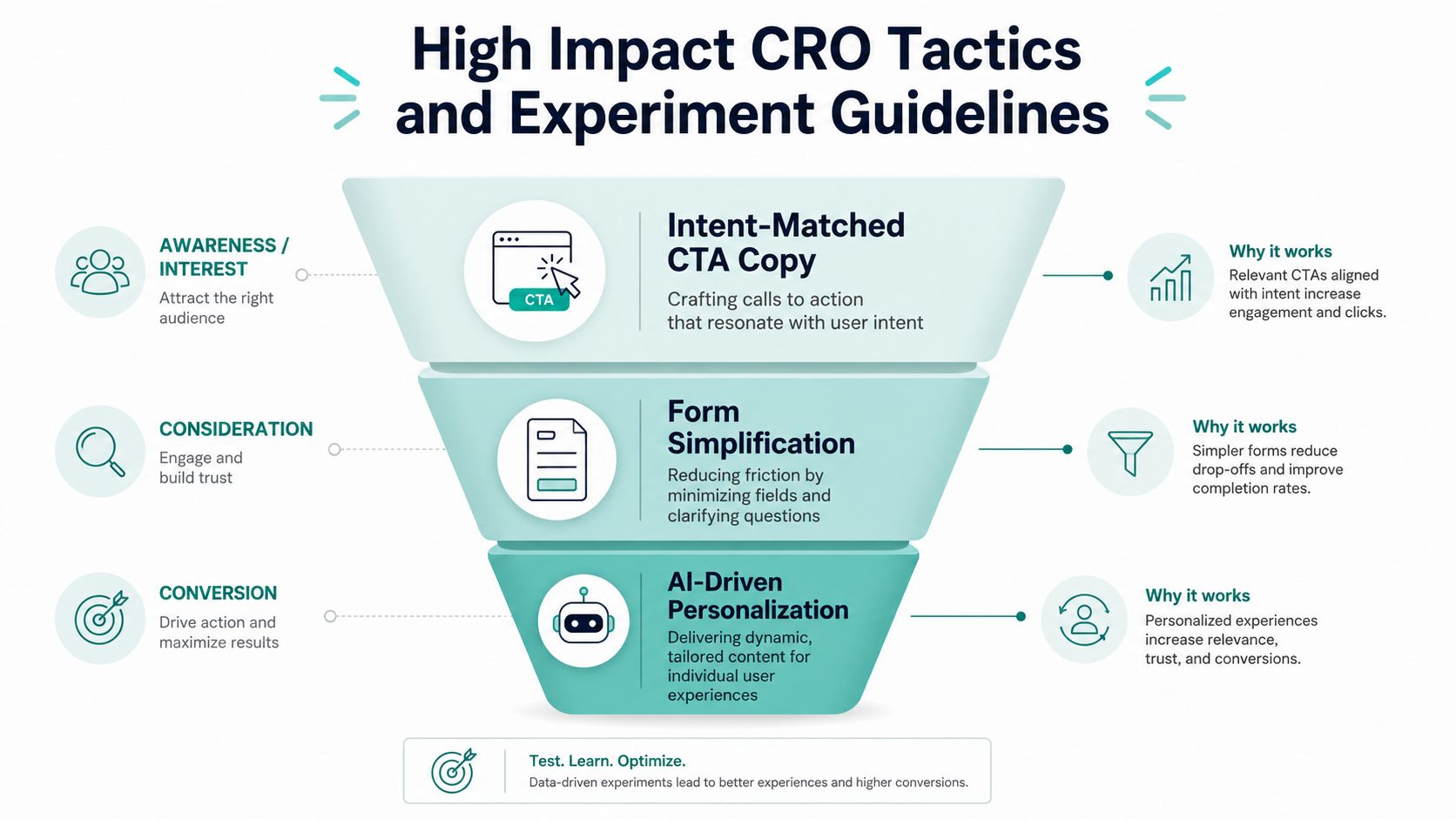
The Matomo CRO best-practices article reports that empirical evidence shows that systematic A/B testing on CTA copy can yield up to a 37.5% conversion jump, while AI personalization can improve engagement metrics by 70% and reduce dropouts by 15%.
That's a useful reminder that language and flow matter. A service prospect doesn't respond to the button in isolation. They respond to whether the wording fits what they want to do next.
Here are tactics worth testing:
- Intent-matched CTA copy. “Book Today” can feel clearer than a vague prompt because it matches immediate action better than generic wording.
- Shorter forms. Ask only for what your team needs at first contact.
- Faster pages. Slow load times push visitors away before they even evaluate your offer.
- Personalized content blocks. Returning visitors or visitors from a specific service page may need different cues than first-time homepage visitors.
Field note: The best CRO tactic is usually the one that removes the biggest moment of hesitation.
A good companion resource is this guide on how to increase conversion rate on a website, especially if you're mapping practical page changes before launching formal tests.
How to run cleaner experiments
Business owners often sabotage tests by changing too many things at once. If you rewrite the headline, redesign the layout, shorten the form, and add new testimonials all together, you won't know what caused the result.
Use a simple experiment format:
| Part of the test | Example |
|---|---|
| Problem observed | Mobile users abandon the estimate form |
| Hypothesis | Reducing required fields will improve form completion |
| Primary metric | Completed estimate requests |
| Success criteria | A clear improvement in completed inquiries without lower lead quality |
Keep the rules simple:
- Test one meaningful variable at a time so the result stays interpretable.
- Define the conversion before launching so nobody changes the goal midstream.
- Check lead quality after the test because a lift in form submissions means little if the inquiries aren't qualified.
- Document losses as well as wins because they sharpen future hypotheses.
The strongest programs treat experiments like operational learning, not creative guesswork.
Service Industry Case Studies and Examples
Generic CRO advice often leaves service owners with the wrong benchmark and the wrong mental model. The more useful question is not “What does the average website do?” It's “What do businesses like mine need from their visitors, and what tends to stop that from happening?”
The 898 Marketing article on service-sector CRO benchmarks makes that gap clear, noting that while ecommerce averages 2–3%, service firms like law and HVAC often see 10–20%+ on lead forms, offering a richer context for setting realistic goals.
A personal injury firm refining intake intent
A personal injury firm outside its primary market had a familiar issue. The site communicated competence, but the intake path asked too much too soon. Visitors landed on practice-area pages, read about the firm, then hit a form that felt more like a case worksheet than a first contact step.
The first useful change wasn't dramatic. The firm reframed the form as an easy case review request, tightened the CTA language, and reduced early friction. It also aligned each page's offer more tightly with the visitor's problem. Car accident pages invited case review. Wrongful death pages used more trust-focused language and a calmer path to contact.
A design reference point for firms thinking about that trust layer is personal injury lawyer website design, because law firm CRO often starts with credibility and intake flow, not flashy design flourishes.
What matters in this example is the lesson. High-intent legal visitors often don't need more persuasion in the abstract. They need to feel that the next step is safe, clear, and relevant to their case.
An HVAC contractor reducing hesitation
An HVAC contractor in a competitive local market had a different issue. Traffic reached the service pages, but the contact experience felt generic. The page told visitors what services were offered, yet it didn't reduce the obvious concerns. Can this team come soon? Do they handle my exact issue? What happens after I submit?
The business improved conversions by clarifying the promise of the next step. Instead of a bland “Contact Us” path, the site used service-specific CTAs, simplified the estimate request, and tightened supporting copy around response expectations. The page also made mobile contact easier, which matters for home-service buyers who are often researching from a phone while the problem is happening.
This example highlights a broader truth. In trades and home services, hesitation often comes from uncertainty rather than lack of interest. The buyer may be ready. The page just hasn't removed enough doubt.
“The visitor usually isn't asking for more marketing. They're asking for a clearer reason to trust the next click.”
Measuring CRO Success and When to Hire an Agency
A successful CRO effort doesn't end when a page looks better. It ends when more qualified visitors take the action you care about, and your team can see that change clearly in the data and in the CRM.
What success actually looks like
Start with a basic scorecard that connects site behavior to business outcomes:
- Primary conversion trend such as form submissions, booked consults, or call clicks
- Lead quality notes from intake or sales staff
- Page-level changes that show which edits were made and when
- Longer-term direction rather than day-to-day noise
A dashboard helps, but the dashboard isn't the point. The point is learning whether a change improved the path from visit to inquiry.
When outside help makes sense
Some owners should keep CRO in-house. Others hit a wall fast.
An agency tends to make sense when:
- Your team lacks time to review funnels, run tests, and implement fixes consistently
- You're getting traffic but can't diagnose the bottleneck
- You redesigned recently and results still feel flat
- You need tighter alignment between SEO, website structure, and conversion paths
The right time to hire help is usually before frustration turns into random changes. CRO works best when someone can connect user behavior, message clarity, technical performance, and lead tracking into one process.
Conclusion and Next Steps
If you've been asking what is conversion rate optimization, the simplest answer is this. It's the work of turning more of your current website visitors into real inquiries by removing friction, clarifying the next step, and matching the page to the visitor's intent.
For service businesses, that work has to be grounded in service-business reality. Buyers need trust. They need relevance. They need a contact path that doesn't feel like paperwork before the relationship has even started. That's why CRO for a law firm, dental office, or HVAC company can't be borrowed blindly from ecommerce playbooks.
A good next step is small and concrete:
- Pick one high-intent page
- Map the next desired action
- Identify the biggest moment of hesitation
- Write one testable hypothesis
- Measure the result against qualified inquiries
That approach keeps CRO practical. You don't need to rebuild the whole site before improving performance. You need to identify where a real prospect loses confidence, then fix that point with care.
If your site gets traffic but too few qualified inquiries, Digital Skyrocket helps service businesses connect web design, SEO, AEO, and conversion improvements so visits are more likely to turn into calls, form submissions, and booked consultations.