You check your rankings on a Monday morning. Your main service page moved up two spots, your agency sent a green arrow in last week's report, and your phone still isn't ringing any more than it did last month. That gap is where most service businesses live right now. They know how to get top of Google search in theory, but nobody connected the ranking work to the calls, forms, and booked jobs that pay for it.
Table of Contents
- What Top of Google Actually Means in 2026
- Mapping Search Intent Before You Write a Word
- Building Service Pages That Earn Clicks and Calls
- Technical SEO as a Quality Control Gate
- E-E-A-T and AEO Without the Shortcuts
- Winning Local Visibility Beyond City-Stuffed Pages
- Authority Building That Survives Algorithm Shifts
What Top of Google Actually Means in 2026
A roofing owner I worked with had chased position one for his main city term for months. He refreshed his rank tracker daily, asked for more city pages, and treated any day outside the top three as a failure. When we finally sat down with his call log, the pattern was obvious. His best leads weren't coming from that trophy term at all. They came from map pack visibility, branded searches after referrals, and two service pages that ranked lower but matched urgent intent.
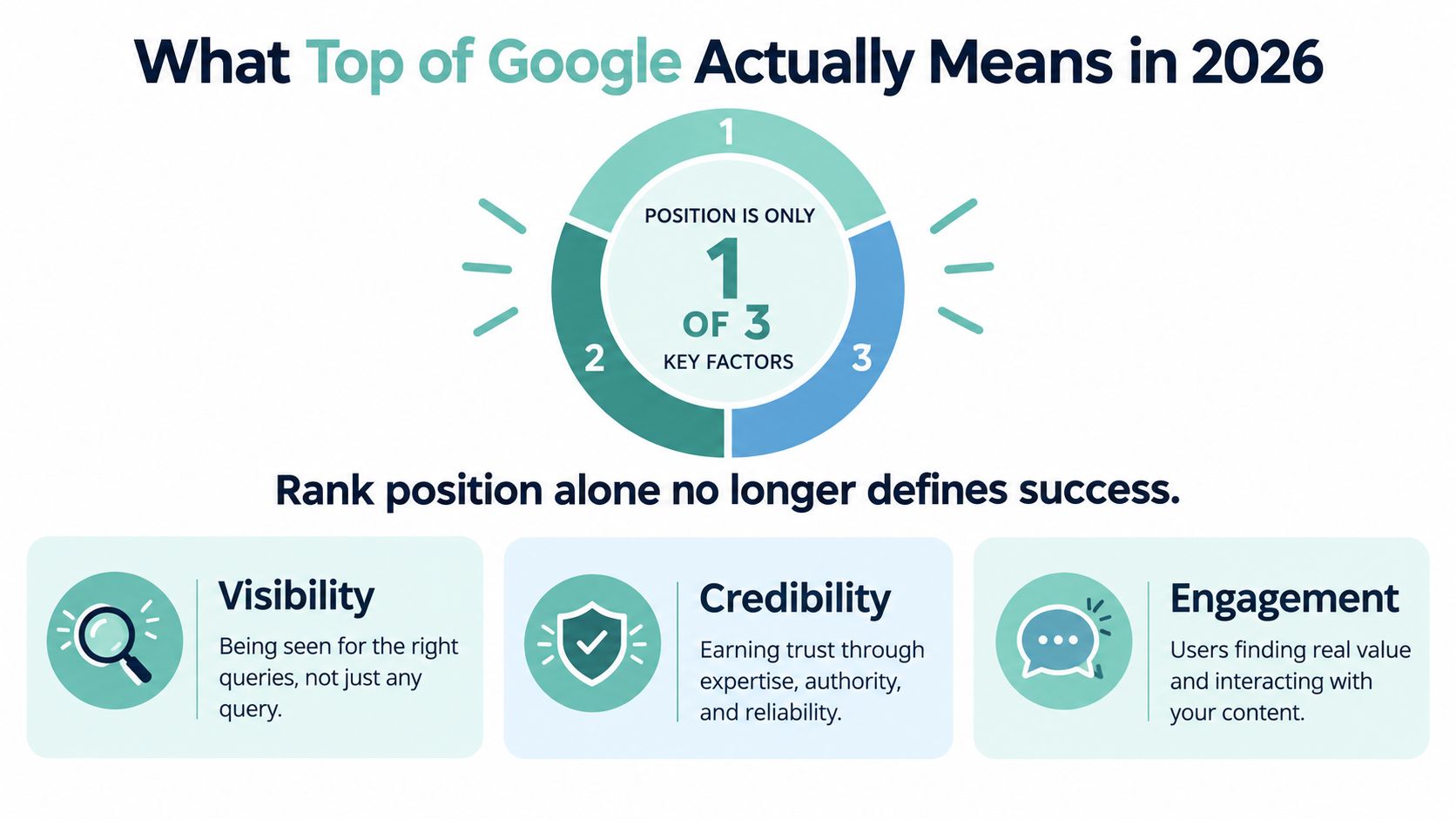
That's the reframe you need before any tactic matters. Top of Google now means being visible, credible, and chosen across several surfaces at once, not holding one organic slot. For a service business that includes the map pack, organic results, cited sources inside AI answers, and the branded search someone runs after hearing your name.
Why Position Alone Misleads You
Clicks don't follow position in a straight line. A 2024 study of 31,648,226 impressions and 416,386 clicks across 8,861,416 daily queries found the first organic result averaged a 9.28% CTR, with first-position CTR ranging from 6.61% to 11.26% depending on query type, according to the 2024 large-scale Google CTR study. Title wording, brand familiarity, ads, maps, images, and answer panels all pull attention away from even a strong listing.
So a page can climb and still underperform if its title promises the wrong thing or its offer feels generic. The reverse also happens. A lower ranked page with a sharper title and clearer local proof can win the click, then the call.
Practical rule: Judge every ranking gain against qualified inquiries, not against the rank tracker alone.
Your next ninety days should separate ranking signals from conversion signals. Ranking signals get you seen. Conversion signals, like proof, clarity, and an obvious next step, get you chosen. If you're also trying to understand how AI answers change that visibility layer, this breakdown of SGE content optimization tactics from MyMentions is a useful companion read, as long as you measure any of it against leads rather than mentions.
Mapping Search Intent Before You Write a Word
Most service pages fail before anyone writes them. Someone picks a keyword, hands it to a writer, and ends up with a page that tries to rank, educate, and sell to three different people at once. Intent mapping fixes that by forcing one decision first. What job does this URL exist to do?
The Four Intents You Actually Compete For
Service businesses don't need an academic taxonomy. You need to sort queries into the intents that change what you build.
- Transactional service intent: Someone wants to hire now, like a personal injury attorney in a specific city. This page needs proof, credentials, and a fast path to contact.
- Cost and comparison intent: Someone asks how much a case is worth or what a service costs. This page needs ranges, factors, and honest qualifiers, not a hard sell.
- Problem diagnosis intent: Someone describes symptoms, damage, or a legal situation and wants to know what it means. This page needs clear explanations and a next step.
- Branded and navigational intent: Someone already knows your name. This page needs to confirm they're in the right place and make contact effortless.
A Worked Example With One Service
Take personal injury in Dallas. "Personal injury lawyer Dallas" and "how much is my Dallas car accident case worth" look related, but they shouldn't share a URL. The first searcher wants a firm. The second wants an answer before they'll trust anyone. If you merge them, you get a page that buries the answer under sales copy and buries the sales case under educational filler. Neither visitor stays.
Cluster instead. List every query you'd want to win, tag each one with an intent, then group only the queries a single page could satisfy completely. Using a semantic keyword grouping approach helps here because it groups by meaning, not just shared words, so "attorney" and "lawyer" variants land together while cost questions stay separate.
Before you brief a writer, run each cluster through three questions. Do we sell this service? Can we prove we've done it well, with results, photos, or named people? Would we be proud if this page was a prospect's first impression of the firm? If any answer is no, kill the cluster or fix the proof problem first. A page that doesn't deserve to exist won't rank its way into deserving it.
Building Service Pages That Earn Clicks and Calls
Put two service pages side by side and you can usually predict the lead count before you check analytics. The difference rarely comes down to keyword density. It comes down to whether the page sounds like the customer, proves the business can do the work, and makes the next step obvious.
| Element | Weak Page | Strong Page |
|---|---|---|
| Title tag | Best Services in Dallas, TX, Dallas Services | The service and city in the customer's own words, plus one differentiator |
| Main heading | Welcome to our services page | States the problem solved and who it's for |
| Proof | Stock photos and years in business | Case results, before and after photos, named practitioners |
| Local detail | City name swapped into identical copy | Neighborhoods served, local rules, real jobs nearby |
| FAQs | Generic questions copied from competitors | Questions from actual intake calls, answered directly |
| Call to action | Contact us link in the footer | Specific next step near proof, repeated after key sections |
Use the Customer's Language Everywhere It Counts
Put the words searchers use in your title, your main heading, your descriptive copy, your image alt text, and your internal anchor text. That's not stuffing. It's matching. Google's Search Essentials guidance on people-first content recommends people-first content, prominent use of words searchers use, and crawlable links, while warning that duplicating one generic city page across many locations or publishing thin pages with no location-specific proof is a common pitfall for local businesses.
Cost content shows this well. A page explaining tile roof replacement cost from America Roofing works because homeowners searching that phrase want numbers, factors, and trade-offs, not a generic roofing pitch with a price keyword pasted in. Your service pages should respect intent the same way.
One Intent Per URL, Then Proof
Give every URL one primary service and location intent. Then load it with the trust signals service businesses underuse most. Named practitioners with real credentials. Photos from actual jobs, not stock libraries. Service area clarity that tells a visitor in ten seconds whether you cover their street. Results and reviews tied to that specific service, not sprinkled randomly sitewide.
Test your own pages against the table above. If your title could belong to any competitor, if your proof is a stock photo and a founding year, if your call to action hides in the footer, you don't have a ranking problem yet. You have a page problem that rankings would only expose to more people.
Technical SEO as a Quality Control Gate
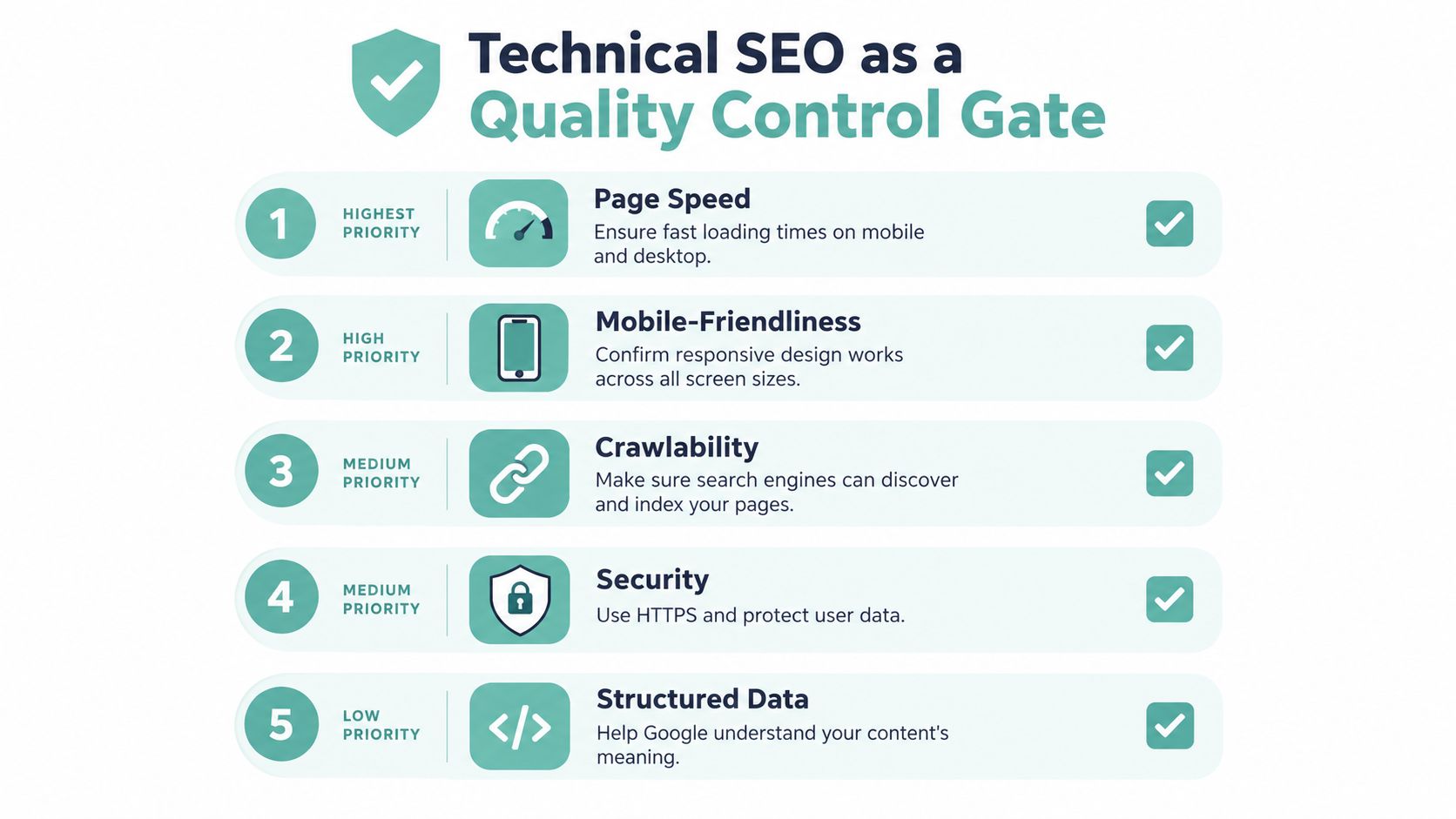
Technical SEO rarely wins a market by itself. It loses markets without notice. A strong page that Google can't crawl, that loads slowly on a phone, or that buries its own importance in a messy site structure will underperform a weaker competitor whose basics are clean. Treat technical work as a gate your pages must pass, in the order it tends to matter.
Fix Crawl and Index Problems First
Confirm every important page is reachable through crawlable internal links. Inspect live URLs in Search Console. Check that robots.txt, a stray noindex tag, authentication walls, or heavy JavaScript aren't blocking access. Then submit an XML sitemap so Google can recrawl what changed. A structured review like a technical SEO audit checklist keeps this from becoming guesswork.
Clear the Core Web Vitals Thresholds
Google recommends a Largest Contentful Paint of no more than 2.5 seconds, an Interaction to Next Paint below 200 milliseconds, and a Cumulative Layout Shift score below 0.1, evaluated using real-user field data at the 75th percentile, per Google's Core Web Vitals documentation. Translate those numbers into release work, not score chasing.
- Compress and size images correctly: Your hero image is usually the LCP element, so serve it in a modern format at the dimensions the layout needs.
- Cut render blocking scripts: Third party widgets and unused JavaScript slow interaction responses, especially on mid range phones.
- Reserve space for everything: Set dimensions on images, embeds, and forms so content doesn't jump while loading.
- Retest with field data: PageSpeed Insights lab scores can miss real user conditions, so confirm improvements in the Chrome UX Report after launch.
Add Structured Data and Clean Architecture
Add LocalBusiness structured data with accurate name, address, phone, hours, and service area, then validate it with the Rich Results Test. It won't guarantee a rich result. It gives Google machine readable facts that can support enhanced appearances. Never mark up information visitors can't see, and never let hours go stale.
Chasing a perfect Lighthouse score while your intent match and calls to action stay weak is the most expensive way to feel productive in SEO.
Pair every performance release with conversion tracking. If faster pages don't produce more qualified calls or completed forms, you've improved a metric, not the business.
E-E-A-T and AEO Without the Shortcuts
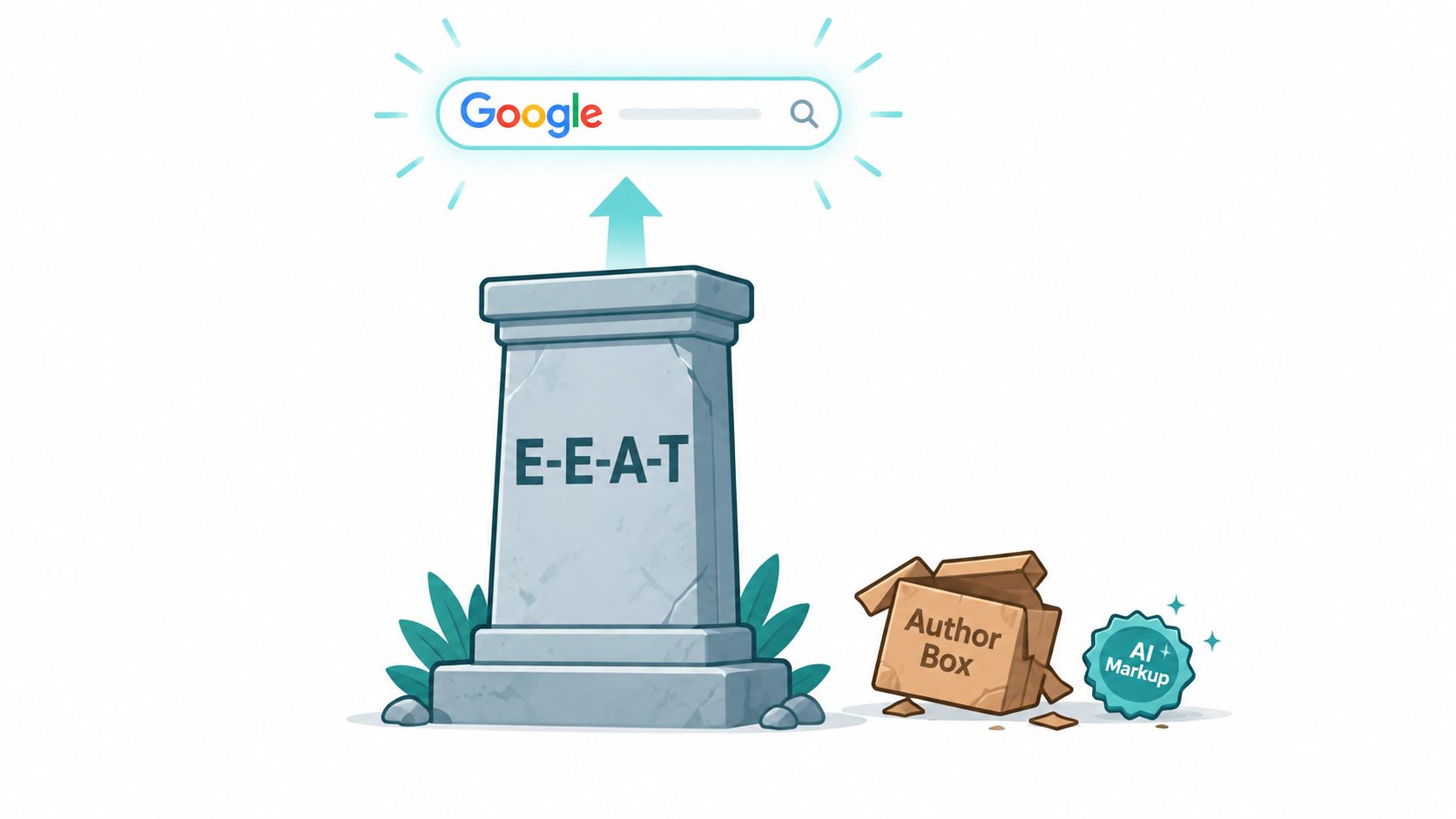
Two kinds of shortcuts dominate this conversation. The first says you can manufacture E-E-A-T by adding an author box and a credentials line to thin content. The second says you need special AI files, AI specific schema, or proprietary markup to appear in AI Overviews. Both claims collapse against Google's own documentation.
What Google Actually Says About AI Features
Pages must already be indexed and eligible for normal Google Search to appear in AI features. There are no additional technical requirements, special schema, or AI-specific files needed for AI Overviews or AI Mode. That reframes the whole discipline. You don't optimize for AI instead of search. You build pages strong enough for search that answer systems can also extract and trust.
Here's the commercial catch most AEO advice skips. Pew Research found that 58% of surveyed users conducted at least one Google search producing an AI summary in March 2025, and when an AI summary appeared, users clicked a traditional result in only 8% of visits versus 15% when no summary appeared, and clicked a cited link inside the summary in just 1% of visits, as referenced in Google's AI features documentation. Being mentioned isn't the same as being visited, and being visited isn't the same as being hired.
What Real Experience Looks Like on the Page
For a law firm, first hand experience means explaining how local courts handle a case type, what intake mistakes hurt claims, and what documentation to bring. For a roofer, it means photos from real tear offs, material trade-offs you've seen fail in your climate, and honest guidance on when repair beats replacement. That specificity does two jobs at once. People trust it, and answer systems can extract it because it says something definite.
- Clear service definitions: State what the service includes and excludes in plain sentences an answer system can lift accurately.
- Concise answers to high intent questions: Answer the question first, then expand, instead of warming up for three paragraphs.
- Visible authorship and credentials: Attach real names and qualifications where the topic demands accountability, especially legal and medical content.
- Accurate Business Profile facts: Keep the information consistent everywhere so nothing contradicts your pages.
Measure this properly. Track rankings, AI visibility where you can observe it, branded search volume, calls, and qualified leads as separate lines. When agencies like Digital Skyrocket build sites for service companies, the SEO and AEO work sits inside the website build itself, so those measurement lines exist from launch rather than getting bolted on later. However you staff it, never let a screenshot of an AI mention substitute for a lead report.
Winning Local Visibility Beyond City-Stuffed Pages
Local rankings run on different physics than national organic rankings. You can't write your way around geography, and you can't template your way into trust. The businesses that win the map pack treat their Business Profile, their reviews, and their local pages as one operating system with an owner, not three chores nobody owns.
The Three Signals That Decide Local Results
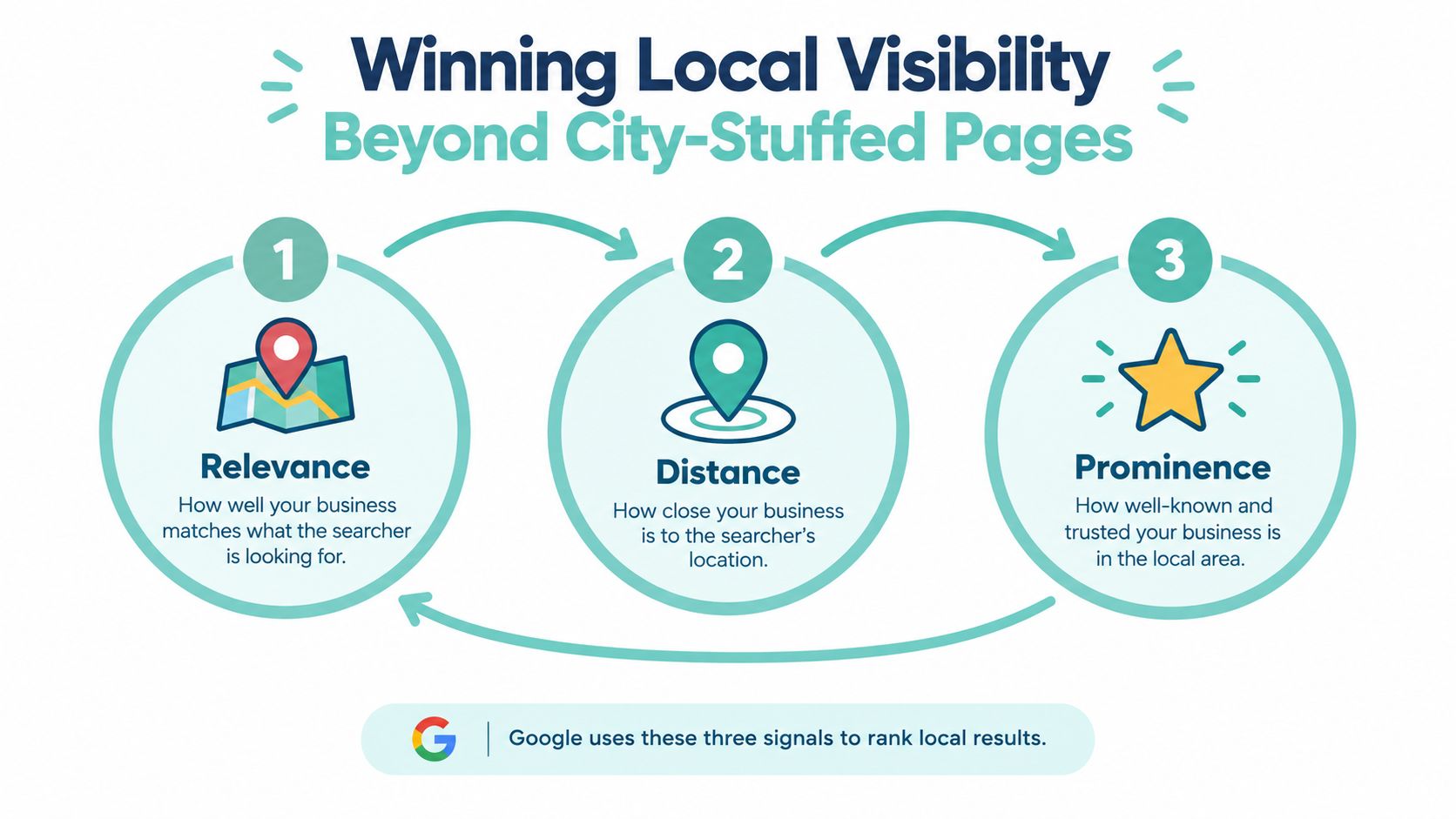
Google identifies three primary factors for local results. Relevance is how closely a Business Profile matches the query, distance is how far the business is from the searcher, and prominence is how well-known the business is, influenced by links and review signals, according to Google's local ranking guidance. Proximity alone can shift rankings between searchers in different neighborhoods, which is why your ranking at the office means little across town.
You can't control distance. You fully control relevance and prominence. Relevance means a complete profile with accurate categories, services, hours, and service area definitions, matched by consistent name, address, and phone details everywhere they appear. A firm like Brian Hansford Law injury attorneys illustrates the service area approach, tying a defined practice to a defined place instead of claiming everywhere. When you build supporting pages, apply location page SEO principles so each page carries real local proof instead of swapped city names.
Reviews Are an Operations Problem
Collecting five star ratings isn't a review strategy. The content of reviews, how recent they are, and how specifically you respond all shape whether searchers trust you enough to call. A detailed review describing the actual problem solved does more persuasive work than ten ratings with no text.
Build a compliant process. Ask for genuine feedback after completed work. Never offer incentives or script the language. Respond specifically to what the reviewer said, and in legal or medical contexts, never confirm private details in a public reply. Automated responses can draft a starting point, but a human should review anything sensitive before it posts. Then watch whether review improvements move map visibility, branded searches, and qualified calls together. That's the signal the system is working.
Authority Building That Survives Algorithm Shifts
Links still matter. They just matter less, and differently, than most link sellers claim. Google's original insight treated links as referrals, with endorsements from important pages carrying more weight than obscure ones. That logic still explains why one citation from a respected local publication outperforms a batch of purchased placements nobody reads. Durable authority comes from being referenced by sources your customers already trust, and from routing that authority internally toward the pages that convert.
Where Durable Authority Actually Comes From
Start with digital PR rooted in things your business genuinely does. Local news coverage of a community project. A quoted perspective in an industry publication. Partnerships with organizations that already list their members or sponsors. These mentions carry brand value even when they don't pass a link, because they drive branded searches, which feed every other signal discussed in this roadmap.
Then fix the authority you already have. Most service sites leak value through internal linking. The homepage and a few old blog posts hold most of the inbound equity while the service pages that produce revenue sit three clicks deep with generic anchor text. Audit which pages earn links and traffic, then link deliberately from them to your priority service and location pages using descriptive anchors. This costs nothing, risks nothing, and often moves pages that have been stuck just off page one.
How to Spot Schemes That Can Get You Removed
Google prohibits tactics built to manipulate rankings or mislead users. Its spam policies define cloaking as showing different content to search engines and users for manipulative purposes, and link spam as creating links primarily to manipulate rankings, alongside prohibitions on doorway abuse, expired-domain abuse, hacked or hidden content, keyword stuffing, and scaled content abuse, per Google's spam policies.
If a vendor can't show you exactly where a link will appear and why that site would naturally reference you, you're buying risk, not authority.
Vet every offer with three questions. Would this placement make sense if Google didn't exist? Can I see live examples on sites with real audiences? Does the contract name the tactics, or hide behind authority metrics? Walk away from anyone selling guaranteed rankings or bulk links by metric tier.
The Measurement Loop That Closes the Roadmap
Authority work needs a monthly cadence. Review new mentions and links earned, check branded search trends, and confirm internal links still point at current priorities after any site changes. Quarterly, prune outreach targets that never respond and double down on publication types that reference you.
Tie everything back to a small set of dashboards. In Search Console, track impressions, clicks, and average position by URL, split branded from non-branded queries. In analytics and call tracking, track qualified calls, form submissions, and booked appointments by landing page. Those two views together tell you whether ranking work is becoming revenue work.
- Weekly: Check for indexation drops, broken priority pages, and call tracking failures so small problems don't cost a quarter.
- Monthly: Review URL level Search Console movement against leads, refresh one underperforming service page, and run your mentions and internal link pass.
- Quarterly: Reassess intent clusters, retire pages that attract unqualified traffic, and reallocate effort toward queries producing booked work.
Learn to read the most confusing pattern in SEO. When position improves but leads don't, you almost never have an authority problem. You have an intent mismatch, a weak title losing the click, or a page that doesn't convert the visit. Fixing that distinction, month after month, is what separates businesses that stay at the top from businesses that visited once.
Ninety days of this rhythm beats a year of chasing tactics. Map intent, rebuild your priority service pages with proof, clear the technical gate, run your local system weekly, and earn references worth having. Rankings follow that operating discipline more reliably than they follow any single trick.
If your site ranks but doesn't ring, the fix usually starts with rebuilding the pages and technical foundation together, which is exactly the web design, SEO, and AEO work Digital Skyrocket does for law firms, roofers, dentists, HVAC companies, and other service businesses. Visit us to start with a fit meeting and an evidence based look at your current traffic, rankings, and lead flow before you commit to a rebuild.