A service business can have a page for every city it serves and still remain invisible in local search. The usual pattern is familiar: the company duplicates one template, replaces the city name, adds a phone number, and expects Google to treat each URL as a useful local resource. Visitors see a polished page, but they can't find meaningful information about the team, service area, directions, local work, or reasons to choose that branch.
Location page SEO works when architecture, entity signals, local proof, and conversion paths reinforce one another. It fails when a website creates city pages solely to occupy more search results. Local intent is substantial, with Google-related sources reporting that 46% of all Google searches have local intent (local search statistics and Google Business Profile data). That opportunity deserves pages built for real customers, not directory-style placeholders.
Table of Contents
- Why Most Location Pages Fail Before They Rank
- Building the Right Site Architecture for Location Pages
- On-Page Content and Local Schema That Actually Rank
- Integrating Google Business Profile With Location Pages
- Creating Unique Content Without Writing From Scratch
- Canonical Strategy and Technical SEO for Multiple Locations
- Tracking Performance and Avoiding Common Pitfalls
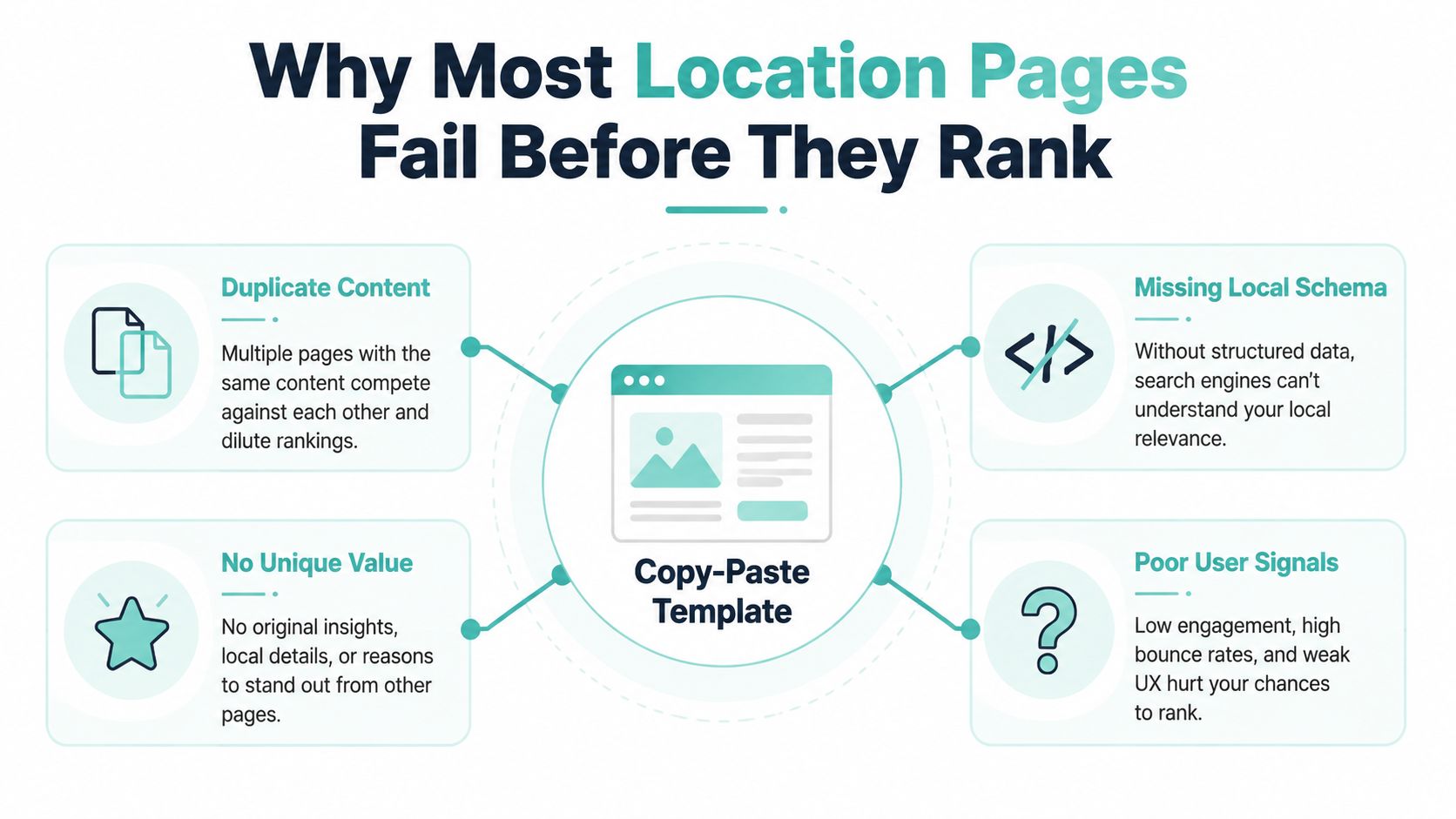
Why Most Location Pages Fail Before They Rank
A roofing company launches pages for Dallas, Plano, and Frisco. Each page has the same headline, the same three paragraphs, the same stock photograph, and the same list of services. Only the city names change. The pages may be technically indexable, but they give search engines little evidence that the business understands or actively serves any one market.
That pattern creates several problems at once. Near-duplicate copy provides no reason for one page to outrank another, while thin content leaves visitors without useful local answers. An inconsistent business name, address, or phone number weakens entity clarity, and generic or missing structured data makes it harder to distinguish branches. Creating pages for places where the business has no credible local relevance adds another risk. A URL isn't valuable just because it contains a city name.
The template swap test
Open two location pages side by side and remove the city names. If the remaining copy still reads identically, you've found a serious quality problem. A legitimate page should contain information that changes because the market changes, such as:
- Service details: Explain which services are most relevant in that area and any practical limits on availability.
- Local proof: Show location-specific projects, staff, testimonials, photographs, or customer questions.
- Access information: Include parking, directions, neighborhoods served, appointment expectations, or service boundaries where relevant.
- Entity details: Use the correct local contact information, hours, address, and structured data for that branch.
The page should answer the user's local intent before they return to the search results. Guidance on location pages emphasizes a unique H1, local landmarks and neighborhoods, specific imagery, and content that can't be transferred unchanged to another city (local content guidance for location pages).
Practical rule: If replacing the city name changes nothing meaningful, the page probably doesn't deserve its own URL.
The commercial rationale is strong. Local searchers often have immediate needs, and a 2026 compilation reports that 76% of people searching for something nearby visit a business within 24 hours, while about 28% of local searches end in a purchase (local search statistics roundup). A weak page wastes an opportunity created by high-intent demand. A useful page helps the visitor verify that the business operates nearby, understands the area, and can take the next step.
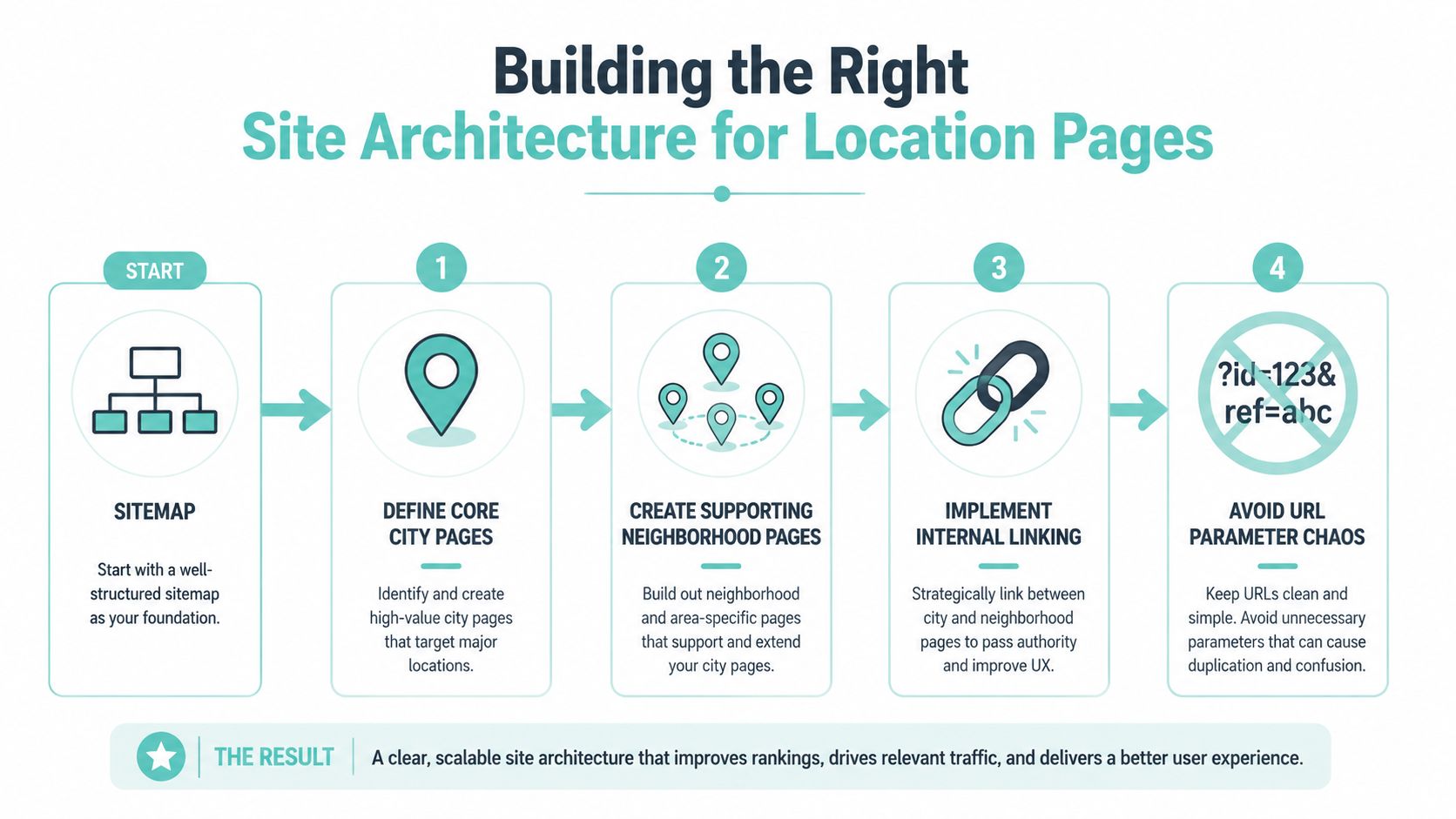
Building the Right Site Architecture for Location Pages
Start with the hierarchy, not the copy. A location page should be easy for both users and crawlers to find, understand, and connect with the services the business provides.
Use a hub-and-spoke structure
Create a dedicated index such as /locations/ or /service-areas/. Link that hub from prominent site navigation, then link each city or branch page from the hub. Keep individual location pages no more than two clicks from the homepage, and connect relevant service pages to location pages in both directions.
A practical structure might look like this:
/locations//locations/dallas//locations/plano//locations/frisco//services/roof-repair//services/roof-repair/dallas/
Don't create a page for every neighborhood automatically. A neighborhood page needs a distinct purpose, relevant service information, and enough local substance to stand on its own. Otherwise, consolidate it into the strongest city page rather than expanding the site with URLs that compete with one another.
Keep URLs predictable
Use a consistent pattern such as /locations/city-name/. Clear URLs help users recognize what they're opening and make large sites easier to audit. Creative slugs rarely add value, while inconsistent structures create unnecessary maintenance work.
Breadcrumbs should reflect the hierarchy, for example, Home, Locations, Dallas. The location index should be useful to people, not just a collection of links. Add short descriptions or service distinctions where they help visitors choose the right page.
A clean sitemap supports discovery and auditing, particularly as the number of locations grows. For a practical structural reference, review this sample sitemap for a website.
Prevent doorway-style isolation
A page becomes more defensible when it has a real relationship with the rest of the site. Link from the location page to the services available there, relevant team pages, contact paths, and useful resources. Link back from those service pages to the appropriate location page where the relationship is genuine.
Avoid stuffing every location into a massive footer or building a chain of pages that users can reach only through an XML sitemap. The architecture should communicate a real operating model: these are the places served, these are the services available, and this is how customers contact the business.
On-Page Content and Local Schema That Actually Rank
A location page needs more than a service keyword followed by a city. It needs a clear, consistent representation of a real business entity operating in a particular place.
Start with a unique H1 that combines the service or business type with the location naturally. Then build the page around the questions a customer in that area needs answered. Explain what the business does locally, how it handles appointments or dispatch, which neighborhoods or communities it serves, and what makes the local operation relevant.
Build the local entity block
Every physical location should have a visible NAP block. The name, address, and phone number must exactly match the Google Business Profile. Include opening hours, directions, an embedded map, and local photographs where appropriate. A service-area business should clearly explain where it travels and what customers should expect, rather than implying that an office exists where it doesn't.
Location-specific structured data should carry the exact business name, physical address, local telephone number, opening hours, and geo-coordinates. Use the most specific suitable LocalBusiness subtype, connect the branch to the wider organization where appropriate, and make sure the structured data describes visible page content. Schema can clarify an entity, but it can't make generic copy useful.
Make local relevance visible
Use real local evidence instead of decorative references. Relevant neighborhoods, landmarks, project areas, local regulations, access instructions, and staff details can help the page explain how the business works in that market. Don't add a landmark merely to make a paragraph look local. If the reference doesn't help the customer understand service delivery, remove it.
Reviews and testimonials should also belong to the location. A quote from a customer who used a specific branch or received work in the target area is more useful than a generic testimonial repeated across the site. Pairing a review with a service detail or project context makes the proof easier to evaluate.
Keyword research can help map services and local modifiers to the correct pages, but it shouldn't dictate unnatural repetition. Use a keyword research guide for local SEO to identify intent, then write for the person who needs the service.
Integrating Google Business Profile With Location Pages
A customer may find a business through Google Maps, then open the website to check whether the branch serves their area. Google Business Profile and the corresponding location page must support that same decision, with matching entities, service details, and conversion paths. Profile activity can expose a page, but the page must provide enough evidence to justify a call, booking, or visit. The scale of this discovery channel makes profile-page alignment an operational requirement, not a branding preference (Google Business Profile statistics).
Align the customer journey
The profile and location page should agree on the details that identify and qualify the business:
- Business identity: Match the name, address, phone number, opening hours, and website URL.
- Services: Explain the services listed in the profile on the relevant location page, using the same meaning without copying boilerplate.
- Visual proof: Show the actual branch, staff, premises, vehicles, or local work. Stock imagery weakens the connection between the listing and the page.
- Reviews: Use relevant local feedback without editing, fabricating, or presenting statements out of context.
- Conversion path: Keep phone calls, forms, bookings, directions, and accessibility information easy to use on a mobile device.
A useful page answers the questions a profile cannot cover in depth. Explain how the branch handles appointments, which services are available locally, what areas it covers, and what a customer should expect after contacting the business. Link the page with consistent profile details, then review the local map optimization strategies that support discovery and engagement.
Reviews need context. A location page should identify the service involved, the area served, and the practical outcome described by the customer. Repeating identical praise across every branch creates a directory pattern and gives visitors little reason to trust the page.
Handle service areas honestly
Google allows up to 20 service areas in a Business Profile and says the total area should not extend beyond about two hours of driving time from the business base. Google also recommends entering specific cities or postal codes rather than a radius (service-area and local business schema guidance).
Use those boundaries to control the site architecture. Publish a service-area page only when the business can explain real coverage, availability, and local customer value. A distant location page created solely to capture a search term can look like a doorway page, especially when its content, contact details, and conversion path are interchangeable with other branches. Keep the location entity, profile, and visible page evidence aligned, and remove pages that have no distinct customer purpose.
Creating Unique Content Without Writing From Scratch
Uniqueness doesn't mean every sentence must be invented independently. It means each page must contain enough location-specific substance that a customer, editor, or search engine can see why the URL exists.
A practical benchmark from local SEO guidance suggests making 40% to 60% of the page unique to the location, while some guides recommend 800 to 1,200 words for competitive markets (BrightLocal location page guidance). Treat those figures as planning references, not publishing quotas. A shorter page with real local proof is stronger than a long page padded with generic neighborhood trivia.
Separate reusable elements from local elements
You can template the parts that need consistency:
- Brand positioning and core service definitions
- General warranty or scheduling language
- Standard contact and accessibility information
- Reusable conversion components
- Legal or compliance language that must remain precise
Write the following for each location instead:
- The H1, title framing, and opening paragraph
- Service-area boundaries and neighborhood coverage
- Directions, parking, access, and appointment details
- Local staff, branch information, or operating practices
- Project examples, photographs, and testimonials
- Questions customers in that area ask
A useful workflow starts with interviews and operational records. Ask the branch manager where technicians work most often, what customers misunderstand, which services vary by area, and what local constraints affect scheduling. Review completed jobs, call recordings, support questions, and approved photographs. Those sources produce specific content far more efficiently than asking a writer to make a city sound “local.”
Avoid manufactured local flavor
Population references, famous attractions, and generic statements about community pride rarely prove service relevance. A page about HVAC service should explain seasonal maintenance practices, property types, dispatch boundaries, or equipment issues the company handles in that market. A law firm page should identify the relevant office, attorneys, jurisdictional context, and intake process only when those details are accurate and visible.
A location page should read like someone responsible for serving that market had a hand in it.
The doorway-page warning signs are easy to recognize: swapped city names, stock images, identical headings, unsupported service claims, and pages with no local contact or proof. If a team can't supply meaningful differences, consolidating the pages may create a better experience and a stronger site than publishing every planned URL.
Canonical Strategy and Technical SEO for Multiple Locations
Canonical tags should clarify page relationships, not hide weak location pages. The default choice for a genuine location page that should rank independently is a self-referencing canonical. That tells search engines the page is the preferred version of its own content.
Canonicalizing one city page to another is appropriate only when the URLs are true duplicates. Two pages that target different locations aren't duplicates merely because their templates resemble one another. Pointing both to a stronger city page can suppress the page that should represent the second market.
Use a simple decision tree
| Situation | Better technical action |
|---|---|
| The page represents a real location and has distinct value | Keep it indexable with a self-referencing canonical |
| Two URLs contain genuinely duplicate content | Select one preferred URL and canonicalize the duplicate |
| The page is thin but the location matters | Improve the local content, proof, and entity details |
| The page has no genuine local purpose | Merge, noindex, or remove it |
Service-area pages need careful labeling. Don't use physical-address schema for a location that has no public branch, and don't present a service-area business as a storefront. The page can still explain coverage, local service delivery, and contact options, but its entity signals must match reality.
Regional versions may need hreflang when the same business serves distinct language or country audiences. That implementation should reflect actual language and regional equivalents, not substitute for unique local content.
Large sites should audit indexation, canonical targets, redirects, orphaned URLs, broken internal links, and sitemap inclusion. Track which location pages receive impressions, clicks, calls, forms, and meaningful engagement. Guidance on canonical handling recommends improving, merging, noindexing, or removing pages that are too thin or lack a real local purpose (canonical strategy for location pages).
Tracking Performance and Avoiding Common Pitfalls
A location page audit should connect rankings to business outcomes. Review each page's organic impressions and clicks by city, target-query visibility, phone calls, form submissions, direction requests, and Google Business Profile interactions. Segment analytics by landing page so a strong brand homepage doesn't hide weak branch performance.
Use Google Search Console for query and page data, Google Analytics for behavior and conversion paths, and a local rank tracker for market-specific visibility. Keep the measurement consistent across branches. A page that ranks well but produces no calls may need stronger proof or a clearer next step, while a page with conversions but limited impressions may need internal links, better targeting, or a stronger local relevance signal.
Audit the page itself
Check these items before expanding the location set:
- Content: The copy, H1, imagery, testimonials, and service details are location-specific.
- Entity data: NAP, hours, map, directions, phone number, and schema agree with the Business Profile.
- Architecture: The page is linked from the location hub and relevant service pages.
- Technical setup: The canonical is correct, the URL is indexable, and the page isn't orphaned.
- Experience: Mobile visitors can call, request service, find directions, and read the page comfortably.
- Trust: Reviews and local proof are current, accurate, and relevant.
FAQ content still has value when it answers real local questions, but don't build it solely for traditional FAQ rich-result expectations. Coverage states that Google FAQ rich results stopped appearing in Search on May 7, 2026, with the FAQ Search Appearance report and Rich Results Test support being removed during 2026 (guidance on local FAQs and AI search). Write concise, self-contained answers for customers and answer engines. Put hours, service boundaries, qualifications, and process details in visible text, not only in scripts or images.
Digital Skyrocket plans and builds lead-generating websites, combining technical SEO, local SEO, answer engine optimization, and conversion improvements for service businesses. If your location pages need a clearer architecture and a more credible path from local search to inquiry, visit Digital Skyrocket to discuss a fit meeting and discovery process.