You probably opened Google Business Profile, saw a review that felt patently wrong, and felt your stomach drop. Maybe the phone went quiet, maybe a competitor's listing looked cleaner by comparison, maybe the comment was so hostile it stopped being feedback and started feeling like an attack. At that point, the question isn't how to make Google like your side of the story. The real question is whether the review violates Google's content policies and can be removed on that basis.
That distinction matters. A legitimate how to dispute Google reviews process is a policy-classification exercise, not a customer-service argument and not a request to erase criticism just because it hurts. If the review is merely negative, blunt, or even unfair but still reflects a real customer experience, Google usually won't remove it. If it maps cleanly to a rule violation, the report can move.
The practical mindset is simple. Treat the dispute like documentation work, not persuasion theater. You're building a record that shows Google exactly which rule was broken, what evidence supports that conclusion, and why the review doesn't belong on the profile.
Table of Contents
- When a Bad Review Crosses the Line
- The Review Categories Google Will Actually Remove
- Build the Evidence Packet Before You Click Report
- Reporting Through Your Business Profile and Google Support
- The Legal and Profile-Level Lines You Cannot Cross
- What to Do After You Submit the Dispute
- A Repeatable Dispute Checklist for Your Business
When a Bad Review Crosses the Line
The first moment most owners realize they need to act is mundane and brutal at the same time. The inbox is full of alerts, the star rating looks worse than it did yesterday, and a competitor down the street is suddenly easier to choose because their profile looks calmer. A bad review feels personal, but the removal question is still legal and procedural, not emotional.
A review dispute only has traction when the content crosses a specific Google rule. Google says reviews need to reflect a genuine, unbiased experience with the business, and only policy-violating reviews are eligible for removal through the normal process. Negative sentiment by itself is not enough, and factual disagreement alone usually won't move the needle.
What this article helps with
It helps when the review looks like spam, fake engagement, a conflict of interest, harassment, profanity, promotional content, or a post from someone who was never a customer. It also helps when the review was incentivized, copied from somewhere else, posted from multiple accounts, or aimed at damaging a competitor's reputation. Those are the kinds of issues Google's policies are designed to catch.
It does not help when the review is harsh, inconvenient, or one-sided but still compliant. If the person really did visit, really did buy, and is just unhappy, the dispute route is usually a dead end. In that case, a measured public reply and better review volume matter more than a removal request.
Practical rule: If you can't point to a policy category, don't file a removal claim just because the review hurts.
The payoff for getting this right is real. Google automatically assesses reviews before publication, and its Maps ecosystem contains approximately 300 million places eligible for reviews, although eligibility varies by location and risk, so the system is built for scale, not sympathy. That means unsupported complaints get triaged quickly and often disappear into rejection. A clean, evidence-backed submission is what gets noticed.
The Review Categories Google Will Actually Remove
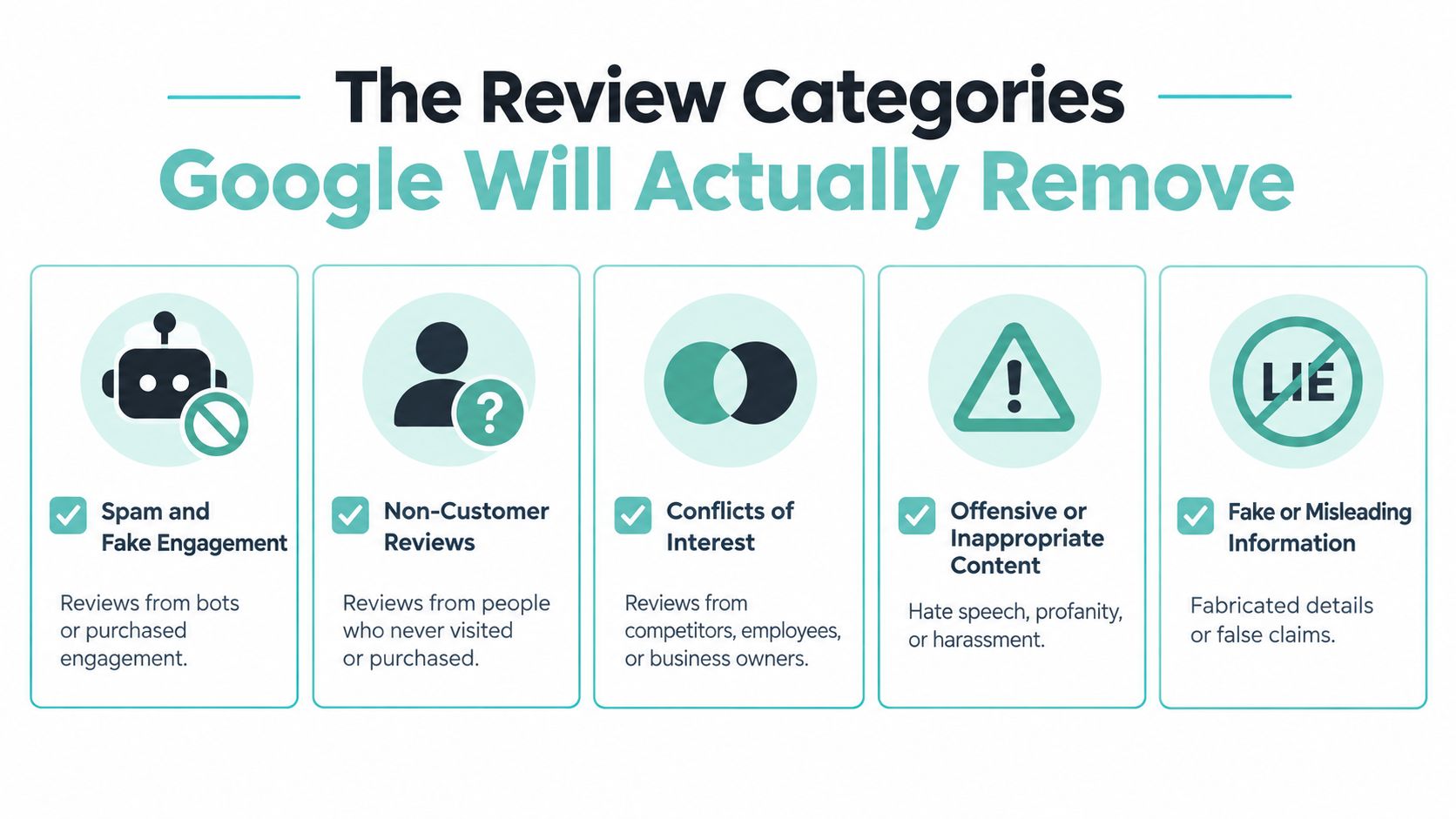
Google's removal logic is narrower than most owners expect. The strongest disputes don't say, “This is unfair.” They say, “This review violates the spam rule,” or “This review is a conflict of interest,” or “This review includes prohibited promotional content.” That category match is the whole game.
The patterns that usually qualify
- Spam and fake engagement. Think of a cluster of reviews that arrive with identical language, the same odd phrasing, or a burst of posts that looks coordinated. A competitor copying the same paragraph across dozens of profiles is a classic example.
- Non-customer reviews. A reviewer names a service your business never sold, or leaves a complaint about a visit that never happened. If your records show no appointment, no invoice, and no customer relationship, that's the kind of mismatch Google can act on.
- Conflicts of interest. A former employee, a competitor, or an owner posting about a rival business can trigger this category. A contractor's crew member leaving a five-star review from a personal device on the company's behalf can also raise the same concern.
- Off-topic or unrelated content. Some reviews read like general rants, political commentary, or grievances about another place altogether. If the comment isn't about the business or location in question, it may be removable.
- Personal attacks, threats, profanity, and copied material. A former employee unloading on the business owner, a review full of slurs, or duplicated text lifted from somewhere else is closer to a policy violation than a simple complaint.
- Promotional or incentivized reviews. Google bans reviews tied to discounts, free goods, free services, compensation, or any other incentive in exchange for posting, changing, or removing a review. The same rule covers multiple accounts used at one person's request.
A review that says “bad service” is usually just criticism. A review that says “I was never there,” includes a link to a competitor, or repeats the same wording found on other profiles starts looking like evidence.
Look for documentary signals, not vibes. Identical phrasing across reviewers, profile photos that look generic, a cluster of reviews landing on the same day, or a reviewer naming a service you never offered are all clues. The best dispute identifies one specific category and matches it to an observable fact, not a broad complaint about unfairness.
Build the Evidence Packet Before You Click Report
A review dispute gets stronger before you ever open the report form. The work is boring, but it's what gives the request credibility. If the evidence is scattered, the submission will feel like a reaction. If the evidence is organized, it feels like a policy case.
What to collect
Save the review URL, the reviewer's display name, the profile URL, the exact publication date, and a clean screenshot with the star rating visible. Keep any public reply already posted, because context matters. If the issue is whether the person was ever a customer, pull the transaction record, appointment log, invoice, or CRM note that proves or disproves the relationship.
Each artifact closes off a different escape hatch. A screenshot helps if the review is edited later. A transaction record settles the “was this person ever a customer” question. A saved profile URL gives Google something to trace if the same account is part of duplicate-account abuse.
Keep the file organized
Use a shared drive folder per review, not a loose pile of screenshots in someone's inbox. Maintain a simple evidence log with dates, names, and the policy category you think applies. Pick one internal contact to own the file so the story doesn't drift if three people start replying at once.
Field note: The cleanest disputes are usually the quietest. If the evidence packet reads like a case file, not a complaint letter, the report is easier to categorize.
If you need a structured way to track the whole process, a reputation monitoring workflow can help you keep reviews, screenshots, and response notes in one place. A practical reference is this reputation monitoring overview, especially if multiple locations are involved.
The sequence becomes mechanical after the packet is ready. Capture the evidence, match the policy, submit the report, then reply publicly only if needed. Without the packet, the rest is guesswork.
Reporting Through Your Business Profile and Google Support
Open your Business Profile, go to Read reviews, find the specific review, and choose the report option. Don't default to vague language like “this is unfair” or “this person is lying” unless you can tie it to a rule. The most effective report starts with the category, then gives one fact that proves why that category fits.
A good submission sounds like this in substance. The review is a conflict of interest because the reviewer is a former employee, and the attached record shows the relationship. Or, the review is spam because the same wording appears across several profiles and the profile photo is duplicated. Or, the review is non-customer content because our appointment log shows no record under that name or date.
A weak report sounds different. It says the review is damaging, the customer is being rude, or the rating is lowering conversion. That kind of language tells Google why you dislike the review, not why it violates policy.
When the in-product report stalls
If the report path doesn't move, use the Google Business Profile support workflow and keep the same evidentiary frame. Don't resubmit the same review five times. Repetition doesn't make a weak case stronger, and it can start to look like spam.
A short worked example is enough to show the difference. A restaurant that receives a review from someone not found in its reservation system, with text copied from another profile, should submit the exact review URL, the screenshot, the reservation log, and the duplicate-language comparison. A restaurant that only says “this hurts us and the reviewer is wrong” is asking Google to decide based on frustration.
For businesses that also need a public response process, this guidance on responding to Google reviews fits naturally with the removal workflow. Keep the dispute and the reply separate, because one is a policy case and the other is a reputation signal.
The Legal and Profile-Level Lines You Cannot Cross
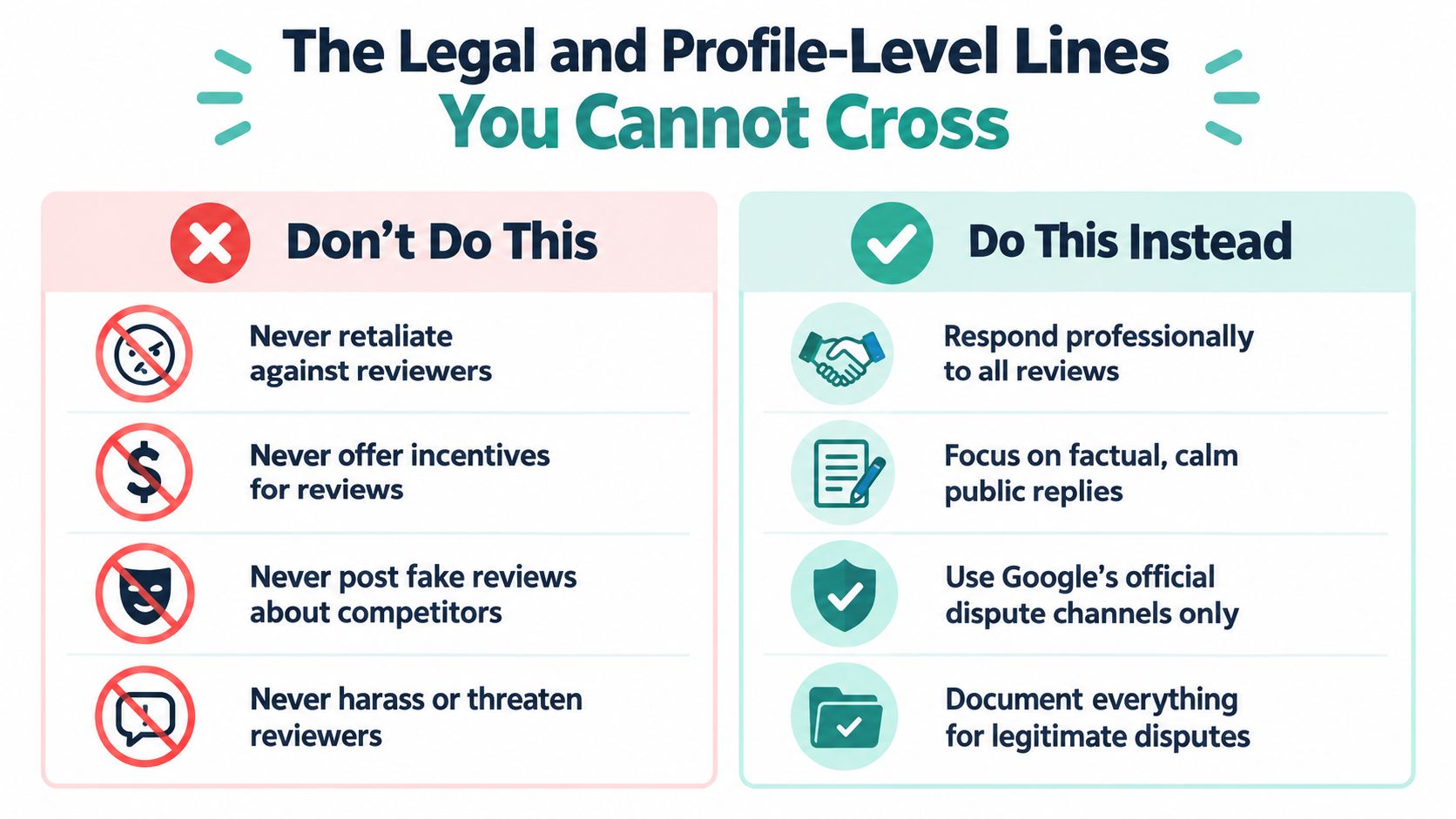
The fastest way to turn a legitimate dispute into a bigger problem is to retaliate. Asking friends and family to flood the listing with positive ratings, offering discounts in exchange for edits, or pushing only happy customers to post reviews creates the kind of pattern Google's systems are built to notice. Posting reviews for competitors crosses a similar line, and the FTC's Consumer Reviews and Testimonials Rule took effect on October 21, 2024, with civil penalties for knowing violations tied to deceptive review practices.
Google's rules and the FTC framework point in the same direction. Authenticity, independence, and real customer experience are the standards. Incentives tied to a particular sentiment are prohibited, whether the sentiment is positive or negative, and that includes paying for reviews, trading discounts for revisions, or offering rewards for removal.
The hidden risk most guides skip
A dispute can also trigger scrutiny of the whole Business Profile if the business looks like it has been manipulating reviews itself. Google says business owners and employees may not submit or incentivize reviews for their own business or competitors, and fake-engagement violations can lead not just to review removal but to restrictions on the profile itself. That can include limits on receiving new reviews or temporary unpublishing of existing reviews.
That matters even more for multi-location service companies. A restriction tied to one location can affect the visibility of legitimate reviews across the map experience, which means a bad acquisition habit in one branch can spill over into the rest of the brand.
If the same team that runs review generation also runs disputes, the process needs more oversight, not more speed.
The safe operating model is an auditable one. Keep the evidence trail, use Google's official channels, avoid incentives, and separate review acquisition from review removal work. That's how you protect the profile while you fight the bad review.
What to Do After You Submit the Dispute
After you submit, the work shifts from filing to reading the outcome correctly. Google may remove the review, restrict related content, or decline the request and leave the review in place. If Google takes action and you believe it was wrong, or if it declines despite stronger evidence, the next move is an appeal through the available Google workflow.
Read the response language carefully. A removal means the platform accepted the violation. A denial means the review was judged compliant, not necessarily true. That distinction matters, because a compliant review can still be unfair, and unfairness alone rarely wins an appeal.
If you have new evidence, use it in the appeal rather than repeating the first report. The decision-maker needs a cleaner factual frame, not a louder version of the same complaint. A public reply can also help, as long as it stays professional and avoids exposing private details or customer data.
A calm reply does three things at once. It shows future readers the business takes feedback seriously, it avoids escalating the conflict, and it records your side without turning the thread into a fight. If the situation later turns into legal escalation, that written record becomes part of the paper trail. For teams that want a more structured response posture, responding to Google reviews with a defined template helps staff know what to say publicly and what to keep out of view.
Keep the operational loop closed
Train front-line staff on how to route private complaints before they become public. Update the process that failed in the first place. If refund requests, service issues, or missed expectations keep showing up in reviews, fix the intake path so customers have somewhere to go before they post.
A Repeatable Dispute Checklist for Your Business
A good review process is a habit, not a rescue mission. Build a simple intake form for incoming reviews, sweep every location weekly, and keep one-page dispute instructions in a shared folder so the same mistake doesn't get made twice. Your team should know which review patterns are disqualifying, which ones are just negative, and which ones deserve a report with evidence.
- Document incoming reviews: Capture the URL, reviewer name, date, star rating, screenshot, and any reply as soon as a concerning review appears.
- Check for policy fit: Compare the review against Google's categories, especially spam, non-customer content, conflict of interest, harassment, and incentivized reviews.
- Keep a live evidence log: Store transaction records, appointment notes, and relationship proof in one place so the report can be built quickly.
- Reply within 48 hours: Use a calm, factual tone and avoid private details.
- Route complaints privately: Put refund requests, service failures, and billing disputes into a service-recovery workflow before they become public.
- Review your acquisition tactics quarterly: Make sure nobody is trading discounts, rewards, or favors for review edits or removals.
If you want a cleaner process, use these reputation management best practices as a reference point for internal hygiene. The point isn't to win every dispute. The point is to keep your profile accurate, compliant, and resilient enough that one bad review doesn't define the whole listing.
If you want help tightening your review response process, preserving evidence the right way, or building a local reputation system that fits your business, Digital Skyrocket works with service companies on reputation management, local SEO, and lead-generating websites. Visit Digital Skyrocket to see how that support can fit your review workflow and broader search visibility.